
Learning how to simplify your online business does not mean sacrificing growth. In fact, removing unnecessary complexity can make it easier to focus on the systems and activities that actually move your business forward.
Building an online business often starts simple.
You have an idea, create a website, find a way to generate leads, and start promoting your offer.
Then the tools begin piling up.
A website platform. An email marketing service. A funnel builder. A CRM. An automation platform. Analytics. Traffic tools. Another login. Another subscription.
Eventually, you can spend more time managing the technology than growing the business.
The solution is not necessarily to eliminate technology. It is to make sure every tool has a clear purpose and works as part of a larger system.
Step 1: Audit What You Are Currently Using
Start by making a simple list of every platform, service, and marketing tool connected to your business.
For each one, ask:
• What does this tool actually do for my business?
• How often do I use it?
• Does another tool already perform the same function?
• Does it connect effectively with the rest of my system?
• Would removing it actually affect my business?
You may discover that several tools are performing overlapping jobs.
Step 2: Identify the Core Functions Your Business Needs
Instead of thinking about individual software products, think about the functions required to operate your business.
Most online businesses need some combination of:
• A professional website
• Landing pages and sales funnels
• Lead capture
• Contact management
• Email marketing
• Marketing automation
• Traffic generation
• Sales and monetization tools
Your exact requirements will vary, but every tool should support an identifiable business function.
Step 3: Eliminate Unnecessary Overlap
Pay particular attention to tools performing essentially the same job.
For example, you may have one platform capable of creating landing pages while paying for another dedicated landing-page service.
You might have automation capabilities inside your marketing platform while subscribing to an additional automation service.
Removing unnecessary overlap can simplify your workflow and potentially reduce operating costs.
Step 4: Connect the Customer Journey
Connecting these pieces helps simplify your online business by creating a smoother path from attracting a prospect to following up with them.
Your technology should support the journey you want a potential customer to take.
Think about that journey from beginning to end:
Traffic → Website or Landing Page → Lead → Follow-Up → Offer → Customer
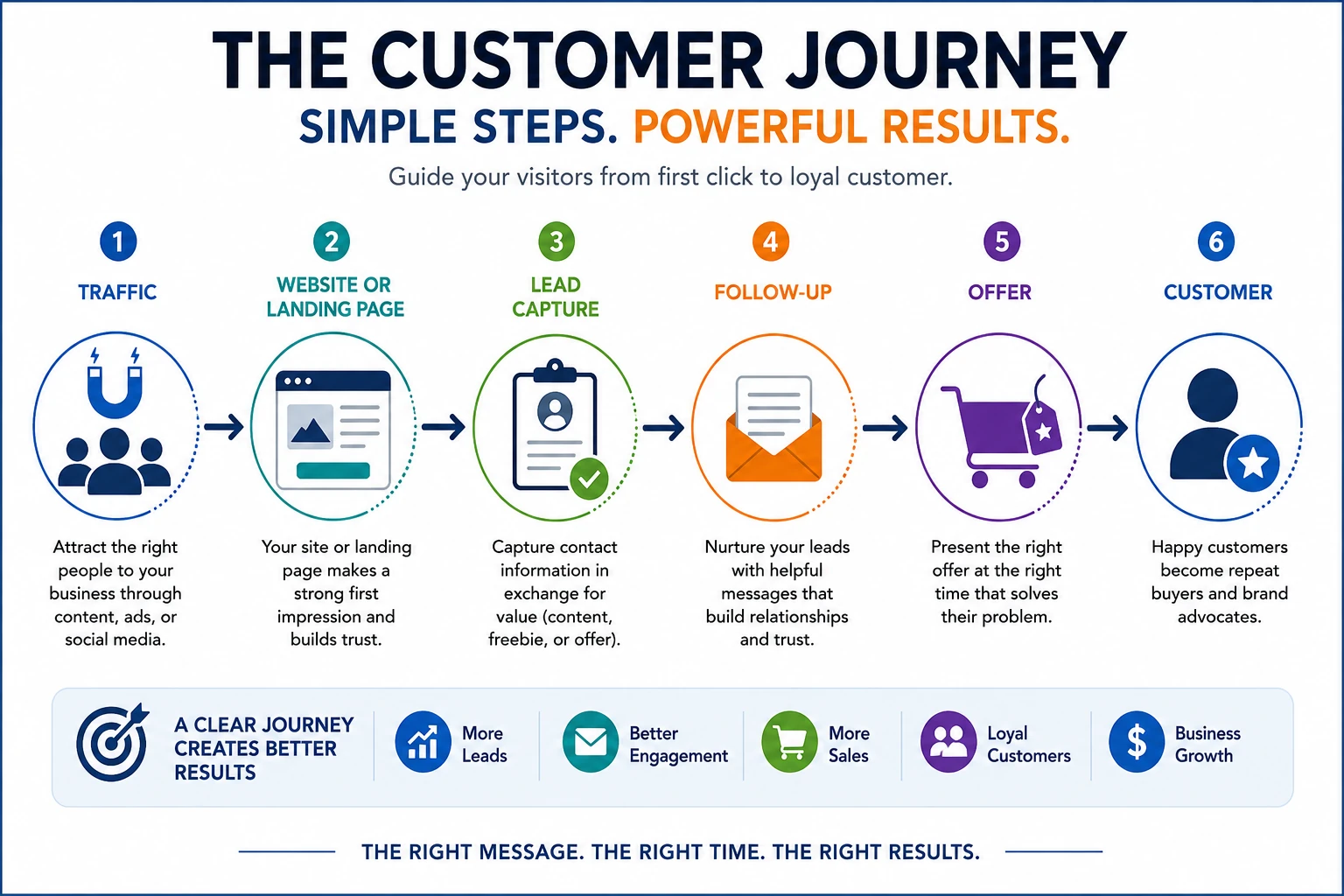
A simple customer journey connects traffic, your website or landing page, lead capture, follow-up, offers, and customers into one clear process.
Each step should naturally lead to the next.
If information constantly needs to be manually copied between systems or visitors encounter disconnected experiences, look for opportunities to simplify the process.
Step 5: Automate Repetitive Tasks
Automation is most valuable when it removes repetitive work without making the customer experience feel impersonal.
Good candidates for automation can include:
• Lead follow-up
• Email sequences
• Contact organization
• Funnel progression
• Customer notifications
• Routine marketing activities
The objective is not to automate everything.
It is to automate predictable processes so you have more time for activities that actually require your attention.
Step 6: Simplify Your Online Business With a Connected System
A connected business platform can also reduce the need to manage multiple disconnected systems separately.
This is where everything comes together.
Your website should support your funnels.
Your funnels should generate and organize leads.
Your follow-up should continue the conversation.
Your automation should keep important processes moving.
Your traffic strategy should consistently introduce the right people into that system.
When those pieces work together, technology becomes infrastructure rather than another responsibility demanding your attention.
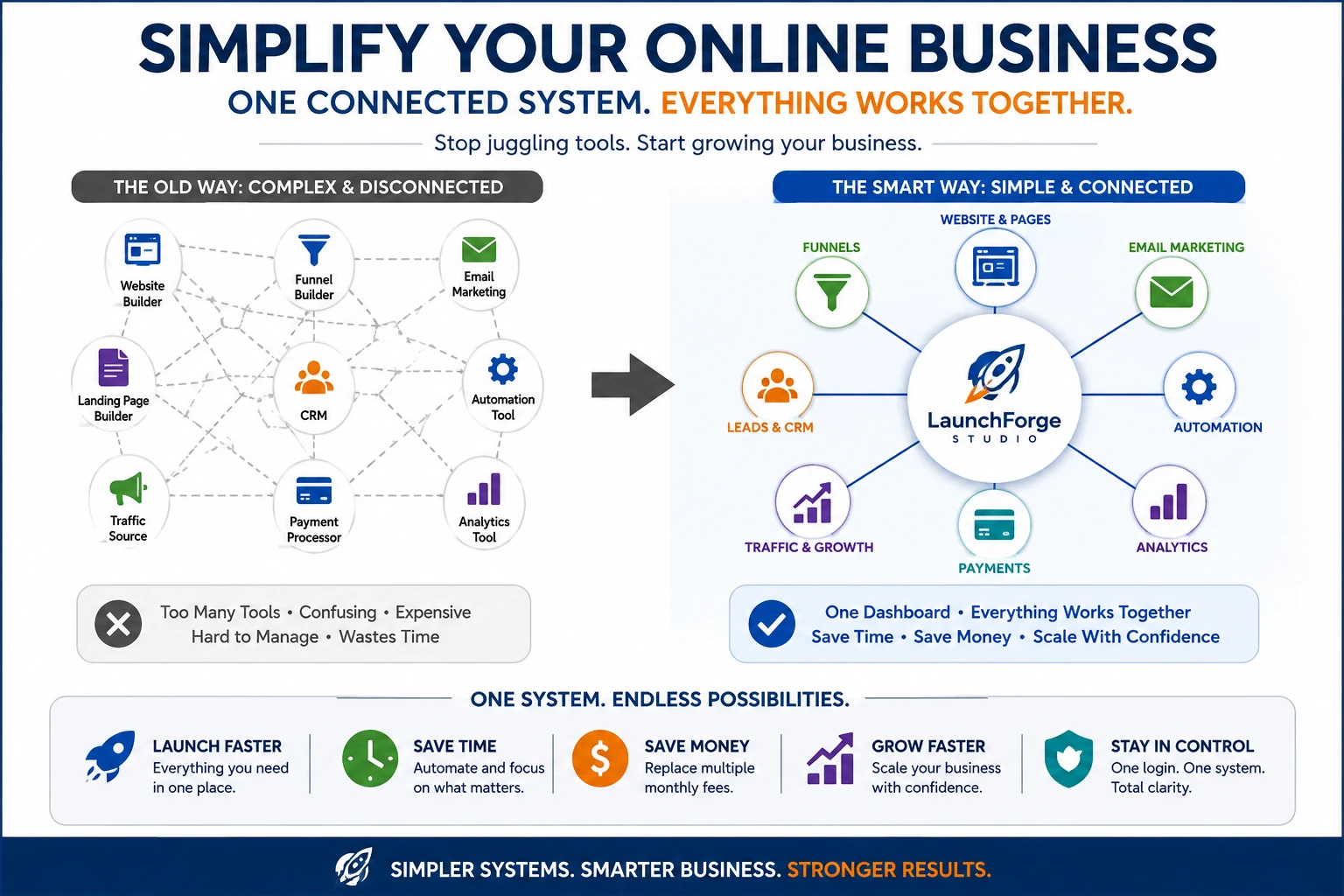
A connected business system can reduce tool overload by bringing websites, funnels, email marketing, leads, automation, payments, traffic, and analytics into a simpler workflow.
Step 7: Measure What Actually Helps You Grow
The goal is to simplify your online business without removing the systems that actually contribute to growth.
Simplifying does not mean sacrificing growth.
In many cases, eliminating unnecessary complexity makes it easier to see what is actually producing results.
Pay attention to meaningful indicators such as:
• Leads generated
• Conversion rates
• Customer acquisition
• Engagement
• Sales
• Time saved through automation
Do not keep a tool simply because you have always used it.
Keep it because it contributes something valuable to your business.
Simpler Can Be More Powerful
A successful online business does not need the largest collection of software.
It needs the right pieces working together toward a clear objective.
Start with what your business actually needs. Remove unnecessary overlap. Connect the customer journey. Automate repetitive processes. Measure what produces results.
The goal is not simply to have fewer tools.
The goal is to simplify your online business so you can spend less time managing tools and more time building something that can grow.
The U.S. Small Business Administration also provides resources for managing and improving the systems that support a growing business.