Your First Business Is Allowed to Be a Beginning
There is a strange amount of pressure that comes with starting an online business.
Before you have made your first sale, built your first website, generated your first lead, or even figured out exactly what you want to offer, it can feel like you are supposed to have the entire future mapped out.
What kind of business should I build?
What if I choose the wrong idea?
What if I spend months building something and later realize it is not what I want to do?
Those questions can keep a good idea sitting on the sidelines for months—or even years.
But there is something I have been learning while building LaunchForge Studio:
Your first online business does not have to be your forever business.
Your first online business only has to be your beginning.
You are allowed to start with what you know today.
You are allowed to learn.
You are allowed to change direction.
And you are absolutely allowed to build something that evolves as you do.
Starting Teaches You Things Planning Never Can
Planning matters.
Research matters.
Thinking through your business model, audience, tools, expenses, and goals can save you from plenty of unnecessary mistakes.
But eventually, planning reaches a limit.
There are things you simply cannot learn until you begin doing the work.
You do not really know how you feel about creating content until you start creating it.
You do not know which marketing methods fit you until you try them.
You do not know what your audience responds to until real people begin interacting with what you build.
And you may not even fully understand what kind of business you want until you have spent some time actually running one.
Action creates information.
Every page you build, email you send, article you publish, traffic source you test, conversation you have, and mistake you make gives you information you did not have before.
That information helps shape what comes next.
Sometimes the business you eventually build becomes possible only because you were willing to start with something that was not yet perfect. You do not need to have everything figured out before you start.
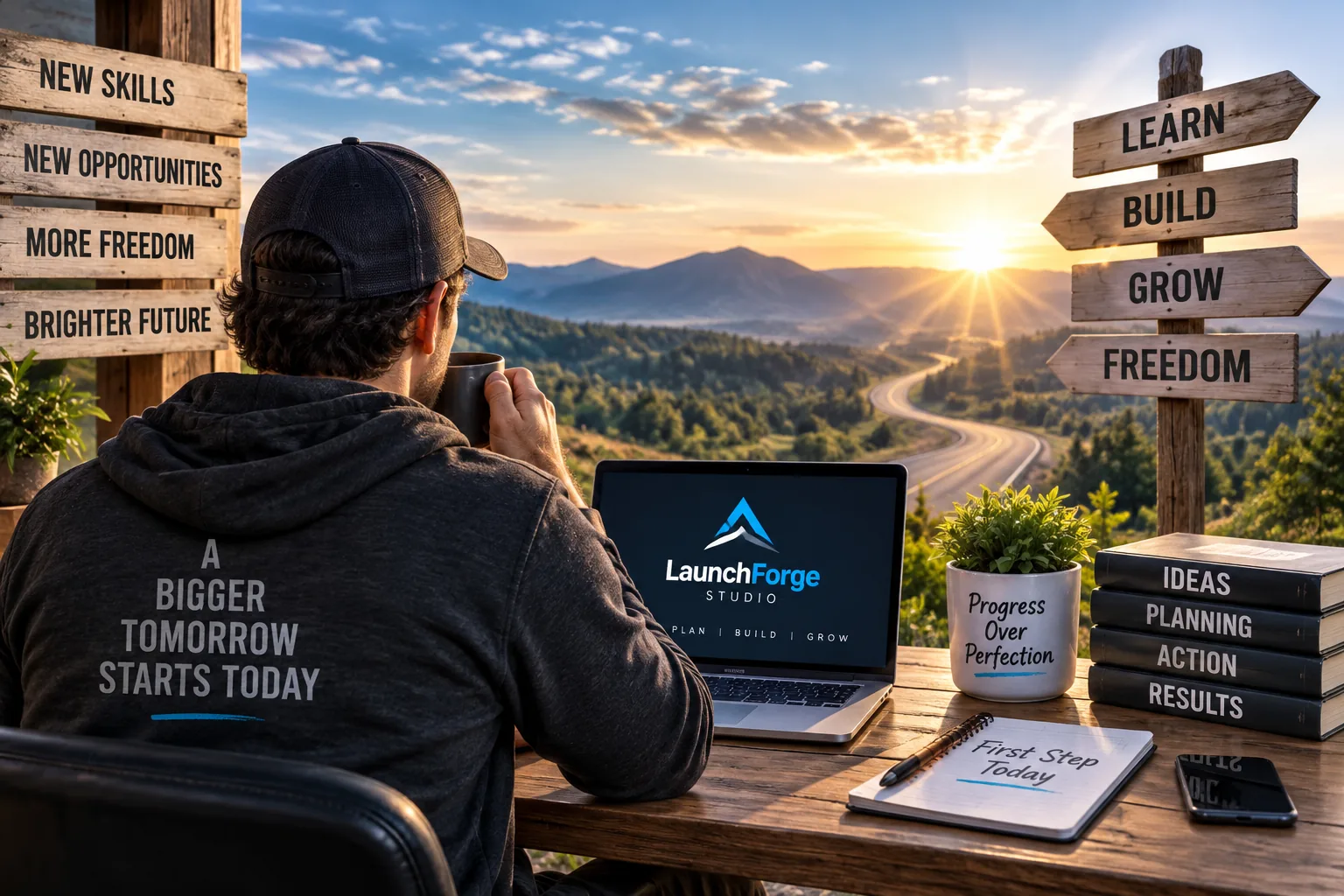
Your first online business is a starting point for developing new skills, discovering opportunities, and building a stronger future.
Your First Business Is Supposed to Teach You Something
One of the biggest mistakes new entrepreneurs make is believing their first business has to be the business they run forever.
It does not.
Your first online business might teach you how to build a website.
It might teach you how to write an email, create a landing page, generate traffic, talk to customers, or make your first sale.
It might also teach you something even more valuable:
What you do not want to do.
That is not failure.
That is information.
Every time you build something, launch something, test an idea, or put an offer in front of real people, you learn something you could never learn by sitting on the sidelines planning.
You begin discovering what you are good at.
What you enjoy.
What people respond to.
And where you want to go next.
LaunchForge Did Not Begin With the Final Blueprint
LaunchForge Studio is a perfect example.
When I started building it, I did not have every page, article, marketing system, social platform, email sequence, or business idea mapped out.
Some things I originally thought would become important eventually became less important.
Other ideas appeared because I was already building.
The website changed.
The messaging changed.
The content strategy evolved.
New tools were tested.
New ways of helping people became clearer.
Even the idea of building LaunchForge in public developed as the business itself developed.
None of that would have happened if I had waited until I could predict the finished version before starting.
The direction became clearer through action.
Sometimes You Discover the Next Step by Building the Current One
This has happened repeatedly while building LaunchForge.
One idea leads to another.
An article creates an idea for another article.
A website change reveals a better way to communicate what LaunchForge is about.
Testing a tool creates a new way to help someone else.
Even conversations about the business can change how I think about what LaunchForge should become.
I could never have planned every one of those developments before starting.
Some opportunities only become visible after you are already moving.
That is one of the reasons I have become such a believer in building, testing, learning, and adjusting instead of waiting for the perfect blueprint.
Action Gives You Something Planning Cannot
You can research an audience for weeks.
You can compare business models.
You can watch tutorials.
You can study competitors.
You can ask AI a thousand questions.
But there comes a point where you need real-world feedback.
You need to publish the page.
Send the email.
Run the traffic.
Create the offer.
Write the article.
Talk to the customer.
See what happens.
Because once something exists in the real world, you finally have something you can improve.
You cannot optimize something you never started.
And that is why your first online business does not need to be your forever business.
It simply needs to be your first real step forward.
You Are Building Skills That Follow You Everywhere
Even if your first online business eventually changes direction, the skills you develop do not disappear.
You take them with you.
Learning how to build a website makes the next website easier.
Learning how to generate leads makes the next offer easier to promote.
Learning email marketing helps you communicate with almost any audience you build in the future.
Learning traffic teaches you where people come from and how to get your message in front of them.
Learning automation shows you how to make a business operate without manually handling every little task.
And learning how to use AI effectively can help you research, brainstorm, troubleshoot, create, and make better decisions faster.
These skills begin stacking on top of one another.
That is when something interesting happens.
You stop feeling like someone trying to start an online business and start becoming someone who knows how to build one.
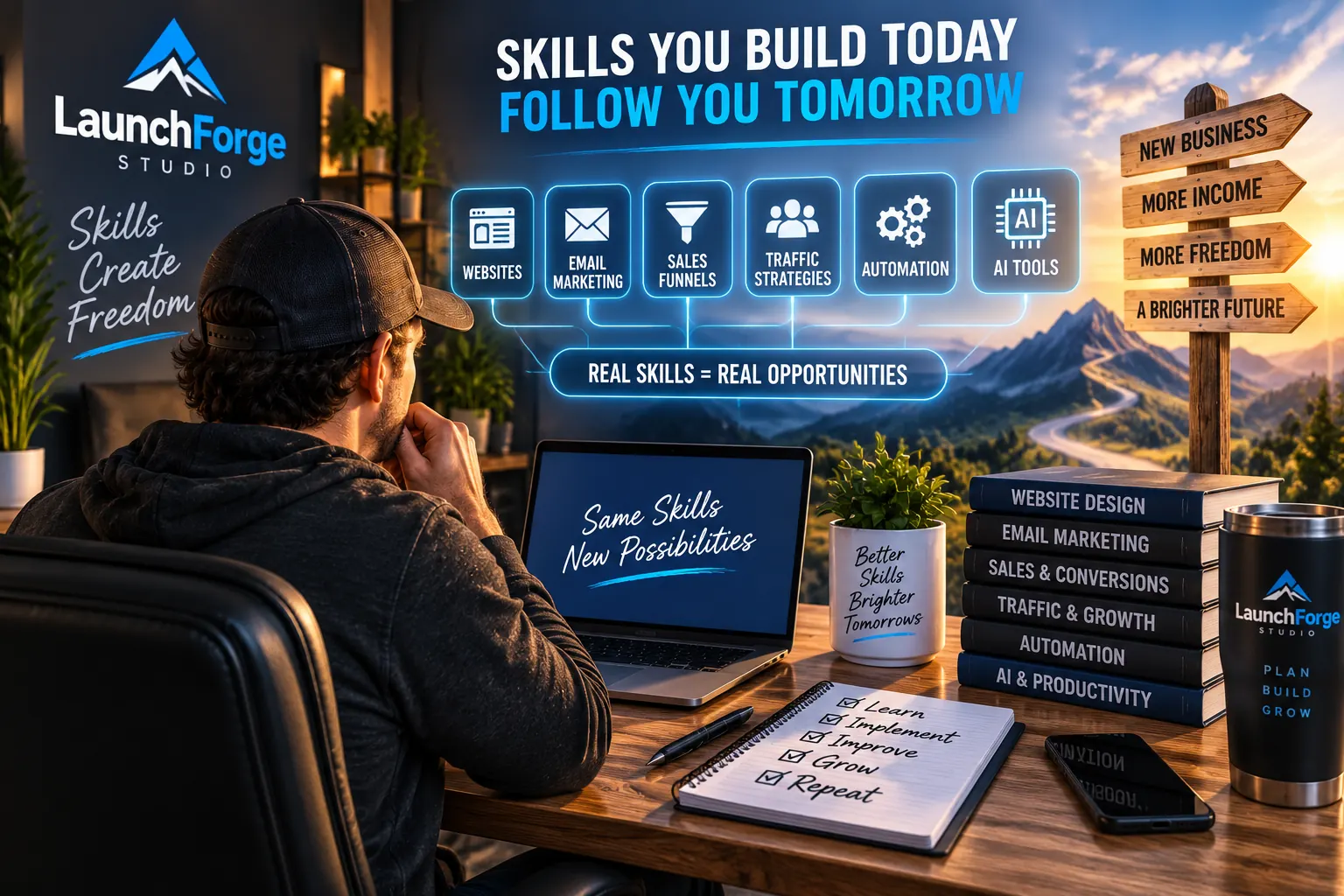
The skills you build in your first online business can follow you into every opportunity and business you create next.
Nothing You Learn Is Wasted
Maybe the first traffic source you test does not perform the way you hoped.
Maybe the first landing page you build needs to be completely redesigned.
Maybe you write an email that barely gets clicked.
Maybe an idea you were convinced would work falls flat.
Those experiences still have value.
They teach you what to test differently next time.
They give you experience that cannot be downloaded, purchased, or handed to you in a tutorial.
The result may disappear. The lesson stays with you.
And those lessons compound.
Your Business Can Evolve With You
There is nothing wrong with changing direction.
Maybe you begin with affiliate marketing and discover you enjoy creating websites.
Maybe you start selling a service and eventually create digital products.
Maybe you build an audience around one subject and discover they need help with something you never expected.
Or maybe your original business works perfectly well, but you discover a better opportunity along the way.
You are allowed to adjust.
You are allowed to experiment.
You are allowed to change your mind.
The goal is not to predict every opportunity before you begin.
The goal is to build enough experience that you can recognize the right opportunities when they appear.
Stop Asking Yourself the Forever Question
Instead of asking:
Is this the business I want to run for the rest of my life?
Try asking:
Is this a business worth building right now?
Can it teach you something?
Can it help someone?
Can it generate leads, customers, or revenue?
Can it help you develop skills you will use again?
Can it move you closer to the kind of business and life you eventually want?
If the answer is yes, that may be enough reason to begin.
You do not need a lifetime commitment.
You need a starting point.
Your First Offer Does Not Have to Be Your Best Offer
The same idea applies to what you sell through your first online business.
A lot of people spend months trying to create the perfect first offer.
They worry about the price.
The name.
The sales page.
The bonuses.
The funnel.
Whether people will buy it.
Those things matter, but your first offer has another important job:
It gives you something real to test.
Until people see your offer, you are working mostly with assumptions.
Once they begin interacting with it, you start getting answers.
Do people understand what you are offering?
Does it solve a problem they actually care about?
Are they clicking but not buying?
Are they asking questions you never thought to answer?
That feedback can help you improve the offer, reposition it, expand it, simplify it, or sometimes replace it entirely.
Your Audience Can Help Shape the Business
This is something that is easy to forget when you are sitting behind a computer trying to plan everything yourself.
Your customers, subscribers, readers, and visitors can teach you what to build next.
Pay attention to the questions people ask.
Pay attention to the articles they read.
Pay attention to the emails they click.
Pay attention to which offers generate interest.
Pay attention to the problems that keep coming up.
Those signals can reveal opportunities you would never find by staring at a business plan.
Instead of trying to predict everything your audience will eventually need, start helping them with what you understand today.
Then listen.
Your business can become better because real people helped show you where it needed to go.
Evolution Is Not Failure
Changing your business does not automatically mean the original idea failed.
Sometimes it means you learned enough to see a better direction.
That distinction matters.
There is a big difference between quitting every time something becomes difficult and making an intelligent adjustment based on what you have learned.
Every business is going to have frustrating days.
Every marketing strategy needs time to produce useful information.
Every new skill has a learning curve.
You do not want to abandon something simply because the first attempt did not work.
But you also do not need to stay chained to an idea just because it was the idea you started with.
Know the Difference Between Persistence and Stubbornness
Persistence says:
This is worth pursuing. I need to keep learning and improving.
Stubbornness says:
I have to keep doing this exactly the same way because changing direction would mean I was wrong.
Those are very different mindsets.
Sometimes the answer is to keep going.
Sometimes it is to change the message.
Sometimes it is to change the offer.
Sometimes it is to try a different traffic source, tool, audience, or strategy.
And occasionally, the right answer really is to build something different.
The important thing is that the decision comes from experience and information instead of fear.
You May Already Be Building Your Next Business
This does not apply only to beginners.
Maybe you already have an online business.
Maybe you have been running it for months or even years.
And maybe the business you built originally no longer fits where you want to go.
That does not mean you have to throw everything away and return to zero.
Look at what you already have.
Your skills.
Your experience.
Your content.
Your audience.
Your relationships.
Your systems.
Your understanding of marketing.
Even your mistakes.
Those are business assets.
Your next direction can be built on top of everything the previous one taught you.
You may not be starting over at all.
You may simply be building the next version.

You are not starting over. Every lesson, mistake, skill, and experience from your first business can help build what comes next.
What You Build Today Can Create Options Tomorrow
One of the best things about building an online business is that you are not only building for today.
You are creating options.
An article you publish today can continue bringing someone to your website months from now.
An email list you begin building can become an audience you communicate with for years.
A skill you develop today may eventually become a service you offer.
A system you create for yourself might later become something you teach someone else.
A relationship you build could lead to an opportunity you cannot see yet.
And an idea that seems small today could eventually become an important part of your business.
You do not always know which pieces will become valuable later.
That is another reason starting matters so much.
You cannot create those possibilities while everything remains an idea.
Build Assets, Not Just Activity
There is a difference between being busy online and actually building something.
You can spend hours scrolling through opportunities, watching videos, comparing tools, checking statistics, and jumping between strategies.
It feels like work.
Sometimes it even looks like work.
But at the end of the day, ask yourself:
What did I actually build?
Did you publish something?
Did you improve your website?
Did you add subscribers to your list?
Did you create a new page?
Did you improve an offer?
Did you learn a skill you can use again?
Did you create a system that saves you time?
Those are things that can continue creating value after today’s work is finished.
That is the kind of progress I want to keep creating with LaunchForge Studio.
Not activity for the sake of activity.
Assets, skills, systems, relationships, and experience that continue building on one another.
Let the Business Tell You What It Needs
As your business grows, problems become easier to see.
That may sound like a bad thing.
It is actually useful.
When nobody visits your website, you learn that traffic needs attention.
When people visit but do not take action, you start looking at your message, offer, or conversion process.
When leads arrive but disappear afterward, you discover the importance of follow-up.
When too much of your day is spent repeating the same tasks, automation starts making sense.
When people keep asking the same question, you may have discovered your next article, guide, email, service, or offer.
Problems create clues.
Instead of trying to build every possible system before you need it, you can allow the business itself to show you where the next improvement belongs.
That approach can make building an online business much more manageable.
Solve the problem in front of you.
Learn from it.
Then move to the next one.
Build the Business in Front of You
You do not have to know what your business will look like five years from now.
You do not even have to know exactly what it will look like one year from now.
Have a direction.
Have goals.
Think about where you want to go.
But give yourself permission to learn things along the way that may change the route.
That is exactly what I am doing with LaunchForge Studio.
I am building it.
Testing things.
Learning new tools.
Creating content.
Experimenting with marketing.
Using AI.
Building systems.
Watching what works.
And adjusting when something can be better.
That is part of the reason I decided to share more of the process publicly.
I do not want LaunchForge to only show the finished result.
I want it to show the building too.
Follow the Build. Learn the Tools. Use What Works for Your Own.
That idea has become an important part of what LaunchForge Studio is becoming.
I am not building from some imaginary finish line and pretending every decision was obvious from the beginning.
It was not.
And the next decision probably will not always be obvious either.
That is the point.
You get to see the tools I use.
The strategies I test.
The things that work.
The things I change.
And the lessons I learn while building a real online business.
Then you can take whatever is useful and apply it to your own.
Follow the build. Learn the tools. Use what works for your own.
Because your business does not need to look exactly like mine.
And your first business does not need to become your forever business.
It just needs to give you somewhere to begin.
Give Yourself Permission to Outgrow the Original Plan
There may come a point when the business you started no longer represents the business you want to build.
That can be uncomfortable.
You invested time into it.
You created pages.
You learned the systems.
You promoted the offers.
You may have even built an audience around it.
Walking away from any part of that can feel like admitting you made a mistake.
But growth does not always mean adding more to what already exists.
Sometimes growth means recognizing that you have outgrown part of the original plan.
That does not erase the work you did.
The experience came with you.
The skills came with you.
The lessons came with you.
And hopefully, some of the assets you created came with you too.
Keep What Works and Leave What Does Not
You do not have to burn everything down every time your direction changes.
Keep the pieces that still make sense.
Maybe the business model changes, but your website-building skills remain valuable.
Maybe an offer disappears, but the audience you built still matters.
Maybe you stop using one marketing strategy, but everything it taught you improves the next one.
Maybe you discover that one small part of your original business is actually the part you enjoy most.
Pay attention to that.
Your next direction does not have to come from a completely new idea.
It might already be hiding inside the business you are running today.
Progress Beats Perfect Direction
There is a temptation to believe successful entrepreneurs always knew where they were going.
They found the perfect niche.
Picked the perfect business model.
Built the perfect offer.
Used the perfect marketing strategy.
And then everything fell into place.
Real businesses rarely develop that neatly.
There are experiments.
Wrong turns.
Unexpected opportunities.
Ideas that sounded great but went nowhere.
Ideas that seemed small but became important.
Strategies that worked for a while and eventually stopped working.
And plenty of moments where the next move was not obvious.
You do not need perfect direction to make meaningful progress.
You need enough direction to take the next useful step.
Then another.
Then another.
Over time, those steps begin creating something you could not completely see when you started.
Your First Business Is a Chapter, Not the Whole Story
If you are thinking about starting your first online business, do not put the weight of your entire future on that first decision.
Choose something worth exploring.
Build it.
Learn from it.
Give it a real opportunity to work.
But understand that you are not signing a contract with your future self that says you must do the exact same thing forever.
And if you already have a business that no longer feels like the right destination, remember this:
You are not required to stay the same person who created the original plan.
You know more now.
You have experienced more.
You have probably made mistakes you would not make again.
That means you are capable of making better decisions today than you could when you first started.
That is not failure.
That is growth.
Start With the Business You Can Build Today
Your first online business does not need to contain every idea you will ever have.
It does not need to predict every opportunity you will eventually discover.
And it certainly does not need to define the rest of your working life.
It needs to get you moving.
Build something useful.
Help someone.
Develop your skills.
Create assets.
Test ideas.
Listen to the market.
Pay attention to what you enjoy and what you are good at.
Then allow everything you learn to influence what comes next.
That is how businesses evolve.
That is how entrepreneurs evolve.
And that is how an idea that begins as your first online business can eventually lead you toward a business you could not have imagined when you started.
Build what you can today. Learn from what happens tomorrow. And never be afraid to build the next version.
That first business might not be your forever business.
But it could be the business that teaches you how to build it. 🚀