Building an Online Business Is Different When You Actually Build One
There is a big difference between reading about building an online business and actually sitting down and trying to build one.
When I started LaunchForge Studio, I had an idea of what I wanted the business to become. I wanted a place where I could explore websites, funnels, lead generation, marketing, automation, AI, traffic, and the tools that connect everything together.
But an idea is not a business.
You still have to choose the technology. Build the website. Create the pages. Set up the systems. Write the content. Connect the marketing tools. Generate traffic. Fix the things that do not work. And occasionally send something straight to the digital trash can and start over.
That is where LaunchForge Studio became more than an idea.
One of the major pieces of the foundation has been Profit Hub System, the platform I chose to help build and operate LaunchForge Studio.
I have already written a separate, detailed review of Profit Hub System. This is not another review.
This is the case study.
I want to show you what I have actually built, which tools became part of the business, what I have learned along the way, and how all those individual pieces are gradually becoming a working online business system.
Not a hypothetical business.
The one you are looking at right now.
Where LaunchForge Studio Actually Started
LaunchForge Studio started with a pretty simple idea:
Build a real online business while documenting what I learn along the way.
I did not want to create another website filled with generic advice about making money online. I wanted to build something myself, use the tools, make the decisions, run the experiments, and then share what actually happens.
That meant I needed more than a website.
I needed a foundation that could eventually support content, landing pages, funnels, lead generation, email marketing, automation, traffic, affiliate marketing, conversion tools, and whatever else the business might need as it grew.
Just as importantly, I did not want to assemble the entire business using a dozen disconnected subscriptions if I could avoid it.
That search eventually led me to Profit Hub System.
After purchasing the platform, I had access to the infrastructure and collection of tools I could begin building around.
But having access to tools and building a business with them are two very different things.
The domain had to be connected.
WordPress had to become an actual website.
Pages had to be designed.
Navigation had to make sense.
Content needed a purpose.
SEO had to be configured.
Lead generation and follow-up systems had to be connected.
And every decision created another question that needed an answer.
That became the real beginning of LaunchForge Studio.
Not when I purchased the tools.
When I started putting them to work.
The Foundation: Turning a Domain Into a Real Website
The first major job was turning launchforgestudio.net from a registered domain into a website that could actually become the home of the business.
Profit Hub System gave me the foundation, including hosting and the WordPress environment I needed to start building. From there, the real work began.
I chose Divi 5 as the design system for LaunchForge Studio and started shaping the site around one question:
What does someone trying to build an online business actually need?
That question eventually helped shape the main areas of the site around websites and funnels, lead generation, marketing and automation, traffic and growth, sales and monetization, hosting and business tools, and AI business solutions.
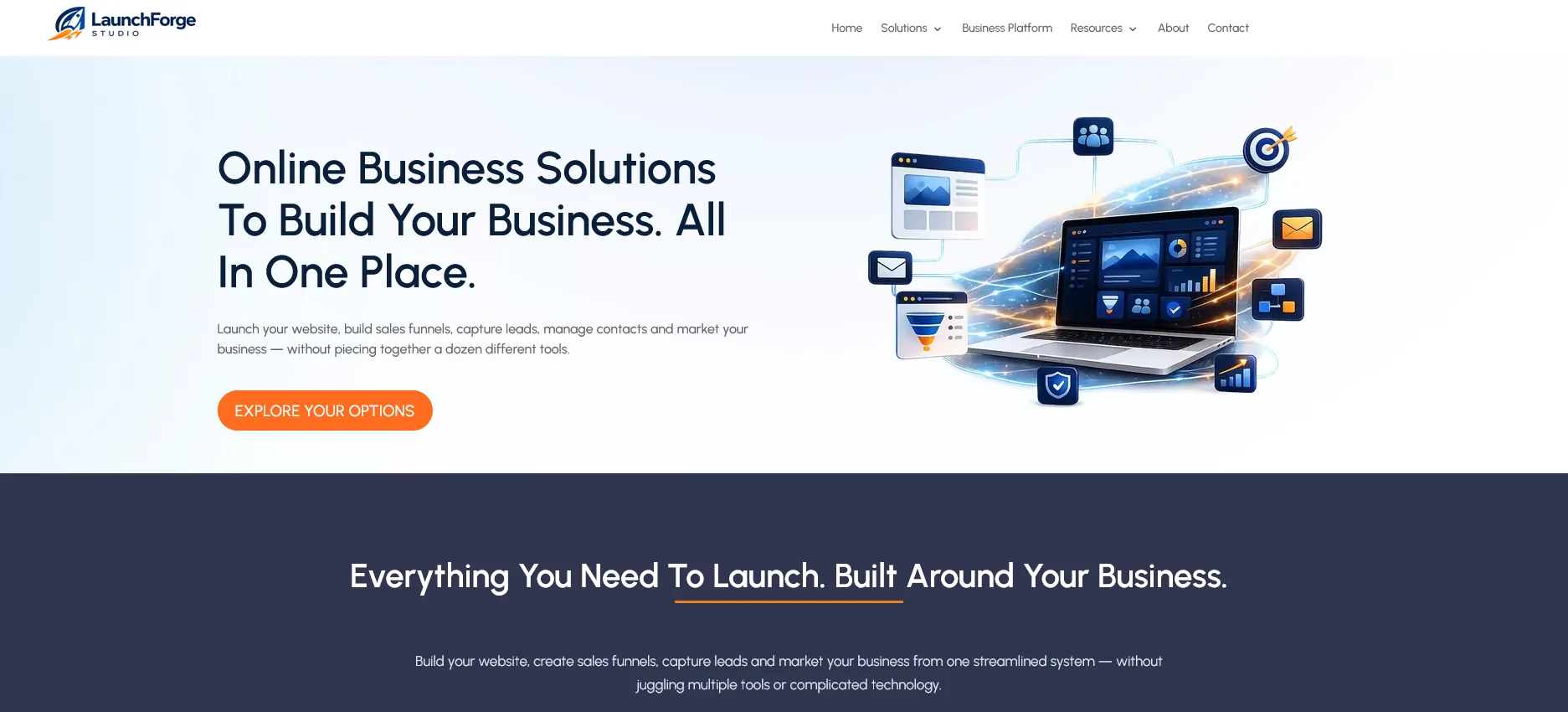
The live LaunchForge Studio homepage after turning the original business idea into a working online business website.
But none of that arrived perfectly formed.
Pages were redesigned.
Headlines changed.
Calls to action moved.
Images were replaced and optimized.
Navigation was reorganized as the site grew.
Some ideas looked great in theory and did not make nearly as much sense once they were sitting on a live website.
That process taught me one of the first important lessons from building LaunchForge Studio:
Your Website Does Not Need to Be Perfect Before You Start
It needs a clear purpose and a solid foundation.
LaunchForge Studio today looks considerably different from the version I started with, and I expect it will continue changing as the business develops.
That is not a failure of the original plan.
That is what building looks like.
Instead of waiting until every page, tool, funnel, and marketing idea was perfect, I put the foundation in place and improved it as I learned more.
And once the website was working, the next challenge became much bigger:
How do I turn a website into an actual business system?
A Website Was Only the Beginning
Getting LaunchForge Studio online was a milestone, but a website by itself was never the goal.
A website can explain what you do, publish content, and give people somewhere to find you.
A business needs more.
It needs ways to attract visitors, capture leads, follow up with people, present offers, measure results, and eventually turn attention into revenue.
That is where I started looking beyond the website itself and into the other systems available through Profit Hub System.
Building Funnels and Landing Pages
I installed WP Funnels so I could begin creating dedicated funnels and landing-page experiences instead of relying entirely on standard website pages.
That distinction matters.
Someone reading a LaunchForge article may be researching a topic. Someone arriving through a specific campaign may need a much simpler path with one clear next step.
Funnels give me the ability to build those paths as the business grows.
And this is an important part of this case study:
Having a tool available does not mean I immediately need to build everything possible with it.
I would rather add systems when they have a real job to perform than create a complicated business simply because the tools exist.
Building an Email Audience I Control
Another priority was creating a way for visitors to stay connected with LaunchForge Studio.
Instead of using the contact area simply as a traditional contact form, I turned it into an opportunity for readers to join the LaunchForge email audience and receive educational content and updates.
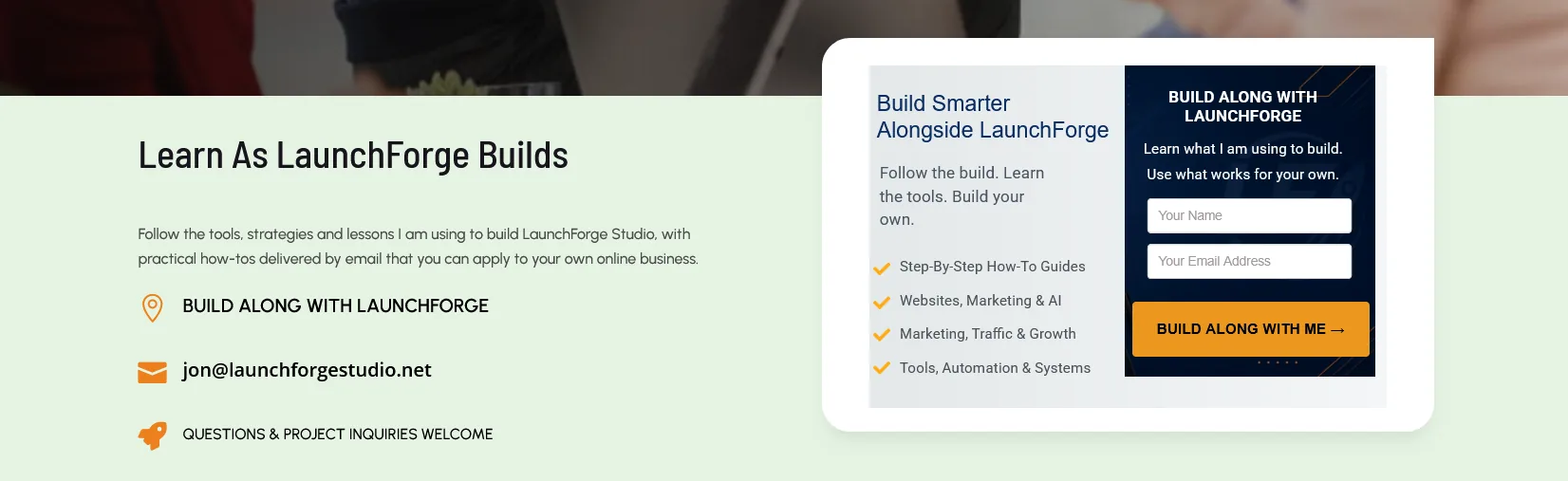
The LaunchForge Studio Build Along signup turns website visitors into an email audience I can continue helping beyond a single website visit.
That gave the website another purpose.
A visitor no longer has to read an article and disappear forever.
They can become part of an audience I can continue helping and communicating with over time.
That lesson has become increasingly important as I build LaunchForge:
Traffic is useful. An audience you can reconnect with is far more valuable.
Connecting the Pieces Instead of Collecting Tools
This is also where my thinking about Profit Hub System began to change.
The value was not simply having access to another tool.
It was being able to build around a broader collection of business systems while deciding which pieces LaunchForge actually needed.
Some tools have already become part of the operation.
Others are waiting until there is a genuine reason to use them.
And I think that is exactly how an online business platform should be approached.
Do not collect tools just because they are available.
Give each tool a job.
The Tools I Am Actually Using to Build LaunchForge Studio
One thing I want to make clear is that I am not using every tool available to me simply because it exists.
That would defeat the purpose.
The goal is to build a useful business system, not win an award for opening the most dashboards.
Instead, I have been adding tools as LaunchForge Studio gives me a reason to use them.
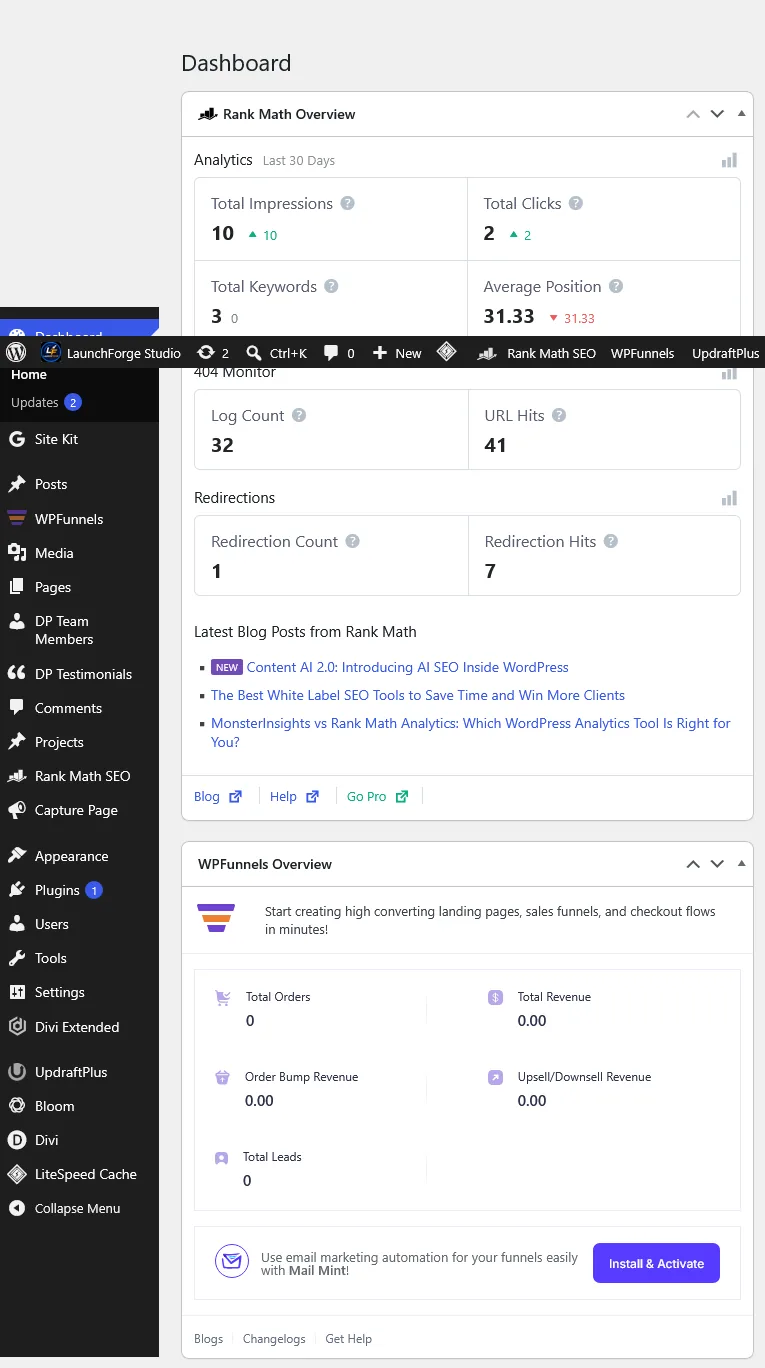
The real WordPress dashboard behind LaunchForge Studio, where I manage SEO, funnels, content, pages, and other parts of the business.
WordPress and Divi 5
WordPress is the content foundation of LaunchForge Studio, while Divi 5 has become the primary design system I use to build and refine the website.
That combination gives me control over the actual property I am building.
I can change page layouts, improve calls to action, create new sections, adjust the mobile experience, publish new resources, and continue evolving the site as LaunchForge grows.
And I have already done plenty of that.
The site you see today is the result of repeated adjustments rather than one perfect first attempt.
WP Funnels
WP Funnels gives me another layer beyond the main website.
It allows me to build focused landing pages and funnel paths for specific campaigns and offers without forcing every visitor through the same general website experience.
I am still developing how funnels will fit into the larger LaunchForge strategy, which is exactly why I consider this a build-along rather than a finished blueprint.
You get to see the system develop as I actually use it.
Marketing and Automation
LaunchForge also needs systems that can help move people beyond that first website visit.
Marketing and automation tools give me ways to build follow-up processes, connect different parts of the business, and reduce repetitive work as the audience grows.
The important part for me is not automating everything.
It is deciding what deserves to be automated.
A bad process does not magically become a good process because software runs it automatically.
Conversion Tools
I also have access to tools such as Conversion Cue, Alert Wave, Trust Bubble, Feedback Flow, and Lead Dialogue.
These are designed to help with areas such as visitor engagement, conversion messaging, feedback, communication, and social proof.
But this is where I refuse to turn this case study into a feature checklist.
I am not going to tell you that every tool transformed my business simply because it is sitting in my account.
Some will earn a permanent place in LaunchForge.
Some may be useful only for specific campaigns.
Others may turn out to be unnecessary for the way I ultimately build the business.
That is part of the experiment.
The Real Test Is Whether a Tool Earns Its Place
This has become one of my biggest rules while building LaunchForge Studio:
A tool should solve a problem before it creates another subscription, another dashboard, or another thing to manage.
That is also why I am documenting this process.
Over time, I can show which tools became essential, which ones were useful in certain situations, and which ones simply did not earn a permanent place in the system.
Because access to software is easy.
Knowing what is actually worth using is the valuable part.
Building the Traffic Side of the Business
A working website and connected business tools do not mean much if nobody ever finds them.
That brought me to another major part of building LaunchForge Studio:
Traffic.
And I quickly learned that I did not want the business to depend on a single traffic source.
Building Content That Can Keep Working
One of the biggest investments I have made in LaunchForge is content.
Instead of treating the Blog, Guides & Tutorials, and Recommended Tools sections as filler for the website, I am building them into actual traffic assets.
Each article gives me another opportunity to answer a question, document an experiment, share what I am learning, or introduce readers to a tool I have genuinely investigated.
Some articles are educational.
Some are reviews.
Others, like this one, document the actual process of building an online business.
The long-term goal is simple:
Create useful content today that can continue bringing people into LaunchForge tomorrow.
Learning SEO by Actually Doing It
Search engine optimization has also become part of the build.
I use Rank Math inside WordPress to help optimize articles and pages, but I have learned not to treat an SEO score like the final judge of whether a piece of content is good.
The score can help identify things I missed.
It cannot tell me whether a reader trusts what I wrote.
I have also connected LaunchForge Studio to Google Search Console, submitted the site’s sitemap, requested indexing for new content, and started watching how pages actually appear in Google Search.
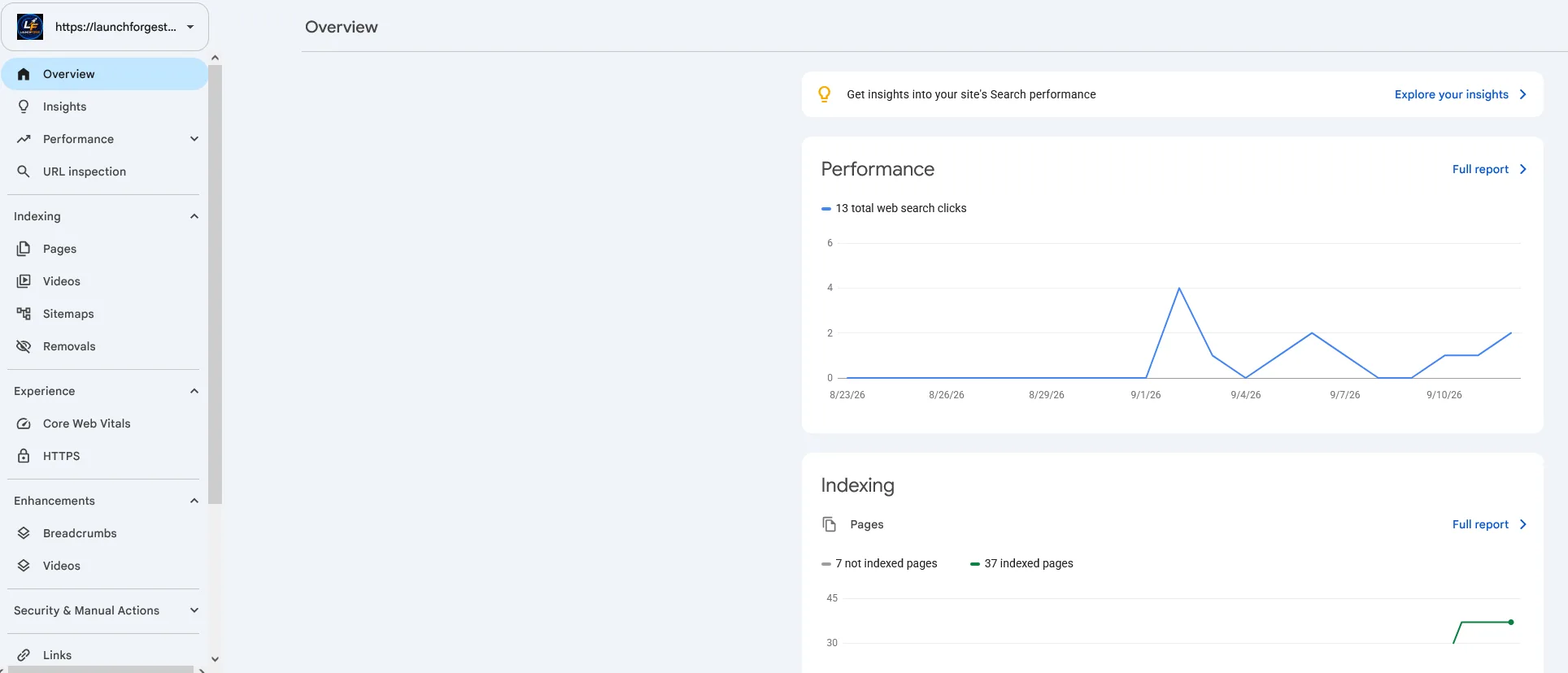
Google Search Console showing the early search activity and indexing progress for LaunchForge Studio as the site continues to grow.
That has made SEO much more tangible.
Instead of talking about rankings in theory, I can publish something and eventually see real impressions, clicks, indexing information, and search positions.
Testing Traffic Beyond Google
Organic search is only one piece of the traffic strategy.
I am also experimenting with other sources and platforms to see where LaunchForge can earn attention.
That includes email-based traffic sources, advertising platforms, social media, affiliate marketing channels, and tools I can test directly and document on the site.
Some experiments will work.
Some will produce traffic without conversions.
Some may produce almost nothing.
I want to document all of it.
Because a traffic source that generates clicks is not automatically a good traffic source.
The real question is what happens after the click.
Build the Destination Before Chasing the Traffic
This may be one of the biggest changes in how I think about online marketing.
It is easy to become obsessed with getting more visitors.
But sending thousands of people somewhere that has no clear purpose does not solve much.
That is why I have spent so much time building the destination first.
The website.
The content.
The lead-generation paths.
The follow-up systems.
The offers.
The measurement.
Then traffic has somewhere meaningful to go.
Traffic gets attention.
The system behind it determines what that attention becomes.
What I Got Wrong While Building LaunchForge Studio
If I made this article sound like every decision worked perfectly the first time, it would completely miss the point of documenting the build.
There have been plenty of mistakes.
Some were technical.
Some were strategic.
And some came from making things more complicated than they needed to be.
I Tried to Solve Too Much at Once
Early on, it was tempting to think about everything LaunchForge Studio might eventually become.
Websites.
Funnels.
Email marketing.
Automation.
Traffic.
Affiliate programs.
AI.
SEO.
Social media.
Conversion tools.
Monetization.
All of those things can matter, but trying to build all of them simultaneously can turn an exciting business into an overwhelming project very quickly.
I have learned to ask a much simpler question:
What does the business actually need next?
That question has saved me from building things simply because I could.
I Changed Things After I Thought They Were Finished
There have been pages I considered finished that I later changed.
Headlines have been rewritten.
Images have been replaced.
Calls to action have moved.
Navigation has been reorganized.
Content strategies have changed as I learned more about what LaunchForge Studio should become.
At first, it is easy to look at those changes as wasted work.
I do not see them that way anymore.
Every revision taught me something about the business.
I Learned That Faster Is Not Always Better
There is always another tool to install, another page to create, another traffic source to test, or another marketing idea to chase.
But adding more does not automatically create progress.
Sometimes the better decision is to publish the article.
Let Google crawl it.
Let the campaign run.
Collect some actual data.
And resist the urge to change everything five minutes later.
That has been one of the harder lessons.
Give the work enough time to tell you something.
I Almost Made the Tools the Business
This may be the most important lesson of all.
It is easy to become fascinated with software when you are building an online business.
But Profit Hub System is not LaunchForge Studio.
Divi 5 is not LaunchForge Studio.
An autoresponder is not LaunchForge Studio.
A funnel is not LaunchForge Studio.
They are tools.
The business is the audience, the content, the experience, the offers, the decisions, and the value those tools help me create.
Once I started looking at technology that way, choosing what belonged in the business became much easier.
I stopped asking:
“What else can I add?”
And started asking:
“What problem does this solve?”
That question has probably saved more things from entering the LaunchForge digital trash can than anything else. 😂
What the LaunchForge Business System Looks Like Today
LaunchForge Studio is still evolving, but it is no longer just an idea and a collection of tools.
There is now a working system behind it.
The Website Is the Home Base
LaunchForgeStudio.net is the central property I am building around.
It gives me one place to publish content, explain the different areas of the business, recommend tools, create educational resources, and connect everything else I am doing.
Social media platforms can bring attention.
Traffic sources can send visitors.
Email can bring people back.
But the website is the destination I control.
Content Creates Multiple Ways to Find the Business
The Blog and Guides & Tutorials sections each have a different role.
The Blog gives me room to explore broader online-business topics and document what I am building.
Guides & Tutorials can help readers understand specific processes and make better decisions.
Recommended Tools gives me a place to publish hands-on reviews and experiences with products I actually investigate or use.
Instead of publishing content simply to fill a website, I want each piece to become another useful entrance into the LaunchForge ecosystem.
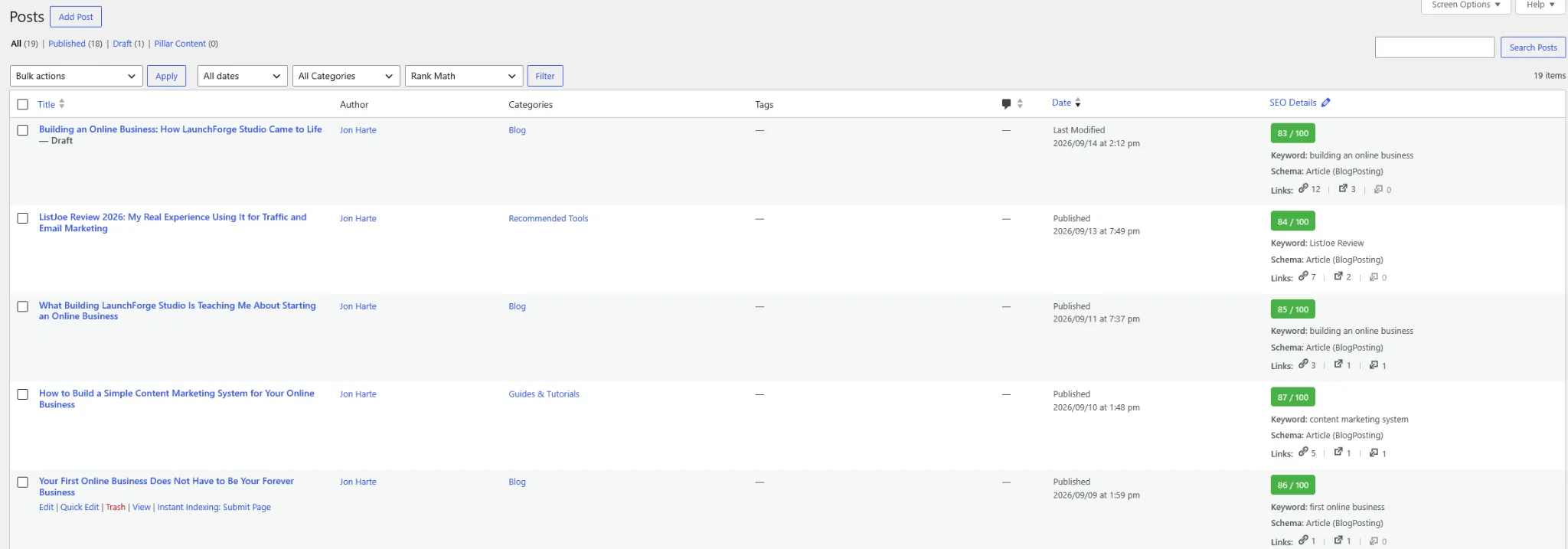
The LaunchForge Studio WordPress content library as it grows with real articles, guides, reviews, and build-along case studies.
Lead Generation Creates the Connection
Once someone reaches LaunchForge, the next challenge is creating a reason for that person to stay connected.
That is where lead generation and email become part of the system.
A visitor may discover LaunchForge through Google, a social post, an advertisement, or another traffic source.
If that person joins the email audience, the relationship no longer depends on them remembering to come back.
That changes the value of the original click.
Traffic Feeds the System
I am continuing to test different ways of bringing people into LaunchForge Studio rather than betting the entire business on one source.
Search traffic is one piece.
Social media is another.
Email-based advertising and traffic platforms provide additional experiments.
Some of those experiments are already becoming articles themselves because I can show what happened rather than simply repeat what a platform promises.
That creates an interesting cycle:
Test the tool.
Measure the results.
Document what happened.
Turn the experience into useful content.
Use that content to attract the next visitor.
That is becoming one of my favorite parts of the LaunchForge model.
Monetization Comes After the Value
LaunchForge Studio also uses affiliate relationships and recommended tools as part of its monetization strategy.
But I do not want the entire site to become one giant collection of affiliate links.
The recommendation has to make sense within the content.
That is why articles such as my tool reviews include what I actually found, including limitations and results that may not look particularly impressive.
If something produced clicks but no conversions, I can say that.
If I have access to a feature but have not meaningfully tested it yet, I can say that too.
Trust is worth more to this business than pretending every tool is perfect.
Profit Hub System Is the Foundation, Not the Story
This is probably the clearest way I can explain where Profit Hub System fits today.
It provides much of the infrastructure and toolkit I am building around.
But the objective was never simply to own Profit Hub System.
The objective was to use the resources available to me to build LaunchForge Studio.
That distinction is important.
The platform provides the tools.
The business comes from what I build with them.
What I Would Do Differently If I Started Again
If I had to start LaunchForge Studio again tomorrow, I would still use many of the same tools.
What I would change is the order in which I used them.
I Would Define the Business Before Building the Website
It is tempting to start with colors, logos, layouts, pages, and all the fun visual stuff.
But the clearer you are about the purpose of the business, the easier those decisions become.
Who are you trying to help?
What problems are you helping them solve?
What kind of content will you create?
What action do you eventually want a visitor to take?
I would answer those questions as early as possible.
A website becomes much easier to build when you know what job it is supposed to perform.
I Would Build the Core Before Adding the Extras
I would focus first on a simple foundation:
Website.
Useful content.
Lead capture.
Email follow-up.
A clear offer or monetization path.
A way to measure what happens.
Then I would add automation, additional funnels, conversion tools, traffic sources, and other systems when the business actually needed them.
Having access to a large collection of tools can be valuable.
Feeling obligated to use every one of them is not.
I Would Start Creating Content Earlier
Content has become much more important to LaunchForge Studio than I originally realized.
Every useful article creates another piece of the business that can potentially be discovered, shared, linked to, emailed, and referenced later.
More importantly, creating content forces me to clarify what I am learning.
A traffic experiment can become a case study.
A tool I test can become a review.
A mistake can become a lesson.
A decision I make while building the site can become something that helps another person make a better decision.
The work itself creates the content.
I would take advantage of that much earlier.
I Would Measure Before Making More Changes
This one would have saved Picky Peter a considerable amount of overtime. 😂
When something is published or a campaign starts running, my instinct is often to keep improving it.
Change the headline.
Move the button.
Rewrite something.
Try another image.
But if I change everything immediately, I never really learn what the original version did.
I would give more experiments enough time to produce meaningful information before deciding they need to be fixed.
I Would Still Expect to Get Things Wrong
There is one thing I would not change.
I would not wait until I knew exactly what I was doing.
Some of the most useful things I have learned about building LaunchForge Studio came from doing something, seeing what happened, and adjusting from there.
There is a point where more research stops helping.
Eventually, you have to build.
Start with a solid foundation.
Use what you need.
Measure what happens.
Improve from there.
That is a much more realistic picture of building an online business than waiting for the mythical moment when you finally know everything.
Where I Am Taking LaunchForge Studio Next
LaunchForge Studio is live, but I do not consider it finished.
Not even close.
The foundation is there. The website is working. Content is being published. Traffic sources are being tested. Email and marketing systems are taking shape.
Now the focus shifts from simply building pieces to making those pieces work better together.
More Real-World Testing
One of my biggest priorities is continuing to test the tools and traffic sources I encounter while building the business.
I do not want LaunchForge Studio to become a library of articles written from product descriptions.
If I can use something myself, I would rather show you what actually happened.
That means more screenshots.
More campaign results.
More numbers.
More things that worked.
And yes, probably a few more trips to the digital trash can.
More Build-Along Content
I also want to document more of the decisions happening behind the scenes.
There is useful information in the finished website, but there may be even more value in showing how it got there.
Why did I choose one approach instead of another?
What happened when I tested it?
What would I change?
Would I still recommend doing it that way six months later?
Those are the kinds of questions I want future LaunchForge content to answer.
Turning Individual Pieces Into a Stronger System
The next stage is also about integration.
Instead of looking at the website, email, funnels, automation, content, traffic, conversion tools, and monetization as separate projects, I want them working together.
A visitor discovers an article.
The article helps solve a problem.
The visitor discovers another useful resource or joins the email audience.
The relationship continues.
Eventually, the right tool, service, or solution may help that person move forward with their own business.
That is a system.
And building that system is much more interesting to me than simply accumulating more software.
Let the Results Decide What Stays
As LaunchForge grows, I expect some tools and strategies to become more important.
Others may disappear entirely.
That is okay.
Nothing gets a permanent position simply because I paid for it.
It has to earn its place.
That philosophy applies to Profit Hub System tools, traffic platforms, affiliate programs, marketing strategies, automation, and just about everything else I test.
If something works, I want to understand why.
If something does not, I want to understand that too.
And either result can become useful information for the next person building an online business.
This Case Study Is Not Finished
That may be the most important part of this entire article.
You are not reading the story after everything worked.
You are reading it while the story is still being written.
LaunchForge Studio will continue changing as I learn, test, build, measure, and occasionally discover that one of my brilliant ideas belongs directly in the digital trash can.
And I intend to keep showing you what happens.
Because the goal of LaunchForge Studio has never been to pretend I have reached the finish line.
The goal is to let you follow the build.
Final Thoughts: The Platform Did Not Build the Business
Profit Hub System has become an important part of the foundation behind LaunchForge Studio.
It gave me access to infrastructure and tools I could begin building around.
But it did not build LaunchForge Studio for me.
I still had to make the decisions.
I still had to build the pages.
I still had to write the content.
I still had to connect the systems, test traffic sources, work on SEO, create marketing campaigns, fix mistakes, and decide what belonged in the business.
And I am still doing all of those things.
That distinction matters because there is no platform, piece of software, funnel, AI tool, or traffic source that removes the need to actually build.
Tools can make the work easier.
They cannot replace the work.
What Profit Hub System Gave Me
For LaunchForge Studio, Profit Hub System gave me something extremely useful:
A place to start building.
Instead of beginning with nothing and trying to assemble every piece of the technical foundation separately, I had a collection of resources I could begin putting to work as the business developed.
Some are already part of LaunchForge.
Some are still being tested.
Some I may use later.
And some may never be necessary.
That is exactly how I want it.
The goal is not to use everything.
The goal is to build something that works.
What LaunchForge Studio Has Taught Me
If there is one lesson I would give someone who is thinking about building an online business, it is this:
Do not wait for the perfect platform.
Do not wait for the perfect website.
Do not wait until you understand every marketing strategy.
And definitely do not wait until you think you cannot make a mistake.
Choose a solid foundation.
Build the first useful version.
Put it in front of real people.
Measure what happens.
Then make it better.
That is how LaunchForge Studio came to life.
And that is how I intend to keep building it.
Follow the Build
This case study represents where LaunchForge Studio stands today, not where it ends.
As I test more tools, build new systems, generate traffic, publish content, and collect real results, I will continue documenting what I learn.
If you want to understand the platform behind much of this build, you can also read my complete Profit Hub System review, where I take a closer look at the platform itself.
But here on LaunchForge Studio, we are going to keep doing something a little different.
Build it.
Test it.
Measure it.
Learn from it.
Then share what actually happened.
Build Smarter. Launch Faster. Grow Stronger.