
Introduction
A lead generation system gives your online business a simple process for turning visitors into people you can continue communicating with. Instead of hoping someone visits your website, looks around, and eventually comes back, you create a clear path that encourages interested visitors to take the next step.
That path might begin with a blog post, search result, social media post, advertisement, referral, or another traffic source. From there, a visitor reaches a page where they can learn more, request information, download a resource, join an email list, or take another meaningful action.
Once that visitor becomes a lead, the relationship does not have to end when they leave your website. You can follow up, provide useful information, introduce relevant solutions, and continue building trust over time.
The good news is that this does not require an enormous collection of complicated marketing tools.
At its core, a simple lead generation system only needs to accomplish a few important things:
• Attract the right visitors
• Give them a reason to take action
• Capture their information
• Follow up and build the relationship
• Track what is working
Once those pieces begin working together, you have something much more valuable than occasional website traffic. You have a repeatable system designed to turn attention into opportunities for your business.
In this guide, I will walk you through that process step by step and show you how the individual pieces can work together without making your marketing unnecessarily complicated.
What Is a Lead Generation System?
A lead generation system is a connected process that helps move someone from being an anonymous visitor to becoming a potential customer, subscriber, or client you can continue communicating with.
Think about a typical website visitor. Someone discovers your business through Google, social media, an advertisement, a referral, or another website. They visit a page, look around for a few minutes, and then leave.
If you have no way to reconnect with that person, the opportunity may disappear with them.
A lead generation system creates a bridge between getting the visitor and building the relationship.
Instead of relying on someone to remember your website and return later, you provide a clear next step. That might be joining your email list, requesting a consultation, downloading a helpful resource, registering for a webinar, asking for more information, or expressing interest in a product or service.
Once they take that action, they are no longer simply another website visitor. They have given you an opportunity to continue the conversation.
That distinction is important:
Traffic gets people to your business.
Lead generation gives you a way to continue the relationship after they arrive.
A good system connects those two activities so that the traffic you work hard to generate has a greater opportunity to become something valuable.
The 7 Parts of a Simple Lead Generation System
A lead generation system becomes much easier to understand when you break it into individual parts. Each part has a specific job, but the real power comes from connecting them into one continuous process.
For this guide, we will use a simple seven-part framework:
1. Identify Your Target Audience
Understand who you want to attract and what problem, need, or goal brings them to your business.
2. Create a Reason to Take Action
Give visitors something valuable enough to encourage the next step, such as useful information, a resource, consultation, newsletter, offer, or other benefit.
3. Build a Landing or Lead Capture Page
Create a focused destination that explains the value and gives visitors a clear action to take.
4. Drive Targeted Traffic
Bring the right people to your page through search engines, content, social media, referrals, advertising, communities, or other relevant traffic sources.
5. Capture and Organize Your Leads
Collect the information visitors choose to provide and organize those contacts so you can communicate with them appropriately.
6. Follow Up and Build the Relationship
Continue providing value through email and other appropriate follow-up instead of allowing the relationship to end after the first visit.
7. Track, Measure, and Improve
Monitor where visitors come from, what they click, which pages generate leads, and where the process can be improved.
None of these steps needs to be overly complicated. In fact, one of the biggest mistakes online business owners can make is adding unnecessary complexity before the basic system is working.
The goal is to create a clear journey:
Target Audience → Reason to Act → Landing Page → Targeted Traffic → Lead Capture → Follow-Up → Track & Improve
Once you understand that journey, the individual tools become much easier to choose because you know exactly what job each tool needs to perform.
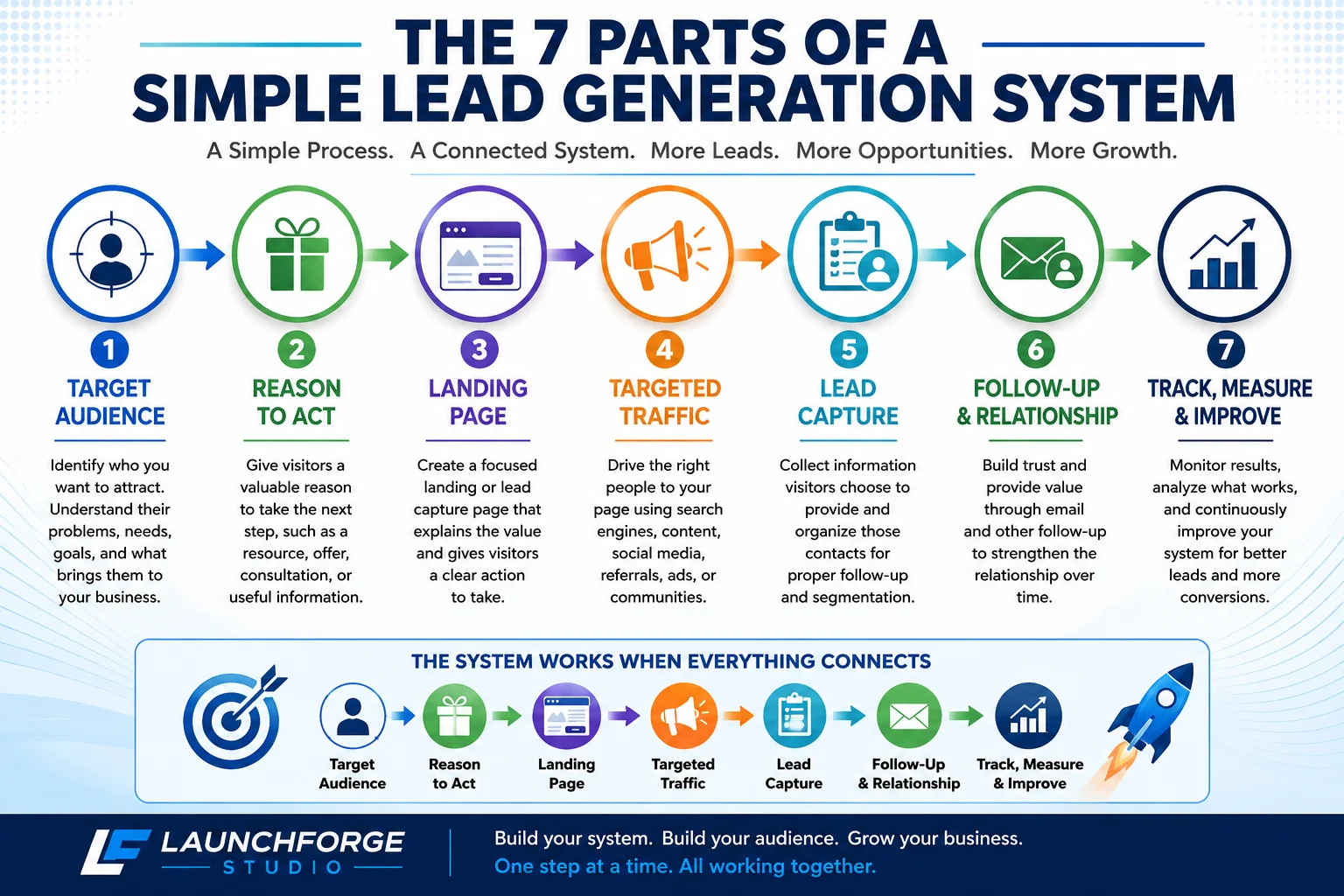
The seven parts of a simple lead generation system, from identifying your target audience and driving traffic to capturing leads, following up, and tracking results.
Step 1: Identify Who You Want to Attract
One of the most important parts of building an effective lead generation system is knowing who you actually want to attract.
It can be tempting to think that reaching more people automatically creates better results. But getting your offer in front of thousands of people who have little interest in what you provide may accomplish far less than reaching a smaller group of people who have a genuine reason to pay attention.
That is why effective lead generation starts with the audience rather than the traffic.
Before you worry about landing pages, email sequences, advertising, or marketing software, ask yourself a few basic questions:
• Who is most likely to benefit from what I offer?
• What problem are they trying to solve?
• What goal are they trying to accomplish?
• What questions might they be asking before they find me?
• What would make them interested enough to take the next step?
You do not need an incredibly detailed customer profile before you begin. The goal is simply to understand the person on the other side of the screen well enough to create something relevant to them.
Targeted Does Not Mean Tiny
Defining an audience does not mean limiting your business to one extremely narrow group of people forever. It means giving your marketing enough direction that your message can connect with someone.
For example, imagine you provide website and marketing solutions for online business owners.
You could advertise by saying:
“We help everyone grow online.”
That message technically includes a huge audience, but it gives almost nobody a specific reason to pay attention.
Now compare it with:
“Build a professional online presence without piecing together a dozen complicated tools.”
The second message speaks much more directly to someone frustrated by complexity and trying to get an online business running.
The audience became clearer, so the message became stronger.
Quality Before Quantity
This principle will become especially important when we discuss traffic later in this guide.
The goal is not simply to attract more visitors. The goal is to attract more of the right visitors.
When the audience and message align, every step that follows becomes easier. Your landing page can speak to a specific need, your offer can provide a relevant next step, and your follow-up can continue a conversation the visitor was already interested in having.
That gives us the foundation for Step 2:
Now that we know who we want to attract, we need to give them a reason to take action.
Step 2: Create a Reason to Take Action
Getting the right person to your website is only the beginning. The next challenge is giving that visitor a clear and worthwhile reason to take action.
People generally do not provide their name, email address, or contact information simply because a form happens to be sitting on a page. They need to understand what they will receive in return and why taking the next step is worth their time.
That value does not always have to be a discount or free product. Depending on your business, the reason to act might be:
• A helpful guide, checklist, or resource
• Access to useful tips or ongoing educational content
• A free consultation or project discussion
• Registration for a webinar or training
• Product updates, special offers, or early access
• A solution to a specific problem the visitor is already trying to solve
The important part is the exchange of value.
Match the Next Step to the Visitor
Not every visitor is ready to buy something immediately.
Someone discovering your business for the first time may be willing to download a useful guide but not schedule a consultation. Another visitor who has already researched your services may be ready to talk about a project.
Your lead generation system should give people a logical next step based on where they are in their journey.
For example:
A visitor reading an educational article might be offered a related checklist or email series.
Someone exploring a service page might be invited to request more information or start a conversation.
A visitor researching a particular tool might be directed toward a detailed guide, comparison, demonstration, or free account.
Each action moves the relationship forward without asking the visitor to make a bigger commitment than they are ready to make.
Make the Value Clear
Whatever you offer, the visitor should be able to understand the benefit quickly.
Compare:
“Join Our Mailing List.”
with:
“Get practical strategies for building and growing your online business delivered to your inbox.”
Both ask for an email address.
But the second explains why someone might actually want to provide it.
A strong reason to act connects what your audience wants with a useful next step your business can provide.
Once that reason exists, we need somewhere focused to present it.
That brings us to Step 3: building the landing or lead capture page.
Step 3: Build a Landing or Lead Capture Page
A landing or lead capture page gives your visitor a focused place to take the next step.
Unlike a typical website page that may contain navigation menus, multiple links, services, blog posts, and other distractions, a lead capture page is usually built around one primary goal.
That goal might be joining an email list, downloading a resource, registering for training, requesting information, starting a project discussion, or taking another specific action.
The simpler that decision is to understand, the easier it becomes for the visitor to know what to do next.
Keep the Page Focused
A useful lead capture page does not need to be complicated. In many cases, it only needs a few essential elements:
• A clear headline that communicates the main benefit
• A short explanation of what the visitor will receive
• A simple form requesting only the information you actually need
• A clear call to action telling the visitor what happens next
• Supporting information that helps answer questions or reduce uncertainty
Every element should support the same primary action.
If your goal is getting someone to join an email list, for example, filling the page with unrelated offers, navigation choices, advertisements, and competing buttons can distract from that goal.
Ask Only for What You Need
Every additional form field creates another decision for the visitor.
If all you need to continue the conversation is a name and email address, you probably do not need to ask for their phone number, company size, mailing address, favorite pizza topping, and mother’s maiden name. 😂
For a more qualified service inquiry, however, asking for a business name or a little information about the project may make sense.
The information you request should match the purpose of the form.
Give the Visitor a Clear Next Step
Your call to action should remove uncertainty.
Generic buttons such as:
“Submit”
technically work, but they do not communicate much value.
Compare that with:
“Get the Free Guide”
“Show Me My Options”
“Start My Project”
or
“Send Me the Training”
Those calls to action reinforce what happens after the visitor clicks.
A good landing page does not need to impress someone with complexity. Its job is to make the value clear and make the next step easy to understand.
Once the page is ready, however, we still have one rather important problem:
Someone needs to see it.
That takes us directly into Step 4 — targeted traffic.
Step 4: Drive Targeted Traffic
Once your landing page is ready, the next part of your lead generation system is getting people to actually see it.
This is where traffic enters the picture.
But there is an important distinction between getting traffic and getting targeted traffic.
A website can receive hundreds or even thousands of visitors and still generate very few leads if those visitors have little interest in the problem, solution, product, or service being presented.
That is why traffic quality matters just as much as traffic quantity.
Where Can Targeted Traffic Come From?
There is no single traffic source that every online business needs to use. The right combination depends on your audience, your offer, your budget, and where potential customers are most likely to discover you.
Traffic can come from sources such as:
• Search Engines — People discovering your website through useful content and search results.
• Blog Content — Articles and guides that answer questions your audience is already asking.
• Social Media — Content and conversations that introduce people to your business.
• Referrals and Backlinks — Visitors arriving through recommendations and links from other relevant websites.
• Online Communities — Participating in relevant groups, forums, and communities where your audience spends time.
• Email Marketing — Bringing existing subscribers back to useful content, offers, and resources.
• Paid Advertising — Using advertising platforms or traffic services to place your message in front of potential visitors.
You do not need to use every traffic source at once. Starting with a few channels you can understand and measure is often more useful than spreading your efforts across every available platform.
Traffic Quality Beats Traffic Volume
Imagine two campaigns.
The first sends 5,000 visitors to your landing page, but those visitors have little interest in what you offer.
The second sends only 500 visitors, but those people are much more closely aligned with your target audience.
The smaller campaign may produce substantially more leads because the visitors arrived with greater relevance or intent.
This is why judging traffic only by the number of clicks can be misleading.
Instead, ask:
• Which traffic sources produce actual leads?
• Which visitors spend time engaging with the page?
• Which sources produce subscribers, inquiries, or other meaningful actions?
• Which campaigns bring people who continue engaging after the first visit?
Those answers tell you considerably more than the click count alone.
Organic and Paid Traffic Can Work Together
You also do not have to choose between organic and paid traffic.
Organic strategies such as useful articles, search visibility, referrals, and backlinks can build traffic gradually over time.
Paid traffic can provide faster exposure and give you an opportunity to test pages, messages, and offers with additional visitors.
The key is understanding what happens after the click.
Sending more traffic into a system that does not capture or follow up with interested visitors may simply create more missed opportunities.
That is why the next step is so important.
Once the right visitors arrive, we need a way to capture and organize the people who want to continue the relationship.
That brings us to Step 5.
Step 5: Capture and Organize Your Leads
When an interested visitor decides to take the next step, your lead generation system needs a way to capture that information and organize it for future communication.
This is the point where an anonymous website visitor can become a subscriber, prospect, or potential customer.
For many online businesses, this happens through an opt-in form connected to an email list or contact management system. The visitor voluntarily provides information such as their name and email address in exchange for the resource, information, consultation, or other value you offered.
But collecting the information is only part of the process.
Connect Your Forms to the Right Place
When someone completes a form, their information needs somewhere to go.
Depending on your business, that might be:
• An email marketing list
• A contact management system
• A customer relationship management system (CRM)
• A project inquiry system
• A webinar or event registration list
• Another appropriate follow-up system
The important thing is that the information does not simply disappear into an inbox or spreadsheet where it is forgotten.
Your form should connect the lead to whatever system will handle the next stage of the relationship.
Keep Your Leads Organized
As your audience grows, organization becomes increasingly important.
Someone who downloads a beginner guide may have different interests from someone requesting information about a service. Likewise, a customer may need different communication than a brand-new subscriber.
Organizing leads into appropriate lists, groups, tags, or segments can help you send information that is more relevant to why they connected with your business in the first place.
You do not need an elaborate segmentation strategy when you are just getting started.
Begin with enough organization to answer a simple question:
Why did this person join my list or contact my business?
Knowing that makes meaningful follow-up much easier.
Respect the Permission You Have Been Given
When someone provides their contact information, they are giving you permission to continue communicating with them within the expectations you established.
Treat that permission as something valuable.
Be clear about what someone is signing up for, provide the information or resource you promised, and give subscribers an appropriate way to manage or unsubscribe from email communications.
The goal is not to collect the largest possible database of email addresses.
The goal is to build a list of people who actually want a relationship with your business.
That difference matters.
Because once somebody becomes a lead, the next question is:
What do you do with that opportunity?
That takes us into one of the most important parts of the entire system:
Step 6 — Follow Up and Build the Relationship.
Step 6: Follow Up and Build the Relationship
Capturing a lead gives you an opportunity to continue the conversation, but what happens next can determine whether that opportunity grows into a meaningful relationship.
Someone joining your email list does not automatically mean they are ready to become a customer.
They may have discovered your business only minutes ago.
That is why effective follow-up should focus on building familiarity, providing value, and helping the subscriber understand how your business can help them.
Start With a Strong Welcome
The first message someone receives after subscribing is an important part of the experience.
If you promised a guide, training, resource, or other information, deliver it promptly and make it easy to access.
A good welcome message can also briefly explain what the subscriber can expect from you going forward.
For example, you might let them know they will receive:
• Helpful educational content
• Practical tips and strategies
• New guides and resources
• Relevant tools or solutions
• Occasional business updates or offers
Setting expectations early helps the subscriber understand why future messages are arriving.
Provide Value Before Asking for Everything
Imagine meeting someone for the first time and immediately asking them to buy five different things.
That would be a pretty short relationship. 😂
Email marketing is not much different.
Your follow-up should give people reasons to continue opening your messages. Teach something useful. Answer questions. Share resources. Help solve problems. Introduce relevant solutions when they genuinely fit the subscriber’s needs.
That does not mean you should never promote anything.
It means promotion works better when it exists within a relationship where the subscriber has already learned that your communication can be useful.
Automation Can Keep the Conversation Moving
You do not have to manually send every follow-up message to every new subscriber.
An automated email sequence can welcome new leads and introduce useful information over several days or weeks.
For example:
Email 1 — Welcome and deliver what was promised
Email 2 — Provide another useful tip or resource
Email 3 — Address a common problem or question
Email 4 — Introduce a relevant solution
Email 5 — Continue the relationship with additional value
The exact sequence will depend on your business and audience, but the principle remains the same:
Automation handles the timing. Your message still needs to provide the value.
Think Beyond the Immediate Sale
Not every lead will become a customer.
And not every customer will make a decision immediately.
Someone may read your emails for weeks or months before they need the particular solution you provide. Another subscriber may never purchase anything but could share one of your articles, recommend your business, or return later when their circumstances change.
That is why follow-up should not be judged solely by whether every email produces an immediate sale.
The bigger objective is to stay useful, relevant, and memorable.
Lead generation gets the conversation started. Follow-up gives the relationship somewhere to go.
And once the system is attracting visitors, capturing leads, and following up with them, we need to know whether everything is actually working.
That takes us to our final step:
Step 7 — Track, Measure, and Improve.
Step 7: Track, Measure, and Improve
Once your lead generation system is running, the final step is understanding what is actually happening inside it.
Without tracking, it is easy to make decisions based on assumptions.
You might think one traffic source is performing well because it sends a lot of visitors, while another source that sends fewer visitors may actually be producing more leads. A landing page may look great but struggle to convert visitors. An email may receive plenty of opens but very few clicks.
Tracking helps replace guesswork with information.
Start With the Numbers That Matter
You do not need to monitor dozens of statistics when you are getting started.
Focus first on measurements that help you understand how people are moving through your system.
These might include:
• Visitors — How many people are reaching your page?
• Traffic Sources — Where are those visitors coming from?
• Opt-Ins or Leads — How many visitors take the action you want?
• Conversion Rate — What percentage of visitors become leads?
• Email Engagement — Are subscribers opening and clicking your follow-up messages?
• Link Clicks — Which links and offers are attracting attention?
• Meaningful Actions — Are leads requesting information, exploring services, registering, purchasing, or taking another important next step?
These numbers begin telling the story of what happens between attracting someone’s attention and producing a meaningful result.
Find the Weakest Part of the System
One of the biggest advantages of tracking is that it helps you identify where the process may be breaking down.
For example:
You may be receiving plenty of traffic but very few leads.
That could indicate a problem with the audience, message, offer, or landing page.
Or you may be generating plenty of leads but receiving very little engagement afterward.
That could point toward the welcome experience, follow-up content, or the relevance of your emails.
Instead of replacing your entire marketing strategy whenever results disappoint you, tracking allows you to investigate the individual parts.
Improve One Thing at a Time
Optimization does not have to mean constantly rebuilding everything.
Sometimes a relatively small change can improve part of the process.
You might test:
• A clearer headline
• A different call to action
• A shorter opt-in form
• A stronger reason to subscribe
• A different traffic source
• A more useful welcome email
• A different follow-up message
When possible, change one important variable at a time.
If you change the headline, offer, form, traffic source, and email sequence simultaneously, it becomes much harder to understand what actually affected the results.
Think of Lead Generation as a Cycle
This is where our seven-part framework comes full circle.
You identify an audience.
You give them a reason to act.
You create the page.
You drive targeted traffic.
You capture interested leads.
You follow up and build the relationship.
Then you measure what happened.
And what you learn from those results helps you improve the audience, message, page, traffic, lead capture, and follow-up the next time around.
So rather than thinking of your lead generation system as something you build once and forget about, think of it as a cycle:
Build → Measure → Learn → Improve → Repeat
Over time, small improvements throughout the system can add up to a much stronger marketing process.
And now that we have examined all seven parts individually, it is time to reconnect them and see how the entire lead generation system works as one continuous journey.
How the Entire Lead Generation System Works Together
The individual parts of a lead generation system become much more powerful when they work together as one connected process.
Think about the journey from the visitor’s perspective.
Someone discovers your business through a search result, article, social media post, advertisement, referral, backlink, or another traffic source.
They arrive because something caught their attention or appeared relevant to a problem, question, or goal they already have.
From there, your landing page or website gives them a reason to take another step.
They might join your email list, download a resource, request information, register for training, explore a service, or take another meaningful action.
Once that happens, your follow-up system allows the relationship to continue even after the visitor leaves your website.
And behind everything, your tracking helps you understand which parts of the process are working and which parts may need improvement.
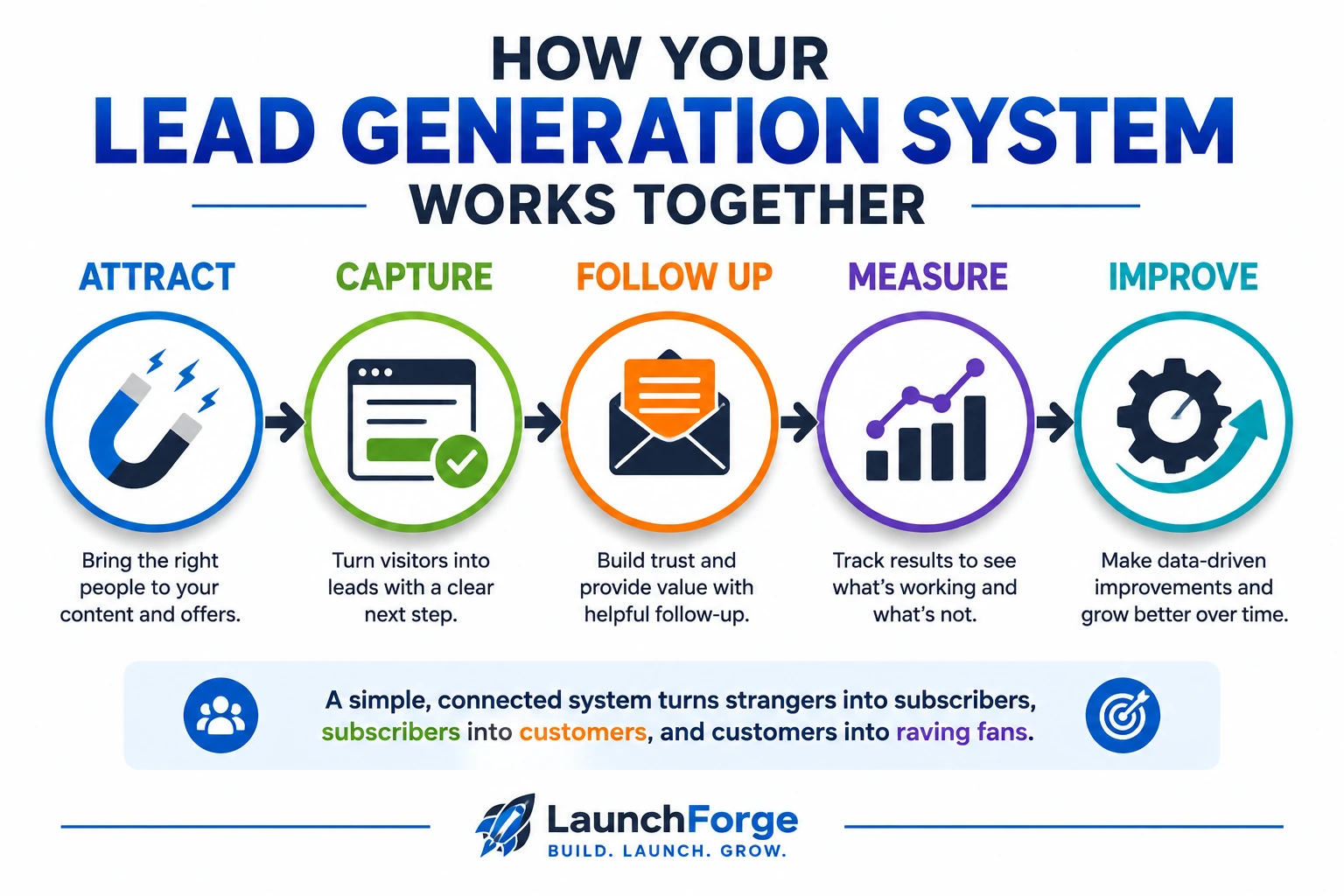
A connected lead generation system attracts the right visitors, captures leads, follows up, measures results, and improves over time.
One Visitor Can Take an Entire Journey
Imagine someone searches Google for information about generating leads for a new online business.
They discover one of your educational articles.
The article answers their immediate question and introduces them to another useful resource.
They decide to join your email list.
Your welcome email delivers what you promised and points them toward another helpful guide.
Several days later, another email introduces them to a tool or service relevant to the problem they originally wanted to solve.
That person may eventually become a customer, subscriber, referral source, or simply a regular reader of your content.
The important point is that the relationship did not depend on a single visit or a single sales pitch.
The system created multiple opportunities to provide value and continue the conversation.
Each Part Supports the Next
This is why improving only one part of the system may not solve everything.
Great traffic sent to a confusing landing page can still produce poor results.
A strong landing page without useful follow-up can capture leads that quickly lose interest.
Excellent emails cannot help very much if nobody is joining the list.
And without tracking, you may not know which part needs attention in the first place.
The seven pieces support one another:
Audience → Value → Page → Traffic → Capture → Follow-Up → Measurement
When those pieces connect, lead generation becomes less about chasing individual clicks and more about building a repeatable process.
Your System Does Not Need to Be Complicated
A beginner might look at this entire process and think they need seven different platforms, complicated automation, expensive software, and a giant marketing budget.
They do not.
You can start with a simple website or landing page, an opt-in form, an email list, a basic follow-up sequence, one or two traffic sources, and enough tracking to understand what is happening.
Then improve the system as your business grows.
Start with the process. Add technology when the process gives you a reason to need it.
That brings us naturally to the next question:
What tools can actually help you build all of this?
Tools You Can Use to Build Your Lead Generation System
Once you understand how a lead generation system works, choosing the technology becomes much easier.
Instead of asking:
“What marketing software should I buy?”
you can ask a much better question:
“What jobs does my system need the technology to perform?”
At a basic level, you may need tools capable of handling:
• Landing and lead capture pages
• Opt-in forms
• Email list management
• Automated email follow-up
• Link and campaign tracking
• Traffic generation or promotion
• Analytics and performance measurement
You can build this system by combining several specialized platforms, or you can use a platform that handles multiple parts of the process in one place.
Neither approach is automatically better. The right choice depends on your business, budget, technical comfort level, and how sophisticated your marketing needs to become.
Start With the Job, Not the Tool
This is an important principle.
It is easy to discover an impressive piece of marketing software and then start looking for reasons to use all of its features.
Try reversing that process.
First identify the problem.
Then choose the simplest tool capable of solving it effectively.
If you only need a basic landing page and email follow-up system, you may not need an expensive collection of advanced automation tools.
As your business grows, your requirements may change. At that point, adding or upgrading technology makes sense because there is a genuine business need behind the decision.
One Platform Can Sometimes Handle Several Jobs
There are also platforms that combine multiple parts of the lead generation process.
One example I use with LaunchForge Studio is LeadsLeap.
LeadsLeap combines several marketing functions we have discussed throughout this guide, including page building, lead capture, email list management and autoresponder functionality, link tracking, traffic tools, advertising, and marketing analytics.
That does not mean you need LeadsLeap to build a lead generation system, and it does not mean it will be the right platform for every business.
It simply demonstrates how several pieces of the process can be connected through one marketing platform rather than assembling a separate service for every function.
I have put together a detailed hands-on guide showing the tools, Free and Pro options, screenshots, and how I use the platform with LaunchForge Studio:
→ Explore My Guide to LeadsLeap Marketing Tools
Keep Your Technology Working for the System
Whatever tools you choose, technology should make your process easier to manage rather than becoming the process itself.
The software may change.
Your email provider may change.
Your page builder may change.
Your traffic sources may change.
But the underlying journey remains remarkably consistent:
Attract → Capture → Follow Up → Measure → Improve
Understanding that process gives you the flexibility to change tools without having to reinvent your entire marketing strategy every time a new platform comes along.
Common Lead Generation Mistakes to Avoid
Even a simple lead generation system can become ineffective when one part of the process is overlooked.
The good news is that many common problems are relatively easy to recognize once you know what to look for.
Mistake #1: Trying to Attract Everyone
A broad message may reach more people, but that does not necessarily mean it will connect with more people.
When your audience is unclear, your headlines, offers, landing pages, and follow-up can become equally unclear.
Start by understanding who you are trying to help and what they are trying to accomplish.
Mistake #2: Sending Traffic Before the System Is Ready
Getting more visitors sounds exciting, but traffic cannot fix a broken process.
Before investing significant time or money into generating traffic, make sure visitors have a clear path to follow.
Ask yourself:
• Is the page easy to understand?
• Is there a clear reason to take action?
• Does the form work correctly?
• Does the lead enter the correct list or system?
• Is the promised information delivered?
• Does the follow-up process actually begin?
Otherwise, you may simply be paying to discover problems you could have fixed beforehand.
Mistake #3: Focusing Only on the Number of Clicks
Clicks tell you that someone arrived.
They do not tell you whether the visitor was relevant, became a lead, engaged with your emails, requested information, or eventually became a customer.
That is why traffic should be evaluated by what happens after the click, not merely by how many clicks you receive.
Mistake #4: Asking for Too Much Too Soon
Every step you ask a visitor to take requires some level of trust.
Someone reading your business for the first time may not be ready to provide extensive personal information, schedule a sales call, or make a purchase.
Give visitors a next step that makes sense for the relationship they currently have with your business.
Small commitments can lead to larger ones as trust develops.
Mistake #5: Capturing Leads Without Following Up
Building an email list accomplishes very little if the people joining it rarely hear from you again.
The purpose of capturing a lead is to create an opportunity to continue the relationship.
Welcome new subscribers, deliver what you promised, provide useful information, and remain relevant enough that they have a reason to keep paying attention.
Mistake #6: Using Too Many Tools
More software does not automatically create better marketing.
In fact, using too many disconnected platforms can introduce additional costs, technical problems, duplicate information, and unnecessary complexity.
Use the tools required to support your process.
Add more technology when it solves a real problem—not simply because another feature is available.
Mistake #7: Never Measuring the Results
If you do not track what is happening, you cannot reliably know what needs improvement.
A traffic source that looks successful may produce very few leads. A page you love may convert poorly. A simple email may outperform one you spent hours creating.
Measure the parts of the system that matter and use that information to guide your next decision.
Mistake #8: Changing Everything at Once
When something is not working, the natural reaction can be to rebuild everything.
New landing page.
New offer.
New traffic source.
New emails.
New software.
Now you have a different system—but very little information about what was actually wrong with the first one.
Make thoughtful changes, measure what happens, and improve the system gradually.
A successful lead generation system is rarely created through one perfect decision. It is developed through a series of informed improvements.
Start Simple and Improve as You Grow
Building a lead generation system can sound complicated when you look at all the pieces at once.
Landing pages. Traffic. Email marketing. Automation. Tracking. Analytics. Follow-up.
It is easy to assume you need everything perfectly configured before you can begin.
You do not.
A simple system that is actually running can teach you far more than an elaborate system that never gets launched.
Build the Simplest Version First
If you were starting today, your first lead generation system could be surprisingly simple.
You might begin with:
• One clearly defined audience
• One useful reason for someone to take action
• One landing or lead capture page
• One email list
• One short follow-up sequence
• One or two targeted traffic sources
• Basic tracking to measure what happens
That is enough to create the foundation.
You can always add more landing pages, email sequences, traffic sources, automation, segmentation, and advanced tracking later.
The important thing is getting the basic process connected and working.
Do Not Wait for Perfect
Your first landing page probably will not be your best landing page.
Your first email sequence probably will not be your best email sequence.
Your first traffic campaign may teach you more about what does not work than what does.
That is part of building the system.
The goal is not to predict every possible outcome before launching.
The goal is to create something useful, observe how people respond, and use what you learn to make the next version better.
Build a System You Understand
There is another advantage to starting simple.
You learn how your own marketing works.
Instead of relying completely on software, templates, automation, or someone else’s strategy, you begin understanding why visitors become leads and why some leads continue moving forward while others do not.
That knowledge stays valuable even when the technology changes.
Tools will continue evolving.
Traffic platforms will come and go.
Marketing strategies will change.
But businesses will still need to attract attention, create value, build relationships, and understand their results.
Those are the fundamentals behind the system we have built throughout this guide.
Your Lead Generation System Starts With One Step
You do not need to build all seven parts today.
Start with the first question:
Who do I want to attract?
Then ask:
What useful next step can I give them?
From there, build the page.
Connect the lead capture.
Create the follow-up.
Start generating targeted traffic.
Measure what happens.
Then improve.
That is how a collection of individual marketing activities becomes a connected lead generation system.
And once that system begins working, you are no longer relying entirely on someone visiting your website at exactly the right moment and immediately making a decision.
You have created a way to turn attention into a conversation, a conversation into a relationship, and that relationship into future opportunities for your business.
Start simple. Connect the pieces. Learn from the results. Improve as you grow.