
Choosing between a landing page and a website can be confusing when you are building an online business.
They can look similar. Both can contain headlines, images, buttons, forms, and information about your business. Both can also be built using many of the same website-building tools.
But they are designed to do very different jobs.
The biggest difference in the landing page vs website debate comes down to focus.
A website gives visitors multiple places to explore. It might introduce your business, explain your services, publish articles, provide contact information, and help people learn more about your brand.
A landing page is much more focused.
Instead of giving visitors several paths to follow, a landing page is typically built around one campaign, one audience, and one primary action.
That action might be joining an email list, registering for a webinar, requesting information, downloading a resource, or learning more about a specific offer.
Understanding that difference can help you decide whether your next campaign needs an entire website, a focused landing page, or both working together.
In this guide, we’ll break down how landing pages and websites differ, where each one fits, and how we use both as we continue building LaunchForge Studio.
Landing Page vs Website: The Simple Difference
Here is the easiest way to think about it:
A website is built for exploration. A landing page is built for focused action.
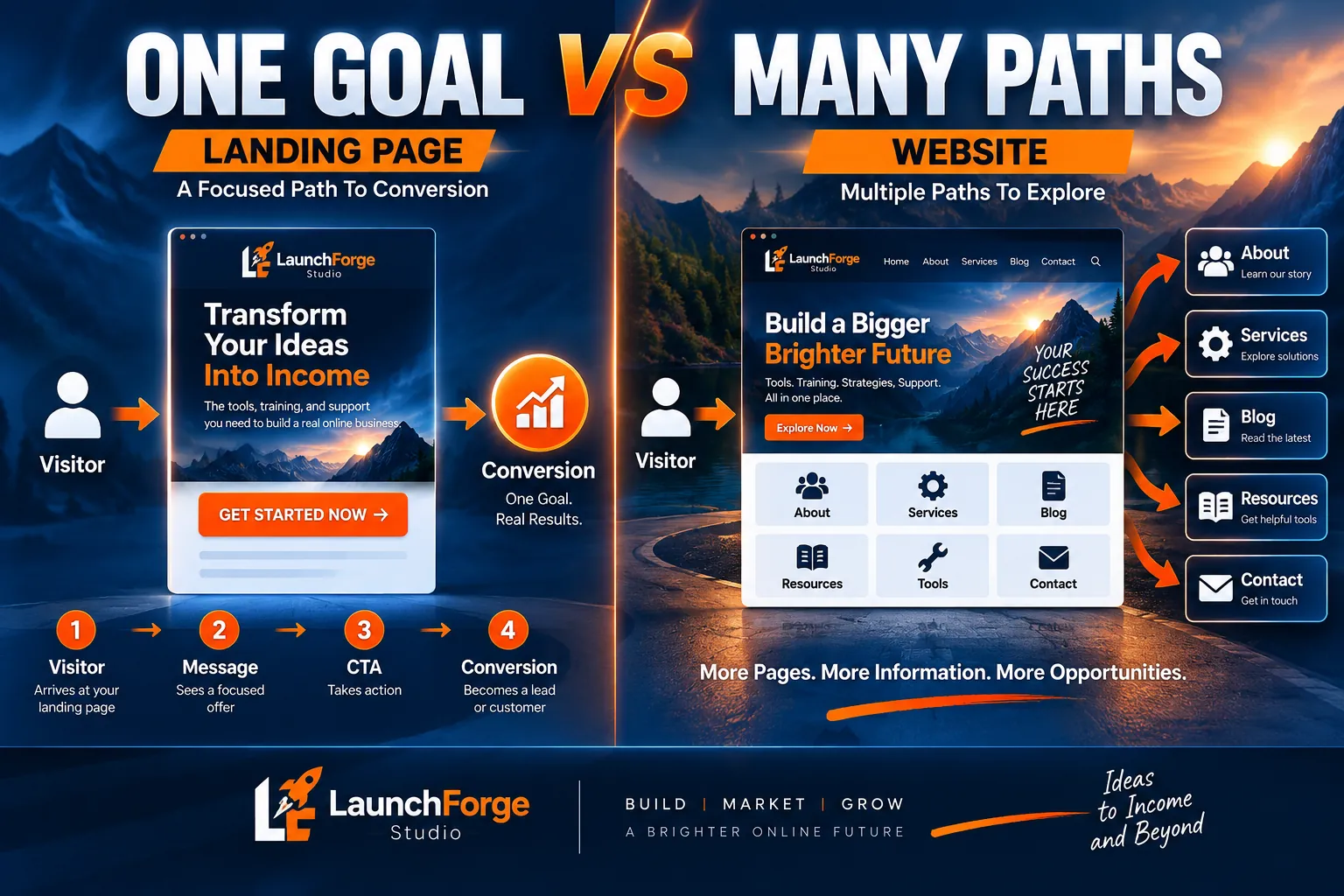
A landing page guides visitors toward one focused conversion goal, while a website provides multiple paths for visitors to explore.
A traditional website usually contains multiple pages connected through navigation menus and internal links.
For example, a business website might include:
- Home
- About
- Services
- Blog
- Resources
- Contact
Visitors can move between those pages depending on what they want to learn.
A landing page usually removes many of those choices.
Instead, the page guides the visitor toward a specific goal.
Imagine someone clicks an advertisement promoting a free guide.
Sending that visitor to a homepage could give them dozens of places to go. They might read an article, visit the About page, browse the navigation menu, or leave without ever finding the guide mentioned in the advertisement.
A dedicated landing page can continue the exact conversation that started with the ad.
The headline can reinforce the offer, the page can explain its value, and the call to action can tell the visitor exactly what to do next.
That difference in purpose affects almost everything else about how the two types of pages are designed.
What Is a Website?
A website is a collection of connected pages that creates a broader online presence for a business, organization, brand, or individual.
Instead of focusing on one campaign, a website can serve many purposes at the same time.
Someone visiting your website might want to learn who you are.
Another visitor might want to read an article.
Someone else might be comparing your services, looking for contact information, or researching a tool you have reviewed.
A website needs enough structure to support all of those different journeys.
That is why websites commonly use navigation menus, categories, internal links, footers, search features, and multiple calls to action.
LaunchForge Studio itself is a good example.
You are reading this article inside a larger website containing guides, tutorials, tool reviews, business resources, and documentation from our own build-along journey.
The website gives those different pieces of content a permanent home and allows visitors to explore whichever subjects are most useful to them.
Common Goals of a Website
A website can help you:
- Establish an online presence
- Explain what your business does
- Publish educational content
- Build authority around your subject
- Attract visitors through search engines
- Provide information about products or services
- Give visitors multiple ways to interact with your business
Because those goals are broader, a website generally gives visitors more freedom than a landing page.
That freedom is a feature, not a flaw.
The visitor is supposed to explore.
What Is a Landing Page?
A landing page is a standalone web page created around a specific goal or campaign.
Unlike a traditional website, it usually gives the visitor fewer choices.
The page might be designed to collect an email address, promote a webinar, introduce a product, encourage a signup, or move someone toward the next step in a sales funnel.
That focused purpose is what separates a landing page from an ordinary website page.
A good landing page does not need to explain everything about your business. It needs to give the right visitor enough information to understand the offer and decide whether to take the intended action.
That is why landing pages often use a simpler structure.
You might see:
- A clear headline
- A short explanation of the offer
- Benefits or supporting information
- Images or other visual proof
- A form or call-to-action button
- Trust elements such as testimonials
- A final call to action
Everything on the page should support the same primary goal.
We covered this concept in more detail in our guide What Is a Landing Page and How Does It Work?, where we break down the purpose, structure, and common elements of landing pages.
Landing Pages Reduce Distractions
One of the biggest advantages of a landing page is the ability to control what happens after someone arrives.
That does not mean forcing a visitor to take action.
It means removing unnecessary distractions.
Suppose you are running a campaign asking people to register for a webinar.
Your normal website might contain links to articles, services, social profiles, tutorials, reviews, and other resources.
Those links are useful when someone is exploring your business.
But during a focused webinar campaign, every additional option gives the visitor another opportunity to leave the path that brought them there.
A dedicated landing page can keep the experience simple:
Explain the webinar.
Show why it may be useful.
Tell the visitor what they will learn.
Provide the registration form.
That is a very different job from the one performed by your main website.
Landing Page vs Website: Key Differences
The difference between a landing page and a website becomes much clearer when you compare them side by side.
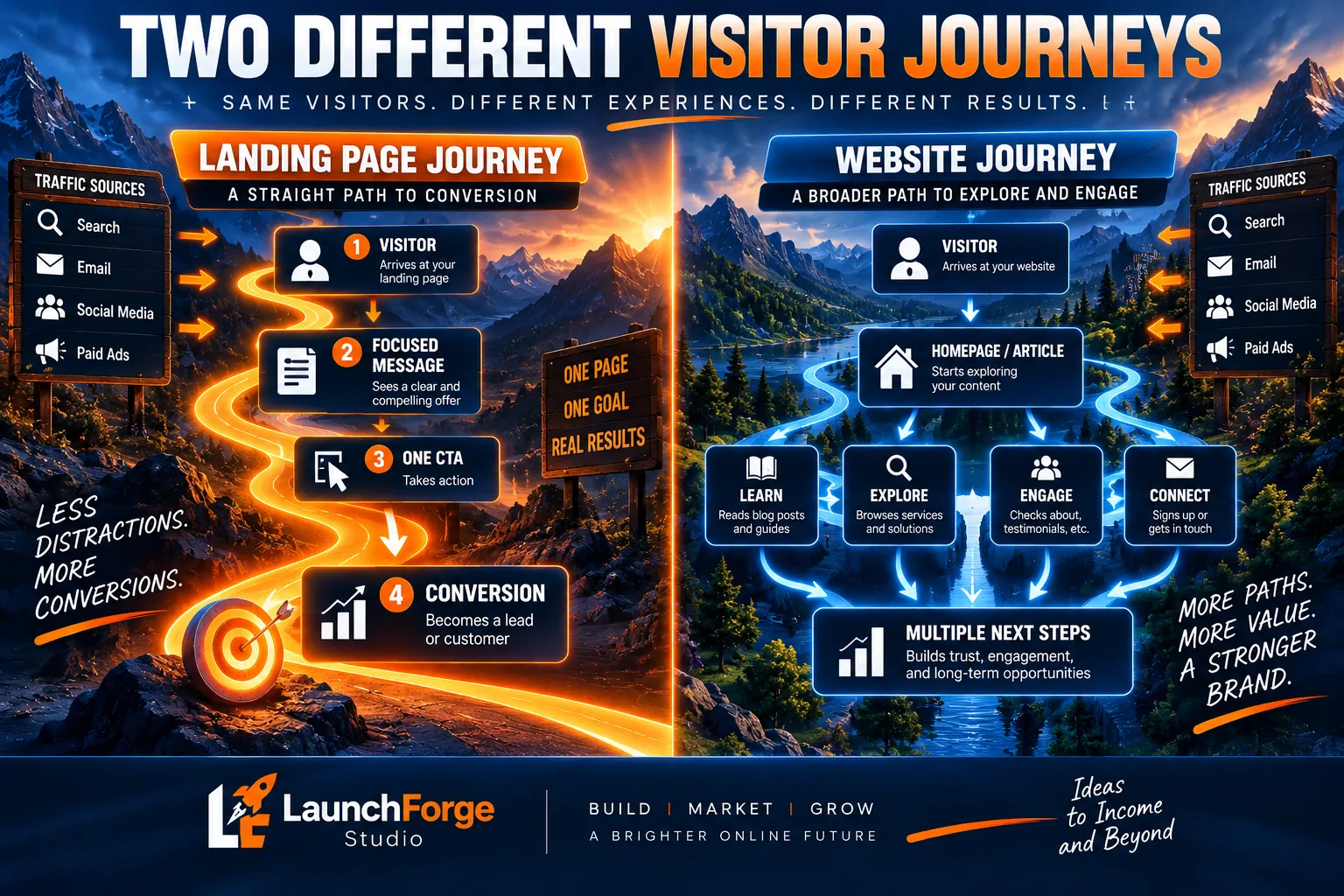
Landing pages create a focused path toward one conversion goal, while websites give visitors multiple ways to explore, learn, engage, and connect.
1. Purpose
A website supports the broader goals of your business.
It can educate visitors, build your brand, attract search traffic, publish content, explain products or services, and provide multiple ways for people to interact with you.
A landing page supports one specific goal.
Its job is usually connected to a campaign or particular stage of the customer journey.
That narrower purpose allows the entire page to be designed around one desired action.
2. Navigation
Most websites need navigation.
Menus help visitors move between important areas and find the information they need.
Landing pages often minimize navigation because exploration is not the primary goal.
Removing or reducing navigation can help keep attention on the message and call to action.
This does not mean every landing page must completely eliminate navigation. The right approach depends on the campaign and the information visitors need.
The important point is that every additional path should have a reason to exist.
3. Number of Pages
A website usually contains multiple connected pages.
As the business grows, that number can expand significantly through articles, tutorials, product pages, resource pages, and other content.
A landing page is generally a single page.
It may connect to a thank-you page or other steps in a funnel, but the landing page itself remains focused on its individual purpose.
4. Traffic Source
Website visitors can arrive from many different places.
They might discover an article through Google, type your domain directly into a browser, follow a social media link, click an internal link, or arrive through a referral.
Landing-page traffic is often more intentional.
A visitor may arrive after clicking a specific advertisement, email link, social media promotion, or campaign CTA.
Because you often know what brought that visitor to the page, you can create a message that closely matches what they clicked.
That continuity can make the experience clearer for the visitor.
5. Calls to Action
A website can contain many different calls to action.
One page might encourage visitors to read an article. Another might invite them to contact the business. Somewhere else, visitors might be asked to join an email list, explore a product, or download a resource.
That variety makes sense because a website serves people with different intentions.
A landing page typically emphasizes one primary call to action.
The wording may appear several times throughout the page, but each CTA usually points toward the same goal.
For example, a lead-generation landing page might place a signup button near the top, another after explaining the benefits, and a final button near the bottom.
Those are multiple buttons, but they all support the same action.
6. Content and Messaging
Website content usually needs to work for a broader audience.
Your homepage, About page, blog, tutorials, and other resources may be visited by people at very different stages of discovering your business.
Landing-page messaging can be much more specific.
If someone clicked an ad about a particular offer, the landing page can continue that exact message instead of introducing every other part of the business.
This is sometimes called message match.
The promise or idea that attracted the click should make sense when the visitor reaches the destination.
If an advertisement promotes a free landing-page checklist but the visitor arrives on a general homepage with no obvious mention of that checklist, the experience can feel disconnected.
A dedicated landing page gives you much more control over that transition.
7. Measurement and Testing
Both websites and landing pages can be measured, but the questions you ask are often different.
With a website, you might want to know which pages attract visitors, how people navigate through the site, which articles perform well, or where visitors enter and leave.
With a landing page, measurement can revolve around a much narrower goal.
How many people visited the page?
How many completed the intended action?
Did one headline or call to action perform differently from another?
That focused goal can make landing pages particularly useful for campaigns and testing.
Landing Page vs Website Comparison
They solve different problems.
A website and a landing page can both play important roles in an online business, but they are designed to do different jobs.
Website
A website is built to support a broader online presence. It usually contains multiple connected pages, navigation menus, and different paths visitors can follow.
A website can serve several audiences, contain multiple calls to action, attract traffic from different sources, and provide detailed information about your business, products, services, and content.
Landing Page
A landing page is usually built around one specific campaign, audience, offer, or action.
Navigation is often reduced or simplified, the message stays tightly focused, and the page typically emphasizes one primary call to action. That makes it easier to measure how visitors respond to a specific campaign or conversion goal.
Neither approach is automatically better. The right choice depends on what you need the page to accomplish.
When Do You Need a Website?
If you are building a long-term online presence, a website can become the foundation that holds everything together.
This is especially useful when people need somewhere to learn about your business beyond a single campaign.
A website makes sense when you want to:
- Explain who you are and what your business does
- Publish articles, guides, tutorials, or other content
- Organize multiple products, services, or resources
- Build visibility through search engines
- Give visitors several ways to explore your business
- Create a central home for your brand online
That is exactly how we use the LaunchForge Studio website.
Instead of building the entire site around one offer, we use different pages and articles for different purposes. Someone might arrive through a tutorial, a tool review, or a search result and then explore other parts of the site.
The website becomes the hub.
Individual landing pages can then be built around specific campaigns or conversion goals without forcing the entire website to serve that one purpose.
When Do You Need a Landing Page?
A landing page makes more sense when you want visitors to focus on one specific action.
Instead of giving people several pages, menu options, and directions they can take, a landing page narrows the experience around a particular goal.
You might use a landing page when you want to:
- Collect email subscribers
- Promote a specific product or service
- Send traffic from an advertising campaign
- Register people for a webinar or event
- Offer a free guide, checklist, or other lead magnet
- Test a particular headline, offer, or call to action
- Create a focused destination for an affiliate or marketing campaign
For example, if we wanted to run a campaign specifically designed to grow the LaunchForge Studio email list, sending visitors to the homepage would give them several possible directions to go.
A dedicated landing page could remove those distractions and focus the message around one action: joining the list.
That does not make the landing page better than the website.
It simply gives the landing page a different job.
Do You Need a Landing Page or a Website?
For many online businesses, the answer is not one or the other.
You can use both.
Think of your website as the central hub of your online presence and landing pages as focused destinations built for particular campaigns.
Your website can contain your permanent content, establish your brand, attract search traffic, and give visitors different ways to learn more about what you do.
Then, when you launch a specific campaign, you can create a landing page designed specifically for the people arriving from that campaign.
For example, the basic journey might look like this:
Advertisement or Email → Landing Page → Signup or Action → Thank-You Page → Website
The landing page handles the focused conversion goal.
The website provides the larger environment visitors can explore before or after that interaction.
This approach also means you do not necessarily need a completely separate platform just to create landing pages.
If your website already runs on WordPress and you have the right page-building tools, you can build landing pages directly inside the same website.
That is exactly what we did at LaunchForge Studio when we built a landing page directly inside WordPress using Divi 5.
The landing page lives within the LaunchForge website, but its purpose and design are much more focused than a typical website page.
That gives us the benefits of both approaches without treating them as competing systems.
Can a Landing Page Replace a Website?
Sometimes, but it depends on what you are trying to accomplish.
If you are launching a single offer, validating an idea, collecting leads, or promoting one specific campaign, a landing page may be enough to get started.
You do not necessarily need a large website with dozens of pages before you can put something useful online.
A focused landing page can give visitors the essential information they need while providing a clear next step.
However, the limitations become more noticeable as your online business grows.
You may eventually want to publish educational content, target different search topics, explain multiple offers, build a resource library, or give visitors more ways to learn about your business.
At that point, trying to make one landing page perform every job can become restrictive.
A website gives you room to expand.
The better question is not whether a landing page can technically replace a website.
It is whether one page can support everything you want your online presence to accomplish.
For a simple campaign, it might.
For a growing content-driven business, a website will usually provide much more room to build.
Can You Have Multiple Landing Pages on One Website?
Absolutely.
In fact, different landing pages can support different campaigns while still belonging to the same website and brand.
You might create one landing page for an email signup campaign, another for a webinar, another for a particular product, and another for traffic coming from a specific advertisement.
Each page can speak directly to the audience and goal connected to that campaign.
This is also why understanding the different types of landing pages matters.
A lead-generation page has a different job from a click-through page, webinar registration page, or sales page.
Instead of trying to build one universal landing page for every visitor, you can create focused pages when a particular campaign calls for them.
Your website remains the central hub while those landing pages become specialized entry points into the larger system.
Landing Page vs Website for SEO
Websites and landing pages can both appear in search results, but they are usually used differently when it comes to SEO.
A full website gives you much more room to build search visibility over time.
Each article, guide, tutorial, product page, or resource can target a different search topic while supporting the larger website through internal links.
That is one reason content-driven websites can become more valuable as they grow.
Instead of relying on one page to rank for everything, you can build a library of useful content around related topics.
That is the approach we are taking with LaunchForge Studio.
This article is part of a larger group of content about landing pages. Other guides explain what landing pages are, the different types you can use, and how we built one directly in WordPress with Divi 5.
Each article answers a different question while connecting to the same broader subject.
What About Landing Page SEO?
A landing page can also be optimized for search engines.
You can use a descriptive page title, relevant headings, useful content, internal links, image alt text, and the other basic elements you would consider when optimizing a normal web page.
But not every landing page needs to be built primarily for organic search.
Some landing pages are created specifically for paid advertising, email campaigns, social media traffic, or short-term promotions.
In those situations, the primary goal may be converting the traffic you intentionally send to the page rather than attracting visitors through Google.
That is another reason the purpose of the page should come first.
If long-term organic search visibility is a major part of your strategy, a broader website with useful supporting content gives you more opportunities to build around multiple search topics.
If you are running a focused campaign for a particular audience, a dedicated landing page may be the more appropriate destination.
The two strategies can also support each other.
A website can attract and educate visitors over time, while landing pages handle focused campaigns when you want those visitors to take a specific next step.
Landing Page vs Homepage: What’s the Difference?
A homepage is part of your website, but it is not usually a landing page in the marketing sense.
Your homepage acts as a general introduction to your business.
It may explain what you do, highlight important resources, introduce products or services, feature recent content, and give visitors several places to go next.
That makes sense because people can arrive at a homepage for many different reasons.
A landing page is usually much more specific.
Instead of introducing the entire business, it continues a particular message or campaign and guides the visitor toward one primary action.
Imagine someone searches for LaunchForge Studio and arrives on our homepage.
That visitor may want to read a tutorial, explore our business platform, learn about the tools we use, or simply figure out what LaunchForge Studio is.
Giving that person several choices is useful.
Now imagine we run a campaign offering a specific free resource.
Someone clicking that campaign already has a reason for visiting.
Sending them to a focused landing page allows us to continue the same message, explain the resource, and provide a clear way to get it.
Your Homepage Has a Different Job
This is where the distinction becomes important.
A homepage asks:
What does this business offer, and where would you like to go?
A landing page asks:
You came here for this specific reason. Would you like to take the next step?
Both pages can contain strong headlines, images, benefits, buttons, and calls to action.
The difference is not simply how they look.
It is what they are designed to accomplish.
That is why turning every homepage into an aggressive landing page can work against the broader purpose of a website.
Sometimes visitors need choices.
Other times they need a clear path.
Knowing which situation you are designing for can help you choose the right type of page.
How to Choose Between a Landing Page and a Website
The right choice starts with the goal you want the visitor to accomplish.
Before building anything, ask yourself one simple question:
What do I want someone to do when they arrive?
If the answer involves exploring your business, reading content, comparing several options, or learning about different products and services, a website probably makes more sense.
If the answer is one specific action, a landing page may be the better fit.
Choose a Website When You Need Room to Grow
A website makes sense when you are building something that will expand over time.
You may start with only a handful of pages, but eventually add articles, tutorials, reviews, resources, products, services, and other content.
The structure of a website gives all of that information somewhere to live.
It also allows visitors to discover parts of your business you may not have originally expected them to find.
That flexibility is valuable when you are building a long-term online presence.
Choose a Landing Page When the Goal Is Specific
A landing page becomes useful when the visitor already has context.
Maybe they clicked an advertisement.
Maybe they followed a link in an email.
Maybe they responded to a social media post or clicked a button promoting a particular resource.
Instead of making that visitor search your website for whatever caught their attention, you can send them directly to a page created around that message.
The more specific the campaign, the more useful that focus can become.
Start With the Goal, Not the Tool

Start with the goal, create the strategy, choose the right page type, and then select the tools that support what you are trying to accomplish.
It is easy to get distracted by page builders, funnel software, templates, plugins, and marketing platforms.
We have learned while building LaunchForge Studio that choosing the tool before understanding the job can make an online business more complicated than it needs to be.
Decide what the page needs to accomplish first.
Then choose the simplest tool and page structure capable of doing the job.
Sometimes that will be a complete website.
Sometimes it will be a landing page.
And quite often, it will be both working together.
Is a Landing Page Cheaper Than a Website?
A landing page can be less expensive to build than a complete website, but that is not always the case.
The cost depends on how you build it, the tools you use, and what the page needs to accomplish.
A simple landing page may only require a headline, some supporting copy, an image, a form, and a call-to-action button.
A full website may require a homepage, about page, contact page, blog, resource sections, navigation, and other supporting pages.
Naturally, building and maintaining that larger structure can require more time and resources.
However, you should also consider the tools you already have.
You May Not Need Another Platform
If you already have a WordPress website and a capable page builder, you may be able to create landing pages using your existing setup.
That is the approach we used when building our landing page with Divi 5.
Instead of automatically adding another platform to our business, we first looked at what our existing tools could already accomplish.
For a new online business, that can be an important habit.
It is easy to accumulate subscriptions because every new marketing problem seems to have a specialized tool promising to solve it.
Before adding another monthly expense, ask whether your current system can already handle the job.
If it can, using what you already have may keep your business simpler.
If your campaigns eventually require features your existing setup cannot provide efficiently, then dedicated landing page or funnel software may become worth considering.
The goal is not to use the fewest tools possible at all costs.
The goal is to use the tools that genuinely earn their place in your business.
Should Beginners Start With a Landing Page or a Website?
If you are just starting an online business, you do not need to build everything at once.
The right starting point depends on what you are trying to launch.
If you have one offer, one audience, and one clear action you want visitors to take, starting with a landing page can keep things simple.
You can create the page, begin sending traffic to it, and learn from how people respond without first building an entire website.
On the other hand, if your plan involves publishing content, building search visibility, reviewing tools, creating tutorials, or developing a recognizable brand over time, starting with a basic website may make more sense.
That website does not need to be enormous.
A few useful pages can provide the foundation, and you can add new content and landing pages as the business develops.
You Do Not Need the Finished Version on Day One
This is something we have experienced firsthand while building LaunchForge Studio.
The website you see today was not completely mapped out before we started.
Pages were built. Ideas changed. Content was added. Some things worked. Other things were adjusted as we learned more.
That process continues.
Waiting until you know exactly what your business will look like a year from now can prevent you from building anything today.
Start with the structure that supports what you need right now.
Then improve it as your business gives you better information about what it needs next.
A landing page can grow into a larger website.
A website can gain specialized landing pages.
Neither decision has to lock you into one approach forever.
How a Website and Landing Pages Can Work Together
A website and landing pages become especially useful when you stop thinking of them as competing options and start thinking of them as different parts of the same system.
Your website can serve as the foundation.
It can publish content, attract search traffic, explain your business, introduce your tools or services, and give visitors a place to explore.
Landing pages can then support specific campaigns built around that foundation.
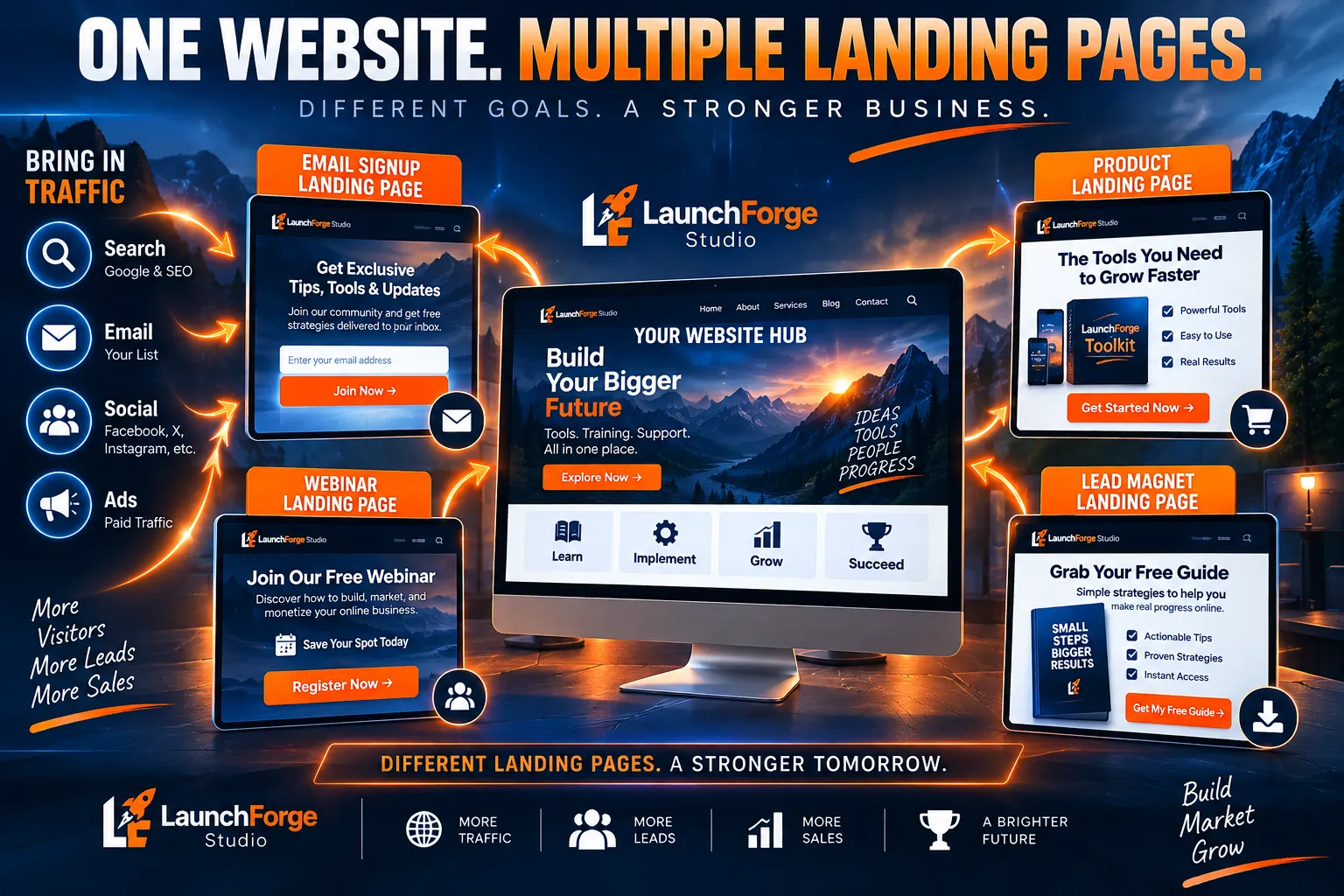
One website can act as the central hub while multiple landing pages support specific campaigns, audiences, and conversion goals.
For example, imagine an online business publishes a helpful tutorial that begins attracting visitors through search engines.
Some of those visitors may want additional information.
The business could offer a related checklist or resource and direct interested readers to a dedicated landing page.
The journey might look like this:
Google Search → Helpful Article → Landing Page → Email Signup → Follow-Up Emails
Now imagine the same business promotes a webinar through social media.
That campaign could use a completely different landing page:
Social Media Post → Webinar Landing Page → Registration → Thank-You Page
The website remains the central home of the business, while each landing page handles a specific conversion goal.
One Website Can Support Many Campaigns
This structure also makes it easier to expand without rebuilding your entire online presence every time you launch something new.
A new campaign does not necessarily require a new website.
It may only require a new landing page.
That page can use messaging designed specifically for the campaign while still being connected to the same business, domain, tools, and overall system.
This is one of the reasons we see landing pages as an extension of a website rather than a replacement for one.
Build the foundation.
Then create focused paths when you need them.
Common Mistakes When Choosing Between a Landing Page and a Website
Choosing between a landing page and a website becomes easier when you understand the job each one is supposed to perform.
Problems often begin when we expect one type of page to do the other type’s job.
Here are a few common mistakes to avoid.
Sending Campaign Traffic to a Busy Homepage
If someone clicks an advertisement, email, or social media promotion for a specific offer, sending that visitor to a general homepage can break the flow of the campaign.
The visitor clicked because something specific caught their attention.
Making them search through navigation menus and unrelated content to find it creates unnecessary friction.
A dedicated landing page can continue the message that brought them there and make the intended next step easier to understand.
Building an Entire Website for One Simple Campaign
The opposite problem can happen too.
You may not need a complete multi-page website just to test one idea, collect registrations, or promote one focused offer.
Building pages that do not serve a real purpose can add work without improving the campaign.
Sometimes one well-designed landing page is enough.
Removing Too Many Choices From a Website
Focus is valuable on a landing page, but a full website usually needs room for exploration.
Visitors arriving through search engines, referrals, or direct visits may have different questions and interests.
Navigation, related content, resource pages, and internal links help those visitors understand the larger business.
Trying to make every website page behave like a tightly controlled landing page can make the site harder to explore.
Adding Too Many Choices to a Landing Page
A landing page can lose its advantage when it becomes overloaded with unrelated links, competing offers, and multiple calls to action.
Every additional choice asks the visitor to make another decision.
That does not mean a landing page must contain almost nothing.
It means the content should support the primary reason the page exists.
Choosing Software Before Choosing a Strategy
This may be one of the easiest mistakes to make.
A new platform will not automatically fix an unclear campaign.
Before buying another landing page builder, funnel platform, plugin, or marketing tool, determine what you are trying to build and what your existing system can already handle.
The strategy should determine the tool.
The tool should not determine the strategy.
Landing Page vs Website: A Simple Way to Decide
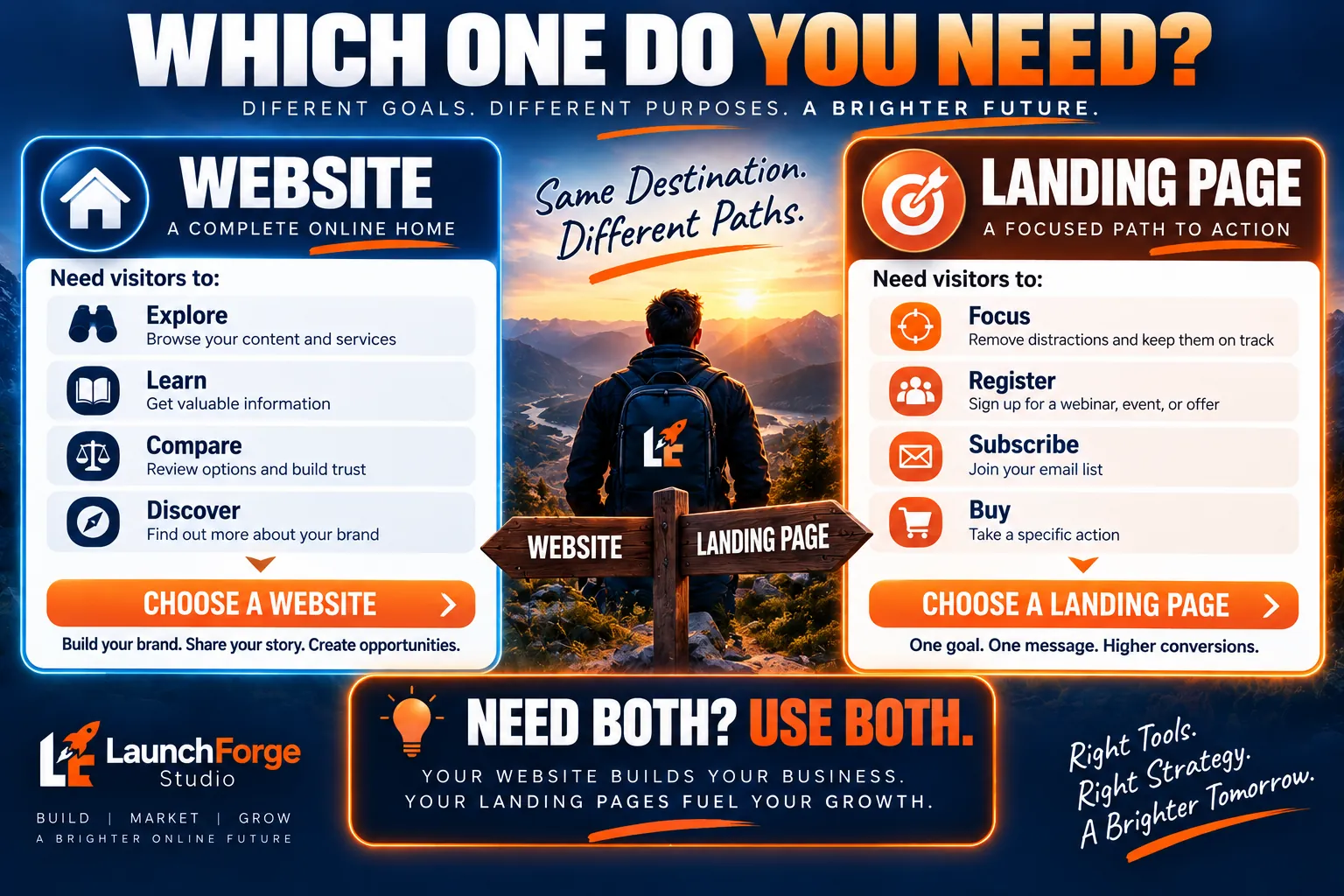
Choose a website when visitors need room to explore and learn. Choose a landing page when they need a focused path to one action. Many online businesses can benefit from using both.
If you are still unsure which one you need, start by looking at the visitor’s journey.
Ask what brought that person to the page and what you want them to do next.
If visitors need to explore your business, learn about different topics, read content, compare options, or navigate between several resources, a website is usually the more appropriate structure.
If visitors are arriving because of one specific campaign and you want them to take one primary action, a landing page can provide a more focused experience.
You can simplify the decision even further:
Use a website when the visitor needs choices.
Use a landing page when the visitor needs focus.
And remember that choosing one does not mean abandoning the other.
A website can become the long-term foundation of your online presence while landing pages support individual campaigns, offers, and conversion goals as your business grows.
That is ultimately how we think about the landing page vs website question at LaunchForge Studio.
They are not competitors.
They are different tools designed to solve different problems.
Landing Page vs Website: Final Thoughts
The difference between a landing page and a website is not really about which one is better.
It is about what you need the visitor to do.
A website gives your online business room to grow. It can introduce your brand, organize your content, attract search traffic, explain what you offer, and give visitors multiple paths to explore.
A landing page removes many of those choices and concentrates attention on one campaign and one primary action.
For many online businesses, the strongest approach is to use both.
Build a website as the foundation of your online presence, then create focused landing pages when a particular campaign, audience, or offer needs its own destination.
That is the approach we are taking as we build LaunchForge Studio.
We are continuing to develop the website as our central hub while using landing pages where a more focused visitor experience makes sense.
If you are ready to build one yourself, our step-by-step guide shows you how to build a landing page in WordPress with Divi 5, including the structure, design decisions, and process we used to create one here at LaunchForge Studio.
Start with the goal.
Choose the right type of page for that goal.
Then build the simplest version capable of doing the job.