
A landing page headline has one of the hardest jobs on the entire page.
Within a few seconds, it needs to help the visitor understand where they are, what the page is offering, and why they should keep reading.
That is a lot of responsibility for one line of text.
A strong landing page headline does not need to be clever, dramatic, or packed with marketing language. It needs to be clear enough that the right visitor quickly understands the value of what comes next.
That sounds simple until you sit down to write one.
You might know exactly what your product, service, lead magnet, or offer does, but turning that knowledge into a short headline can suddenly make the blinking cursor feel like your greatest enemy.
Should you describe the product?
Lead with the benefit?
Ask a question?
Make a promise?
Use a number?
Keep it short?
There is no single headline formula that works for every landing page. The right approach depends on the offer, the audience, the traffic source, and the action you want the visitor to take.
But there are principles you can use to make the process much easier.
In this guide, we are going to break down how to write a landing page headline that gets attention for the right reasons. We will look at clarity, relevance, value, specificity, message match, subheadlines, practical headline formulas, common mistakes, and testing.
More importantly, we are going to treat the headline as part of the entire landing page experience rather than an isolated piece of copy.
Because getting attention is only the beginning.
The headline also needs to give the visitor a reason to stay.
What Should a Landing Page Headline Actually Do?
Before trying to write a better headline, it helps to understand what the headline is supposed to accomplish.
Its job is not simply to sound interesting.
When someone arrives on a landing page, they are usually trying to answer a few basic questions very quickly:
Where am I?
Is this what I expected to find?
What is being offered?
Why should I care?
What should I do next?
Your headline should begin answering those questions immediately.
That does not mean cramming every detail about the offer into one sentence. In fact, trying to explain too much usually makes a headline weaker.
Instead, the headline should establish the central idea of the page.
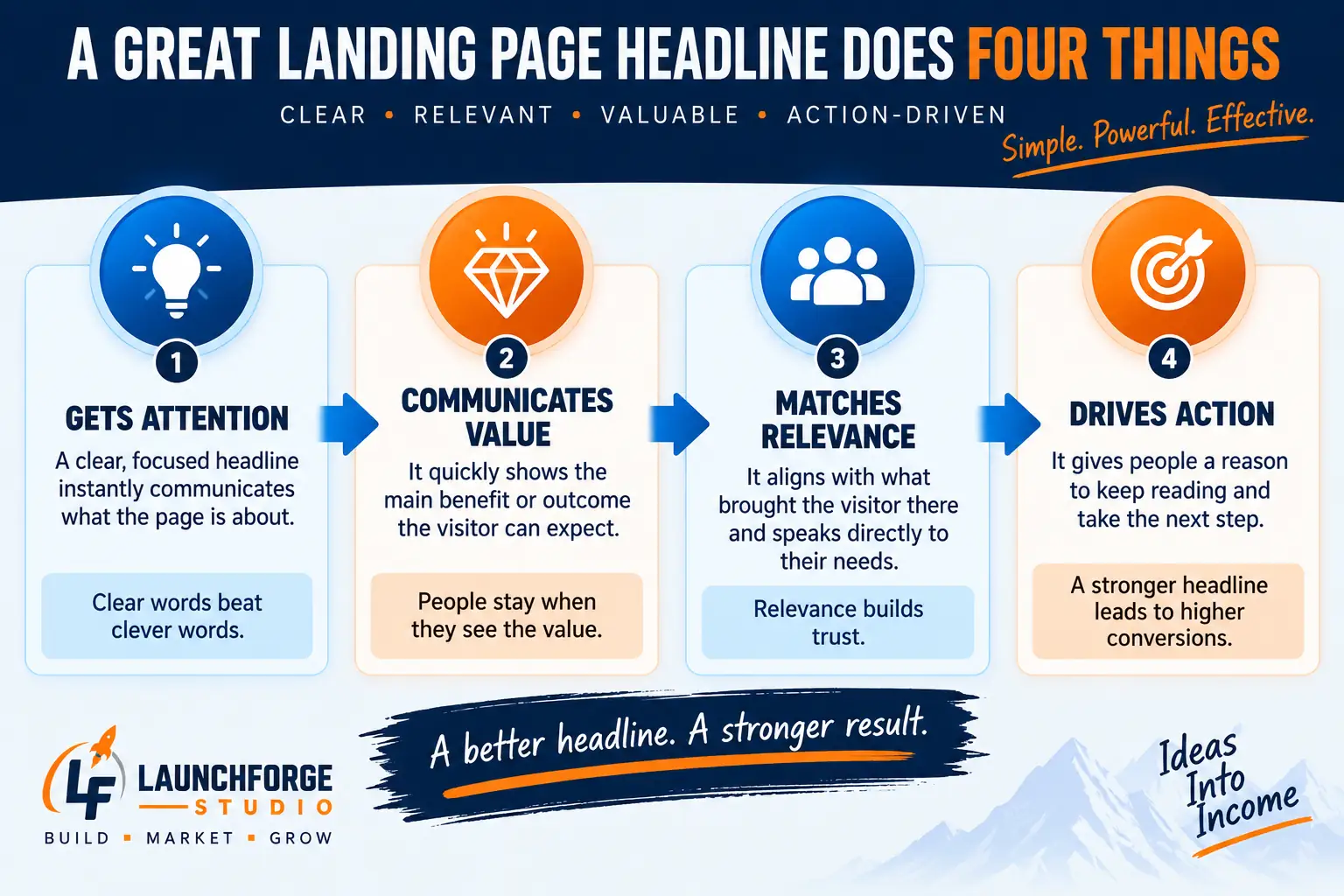
A strong landing page headline gets attention, communicates value, matches visitor expectations, and supports the next action.
Give the Visitor a Reason to Keep Reading
Think of the headline as the beginning of a conversation.
It does not have to explain everything. It simply needs to communicate enough value and relevance that the visitor wants to continue.
For example, imagine a landing page offering a beginner’s guide to email marketing.
A headline like:
Email Marketing Guide
tells the visitor what the offer is, but not much else.
Now compare it with:
Build Your First Email List Without Getting Buried in Complicated Tools
The second version gives the visitor more information. It identifies an outcome and addresses a problem the intended audience may already recognize.
That does not automatically make it the perfect headline.
But it gives the reader a stronger reason to continue.
Make the Headline Work With the Rest of the Page
The headline should not be expected to carry the entire landing page by itself.
The subheadline can provide additional context.
The supporting copy can explain the offer.
Images can help visitors understand what they are getting.
Trust signals can reduce uncertainty.
The call to action can tell them what to do next.
Each element has a job.
The headline simply needs to perform its job well enough to move the visitor into the next part of the page.
That is why writing a strong landing page headline starts with clarity rather than cleverness.
If the visitor cannot quickly understand what you mean, it does not matter how creative the wording sounds.
1. Start With Clarity Before Creativity
One of the easiest mistakes to make when writing a landing page headline is trying too hard to make it clever.
A clever phrase might sound memorable to the person who wrote it, but if visitors have to stop and figure out what it means, the headline is creating work instead of removing it.
Your visitor should not need to solve a puzzle.
They should be able to look at the headline and quickly understand the main idea.
Ask What the Visitor Needs to Understand First
Before writing the headline, forget about catchy wording for a moment.
Ask yourself:
What am I actually offering?
Who is this page for?
What problem does the offer help solve?
What outcome does the visitor want?
Why would that outcome matter to them?
Those answers give you the raw material for the headline.
Suppose you created a tool that helps small business owners schedule social media posts.
You could write:
Take Control of Your Digital Future
It sounds positive, but it could describe almost anything.
Now consider:
Schedule a Week of Social Media Posts in One Sitting
The second headline is much more specific.
The visitor immediately gets an idea of what the tool helps them accomplish.
Clear Does Not Mean Boring
Clarity and personality are not opposites.
Once the meaning is obvious, you can experiment with stronger language, rhythm, specificity, emotion, or personality.
The important part is the order.
Start by making the message understandable.
Then make it interesting.
If you reverse that process, it is easy to end up with a headline that sounds impressive but communicates very little.
A useful test is to imagine showing only the headline to someone who knows nothing about the page.
Would they have a reasonable idea of what is being offered or what benefit they might receive?
If the answer is no, the headline probably needs another pass.
The strongest wording is often not the cleverest sentence you can create.
It is the sentence that makes the value easiest to understand.
2. Focus the Headline on the Value for the Visitor
A landing page headline becomes stronger when it answers a simple question:
What does the visitor get out of this?
Businesses naturally think about products in terms of features.
A course has twelve modules.
A software platform has automation tools.
A guide contains forty pages.
A service includes weekly consultations.
Those details may matter later, but they are not always the strongest place to begin.
The visitor is usually more interested in what those features can help them accomplish.
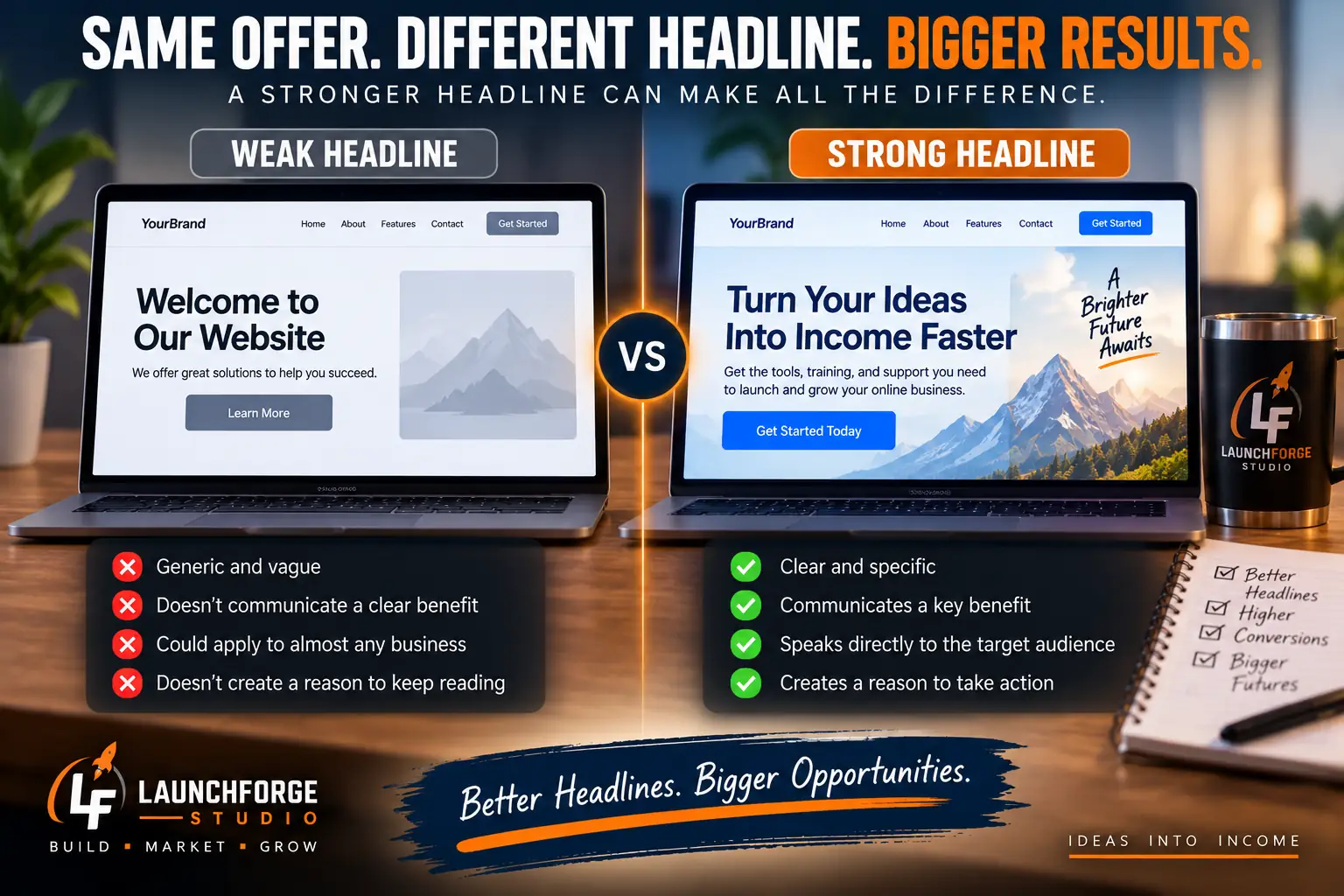
A stronger landing page headline replaces vague messaging with a clear benefit, specific meaning, and a reason for the visitor to continue.
Translate Features Into Benefits
One way to uncover a stronger headline is to take a feature and ask:
So what?
Suppose you are promoting an email marketing platform with automated follow-up sequences.
The feature might be:
Automated Email Sequences
Now ask what that feature actually helps the customer do.
It could help them follow up with leads automatically.
Go one step further.
Why does that matter?
Because they can stay in contact with potential customers without manually sending every message.
That gives us much stronger material for a headline:
Follow Up With Every Lead Without Sending Every Email Yourself
The feature has not disappeared.
We have simply translated it into something the visitor can immediately understand and value.
Connect the Benefit to a Real Problem
Benefits become even more useful when they connect with something the visitor is already trying to solve.
Imagine a landing page promoting a website builder.
A feature-focused headline might say:
Professional Drag-and-Drop Website Builder
That tells us something about the product.
But a beginner may care more about the outcome:
Build a Professional Website Without Learning How to Code
Now the headline connects the product to a recognizable obstacle.
The visitor does not merely learn what the tool contains.
They understand what it may help them do.
Do Not Promise More Than the Offer Can Deliver
Benefit-driven headlines can become dangerous when the desire to sound persuasive turns into exaggeration.
There is an important difference between communicating value and guaranteeing an outcome you cannot control.
A headline such as:
Build Your First Landing Page Without Starting From Scratch
describes a practical benefit.
A headline such as:
Build This Page and Double Your Sales Overnight
makes a much bigger claim.
Unless you have strong evidence that supports a specific promise, avoid turning the headline into a guarantee.
A strong headline does not need hype to create interest.
It needs to connect a real offer with something the right visitor genuinely wants.
That is where persuasive copy starts becoming useful instead of merely loud.
3. Match the Headline to What Brought the Visitor There
A strong headline does not begin when someone reaches the landing page.
The experience often begins one step earlier.
Maybe the visitor clicked an advertisement.
Maybe they followed a link in an email.
Maybe they clicked a social media post.
Maybe they found the page through a search engine.
Whatever brought them there created an expectation.
Your landing page headline should continue that conversation rather than suddenly starting a different one.
This is often called message match.
Continue the Promise That Earned the Click
Imagine someone sees an advertisement that says:
Get Our Free Beginner’s Guide to Building Your First Landing Page
They click the ad and arrive on a page with this headline:
Transform Your Digital Marketing Strategy
There may technically be a landing page guide somewhere on that page, but the connection is weak.
The visitor now has to figure out whether they landed in the right place.
Compare that with:
Build Your First Landing Page With This Free Beginner’s Guide
The second headline continues the idea that motivated the click.
The wording does not need to be identical, but the promise should feel consistent.
Reduce the Mental Reset
Every unnecessary question creates friction.
If someone clicks because they expect a free guide, do not make them search the page to discover whether the guide is actually free.
If an email promotes a webinar about generating leads, the landing page should not suddenly lead with a vague promise about growing a business.
If an advertisement focuses on simplifying email automation, the landing page should not make visitors decode a headline about achieving marketing freedom.
The visitor should feel like they have moved naturally from one step to the next.
Not like they have entered an entirely different conversation.
Think About the Traffic Source Before Writing
This is why the traffic source should influence the headline.
Before finalizing your copy, ask:
What did the visitor see immediately before reaching this page?
What promise encouraged them to click?
What words or ideas were emphasized?
What are they expecting to find now?
Does the headline confirm that expectation?
You may even discover that different traffic sources need different versions of the same landing page.
Someone arriving from a highly specific advertisement may already understand the problem.
Someone arriving from a broader educational article may need more context.
The offer can remain the same while the headline changes to create a smoother transition.
The goal is simple:
Make the visitor feel that the page they reached is the page they intended to reach.
When the headline confirms that expectation quickly, the rest of the landing page has a much better opportunity to do its job.
4. Make the Headline Specific Enough to Matter
Vague headlines are easy to write because they can sound impressive without committing to anything.
Grow Your Business.
Reach Your Potential.
Get Better Results.
Work Smarter.
Those phrases are not necessarily wrong, but they leave the visitor with an important question:
How?
Specificity helps answer that question.
The more clearly your headline connects the offer to a recognizable outcome, problem, audience, or situation, the easier it becomes for the right visitor to understand why the page may matter to them.
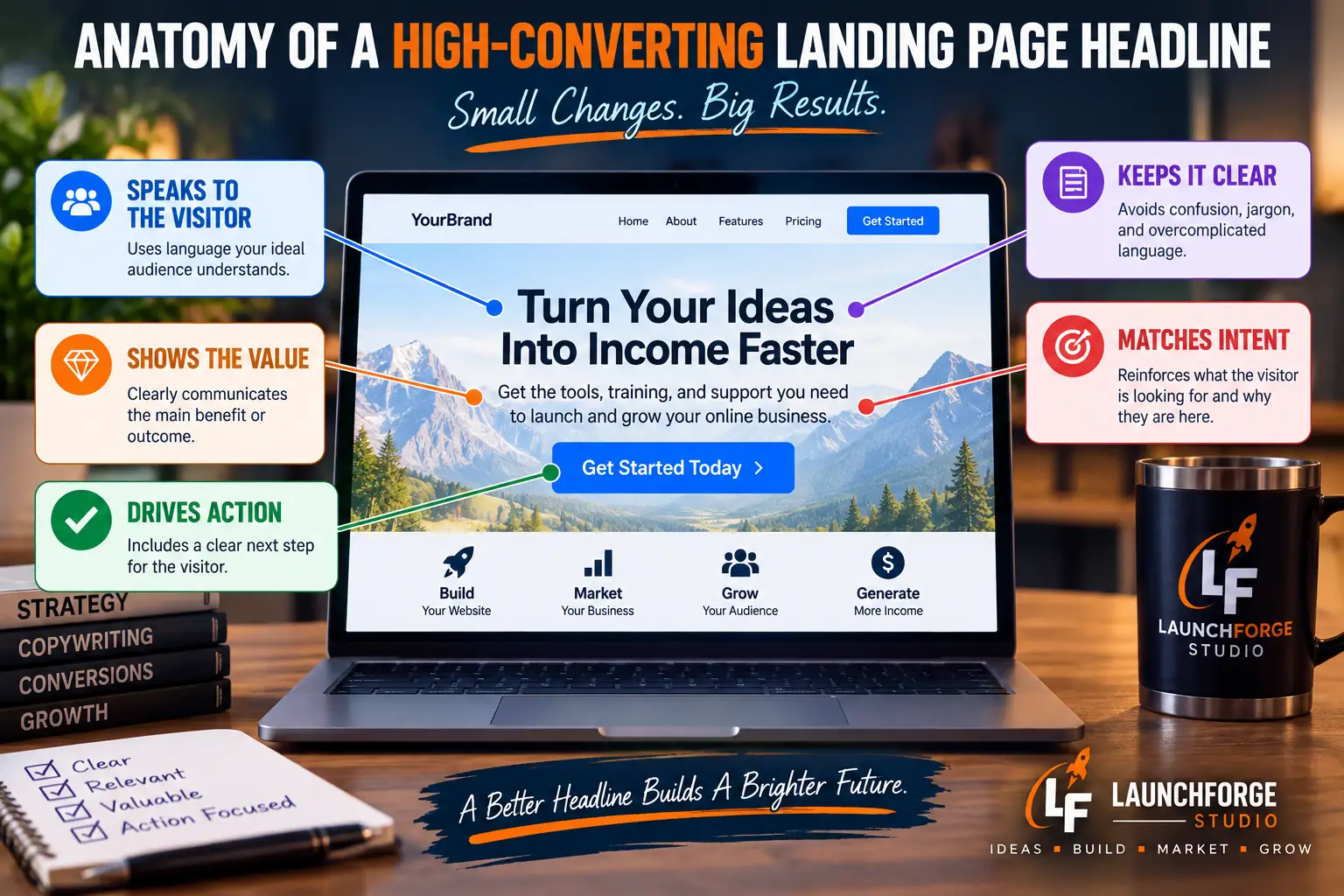
An effective landing page headline works with the supporting message and call to action to communicate value, match visitor intent, and guide the next step.
Replace Broad Claims With Concrete Meaning
Suppose a landing page promotes a guide about generating leads.
You could write:
Generate Better Results for Your Business
But “better results” could mean almost anything.
Now consider:
Build a Simple Lead Generation System for Your Online Business
The second headline gives the visitor something concrete.
They know the topic.
They know the intended outcome.
They have a better idea of what they will learn.
Specificity does not always require numbers or statistics. Sometimes it simply means replacing broad marketing language with words that describe what is actually happening.
Use Details That Help the Right Visitor Recognize Themselves
Specificity can also come from identifying who the offer is for or what situation it addresses.
Consider:
Create Better Marketing Content
Now compare it with:
Plan a Month of Social Media Content Without Starting From a Blank Screen Every Morning
The second version describes a much more recognizable situation.
Someone struggling with that exact problem may immediately think:
That is what I need help with.
That recognition can be more powerful than a generic claim aimed at everyone.
Use Numbers Only When They Add Useful Information
Numbers can make a headline more specific, but they are not automatically persuasive.
A number works best when it helps explain the offer.
For example:
7 Steps to Build Your First Lead Capture Page
The number tells the visitor something about the structure of the content.
Likewise:
Create Your First Welcome Email Sequence in 5 Simple Steps
gives the reader an idea of what they are about to learn.
But adding a number simply because headline advice says numbers attract attention can make the copy feel forced.
11 Incredible Ways to Transform Your Business Today
may be specific mathematically, but the underlying promise is still vague.
Use numbers when they clarify the offer, process, timeframe, quantity, or result.
Not because the headline needs decorative mathematics.
Specific Does Not Mean Complicated
There is also a point where specificity becomes overload.
A headline does not need to explain the audience, feature list, process, benefit, guarantee, timeframe, and call to action all at once.
That is what the rest of the landing page is for.
Give the visitor enough information to understand the central promise.
Then let the subheadline and supporting copy handle the details.
A useful headline is specific enough to create meaning without becoming so crowded that the meaning gets buried.
5. Let the Subheadline Support the Main Headline
Sometimes the best way to improve a landing page headline is to stop asking it to do everything.
That is where the subheadline becomes useful.
The headline can communicate the main promise or benefit.
The subheadline can add context, explain how the offer works, identify the audience, or clarify something the visitor needs to know before moving forward.
Together, they can communicate more without turning the main headline into a paragraph.
Give the Headline and Subheadline Different Jobs
Imagine you are promoting a simple email marketing guide.
You could try to squeeze everything into one headline:
Learn How to Build an Email List, Create a Welcome Sequence, Automate Your Follow-Up, and Start Email Marketing Without Complicated Tools
The meaning is clear, but the headline is carrying a lot of weight.
Instead, you could divide the message:
Build Your First Email Marketing System
Then support it with:
Learn how to capture leads, create a simple welcome sequence, and automate your follow-up without piecing together a complicated stack of tools.
The central promise is now easier to scan.
The supporting information is still there, but it has room to breathe.
Use the Subheadline to Answer the Next Question
A useful way to think about the relationship is:
The headline creates understanding and interest.
The subheadline answers the next logical question.
Suppose the headline says:
Build a Landing Page That Turns Visitors Into Leads
The visitor may immediately wonder:
How?
The subheadline could answer:
Create a focused page with a clear message, a strong call to action, and a layout designed to guide visitors toward one specific goal.
Now the two pieces work together.
The headline communicates the outcome.
The subheadline begins explaining how the page supports that outcome.
Do Not Repeat the Headline in Different Words
A weak subheadline often says almost exactly what the headline already said.
For example:
Build Your First Sales Funnel
followed by:
Learn How to Create Your First Sales Funnel
The second line adds almost nothing.
Instead, use that space to provide information the headline could not comfortably carry:
Build Your First Sales Funnel
followed by:
Connect your landing page, lead capture, follow-up, and offer into one simple path you can improve over time.
Now the visitor learns something new.
Read Them Together
Before finalizing the copy, read the headline and subheadline as one continuous message.
Ask yourself:
Does the headline communicate the central idea?
Does the subheadline add useful information?
Do they sound natural together?
Is anything unnecessarily repeated?
Can the visitor understand the offer without reading several paragraphs?
If the answer is yes, you probably have a stronger opening message than you would get by forcing everything into one oversized headline.
The headline does not have to finish the conversation.
It only needs to start it well.
6. Write Several Headlines Before Choosing One
The first headline you write does not have to be the headline you publish.
In fact, treating the first idea as the final answer can make headline writing harder than it needs to be.
Instead of trying to create the perfect headline immediately, give yourself permission to write several imperfect versions.
The goal at this stage is not perfection.
It is options.
Start With the Simplest Version
Begin by writing the most straightforward description of the offer you can.
Suppose you are creating a landing page for a free guide that teaches beginners how to build a simple sales funnel.
Your first version might be:
Learn How to Build Your First Sales Funnel
Nothing fancy.
But now you have something to work with.
From there, you can explore different angles.
A benefit-focused version:
Build a Simple Sales Funnel That Guides Visitors Toward the Next Step
A problem-focused version:
Stop Sending Traffic Without a Clear Path for Visitors to Follow
A beginner-focused version:
Build Your First Sales Funnel Without Making It Complicated
A process-focused version:
Turn Your Landing Page, Follow-Up, and Offer Into One Simple Sales Funnel
Each version emphasizes something different while staying connected to the same underlying offer.
Try Different Angles Before Different Words
This is an important distinction.
Changing a few words is not always the same as creating a genuinely different headline.
For example:
Build a Better Landing Page
Create a Better Landing Page
Make a Better Landing Page
Those are technically three headlines, but they all approach the message from essentially the same angle.
Instead, change what the headline emphasizes.
You might focus on:
The desired outcome.
The problem being solved.
The intended audience.
The simplicity of the process.
The speed or convenience, when you can support it.
The specific thing the visitor will learn or receive.
The obstacle the offer helps remove.
Now you are generating different ideas instead of rearranging synonyms.
Create a Shortlist
Once you have several possibilities, narrow them down.
Do not ask only:
Which one sounds the coolest?
Ask:
Which one is easiest to understand?
Which one best matches the offer?
Which one speaks most directly to the intended visitor?
Which one continues the message that brought the visitor to the page?
Which one communicates meaningful value without exaggerating?
You may end up combining parts of two different versions.
That is fine.
Headline writing is often an editing process rather than a sudden flash of brilliance.
Keep the Headlines You Do Not Use
Do not immediately delete every headline that loses the first round.
Save the strongest alternatives.
They may become useful later for advertisements, email subject lines, social posts, section headings, or future tests.
More importantly, having alternatives gives you something to compare against the version you initially choose.
You are no longer asking whether one headline feels good.
You are asking which of several reasonable options communicates the message most effectively.
That is a much more useful question.
7. Use Headline Frameworks to Generate Better Ideas
Headline frameworks can be useful when you know what you want to communicate but are struggling to turn the idea into a sentence.
Think of them as starting points rather than formulas.
You still need to adapt the wording to the offer, audience, and landing page.
Here are several practical approaches.
Lead With the Desired Outcome
Start with what the visitor wants to accomplish.
A simple structure is:
Get or Achieve [Desired Outcome] Without [Common Obstacle]
For example:
Build Your First Website Without Learning How to Code
Or:
Create a Simple Email Follow-Up System Without Sending Every Message Manually
This approach works well when the desired result and the obstacle are both easy for the visitor to recognize.
Lead With the Problem
Sometimes the problem is more immediately recognizable than the solution.
A simple structure is:
Stop [Problem] and Start [Desired Improvement]
For example:
Stop Juggling Marketing Tools and Start Building From One Connected System
The key is making sure the problem is real and relevant to the audience.
Do not invent anxiety simply to make the headline sound more dramatic.
Lead With What the Visitor Will Learn
Educational landing pages often benefit from being straightforward.
A simple structure is:
Learn How to [Specific Outcome]
For example:
Learn How to Build a Landing Page in WordPress
Or:
Learn How to Create Your First Automated Welcome Sequence
There is nothing wrong with a simple headline when it clearly describes what the visitor came to learn.
Lead With the Audience
If the offer is designed for a specific group, identifying that group can make the headline more relevant.
A simple structure is:
[Outcome or Solution] for [Specific Audience]
For example:
Simple Lead Generation for New Online Business Owners
This can help the right visitor quickly recognize that the page was created with someone like them in mind.
Lead With Simplicity
For audiences overwhelmed by complexity, simplicity itself can become part of the value.
A simple structure is:
A Simpler Way to [Desired Outcome]
For example:
A Simpler Way to Build and Manage Your Online Business
This approach works best when the offer genuinely reduces complexity.
If the process still requires substantial work, the supporting copy should make that clear rather than implying that everything happens effortlessly.
Lead With a Specific Resource
Sometimes the offer itself should take center stage.
A simple structure is:
Get [Specific Resource] to Help You [Desired Outcome]
For example:
Get the Landing Page Checklist to Help You Prepare Before You Publish
This works particularly well for guides, checklists, templates, reports, webinars, and other clearly defined resources.
Use Frameworks to Explore, Not to Copy
The purpose of these frameworks is to help you approach the same offer from different directions.
You might write one headline around the outcome.
Another around the problem.
Another around the audience.
Another around simplicity.
Then compare them.
Do not force your offer into a framework that does not fit.
And do not assume that using a familiar structure automatically makes the headline effective.
The framework gives you a place to begin.
Your understanding of the visitor is what turns it into a headline worth testing.
8. Avoid the Landing Page Headline Mistakes That Weaken the Message
Sometimes improving a headline is less about adding something and more about removing what gets in the way.
A headline can be grammatically correct, creative, and technically relevant while still making the visitor work too hard to understand it.
Here are some of the most common problems to watch for.

Effective landing page headlines combine clarity, specificity, relevance, value, and a reason to continue toward the next action.
Being So Clever That the Meaning Disappears
Creativity can give a brand personality.
Confusion does not.
Consider a headline like:
Your Future Starts Where Ordinary Ends
It sounds dramatic.
But what is the page selling?
Software?
Business coaching?
Running shoes?
A timeshare on Mars?
The visitor should not have to read half the landing page before discovering what the headline was trying to say.
If you want personality, add it after the core message is clear.
Using Empty Marketing Language
Certain phrases appear so frequently in marketing that they can stop communicating anything specific.
Transform your business.
Unlock your potential.
Revolutionize your results.
Take everything to the next level.
None of these phrases automatically makes a headline bad.
The problem is that they need context.
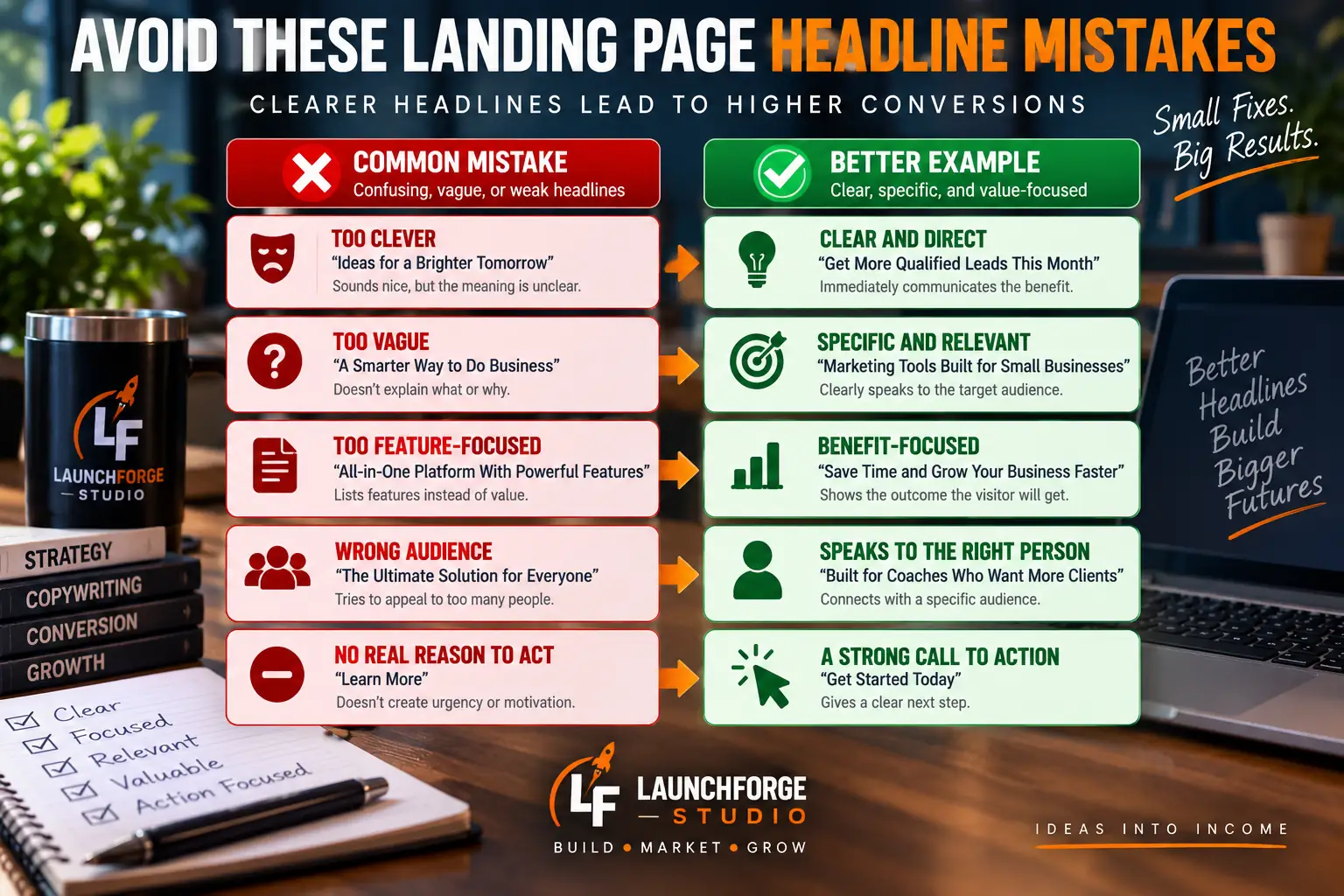
Avoid vague, overly clever, feature-focused headlines by making the message clear, specific, relevant, and focused on visitor value.
Take Your Marketing to the Next Level
does not tell the visitor very much.
Compare it with:
Turn New Leads Into an Automated Email Follow-Up Sequence
Now there is something concrete for the visitor to understand.
Trying to Speak to Everyone
A headline written for everyone often becomes meaningful to no one.
If the offer is specifically designed for beginners, saying so may strengthen the message.
If it solves a particular problem for affiliate marketers, small business owners, creators, or another defined audience, that context may matter.
You do not necessarily need to name the audience directly in every headline.
But you should know who you are writing for.
That understanding influences the problems, benefits, and language you choose.
Making Unsupported Claims
A stronger promise is not automatically a stronger headline.
Claims such as:
Guaranteed to Triple Your Conversions
or:
Make $10,000 in Your First 30 Days
may attract attention, but they also create expectations that require evidence.
Specific performance claims should not be invented simply because they sound persuasive.
If you have legitimate data supporting a claim, present it accurately and with the necessary context.
If you do not, build the headline around a benefit you can reasonably explain.
Credibility is more valuable than temporary attention.
Creating Fake Urgency
Urgency can be appropriate when there is a real deadline, limited enrollment period, expiring offer, or another genuine reason to act.
Manufactured urgency is different.
If the headline screams:
LAST CHANCE — ACT NOW BEFORE IT IS GONE FOREVER
while the same offer remains available every day, the message can undermine trust.
Use urgency when the circumstances justify it.
Do not manufacture a ticking clock because you think every landing page needs one.
Stuffing the Headline With Keywords
Search visibility can matter for landing pages that are intended to appear in organic search.
That does not mean repeating the target keyword until the headline sounds like it was assembled by a malfunctioning robot.
The keyword should fit the meaning.
The headline still needs to sound like something written for a human being.
If adding another keyword makes the message awkward, confusing, or repetitive, the headline is probably better without it.
Writing the Headline Before Understanding the Offer
This may be the biggest mistake of all.
If you cannot clearly explain what the offer is, who it helps, and why somebody would want it, writing the headline becomes guesswork.
Go back to the offer.
Clarify the audience.
Clarify the problem.
Clarify the benefit.
Clarify the action.
Then return to the headline.
Good copy cannot permanently hide an unclear offer.
Eventually, the visitor will notice.
9. Keep the Headline as Short as the Message Allows
There is no perfect number of words for every landing page headline.
Some offers can be explained clearly in five words.
Others need ten or fifteen.
Trying to force every headline into an arbitrary length can make the message weaker rather than stronger.
The better goal is to use enough words to communicate the idea clearly without carrying unnecessary baggage.
Remove Words That Do Not Add Meaning
Once you have a headline you like, read it again and look for words that are not doing useful work.
Suppose you wrote:
Discover an Easier and More Effective Way to Build Your Very First Landing Page Today
There is a useful idea hiding inside that sentence, but several words are competing for space.
You might simplify it to:
A Simpler Way to Build Your First Landing Page
Or:
Build Your First Landing Page Without Making It Complicated
The best version depends on the offer, but both communicate the central idea more directly.
Editing is not about making every headline extremely short.
It is about making every word earn its place.
Do Not Sacrifice Meaning Just to Make It Shorter
Short headlines can look clean on a page, especially on mobile devices.
But short does not automatically mean effective.
Consider:
Grow Faster
It is certainly short.
It is also extremely vague.
Now compare it with:
Build a Simpler Marketing System That Can Grow With Your Business
The second version is longer, but it communicates substantially more information.
If shortening a headline removes the reason someone should care, the edit has gone too far.
Read the Headline Out Loud
One of the simplest editing techniques is to say the headline out loud.
Awkward wording often becomes easier to notice when you hear it.
Pay attention to places where you stumble.
Listen for unnecessary repetition.
Notice whether the sentence sounds natural or like marketing language assembled from a collection of buzzwords.
If you would never say the sentence to another person, ask whether it needs to be rewritten.
Check How It Looks on the Actual Page
A headline does not live inside a document forever.
Eventually, it has to appear on the landing page.
That means layout matters.
A headline that looks perfectly reasonable in the WordPress editor may wrap awkwardly when placed inside the actual design.
Check it on mobile.
Look at where the lines break.
Make sure important words are not separated in a way that makes the message harder to read.
And make sure the headline does not dominate so much of the screen that the visitor cannot easily see the supporting message or primary call to action.
The final decision should consider both the copy and the page where the copy will live.
Let Clarity Determine the Length
Do not cut useful words simply to reach an imaginary headline limit.
Do not add filler simply because the headline looks too short.
Say what needs to be said.
Remove what does not.
Then let the design support the message.
A landing page headline should be long enough to communicate meaningful value and short enough that the visitor can understand it quickly.
That is a much more useful standard than chasing a specific word count.
10. Make the Headline and Call to Action Work Together
The headline tells visitors why the page deserves their attention.
The call to action tells them what to do with that attention.
Those two elements should support the same goal.
If the headline creates one expectation and the call to action introduces something completely different, the visitor may hesitate.
That is why it helps to review the headline and CTA together rather than writing each one in isolation.
Make the Next Step Feel Natural
Suppose the headline says:
Get the Beginner’s Guide to Building Your First Landing Page
A CTA such as:
GET THE FREE GUIDE
creates a natural continuation.
The visitor understands what is being offered and what happens when they click.
Now imagine the same headline followed by:
START YOUR JOURNEY
The button may sound inspirational, but it is less specific.
What journey?
What happens after the click?
Does the visitor receive the guide?
Do they create an account?
Are they buying something?
The CTA should reduce uncertainty rather than introduce more of it.
Keep the Promise Consistent
Consider another example.
Headline:
Build Your First Email Welcome Sequence
Supporting copy explains that the visitor will receive a step-by-step tutorial.
The CTA might say:
SHOW ME HOW
or:
READ THE TUTORIAL
Both continue the promise established by the headline.
But a button such as:
BUY NOW
would create confusion unless the page had already explained that something was being sold.
The action should make sense based on everything the visitor has read immediately before it.
Use the Headline to Set Up the Action
Sometimes the relationship can be even more direct.
Headline:
Ready to Build Your First Landing Page?
Subheadline:
Follow our step-by-step Divi 5 guide and build a focused page around one clear conversion goal.
CTA:
BUILD YOUR LANDING PAGE
The headline creates the context.
The supporting copy adds information.
The CTA provides the next step.
Each element moves the visitor forward without forcing them to reinterpret the message.
Avoid Competing Calls to Action
A focused landing page usually works best when the visitor can quickly identify the primary action.
If the headline promotes a free guide but the opening section contains buttons for the guide, a webinar, a pricing page, a blog article, a social profile, and three unrelated products, the page is asking the visitor to make several decisions at once.
That weakens the focus created by the headline.
Secondary links may sometimes be useful, depending on the page and offer, but the primary action should remain obvious.
The visitor should not have to wonder which button represents the promise made at the top of the page.
Review the Entire Opening Section as One Message
Before publishing, look at the headline, subheadline, supporting visual, and primary CTA together.
Ask:
Does the headline communicate the main value?
Does the subheadline provide useful context?
Does the visual support the message?
Does the CTA clearly describe the next step?
Do all four elements point toward the same goal?
If they do, the opening section begins to function as one connected experience.
That is much stronger than optimizing each element separately and hoping they somehow work together.
11. Test the Headline Instead of Assuming You Got It Right
You can follow every headline-writing principle in this guide and still not know with certainty how real visitors will respond.
That is because a headline is not being written for you.
It is being written for the people arriving on the page.
Once the landing page begins receiving enough relevant traffic, actual visitor behavior can help you determine whether your original choice deserves to stay.
Start With a Meaningful Alternative
Remember the headline shortlist you created earlier?
This is one reason to keep it.
Instead of testing tiny changes that barely affect the message, choose an alternative that represents a meaningful difference.
For example, you might compare a benefit-focused headline:
Build Your First Landing Page Without Starting From Scratch
with a problem-focused headline:
Stop Sending Traffic to Pages Without a Clear Conversion Goal
Those headlines approach the same general subject from different angles.
That gives the test something meaningful to compare.
Changing one word from “Build” to “Create” may eventually be worth exploring, but it is usually less informative than testing two genuinely different messages.
Change One Major Variable at a Time
If you change the headline, subheadline, image, CTA, form, and page layout at the same time, you may see different results without knowing what caused them.
That makes the test much harder to learn from.
Instead, isolate the variable you are trying to understand.
If you are testing the headline, keep the rest of the experience as consistent as practical.
Then compare what happens.
Decide What Success Actually Means
Do not evaluate a headline only by whether people remain on the page for a few extra seconds.
Connect the test to the actual goal of the landing page.
That might mean:
Form submissions.
Guide downloads.
Webinar registrations.
Trial signups.
Product purchases.
Clicks to the next stage of a funnel.
The useful measurement depends on what the page was built to accomplish.
A headline that attracts attention but brings the wrong people deeper into the page may not be an improvement.
Give the Test Enough Information to Be Useful
Avoid declaring a winner because three people saw one version and two of them clicked.
Small samples can produce noisy results.
The amount of traffic needed for a useful test depends on factors such as the current conversion rate, the size of the difference you are trying to detect, and how confident you want to be in the result.
If your page receives very little traffic, formal A/B testing may not be practical yet.
That does not mean you cannot improve the headline.
You can still review visitor behavior, collect feedback, compare the message against the traffic source, and continue refining the page as you learn more about the audience.
Let the Result Challenge Your Assumptions
You may love one headline.
Your visitors may respond better to another.
That is useful information.
The goal is not to prove that your first idea was brilliant.
The goal is to learn which message better supports the page’s purpose.
Write thoughtfully.
Publish.
Measure what happens.
Then improve what the evidence gives you a reason to improve.
That process is far more valuable than searching forever for a perfect headline before anybody has even seen the page.
12. Use This Landing Page Headline Checklist Before You Publish
By the time you reach this point, you may have several headline ideas competing for the top of the page.
Before choosing one, step away from the individual words for a moment and evaluate the entire message.
A simple checklist can help.
Is the Headline Clear?
Can someone unfamiliar with the offer understand the basic idea quickly?
If the headline depends on clever wordplay, vague language, or insider terminology, simplify it.
The visitor should not need an explanation of the explanation.
Does It Communicate Value?
Does the headline give the visitor a reason to care?
That value might be an outcome, a solution to a problem, useful information, a resource, greater simplicity, or another meaningful benefit.
You do not need to promise the world.
You need to communicate why the offer is worth another few seconds of attention.
Does It Match the Visitor’s Expectation?
Think about what brought the visitor to the page.
Does the headline continue the promise made in the advertisement, email, search result, social post, or other traffic source?
A strong headline should make the visitor feel like they arrived in the right place.
Is It Specific Enough?
Look for vague phrases that could describe hundreds of unrelated offers.
Can you replace them with something more concrete?
Could you identify the outcome, audience, problem, resource, or process more clearly?
Specificity gives the message substance.
Does the Subheadline Add Something Useful?
If you are using a subheadline, make sure it does more than repeat the headline.
Use it to add context, explain the benefit, clarify the process, identify the audience, or answer the visitor’s next likely question.
Headline and subheadline should work together.
Does the CTA Continue the Same Message?
Read the headline and primary CTA together.
Does the action make sense?
If the headline promises a free guide, the button should make it obvious how to get the guide.
If the headline introduces a tutorial, the CTA should naturally move the visitor toward that tutorial.
Do not make visitors decode what happens next.
Can You Remove Anything?
Read the headline one more time.
Look for filler.
Look for repeated ideas.
Look for words that sound impressive but do not add meaning.
Remove what the headline does not need while protecting the clarity and value it does need.
Can You Support the Promise?
Make sure the landing page actually delivers what the headline says it will deliver.
If you make a specific claim, be prepared to support it.
If you introduce a benefit, the rest of the page should explain how the offer provides that benefit.
The headline earns attention.
The rest of the page has to earn trust.
Does It Work on the Actual Page?
Finally, stop evaluating the headline inside the editor.
Check desktop.
Check mobile.
Look at the headline beside the subheadline, visual, CTA, and surrounding design.
Make sure the message remains easy to understand when it becomes part of the real page.
If the headline passes those checks, you have something worth publishing.
It may not be the final version forever.
It does not need to be.
It needs to be clear, relevant, credible, and strong enough to put in front of real visitors so you can begin learning from what happens next.
A Build Along With LaunchForge Headline Example
The easiest way to understand these principles is to see how they come together on a real page.
When we built a landing page for LaunchForge Studio, we used this headline:
Build a Landing Page That Turns Visitors Into Leads
The supporting copy was:
Create a focused landing page with a clear message, a strong call to action, and a layout designed to guide visitors toward one specific goal.
This gives us a useful example to examine because the headline was not created as an abstract copywriting exercise.
We created it while building an actual landing page.
Start With the Main Outcome
The headline does not begin by talking about WordPress, Divi 5, page modules, design settings, or any of the tools used to build the page.
Those things matter during the build.
But they are not the main reason somebody would want the page.
The headline focuses on the intended outcome:
Turning visitors into leads.
That immediately gives the landing page a purpose.
Let the Supporting Copy Explain the Approach
The headline does not try to explain everything required to achieve that outcome.
Instead, the supporting copy introduces several of the ideas behind the page:
A clear message.
A strong call to action.
A focused layout.
One specific goal.
That gives the visitor more information without forcing the headline to carry every detail.
Keep the Page Focused on the Same Goal
The headline and supporting copy establish what the page is about.
The rest of the experience should continue that message.
If we suddenly filled the page with unrelated offers, navigation choices, competing buttons, and several different conversion goals, the opening promise would lose much of its focus.
The headline works because it is part of a larger page built around the same objective.
Could We Write Other Versions?
Absolutely.
We could try a more instructional angle:
Build a Focused Landing Page Designed to Generate Leads
We could emphasize simplicity:
A Simpler Way to Turn Landing Page Visitors Into Leads
Or we could focus on the process:
Build a Landing Page Around One Clear Conversion Goal
Any of those might be worth considering.
The important point is that we do not have to pretend we know which version is universally best.
We can choose the version that most clearly reflects the page we are building, put it in front of real visitors, and learn from what happens.
This Is Why We Build Before We Teach
At LaunchForge Studio, we want these guides to connect with the work of building an actual online business.
That means we can take something we have created, examine the decisions behind it, identify what worked or what could be improved, and turn those lessons into something another person can use.
That is the idea behind Build Along With LaunchForge.
Build something real.
Understand why you built it that way.
Put it to work.
Measure what happens.
Then use what you learn to make the next version better.
The headline is only one small part of that process.
But it is a perfect example of how building and learning can work together.
Write the Headline, Then Put It to Work
Writing a landing page headline can feel surprisingly difficult for something that may only contain a handful of words.
That is because those words have an important job.
They need to help the right visitor quickly understand what the page is about, recognize why the offer matters, and decide whether it is worth continuing.
You do not need a secret formula to make that happen.
Start with the offer.
Understand who the page is for.
Identify the problem or outcome that matters to that person.
Write the clearest version first.
Then explore different angles.
Focus on value.
Make the message specific.
Match the expectation created by the traffic source.
Use the subheadline to provide context.
Make sure the call to action continues the same conversation.
And before you publish, read the entire opening section as one connected message.
Most importantly, do not spend so long searching for the perfect headline that the landing page never reaches a real visitor.
Write several good options.
Choose the strongest one you can based on what you know today.
Put it on the page.
Launch it.
Then pay attention to what happens.
If the evidence gives you a reason to change it, change it.
That is how a headline becomes more than a piece of copy sitting inside an editor.
It becomes part of a real business system you can learn from.
That is how we approach the work at LaunchForge Studio.
We build.
We put what we build to work.
We learn from what happens.
Then we take those lessons into the next thing we create.
Because the goal is not to write the perfect landing page headline in isolation.
The goal is to build a better landing page one informed decision at a time.