Meta business terms are changing on October 30, 2026, and the updates have raised an important question for small business owners: Could the websites they connect to Facebook and Instagram become part of Meta’s artificial intelligence ecosystem?
For entrepreneurs who rely on social media to attract customers, promote blog articles, generate leads, or build an online presence, that question deserves attention.
After all, your website is more than a collection of pages.
It represents your ideas, your work, your brand, and often years of effort spent creating something valuable.
So when reports began circulating about updated Meta business terms that appeared to address website crawling and AI training, concerns spread among publishers, marketers, and website owners.
But here’s where the story gets interesting.
Following criticism, Meta reportedly revised some of the controversial language before the October 30 effective date. However, questions remained about what the revised terms actually meant, which versions applied, and how website owners could understand their potential implications.
That distinction matters.
There’s a significant difference between a company updating its commercial agreements, introducing language that raises concerns about AI training, and actually using a particular website’s content to train an AI model.
Those situations shouldn’t be treated as interchangeable.
And for small business owners, reacting to an alarming headline without understanding the underlying policy can create unnecessary confusion.
At LaunchForge Studio, we believe that building a successful online business means understanding the platforms you depend on without allowing every new technology announcement to derail your progress.
Facebook and Instagram can still play valuable roles in helping businesses connect with audiences. At the same time, website owners should understand the agreements, settings, and content-sharing practices that may affect their online presence.
In this guide, we’ll examine what the October 2026 Meta business terms controversy is about, why website crawling and AI training became central concerns, what Meta reportedly changed, and what small website owners can reasonably do to stay informed.
We’ll also explain the difference between confirmed policy language, reported interpretations, and questions that remain unanswered.
Because when it comes to protecting your online business, informed decisions are far more useful than unnecessary panic.
Let’s start with what Meta’s business terms actually are and why the October 30 date matters.
What Are Meta’s New Business Terms for October 2026?
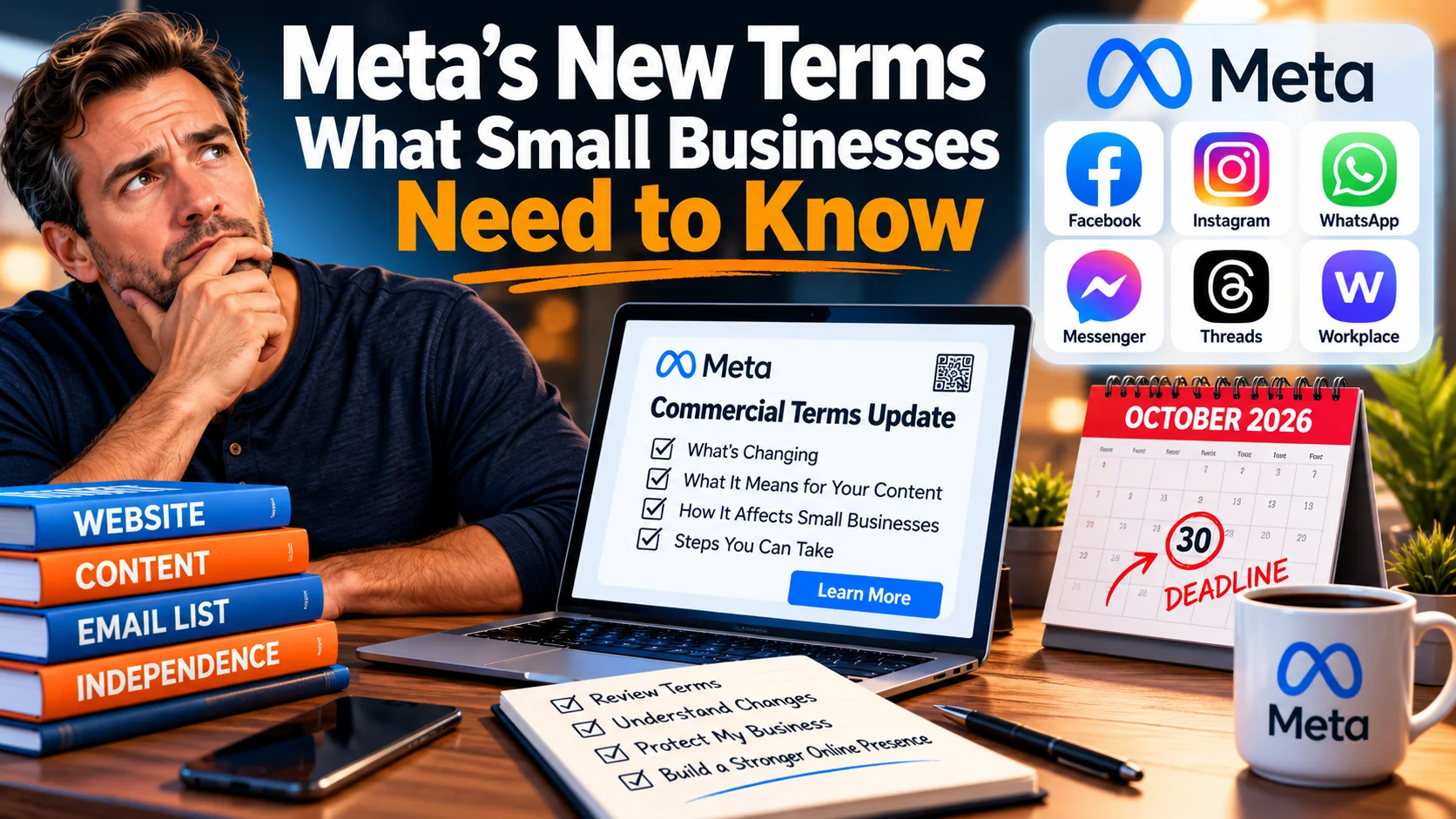
Understanding Meta’s updated business terms is an important first step for small website owners.
Meta business terms are receiving renewed attention because the company is updating the agreements that govern how businesses use its platforms and commercial services.
The revised Commercial Terms are scheduled to take effect on October 30, 2026, and they have generated discussion about website crawling, artificial intelligence, and the relationship between business accounts and independently owned websites.
For someone running a small online business, the language can seem complicated.
You might use Facebook to share blog articles, Instagram to promote your brand, or Meta Business Suite to manage your social media presence. You probably don’t spend much time examining the legal agreements behind those everyday activities.
However, understanding the basics can help you recognize which changes deserve your attention.
Understanding Meta’s Commercial Terms
Meta’s Commercial Terms are part of the agreements that apply when individuals or organizations use certain Meta products for business or commercial purposes.
These agreements establish conditions for using the company’s business-related tools and services.
They operate alongside other applicable Meta policies, including terms governing individual platforms, advertising, and specific business features.
For example, a business might use Meta’s services to:
- Manage a Facebook Page representing its brand.
- Operate an Instagram account for commercial purposes.
- Run paid advertising campaigns.
- Promote products or services.
- Manage business communications.
- Access Meta Business Suite or advertising management tools.
- Connect online marketing activities with an external website.
Each of these activities may involve different features, settings, and applicable agreements.
The important distinction is that Meta’s Commercial Terms are not simply another announcement about a new Facebook feature.
They help define the contractual relationship between Meta and businesses using its commercial products.
That makes changes to these terms worth understanding, particularly when they address content or websites that exist outside Meta’s own platforms.

Who Do the Updated Meta Business Terms Apply To?
One of the biggest misconceptions surrounding this announcement is that it only concerns large corporations, major advertisers, or professional news publishers.
In reality, the scope of Meta’s commercial services extends well beyond those organizations.
Small business owners, independent creators, online retailers, and digital marketers may also use products covered by the Commercial Terms.
Consider a few examples.
A small business owner might maintain a Facebook Page to communicate with customers and share updates about products or services.
A blogger might use a business-oriented social media presence to distribute articles and attract visitors to an independently owned website.
An affiliate marketer might share educational content through Facebook while directing interested readers toward product comparisons or recommendations.
An online store owner might use Meta’s advertising tools to promote products and reach potential customers.
A digital creator might use Instagram and related business tools to develop an audience and promote resources.
These businesses have different goals, but they share something important: they may depend on Meta’s commercial ecosystem to connect their websites with potential customers.
That does not mean every personal Facebook account or ordinary social media interaction is governed by exactly the same provisions.
The terms that apply depend on the products, account activities, and services involved.
For website owners, the practical question is whether their business activities fall within the scope of the updated Commercial Terms.
Why October 30, 2026, Matters
October 30 is the scheduled effective date for Meta’s updated Commercial Terms.
An effective date identifies when a revised agreement is intended to begin governing the activities it covers.
That is different from the date when the company first announces a change or makes revised language available for review.
In this case, the distinction became particularly important because questions about website crawling and AI training emerged before the updated terms were scheduled to take effect.
Publishers and industry observers began examining the language and questioning how broadly it might be interpreted.
Meta subsequently clarified its position and revised some of the disputed wording.
However, the effective date remained an important reference point for businesses reviewing the changes.
For small website owners, October 30 should be treated as an opportunity to understand the applicable terms rather than a reason to make rushed decisions.
A sensible approach includes reviewing the official agreement, identifying the Meta business products you use, and checking whether any relevant settings or website connections deserve attention.
It is also important to recognize that policy language can change during the period between an announcement and its effective date.
That means an article, screenshot, or social media post published earlier in October may not reflect the latest available wording.
When reviewing a developing policy issue, the official terms applicable to your account should take priority over outdated summaries.
What Changed From Meta’s Previous Terms?
The controversy surrounding the October 2026 update centers partly on how Meta describes its ability to access websites associated with businesses using its services.
Earlier Commercial Terms already governed business activities, advertising relationships, and content shared through Meta products.
The revised agreement introduced more explicit language addressing automated access to external websites and the potential uses of information collected through that access.
Automated access may involve technologies commonly described as web crawlers, bots, or scrapers.
These systems can visit webpages, retrieve information, and process publicly accessible content for different purposes.
Such technology is not unique to Meta.
Search engines, website monitoring services, social media platforms, and other online services use automated systems for activities ranging from link previews to search indexing.
The important issue is not simply whether automated website access exists.
It is what a company says it may access, how collected information may be used, and what permissions or limitations apply.
In the initial version of Meta’s updated language, references to using website content for training purposes raised concerns among publishers and legal commentators.
Those concerns were significant because businesses may maintain websites containing original articles, photographs, product information, educational materials, and other valuable content.
Following criticism, Meta said it had clarified the language to reflect that the relevant crawling provisions concerned its advertising and business products.
Reports also indicated that the explicit training reference was removed from a revised version of the terms.
However, questions remained about the wording displayed in different versions of the agreement and the precise scope of the remaining permissions.
That distinction is essential.
Removing an explicit reference to training does not automatically remove every provision concerning automated website access.
Likewise, the existence of a crawling provision does not prove that a particular business website has been accessed or that its content has been used to train an AI model.
Understanding the difference between contractual language, technical capabilities, and actual data use is necessary before drawing conclusions.
For small website owners, the most useful starting point is understanding what the terms say and how those terms relate to their business activities.
With that foundation established, we can examine the website crawling and AI-training language that brought Meta’s October 2026 update into the spotlight.
Why Meta’s Website Crawling and AI Language Sparked Controversy
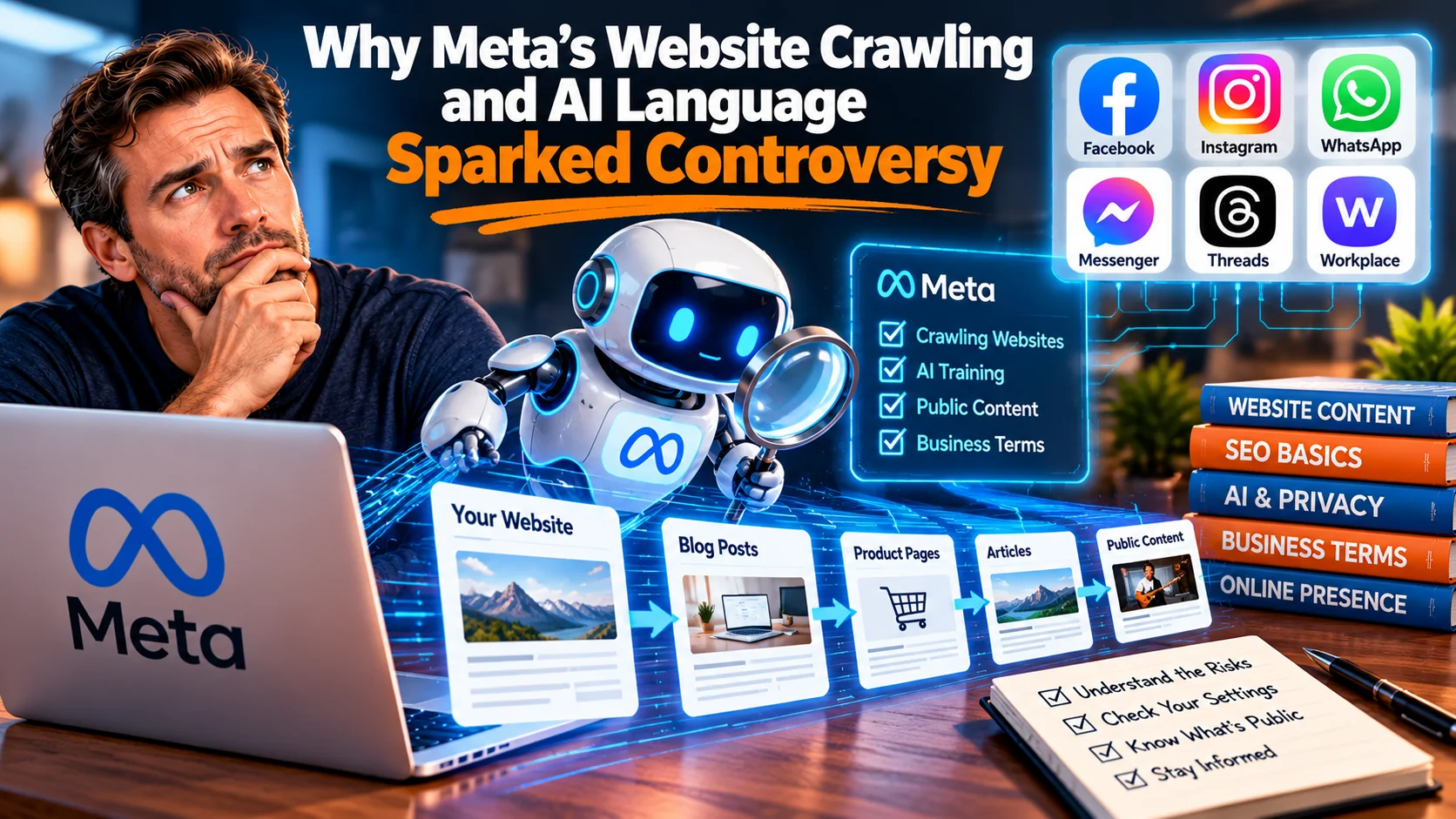
Meta’s website crawling and AI-related policy language sparked questions about how online content could be accessed and used.
The controversy surrounding Meta business terms in October 2026 began with a question that matters to almost every website owner: What happens when a technology company claims permission to access information published on a website connected to its business services?
For many entrepreneurs, sharing a website link on Facebook or Instagram is simply part of everyday marketing.
You publish an article, share it with your audience, and hope interested readers visit your website.
But the language discussed in Meta’s updated Commercial Terms raised concerns about whether that relationship could involve something beyond ordinary social media promotion.
In particular, publishers questioned provisions concerning automated website access and references to artificial intelligence training.
Understanding why those provisions attracted attention requires separating several related technologies and activities.
What Website Crawling Actually Means
Website crawling is the process of using automated software to visit webpages and retrieve information.
These automated systems are commonly called crawlers, bots, or spiders.
They can follow links, inspect page content, identify images, and collect information depending on how they are designed and configured.
Crawling is a normal part of how the internet operates.
For example, search engines use crawlers to discover webpages and understand what information those pages contain.
Social media platforms may also retrieve information from websites to generate previews when someone shares a link.
If you publish an article and share its URL on Facebook, the platform may retrieve details such as the article title, description, and preview image.
That activity can help people understand what a link contains before clicking it.
For a small business, these previews can be useful marketing tools.
They make shared content more recognizable, improve presentation, and help visitors decide whether a webpage is relevant to their interests.
However, not every automated system accesses websites for the same purpose.
Some crawlers support search indexing.
Others retrieve information for link previews, analytics, security checks, or other technical functions.
Still others may collect information for uses involving machine learning or artificial intelligence.
The distinction matters because allowing a platform to retrieve information for a social media preview is not necessarily the same as agreeing that the information may be used for every possible purpose.
Website owners should therefore consider two separate questions.
First, what information can an automated system access?
Second, what does the organization operating that system say it may do with the information afterward?
Those questions are central to understanding the concerns surrounding Meta’s October 2026 Commercial Terms.
The Original AI-Training Language That Raised Questions
Reports about Meta’s proposed Commercial Terms drew attention to language addressing websites associated with businesses using Meta’s commercial products.
The disputed wording was interpreted by some publishers and legal commentators as potentially granting Meta broad permission to access website information and use it for purposes that included artificial intelligence training.
That possibility immediately raised concerns.
Imagine a small business owner who spends months creating original tutorials, product explanations, photographs, and educational resources.
The owner publishes that material on an independently operated website and shares links through a Facebook business presence.
The concern was whether participation in Meta’s business ecosystem could create contractual permissions extending beyond content deliberately uploaded to Facebook or Instagram.
In other words, website owners wanted to know whether the agreement might affect material hosted on their own websites.
This was particularly important because the distinction between content published directly on a social platform and content hosted independently is meaningful.
When someone uploads a photograph to Instagram, the platform’s applicable terms govern certain permissions related to that upload.
But an article published on an independent WordPress website exists outside Instagram.
Sharing a link to that article does not physically move the entire article onto Meta’s platform.
The controversy centered on whether the proposed Commercial Terms could establish additional permissions concerning those external webpages.
References to AI training made the issue more sensitive.
Training an artificial intelligence model may involve processing large quantities of information to identify patterns and improve the model’s capabilities.
That is a different activity from generating a temporary preview of a shared link.
The reported wording raised questions about the extent of the permissions Meta was seeking and whether businesses understood the implications.
However, an important distinction must be maintained.
The presence of a proposed contractual permission does not establish that Meta actually used a particular website’s content to train an AI model.
The controversy concerned what the terms appeared to authorize, not verified evidence that every connected website had been used for AI training.
Why Publishers and Small Website Owners Were Concerned
For established publishers, original content represents an investment in reporting, research, writing, photography, and editorial expertise.
For small website owners, the investment may be even more personal.
A solo entrepreneur might write every article, design every page, and develop every educational resource without a dedicated team.
That work creates value for readers while helping establish the website’s reputation.
The possibility that content could be accessed and processed for additional purposes without a clearly understood agreement naturally raises questions.
Several concerns deserve attention.
Control over original content
Website owners want to understand how their articles, photographs, product descriptions, and other original materials may be used.
Public accessibility does not automatically mean that every possible use of a work is authorized.
The legal relationship between publicly available content, contractual permissions, copyright, and AI training is complicated and can vary depending on the circumstances and jurisdiction.
Clarity about consent
Business owners may use Facebook or Instagram primarily to communicate with customers.
They might not expect that agreeing to commercial terms could have implications for content hosted on a separate website.
This raises questions about whether contractual language is sufficiently clear and whether users understand the permissions involved.
The relationship between visibility and control
Small businesses often depend on large platforms for visibility.
Social media can help attract visitors, generate interest, and introduce a brand to potential customers.
But businesses may also want to retain meaningful control over the original material they publish.
Balancing those interests becomes difficult when platform agreements are complex or subject to change.
Uncertainty about AI-related uses
Artificial intelligence systems are developing rapidly, and businesses may not fully understand how different types of data collection contribute to those systems.
A policy that mentions automated access, machine learning, or training can raise legitimate questions even when the practical implications are not immediately clear.
Limited resources for reviewing legal agreements
Large publishers may have legal teams available to examine policy updates.
Independent bloggers and small business owners often do not.
They need explanations that distinguish confirmed facts from speculation and identify reasonable steps they can take without requiring specialized technical knowledge.
These concerns help explain why the proposed changes attracted attention.
They do not, however, establish that every interpretation circulating online was accurate.
Meta’s Response to the AI-Training Concerns
Following criticism of the proposed Commercial Terms, Meta reportedly revised the disputed language before the October 30 effective date.
Reporting published on October 17 indicated that Meta had removed an explicit reference to AI training from a revised version of the agreement.
Meta also explained that the relevant provisions concerned advertising and business products.
This response was significant because the original controversy involved uncertainty about whether the terms could authorize broader use of content from websites associated with business accounts.
Removing explicit AI-training language changed how the agreement could be read.
However, it did not necessarily resolve every concern about automated website access.
A provision allowing a company to retrieve information from certain websites can still raise questions about the scope and purpose of that access, even without a specific reference to AI training.
It is also important to distinguish between Meta’s explanation of its intentions and the exact wording of the applicable agreement.
Company statements can provide useful context.
But website owners should review the current official terms rather than rely exclusively on a summary published before revisions were made.
Another complication emerged when subsequent reporting indicated that different versions of the Commercial Terms did not necessarily display identical language.
That created additional uncertainty about which wording was current and how it applied to different users.
For small businesses, the lesson is not that every social media account represents an immediate threat to website content.
It is that significant changes to platform agreements deserve careful review, particularly when the wording concerns independently operated websites.
What Remains Unclear About Meta’s Website Crawling Permissions
Even after Meta’s reported revisions, several questions remained important for publishers and small website owners.
One question concerns which websites fall within the scope of the relevant provisions.
A business might operate several websites, use different Meta products, or maintain separate social media accounts for different purposes.
The exact relationship between those activities and the applicable Commercial Terms deserves attention.
Another question concerns the types of automated access contemplated by the agreement.
Retrieving information for advertising functionality is not necessarily equivalent to collecting information for AI training.
The distinction depends on the relevant language, technical implementation, and actual use of the information.
A third question concerns the relationship between contractual permissions and website-level technical controls.
Website owners may use tools such as robots.txt to communicate crawling preferences to automated systems.
However, robots.txt is a technical instruction mechanism rather than a universal legal restriction.
It also does not guarantee that every automated system will follow the instructions or that previously collected information will be removed.
There are also questions about the differences between regional or otherwise applicable versions of Meta’s terms.
If wording varies, a business owner should avoid assuming that a screenshot from another account or region accurately represents the agreement governing their own activities.
Finally, there is the broader question of how businesses can remain informed as platform policies evolve.
Terms may be revised, clarified, or replaced over time.
A responsible response involves reviewing official documentation, watching for material changes, and avoiding assumptions that go beyond the available evidence.
For small website owners, the most useful approach is to recognize what has been reported while acknowledging what has not been conclusively established.
The October 2026 controversy illustrates why website ownership, content control, and platform dependence deserve ongoing attention.
Next, we’ll examine Meta’s reported October 17 revisions more closely and explain why differences between versions of the Commercial Terms created additional confusion.
What Meta Changed on October 17 and Why Confusion Remains
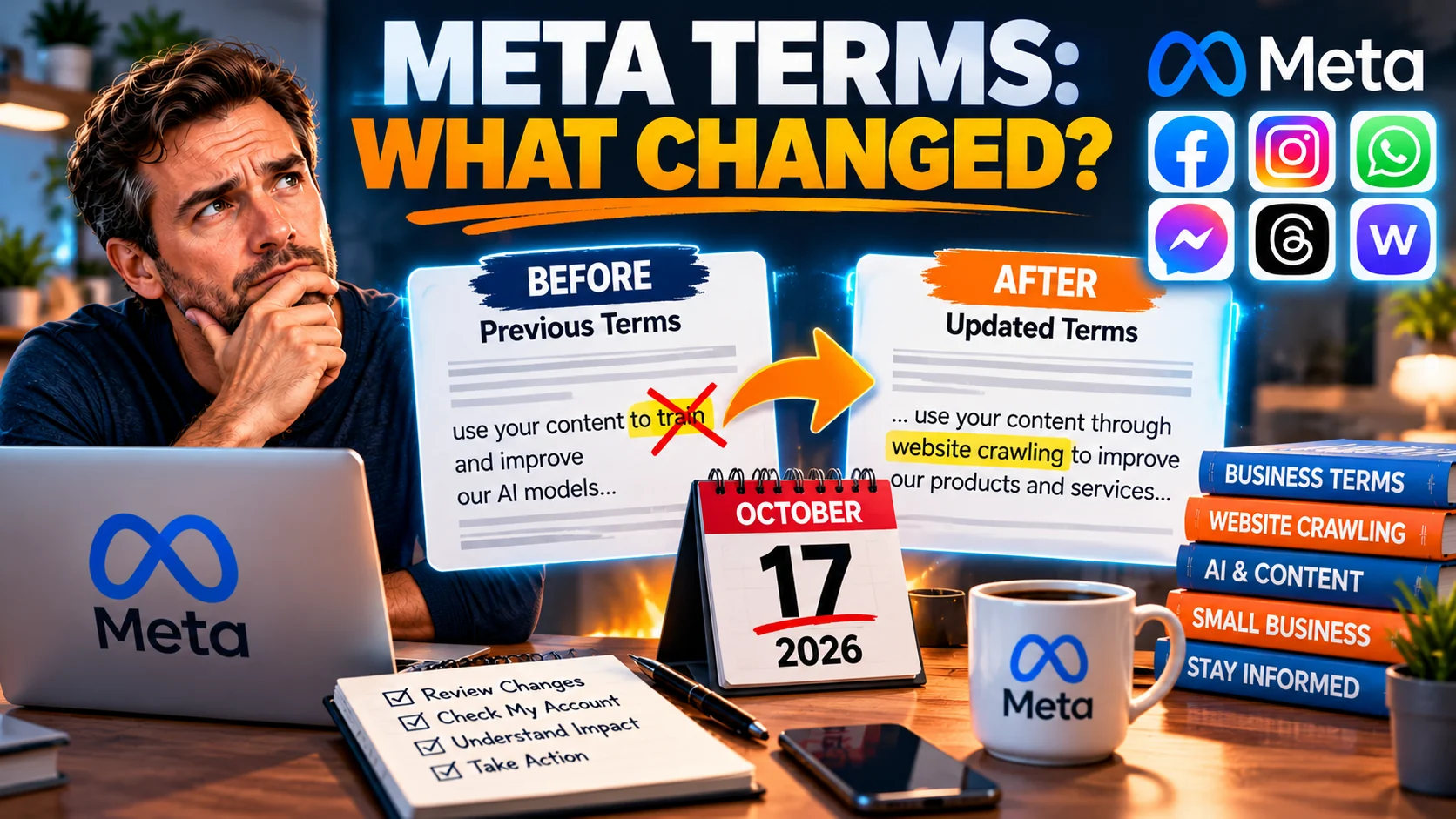
Meta removed explicit AI-training wording from its revised terms, but questions about website crawling permissions remained.
The controversy surrounding Meta business terms took another turn on October 17, 2026, when reports indicated that the company had revised language in its upcoming Commercial Terms.
For website owners who had been following the discussion, this was an important development.
The initial concerns focused on wording that appeared to permit automated access to websites associated with Meta’s business services, including references to artificial intelligence training.
Following criticism, Meta reportedly removed the explicit AI-training reference from a revised version of the agreement.
That change was meaningful, but it did not immediately answer every question.
Some reports subsequently indicated that different versions of the terms still contained different wording. As a result, publishers and business owners faced a familiar problem: determining which information was current, which provisions applied to them, and what the changes meant in practice.
Understanding the timeline helps explain why the story continued to develop even after Meta responded.
The Reported October 17 Revision
On October 17, reporting indicated that Meta had adjusted the controversial language in its updated Commercial Terms.
The revision followed public discussion about whether the agreement could permit Meta to access information from business-associated websites and use that information for artificial intelligence training.
The most significant reported change was the removal of an explicit reference to AI training from a revised version of the agreement.
For publishers concerned about the possible use of their content, that distinction mattered.
A contractual provision that expressly identifies AI training as a permitted use can raise different questions from one that describes automated access for advertising or business-related purposes.
However, removing a specific phrase does not necessarily eliminate every permission described elsewhere in an agreement.
For example, a company might maintain provisions concerning the retrieval of publicly accessible website information to support certain services.
The implications of those provisions depend on their exact wording and the surrounding terms.
That is why website owners should avoid treating a reported revision as proof that every concern has been resolved.
The appropriate question is what the current agreement actually says.
Another important detail is timing.
The revisions were reported before the scheduled October 30 effective date.
This means the public discussion was taking place while businesses still had an opportunity to examine the proposed changes.
For small business owners, that provided a window to review their accounts, understand the relevant policies, and consider whether they needed additional clarification.
Meta’s Explanation of the Updated Language
Meta’s reported explanation emphasized that the relevant changes concerned its advertising and business products.
That distinction is important because the company’s commercial ecosystem includes services that rely on connections between social media activity and external websites.
For example, businesses may use Meta products to advertise webpages, promote products, or measure the performance of certain marketing activities.
Those activities can involve website URLs, page information, and technical interactions between platforms.
However, the existence of legitimate business functions does not automatically explain the full scope of every contractual permission.
Website owners should distinguish between three separate elements.
The company’s stated purpose
This describes why Meta says a provision exists and what business activities it is intended to support.
The language of the agreement
This establishes the wording that businesses are being asked to accept, subject to applicable law and other governing terms.
The actual technical activity
This concerns what automated systems do in practice, including which webpages they access and what information they retrieve.
These elements are related, but they are not interchangeable.
A company’s explanation can help readers understand the intended purpose of a policy.
The agreement itself provides the relevant contractual language.
Technical documentation may explain how particular systems operate.
Together, these sources provide a more complete picture than any one source alone.
For a beginner running a WordPress website, this distinction may seem overly technical.
But it becomes easier to understand with a simple example.
Imagine that you use Facebook to promote a new article.
Meta may retrieve information from the article to generate a preview for people viewing the link.
That is one identifiable technical function.
Now imagine a policy describing additional permissions to access information from websites associated with commercial services.
The questions become broader.
Which websites are covered?
What information can be retrieved?
What purposes are permitted?
And what limitations apply?
These questions cannot be answered solely by knowing that Meta operates advertising products.
They require examining the applicable documentation.
Why Different Versions of the Terms Matter
One reason the October 2026 controversy continued was reporting that different versions of Meta’s Commercial Terms did not necessarily display identical wording.
This creates a practical challenge for anyone trying to understand a policy update.
A website owner might read one article describing the original language, another discussing the reported revision, and a third showing a version that still contains disputed wording.
Without considering when each source was published and which version it examined, those reports can appear contradictory.
There are several possible explanations for differences between displayed policy versions, including revisions made at different times or terms presented to different users.
However, the existence of different wording does not, by itself, establish why the differences occurred.
That distinction matters.
We should not assume that every business account is subject to identical terms without checking the applicable agreement.
We also should not assume that a particular version applies worldwide simply because it appears on an official webpage.
For businesses operating across different regions, contractual language and legal requirements may vary.
The safest approach is to examine the terms associated with the relevant account and service.
This is especially important when a policy is changing close to its effective date.
A screenshot taken several days earlier may no longer reflect the latest wording.
Similarly, an article accurately describing an earlier version may become incomplete when new information emerges.
For small website owners, the practical lesson is straightforward.
Always consider the date and source of information about platform policies.
When possible, prioritize current official documentation over summaries circulating through social media.
Independent reporting remains valuable for identifying concerns and explaining developments, but the applicable agreement is the primary reference for understanding what a business is being asked to accept.
How to Check the Meta Terms That Apply to Your Account
If you operate a business using Facebook, Instagram, or Meta’s advertising tools, reviewing the current terms is a reasonable step.
You do not need to become a legal expert to begin.
Start by identifying which Meta services your business actually uses.
For example, you may manage a Facebook Page, operate a professional Instagram account, run advertisements, or use Meta Business Suite.
These activities may involve different agreements or additional policies.
Next, locate Meta’s official Commercial Terms.
You can begin with the company’s published legal documentation and follow any notices associated with your business account.
When reviewing the agreement, pay particular attention to provisions involving external websites, automated access, content permissions, and changes to the terms.
Read those provisions in context rather than focusing on a single sentence.
A phrase that appears broad when isolated may be qualified by surrounding language.
Conversely, an explanation provided in a separate announcement may not address every detail of the agreement.
It can also be helpful to record the date you reviewed the terms.
If the policy changes again, having a dated record makes it easier to compare versions.
For businesses that rely heavily on Meta advertising or maintain valuable proprietary content, additional review may be appropriate.
A qualified legal professional can help interpret contractual language in the context of a particular business.
That may be especially useful when the business operates across multiple jurisdictions or has significant intellectual property concerns.
For most small website owners, however, the immediate priority is understanding which services they use and identifying the official terms that govern those activities.
The goal is informed decision-making, not unnecessary alarm.
What Small Businesses Can Learn From the Policy Confusion
The events surrounding Meta’s October 2026 Commercial Terms illustrate a broader challenge of operating an online business.
Platforms evolve.
Policies change.
New technologies introduce questions that existing agreements may not address clearly.
And small business owners often have limited time to investigate every development.
That makes it tempting to rely on headlines or social media commentary.
But headlines rarely provide enough context to understand a complicated policy change.
A more useful approach is to develop a simple review process.
When a major platform announces updated terms, ask what has changed and whether the changes apply to your business activities.
Identify the official source.
Look for the effective date.
Check whether the company has issued clarifications or revisions.
Then consider whether any practical action is necessary.
This process can help prevent two common mistakes.
The first is ignoring a meaningful policy change because the language appears complicated.
The second is making disruptive business decisions based on an interpretation that has not been verified.
Neither approach serves a small business particularly well.
At LaunchForge Studio, we believe that online entrepreneurs benefit from maintaining a healthy balance between using powerful third-party platforms and developing resources they control.
Social media can introduce people to your business.
Advertising tools can help you reach potential customers.
But your independently operated website, original educational content, and direct relationships with your audience remain important parts of a sustainable online presence.
A changing platform agreement is a reminder to understand those relationships rather than a reason to abandon them.
Now that we’ve examined the October 17 revisions and the uncertainty surrounding different versions of the terms, let’s consider what these changes could mean for bloggers, affiliate marketers, online stores, and other small website owners.
What Meta’s Updated Terms Could Mean for Small Website Owners
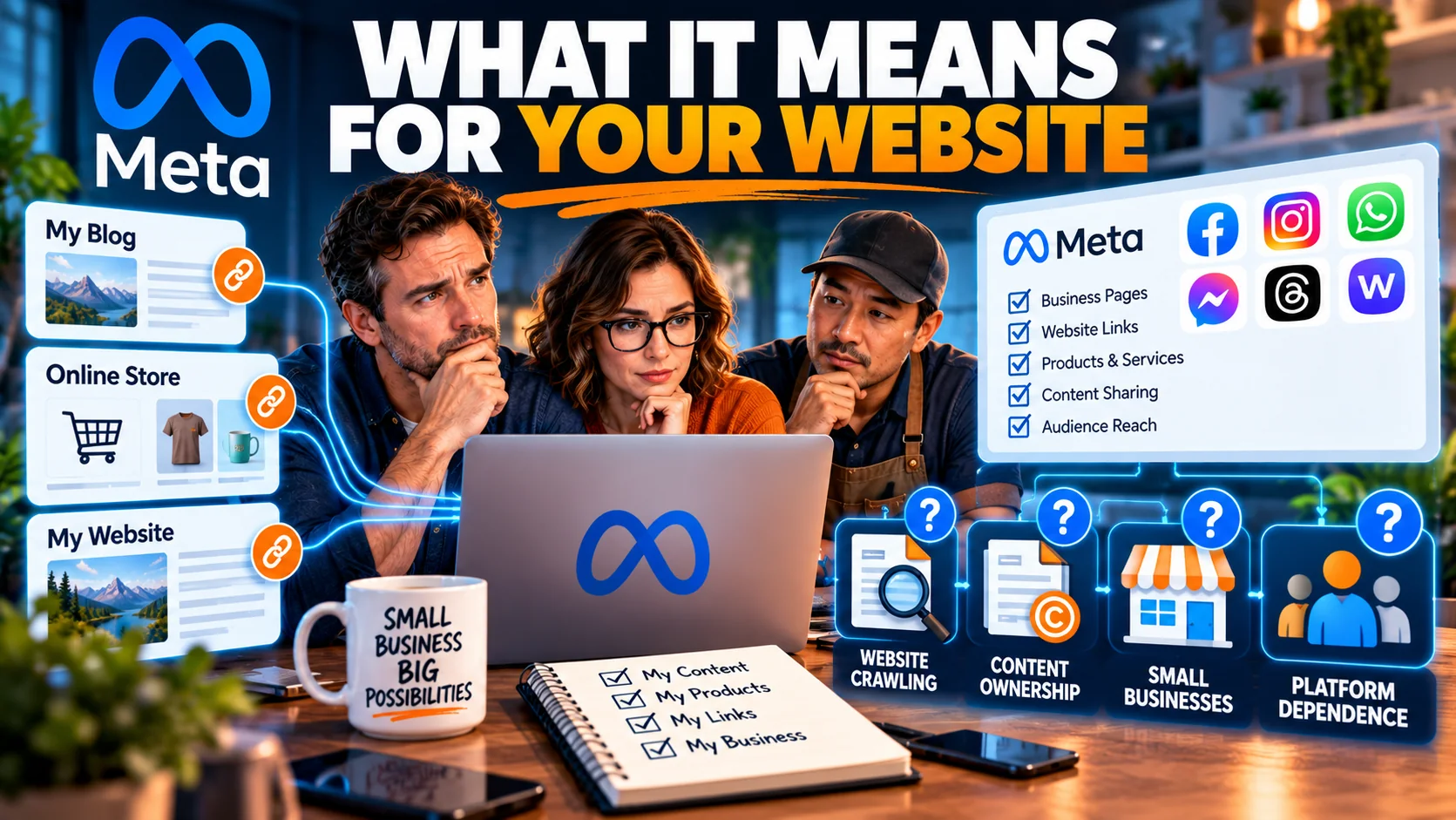
Meta’s updated business terms raise questions about website links, content ownership, and the relationship between small businesses and social platforms.
For small website owners, the most important question surrounding Meta business terms is not simply what the company changed.
It is how those changes might affect the everyday activities involved in running an online business.
Many entrepreneurs depend on Facebook and Instagram to introduce people to their websites, promote educational content, and build relationships with potential customers.
Others use Meta’s advertising tools to reach new audiences or support online sales.
These activities create connections between a business’s independently operated website and Meta’s commercial ecosystem.
That relationship is why the October 2026 Commercial Terms deserve attention.
However, the potential implications vary depending on how a business uses Meta’s services, what content it publishes, and which agreements apply.
Let’s look at several common situations.
Business Pages and Website Links
A Facebook business Page often serves as an extension of a company’s online presence.
It may display the business name, contact information, website address, product details, and links to articles or other resources.
For many small businesses, maintaining a Facebook Page is a practical way to remain visible to customers.
A restaurant might share its menu.
A local service provider might publish helpful tips.
An online entrepreneur might share educational articles designed to answer common customer questions.
In each case, the business may direct visitors toward an independently operated website.
The October 2026 controversy raised questions about whether website connections established through Meta’s commercial products could be relevant to the permissions described in the updated terms.
That does not mean every website linked from a Facebook Page has automatically been used for AI training.
Nor does it establish that simply adding a URL grants Meta unlimited rights to every piece of content on that website.
The applicable language, services, and circumstances matter.
For a small business owner, the reasonable response is to understand which website addresses are associated with their Meta business presence.
You may have added a website URL to a Page profile years ago.
You might also have used the same URL in advertising campaigns or other business tools.
Reviewing those connections can help you understand how your business interacts with the platform.
It also provides an opportunity to remove outdated links and confirm that your public business information is accurate.
These are useful maintenance practices regardless of the October 2026 controversy.
Bloggers and Independent Content Creators
Bloggers have particular reasons to pay attention to policies involving website access and content use.
An independent blog may contain hundreds of articles developed through research, experience, experimentation, and careful writing.
That content can attract visitors from search engines, social media, newsletters, and direct recommendations.
For many creators, the website itself is the foundation of their online business.
Social media platforms help distribute the content, but the original articles remain on the creator’s own website.
Consider a blogger who publishes a detailed tutorial about building a website.
The article might include original explanations, screenshots, examples, and recommendations.
After publication, the blogger shares the article on Facebook to reach a wider audience.
A social media preview may display the article title, featured image, and description.
That is a familiar part of content distribution.
The concern raised by Meta’s proposed language involved whether the relationship between a business account and an external website could extend beyond those ordinary preview functions.
For independent creators, understanding that distinction matters.
A website owner may be comfortable allowing social media platforms to retrieve information necessary for link previews while having questions about broader collection or reuse of original material.
The October 2026 controversy highlights why those purposes should not be treated as identical.
It also reinforces the value of maintaining clear ownership and attribution information on a website.
Bloggers should identify original work appropriately, maintain records of important content, and understand the terms governing the platforms they use.
These practices cannot prevent every possible form of automated access.
However, they can help creators manage their content more deliberately and recognize when a policy change deserves additional attention.
Affiliate Marketers and Digital Entrepreneurs
Affiliate marketers frequently rely on a combination of websites, educational articles, email marketing, and social media.
A marketer might publish a software comparison, explain how a business tool works, or create a tutorial for beginners.
The article may contain affiliate links that allow the publisher to earn a commission when a reader makes a qualifying purchase.
Facebook and Instagram can help introduce that content to interested audiences.
For these businesses, the controversy surrounding Meta’s updated terms raises two distinct considerations.
The first concerns original website content.
Affiliate marketers often invest significant effort in creating product reviews, comparisons, and instructional resources.
Those materials may contain original explanations, photographs, screenshots, and observations based on firsthand experience.
Questions about automated website access are relevant because this content represents part of the marketer’s business investment.
The second consideration involves dependence on third-party platforms.
An affiliate marketer who relies entirely on a single social media platform may be especially vulnerable to changes in policies, reach, advertising requirements, or account access.
The October 2026 Commercial Terms are one example of how platform relationships can evolve.
That does not mean affiliate marketers should stop using Meta’s services.
Instead, it highlights the importance of understanding the rules and maintaining more than one way to reach an audience.
An independently operated website can serve as a central destination for educational content.
An email subscription system can provide a direct communication channel with readers who choose to subscribe.
Search engine visibility can introduce people to articles without requiring every visit to originate from social media.
Together, these channels can help reduce reliance on any single platform.
For beginners, the objective should be to build a manageable system rather than accumulate an overwhelming collection of marketing tools.
The strongest approach is usually one that combines useful content, responsible promotion, and clear communication with readers.
Online Stores and Businesses Selling Products
Online stores may interact with Meta’s commercial services differently from bloggers or affiliate marketers.
A business selling physical or digital products might use Facebook advertising, Instagram promotions, or other business tools to attract customers.
Its website may contain product descriptions, photographs, pricing information, customer-facing policies, and purchasing instructions.
Some businesses also connect catalogs or other commerce-related information to Meta products.
These activities can involve more extensive relationships between a website and the platform’s commercial tools.
That makes understanding the applicable terms especially relevant.
For example, an online store owner should know which business assets are connected to Meta and what information is being shared through those connections.
This includes distinguishing between information deliberately supplied through business tools and information that might be accessed through automated website retrieval.
The two activities are not necessarily governed by identical mechanisms.
A product catalog intentionally connected to a commerce service is different from an automated system visiting a public webpage.
Similarly, advertising measurement tools may involve data practices that are separate from the crawling language discussed in the October 2026 controversy.
Small business owners should avoid combining all these activities into one broad assumption about data collection.
Instead, review each connection according to its actual purpose.
If your business uses Meta advertising, examine the relevant advertising and commercial agreements.
If you use website tracking or commerce integrations, review their documentation and settings separately.
If your website contains proprietary product information or valuable original materials, consider whether additional technical or legal guidance is appropriate.
The goal is to understand the information flows associated with your business.
That knowledge can support better decisions about privacy, security, content management, and platform relationships.
AI Content Ownership, Copyright, and Control
Perhaps the most important broader issue raised by the October 2026 controversy is the relationship between artificial intelligence and independently created online content.
Website owners often assume that publishing material on their own domain gives them complete control over how that material is accessed and used.
In practice, the situation is more complicated.
A publicly accessible webpage can be visited by people and automated systems, subject to technical restrictions and applicable law.
Copyright may protect original expression, but the extent of that protection depends on the work and the circumstances.
A platform’s terms may also establish certain contractual permissions when a business uses its services.
These concepts are related, but they are not interchangeable.
Copyright ownership concerns legal rights associated with original creative works.
Contractual permissions concern what parties agree may be done under an applicable agreement.
Technical access controls concern mechanisms used to regulate or communicate preferences about automated access.
AI training practices concern how information may be processed to develop or improve artificial intelligence systems.
A website owner should not assume that controlling one of these areas automatically resolves every issue in the others.
For example, a robots.txt file may communicate that certain automated crawlers should not access specified areas of a website.
However, it does not function as a universal copyright notice or guarantee that all automated systems will comply.
Likewise, including a copyright notice on a website does not physically prevent an automated system from retrieving publicly accessible information.
And accepting a commercial agreement does not necessarily mean surrendering ownership of all independently created material.
The exact permissions and legal consequences depend on the relevant terms and circumstances.
For small website owners, this complexity can feel frustrating.
For a practical look at maintaining control while benefiting from artificial intelligence, explore our guide, How to Use AI as a Business Partner Without Letting It Run Your Business.
But it also provides a useful reminder that content protection should involve more than one consideration.
Maintain clear records of original work.
Understand which platforms and services your business uses.
Review important agreements when they change.
Consider technical crawling controls where appropriate.
And seek qualified advice when the potential consequences are significant.
Most importantly, avoid assuming that every mention of AI training in a policy means your content has already been used.
The October 2026 Meta business terms controversy concerns disputed language, reported revisions, and questions about the scope of automated access.
Those issues deserve careful attention without exaggerating what has been established.
For entrepreneurs building their first websites, the practical lesson is simple.
You can benefit from powerful marketing platforms while still taking an active interest in how your original content is managed.
Next, we’ll turn that understanding into practical steps you can take to review your website, business accounts, and relevant settings before Meta’s October 30 effective date.
How to Review Your Website Before Meta’s October 30 Deadline
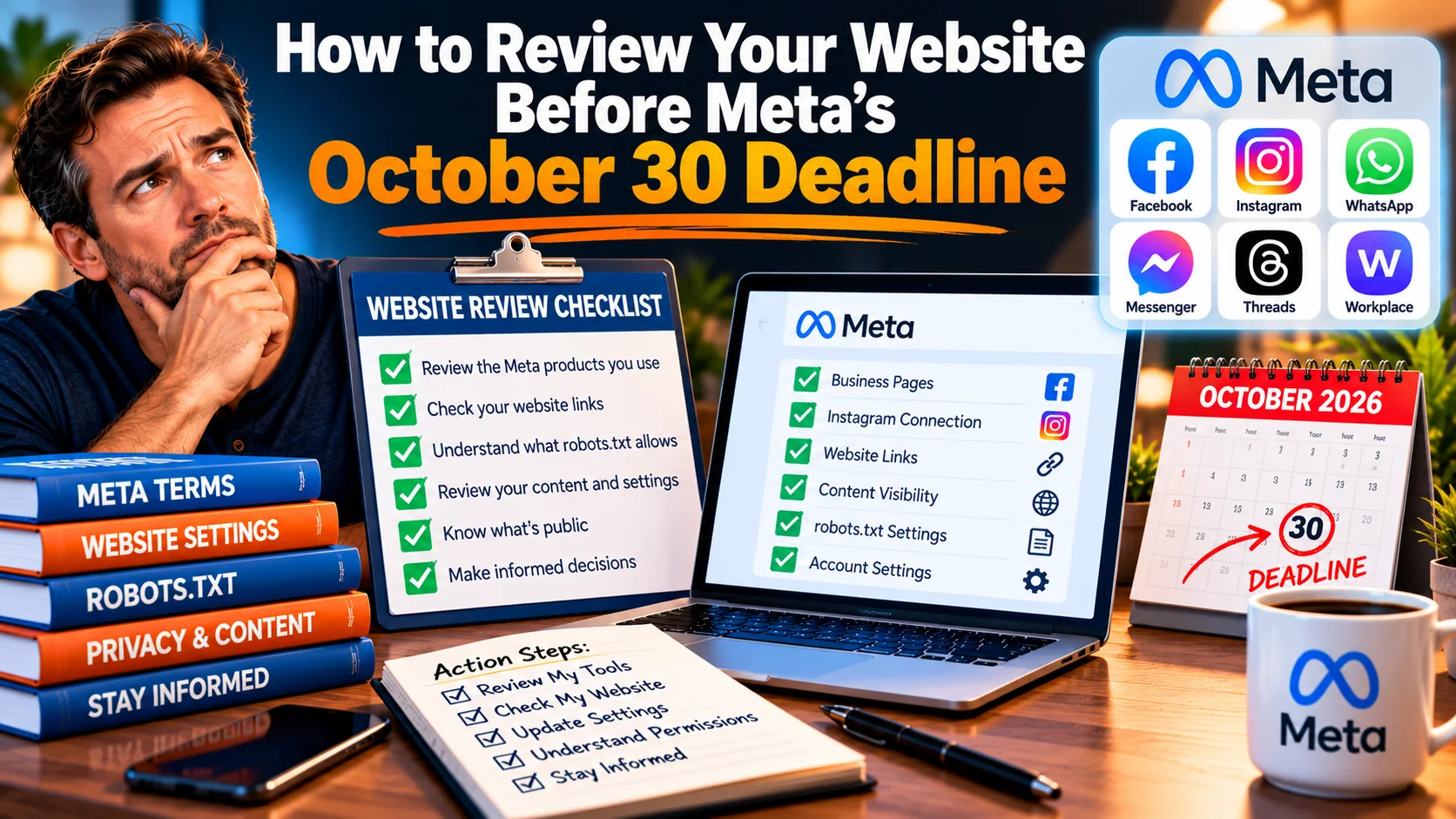
A practical website review can help business owners understand their Meta connections, crawler settings, and applicable terms before October 30.
With Meta business terms scheduled to change on October 30, 2026, small website owners have an opportunity to review how their businesses interact with the company’s commercial services.
The goal isn’t to disconnect every social media account or make dramatic changes based on alarming headlines.
Instead, focus on understanding which services you use, what information your website makes available, and which technical controls may be relevant.
These steps can help you make more informed decisions without disrupting the marketing activities that support your business.
Review the Meta Business Products You Actually Use
Start by identifying your business-related activities across Facebook, Instagram, and Meta’s other commercial tools.
You may maintain a Facebook Page, manage a professional Instagram account, use Meta Business Suite, or run advertising campaigns.
Some businesses use several of these services, while others maintain only a basic social media presence.
Make a simple inventory of the products you actively use.
Then review the official terms and policies associated with those products.
Pay particular attention to Meta’s Commercial Terms and any additional agreements that apply to your activities.
The important question is not whether you have a Facebook account.
It is which commercial services your business uses and what agreements govern those services.
You can begin with Meta’s official Commercial Terms.
Because the wording has been the subject of revisions, check the version currently applicable to your business rather than relying on an older screenshot or summary.
Check the Website URLs Connected to Your Business
Next, review the website addresses associated with your Meta business presence.
These may appear in your Facebook Page information, Instagram profile, advertisements, business settings, or connected commerce tools.
Confirm that the URLs are accurate and point to websites you currently operate or intend to promote.
If you discover outdated links, update them where appropriate.
You should also distinguish between different types of connections.
A website address displayed in a public profile is not necessarily the same as a website integrated with advertising measurement or commerce services.
Each connection may involve different technical functions and policies.
Reviewing these relationships helps you understand how your website participates in Meta’s business ecosystem.
However, removing a URL should not be assumed to revoke permissions already granted under an agreement or erase information previously collected.
Those questions depend on the applicable terms and circumstances.
Understand What Your Robots.txt File Can and Cannot Do
A robots.txt file provides instructions that automated web crawlers can use when accessing a website.
For many WordPress websites, this file is accessible through an address ending in /robots.txt.
Website owners may use it to communicate which areas of a site certain crawlers should avoid.
However, robots.txt has important limitations.
It is not a password system, a copyright enforcement mechanism, or a guarantee that every automated bot will obey its instructions.
It also does not automatically delete information collected before a rule was added.
Before changing your robots.txt configuration, understand which crawler you are addressing and what the proposed rule would affect.
Blocking a crawler involved in generating social media previews could interfere with how your articles appear when shared.
Similarly, broad restrictions could unintentionally affect search visibility or other useful website functions.
For beginners, making sweeping changes without understanding the consequences can create more problems than it solves.
If you use WordPress and an SEO plugin, review the available documentation before editing crawler rules.
And remember that blocking a technical request does not necessarily resolve a separate question about contractual permissions.
Distinguish Between Meta’s Different Crawlers
Not every automated request associated with Meta serves the same purpose.
Some systems retrieve information needed to display shared links.
Others may support different platform functions.
That is why website owners should avoid assuming that all Meta-related crawlers are interchangeable.
Meta publishes technical documentation about its web crawlers, including information relevant to how websites interact with its services.
You can consult Meta’s web crawler documentation when investigating specific crawler behavior.
Before making changes, identify the relevant crawler and review its documented purpose.
Consider whether restricting it might affect features your business relies on.
For example, attractive link previews can help readers recognize your articles when you share them on Facebook.
Disrupting those previews may reduce the usefulness of your social media posts.
The objective should be to make an informed technical decision, not to block every unfamiliar automated system.
Document Your Current Settings and Policy Review
Keeping a simple record of your review can be helpful, especially when platform terms are changing.
Record which Meta business products you use, the website URLs associated with them, and the date you examined the applicable terms.
If you make changes to website settings, note what you changed and why.
You may also want to save a copy of relevant policy language for your own records, subject to the platform’s applicable rules.
This gives you a reference point if Meta publishes further clarifications.
It can also help you avoid repeating the same investigation whenever another article or social media post raises concerns.
A basic document or spreadsheet is sufficient.
You do not need an expensive monitoring system to keep track of a handful of important business settings.
The goal is clarity and consistency.
Know When Professional Advice Makes Sense
Most small website owners can begin by reviewing their accounts, reading official documentation, and understanding the basic differences between website crawling and AI training.
However, some situations deserve additional expertise.
If your business depends heavily on proprietary content, operates across multiple jurisdictions, or has substantial advertising and contractual obligations, professional guidance may be worthwhile.
A qualified legal professional can help interpret the agreement in the context of your specific circumstances.
A knowledgeable website developer or technical specialist may help evaluate crawler behavior and website configuration.
These are different areas of expertise.
A technical setting cannot answer every legal question, and a legal interpretation does not automatically explain how a crawler operates.
For most beginners, the best immediate approach is straightforward.
Review the applicable terms, confirm your website connections, avoid untested technical changes, and stay alert for official updates.
You don’t need to panic about every platform policy change. You need enough information to make decisions that support your business.
That is a much more sustainable approach to managing an online presence.
Should Small Businesses Stop Using Facebook and Instagram?
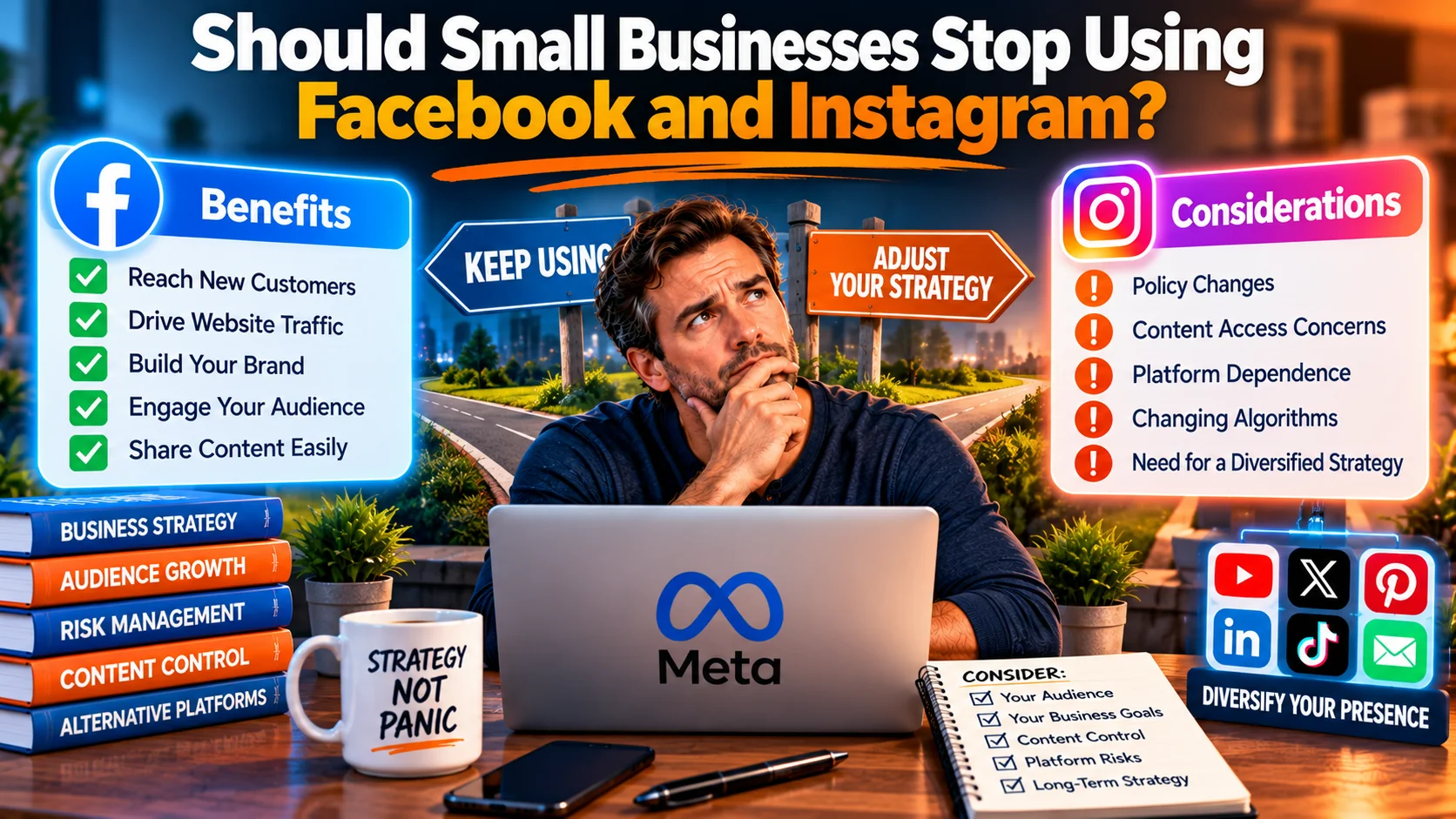
Facebook and Instagram can remain valuable marketing channels, but small businesses should balance visibility with content ownership and platform independence.
When a major technology company announces controversial policy changes, it’s understandable for business owners to question whether they should continue using its services.
However, Meta business terms changing on October 30, 2026, does not automatically mean every small business should abandon Facebook or Instagram.
These platforms can still help entrepreneurs reach customers, share educational content, and develop relationships with their audiences.
The more useful question is how to benefit from those opportunities while understanding the risks of depending too heavily on a third-party platform.
Understanding the Actual Risks
The concerns surrounding Meta’s updated Commercial Terms involve contractual permissions, automated website access, and questions about how information may be used.
Those issues deserve attention.
However, the existence of disputed policy language does not establish that every business website has been accessed or used for artificial intelligence training.
Business owners should distinguish between what an agreement may authorize, what Meta says its systems do, and what has actually been verified.
That distinction makes it easier to respond proportionately rather than make decisions based on speculation.
Why Panic Is Not a Business Strategy
Removing your Facebook Page or abandoning Instagram might feel like an immediate way to regain control.
But such a decision could also eliminate a useful source of traffic, customer communication, or brand visibility.
Before making major changes, consider how much your business depends on these platforms and whether you have alternative ways to reach your audience.
Review the current terms, examine your account connections, and identify any concerns that genuinely affect your operations.
A deliberate decision based on reliable information is more valuable than a rushed reaction to an alarming headline.
Balancing Visibility and Content Control
Social media and independently operated websites serve different purposes.
Facebook and Instagram can introduce people to your business, while your website provides a central location for your articles, resources, products, and services.
If you’re ready to establish that foundation, our guide, How to Build a Business Website With WordPress: A Beginner’s Guide, walks beginners through the process.
Using both strategically allows you to benefit from social media visibility without making those platforms the entire foundation of your online presence.
This doesn’t eliminate every risk associated with external services.
However, it encourages a healthier balance between reaching new audiences and maintaining resources that you manage directly.
Building an Audience Beyond Social Media
One of the most useful lessons from the October 2026 controversy is the importance of developing direct relationships with your audience.
A website gives readers a place to discover your content.
An email subscription system allows interested visitors to receive updates when they choose to subscribe.
Search engine visibility can help people find your educational resources without relying exclusively on social media recommendations.
Search platforms are evolving, too. Our article, Google Is Changing AI Search Again: Will Small Websites Finally Get More Clicks?, explores what those changes could mean for independent website owners.
These channels work best when they support one another.
For help bringing your website, social media, and other marketing channels together, explore our guide, How to Create a Digital Marketing Strategy for Beginners: A Step-by-Step Guide.
At LaunchForge Studio, our approach is to provide genuinely useful information, help beginners make informed decisions, and build trust through consistent value.
That philosophy applies whether we’re publishing an article, sharing a social media post, or introducing readers to a business tool.
The goal isn’t to avoid every third-party platform. It’s to use those platforms thoughtfully while building a business that doesn’t depend entirely on any one of them.
Meta Business Terms 2026: Frequently Asked Questions
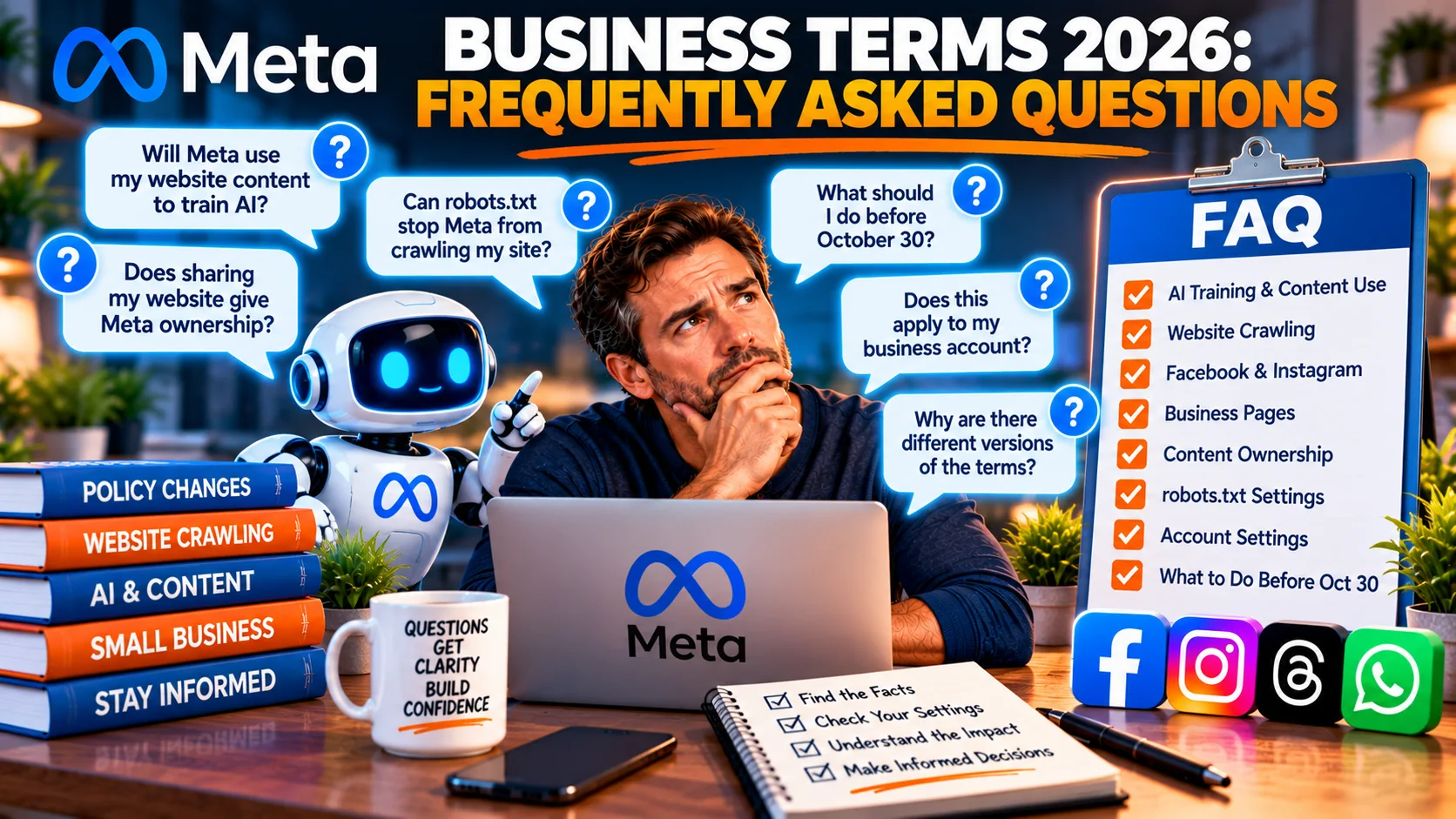
Answers to common questions about Meta’s business terms can help website owners understand policy changes and make informed decisions.
Will Meta Use My Website Content to Train AI?
The October 2026 controversy involved proposed Commercial Terms containing language that raised concerns about website crawling and AI training.
Meta reportedly removed an explicit AI-training reference from a revised version on October 17. However, questions remained about differences between versions of the agreement.
The disputed language does not, by itself, prove that Meta has used content from your particular website to train an AI model.
Review the latest official terms applicable to your business before drawing conclusions.
Does Sharing My Website on Facebook Give Meta Ownership of My Content?
Sharing a link to your website does not automatically transfer ownership of your original articles, photographs, or other creative work to Meta.
However, using Meta’s services may involve granting certain permissions under applicable agreements.
Copyright ownership and contractual permissions are different concepts.
Understanding what you own and what permissions you grant is an important part of managing your online business.
Can Robots.txt Stop Meta From Crawling My Website?
A robots.txt file can communicate crawling instructions to automated systems that recognize and follow them.
However, it does not guarantee that every crawler will comply, prevent all forms of website access, or remove information previously collected.
Blocking certain crawlers may also interfere with useful functions such as Facebook link previews.
Review Meta’s crawler documentation and understand the potential consequences before making changes.
What Should Small Business Owners Do Before October 30?
Start by reviewing the current Meta Commercial Terms and identifying which business products you use.
Check the website URLs connected to your accounts, review relevant settings, and document any changes you make.
Avoid making major technical or marketing decisions based solely on alarming headlines.
If your business has significant legal, contractual, or intellectual property concerns, consider seeking qualified professional advice.
The objective is to understand the policies affecting your business and respond appropriately.
Final Thoughts: Stay Informed Without Losing Control of Your Business
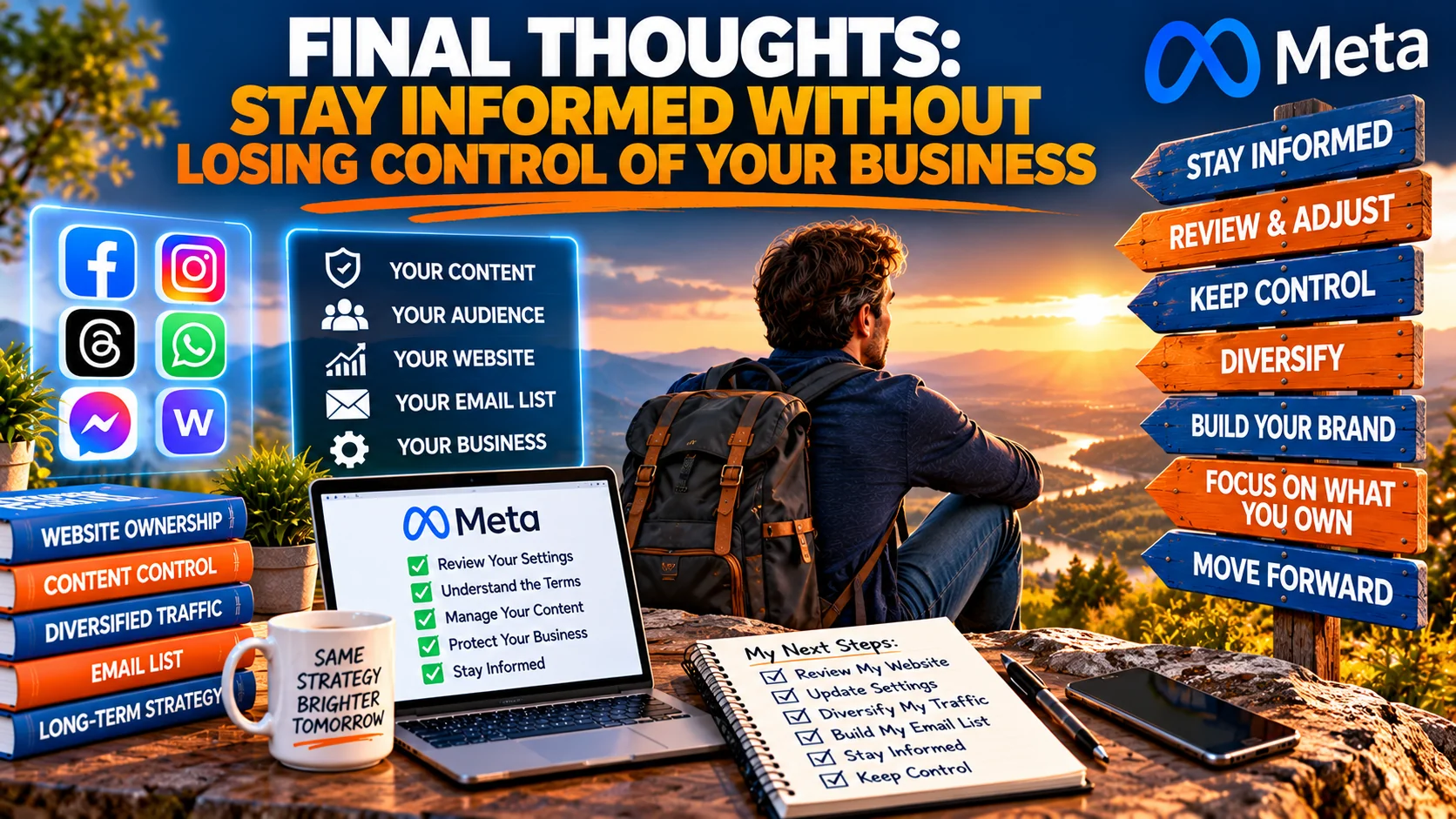
Platform policies may change, but building an independent website, maintaining audience relationships, and providing genuine value remain essential.
The controversy surrounding Meta business terms in October 2026 highlights an important reality of running an online business: the platforms we depend on can change their policies, technologies, and agreements.
For small website owners, those changes can raise legitimate questions about content ownership, automated website access, and the growing role of artificial intelligence.
Meta’s reported revisions to its Commercial Terms demonstrate why it’s important to examine developing stories carefully rather than rely on the first headline that appears.
The original AI-training concerns deserve attention, but they should not be confused with verified evidence that every business website has been used to train artificial intelligence.
Understanding that distinction allows entrepreneurs to make informed decisions without unnecessary fear.
Before October 30, review the official terms that apply to your business, understand which Meta services you use, and consider whether any website connections or settings need attention.
Just as importantly, remember that your online business should be built on more than one platform.
Your website, original content, subscriber relationships, and reputation are valuable resources worth developing and maintaining.
At LaunchForge Studio, we believe sustainable growth begins with providing genuine value, treating people with integrity, and helping others succeed.
That means staying informed about important changes while keeping our attention on what matters most: creating useful resources, earning trust, and building meaningful relationships with the people we serve.
Technology will continue to evolve. Platform policies will continue to change. But a business built around genuine value has a foundation worth protecting.