If you’re searching for a ClickFunnels review, you’re probably trying to answer a simple question: Is this platform actually worth paying for when you want to build landing pages and sales funnels?
ClickFunnels is one of the better-known platforms built around creating funnels that guide visitors through a specific marketing or sales process. But the platform has expanded well beyond basic landing pages, with tools for websites, email marketing, automation, courses, customer management, and more.
That makes ClickFunnels interesting for what we’re building here at LaunchForge Studio. We’ve been exploring landing pages from several angles—what they are, the different types you can build, and how to create one yourself in WordPress with Divi 5. ClickFunnels gives us an opportunity to look at a platform designed specifically around the funnel side of that equation.
There’s one important distinction before we go any further: we have not used the ClickFunnels free trial or personally built a funnel inside the platform.
Instead, this review is based on our research into ClickFunnels’ current features, pricing, landing page and funnel tools, terms, affiliate materials, and independent customer feedback. Where something would require firsthand experience to judge fairly, we’ll tell you rather than pretending we’ve tested something we haven’t.
Affiliate Disclosure: LaunchForge Studio is an independent ClickFunnels affiliate. If you purchase or sign up for ClickFunnels through links on this page, we may receive a referral commission at no additional cost to you. Our opinions and conclusions are our own.
What Is ClickFunnels?
ClickFunnels is an online platform designed to help businesses create sales funnels, landing pages, websites, and other parts of the customer journey from one connected system.
The basic idea behind a sales funnel is simple. Instead of sending a visitor to a traditional website and giving them dozens of places to go, a funnel guides that visitor through a planned series of steps toward a specific action.
That action might be joining an email list, registering for an event, purchasing a product, booking an appointment, or moving from a landing page to the next stage of an offer.
This is where ClickFunnels connects directly with what we’ve been building at LaunchForge Studio.
A landing page can handle one specific conversion goal. A funnel takes that idea further by connecting multiple pages and actions into a larger customer journey.
For example:
Traffic → Landing Page → Lead or Purchase → Follow-Up → Next Offer
ClickFunnels is built around creating and managing that type of process without requiring users to assemble every part from completely separate tools.
That’s one reason the platform has become closely associated with online sales funnels. But today’s ClickFunnels platform goes considerably further than simply building funnel pages.
What Can You Build With ClickFunnels?
ClickFunnels has grown into considerably more than a landing page builder.
The platform is still centered around sales funnels, but its current collection of tools can support several parts of an online business from the same ecosystem.
Landing Pages and Sales Funnels
This is the part of ClickFunnels that interests us most for this review.
You can create individual landing pages or connect multiple pages together as steps in a sales funnel. ClickFunnels provides a drag-and-drop editor along with templates that can be customized without requiring you to write the underlying code.
That makes it possible to build pages for collecting leads, presenting offers, processing sales, and moving visitors through different stages of a funnel.
Email Marketing and Automation
ClickFunnels also includes email marketing and automation tools.
That means a visitor’s journey does not necessarily have to stop after completing a landing page. Leads can be followed up through email and connected to automated workflows designed around actions they take within the funnel.
For someone trying to reduce the number of separate services needed to run a marketing system, that integration may be one of the more important parts of the platform.
Websites, Stores, Courses, and Communities
The platform extends into other areas as well.
ClickFunnels currently provides tools for building websites, selling products through online stores, delivering courses, creating membership and community experiences, and managing contacts and customer relationships.
It also includes features such as appointments, analytics, checkout tools, A/B testing, and other applications that can support different stages of the customer journey.
The important point is that you do not necessarily need every one of these features to use ClickFunnels.
For someone primarily interested in landing pages and funnels, the real question is whether having these tools connected inside one platform provides enough value to justify the cost.
ClickFunnels Pricing in 2026
ClickFunnels is not positioned as a low-cost standalone landing page builder. Its pricing reflects the fact that you’re getting a broader collection of funnel, marketing, email, course, website, and automation tools within the platform.
At the time of this review, ClickFunnels offers three primary monthly plans:
Launch — $97 per month
Launch is the entry-level plan. It includes unlimited funnels, landing pages, site pages, and visitors, along with one workspace, two team members, up to 10,000 contacts, 50,000 emails per month, three courses, and five custom domains.
Scale — $197 per month
Scale increases the limits considerably, including five workspaces, five team members, up to 75,000 contacts, 300,000 emails per month, six courses, and unlimited custom domains. It also adds features such as priority and live chat support, the custom code editor, webhooks, and full API access.
Optimize — $297 per month
Optimize is aimed at marketers operating at a larger scale. It includes 10 workspaces, 10 team members, up to 150,000 contacts, 750,000 emails per month, 10 courses, unlimited custom domains, and the additional capabilities included with Scale.
ClickFunnels also offers annual billing at a discount. At the time of writing, the advertised annual rates work out to approximately $81 per month for Launch, $164 per month for Scale, and $248 per month for Optimize.

ClickFunnels pricing shown at the time of our review, including the Launch, Scale, Optimize, and Dominate plans. Pricing and features may change.
Is $97 Per Month Expensive for a Landing Page Builder?
If all you need is a single landing page, $97 per month can be difficult to justify.
But that isn’t really the fairest way to evaluate ClickFunnels.
The platform is designed to combine several functions that might otherwise require separate services, including landing pages, funnels, email marketing, automation, checkout tools, websites, courses, and customer management.
So the better question is not simply whether $97 is expensive for a page builder.
It’s whether you would actually use enough of the broader ClickFunnels platform to make that monthly cost worthwhile for your business.
For someone who only needs a few pages and already has WordPress, hosting, email marketing, and other tools in place, the equation can look very different from someone who wants to build an entire funnel-driven marketing system inside one platform.
ClickFunnels for Landing Pages: What Does It Actually Offer?
Landing pages are where ClickFunnels connects most directly with what we’ve been building at LaunchForge Studio.
ClickFunnels allows you to create a standalone landing page for a specific campaign or make that page part of a larger sales funnel.
You can start with a template or build a page from scratch using the ClickFunnels drag-and-drop editor. Page elements can be moved and customized without requiring you to write code, and the editor is designed to support pages across desktop and mobile devices.
That covers the basic page-building side of the equation.
Where ClickFunnels becomes more interesting is what can happen after someone reaches the page.
From Landing Page to Complete Funnel
A landing page does not have to operate by itself.
You might start with a page designed to collect an email address and then send the visitor to a thank-you page. From there, an automated email sequence could continue the conversation and eventually direct that lead toward an offer.
Another funnel could move someone directly from a sales page to checkout and then present an additional offer after the purchase.
Instead of building each piece independently and figuring out how to connect everything later, ClickFunnels is designed around linking those steps together.
That is the fundamental difference between looking at ClickFunnels purely as a landing page builder and looking at it as a funnel platform.
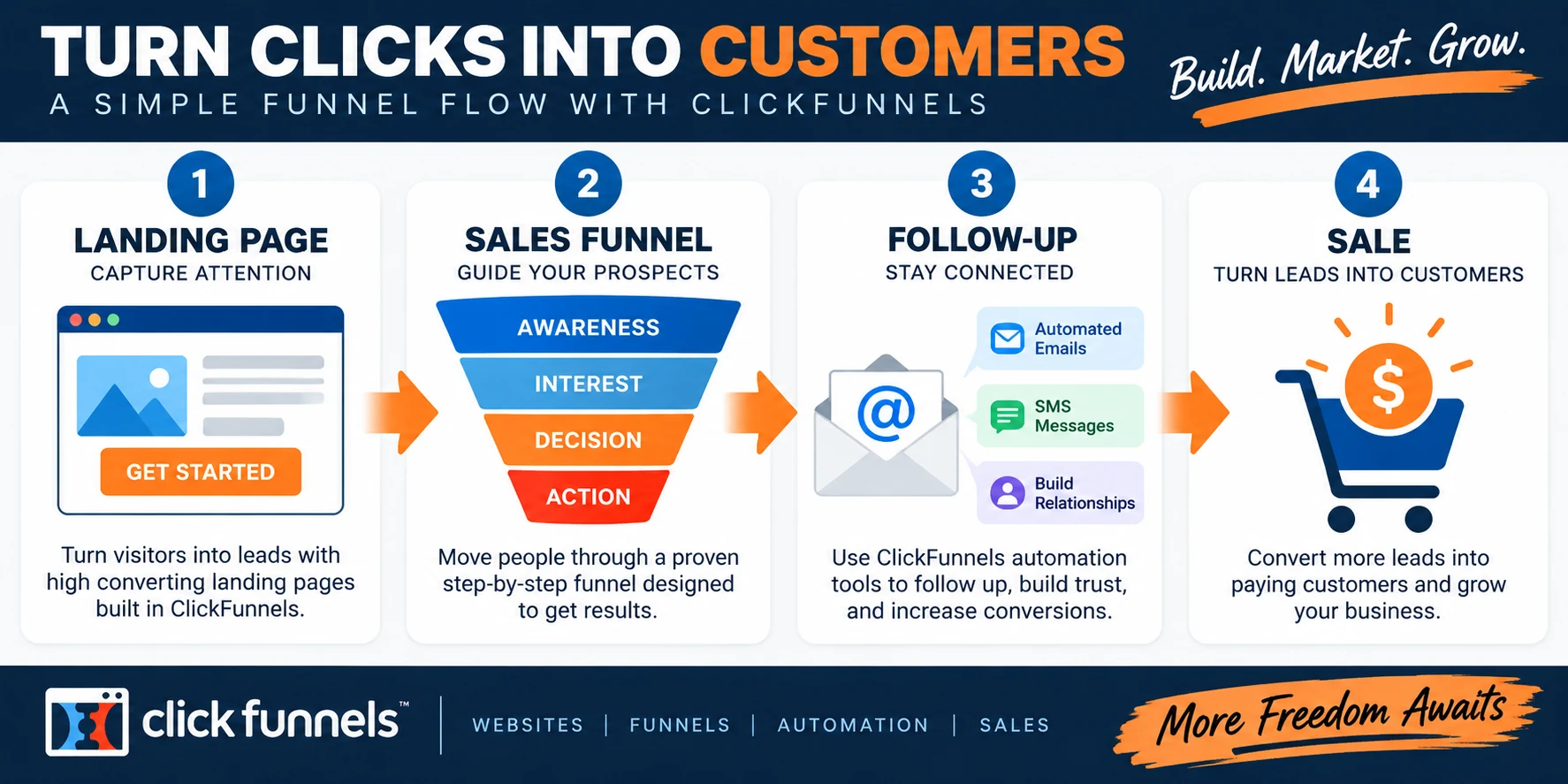
A simple funnel flow showing how a landing page can lead into a sales funnel, automated follow-up, and ultimately a sale.
Built-In A/B Testing
ClickFunnels also includes A/B testing capabilities.
A/B testing lets you create variations of a page or funnel step and compare their performance. For example, you could test different headlines, calls to action, page designs, offers, or checkout experiences to see which version produces better results.
This matters because publishing a landing page is only the beginning.
Once real visitors start reaching the page, testing gives you a way to make decisions based on actual behavior rather than assuming the first version you built is automatically the best one.
How This Differs From Our Divi 5 Landing Page
Our LaunchForge Studio landing page was built directly inside WordPress using Divi 5.
That approach gives us control over the page within a WordPress website we already operate. ClickFunnels approaches the problem from a different direction: the landing page can become one component of a larger funnel system with follow-up, testing, checkout, automation, and other steps connected around it.
Neither approach automatically makes a landing page effective.
The platform can provide the tools, but the page still needs a clear goal, focused message, strong call to action, and an offer that gives the visitor a reason to take the next step.
Who Is ClickFunnels Best Suited For?
ClickFunnels can technically be used by many different kinds of businesses, but that does not mean every business needs it.
The platform makes the most sense when funnels are going to play an important role in how you generate leads, sell products or services, and follow up with potential customers.
Entrepreneurs and Online Business Owners
Someone building an online business may want more than a traditional website.
If your strategy involves attracting visitors, capturing leads, presenting offers, processing payments, and following up with customers, ClickFunnels is designed to connect those activities within the same platform.
This can be especially appealing to someone who would rather work inside one ecosystem than assemble and connect several separate marketing tools.
Coaches, Consultants, and Course Creators
ClickFunnels can also make sense for businesses that sell expertise.
A coach or consultant might use a funnel to generate leads, qualify potential clients, schedule appointments, and present an offer.
Course creators can combine funnels with email follow-up, checkout pages, courses, membership areas, and communities without necessarily moving customers between several unrelated platforms.
Affiliate and Digital Marketers
Affiliate marketers can use landing pages and funnels to create a bridge between traffic sources and the products or services they promote.
Instead of sending every visitor directly to an affiliate offer, a marketer could use a landing page to explain an offer, collect a lead when appropriate, or guide the visitor toward a more specific next step.
As with any affiliate marketing strategy, the funnel itself does not guarantee results. Traffic quality, the offer, the message, and the relationship with the audience still matter.
Ecommerce and Product Sellers
ClickFunnels also supports physical product sales through its store and checkout tools.
A seller might use a funnel to focus attention on a particular product, add order bumps or additional offers, and continue communicating with customers after the initial purchase.
That funnel-first approach is different from simply presenting visitors with a large catalog and expecting them to browse until they find something they want.
When ClickFunnels May Be More Than You Need
This part matters.
If you only need a basic website, a blog, or an occasional landing page, ClickFunnels may provide considerably more functionality than you actually need.
The same applies if you already have a WordPress website, page builder, email marketing service, checkout system, and automation tools that work well together.
In that situation, moving everything into another platform may not solve a meaningful problem.
ClickFunnels becomes easier to justify when you plan to make regular use of the broader funnel system—not simply because you need somewhere to publish one landing page.
ClickFunnels Pros and Cons
No platform is the right fit for every online business.
ClickFunnels brings a large collection of marketing tools together under one roof, but that convenience comes with a monthly cost and a different approach than building your business around a traditional website.
Here are the main advantages and considerations we see based on the platform’s current features and pricing.
ClickFunnels Pros
Funnels are at the center of the platform
ClickFunnels is built around moving visitors through a planned customer journey. Landing pages, checkout pages, follow-up, email, automation, upsells, and other funnel steps can work within the same ecosystem.
Unlimited funnels and landing pages on the primary plans
The current Launch, Scale, and Optimize plans include unlimited funnels, landing pages, site pages, and visitors. Other limits, including contacts, monthly emails, workspaces, team members, courses, and custom domains, vary by plan.
Built-in email marketing and automation
Having email and automation capabilities inside the same platform can reduce the need to connect a separate email service to every funnel you create.
A/B testing is built into the platform
Being able to test different versions of funnel pages and marketing elements gives marketers a way to improve campaigns using actual performance data rather than guesswork.
More than just funnel pages
ClickFunnels also includes tools for websites, stores, courses, communities, appointments, customer management, analytics, and other parts of an online business.
ClickFunnels Cons and Considerations
The starting price is $97 per month
That’s a meaningful recurring expense, particularly for a beginner who is not yet generating revenue or someone who only needs an occasional landing page.
You may be paying for tools you don’t need
The all-in-one approach is valuable when you’re actually using several parts of the platform. If you already have a website, page builder, email platform, automation system, and checkout solution that work well together, some of the ClickFunnels feature set could duplicate tools you’re already paying for.
Important limits still exist
Although funnels, landing pages, site pages, and visitors are currently unlimited on the primary plans, other resources are not. Contacts, monthly email volume, courses, workspaces, team members, and—in the Launch plan—custom domains have defined limits.
Moving platforms has a cost of its own
Switching to an all-in-one platform isn’t only about the subscription price. If you’ve already built pages, email sequences, automations, products, and other systems elsewhere, rebuilding or moving those assets requires time and effort.
It’s difficult for us to judge the editor itself without using it
ClickFunnels describes its editor as a drag-and-drop building experience, but this is one area where we’re deliberately not going to give you a fake verdict.
We haven’t personally built a ClickFunnels page.
So while we can verify what the editor is designed to do, we can’t honestly tell you whether we found it easier, faster, or more enjoyable to use than another page builder.
That judgment requires actually using the software.
What Do Actual ClickFunnels Users Say?
Because we have not personally used the ClickFunnels page builder, independent customer reviews are especially useful for this part of our evaluation.
At the time of this review, ClickFunnels has an overall rating of 4.5 out of 5 on Capterra based on 666 reviews. Its individual ratings include 4.3 for ease of use, 4.3 for customer service, and 4.1 for value for money.
Those numbers provide some useful context, but the comments behind them tell us more.
What Users Commonly Like
Positive reviews frequently mention the ability to create landing pages and funnels without coding.
Users also point to templates, marketing features, automation, upsells, order bumps, and having multiple tools available within one platform as advantages.
For some customers, that combination appears to be the real appeal of ClickFunnels. Instead of treating the software as nothing more than a page builder, they’re using it as part of a larger sales and marketing system.
Where Users Report Frustration
The feedback isn’t universally positive.
Some reviewers describe a learning curve created by the number of features available, while others mention the monthly cost as a drawback.
There are also reviews describing technical problems, difficulty with certain features, or mixed experiences with customer support.
That doesn’t mean every ClickFunnels customer will experience those problems. Individual software reviews can vary dramatically depending on what someone is building, their technical experience, the version of the software they used, and the features they rely on.
But those criticisms are still worth considering before committing to a recurring subscription.
The Bigger Pattern in the Reviews
Taken together, the customer feedback reinforces something we’ve already noticed while researching ClickFunnels.
The platform appears to make the most sense when you intend to use it as a funnel and marketing system, rather than paying $97 per month simply because you need somewhere to build a landing page.
If you can take advantage of several parts of the platform, having those tools connected may provide meaningful value.
If you only need one or two of them, the economics become much harder to justify.
ClickFunnels Free Trial and Cancellation: What You Should Know
ClickFunnels promotes a free trial, but there’s an important detail to understand before starting one: the trial automatically converts into a paid subscription if you don’t cancel it in time.
According to the current ClickFunnels Terms of Service, the company says it will send an email reminder at least seven days before you’re charged.
If you decide not to continue, the Terms say you must cancel at least 24 hours before the free trial ends. Cancellation can be requested through your ClickFunnels Account Dashboard or by contacting ClickFunnels support.
If the trial is not canceled in time, the payment method provided during enrollment is automatically charged the applicable monthly subscription rate.
Why We Chose Not to Start the Free Trial
For this review, we considered starting the ClickFunnels trial so we could test the page builder ourselves.
Ultimately, we decided not to.
We weren’t interested in starting a recurring $97-per-month subscription simply for the sake of being able to say we had clicked around inside the software.
That decision creates a limitation in this review, and we’re comfortable acknowledging it.
We can research the platform’s features, pricing, terms, independent customer feedback, and published capabilities. What we cannot do is give you a firsthand opinion about what it’s like to build and manage a complete funnel inside ClickFunnels.
If hands-on experience with the editor is the most important part of your buying decision, keep that limitation in mind.
What Happens After the Trial?
The billing terms become more important once someone becomes a paying subscriber.
ClickFunnels’ current Terms say monthly and annual subscriptions require at least 10 days’ notice before the next subscription period. With less notice, the payment method may still be charged. The Terms also describe the subscription as using negative option billing, meaning recurring billing continues until the customer completes the required cancellation process.
That’s worth knowing before entering payment information—not after seeing another charge on your statement.
As with any subscription software, we recommend reading the current billing and cancellation terms yourself before starting a trial because pricing, offers, and policies can change.
Is ClickFunnels Worth It in 2026?
Whether ClickFunnels is worth the price depends less on how many features it offers and more on how many of those features you will actually use.
At $97 per month for the Launch plan, ClickFunnels is difficult to justify if your only goal is to publish an occasional landing page.
There are other ways to accomplish that, including the WordPress and Divi 5 approach we’ve been using here at LaunchForge Studio.
But ClickFunnels becomes a different proposition when landing pages are only the beginning of what you want to build.
If your business relies on funnels that connect lead generation, email follow-up, checkout pages, upsells, courses, customer management, automation, and other marketing activities, having those pieces available inside one platform may reduce the number of separate tools you need to manage.
ClickFunnels May Make Sense If…
You plan to build and test multiple sales funnels.
You want landing pages, email marketing, automation, checkout tools, and other funnel components connected inside one platform.
You sell products, services, coaching, courses, memberships, or other offers where a structured customer journey matters.
You expect to use enough of the included tools to justify the recurring subscription cost.
You would rather operate within an integrated platform than assemble your marketing system from several separate services.
ClickFunnels May Not Make Sense If…
You only need a basic website or a few landing pages.
You already have a WordPress-based marketing stack that does what you need.
You’re unlikely to use the email, automation, checkout, course, store, or other tools included with the platform.
A $97 monthly software expense would put unnecessary pressure on a new business that is still trying to validate its offer.
You prefer owning and managing your website through WordPress rather than building a larger portion of your business inside a hosted platform.
Our Take
ClickFunnels clearly offers much more than a basic landing page builder. Its current platform is designed around connecting multiple stages of the customer journey, from attracting a visitor to generating a lead, making a sale, and continuing the relationship afterward.
That doesn’t automatically make it worth $97 per month for everyone.
For someone who intends to use ClickFunnels as a central part of a funnel-driven business, the collection of integrated tools is where the value proposition becomes much easier to understand.
For someone who only wants to build a landing page, it is probably more platform than the job requires.
And because we haven’t personally built a funnel inside ClickFunnels, we’re not going to pretend we can give the editor itself a final thumbs-up or thumbs-down.
What we can say is that the feature set makes sense for the audience ClickFunnels is targeting.
Whether those features are worth the recurring cost depends on what you’re actually going to build with them.
Ready to Explore ClickFunnels for Yourself?
Research can tell you a lot about a platform, but whether ClickFunnels fits your business ultimately depends on what you’re trying to build.
If you’re looking for a system that combines landing pages, sales funnels, email marketing, automation, checkout tools, and other parts of the customer journey, you can explore ClickFunnels and decide whether the platform makes sense for you.
Before starting a trial, take a look at the current plans, features, and billing terms so you know exactly what you’re signing up for.
Explore ClickFunnels and Start a Free Trial
Affiliate Disclosure: The link above is an affiliate link. LaunchForge Studio may receive a commission if you sign up through it, at no additional cost to you.
Frequently Asked Questions About ClickFunnels
What is ClickFunnels used for?
ClickFunnels is designed to help businesses create landing pages, sales funnels, checkout experiences, and other parts of a customer journey. The platform also includes tools for email marketing, automation, websites, courses, communities, stores, and customer management.
How much does ClickFunnels cost?
At the time of this review, the ClickFunnels Launch plan starts at $97 per month. Scale is $197 per month, while Optimize is $297 per month. Annual billing is also available at discounted effective monthly rates.
Does ClickFunnels include landing pages?
Yes. Landing pages are one of the core parts of ClickFunnels. You can create standalone landing pages or use them as individual steps within a larger sales funnel.
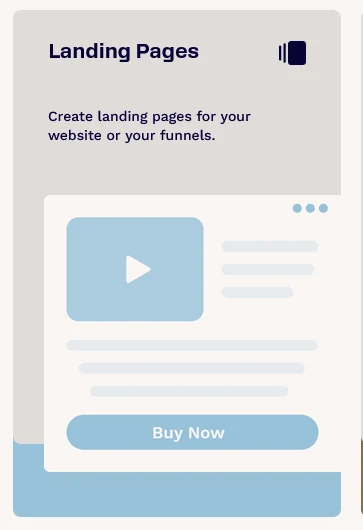
ClickFunnels includes a dedicated Landing Pages tool for creating pages that can work independently or as part of a sales funnel.
Do I need ClickFunnels if I already use WordPress?
Not necessarily.
WordPress can already be used to build websites and landing pages, especially when combined with a page builder such as Divi 5. ClickFunnels becomes more relevant when you want an integrated platform centered around funnels, follow-up, automation, checkout, testing, and other marketing functions.
Which approach makes more sense depends on the tools you already have and what you’re trying to build.
Does ClickFunnels offer a free trial?
Yes. ClickFunnels currently offers a free trial. According to its Terms of Service, the trial converts to a paid subscription unless it is canceled at least 24 hours before the trial ends.
Always check the current offer and billing terms before signing up because pricing and trial conditions can change.
Can beginners use ClickFunnels?
ClickFunnels is designed to let users create pages and funnels without having to code them from scratch.
However, building the page is only one part of building an effective funnel. Beginners still need to understand their offer, audience, messaging, traffic strategy, follow-up, and the action they want visitors to take.
The software can provide the tools. It cannot make those decisions for you.
Final Thoughts: Choose the Funnel Tool That Fits the Business
ClickFunnels has earned its place as one of the better-known platforms built around sales funnels, but the important question isn’t whether it has a long list of features.
It’s whether those features match the business you’re actually building.
If you want landing pages, funnels, email marketing, automation, checkout tools, courses, and other marketing functions connected within one ecosystem, ClickFunnels gives you a platform designed around that approach.
If you already have those pieces working together—or you simply need a website and an occasional landing page—the additional monthly expense may be harder to justify.
That’s one of the lessons we’re continuing to learn while building LaunchForge Studio.
The goal isn’t to collect as many tools as possible.
It’s to understand what you’re trying to accomplish, choose the tools that help you accomplish it, and then actually put them to work.
ClickFunnels is another option in that toolbox.
Whether it belongs in yours depends on what you plan to build.
Build Smarter. Launch Faster. Grow Stronger.