
Is your online business too complicated? If it feels that way, you are definitely not alone.
Most online businesses do not start out complicated. They become complicated one decision at a time.
You add a website builder because you need a website.
Then you add an email marketing platform.
A landing page builder.
A contact management system.
An automation tool.
Analytics.
Link tracking.
Social media tools.
Traffic platforms.
Maybe a few WordPress plugins.
Then another piece of software promises to make everything easier, so you add that too.
Before long, something that was supposed to give you more freedom starts requiring an increasing amount of time just to manage.
You have multiple logins, monthly subscriptions, disconnected systems, overlapping features, integrations that need attention, and dashboards filled with tools you barely use.
The strange part is that every individual decision may have made sense at the time.
The problem is what happens when all of those decisions begin stacking on top of each other.
Complexity quietly becomes part of the business.
And more complexity does not automatically create better results.
In many cases, it does the opposite.
It becomes harder to understand what is working, harder to identify what needs improvement, and harder to spend your time on the activities that actually help the business grow.
The solution is not necessarily to throw everything away and start over.
Instead, it begins with understanding why online businesses become complicated in the first place and learning how to recognize complexity that is no longer serving a useful purpose.
That is exactly what we are going to break down in this article.
How Online Businesses Become Complicated
Most people do not intentionally build a complicated online business.
It usually happens gradually.
You start with a simple goal. Maybe you want to sell a product, promote a service, build an email list, generate leads, or create another source of income online.
At first, you only need a few basic tools to make that happen.
Then the business begins to grow.
You discover a new marketing strategy, so you add another tool.
You want better email automation, so you add another platform.
You hear that you need a funnel.
Then a CRM.
Then better analytics.
Then another traffic source.
Then another plugin that promises to solve a problem you did not even realize you had.
Each addition seems small by itself.
But eventually, all those small additions begin creating something much bigger: a business with more moving parts than you actually need.
Complexity Usually Happens Gradually
One of the reasons complexity can be difficult to recognize is because it rarely appears overnight.
Imagine starting with a website and an email marketing platform.
That feels manageable.
A few months later, you add a landing page builder because you want better lead capture.
Then you subscribe to another service for automation.
Another for link tracking.
Another for scheduling social media.
Another for analytics.
None of those decisions necessarily feels excessive when you make it.
But six months later, you may be managing several different platforms just to accomplish a handful of basic marketing tasks.
You are no longer simply running the business.
You are also managing the technology required to run the business.
And that distinction matters.
Every New Tool Creates Another Moving Part
Adding a new tool does not only give you another feature.
It can also give you another login to remember, another dashboard to learn, another subscription to manage, another integration to maintain, and another place where your business information may be stored.
Sometimes that tradeoff is completely worthwhile.
A tool that solves an important problem or saves significant time can make your business much easier to operate.
The problem begins when tools are added without considering how they fit into the larger system.
Before adding something new, it helps to ask a simple question:
What specific problem will this solve that my current system cannot already solve?
If there is a clear answer, the new tool may have a useful role.
If there is not, you may simply be adding another layer of complexity.
Growth Does Not Require Constantly Adding More
There is an easy assumption to make when building an online business:
More tools + more strategies + more automation = more growth.
But growth does not always work that way.
Sometimes the next improvement does not come from adding something.
It comes from removing something unnecessary.
Simplifying a process.
Connecting systems that already exist.
Using the tools you already have more effectively.
Or focusing more attention on the few activities that are actually producing results.
A growing business may eventually need more sophisticated systems.
But sophistication should solve real problems.
It should not create new ones.
That is why one of the most useful skills you can develop as an online business owner is knowing the difference between complexity that supports growth and complexity that simply creates more work.
The Tool Overload Problem
One of the fastest ways to make an online business complicated is to collect more tools than the business actually needs.
It is surprisingly easy to do.
Most marketing platforms are designed to solve a particular problem.
One promises better landing pages.
Another promises smarter email automation.
Another offers better analytics.
Another handles contact management.
Another tracks links.
Another schedules social media.
Another builds funnels.
Another manages customer relationships.
Individually, each tool may be useful.
The problem begins when several of them start doing the same jobs.
You may discover that your email platform already includes landing pages.
Your website platform may already include lead capture forms.
Your marketing platform may already provide link tracking.
Your CRM may include automation features you are paying another service to provide.
Some marketing platforms combine several of these functions in one place. For example, I use LeadsLeap for several parts of my own marketing system, including lead capture, email follow-up, page building, and link tracking. You can see how those tools work together in my complete LeadsLeap marketing tools guide.
Suddenly, you are not just paying for multiple tools.
You are paying multiple tools to perform many of the same functions.
More Features Do Not Always Mean More Value
It is easy to evaluate software based on the number of features it includes.
A platform with 100 features can appear more valuable than one with 20.
But the number of features available is not nearly as important as the number of features you actually use.
If your business only needs five core functions, having another 95 options sitting inside a dashboard does not necessarily make the business better.
Sometimes those additional features actually make the platform harder to understand.
Menus become larger.
Settings become more complicated.
There are more things to configure.
And instead of using the tool confidently, you spend more time trying to figure out what everything does.
A better question is:
Does this tool make an important part of my business easier to accomplish?
That is a much more useful measurement than the length of the feature list.
The Hidden Cost of Another Subscription
The obvious cost of a software subscription is the monthly or annual fee.
But there are other costs that are much easier to overlook.
Every new platform requires some amount of time to learn.
It may need to be configured.
It may need to connect with other systems.
Data may need to be imported or synchronized.
Automations may need to be tested.
Updates can change how features work.
And when something stops working, somebody has to figure out why.
That means the real cost of another tool is not simply:
How much does this cost every month?
It is also:
How much time and attention will this require from me?
For a small online business, that distinction can be enormous.
Your time is one of the resources you cannot simply purchase back at the end of the month.
Tool Collecting Can Become a Distraction
There is another problem with constantly searching for new software.
It can feel like progress.
Finding a new platform, setting it up, customizing the dashboard, building an automation, and connecting integrations can create the feeling that you are improving the business.
Sometimes you are.
But sometimes you are simply reorganizing the machinery.
Meanwhile, the activities that actually move the business forward may be waiting:
Creating useful content.
Generating targeted traffic.
Building relationships.
Following up with leads.
Improving an offer.
Helping customers.
Making sales.
The newest piece of software will always be tempting.
But software is supposed to support the work of the business, not become the work of the business.
The goal is not to build the biggest collection of marketing tools.
The goal is to build a business where the tools you choose work together to make important tasks simpler, faster, and easier to manage.
Disconnected Systems Create Hidden Work
Having several tools is not automatically a problem.
The bigger problem is what happens when those tools do not communicate well with each other.
Your website may collect the lead.
Your email platform may store the subscriber.
Your CRM may track the relationship.
Your analytics platform may measure the visit.
Your link tracker may record the click.
Your automation platform may connect several of those systems together.
Each tool may be doing its job correctly.
But now you are responsible for making sure the entire chain continues working.
Every Connection Creates Another Dependency
Imagine someone visits your website and fills out a lead capture form.
That information needs to travel somewhere.
Perhaps the form sends the contact to your email marketing platform.
An integration then adds information to your CRM.
Another automation applies a tag.
That tag triggers an email sequence.
Your tracking system records where the visitor originally came from.
When everything works, the process can feel almost invisible.
But if one connection breaks, the entire journey can be affected.
The form works, but the subscriber never reaches the email list.
The subscriber reaches the list, but the automation does not trigger.
The email sends, but the tracking information disappears.
The individual tools may still be functioning perfectly.
The problem exists between them.
Manual Work Begins Filling the Gaps
Disconnected systems frequently create another problem: manual work.
You start exporting contacts from one platform and importing them into another.
You copy information between dashboards.
You update customer details in multiple places.
You compare reports because different platforms are showing different numbers.
You check automations because you are not completely confident they are still working.
A task that should take a few minutes can gradually turn into a routine that has to be repeated every week.
One manual workaround may not seem important.
Ten of them can become a significant part of running the business.
More Systems Can Mean More Places to Troubleshoot
When a simple system stops working, finding the problem is usually straightforward.
When a complicated system stops working, troubleshooting can become a scavenger hunt.
Was it the website?
The form?
The plugin?
The integration?
The email platform?
The automation?
The tracking code?
The API connection?
The problem may be buried several layers away from where you first noticed it.
That does not mean integrations or multiple platforms should always be avoided.
They can be incredibly useful.
But every additional connection introduces another place where something may eventually require attention.
The Best System Is Not Always the Most Advanced
It is easy to admire a sophisticated marketing system with dozens of automations, integrations, triggers, tags, funnels, and dashboards.
But sophistication only matters when it serves a useful purpose.
For many businesses, a smaller connected system can be more valuable than a larger disconnected one.
You know where your leads are stored.
You know what happens after someone subscribes.
You know which system sends the follow-up.
You know where to look when something needs attention.
Most importantly, you understand how the entire process works.
That understanding gives you something complexity often takes away:
Control.
And once the basic system is working reliably, you can always expand it when the business gives you a genuine reason to do so.
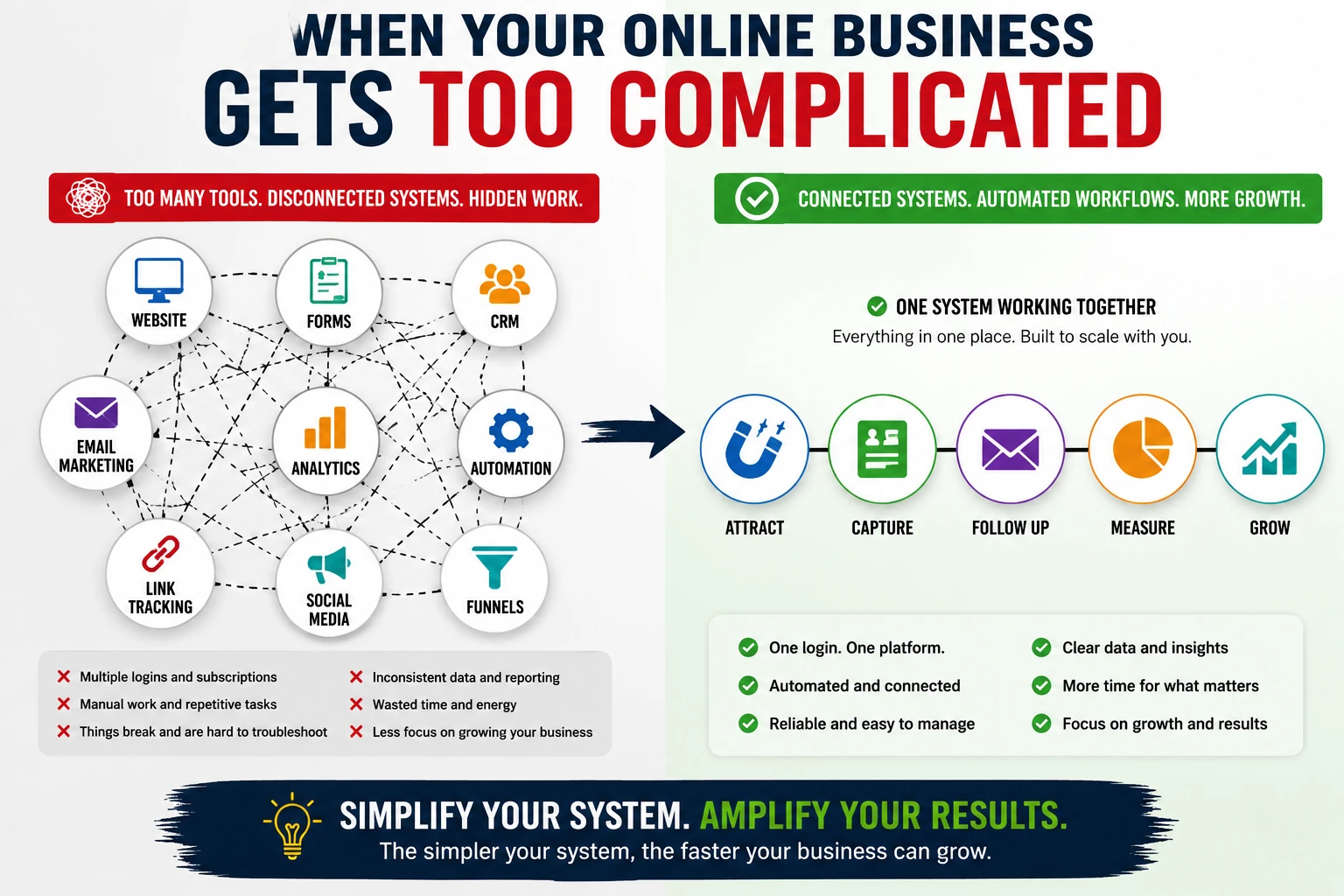
Too many disconnected tools can create unnecessary complexity. A simpler, connected system makes it easier to attract leads, follow up, measure results, and grow.
Automation Can Actually Make Things More Complicated
Automation is often presented as the solution to almost every online business problem.
And when it is used well, automation can be incredibly valuable.
It can send follow-up emails automatically.
Organize leads.
Apply tags.
Move information between systems.
Schedule repetitive tasks.
Trigger notifications.
Track customer activity.
And handle routine processes while you focus on other parts of the business.
But there is an important distinction:
Automation does not automatically create simplicity.
If the process underneath the automation is already complicated, automating it can simply create a complicated process that runs by itself.
Automating a Bad Process Does Not Fix the Process
Before automating something, it helps to understand exactly what you are trying to accomplish.
Imagine you have a five-step manual process for handling a new lead.
If three of those steps are unnecessary, building an elaborate automation around all five steps does not improve the process.
You have simply automated unnecessary work.
A better approach is:
Simplify first. Automate second.
Remove steps that do not provide value.
Combine steps when possible.
Make sure you understand how information should move through the system.
Then automate the repetitive parts that genuinely save time.
The result is usually a smaller automation that is easier to understand, easier to test, and easier to maintain.
Too Many Automations Can Become Difficult to Manage
Automations tend to accumulate just like software tools.
You create one for new subscribers.
Another for customers.
Another for abandoned forms.
Another for tagging contacts.
Another for moving information between platforms.
Another for notifications.
Another for follow-up.
Eventually, you may have dozens of workflows running behind the scenes.
The danger is that you stop remembering exactly what all of them do.
Change one trigger and something unexpected happens somewhere else.
Remove a tag and another workflow stops running.
Replace a form and an old automation continues waiting for information that will never arrive.
The system may be automated, but maintaining the automation becomes another job.
Automation Should Remove Work, Not Create More of It
A useful automation should have a clear purpose.
You should be able to explain what triggers it, what happens next, and what result it is supposed to produce.
For example:
A visitor requests a resource → they are added to the correct email list → the resource is delivered → the follow-up sequence begins.
That is easy to understand.
If something goes wrong, you know where to start looking.
Compare that with an automation involving multiple platforms, conditional branches, tags, webhooks, integrations, and overlapping workflows that nobody remembers setting up six months ago.
More sophisticated does not necessarily mean more effective.
Keep the Human Part of the Business
There is also something automation should not replace:
the relationship between your business and the people you are trying to help.
Automating delivery, organization, reminders, and routine follow-up can save enormous amounts of time.
But your messages still need to sound like they came from a person.
Your content still needs to provide something useful.
Customer questions still deserve thoughtful responses.
And your business still needs to understand what its audience actually wants.
The best automation often works quietly in the background.
The customer does not think:
“Wow, what an impressive automation workflow.”
They simply experience a business that responds consistently, delivers what was promised, and makes the next step easy.
That is when automation is doing its job.
Use technology to remove repetitive work while keeping the parts of your business that require judgment, creativity, and genuine human connection.
The Cost of Constantly Switching Tools
There is always another tool promising to be faster, easier, smarter, cheaper, or more powerful than the one you are currently using.
Sometimes switching makes sense.
A platform may become too expensive.
A feature you genuinely need may be missing.
The service may no longer fit the direction of your business.
Or another platform may allow you to consolidate several tools into one simpler system.
But constantly moving from one platform to another can create a different kind of complexity.
You never give your system enough time to become stable.
Switching Tools Has a Cost Beyond Money
The price of changing software is not limited to the new subscription.
You also have to consider everything surrounding the change.
Accounts need to be created.
Settings need to be configured.
Contacts may need to be transferred.
Landing pages may need to be rebuilt.
Forms may need to be replaced.
Automations may need to be recreated.
Tracking links may need to be updated.
Integrations need to be reconnected.
And then everything needs to be tested.
Even when the new platform costs less money, the migration itself can require a significant investment of time.
That does not make switching a bad decision.
It simply means the true cost of switching should include your time as well as your money.
The Shiny Object Problem
Online marketing moves quickly.
There is always a new platform, strategy, feature, artificial intelligence tool, traffic source, or automation promising to change the way you run your business.
That creates a powerful temptation.
You begin building with one system.
Then something new appears.
You stop what you are doing and move to the new system.
A month later, another opportunity appears.
So you change direction again.
Eventually, you have spent a tremendous amount of time starting systems without spending enough time improving any of them.
The newest tool may be exciting.
But excitement and usefulness are not the same thing.
Familiarity Has Value
There is an advantage to using a tool long enough to understand it well.
You learn where everything is.
You discover shortcuts.
You understand its limitations.
You develop processes around it.
You become faster at completing routine tasks.
You know how to troubleshoot common problems.
That familiarity creates efficiency.
A newer platform might have more features, but if it takes months to learn and requires rebuilding everything you already have, those additional features may not immediately make your business better.
Sometimes the tool you already understand is more valuable than the tool with the longer feature list.
Know When Switching Actually Makes Sense
The answer is not to remain loyal to software forever.
Businesses change.
Technology changes.
Your needs change.
There are legitimate reasons to replace a platform.
The important question is whether the change solves a meaningful business problem.
Before switching, ask yourself:
What specific problem will the new tool solve?
What will I be able to eliminate by switching?
How difficult will the migration be?
Will this make the overall system simpler or merely different?
What measurable improvement am I expecting from the change?
Those questions can help separate a strategic upgrade from another shiny object.
When a major website change is involved, Google also recommends changing one thing at a time whenever possible, making it easier to identify the cause if something goes wrong.
A good technology decision should move your business toward a system that is easier to operate, easier to understand, and better suited to what you are actually trying to accomplish.
The goal is not to have the newest tools.
The goal is to have the right tools working reliably.
Why Simple Systems Are Easier to Improve
One of the biggest advantages of a simple online business system is not merely that it is easier to manage.
It is easier to improve.
When you understand how the important pieces of your business connect, you can look at the results and identify where something needs attention.
Traffic comes in.
Visitors reach a page.
Some become leads.
Those leads receive follow-up.
Some eventually take another meaningful action.
That creates a process you can observe, measure, and improve.
But when dozens of tools, campaigns, automations, funnels, and strategies are operating at the same time, understanding what caused a particular result becomes much more difficult.
Simple Systems Make Problems Easier to Find
Imagine your landing page is receiving plenty of visitors, but very few people are becoming leads.
That gives you a relatively clear problem to investigate.
Maybe the offer is not compelling enough.
Maybe the headline is unclear.
Maybe the form asks for too much information.
Maybe the traffic reaching the page is not the right audience.
You have a manageable number of possibilities to examine.
Now imagine the same situation spread across several landing page builders, multiple traffic sources, different forms, several email lists, multiple tracking systems, and overlapping campaigns.
The problem has not necessarily become more difficult.
Finding the problem has.
Simplicity reduces the number of places you have to look.
Measurement Becomes More Useful
Data is valuable when it helps you make a decision.
More data does not automatically create better decisions.
A complicated business can generate an enormous amount of information:
Page views.
Clicks.
Impressions.
Open rates.
Conversion rates.
Traffic reports.
Automation activity.
Social engagement.
Subscriber counts.
Campaign statistics.
There is nothing wrong with collecting useful data.
But if you are staring at ten dashboards without knowing which numbers actually matter, analytics can become another source of noise.
A simpler system allows you to focus on measurements connected to a specific business objective.
For example:
How many targeted visitors reached the page?
How many became leads?
How many engaged with the follow-up?
How many took the next meaningful action?
Now the numbers tell a story.
You Can Improve One Variable at a Time
This is where simplicity becomes particularly powerful.
When something is not performing as well as you would like, resist the temptation to change everything.
Do not replace the landing page, rewrite every email, change the offer, switch traffic sources, redesign the website, and install three new tools at the same time.
If the results improve, you will have no idea what caused the improvement.
If the results get worse, you will have the same problem.
Instead, change one meaningful variable.
Observe what happens.
Learn from the result.
Then make the next improvement.
That process may feel slower than rebuilding everything at once.
Over time, however, it gives you something much more valuable:
knowledge about how your own business actually works.
If you want to see how this improvement process works within a complete marketing workflow, my step-by-step guide to building a simple lead generation system walks through attracting visitors, capturing leads, following up, tracking results, and improving the system over time.
Simplicity Makes Growth More Repeatable
Once you understand what is working, you can begin doing more of it.
If a particular traffic source consistently attracts the right visitors, you can invest more attention there.
If a landing page converts well, you can study why.
If an email sequence generates engagement, you can use what you learned when creating the next one.
If a particular type of content attracts qualified leads, you can create more content around related problems.
Instead of constantly searching for the next strategy, you begin improving a process that has already demonstrated value.
That is a much stronger foundation for growth.
You do not need to understand every marketing strategy available.
You need to understand your system, what each part is supposed to accomplish, and where your next improvement is most likely to matter.
How to Simplify an Online Business Without Starting Over
Realizing that your online business has become too complicated does not mean you need to tear everything down and rebuild it from scratch.
In fact, that can create even more unnecessary work.
A better approach is to simplify what you already have.
Look at the systems, tools, subscriptions, processes, and marketing activities currently supporting your business and determine which ones are actually helping you accomplish something important.
The goal is not to create the smallest business possible.
The goal is to create a business where every important piece has a clear purpose.
For a practical step-by-step approach to reducing tool overload and creating a more manageable system, see my guide on how to simplify your online business without sacrificing growth.
Start With What Your Business Actually Needs to Do
Before looking at software, step away from the dashboards for a moment.
Think about the basic jobs your business needs to accomplish.
For many online businesses, the list may be surprisingly short.
You need somewhere people can learn about your business.
You need a way to attract visitors.
You need a way to capture interested prospects.
You need a way to communicate and follow up.
You need a way to present your products or services.
You need a way to measure what is happening.
Depending on your business model, you may also need payment processing, appointment scheduling, customer support, membership management, or other specialized functions.
But start with the business requirements, not the software.
Once you understand what the business needs to accomplish, evaluating the technology becomes much easier.
Take Inventory of What You Already Use
Next, make a simple list of the tools currently connected to your business.
Include everything.
Website hosting.
WordPress plugins.
Email marketing platforms.
Landing page builders.
CRM software.
Automation services.
Analytics platforms.
Link trackers.
Social media tools.
Graphic design software.
Traffic services.
Scheduling tools.
Subscriptions you may have forgotten you were still paying for.
Then write down what each one actually does for the business.
This exercise can reveal something interesting.
You may discover that several tools perform overlapping functions.
You may also discover software you have not meaningfully used in months.
Look for Overlap
Suppose you are paying for one platform to build landing pages, another to capture leads, another to send email, another to track links, and another to manage contacts.
Now suppose one of the platforms you already use can perform three or four of those functions.
That does not automatically mean you should consolidate everything into that platform.
But it gives you something worth evaluating.
Ask:
Would combining these functions make the business easier to operate without sacrificing something important?
If the answer is yes, consolidation may remove subscriptions, integrations, logins, and maintenance from the business at the same time.
That is where simplification can create real value.
Remove Before You Add
When businesses encounter a problem, the first instinct is often to find another tool.
Try reversing the question.
Instead of asking:
What can I add to solve this?
Ask:
Is there anything I can remove, combine, or simplify first?
Maybe an existing tool already has the feature you need.
Maybe an unnecessary step can be eliminated.
Maybe two automations can become one.
Maybe a process does not need software at all.
Maybe the problem exists because the current system has too many moving parts.
Removing something can sometimes create a bigger improvement than adding something new.
Simplify One Area at a Time
Do not try to simplify your entire business in one afternoon.
That can quickly become another complicated project.
Choose one area.
Maybe it is your email marketing.
Your lead capture process.
Your website plugins.
Your traffic tracking.
Your monthly software subscriptions.
Or your follow-up system.
Understand how that area currently works.
Identify what is necessary.
Remove or consolidate what is not.
Test the result.
Then move to the next area.
This keeps the business functioning while you simplify it.
Protect What Is Already Working
Simplification should not mean removing something simply because you want fewer tools.
If a platform is producing results, saving time, or performing an important job reliably, there may be no reason to change it.
The objective is not:
Use as few tools as possible.
The objective is:
Use as few unnecessary tools and processes as possible.
That distinction matters.
A business with ten carefully chosen tools may be simpler to operate than a business with five poorly connected ones.
What matters is how the pieces work together.
Create a Simpler Path Through the Business
Once you begin removing unnecessary complexity, look at the business as a connected journey.
How does someone discover you?
Where do they go next?
How do they become a lead?
What happens after they join your list or contact you?
How do you continue the relationship?
How do you know whether the process is working?
You should be able to describe the basic journey without needing a flowchart that looks like the wiring diagram for the Space Shuttle. 😂
Ideally, the core process becomes something like:
Attract → Capture → Follow Up → Convert → Measure → Improve
That does not mean there cannot be sophisticated technology operating underneath the process.
It means the business itself remains understandable.
And that is the real objective of simplification.
Remove what does not serve the process. Connect what does. Improve what remains.
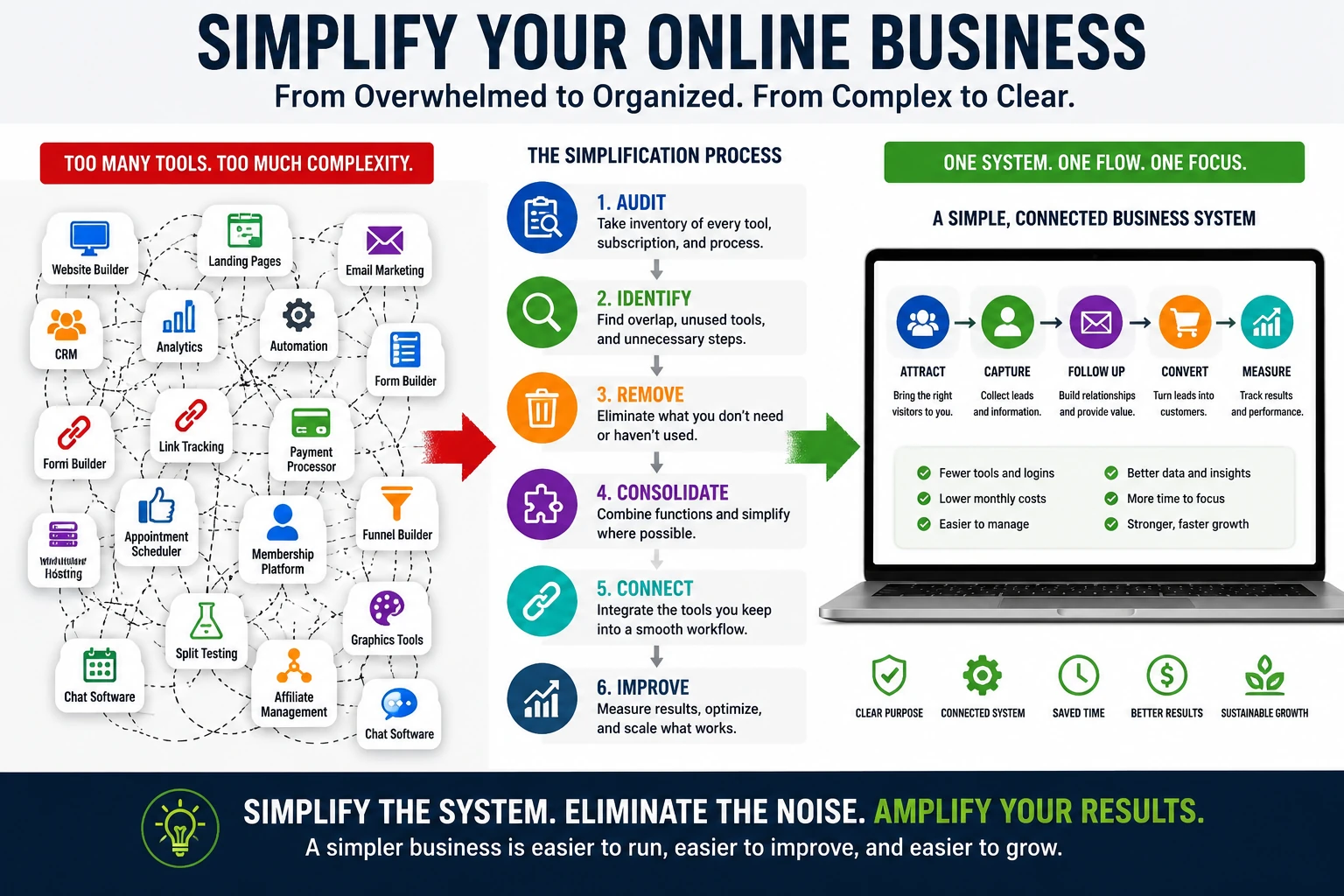
Simplify your online business by auditing your tools, identifying unnecessary complexity, removing what you do not need, consolidating functions, connecting your systems, and improving what works.
What Your Online Business Actually Needs
Once you strip away the software, subscriptions, dashboards, plugins, and marketing terminology, most online businesses need to accomplish a relatively small number of important things.
The exact requirements will depend on the type of business you are building.
An ecommerce store will have different needs than a consultant.
A local service business will operate differently from an affiliate marketer.
A membership website will require functionality that a simple lead generation website may not need.
But underneath those differences, many online businesses share the same basic foundation.
A Place to Establish Your Online Presence
Your business needs somewhere people can learn who you are, what you do, and how you can help them.
For many businesses, that means a website.
It does not necessarily need dozens of pages.
A smaller website with clear information and an obvious path forward can be more useful than a massive website visitors struggle to navigate.
At minimum, someone arriving at your website should be able to understand:
What does this business do?
Who is it for?
How can it help me?
What should I do next?
If those questions are difficult to answer, adding more technology probably will not solve the problem.
If you are planning or improving your own site, you can also explore my Website & Page Design resources for building a clearer, more effective online presence.
A Way to Attract the Right People
A website sitting quietly on the internet is not much of a marketing system.
People need a way to discover it.
That can happen through search engines, useful content, social media, referrals, backlinks, communities, email marketing, paid advertising, or other traffic sources.
You do not need to master every traffic strategy at once.
In fact, trying to do that can recreate the exact complexity we are trying to remove.
Choose a few traffic sources that make sense for your audience and learn how to use them effectively.
Then expand when the results justify it.
A Way to Capture Interest
Not every visitor will be ready to purchase something or contact you immediately.
That does not mean the visit has to be lost.
A lead capture system gives interested visitors another way to continue the relationship.
That might include an email signup form, downloadable resource, webinar registration, consultation request, free account, quote request, or another relevant next step.
The important part is that there is somewhere for interested people to go.
Traffic creates attention. Lead capture gives that attention somewhere to continue.
A Way to Follow Up
Once someone becomes a lead, the business needs a way to communicate with them.
For many online businesses, email remains one of the most practical ways to do that.
A simple follow-up system can welcome a new subscriber, deliver what was promised, provide useful information, answer common questions, and introduce relevant products or services over time.
This is one area where thoughtful automation can dramatically simplify the business.
Instead of manually contacting every new subscriber, the basic process can happen consistently in the background.
If you use commercial email in your business, it is also important to understand the rules that apply to marketing messages and giving recipients a clear way to opt out.
Something Valuable to Offer
Technology cannot replace the reason the business exists.
At some point, you need something useful to offer people.
That may be a service.
A physical product.
A digital product.
A membership.
A recommendation.
A consultation.
Training.
Software.
Or another solution to a problem your audience wants solved.
The marketing system exists to connect the right people with that value.
Without the value, the system is simply machinery.
A Way to Measure What Is Happening
Finally, you need enough information to understand whether the system is working.
That does not require watching every metric available.
Start with the measurements connected to the journey you are trying to create.
Where are visitors coming from?
Which pages are they reaching?
Are they becoming leads?
Are they engaging with your follow-up?
Are they taking meaningful actions?
Where are people leaving the process?
Those questions give you information you can actually use.
The Foundation Is Smaller Than It Looks
When all of this is stripped down, the foundation of many online businesses looks something like this:
Presence → Traffic → Lead Capture → Follow-Up → Offer → Measurement
Everything else should support one or more of those functions.
That gives you a useful filter whenever you are considering another tool, strategy, or subscription:
Where does this fit into my business?
What important function does it improve?
What problem does it solve?
If you cannot answer those questions clearly, you may not need it yet.
A business does not become stronger because it has more moving parts.
It becomes stronger when the important parts work together.
Build Around the Process, Not the Software
One of the easiest ways to make an online business unnecessarily complicated is to let software determine how the business operates.
You discover a platform with dozens of features.
Then you begin building your business around those features simply because they are available.
You create automations because the platform has an automation builder.
You add funnels because there is a funnel feature.
You create tags, pipelines, workflows, campaigns, and dashboards because the software gives you the option.
Eventually, the technology starts determining the process instead of supporting it.
A better approach is to reverse the order.
Define the process first. Choose the technology second.
Start With the Customer Journey
Before deciding which tools you need, think about the journey you want someone to experience.
How will they discover your business?
What will they see when they arrive?
What useful next step can they take?
What happens after they become a lead?
How will you continue communicating with them?
What solution can you eventually offer?
How will you measure whether the process is working?
Those questions describe the business.
The software simply helps you execute it.
If the process is:
Visitor → Landing Page → Email List → Follow-Up → Offer
then your technology needs to support that process.
You do not need to redesign the entire business simply because another platform offers 47 additional features.
Give Every Tool a Job
Every tool in your business should have a reason for being there.
Your website has a job.
Your email platform has a job.
Your analytics has a job.
Your lead capture system has a job.
Your automation has a job.
Your traffic tools have a job.
Some platforms may perform several of those jobs.
Others may specialize in one particular function.
Either approach can work.
The important part is being able to answer:
Why am I using this?
If the answer is unclear, that tool deserves a closer look.
Do Not Build Around Features You Might Need Someday
This is another easy trap.
You choose complicated software because you might need its advanced features someday.
Maybe the platform can manage 100,000 contacts.
Build 50 different funnels.
Run extremely sophisticated automations.
Manage a large sales team.
Create advanced customer pipelines.
That may be impressive.
But if your current business needs one website, two landing pages, a small email list, and a straightforward follow-up sequence, you may be solving problems that do not exist yet.
There is nothing wrong with choosing technology that gives you room to grow.
But there is a difference between room to grow and paying for complexity you may never use.
Build for the business you have while keeping an eye on the business you want to become.
Let Your Needs Determine When the System Expands
Eventually, growth may create legitimate reasons to add more technology.
Your contact list becomes difficult to manage.
Your team grows.
Customer support volume increases.
Manual processes consume too much time.
Your reporting needs become more sophisticated.
Your current platform reaches a genuine limitation.
Now the business itself is telling you something needs to change.
That is a much better reason to expand than simply discovering another piece of software.
Add complexity when complexity solves a real problem.
Until then, simplicity gives you room to focus on the work that actually moves the business forward.
Technology Should Become Almost Invisible
A well-designed business system does not require you to spend every day thinking about the software underneath it.
Visitors arrive.
Pages load.
Forms work.
Leads are captured.
Emails are delivered.
Automations run.
Results are tracked.
And you spend more of your time creating value, improving the business, helping customers, and generating growth.
That is what technology is supposed to accomplish.
Not another collection of dashboards demanding your attention.
Not another pile of subscriptions.
Not another system you constantly have to babysit.
The best technology supports the business so effectively that you can spend more time running the business and less time running the technology.
Simple Does Not Mean Small
There is a misconception that a simple online business must also be a small online business.
It does not.
Some of the strongest systems are simple precisely because the people operating them understand what matters and have removed unnecessary friction.
A business can have thousands of customers, large amounts of traffic, sophisticated marketing, multiple products, automation, employees, and significant revenue while still maintaining a clear underlying process.
The difference is that complexity is added intentionally, not accidentally.
Simple and Basic Are Not the Same Thing
A basic system may lack capabilities the business genuinely needs.
A simple system has the capabilities it needs without unnecessary complications.
That is an important distinction.
Imagine two businesses.
The first uses three poorly connected tools and requires several manual workarounds every day.
The second uses eight tools that communicate properly, automate repetitive tasks, and give everyone involved a clear understanding of what happens next.
Which business is simpler?
Probably the second one.
The number of tools does not determine simplicity.
The amount of unnecessary friction does.
Simplicity Can Make Scaling Easier
Imagine trying to increase the amount of traffic coming into a system you barely understand.
More visitors arrive.
More leads enter.
More emails are triggered.
More customer questions appear.
More data moves between platforms.
Any weakness that existed at a smaller scale can become much more noticeable as volume increases.
That is why simplifying before scaling can be so valuable.
When the underlying process is clear, you have a stronger foundation for handling more activity.
You know where leads go.
You understand the follow-up.
You know which tools are responsible for which functions.
You know what needs to be measured.
You know where to look when something goes wrong.
Instead of scaling confusion, you are scaling a process you already understand.
Standardization Reduces Unnecessary Decisions
Another benefit of simplicity is that routine tasks can become repeatable.
You can create standard processes for publishing content.
Handling new leads.
Following up with prospects.
Onboarding customers.
Reviewing analytics.
Managing campaigns.
Responding to common requests.
You do not have to reinvent the process every time the same situation occurs.
That saves more than time.
It reduces the number of small decisions competing for your attention throughout the day.
Your energy can go toward decisions that actually require it.
Complexity Should Earn Its Place
As a business grows, some additional complexity is inevitable.
You may need more advanced automation.
Additional team members.
Better reporting.
More sophisticated customer management.
New marketing channels.
Additional security or administrative systems.
There is nothing wrong with that.
The question is whether each new layer has earned its place.
Does it solve a real problem?
Does it save meaningful time?
Does it improve the customer experience?
Does it provide information you genuinely need?
Does it allow the business to handle growth more effectively?
If it does, the additional complexity may be completely justified.
If it does not, it may simply be another moving part.
Build Something You Can Continue to Understand
Growth should not require losing control of your own business.
You may eventually delegate responsibilities to employees, contractors, agencies, or automation.
But you should still understand the basic system you have created.
That understanding makes it easier to evaluate new opportunities, recognize problems, communicate with people helping you, and decide where the business should go next.
The goal is not to keep your business small.
It is to keep the logic behind the business clear as the business becomes larger.
That is a very different objective.
Keep the foundation simple. Let the results give you a reason to expand.
Make Your Online Business Easier to Run
Building an online business can become complicated surprisingly quickly.
One tool becomes three.
Three subscriptions become eight.
A simple follow-up process becomes a collection of automations.
A straightforward marketing strategy becomes several campaigns running across different platforms.
And because each addition happened for a reason, it can be difficult to recognize when the entire system has become harder to manage than it needs to be.
The answer is not to eliminate every tool, avoid automation, or refuse to use sophisticated technology.
It is to become more intentional about what earns a place in your business.
Simplification Is an Ongoing Process
Your business will continue to change.
New opportunities will appear.
Technology will improve.
Your audience may grow.
Your marketing may expand.
And the tools that make sense today may eventually need to be replaced.
That means simplification is not something you do once and forget about.
Periodically look at the business and ask:
What am I actually using?
What is producing value?
What is costing money without contributing much?
Where am I doing unnecessary manual work?
Which tools overlap?
Which processes have become harder than they need to be?
A small amount of regular cleanup can prevent years of unnecessary complexity from accumulating.
Focus on What Moves the Business Forward
It is easy to spend an entire day working on an online business without doing much that actually grows it.
You can reorganize dashboards.
Install plugins.
Adjust automations.
Compare software.
Redesign pages.
Change settings.
Watch training videos.
And research the next tool.
Some of those activities may be necessary.
But they should support the activities that actually matter.
Creating value.
Attracting the right people.
Generating leads.
Building relationships.
Helping customers.
Improving your products or services.
Making sales.
Learning from your results.
That is the business.
Everything else exists to support it.
You Do Not Need the Perfect System
There will always be something you could improve.
Another automation you could build.
Another page you could optimize.
Another tool you could test.
Another strategy you could try.
Another feature you could configure.
If you wait until everything is perfect, you can spend an enormous amount of time preparing to grow instead of actually growing.
Build a system that works.
Understand it.
Use it.
Measure it.
Improve it.
And allow the business to tell you when something genuinely needs to change.
Start With One Thing
If your online business is too complicated right now, do not try to fix everything today.
Choose one area.
Look at your email marketing.
Your website.
Your lead generation.
Your subscriptions.
Your automations.
Your traffic strategy.
Your plugins.
Your follow-up process.
Find one thing that is creating unnecessary friction and simplify it.
Then find another.
Small improvements begin adding up.
Eventually, something interesting happens.
You spend less time managing the machinery behind the business and more time doing the work the machinery was supposed to help you accomplish in the first place.
And that is ultimately what a simpler online business should give you:
More clarity.
More control.
More time to focus on what matters.
And a business that is easier to manage, improve, and grow.
You do not need more complexity to build something bigger.
You need a system you understand, a process you can improve, and tools that earn their place.