
Scalelup Review starts with a simple question: what happens when you want more people to see what you’re promoting without relying on just one source of traffic?
You can spend money on advertising, post on social media, build email lists, exchange traffic, and test different promotional platforms — yet still wonder whether anyone is actually seeing what you’re promoting.
I’ve spent plenty of time testing different ways to get attention for online offers.
That’s actually how I ended up using Scalelup.
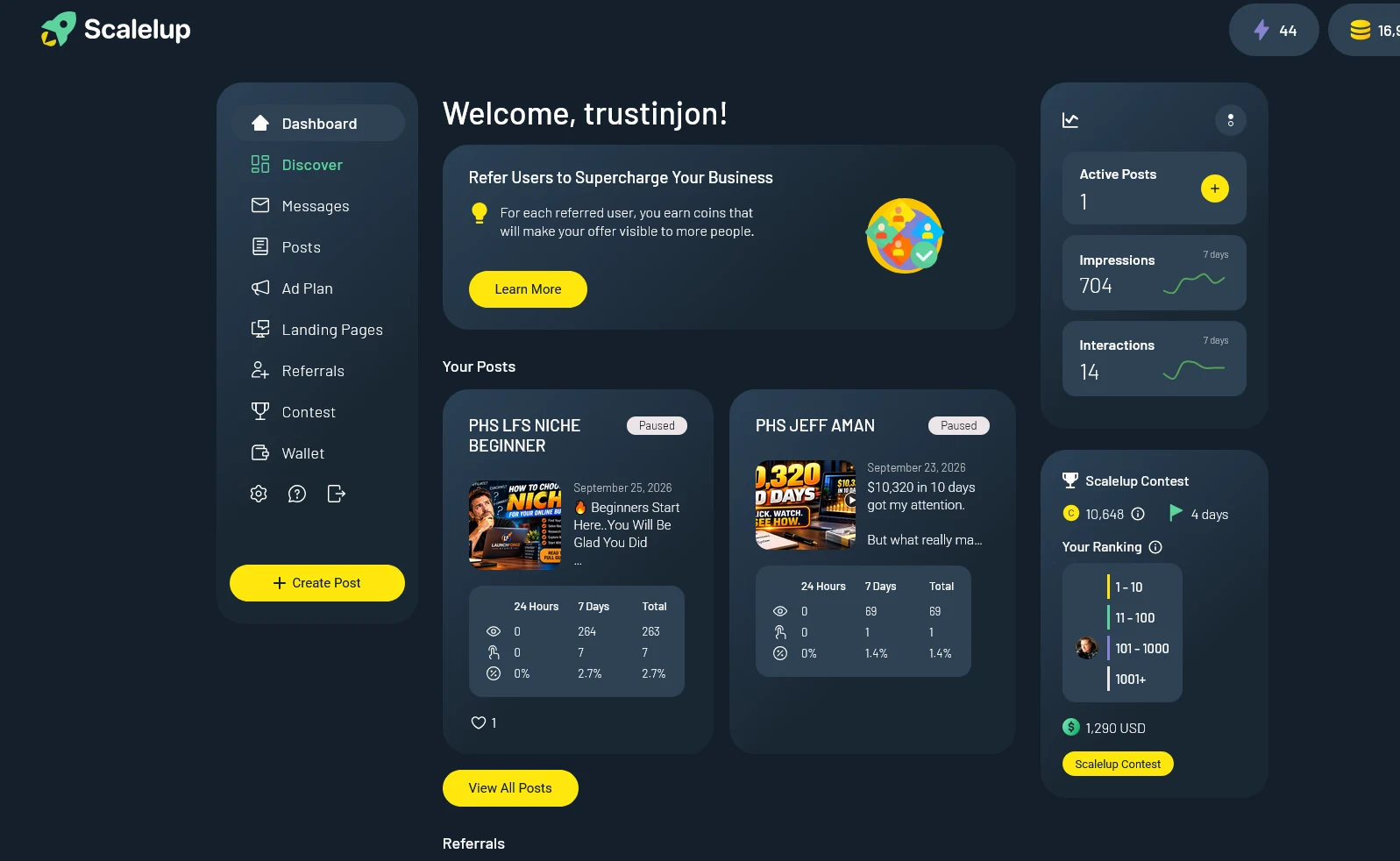
Inside the Scalelup member area, where users can create posts, discover offers, earn Coins, manage referrals, and track activity.
I’ve been using the platform for about a year, and during that time I’ve created promotional posts, earned and spent Coins, watched impressions and clicks, explored the Discover section, and used Scalelup as one of the traffic sources in my own online marketing.
So rather than giving you a review based on a quick signup and a few minutes clicking around the dashboard, I wanted to take you inside the platform and show you how Scalelup actually works.
We’ll look at the different parts of the system, including the Coin system, promotional posts, the Discover section, landing pages, mailing lists, autoresponders, advertising plans, referrals, contests, and the affiliate program.
I’ll also show you some of the numbers from my own activity so you can see what the platform looks like from the user’s side.
Because there’s an important distinction I want to make right from the beginning:
Traffic is not the same thing as conversions.
Getting your advertisement or offer in front of people is one part of marketing.
What happens after someone sees it depends on the offer, the message, the landing page, the audience, and what you ask that visitor to do next.
That’s why I’m approaching this review from a practical perspective.
What is Scalelup?
How does it work?
What can you actually do with it?
And perhaps most importantly…
How could a platform like this fit into a larger online marketing strategy?
Let’s take a look.
What Is Scalelup?
Scalelup is an advertising and traffic platform built around the idea of giving members different ways to promote their businesses, offers, and websites while also providing opportunities to earn Coins through activity on the platform.
The first thing that stood out to me is that Scalelup isn’t simply a traditional advertising site where you put money into an ad and wait for visitors. There are several parts of the platform that work together.
Members can create promotional posts, browse and interact with other members’ offers through the Discover section, create landing pages, manage mailing lists and autoresponders, participate in referrals, and use advertising plans when they want additional features and exposure.
The platform uses Coins as part of its internal activity and advertising system. Coins can be earned through certain activities and can also be purchased. When you create promotional posts, the cost of displaying those posts is based on the platform’s current Cost Per Impression, or CPI, which is shown in Coins.
That creates an interesting model because you’re not limited to one method of promotion.
You can create a post for an offer, allow it to receive impressions, browse the Discover section to find other members’ offers, and use the Coins you earn through activity to continue promoting your own business.
There are also free components available.
For example, Scalelup provides members with the ability to create a lead-capture landing page and use it to direct traffic toward an offer. The platform also includes mailing-list and autoresponder functions, giving members tools for collecting leads and following up with them.
From my experience using Scalelup, that combination is what makes the platform more interesting than simply looking at it as another place to purchase advertising.
It’s a complete environment where traffic, promotion, lead generation, and member activity are connected.
And because I’ve been using Scalelup for about a year, this review isn’t based on simply signing up, clicking through a few menus, and calling it a review.
I’ve actually used the platform.
That’s what I want to show you throughout the rest of this review.
Want to See What Scaleup Can Do for Your Own Marketing?
Scaleup brings advertising, traffic, landing pages, referrals, and other promotional tools together in one platform. Take a closer look at the features I’ve been using throughout this review.
How Does the Scalelup Coin System Work?
One of the first things you’ll notice inside Scalelup is the Coin system.
Coins are used throughout the platform for advertising activity, including the impressions generated by promotional posts. You can earn Coins through activity on the platform, and you can also purchase Coins when you want to increase your available advertising balance.
The important thing to understand is that Coins aren’t simply a number sitting in your account. They are part of how you participate in the Scalelup ecosystem.
Earning Coins Through Activity
One way to earn Coins is by exploring the Discover section.
This is where you’ll find promotional posts from other members. You can browse those offers and interact with them, giving you an opportunity to earn Coins while also seeing what other marketers are promoting.
There are also referral rewards. When you refer a new user who meets Scalelup’s qualification requirements, you can receive a Coin reward.
The platform currently states that a referred user must find at least 1,000 Coins while browsing posts on the Discover page before becoming a qualified referral.
That distinction is important because simply sending someone your referral link doesn’t automatically make the referral qualified.
Using Coins for Your Own Advertising
When you create a promotional post, Scalelup displays a CPI, or Cost Per Impression, for the campaign.
The post creation screen shows a CPI range of 3 to 30 Coins per impression, with the actual CPI subject to change over time.
You can also choose whether to set a daily spending limit.
That gives you some control over how quickly your Coin balance is used while your promotional post is running.
For example, if your goal is to test an offer rather than immediately commit a large amount of Coins, you can start with a smaller campaign and watch the activity before deciding what you want to do next.
Coins Connect Several Parts of the Platform
What I find interesting about this system is that Coins aren’t isolated to one advertising feature.
They connect several activities within Scalelup.
You can earn Coins through platform activity, use Coins toward promotional impressions, and potentially earn additional Coins through qualified referrals.
The platform also has a contest system where one contest point is earned for each Coin you earn, giving active members another reason to participate.
So when you look at Scalelup, I wouldn’t think of the Coin balance simply as an advertising budget.
It’s more accurate to think of Coins as the platform’s internal activity and advertising currency.
And once you understand that, the rest of the platform starts making a lot more sense.
Creating Promotional Posts on Scalelup
The main advertising feature I use on Scalelup is the Posts section.
This is where you create promotional posts for your business, website, product, service, or offer and put them in front of other members on the platform.
The process is straightforward.
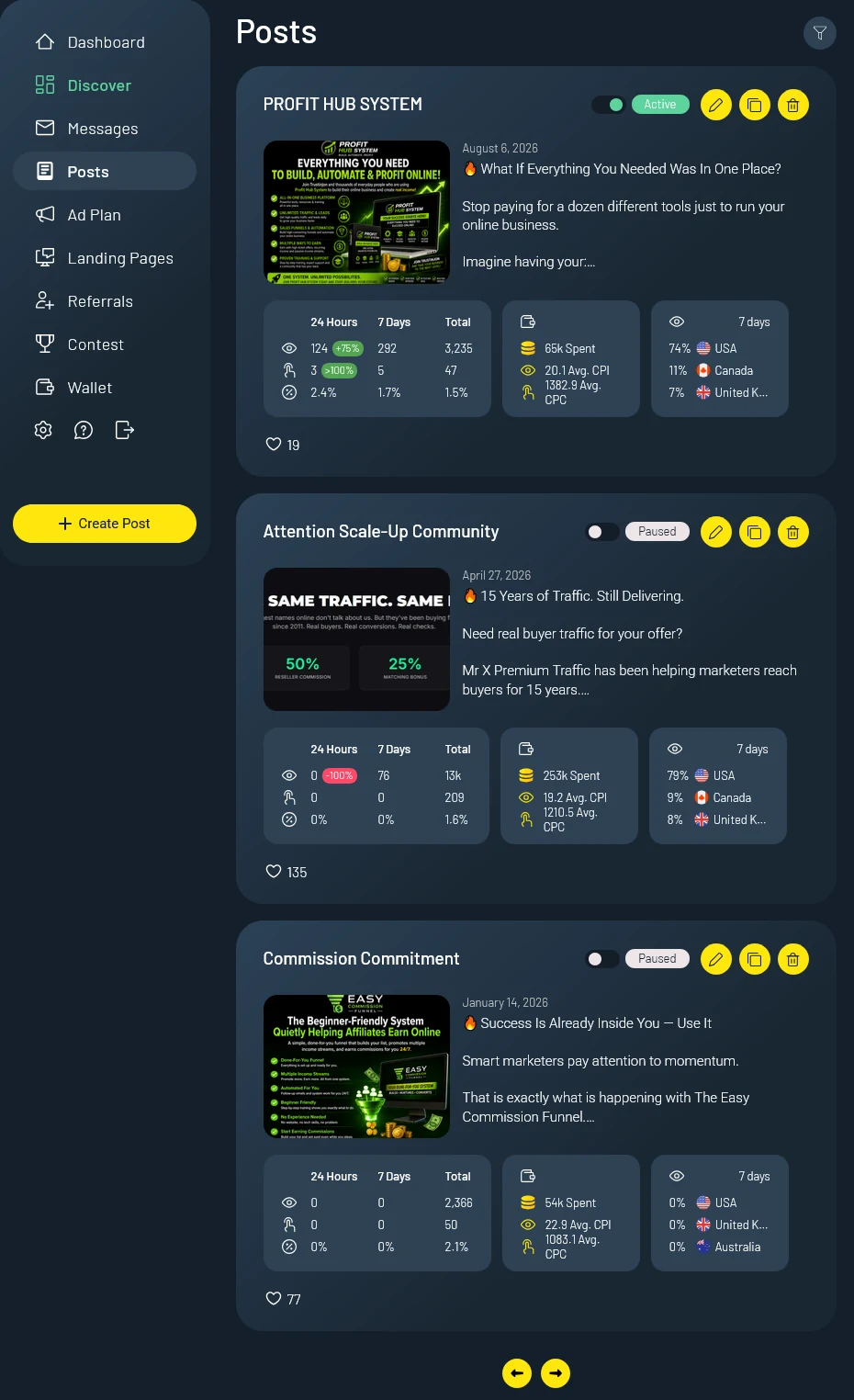
ScaleLup Posts section showing active and paused promotional campaigns with performance statistics.
When creating a new post, you can enter your promotional message, add an image, provide an optional destination link, choose your country targeting, and decide whether you want to place a daily spending limit on the campaign.
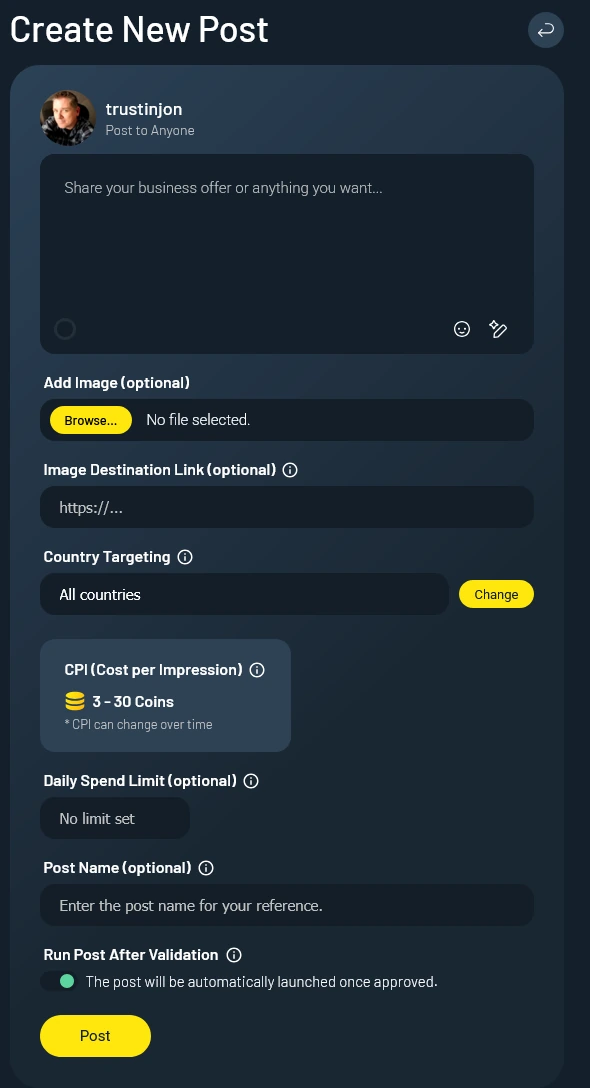
Scaleup’s Create New Post screen showing the options available for setting up a promotional campaign.
Add Your Promotional Message
The post editor gives you a space to write the message you want other members to see.
This is where your headline and promotional copy need to do the heavy lifting.
You can use the post to introduce an offer, highlight a benefit, generate curiosity, or send people toward a landing page.
You can also add an image to make the promotion more visually noticeable.
Add Your Destination Link
Scalelup allows you to enter an Image Destination Link, which can direct someone to the page associated with your promotion when they interact with the image.
That gives you another way to connect the promotional post with the offer you’re advertising.
For marketers, this can be useful when you’re promoting a landing page rather than sending traffic directly to a sales page.
Country Targeting
Another useful option is Country Targeting.
You can leave the post set to all countries or change the targeting to focus on specific countries.
That gives you an additional layer of control over the audience seeing your promotion.
Whether you want broad exposure or want to concentrate your advertising on particular markets, this setting lets you make that choice when creating the post.
Set a Daily Spending Limit
Scalelup also provides an optional Daily Spend Limit.
If you don’t want your Coins being consumed too quickly, you can set a daily limit rather than leaving the campaign without a limit.
I like having this option because it makes testing an offer much easier.
Instead of throwing a large amount of Coins at a campaign immediately, you can control the pace, watch the activity, and make adjustments based on what you’re seeing.
Validation Before Your Post Goes Live
Once you’ve created the post, Scalelup validates it before it can begin running.
There’s also an option called Run Post After Validation, which allows the post to automatically launch once it has been approved.
That means you don’t necessarily have to come back and manually start the campaign after validation.
For anyone running multiple promotions, that little bit of automation can make managing campaigns easier.
Understanding Scalelup Impressions, Clicks, CPI, and CPC
If you’re going to use Scalelup for advertising, there are four numbers you’ll want to understand: impressions, clicks, CPI, and CPC.
At first glance, the statistics can look a little confusing because Scalelup charges for impressions using Coins, while the dashboard can also show you the number of clicks your promotion receives and the average cost associated with those clicks.
Understanding the difference between these numbers makes it much easier to evaluate what your campaigns are actually doing.
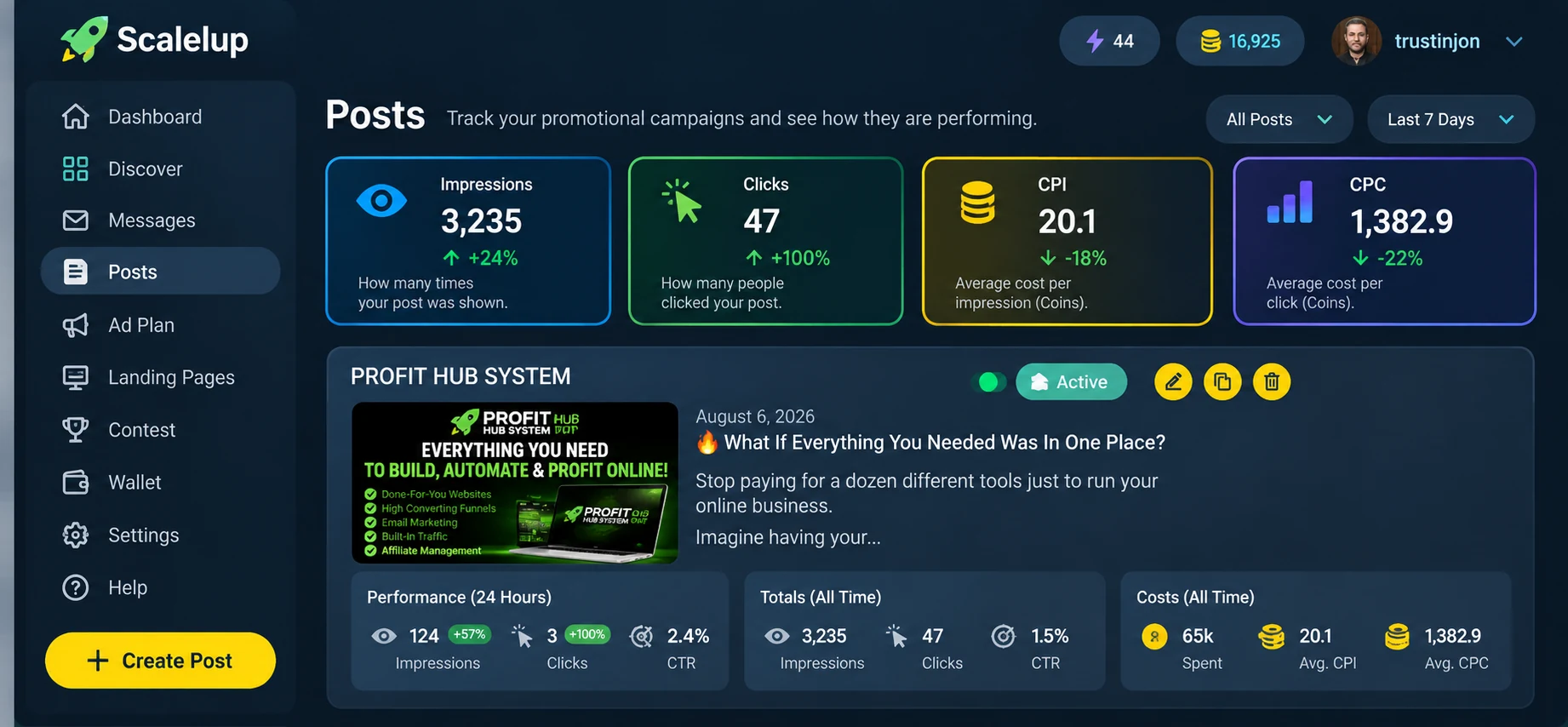
Scalelup campaign performance dashboard showing impressions, clicks, CPI, and CPC metrics.
What Is an Impression?
An impression represents an instance where your promotional post is displayed to a member.
An impression does not necessarily mean that somebody clicked your advertisement, visited your website, or became a lead.
It simply means your promotion was shown.
That’s an important distinction to remember when looking at your statistics.
If your campaign receives 1,000 impressions, that means your promotion was displayed 1,000 times. It does not mean you received 1,000 visitors.
What Is a Click?
A click is a different measurement.
A click indicates that someone interacted with your promotional post in a way that resulted in a click through to the destination associated with your promotion.
This is the number I pay particularly close attention to because impressions tell me how much exposure a promotion received, while clicks give me an indication of how many people took the next step.
Neither number, by itself, tells you whether an offer was successful.
The real question is what happens after the click.
If someone clicks through to your landing page but doesn’t take the action you’re asking them to take, the traffic may still have been useful exposure, but it hasn’t produced the result you’re ultimately looking for.
What Does CPI Mean?
CPI stands for Cost Per Impression.
This is the number of Coins associated with displaying your promotional post.
When you create a post, Scalelup allows you to select a CPI within the range available on the platform.
The higher the CPI, the more Coins are used as your post receives impressions.
Your actual CPI can also vary depending on the targeting and settings associated with your promotion.
This is why you should pay attention to the CPI displayed when you create or edit a campaign rather than assuming every campaign will cost exactly the same amount.
What Does CPC Mean?
CPC stands for Cost Per Click.
Unlike CPI, CPC isn’t the amount you select when creating your post.
Instead, it provides a way of looking at the relationship between the Coins you’ve spent and the number of clicks your promotion received.
For example, if a campaign spends 5,000 Coins and receives 10 clicks, the average cost associated with those clicks would be 500 Coins per click.
That doesn’t mean Scalelup charged you 500 Coins each time somebody clicked.
Your Coins were being used according to the campaign’s impression-based cost.
The CPC is simply another way to analyze the results afterward.
Looking at the Numbers Together
This is where the statistics become more useful.
Suppose you have two campaigns.
One campaign receives a large number of impressions but very few clicks.
Another receives fewer impressions but generates a higher number of clicks relative to its exposure.
Looking only at impressions, you might assume the first campaign performed better.
Looking at clicks and CTR, you might see a completely different picture.
That’s why I don’t recommend judging a Scalelup campaign by a single number.
I look at the combination of:
Impressions
Clicks
CTR
Coins Spent
Average CPI
Average CPC
The geographic breakdown can also be useful when country targeting is involved.
A Real Example From My Scalelup Account
This is where I can show you something much more useful than a theoretical example.
I’ve been using Scalelup to promote different offers, including Profit Hub System-related promotions.
One of my campaigns titled PHS LFS NICHE BEGINNER had accumulated hundreds of impressions and several clicks while using thousands of Coins.
The dashboard showed the impressions, clicks, CTR, Coins spent, average CPI, average CPC, and geographic distribution of the traffic.
Another older Profit Hub System campaign accumulated more than 3,000 impressions and dozens of clicks.
Those numbers don’t automatically tell us whether someone purchased something after clicking.
They do, however, show us exactly what the Scalelup advertising system is designed to measure: exposure and interaction with the promotion.
That’s an important distinction because I don’t want to tell you that a certain number of impressions or clicks automatically equals a certain amount of money.
It doesn’t.
Your results will depend on what you’re promoting, how well your message connects with the audience, where you’re sending the traffic, and what happens once visitors arrive.
Why I Watch CTR
CTR, or click-through rate, gives you another useful piece of information.
It helps put your clicks into context by comparing the number of clicks with the number of impressions.
A campaign receiving 10 clicks from 100 impressions has a very different click-through rate from a campaign receiving 10 clicks from 10,000 impressions.
That makes CTR useful when comparing campaigns that received different amounts of exposure.
For me, the statistics aren’t about finding one magic number.
They’re about watching what happens when I change the offer, promotional copy, image, destination, or targeting.
That’s where the data becomes useful.
Scalelup Landing Pages and Lead Generation
Getting someone to click on an advertisement is only one part of the marketing process.
The next question is where you send that person.
Scalelup includes its own landing page system, which gives members another option besides sending advertising traffic directly to an external website or sales page.
This is particularly useful if your goal is to build an email list rather than simply send someone straight to an offer.
Creating a Lead-Capture Landing Page
Inside the Scalelup members area, you’ll find a dedicated Landing Pages section where you can create a lead-capture page.
The platform provides customizable landing pages that are designed to collect information from visitors who arrive through your promotional efforts.
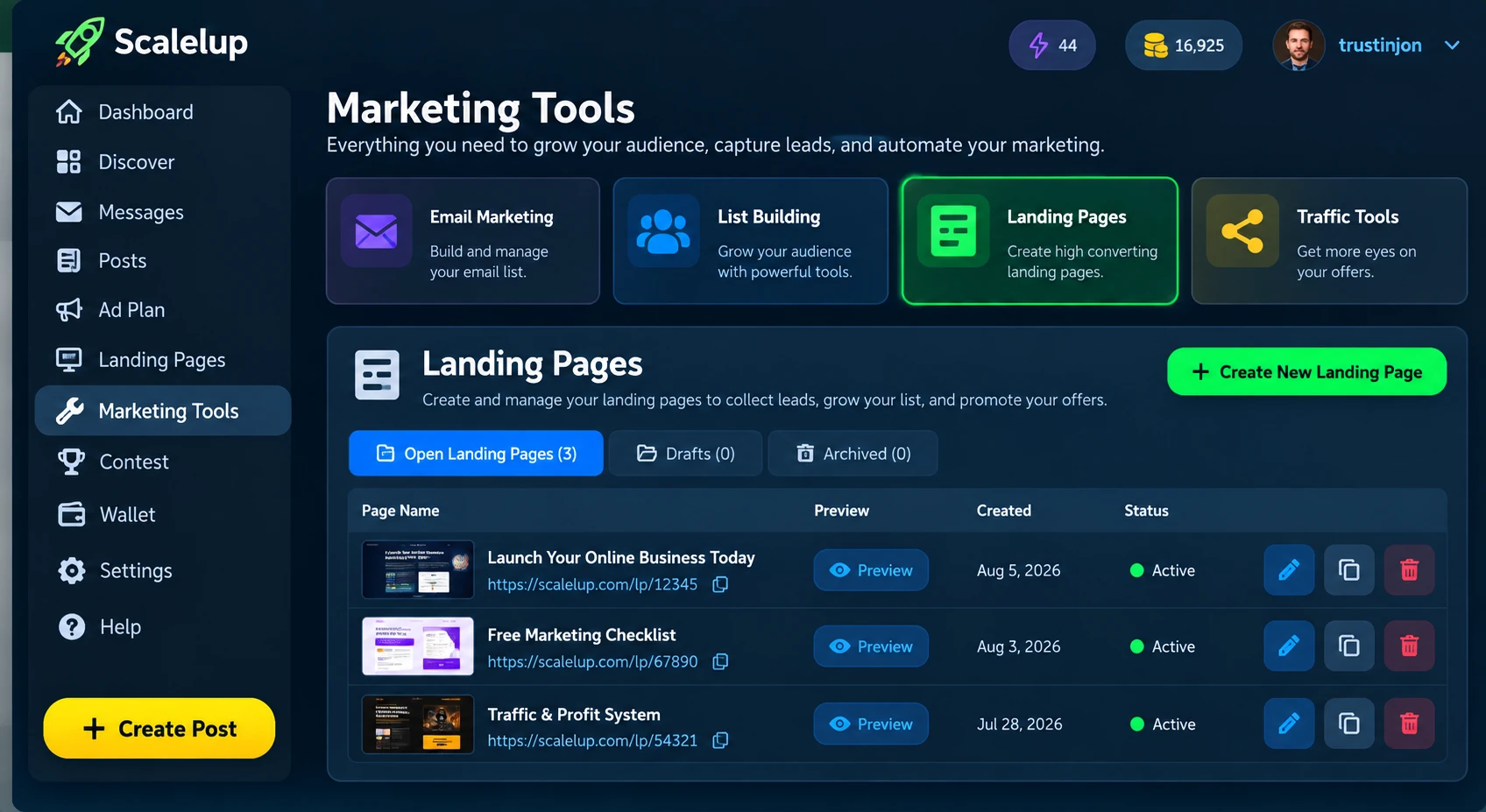
Scalelup Landing Pages interface showing the tools available to create and manage lead-capture pages.
The basic idea is straightforward:
Create the landing page → send traffic to it → collect the lead → follow up with that lead.
For someone who is just getting started with online marketing, having the landing page function available inside the same platform can simplify the process.
You don’t necessarily have to find a separate landing-page builder before you can begin experimenting with lead generation.
Landing Pages Give Your Traffic Somewhere to Go
This is an important part of how I think about using a traffic platform.
An impression is exposure.
A click is a visitor.
But a lead gives you the opportunity to continue communicating with that person.
Instead of sending every visitor directly to a sales page, you can use a landing page to introduce an idea, provide additional information, and ask the visitor to take a specific action.
That action might be joining a mailing list, requesting information, or entering their contact details so you can follow up with them.
The exact strategy will depend on what you’re promoting.
The important thing is that Scalelup provides the infrastructure to support that process.
Connecting Landing Pages With Lead Collection
Scalelup’s landing-page system is connected to its lead-management features.
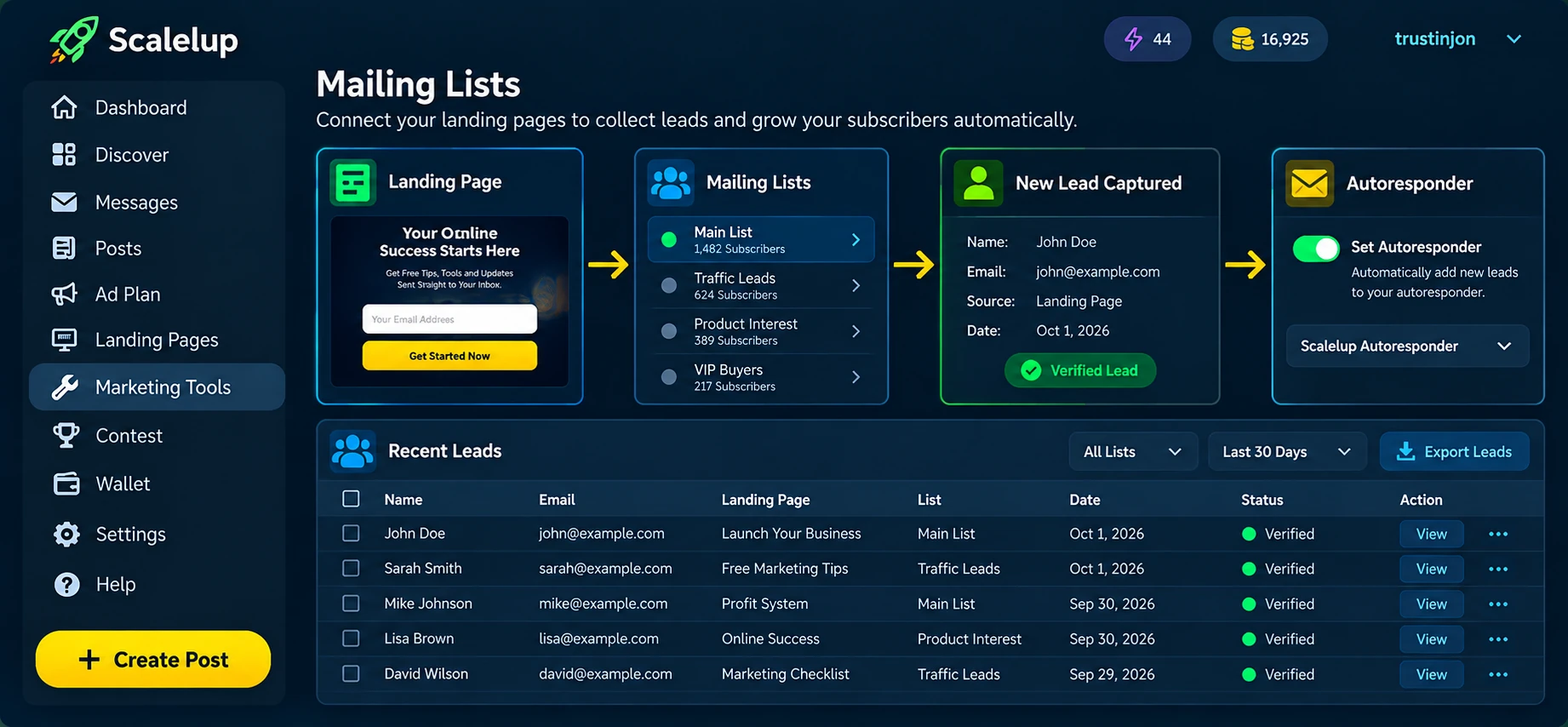
Scalelup lead collection workflow showing how landing pages connect with mailing lists and follow-up automation.
When a visitor submits the form on a lead-capture page, the lead can be added to a mailing list associated with the page.
The platform also provides statistics for email leads, allowing you to look at activity over different time periods and see your total lead activity.
This gives you another measurement beyond impressions and clicks.
Instead of only asking:
How many people saw my promotion?
or:
How many people clicked it?
you can also begin asking:
How many people actually became leads?
That’s a much more meaningful question when your ultimate goal is building an audience you can communicate with over time.
Using a Landing Page Instead of a Direct Offer Link
There isn’t one universal rule saying every advertisement should go to a landing page.
Sometimes a direct link to an offer makes sense.
Other times, collecting the visitor as a lead first may make more sense.
For example, if I’m promoting a business opportunity or marketing tool, I may want the visitor to understand what they’re looking at before asking them to make a purchase or sign up.
A landing page gives me a controlled environment for doing that.
I can explain the opportunity, focus the visitor’s attention on one action, and then continue the conversation through email if they choose to join the list.
That can be especially useful when the visitor isn’t ready to make a decision the first time they see the offer.
Landing Pages and the Rest of the Scalelup System
This is where the different parts of Scalelup start fitting together.
You can create a promotional post to generate exposure.
That post can send people to a landing page.
The landing page can collect a lead.
That lead can be associated with a mailing list.
And the autoresponder can then be used to follow up.
So the process can look something like this:
Promotion → Click → Landing Page → Lead → Email Follow-Up
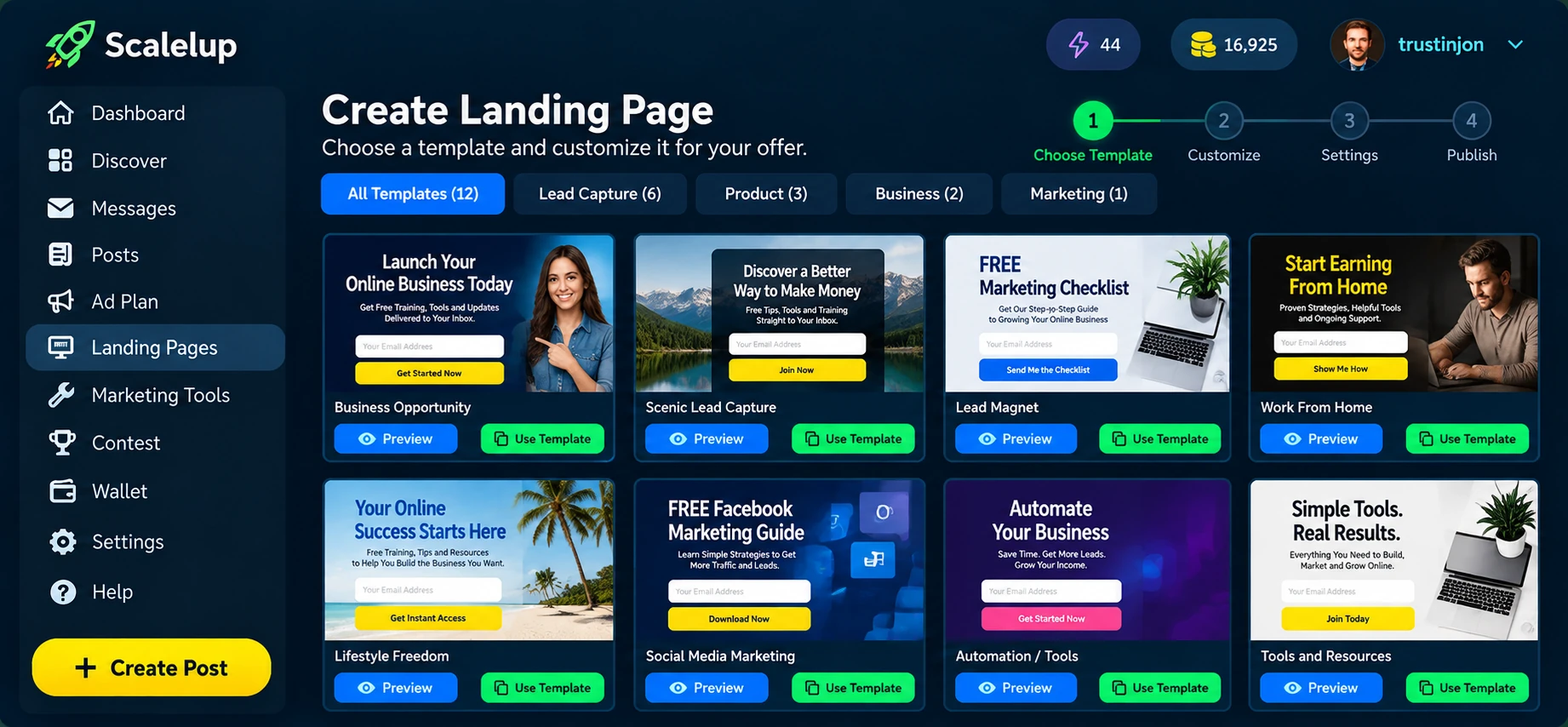
Scalelup landing page builder showing available templates for lead capture, marketing, and business promotions.
That’s considerably different from simply buying a block of traffic and hoping someone purchases something immediately.
You’re creating a path for the visitor.
A Landing Page Still Needs a Good Offer
Having a landing-page builder doesn’t automatically make a campaign successful.
The page still needs a clear purpose.
Your headline needs to communicate what you’re offering.
Your message needs to give the visitor a reason to continue.
Your form needs to ask for the appropriate information.
And your call to action needs to make the next step obvious.
The traffic source can get someone to the page, but the page itself has to do its job once the visitor arrives.
That’s something I always keep in mind when testing traffic.
If a campaign receives impressions and clicks but produces very few leads, the problem isn’t necessarily the traffic source.
The offer, message, landing page, targeting, or follow-up process could also be contributing to the result.
Why Lead Generation Matters
For me, this is one of the more useful aspects of having landing pages available inside Scalelup.
Traffic can disappear as soon as someone leaves your website.
A lead can give you another opportunity to communicate with that person.
That’s why I generally look at traffic as part of a larger process rather than the final objective.
Get attention.
Earn the click.
Provide value.
Capture the lead.
Follow up.
That’s the kind of marketing system a landing page can help you build.
And because Scalelup includes both the landing-page and email-related components, you can connect those steps without necessarily having to assemble every piece from a different platform.
Scalelup Mailing Lists and Autoresponders
Getting a visitor to your landing page is only the beginning if your goal is to build a long-term audience.
Once someone becomes a lead, you need a way to organize that contact and communicate with them.
That’s where Scalelup’s mailing lists and autoresponder features come into the picture.
Instead of treating every click as the end of the campaign, these tools give you a way to continue the conversation after someone has submitted their information through a lead-capture landing page.
Mailing Lists Help Organize Your Leads
Scalelup includes a dedicated mailing-list area where leads collected through its landing pages can be organized.
Inside the members area, you can see the mailing lists associated with your account along with lead-related statistics.
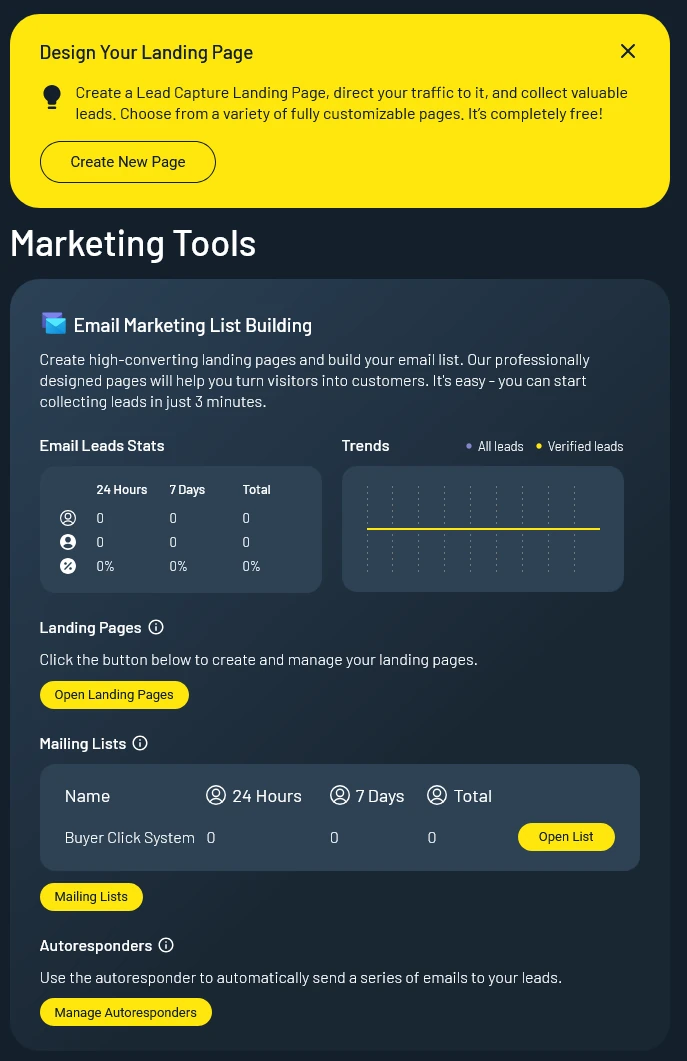
Scalelup email marketing tools showing lead statistics, mailing lists, landing pages, and autoresponders.
The system provides different time periods for viewing activity, including the previous 24 hours, seven days, and the total number of leads.
That gives you a simple way to keep an eye on whether your lead-generation efforts are actually producing new contacts.
For example, if you start promoting a new landing page, you can look beyond the number of impressions and clicks and see whether people are actually joining the associated list.
That’s another important step in measuring a traffic campaign.
Lead Collection Is Different From Traffic
This is something worth emphasizing because it’s easy to get caught up in traffic numbers.
Suppose your promotional post receives hundreds of impressions.
That’s exposure.
Suppose some of those people click through to your landing page.
That’s traffic.
But if visitors submit their information and join your mailing list, you’ve created something that can potentially be used for future communication.
The objective has moved from simply getting attention to building an audience.
That’s why I like looking at the traffic process as a series of steps rather than focusing on one statistic.
Impressions → Clicks → Landing Page Visitors → Leads → Follow-Up
Every step has a job.
What Is an Autoresponder?
An autoresponder is a system that allows emails to be sent automatically based on the setup of a mailing list or lead-generation process.
Scalelup includes an autoresponder feature that can be used to create a sequence of messages for your leads.
This can be useful because you don’t have to manually send a separate email every time someone joins your list.
Instead, you can prepare your follow-up messages ahead of time.
For example, you might create a sequence that introduces yourself, provides useful information, explains the offer you’re promoting, and then directs subscribers toward the next step.
The exact content and frequency of those emails are up to you.
Why Follow-Up Matters
Not everyone who visits a landing page is ready to take action immediately.
Someone might be curious enough to provide their email address but not ready to purchase.
Another person might need more information before deciding whether an offer is right for them.
That’s where follow-up becomes important.
Instead of relying on a single visit, you have an opportunity to provide additional information over time.
This is one reason I consider email marketing an important part of an online business.
You don’t have to depend entirely on getting the same person to click another advertisement tomorrow.
You can continue communicating with people who have already expressed enough interest to join your list.
Scalelup Brings the Pieces Together
The interesting thing about Scalelup is that the mailing-list and autoresponder features don’t exist in isolation.
They connect with the landing-page system we’ve already discussed.
A visitor can arrive at a lead-capture page through your promotional efforts.
They can submit their information.
That lead can then be associated with a mailing list.
And your autoresponder can provide the follow-up communication.
That creates a simple marketing sequence:
Traffic → Landing Page → Lead Capture → Mailing List → Automated Follow-Up
For someone just starting to learn about online marketing, seeing those pieces together can help make the overall process easier to understand.
You don’t have to think of traffic, lead generation, and email marketing as three completely unrelated activities.
They can work together as parts of the same system.
Your Follow-Up Still Matters
Having an autoresponder doesn’t mean you can simply create a few emails and forget about them.
The quality of your follow-up matters.
Your subscribers gave you their contact information because they were interested in something.
You should respect that attention by providing information that is relevant to why they joined your list.
That means avoiding endless promotional messages with nothing useful in between.
Teach something.
Answer questions.
Explain the problem your offer addresses.
Provide useful resources.
Then give people an opportunity to take the next step when it makes sense.
That’s the approach I prefer because the goal isn’t simply to collect as many email addresses as possible.
The goal is to build an audience that actually wants to hear from you.
And that’s where Scalelup’s landing pages, mailing lists, and autoresponder tools become more interesting when viewed as part of the larger platform.
Scalelup Advertising Plans
If you want to take your advertising beyond the Coin-based promotion system, Scalelup also offers paid advertising plans with additional features and a larger daily Coin allocation.
The plans are designed around different levels of advertising activity, so the amount of exposure and the additional tools available can increase as you move from one plan to another.
The plans I see inside my Scalelup account are Bronze, Silver, and Gold.
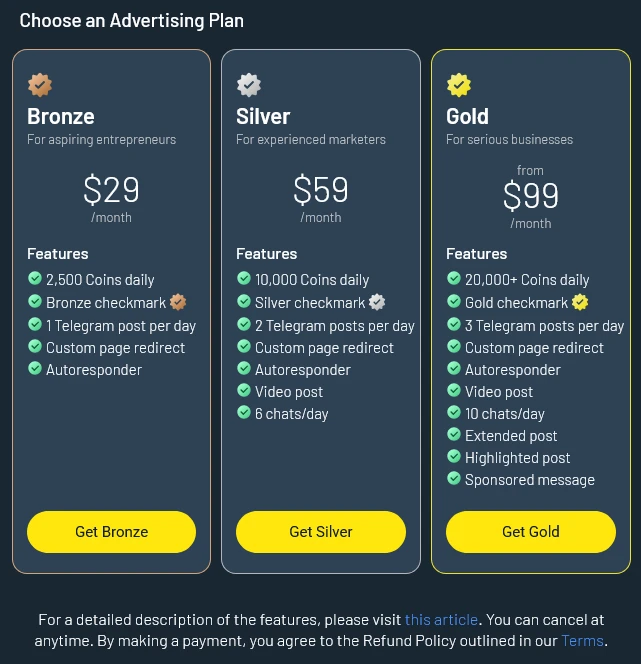
Scalelup advertising plans showing Bronze, Silver, and Gold options with their monthly pricing and included features.
Bronze Plan
The Bronze plan is currently displayed at $29 per month and includes 2,500 Coins per day.
The features shown with the Bronze plan include:
- Bronze checkmark
- One Telegram post per day
- Custom page redirect
- Autoresponder
For someone who wants to move beyond earning Coins through Discover activity and have a dedicated daily Coin allocation, this provides an entry-level paid option.
Silver Plan
The Silver plan is currently displayed at $59 per month and includes 10,000 Coins per day.
It includes the Bronze-level features along with additional capabilities such as:
- Silver checkmark
- Two Telegram posts per day
- Custom page redirect
- Autoresponder
- Video post
- Six chats per day
The larger daily Coin allocation also gives you considerably more room for promotional activity than the Bronze plan.
Gold Plan
The Gold plan is currently displayed as starting at $99 per month, with 20,000 or more Coins per day depending on the option selected.
The features shown include:
- Gold checkmark
- Three Telegram posts per day
- Custom page redirect
- Autoresponder
- Video post
- Ten chats per day
- Extended post
- Highlighted post
- Sponsored message
This is where the platform starts adding more promotional capabilities beyond simply increasing the number of Coins available each day.
Do You Need an Advertising Plan?
This is an important question, especially if you’re just getting started.
No, I wouldn’t say that you need to purchase an advertising plan simply to begin using Scalelup.
One of the things I like about the platform is that you can participate in the Coin system through activity and get a feel for how everything works before deciding whether additional paid features make sense for you.
That’s the approach I would recommend from a practical standpoint.
Learn the platform first.
Create some posts.
Use Discover.
See how the Coin system works.
Watch your impressions and clicks.
Then decide whether a paid advertising plan provides something you actually need.
Paid Plans Are About More Than Coins
It’s easy to look at the advertising plans and compare them only by their daily Coin allocation.
But that’s not the whole story.
The different plans also unlock additional promotional features.
Depending on the plan, you can gain access to things such as video posts, additional messaging capabilities, highlighted posts, sponsored messages, and other promotional tools.
That means the right plan, if you eventually choose one, depends on how you intend to use Scalelup, rather than simply choosing the plan with the largest Coin balance.
Pricing and Features Can Change
One thing I always recommend when evaluating an online marketing platform is to check the current pricing and features before making a purchase.
The plan information I’m showing in this review reflects what I see inside Scalelup while putting this article together.
Online platforms can change their pricing, feature sets, Coin allocations, and plan structures over time.
So consider the information here a snapshot of the platform as I’m experiencing it rather than a guarantee that these exact plans will remain unchanged forever.
For me, the more important question isn’t simply “Which plan should I buy?”
It’s:
“Do I actually need a paid plan for the way I’m using Scalelup?”
That’s a much better question to ask before putting another recurring charge on your credit card.
Scalelup Referral Program
Another part of Scalelup that deserves some attention is the Referral Program.
This is separate from simply using Scalelup to promote your own offers. The referral system gives members an opportunity to introduce other people to the platform and earn rewards when those referrals meet the platform’s qualification requirements.
There are several pieces to the referral system, so it’s worth looking at them separately.
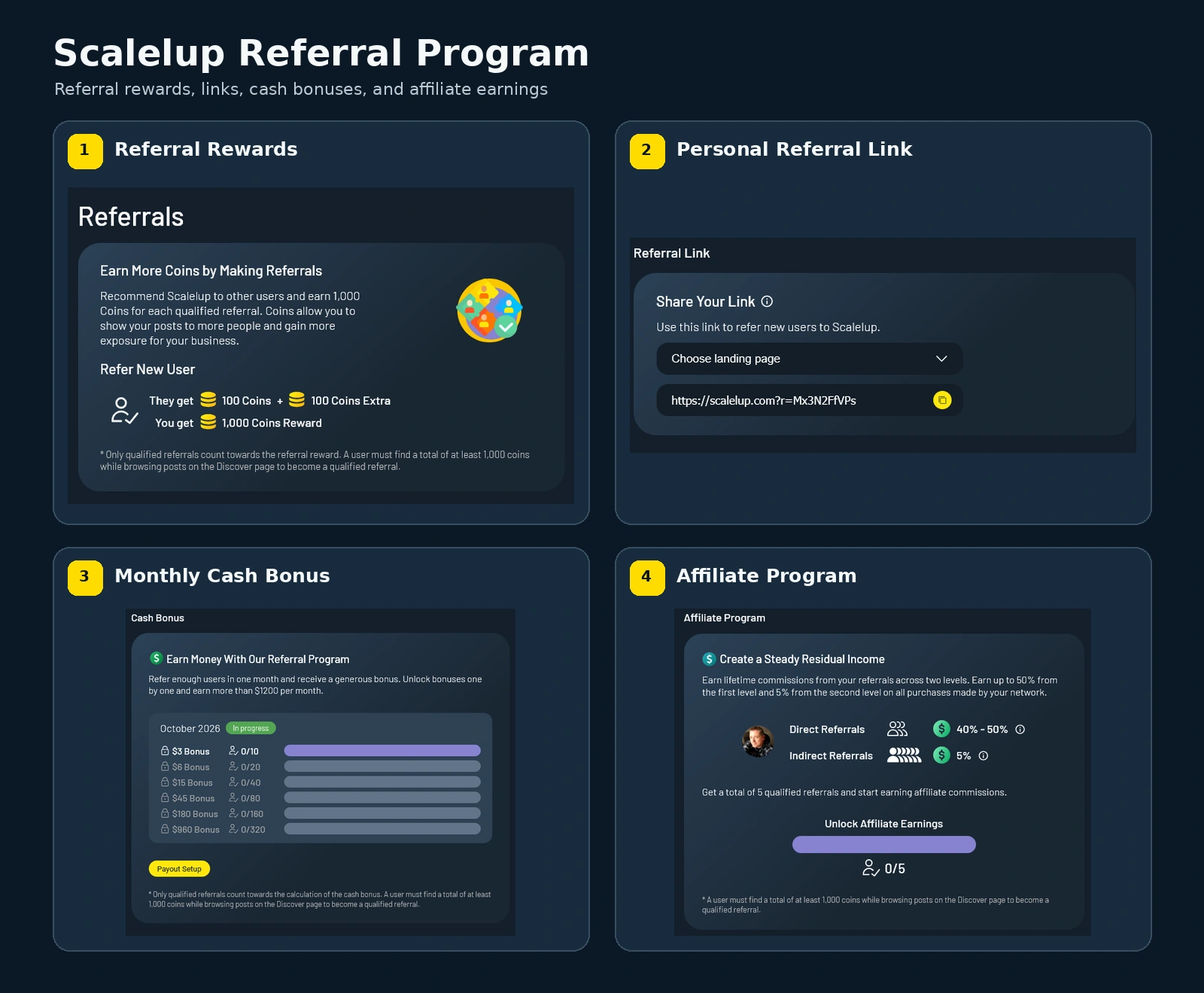
Scalelup referral program featuring referral rewards, personalized referral links, monthly cash bonuses, and affiliate earnings.
How Scalelup Referral Rewards Work
When you refer someone to Scalelup, the person joins through your personalized referral link.
According to the referral information displayed inside the platform, a new referral can receive an initial Coin reward, while the referring member can receive additional Coins when that referral becomes qualified.
The important word here is qualified.
Simply getting somebody to register does not mean the referral has necessarily met all of the requirements for the reward.
Scalelup currently requires a referred user to earn at least 1,000 Coins through the Discover section before that person becomes a qualified referral.
That means the referral system encourages new members to actually participate in the platform rather than simply creating an account and disappearing.
Your Personal Referral Link
Scalelup provides each member with a personalized referral link that can be shared with prospective users.
One feature I found interesting is that the referral system allows you to choose a landing page associated with your referral link.
That gives you more flexibility than simply handing somebody a raw registration URL.
You can direct someone toward information about the platform first and then allow them to decide whether they want to join.
That’s a useful approach when you’re introducing a platform to someone who has never heard of it.
Referral Statistics
The Referral section also provides statistics so you can keep track of your activity.
The information includes areas such as:
- Registered referrals
- Qualified referrals
- Referral rewards
This makes it easier to distinguish between someone who simply registered and someone who has completed the requirements necessary to become a qualified referral.
Again, that’s an important distinction when looking at the numbers.
Monthly Referral Bonuses
Scalelup also displays a Monthly Cash Bonus structure based on qualified referrals.
The more qualified referrals you generate during the applicable period, the higher the potential bonus level shown in the program.
This is separate from the initial Coin rewards associated with referrals.
So there are multiple layers to the referral system rather than one single reward.
Referral Creatives
Scalelup also provides promotional materials that members can use when introducing others to the platform.
The Referral section includes advertising creatives in different formats, including banner-style promotional materials.
For someone who wants to promote their referral link on a website, advertising platform, email, or another marketing channel, having ready-made promotional materials can make the process easier.
You don’t necessarily have to design every referral advertisement yourself.
Referrals Can Also Connect With the Contest System
There’s another interesting connection between the referral system and the rest of Scalelup.
Qualified referrals can contribute to your overall activity within the platform, including the contest system.
That means referrals aren’t necessarily isolated from the other things you’re doing inside Scalelup.
The platform has designed several of its features so that activity in one area can connect with another.
For example, you can earn Coins through Discover activity, earn rewards through qualified referrals, and accumulate contest points based on eligible Coin activity.
Referrals Are Not the Same as Affiliate Earnings
One thing I want to make clear is that the referral program and the affiliate program are not exactly the same thing.
The referral system includes Coin rewards and other referral-based incentives.
Scalelup also has a separate affiliate program with its own commission structure and qualification requirements.
I’ll cover that separately because combining the two could make the system unnecessarily confusing.
And that’s something I want to avoid throughout this review.
There are quite a few moving parts inside Scalelup, but once you separate the features and understand what each one does, the overall platform becomes much easier to follow.
Scalelup Affiliate Program
If you’re interested in earning commissions by referring people to marketing platforms, Scalelup also has a separate affiliate program.
It’s important to keep this separate from the referral rewards we just discussed.
The referral system provides Coin-based rewards and other incentives for qualified referrals, while the affiliate program is designed around earning commissions from eligible purchases made by people in your affiliate network.
How the Scalelup Affiliate Program Works
The affiliate program uses a two-level structure.
That means there is an opportunity to earn from people you personally refer as well as from a second level within your referral network.
The commission rates shown by Scalelup are:
- 40% to 50% on direct referrals
- 5% on indirect referrals
The exact direct commission rate can vary based on the applicable sales-volume requirements.
That makes the affiliate program something worth looking at separately if you’re already building an audience of people interested in online marketing, advertising, traffic generation, or related tools.
There Is a Qualification Requirement
There is an important requirement before affiliate earnings become available.
Scalelup currently states that you need five qualified referrals to unlock the affiliate program.
Again, this is why I keep emphasizing the difference between a registered referral and a qualified referral.
Someone can click your referral link and create an account without necessarily satisfying the qualification requirement.
The person has to meet Scalelup’s definition of a qualified referral before that referral counts toward the requirement.
Direct and Indirect Referrals
The two-level structure is fairly straightforward once you understand the terminology.
A direct referral is someone who joins Scalelup through your referral.
An indirect referral comes through the next level of your referral network.
The commission structure then provides a percentage from eligible activity at each level.
The direct level has the larger commission percentage, while the indirect level carries the smaller percentage.
This gives members an additional reason to build a referral network rather than looking at the affiliate program as a one-time opportunity.
Referral Tools and Promotional Creatives
Scalelup also provides promotional materials that can be used when promoting the platform.
The Referral area includes ready-made creative materials in different formats.
That can be helpful if you want to promote your Scalelup referral link through a website, advertising platform, email campaign, or another marketing channel.
For someone who already knows how to create promotional content, you can also use the basic referral link alongside your own advertising strategy.
That’s actually how I tend to think about affiliate marketing in general.
The affiliate link itself isn’t the marketing strategy.
The marketing strategy is what gets the right person to the right offer.
The link simply identifies the referral.
Who Might Be Interested in the Affiliate Program?
The affiliate side of Scalelup may be particularly relevant to people who already have an audience interested in online business and marketing.
For example, someone who creates content about traffic generation, lead generation, affiliate marketing, or online business tools may find that Scalelup fits naturally into their existing content.
You don’t need to make the affiliate program the entire focus of your marketing.
It can simply be one additional monetization option within a broader content and traffic strategy.
Keep the Commission Claims in Perspective
As with any affiliate program, commission percentages alone don’t tell the whole story.
A high percentage doesn’t automatically mean you’ll generate significant income.
You still need people who are interested in the platform, and those people need to take whatever qualifying action is required for commissions to be generated.
That’s why I prefer looking at the affiliate program as an additional feature of Scalelup rather than treating it as the primary reason to use the platform.
For me, the advertising and traffic functions are the reason Scalelup is relevant to my marketing.
The referral and affiliate components are additional opportunities that come with being a member.
And keeping those purposes separate makes it much easier to understand what Scalelup is actually offering.
The Scalelup Contest System
Scalelup also includes a contest system that gives active members another reason to participate on the platform.
At first glance, the contest might seem like a separate feature from the advertising and traffic side of Scalelup. Once you understand how the points are generated, however, you can see how it connects with several other parts of the platform.
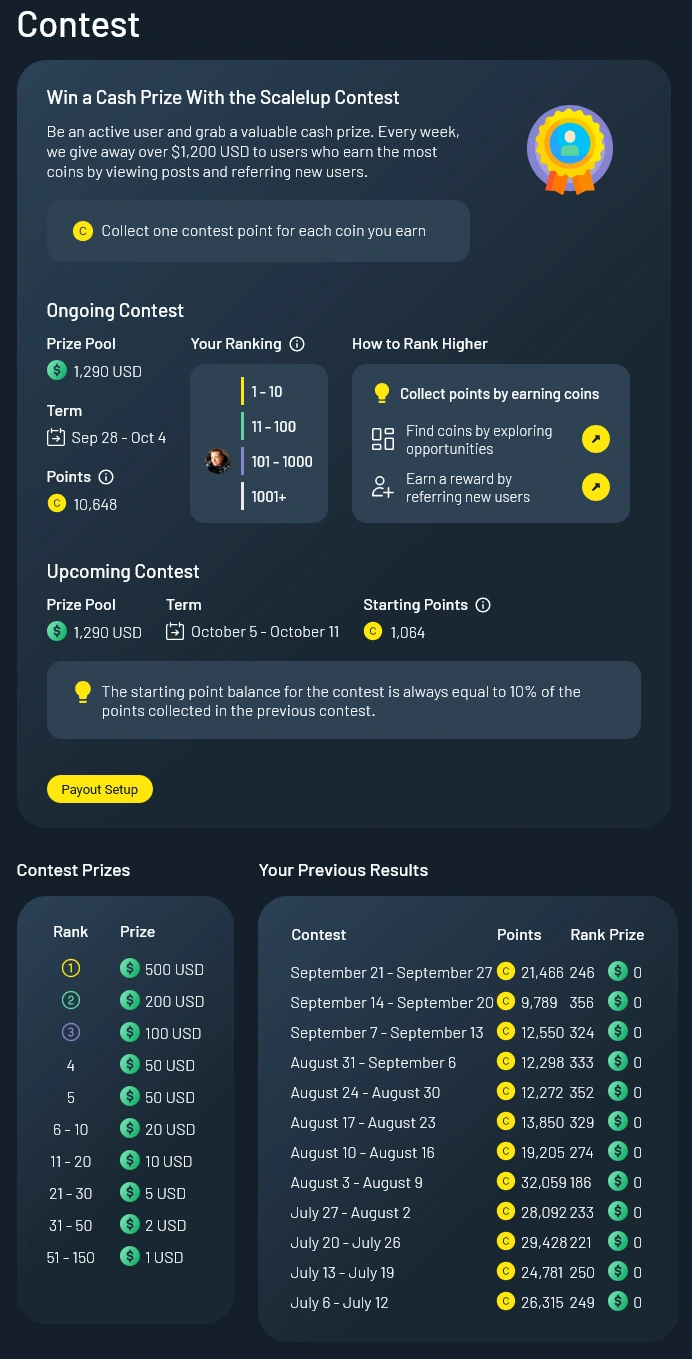
Scalelup contest system showing contest points, rankings, prize pools, prizes, and previous contest results.
How Scalelup Contest Points Work
The contest is based on activity that generates Coins.
Scalelup currently states that members earn one contest point for each Coin earned through eligible activity.
That means your participation in the platform can serve more than one purpose.
You can earn Coins that may be used toward your own promotional activity, while that same qualifying activity can also contribute to your contest position.
Qualified referral activity can also contribute to the contest system.
This creates another connection between the different features inside Scalelup.
Weekly Contests
The contest system operates on a weekly basis.
Inside the members area, you can see the current contest period, the available prize pool, the rankings, and the prizes associated with different positions.
You can also view previous contest results.
That makes it possible to see how the contests have operated over time rather than only seeing the current week’s standings.
The specific prize amounts and contest dates can change, so if you’re interested in participating, it’s worth checking the current contest information inside your account.
How the Contest Fits Into the Scalelup Ecosystem
What I find interesting about the contest is that it gives the Coin system another layer of usefulness.
Think about the process:
Participate in Discover
↓
Earn Coins
↓
Use Coins for Promotion
↓
Earn Contest Points Through Eligible Activity
That means the Discover system isn’t simply something you use when you need more advertising Coins.
It can also contribute to your overall activity within Scalelup.
Referrals can create another path for earning Coins and qualifying for additional rewards, which can also tie into the contest structure.
So several of the platform’s features overlap without actually being the same feature.
Contest Rankings
The Contest section displays a leaderboard showing the members currently ranking within the contest.
The rankings are based on the number of contest points accumulated during the applicable contest period.
The prize structure is also displayed so members can see what different positions can earn.
This makes the contest easy to understand at a glance.
You can see where you stand, how many points you’ve accumulated, and what the current rankings look like.
Previous Contest Results
Another useful part of the Contest section is the Previous Results area.
This allows you to look at completed contests and see the members who finished in different positions.
For someone trying to understand how active the contest system is, historical results can provide additional context.
It also demonstrates that the contest isn’t simply a theoretical feature sitting in the menu.
There is a history of completed contests and published results.
A Contest Is Not a Traffic Strategy
I want to make one distinction here.
The contest isn’t something I would look at as a replacement for your advertising strategy.
It’s an additional feature of the platform.
If you’re using Scalelup because you want to promote an offer, generate exposure, build a list, or experiment with another traffic source, those objectives should remain the focus.
The contest can simply be an additional benefit of participating in the platform.
And just like the other features we’ve discussed, I wouldn’t join Scalelup solely because of the contest.
Look at the platform as a whole and decide whether the advertising, traffic, lead-generation, and marketing features fit what you’re trying to accomplish.
If the contest is something you enjoy participating in along the way, that’s an added bonus.
Understanding the Scalelup Wallet
If you’re going to use Scalelup regularly, you’ll eventually want to understand where your Coins are going and how the platform keeps track of your account activity.
That’s where the Wallet section comes in.
The Wallet gives you a central place to see your current balances and review the transactions associated with your Scalelup account.
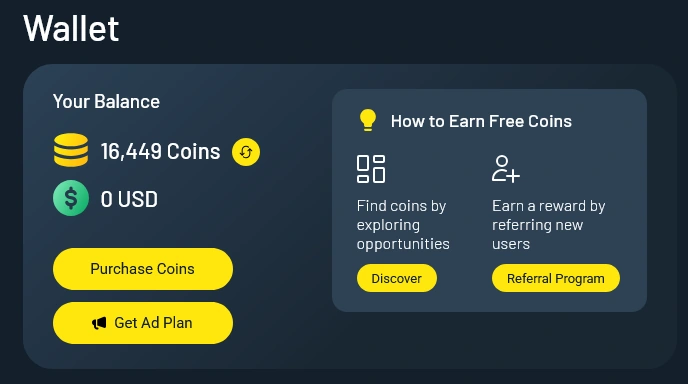
Scalelup Wallet showing the current Coin and USD balances, Coin purchase option, advertising plan access, and ways to earn free Coins.
Your Coin and Cash Balances
At the top of the Wallet, Scalelup separates your account into two balances:
Coins
and
USD
The Coin balance represents the Coins currently available in your account for eligible activities and promotions.
The USD balance represents your available cash balance within the platform.
These are separate balances, so it’s important not to look at your Coin balance as though it were the same thing as a cash balance.
For example, at the time I’m documenting my account for this review, my Wallet shows a Coin balance while my USD balance is $0.
That’s simply a snapshot of my account at the time of writing.
Purchasing Coins
The Wallet provides a direct option for purchasing additional Coins.
This can be useful if you want to increase your promotional activity without waiting to accumulate enough Coins through Discover or other eligible activities.
Whether purchasing Coins makes sense for you depends on how actively you plan to advertise and how you want to manage your marketing budget.
I wouldn’t recommend purchasing Coins simply because they’re available.
I’d first understand how much exposure you’re getting from your current campaigns and determine whether additional Coins actually serve a purpose in your advertising strategy.
Accessing Advertising Plans
The Wallet also provides a shortcut to the Ad Plan section.
That makes sense because the Coin balance and advertising activity are closely connected.
If you’re looking at your available Coins and deciding that you want more consistent promotional resources, you can move directly into the advertising-plan area to review the available options.
Again, the important thing is understanding what you’re actually trying to accomplish before adding another recurring expense.
Coin Transactions
One of the most useful parts of the Wallet is the Coin Transactions history.
This gives you a record of activity affecting your Coin balance.
For example, you can see Coins being added through eligible activities and Coins being deducted as your promotional posts receive impressions.
That makes the transaction history useful when you’re trying to understand how quickly a campaign is consuming your available advertising balance.
Instead of simply watching the number go down, you can look at the transaction history and see what activity is associated with the changes.
Cash Transactions
The Wallet also contains a separate Cash Transactions area.
This is where cash-related activity would be recorded.
In my account, this section currently shows no transactions.
That’s worth pointing out because I’m showing you what I actually see inside my account rather than assuming every feature has activity attached to it.
Your account could look different depending on your own referral, affiliate, or other cash-related activity.
Billing History
There’s also a Billing History section for account billing information.
Again, my account currently doesn’t show any invoices in this area.
If you purchase paid services or other items that generate billing records, this is the type of section where you’d expect that information to appear.
The Wallet Gives You a Better Picture of Your Advertising
For me, the biggest value of the Wallet isn’t simply knowing how many Coins I have.
It’s being able to connect my balance with my actual advertising activity.
If I create a promotional post and allow it to run, Coins are being consumed as the post generates impressions.
If I participate in Discover and earn Coins, my available balance increases.
If I purchase Coins, I have another source of advertising currency.
Looking at those activities together gives me a much clearer picture of how I’m using the platform.
That’s especially important when you’re testing multiple offers.
You want to know not only whether a promotion is receiving impressions and clicks, but also how many Coins you’re putting into generating that exposure.
Keep Coins and Results in Perspective
One of the easiest mistakes to make with any traffic platform is to focus too heavily on the amount of activity you’re generating.
A large Coin balance doesn’t automatically mean you’ll generate sales.
Likewise, thousands of impressions don’t automatically mean an offer is going to convert.
The Wallet tells you what is happening with your account balance.
Your campaign statistics tell you what is happening with your promotions.
And your own sales, leads, or other desired actions tell you whether the traffic is ultimately producing the result you’re looking for.
Those are three different things.
That’s why I like having access to the Wallet and the campaign statistics together.
They let me look at both sides of the equation:
What am I spending?
and
What am I getting from that activity?
For me, that’s much more useful than simply chasing a large impression number.
How I’ve Used Scalelup
Everything we’ve covered so far explains what Scalelup provides and how the different parts of the platform work.
Now I want to step away from the feature list for a moment and talk about how I’ve actually used Scalelup.
I’ve been using the platform for about a year, and my primary reason for using it has been advertising and generating additional exposure for online offers.
That experience has given me an opportunity to see how the platform works over time rather than judging it based on a single campaign.
Using Scalelup to Promote Profit Hub System
One of the offers I’ve promoted through Scalelup is Profit Hub System.
I’ve created multiple promotional posts around the offer and have experimented with different headlines, promotional messages, and campaigns.
That has given me actual campaign statistics to work with rather than relying on theoretical examples.
One of the campaigns in my account is titled PHS LFS NICHE BEGINNER.
At the time I captured the statistics for this review, that campaign had generated 263 impressions and 7 clicks, producing a 2.7% click-through rate.
The campaign had used 5,737 Coins, with an average CPI of 21.8 Coins and an average CPC of 819.6 Coins.
The geographic breakdown also showed that the majority of the impressions came from the United States, followed by Canada and the United Kingdom.
Those numbers give you a snapshot of what one of my actual Scalelup campaigns looked like.
They don’t tell the entire story, though.
Another Profit Hub System Campaign
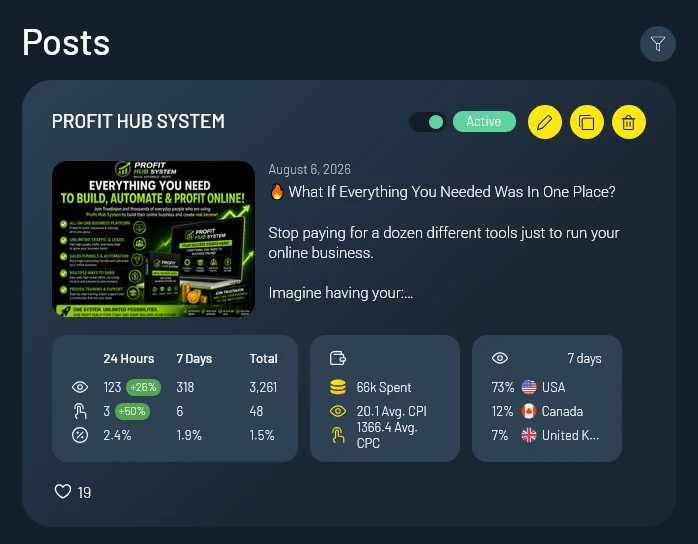
Scalelup Profit Hub System campaign showing impressions, clicks, CTR, Coin spend, CPC, and geographic traffic.
I also have an older Profit Hub System campaign in my account that accumulated substantially more exposure.
That campaign recorded 3,261 impressions and 48 clicks, with a 1.5% click-through rate.
It had used approximately 65,000 Coins, with an average CPI of 20.1 Coins and an average CPC of 1,382.9 Coins.
The geographic distribution again showed the United States as the largest source of impressions, followed by Canada and the United Kingdom.
This is one of the reasons I like keeping an eye on the statistics.
Two campaigns promoting related material can produce different numbers.
That doesn’t necessarily mean one campaign was automatically successful and the other was a failure.
The campaign message, image, targeting, timing, offer, and destination can all affect what happens.
What These Numbers Actually Tell Me
I don’t look at these statistics and automatically say, “47 clicks means the campaign worked.”
That’s not enough information.
What I can say is that the campaign generated exposure and clicks.
If I want to know whether those clicks produced leads, sales, or another desired action, I have to look at what happened after the visitor left Scalelup.
That’s why I’ve become more careful about separating traffic metrics from business results.
Impressions tell me that people were exposed to the promotion.
Clicks tell me that some people took the next step.
CTR helps me understand how those clicks relate to the number of impressions.
Coins spent tell me what the exposure cost within the Scalelup system.
But none of those numbers, by themselves, tell me whether someone ultimately purchased something.
Testing Different Promotions
Another benefit of using the platform over time is the ability to experiment.
I’ve used Scalelup for different promotions rather than running one advertisement forever.
That gives me an opportunity to test different approaches.
I can change the headline.
I can change the promotional message.
I can change the image.
I can change the destination.
I can adjust the targeting.
I can also control the pace of spending with the campaign’s daily spending limit.
That makes the platform more useful to me as a testing environment.
I’m not simply asking, “Does Scalelup work?”
I’m asking more specific questions.
Which offer gets attention?
Which message generates clicks?
Which destination produces leads?
How much exposure am I getting for the Coins I’m spending?
Those questions are much more useful than expecting one traffic source to magically produce a certain result.
Why I Keep Scalelup in My Traffic Mix
I don’t use Scalelup as the only source of traffic for LaunchForge Studio or the offers I’m promoting.
I look at it as one piece of a larger traffic strategy.
That’s important because I don’t believe an online business should depend entirely on one advertising platform.
Different traffic sources reach different audiences.
Different platforms have different costs and different types of activity.
And different offers can behave differently depending on where the traffic comes from.
For me, Scalelup provides another place where I can put an offer in front of people, monitor the exposure and clicks, and experiment with different promotional approaches.
That’s the role it plays in my overall marketing.
My Experience Is Not a Guarantee of Your Results
There’s another point I want to make because this is a review based on my own experience.
Your results may be different.
The fact that I’ve received a certain number of impressions or clicks from a campaign doesn’t mean someone else will receive the same numbers.
Your offer may be different.
Your promotional copy may be different.
Your image may be different.
Your targeting may be different.
And the platform itself can change over time.
So consider my campaign statistics examples of what I’ve experienced, not promises of what you should expect.
That’s how I think traffic platforms should be evaluated.
Use the information available to you, run your own tests, track what happens, and make decisions based on your own data.
For me, that’s been a much more useful way to approach Scalelup than simply looking for someone to tell me whether it’s “good” or “bad.”
I’ve been able to use it, test it, watch the numbers, and decide how it fits into my own marketing.
And that’s exactly what I wanted this review to show you.
What I Like About Scalelup
After using Scalelup for about a year, there are several things about the platform that stand out to me.
I’m not saying every feature will be equally useful to every marketer, but having spent time inside the platform and actually using its advertising system, I can point to several things that I personally find useful.
You Can Start With the Coin System
One thing I appreciate is that you don’t necessarily have to begin by purchasing a paid advertising plan.
The Discover section gives you a way to participate in the platform and earn Coins through activity.
That gives you an opportunity to become familiar with how the system works before deciding whether you want to spend additional money on advertising.
For someone who is brand new to a traffic platform, I think that’s valuable.
You can learn the basic process, create a post, see how impressions are generated, watch your statistics, and get a feel for how quickly Coins are being used.
There Are More Than Just Advertising Posts
Another thing I like is that Scalelup isn’t limited to one advertising format.
The platform includes promotional posts, landing pages, mailing lists, autoresponders, messaging, referrals, contests, and additional advertising features through its paid plans.
That gives you several different ways to use the platform depending on what you’re trying to accomplish.
If your goal is simply getting exposure, you can create promotional posts.
If your goal is lead generation, you can use a landing page.
If you’re building an email list, you have mailing-list and autoresponder functionality.
If you’re interested in referring other members, there’s a referral and affiliate system.
Those features don’t replace a complete marketing strategy, but having them available in one environment can make things more convenient.
The Statistics Give You Something to Measure
I also like having actual campaign statistics available.
Instead of simply running an advertisement and hoping somebody sees it, I can look at the number of impressions, clicks, CTR, Coins spent, CPI, and CPC associated with a campaign.
That gives me information I can use when deciding what to test next.
If one promotional message generates more clicks than another, that’s worth knowing.
If an advertisement receives plenty of impressions but very few clicks, that’s worth investigating.
If a campaign is consuming Coins faster than expected, that’s also useful information.
The statistics don’t tell me everything I need to know, but they give me data to work with.
Country Targeting Adds Another Layer of Control
The ability to select countries when creating a promotional post is another useful feature.
Not every offer is intended for exactly the same audience.
Depending on what you’re promoting, you may want broad international exposure or you may want to concentrate your advertising on particular countries.
Having country targeting available gives you another variable to test.
And again, I’m more interested in testing than assuming that one targeting setup will work for every offer.
The Landing Page and Email Tools Are Useful Additions
The landing-page system is another feature I like because it gives you an option for capturing leads instead of sending every visitor directly to an external offer.
Then the mailing-list and autoresponder features can help you continue communicating with those leads.
That creates a more complete process than simply generating clicks.
Traffic gets attention.
The landing page creates an opportunity to capture the visitor.
The mailing list gives you a way to organize the lead.
The autoresponder gives you a way to follow up.
Those are all important pieces of online marketing.
The Platform Gives You Multiple Ways to Participate
Another thing I find interesting is that Scalelup gives members different ways to participate.
You can advertise.
You can earn Coins through Discover.
You can refer other members.
You can participate in contests.
You can build landing pages.
You can communicate with other members.
You can use the paid advertising plans if you need additional features.
You don’t have to use every feature.
In fact, I wouldn’t recommend trying to use every feature simply because it’s there.
Instead, I think it makes more sense to choose the parts that support your particular marketing strategy.
It Gives Me Another Traffic Source
Ultimately, one of the biggest reasons I continue using Scalelup is simple:
It gives me another place to promote my offers.
I don’t want LaunchForge Studio or any online business I build to depend entirely on one traffic source.
That’s why I like having multiple channels available.
Some traffic sources may produce more impressions.
Some may produce more clicks.
Some may be better suited to building an email list.
Others may be useful for testing different offers.
Scalelup is one of the platforms I can use as part of that mix.
And because I’ve been using it for approximately a year, I have enough experience with it to understand how the basic system works and how I want to incorporate it into my own marketing.
That’s ultimately what matters most to me.
A traffic platform doesn’t have to do everything.
It simply needs to provide useful tools that fit into the marketing system I’m building.
For my purposes, Scalelup has done that.
Things to Understand Before Using Scalelup
No traffic platform is a magic button, and Scalelup is no different.
After using it for about a year, there are a few things I think are worth understanding before you decide how you want to use the platform.
Traffic Does Not Guarantee Conversions
The first thing to remember is that impressions and clicks are not the same as conversions.
Scalelup can put your promotion in front of people, but what happens after someone clicks depends on your offer and everything surrounding it.
Your headline matters.
Your promotional message matters.
Your landing page matters.
Your call to action matters.
And what you do with the visitor after they arrive matters.
A traffic platform can provide the opportunity to get attention, but you still have to give people a reason to take the next step.
Keep an Eye on Your Coins
Because Scalelup uses Coins for impression-based advertising, you should pay attention to how quickly your campaigns are consuming them.
Before launching a promotion, look at the current CPI and consider whether you want to set a daily spending limit.
That allows you to control the pace of your campaign instead of simply allowing your available Coins to be consumed without monitoring the activity.
I prefer testing smaller campaigns first and watching the numbers before deciding whether I want to put more Coins behind an offer.
Your Offer Matters
Not every offer is going to appeal to every audience.
A campaign can receive impressions without generating many clicks.
It can receive clicks without generating leads.
And it can generate leads without producing sales.
Those are different stages of the marketing process.
If you’re testing Scalelup, give yourself enough information to determine where the process is working and where it may need improvement.
Don’t automatically blame the traffic source if an offer doesn’t convert.
Sometimes the issue is the message, the landing page, the offer itself, or what happens after the visitor arrives.
Don’t Confuse Platform Activity With Business Results
This is probably the biggest lesson I would take away from using any traffic platform.
A busy dashboard can look exciting.
Lots of impressions.
Lots of clicks.
Coins moving through the account.
New activity appearing in your statistics.
But none of those numbers automatically equal revenue.
Your actual business objective might be a lead, a sale, an email subscriber, a registration, or another specific action.
That’s the number you ultimately need to track.
Use Scalelup’s statistics to understand what is happening inside Scalelup, and use your own website, landing-page, email, or sales tracking to understand what happens after the visitor leaves Scalelup.
Features and Pricing Can Change
The screenshots and plan information in this review represent what I saw while using and documenting Scalelup.
Online platforms can change.
Pricing can change.
Advertising plans can change.
Features can be added, removed, or modified.
Coin costs and promotional options can also change.
So if you’re considering purchasing an advertising plan or using a particular feature, check the current information inside Scalelup before making a decision.
Start With a Clear Purpose
You also don’t need to use every feature simply because Scalelup provides it.
You might primarily want advertising exposure.
You might be interested in building an email list.
You might want to experiment with landing pages.
You might be interested in the referral or affiliate program.
Or you might want to combine several of these features.
Before jumping into everything at once, decide what you’re actually trying to accomplish.
Then use the parts of Scalelup that support that goal.
For me, that’s meant treating Scalelup primarily as another traffic and promotional channel while using the other features when they make sense for a particular marketing objective.
That keeps the platform useful without turning it into another collection of tools I’m trying to manage simply because they’re available.
Final Thoughts on Scalelup
After using Scalelup for about a year, I see it as another useful traffic and marketing tool that can fit into a larger online business strategy. The key is understanding what the platform provides, testing your own promotions, and tracking what happens after the click.
Want to Explore Scaleup for Yourself?
If you’re looking for another way to promote your offers, generate exposure, and test different marketing approaches, you can take a closer look at the Scaleup platform and see whether it fits your strategy.