
Getting someone to visit your website is important.
Getting that person to become a lead is even better.
But neither one automatically creates a customer.
The real opportunity begins with what happens after someone gives you permission to continue the conversation.
Maybe they joined your email list, requested information, downloaded a resource, filled out a form, registered for something, or showed interest in one of your offers.
At that moment, you have something far more valuable than another anonymous website visitor.
You have an opportunity to build a relationship.
That is where a good follow up system comes in.
Instead of hoping a new lead remembers your business and eventually comes back, a follow up system gives you a simple process for staying connected, providing value, answering questions, building trust, and helping that person decide what to do next.
And it does not need to be complicated.
In this guide, we are going to break down how to build a simple follow up system that works alongside your website and lead generation process so you can turn more of the attention you are already generating into meaningful business opportunities.
The goal is not to chase every lead.
The goal is to create a system that keeps the conversation going.
Why Most Leads Do Not Become Customers Right Away
One of the biggest mistakes businesses make is assuming that someone who shows interest should be ready to buy immediately.
That is rarely how people make decisions.
A visitor may discover your website while researching a problem. They might join your email list because something caught their attention. They may download a resource, request more information, or look at an offer without being ready to make a decision that day.
That does not make them a bad lead.
It simply means they are not ready yet.
People often need time to understand what you offer, compare their options, get answers to their questions, and decide whether they trust the business behind the offer.
Without a follow up system, that entire process is left to chance.
The person leaves your website.
Life gets busy.
Another email arrives.
Another website gets their attention.
And eventually, they may forget why they were interested in your business in the first place.
A good follow up system helps prevent that relationship from disappearing.
Instead of expecting one website visit or one email to do all the work, you create multiple opportunities to reconnect with the lead and continue providing something useful.
That might mean answering a common question.
Sharing a helpful guide.
Explaining how something works.
Showing them a solution to a problem they are experiencing.
Or simply reminding them that your business is still there when they are ready to take the next step.
Follow up is not about pressuring someone into buying.
It is about staying useful long enough to be remembered when they are ready.
What Is a Follow Up System?
A follow up system is a planned process for staying connected with people after they first interact with your business.
Instead of relying on memory or manually deciding when to contact every new lead, you create a repeatable path that helps move the relationship forward.
At its simplest, a follow up system answers three questions:
Who are you following up with?
What should they receive next?
When should they receive it?
For example, someone might visit your website and join your email list.
That action triggers the beginning of the follow up process.
They could immediately receive a welcome message that delivers what they requested and explains what they can expect from you.
A few days later, they might receive a helpful resource related to the reason they joined.
Later, you could introduce another guide, answer a common question, share a useful recommendation, or point them toward an offer that makes sense for their situation.
Each message has a purpose.
And each step continues the conversation that began when the person first became a lead.
A simple follow up system might look like this:
Visitor → Lead → Welcome → Value → Education → Recommendation → Next Step
The exact path will vary depending on your business, but the principle remains the same.
You are creating a logical journey instead of sending disconnected messages and hoping something eventually works.
That is the difference between simply collecting leads and actually having a system for developing them.
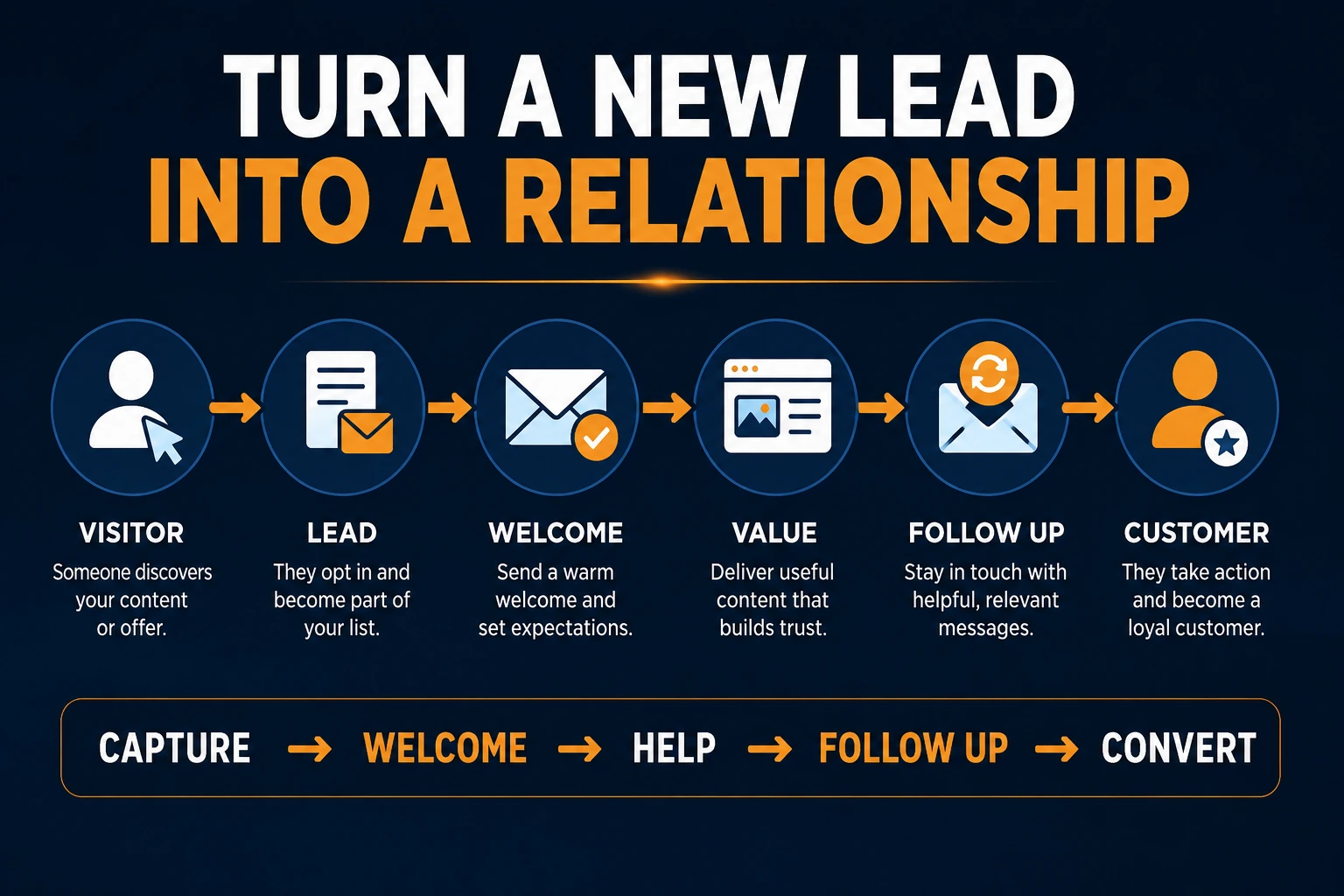
A simple follow up system connects the journey from visitor and lead to continued communication and customer action.
The Five Parts of a Simple Follow Up System
A follow up system does not need dozens of automations, complicated funnels, or hundreds of emails.
For most online businesses, the foundation can be built around five simple parts.
1. A Clear Entry Point
Every follow up process begins somewhere.
Someone might subscribe to your email list, complete a contact form, download a resource, register for a webinar, request information, or respond to an offer.
Whatever the entry point is, make the next step obvious.
The person should know what they signed up for and what they can expect to happen next.
2. An Immediate Welcome
Once someone becomes a lead, acknowledge them.
A simple welcome message can confirm their request, deliver anything you promised, introduce your business, and explain what they should expect from you.
This first interaction sets the tone for everything that follows.
3. Useful Follow Up Content
Do not make every message a sales pitch.
Give people reasons to continue opening your emails and paying attention to your business.
Share practical advice, answer common questions, explain important concepts, point toward helpful resources, and address problems your audience is trying to solve.
Every useful interaction gives the relationship another opportunity to grow.
4. A Relevant Next Step
Eventually, your follow up should lead somewhere.
That next step might be reading another guide, visiting a product or service page, requesting a consultation, watching a presentation, trying a tool, or considering an offer.
The important part is relevance.
The next step should feel like a natural continuation of the conversation rather than a sudden sales pitch.
5. A Way to Continue the Relationship
Not every lead will take action during your initial follow up sequence.
That does not mean the relationship needs to end.
After the initial sequence, leads can continue receiving useful emails, new articles, business updates, educational resources, recommendations, and occasional offers.
This creates a much longer opportunity for your business to remain useful and relevant.
Capture the lead. Welcome them. Help them. Guide them. Stay connected.
That is the foundation of a simple follow up system.
How to Build Your Follow Up System Step by Step
Now that you understand the basic pieces, it is time to connect them into a process that can actually work for your business.
The easiest way to do that is to start with the journey your lead should take rather than immediately thinking about software.
Step 1. Decide How Someone Becomes a Lead
Start by identifying the action that begins your follow up system.
For an online business, that could happen when someone:
• Joins your email list
• Completes a lead capture form
• Downloads a free resource
• Registers for a webinar or presentation
• Requests additional information
• Expresses interest in a product or service
You do not need to create every possible entry point at once.
Start with one.
A single lead capture page connected to a simple follow up process is far more useful than several disconnected forms with no clear plan for what happens afterward.
Step 2. Determine What Should Happen Immediately
Think about what the person expects after submitting their information.
If you promised a resource, deliver it.
If they requested information, tell them where to find it.
If they joined your email list, welcome them.
Do not leave a new lead wondering whether their submission worked.
The first follow up should complete the promise that convinced them to become a lead.
Step 3. Identify the Questions They Are Likely to Have
Before writing a sequence of emails, think about the person receiving them.
What problem are they trying to solve?
What might be confusing?
What concerns could prevent them from moving forward?
What information would genuinely help them make a better decision?
Those questions can become the foundation of your follow up content.
Instead of trying to invent reasons to email people, you are answering questions they are already likely to have.
Step 4. Create a Logical Sequence
Once you know what your leads need, organize the information into a simple progression.
For example:
Day 1: Welcome and deliver what was promised
Day 2: Help them understand the problem
Day 4: Share a useful solution or resource
Day 6: Answer a common question or objection
Day 8: Introduce a relevant next step
This is only an example.
There is no universal schedule that works for every audience or business. The goal is to create a reasonable rhythm that keeps the conversation moving without overwhelming the person receiving your messages.
Step 5. Decide What Happens After the Initial Sequence
Your follow up system should not simply reach the final automated email and disappear.
Decide where the lead goes next.
They might move onto your regular email list, receive new educational content, get notified when you publish another guide, or continue hearing from you when you have something relevant to share.
This creates continuity between your automated follow up and your ongoing marketing.
A good follow up system has a beginning, but the relationship does not need to have an expiration date.
What Should You Send During Follow Up?
Knowing when to follow up is only half of the equation.
You also need something worth sending.
This is where many businesses make the mistake of turning every follow up message into another attempt to make a sale.
If every email says buy this, join this, or click this offer, people quickly learn that there is little reason to pay attention unless they are already prepared to buy.
A better follow up system mixes promotion with genuinely useful communication.
Educational Content
Teach your leads something that helps them better understand the problem they are trying to solve.
This could include a tutorial, checklist, article, quick tip, comparison, or explanation of a common mistake.
Educational content demonstrates that your business can provide value before asking for another commitment.
Answers to Common Questions
Think about the questions someone might ask before taking the next step.
How does this work?
Who is it designed for?
What should I do first?
What mistakes should I avoid?
What should I look for when comparing solutions?
Answering those questions through your follow up gives people useful information while removing some of the uncertainty that can prevent them from moving forward.
Helpful Resources
Your existing content can become part of your follow up system.
If you have written an article, created a guide, recorded a tutorial, or discovered a useful resource that relates to the reason someone became a lead, share it.
You do not need to create something new for every email.
Good content can continue working for your business long after you publish it.
Stories and Examples
Sometimes the easiest way to explain an idea is to show what it looks like in practice.
Share an experience, lesson, example, or simple scenario that helps the reader understand the problem and the possible solution.
Stories can make your follow up feel more human and less like a sequence of automated marketing messages.
Relevant Recommendations
There is nothing wrong with making an offer during follow up.
The key is making sure the recommendation fits the conversation.
If someone joined your list because they wanted help generating leads, a recommendation related to lead generation makes sense.
A completely unrelated offer probably does not.
The better the recommendation matches the reason the person became a lead, the more natural the next step becomes.
Invitations to Continue
Not every message needs to end with a purchase.
Sometimes the best next step is simply another interaction.
Invite the person to read another article, watch a tutorial, reply to a question, explore a resource, or learn more about a particular solution.
Each interaction gives your business another opportunity to remain relevant.
The purpose of follow up is not to squeeze a sale out of every message.
It is to keep delivering enough value that taking the next step eventually feels natural.
How Often Should You Follow Up With Leads?
One of the most common questions about follow up is how often you should contact someone.
Send too little and people may forget about you.
Send too much without providing value and people may start ignoring you.
The goal is not to find a magical number of emails.
The goal is to create a consistent rhythm that makes sense for the relationship.
Follow Up More Closely at the Beginning
The first few days after someone becomes a lead are important because their interest is still fresh.
They remember why they visited your website.
They remember why they joined your list.
And they are more likely to recognize your name when another message arrives.
That makes the beginning of the relationship a good time to provide your most important information.
Welcome them.
Deliver what you promised.
Help them understand the problem.
Show them where to find additional resources.
Give them a clear next step.
Give Every Message a Reason to Exist
Do not send an email simply because your automation says another email is due.
Ask yourself what the reader gets from receiving it.
Does it answer a question?
Solve a small problem?
Teach something useful?
Clarify an important idea?
Point toward a helpful resource?
Help them make a decision?
If you cannot identify the purpose of the message, it probably does not need to be sent.
Consistency Matters More Than Constant Contact
Following up does not mean flooding someone’s inbox.
A useful message every few days can be far more effective than sending several messages that provide little value.
After the initial follow up period, you can settle into a schedule that works for your business and gives you enough time to create worthwhile communication.
That might mean sending something once or twice a week, publishing useful content regularly, or contacting your audience when you genuinely have something relevant to share.
The right frequency depends on your audience, your business, and the expectations you establish when someone joins your list.
Pay Attention to Your Audience
Your subscribers will help tell you whether your follow up rhythm is working.
Look at whether people are opening your emails, clicking your links, replying, unsubscribing, and taking the actions you want them to take.
If engagement begins falling, the answer is not automatically to send more email.
Look at the quality and relevance of what you are sending first.
Frequency cannot compensate for communication people do not find useful.
A strong follow up system stays present without becoming noise.
Be consistent enough to be remembered and useful enough to be welcomed.
How Automation Makes Follow Up Easier
As your business begins generating more leads, manually following up with every person can become difficult.
That is where automation becomes useful.
Automation allows certain parts of your follow up system to happen automatically after someone takes a specific action.
A new subscriber joins your list.
Your welcome email is sent.
They receive the resource they requested.
The next message arrives according to the schedule you created.
The process continues without requiring you to manually send every email.
But there is an important distinction to make.
Automation should make communication easier. It should not make your business feel less human.
Automate the Repetitive Parts
The best place to begin is with actions that should happen consistently for every new lead.
For example, you might automate:
Welcome messages
Lead magnet delivery
Educational email sequences
Reminders
Links to useful resources
Basic segmentation based on subscriber actions
These are predictable activities that software can handle efficiently.
This gives you more time to focus on the parts of your business that actually benefit from your personal attention.
Use Triggers to Start the Right Follow Up
A trigger is simply an action that tells your system what should happen next.
Someone completes a form.
Someone joins a particular email list.
Someone requests a specific resource.
Someone clicks a link showing interest in a particular topic.
Those actions can help determine what information the person should receive next.
This is much more useful than treating every lead exactly the same.
Someone interested in website design may need different information than someone interested in generating traffic or improving lead generation.
Your automation can help keep those conversations relevant.
Do Not Automate Everything
Just because something can be automated does not mean it should be.
There are moments when a personal response is more valuable.
A lead may reply to an email with a specific question.
A potential customer may need help understanding whether something is right for them.
Someone might have a problem that does not fit neatly into an automated sequence.
Those are opportunities to step outside the automation and have a genuine conversation.
The system should support the relationship, not replace it.
Write Automated Messages Like a Person
Automated emails do not need to sound automated.
Avoid writing messages as though they came from a giant marketing machine.
Use straightforward language.
Explain why you are contacting the person.
Provide something useful.
Give them a clear next step when appropriate.
And write in a way that sounds like an actual person communicating with another person.
The reader does not need to be constantly reminded that software is moving them through a sequence.
They simply need to receive useful communication at the right time.
Start Simple and Improve Over Time
You do not need an elaborate automation map with dozens of branches to create an effective follow up system.
Start with a basic sequence.
Make sure it works.
Watch how people respond.
Then improve it.
You can add segmentation, behavioral triggers, additional sequences, and more sophisticated automation later if your business actually needs them.
This keeps you from making the same mistake many online businesses make with their software stack.
Complexity should be earned by necessity, not added because the technology makes it possible.
A simple automated follow up system that consistently works is far more valuable than an impressive automation diagram nobody understands.

Automation can handle consistent follow up while your business remains focused on building genuine relationships.
Personalization Makes Follow Up More Relevant
Automation helps you communicate consistently, but relevance is what helps that communication feel useful.
Personalization does not mean every email needs to contain complicated dynamic content or dozens of different subscriber segments.
It starts with understanding why someone became a lead in the first place.
Remember Where the Lead Came From
Imagine two people join your email list.
One discovered your business through an article about generating leads.
The other arrived through a guide about simplifying their online business tools.
They may both be subscribers, but they did not arrive with the same problem.
That information can help you decide what each person should receive next.
The lead generation subscriber might benefit from content about landing pages, follow up, email marketing, and conversion.
The subscriber interested in simplifying their business might benefit from information about choosing tools, automation, connected systems, and reducing unnecessary complexity.
The better you understand what created the interest, the easier it becomes to continue the right conversation.
Segment Leads When It Makes Sense
Segmentation simply means organizing leads based on useful differences.
You might segment people according to:
What they signed up for
Which form or landing page they used
Topics they showed interest in
Links they clicked
Products or services they explored
Whether they are a new lead or an existing customer
You do not need dozens of segments.
Create them only when the difference helps you send more relevant communication.
Use Names Carefully
Adding someone’s first name to an email can make a message feel more personal, but inserting a name is not the same thing as personalization.
An email can say a person’s name five times and still have nothing relevant to say.
Meanwhile, an email without their name can feel highly personal if it directly addresses the problem that caused them to subscribe.
Relevance is more important than personalization tricks.
Let Behavior Help Guide the Conversation
What people do after joining your list can provide useful clues about what interests them.
If someone repeatedly clicks content about lead generation, that tells you something.
If another subscriber consistently reads articles about website building, that tells you something different.
You do not need to track every movement someone makes.
But when your email or marketing platform provides useful engagement information, you can use it to make better decisions about what to send.
Keep Personalization Helpful
There is a line between relevant communication and making someone feel like every action they take is being watched.
Personalization should make the experience easier and more useful.
It should not feel invasive.
Use the information people voluntarily provide and the reasonable engagement data available through your marketing tools to improve the conversation.
Then keep the focus where it belongs.
Understand what your lead needs and help them take the next logical step.
That is personalization with a purpose.
Common Follow Up Mistakes That Cost You Leads
Even a simple follow up system can lose effectiveness when a few basic principles are ignored.
The good news is that most of these mistakes are easy to recognize and correct.
Waiting Too Long to Follow Up
When someone becomes a lead, their interest is usually strongest near the moment they take action.
If several days pass before they hear from you, they may no longer remember your website, your offer, or even why they gave you their information.
Your first response does not need to be complicated.
A simple welcome message confirming what they requested can immediately establish the connection.
Do not make a new lead wonder what happened after they clicked submit.
Making Every Message a Sales Pitch
People rarely join an email list because they want another salesperson in their inbox.
If every message immediately pushes another product or promotion, subscribers can quickly stop paying attention.
Give before you ask.
Teach something.
Answer a question.
Share a resource.
Help solve a small problem.
Then, when you do make a recommendation, it becomes part of an existing relationship instead of another advertisement competing for attention.
Sending Unrelated Offers
A person becomes a lead because something specific caught their interest.
Your follow up should respect that context.
If someone joins your list after reading about lead generation and the next several emails promote completely unrelated opportunities, the experience becomes confusing.
Keep the conversation connected to the reason the relationship started.
Relevance creates continuity.
Overcomplicating the System
It is easy to become fascinated with automation.
Triggers connect to tags.
Tags activate sequences.
Sequences branch into additional workflows.
Soon you need a diagram just to understand what happens when someone joins your list.
Advanced automation can be valuable when a business actually needs it.
But complexity for its own sake creates more opportunities for something to break.
Start with the simplest system capable of accomplishing the goal.
You can always expand it later.
Forgetting to Test the Experience
Before sending real leads through your follow up system, go through it yourself.
Complete your own form.
Check the confirmation page.
Open the welcome email.
Click the links.
View the messages on your phone.
Make sure the promised resource arrives.
Check that the sequence occurs in the correct order.
You may be surprised by how many small problems become obvious when you experience the system from the subscriber’s perspective.
Ignoring Replies and Engagement
Automation can make it easy to think about subscribers as numbers moving through a system.
But those numbers represent people.
If someone replies to an email, asks a question, or shows clear interest in taking the next step, pay attention.
Those moments may be more valuable than anything your automated sequence could send next.
Never Updating the Follow Up
Your first follow up sequence does not need to be your final follow up sequence.
Offers change.
Websites change.
Links change.
Your audience teaches you what questions they actually have.
And your own understanding of the business improves.
Review your follow up periodically and remove outdated information, repair broken links, improve weak messages, and add useful content when necessary.
Build the system once, but do not assume it should remain unchanged forever.
The biggest follow up mistakes usually do not require more technology to fix.
They require better attention to the person on the other side of the message.
How to Measure Whether Your Follow Up System Is Working
Once your follow up system is running, the next question is simple.
Is it actually helping?
You do not need to become obsessed with dashboards or track dozens of metrics.
A few useful signals can tell you whether people are receiving your messages, engaging with your content, and moving toward the next step.
Email Open Rates
Open rates can give you a general idea of whether people are noticing your emails.
If very few subscribers are opening a particular message, look at the subject line, timing, sender recognition, and whether your previous messages gave people a reason to keep paying attention.
Open rates are not a perfect measurement, so they should not be viewed in isolation.
Use them as one signal among several.
Click Through Rates
Clicks tell you whether people are taking action inside your messages.
If you send subscribers to an article, resource, landing page, product, or next step, look at how many people actually click.
A message can have a strong open rate and still accomplish very little if nobody takes the next action.
Pay attention to which topics and calls to action generate the most engagement.
They can teach you a great deal about what your audience actually wants.
Replies and Conversations
Not every valuable result fits neatly into a percentage.
A subscriber replying with a question can be an important signal.
So can someone asking for additional information or telling you that a particular email helped them.
These interactions show that your follow up is creating more than clicks.
It is creating conversation.
Unsubscribe Rates
People leaving your list is normal.
Not everyone who becomes a lead will remain interested forever.
However, if a particular email causes an unusual increase in unsubscribes, take a closer look at it.
Was the message relevant?
Did you send too frequently?
Was the subject misleading?
Did the content match what people expected when they joined?
An unsubscribe is not automatically a failure, but patterns can reveal problems worth investigating.
Conversions
Eventually, your follow up system should help people take meaningful actions.
What counts as a conversion depends on your business.
It might be requesting a quote.
Scheduling a conversation.
Registering for a webinar.
Creating an account.
Purchasing a product.
Joining a service.
Or taking another action that moves the relationship forward.
The important question is not simply whether people opened your emails.
Did your follow up help more leads take the next meaningful step?
Look for Patterns Instead of Chasing Individual Numbers
One email performing poorly does not necessarily mean your entire system is broken.
Likewise, one unusually successful email does not mean you have discovered a permanent formula.
Look at performance over time.
Which subjects consistently attract attention?
Which resources receive clicks?
Where do leads stop engaging?
Which messages generate replies?
Which calls to action lead to meaningful results?
Those patterns give you something useful to improve.
Improve One Thing at a Time
When you identify a weak point, avoid rebuilding the entire system immediately.
Change one element.
Test a different subject line.
Clarify a call to action.
Improve a weak email.
Replace an outdated resource.
Adjust the timing.
Then watch what happens.
The goal is not to create a perfect follow up system on day one.
The goal is to build a useful system and keep making it better.
Connect Your Follow Up System to the Rest of Your Business
A follow up system should not operate as an isolated piece of your marketing.
It should connect with the rest of the journey you are creating for your audience.
Think about how someone might discover your business.
They see one of your advertisements.
They find an article through a search engine.
They click a social media post.
They receive a recommendation from someone.
They visit your website.
That creates attention.
But attention alone does not give you much opportunity to build a relationship.
Your lead generation system gives that visitor a reason to identify themselves and stay connected.
Then your follow up system takes over.
Traffic creates the opportunity.
Your website creates the destination.
Lead generation creates the connection.
Follow up develops the relationship.
Your offer provides the next step.
When those pieces work together, you are no longer relying on a single advertisement, website visit, or sales page to produce the entire result.
You are building a connected process.
Your Website Should Support the Journey
Your website is often where the relationship begins.
Make it easy for visitors to understand what you do, find useful information, and take a logical next step.
That might mean joining your email list, requesting information, reading another article, downloading a resource, or exploring a relevant solution.
Every page does not need to aggressively capture a lead.
But important pages should give interested visitors somewhere useful to go next.
Your Lead Generation Should Connect to Follow Up
Capturing an email address without having a plan for what happens afterward leaves much of the opportunity unused.
Before creating another opt in form or landing page, ask yourself:
What happens after someone becomes a lead?
If you cannot answer that question, build the follow up before sending more traffic to the form.
The two systems should be designed together.
Your Content Can Fuel the System
One of the advantages of consistently creating useful content is that it gives you something valuable to share with your leads.
A guide you publish today can become part of an email sequence tomorrow.
A tutorial can answer a common subscriber question.
A product review can help someone evaluate a possible solution.
A new article can give you a reason to reconnect with subscribers who have been on your list for months.
This means your website content and email marketing can support each other instead of functioning as separate activities.
Your Offers Should Feel Like the Next Step
When your follow up has helped someone understand a problem, learn about possible solutions, and become familiar with your business, making an offer does not need to feel like an abrupt change in direction.
It can simply be the next logical step.
That is very different from capturing someone’s email address and immediately bombarding them with unrelated promotions.
The relationship provides context for the recommendation.
Build the System Before You Add More Traffic
It is tempting to believe that more traffic will solve every marketing problem.
But sending more visitors into a disconnected system can simply create more missed opportunities.
Before constantly chasing additional clicks, make sure you have somewhere useful to send those people and a way to continue the relationship when they show interest.
Traffic becomes far more valuable when there is a system waiting for it.
That is why follow up should not be viewed as just another email marketing tactic.
It is one of the connections that helps turn separate marketing activities into an actual business system.
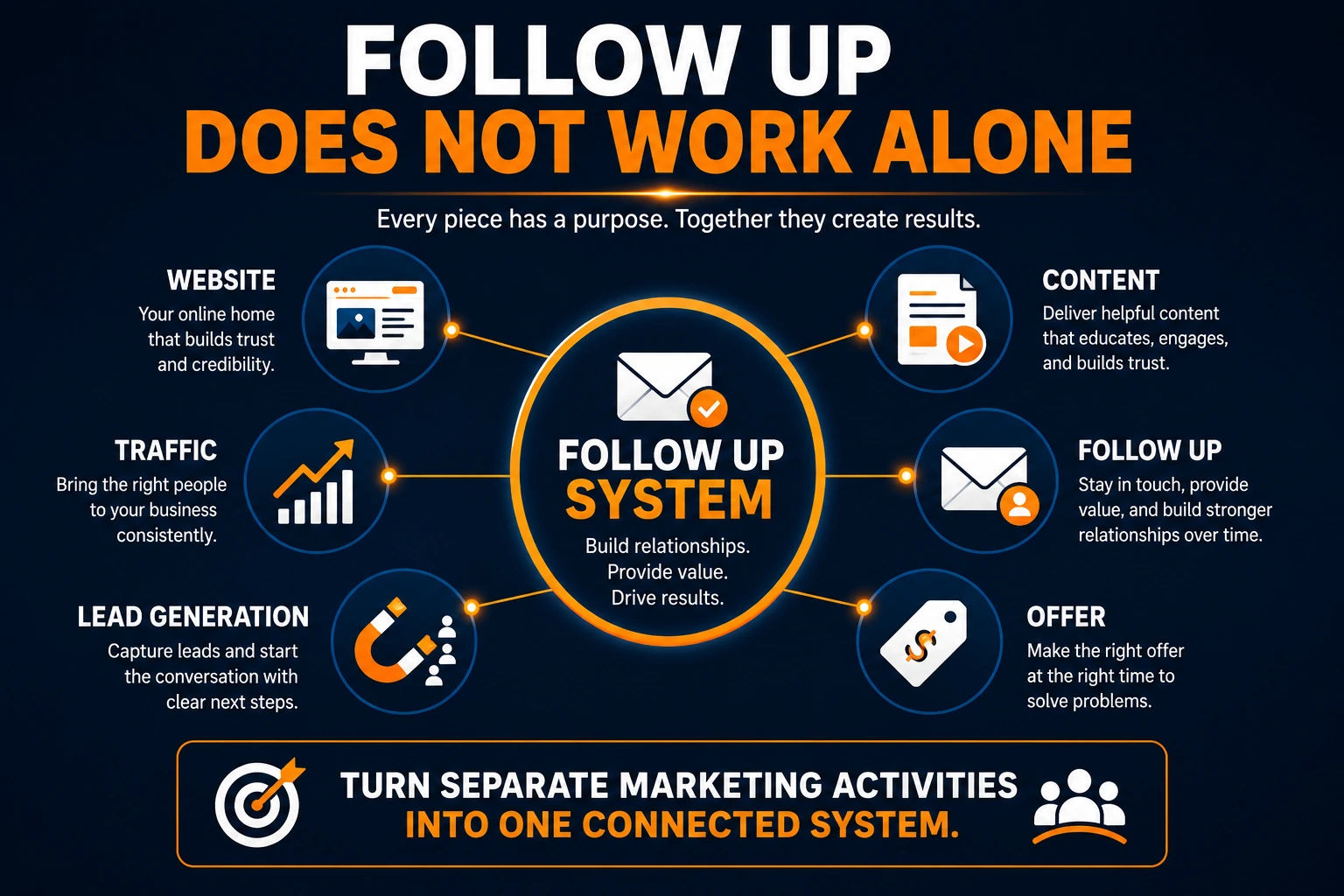
Follow up works best when your website, traffic, lead generation, content, and offers operate as one connected business system.
Start Simple and Let Your Follow Up System Grow With Your Business
By this point, it can be tempting to start imagining complicated automation workflows, dozens of email sequences, detailed subscriber segments, and sophisticated marketing funnels.
You do not need any of that to get started.
A useful follow up system can begin with one lead source, one welcome message, a short sequence of helpful emails, and one clear next step.
That is enough to create something you can actually use, test, and improve.
Build the First Version
Start with the simplest version of the journey.
Someone discovers your business.
They become a lead.
They receive what you promised.
You follow up with useful information.
You introduce a relevant next step.
You continue the relationship.
Get that process working before worrying about everything you might add later.
Learn From Real Leads
Once people begin moving through your system, you will learn things that are difficult to predict beforehand.
You will discover which questions people ask.
You will see which emails receive clicks.
You will notice which topics generate interest.
You may find places where people become confused or stop engaging.
That information can help you improve the system based on actual behavior rather than assumptions.
Add Complexity Only When It Solves a Problem
Eventually, your business may need additional sequences, better segmentation, more automation, different lead sources, or more advanced tracking.
Add those things when they have a clear purpose.
Do not add them simply because your software provides the feature.
Every additional piece creates something else you need to understand, maintain, and occasionally troubleshoot.
A simple system that gets used is better than a complicated system that never gets finished.
Focus on the Relationship
Behind every form submission, subscriber count, open rate, and click is a person who decided your business was worth giving some attention.
Treat that attention as something valuable.
Help them.
Communicate clearly.
Make useful recommendations.
Give them opportunities to take the next step without trying to force the decision.
And stay connected when they are not ready yet.
That is ultimately what a follow up system is designed to accomplish.
It gives your business a repeatable way to continue conversations that might otherwise disappear.
You do not need to chase every lead.
Build a system that gives the right leads a reason to keep coming back.
Build a Follow Up System That Keeps the Conversation Going
Generating leads is important.
But collecting names and email addresses is not the same thing as building relationships with the people behind them.
That is where your follow up system becomes valuable.
It gives your business a repeatable way to welcome new leads, provide useful information, answer questions, build familiarity, and guide interested people toward an appropriate next step.
And you do not need an elaborate marketing operation to make it work.
Start with one clear entry point.
Create a useful welcome experience.
Follow up with information that helps your audience.
Make relevant recommendations when they make sense.
Use automation to handle repetitive tasks while keeping the communication human.
Then pay attention to how people respond and improve the system over time.
The technology is there to support the conversation. The relationship is what makes the conversation valuable.
When your website, lead generation, follow up, content, marketing, and offers begin working together, you create something much more useful than a collection of disconnected tools.
You create a business system.
And that system gives every new lead a better opportunity to become more than another name sitting in a database.
Generating the lead is only the beginning.
What happens next is where the relationship is built.
Ready to Build a Smarter Online Business?
Your follow up system is only one part of the bigger picture.
LaunchForge Studio is built around helping entrepreneurs and online marketers connect those pieces with practical guides, tutorials, tools, and resources for building a simpler and more effective online business.
If you are ready to keep building, explore the LaunchForge guides and tools and find the next piece of your system.