
The internet has opened doors that previous generations could barely imagine. Today, almost anyone can launch an online business, learn valuable skills, connect with customers around the world, or discover opportunities that weren’t available just a few decades ago.
But there’s another side to that convenience, and unfortunately, not everyone online has your best interests at heart.
Knowing how to spot an online scam has become an essential skill for anyone who spends time on the internet, especially people exploring online business opportunities, digital marketing platforms, work-from-home programs, or new ways to earn additional income.
And here’s the uncomfortable truth: online scams don’t always look like scams.
Some arrive as professional-looking websites with impressive graphics, convincing testimonials, and promises that sound almost too good to pass up. Others appear through social media advertisements, unexpected emails, private messages, or seemingly legitimate business offers.
Some scammers even spend considerable time building trust before asking for money or personal information.
The days of assuming every scam comes from a poorly written email promising millions from a mysterious overseas inheritance are long gone.
Today’s online scams can look surprisingly legitimate, and even experienced internet users can be targeted.
That’s what makes this topic so important.
At LaunchForge Studio, we spend a great deal of time helping beginners understand online business tools, marketing systems, website building, and digital opportunities. But learning how to build something online is only part of the journey.
Learning how to protect yourself along the way matters just as much.
We’ve always believed that starting an online business should be about creating value, developing useful skills, and making informed decisions—not blindly trusting every advertisement promising overnight success.
And let’s be clear about something.
Not every unfamiliar website, expensive product, disappointing service, or online business opportunity is a scam.
Legitimate businesses can have limitations. Marketing platforms can deliver disappointing results. A product might simply be the wrong fit for someone’s needs.
There’s an important difference between a purchase that doesn’t work out and a business deliberately misleading people.
Understanding that difference helps you become a more confident, informed consumer without developing the habit of assuming everyone is dishonest.
In this article, we’re going to explore 15 warning signs of an online scam, along with practical ways to investigate suspicious websites, questionable business offers, misleading income claims, and increasingly convincing AI-generated deception.
We’ll also discuss what to do if you suspect you’ve already been targeted, including steps that may help protect your accounts, personal information, and finances.
Our goal isn’t to frighten you away from the internet or discourage you from exploring new opportunities.
It’s to help you recognize situations where something doesn’t feel right, understand what to investigate, and make decisions based on facts rather than pressure.
Because the internet really is full of possibilities.
The trick is learning how to recognize the genuine opportunities without handing your wallet to someone who’s already planning their next vacation with your money.
Why Online Scams Are Getting Harder to Recognize

Modern online scams can combine professional designs, fake testimonials, and urgent offers to create a misleading sense of trust.
There was a time when spotting a suspicious online offer seemed relatively straightforward.
An unexpected email would arrive announcing that you’d inherited millions of dollars from a distant relative you’d never heard of. The message might contain obvious spelling mistakes, strange formatting, and an urgent request for your banking information.
For many people, those warning signs were enough to recognize that something wasn’t right.
But online scams have evolved.
Today, fraudulent websites can resemble legitimate businesses. Fake advertisements can appear alongside trustworthy content. Social media profiles can look authentic, complete with photographs, followers, and convincing conversations.
Even customer testimonials, business credentials, and professional-looking sales pages can be manipulated to create a false sense of credibility.
The biggest challenge isn’t that every online scam has become sophisticated. It’s that appearances alone are no longer a reliable way to determine whether something is legitimate.
And for people who are just beginning to explore online business opportunities, that distinction matters more than ever.
Online Scams Have Become a Serious Financial Problem
The financial impact of internet-related crime is substantial.
According to the FBI’s 2025 Internet Crime Report, the Internet Crime Complaint Center received more than 1 million complaints, with reported losses totaling approximately $20.9 billion.
That’s a staggering amount of money.
And remember, those figures represent complaints submitted to the FBI. They don’t necessarily account for every fraudulent transaction or individual who never reported an incident.
The report highlights the financial damage associated with internet-enabled crime, including investment fraud and other schemes that exploit digital communication and financial systems.
For someone building an online business, these numbers offer an important reminder: learning how to recognize suspicious opportunities is just as valuable as learning which tools to use or how to attract customers.
You can read more in the FBI’s official announcement about its 2025 Internet Crime Report.
The purpose of sharing these statistics isn’t to make the internet sound terrifying.
It’s to demonstrate that online fraud is a genuine problem affecting real people—and one that deserves informed attention.
Professional Websites Can Create a False Sense of Trust
Imagine discovering an online business platform that promises to help you start earning money.
The homepage looks fantastic.
It has modern graphics, beautifully designed sections, impressive testimonials, and videos showing people who supposedly achieved incredible results.
There’s even a countdown timer encouraging you to purchase before the special offer disappears.
Everything looks professional.
But what does that appearance actually tell you?
Not necessarily very much.
Website-building technology has made it easier than ever to create attractive online experiences. That’s wonderful for legitimate entrepreneurs, especially beginners who don’t have extensive technical skills or expensive development teams.
Unfortunately, dishonest operators can use the same technology.
A polished website demonstrates that someone knows how to present information. It doesn’t automatically prove that the information is truthful.
That’s why an unfamiliar online business should be evaluated beyond its appearance.
Who operates it? What does the product actually provide? Are the pricing details transparent? Can the claims be independently verified?
Those questions matter far more than whether the homepage has beautiful animations and a fancy logo.
After all, a shiny website can make a terrible business look impressive.
Putting racing stripes on a lawn mower doesn’t make it a Ferrari.
Scammers Know How to Exploit Human Emotions
One reason online scams continue to work is that they don’t rely exclusively on technical tricks.
They rely on human behavior.
A suspicious offer might promise financial freedom to someone struggling with expenses.
Another might create anxiety by claiming that a bank account has been compromised.
A fake employment opportunity could appeal to someone desperately searching for work.
And an investment promotion might suggest that everyone else is making money while you’re missing out.
These approaches attempt to influence decisions through emotions such as fear, excitement, urgency, curiosity, and hope.
That doesn’t mean people who respond to them lack intelligence or common sense.
It means scammers are deliberately designing messages around predictable human reactions.
The Federal Trade Commission identifies several recurring characteristics of fraudulent approaches, including unexpected contact, pressure to act quickly, and demands for particular payment methods.
You can explore those warnings in the FTC’s official guide to avoiding scams.
The goal of a manipulative offer is often to make the emotional reaction happen before the careful evaluation.
Recognizing that pattern gives you an opportunity to slow the process down.
Artificial Intelligence Is Adding Another Layer of Complexity
Artificial intelligence has introduced powerful capabilities for businesses, creators, and everyday internet users.
It can assist with writing, design, research, customer communication, and many other legitimate activities.
But the same technology can also be misused.
AI-generated text can make fraudulent messages sound polished and professional. Synthetic images can create convincing promotional material. Voice-cloning technology can make impersonation attempts more believable.
This doesn’t mean every AI-generated image or automated message is suspicious.
The technology itself isn’t proof of dishonesty.
What matters is how the technology is being used and whether someone is deliberately misrepresenting information to gain your trust, money, or personal details.
We’ll explore AI-assisted scams in greater detail later in this guide, including practical ways to verify suspicious communications.
For now, remember one important principle:
A message that looks authentic, sounds convincing, or uses professional language still needs to be evaluated on its merits.
Why Learning to Recognize Scams Matters for New Entrepreneurs
At LaunchForge Studio, we regularly explore the tools, platforms, and strategies people can use to build an online presence.
And there’s no shortage of legitimate options available.
Website builders, marketing automation platforms, email services, sales funnels, and educational resources can all serve valuable purposes.
But beginners often encounter these products while they’re still learning how online business works.
That can make it difficult to distinguish between a realistic description of a tool’s capabilities and an exaggerated promise about what purchasing that tool will accomplish.
For example, software that helps someone create landing pages and manage email subscribers may provide genuine business value.
But that doesn’t mean it can guarantee customers, sales, or income.
Those results depend on additional factors, including the offer, audience, marketing approach, and work involved.
Understanding the difference between a useful tool and an unrealistic promise is one of the most important lessons a new online entrepreneur can learn.
And that brings us to the practical part.
Rather than relying on appearances, excitement, or someone else’s enthusiastic sales pitch, let’s examine the warning signs that can help you identify questionable online offers before making a costly decision.
15 Warning Signs of an Online Scam
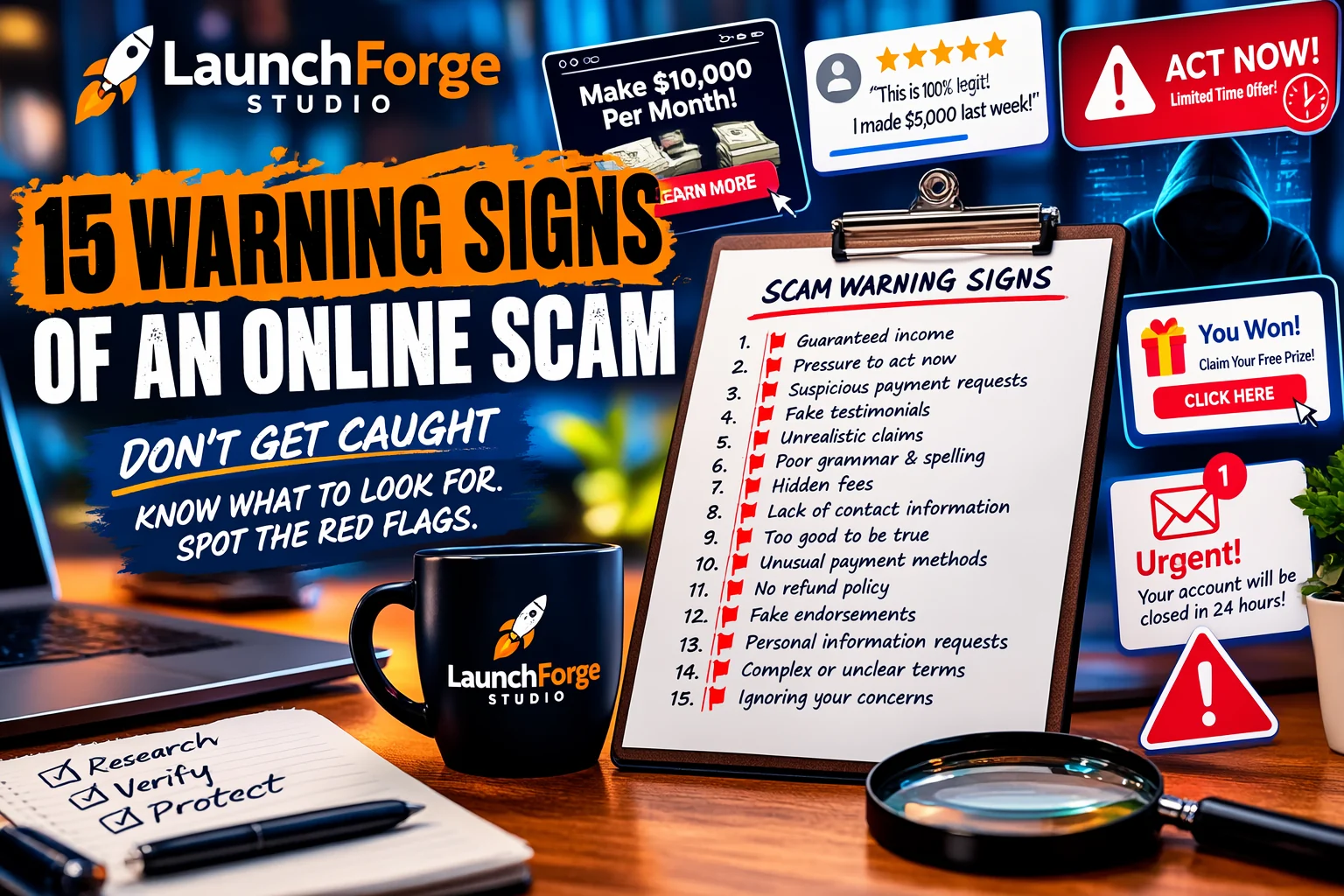
From unrealistic income promises to fake reviews and urgent payment demands, recognizing warning signs can help you investigate suspicious online offers.
Knowing how to spot an online scam becomes much easier when you understand the warning signs that dishonest individuals and businesses frequently use to manipulate people.
Some are obvious once you know what to look for. Others are surprisingly subtle, especially when they’re hidden behind a professional website, convincing testimonials, or an offer that appears to solve a problem you’ve been struggling with.
But before we explore these warning signs, there’s an important distinction worth making.
A single red flag doesn’t automatically prove that a website, company, or business opportunity is fraudulent.
A legitimate business might offer a temporary discount. A small company might have limited customer reviews. And an inexperienced website owner might occasionally publish unclear information.
What matters is the overall pattern.
When questionable claims, high-pressure tactics, missing information, and unusual payment demands start appearing together, it’s time to investigate more carefully.
The following 15 warning signs will help you recognize situations that deserve closer attention before sharing sensitive information or spending your hard-earned money.
1. The Offer Promises Guaranteed Income or Results
Imagine coming across an advertisement promising that anyone can earn thousands of dollars every month by following a simple online system.
No experience necessary.
No special skills required.
Practically no work involved.
And best of all? The results are supposedly guaranteed.
Sounds wonderful, doesn’t it?
Unfortunately, guaranteed income claims are among the most important warning signs to investigate when evaluating online business opportunities.
Legitimate businesses can provide useful products, training, software, and services. They can help customers develop skills, automate repetitive tasks, organize business activities, and potentially improve their chances of achieving particular goals.
But they generally cannot control every factor that determines whether someone earns money.
Consider an online marketing platform that provides website hosting, sales funnels, and email automation.
Those features may be genuinely valuable.
However, purchasing access to them doesn’t automatically create an audience, produce paying customers, or guarantee a profitable business.
The tools support the work. They don’t eliminate the need for it.
This distinction is especially important for beginners who may encounter promotional messages suggesting that buying a particular system is practically the same as purchasing financial success.
The Federal Trade Commission warns consumers to approach business opportunities promising guaranteed earnings or supposedly proven money-making systems with caution.
What should you do?
Look beyond the promised results and investigate what the product actually provides.
Ask yourself whether the company explains the work involved, acknowledges realistic limitations, and offers credible evidence supporting its claims.
If someone guarantees financial success while refusing to explain how that success is achieved, that’s a compelling reason to proceed carefully.
And remember, screenshots of large commission payments aren’t the same as evidence that a typical customer will achieve similar results.
A screenshot might show revenue without accounting for expenses, refunds, advertising costs, or the time invested.
The takeaway: A useful business tool can help you build something. It cannot honestly promise that everyone who purchases it will achieve the same financial outcome.
2. You’re Pressured to Make an Immediate Decision
Limited-time promotions are common in legitimate marketing.
Businesses may offer seasonal discounts, introductory pricing, or special promotions that genuinely expire.
There’s nothing inherently dishonest about that.
The warning sign appears when urgency becomes a tool for preventing you from making an informed decision.
Imagine researching a business opportunity and receiving a message that says:
You have exactly 10 minutes to purchase this system. If you leave this page, your opportunity to become financially independent disappears forever.
That’s a rather dramatic amount of pressure for someone who simply wanted to learn about an online business.
Scammers frequently use urgency to encourage impulsive decisions.
They might claim that an account will be suspended, a valuable opportunity will disappear, or a financial penalty will occur unless you respond immediately.
The objective is often to keep you focused on the supposed consequences of waiting rather than the details of the request.
What should you do?
Give yourself permission to stop.
Review the offer, read the terms, compare alternatives, and investigate the company independently.
If a seller becomes aggressive when you ask reasonable questions or request time to think, take that behavior seriously.
A legitimate business might have a genuine deadline, but it shouldn’t need to prevent you from understanding what you’re purchasing.
The takeaway: A real deadline can be reasonable. Pressure designed to stop you from thinking clearly is a warning sign.
3. The Website Address Looks Suspicious or Misleading
One of the simplest ways to investigate a suspicious website is to examine its address carefully.
Fraudulent websites sometimes imitate recognizable businesses by using domain names that resemble legitimate ones.
They may add extra words, change a letter, introduce unusual punctuation, or create misleading subdomains.
For example, imagine a fictional company operating at:
trustedbusiness.example
A suspicious imitation might appear at:
trustedbusiness-login.example.net
Although the second address contains the company’s name, it’s an entirely different domain.
A visitor who glances quickly at the address might assume they’re dealing with the legitimate company.
That’s exactly the confusion impersonation scams attempt to create.
Some fraudulent pages also reproduce familiar company logos, website layouts, product images, and color schemes to make the experience appear authentic.
Here’s another important detail: a website using HTTPS isn’t automatically trustworthy.
HTTPS helps encrypt information exchanged between your browser and the website.
It doesn’t establish whether the website owner is honest.
A fraudulent website can use HTTPS just as a legitimate business can.
What should you do?
Examine the complete domain before entering passwords, payment details, or other sensitive information.
If a message claims to come from a familiar organization, independently navigate to its official website instead of trusting the link in the message.
Be especially cautious when the website’s address doesn’t match the business you’re expecting to visit.
The takeaway: Professional design and HTTPS are useful features, but neither proves that a website belongs to the company it claims to represent.
4. You’re Asked to Pay Using Gift Cards, Cryptocurrency, or Unusual Transfers
Payment arrangements can reveal a great deal about the legitimacy of an online transaction.
One of the strongest warning signs appears when someone insists that you use a payment method that is difficult to reverse or recover.
For example, a supposed business representative might demand that you purchase gift cards and provide the card numbers as payment.
Someone else might require an immediate cryptocurrency transfer to unlock an account, activate a service, or release supposed earnings.
Of course, cryptocurrency and bank transfers have legitimate uses.
The concern isn’t simply the existence of these payment methods.
It’s the combination of an unfamiliar seller, unusual payment instructions, urgency, and limited options for recovering your money.
The FTC specifically warns that scammers frequently demand payments through gift cards, cryptocurrency, wire transfers, or other methods that can make recovery difficult.
Gift cards are an especially clear example.
If someone claiming to represent a business, government agency, or financial institution tells you to purchase gift cards and send the redemption codes, that’s a major warning sign.
What should you do?
Before paying an unfamiliar business, investigate the seller and understand the payment arrangement.
For eligible purchases, credit cards may offer useful dispute protections, although those protections depend on the circumstances and applicable terms.
Avoid transferring money simply because someone insists there’s no alternative.
And never treat an unusual payment demand as normal merely because the person requesting it sounds professional.
The takeaway: A trustworthy transaction should involve understandable payment terms, not pressure to move money through suspicious or unnecessarily irreversible methods.
5. The Company Has No Verifiable Identity or Contact Information
Every legitimate online business doesn’t need an enormous office, dozens of employees, or an expensive corporate headquarters.
Many successful businesses begin with one person working from a home office.
At LaunchForge Studio, we understand that building something meaningful often starts small.
But operating a small business is different from deliberately hiding the information customers need to make informed decisions.
When you’re considering purchasing a product or service, you should be able to determine who you’re dealing with and understand the basic terms of the transaction.
Potential warning signs include:
- Contact information that doesn’t work or repeatedly goes unanswered.
- Conflicting business names across the website, checkout page, and purchase terms.
- Claims about certifications, registrations, or partnerships that cannot be independently verified.
- Missing or confusing refund, cancellation, and subscription information.
- Refusal to identify the product provider or explain who is responsible for delivering the service.
None of these circumstances automatically proves fraud.
For example, some legitimate digital businesses provide support primarily through email or online ticket systems rather than public telephone numbers.
What matters is whether the company offers reasonable transparency and can substantiate important claims.
What should you do?
Research the company using independent sources.
Read its policies, verify its contact information where practical, and compare the business details across its website and other credible records.
If you’re considering an expensive purchase, request clarification about any information you don’t understand.
The takeaway: A legitimate business doesn’t need to be enormous, but it should be reasonably transparent about what it sells, who is responsible, and the terms customers are agreeing to.
6. The Reviews and Testimonials Seem Too Good to Be True
Customer reviews can be incredibly helpful when you’re researching an unfamiliar product, service, or online business opportunity.
They provide insight into other people’s experiences and may reveal strengths or limitations that aren’t obvious from a company’s sales page.
But there’s one important thing to remember.
Not every testimonial you see online represents a genuine, independent customer experience.
Some dishonest businesses use fabricated reviews, misleading endorsements, or selectively presented results to make an offer appear more successful than it actually is.
Imagine discovering a business platform where every customer supposedly earns thousands of dollars within their first week.
Every testimonial is glowing.
Nobody encounters technical problems.
Nobody struggles to find customers.
And apparently, everyone becomes financially independent before finishing their morning coffee.
Wouldn’t that be convenient?
Unfortunately, real businesses rarely work that way.
Even legitimate products with excellent reputations have limitations, learning curves, and customers whose experiences differ.
That’s why testimonials describing extraordinary results deserve careful examination.
Other possible warning signs include:
- Multiple reviews using identical or unusually similar wording.
- Testimonials that make impressive claims without explaining what was actually achieved.
- Customer photographs that appear repeatedly on unrelated websites.
- Reviews that seem to have been published within an unusually short period.
- Financial success stories that leave out expenses, risks, or other relevant details.
None of these signs independently proves that a review is fake. However, they can provide good reasons to investigate further.
What should you do?
Look beyond testimonials displayed on the company’s own website.
Compare information from independent review platforms, community discussions, and other credible sources.
Read detailed reviews that explain both advantages and disadvantages.
Also consider whether the reviewer has a financial relationship with the business.
Affiliate commissions don’t automatically make a recommendation dishonest, but that relationship should be disclosed so readers can evaluate the recommendation with appropriate context.
The takeaway: Genuine customer feedback can help you make better decisions, but impressive testimonials should support your research—not replace it.
7. Someone Contacts You Unexpectedly Asking for Money or Personal Information
Not every online scam begins with someone searching for a suspicious website.
Sometimes the suspicious offer finds you.
It might arrive as an email, text message, social media notification, direct message, or unexpected telephone call.
The sender may claim to represent your bank, a delivery company, an online retailer, or another organization you recognize.
The message might say there’s a problem with your account, an undelivered package, or an urgent payment that requires your attention.
In other situations, someone may announce that you’ve won a prize or qualified for a valuable financial opportunity.
The goal is often to convince you to respond before checking whether the communication is genuine.
One of the strongest warning signs is an unexpected request for passwords, security codes, payment details, or other sensitive information.
Scammers may also use impersonation tactics to make their messages appear to originate from legitimate organizations.
A familiar logo or professional email signature doesn’t establish that the sender is authentic.
Even the displayed sender name can be misleading.
What should you do?
Avoid clicking links or downloading attachments from unexpected messages until you’ve verified the source.
If a communication claims to come from your bank, visit its official website independently or call the number printed on your bank card.
If a message claims that an online account requires immediate attention, open the service through its official application or website.
And never provide a one-time verification code simply because someone contacts you requesting it.
Those codes are often designed to protect your account from unauthorized access.
Giving one to a stranger can defeat that protection.
The takeaway: An unexpected message deserves independent verification, especially when it involves money, account security, or personal information.
8. You’re Told to Keep the Opportunity Secret
Some fraudulent schemes involve more than misleading websites or unrealistic income claims.
They involve deliberate attempts to isolate the person being targeted.
A scammer might tell you that an opportunity is confidential, that other people won’t understand it, or that discussing the offer with friends and family could jeopardize your chance to participate.
In other cases, someone pretending to represent an authority figure may insist that you must not tell anyone about an urgent financial problem.
Why would someone make such a demand?
Because an outside perspective can interrupt the manipulation.
A friend, relative, or trusted professional may notice inconsistencies that are difficult to recognize when you’re feeling excited, frightened, or pressured.
Consider a fictional investment opportunity where a promoter promises extraordinary returns but insists that participants must never discuss the arrangement with anyone outside the group.
That should raise questions.
Legitimate businesses sometimes protect confidential information, including trade secrets, customer records, and private business arrangements.
But reasonable confidentiality is very different from pressuring someone to avoid independent advice about a financial commitment.
What should you do?
If you’re being asked to make a significant purchase or financial decision, give yourself permission to discuss it with someone you trust.
Ask whether the secrecy requirement has a legitimate, understandable purpose.
If the seller becomes angry or threatening because you want outside advice, consider that a serious warning sign.
You should never feel obligated to make an unfamiliar financial commitment without understanding what you’re agreeing to.
The takeaway: A legitimate opportunity shouldn’t depend on isolating you from people who might help you make an informed decision.
9. You Must Pay Money to Receive Money You’ve Supposedly Earned
This warning sign is especially important for people exploring remote work, online income opportunities, and unfamiliar digital platforms.
Imagine receiving an unsolicited message offering simple work-from-home tasks.
The assignment sounds easy.
You might be asked to review products, rate applications, complete online activities, or perform small digital assignments.
After completing several tasks, a dashboard begins displaying your supposed earnings.
Everything looks promising.
Then comes the catch.
When you attempt to withdraw the money, the platform tells you that your account requires an additional deposit.
Perhaps you need to unlock a higher level, complete a special task, or pay a fee to release your balance.
And the more you attempt to withdraw, the more money you’re asked to contribute.
This pattern closely resembles what the Federal Trade Commission describes as a task scam.
In these schemes, scammers may create the appearance of legitimate work while using fake account balances to convince participants that earnings are accumulating.
Some operations may even provide a small initial payment to build confidence before requesting larger deposits.
The important distinction is that a number displayed on a website doesn’t prove that real, withdrawable earnings exist.
A fraudulent dashboard can show practically anything its operator wants you to see.
What should you do?
Be extremely cautious when an unfamiliar work platform requires you to deposit personal funds to receive compensation you’ve supposedly earned.
Research the company independently before accepting unexpected employment offers.
Avoid assuming that a small initial payment establishes the legitimacy of the entire operation.
And remember that a legitimate employer normally pays workers for their services rather than requiring them to purchase access to their wages.
The takeaway: If someone tells you that you must keep paying money to withdraw your supposed earnings, stop and investigate before sending anything else.
10. Important Pricing, Subscription, or Refund Details Are Hidden
Not every questionable online offer promises extraordinary wealth.
Some rely on confusing billing arrangements, misleading introductory prices, or incomplete information about what customers are purchasing.
Imagine finding a service advertised for a surprisingly low one-time payment.
The sales page makes the product sound comprehensive.
You complete the purchase, only to discover that essential features require additional subscriptions.
Or perhaps the introductory payment automatically converts into a recurring charge that wasn’t clearly explained.
Additional features and paid upgrades aren’t inherently suspicious.
Many legitimate software platforms offer different plans, optional services, and subscription-based pricing.
The important distinction is whether those costs and limitations were communicated accurately before the customer committed.
A transparent business should make it reasonably clear what customers receive, what they’ll pay, and which conditions apply.
When researching an unfamiliar offer, pay attention to:
- Whether the advertised price is one-time or recurring.
- Which features are included in the initial purchase.
- Whether upgrades are optional or necessary for the advertised functionality.
- How cancellations and refunds work.
- Whether a free trial automatically becomes a paid subscription.
- Whether important restrictions are buried in confusing or contradictory terms.
A product doesn’t need to be inexpensive to be legitimate.
And a premium service isn’t automatically dishonest because it costs more than an alternative.
But customers should be able to make informed purchasing decisions without discovering major financial obligations after paying.
What should you do?
Read the terms before entering payment information.
Review checkout details carefully, including any recurring billing arrangements.
Save relevant receipts, pricing information, and purchase terms.
If important conditions remain unclear, contact the company and request clarification before completing the transaction.
Be particularly careful when a seller refuses to explain the full cost or insists that you purchase immediately before receiving basic information.
The takeaway: Transparent pricing doesn’t guarantee that a product is right for you, but deliberately misleading customers about costs and obligations is a serious warning sign.
11. The Website Uses Fake Endorsements or Claims of Official Approval
There’s a reason businesses display testimonials, certifications, awards, and recognizable company logos.
They help establish credibility.
Unfortunately, scammers understand that psychology just as well as legitimate business owners.
A questionable website might feature a famous entrepreneur’s photograph, display the logo of a respected organization, or claim that its product has received official government approval.
The problem?
Those endorsements and credentials may be completely fabricated or used without permission.
Some scammers even create advertisements that resemble legitimate news articles, complete with familiar branding and supposedly independent recommendations.
For someone unfamiliar with the company, these details can create the impression that the offer has already been thoroughly investigated.
But an attractive badge or recognizable photograph isn’t independent verification.
What should you do?
If a company claims to be endorsed, certified, licensed, or officially partnered with another organization, verify that relationship through the organization’s own website.
Be cautious about endorsements that appear only on the seller’s promotional materials.
And remember, legitimate businesses generally don’t need to invent famous supporters to explain what their products actually do.
The takeaway: Trustworthy endorsements should be independently verifiable, not simply impressive-looking decorations on a sales page.
12. The Seller Avoids Answering Straightforward Questions
Here’s a simple way to learn a great deal about an unfamiliar online business.
Ask a reasonable question.
Perhaps you want to know whether a service includes technical support, how its subscription works, or whether an advertising platform guarantees a particular number of visitors.
A transparent business should be able to explain its offering clearly.
That doesn’t mean every representative will know every answer immediately.
Sometimes a question requires additional research or assistance from another department.
The warning sign appears when someone consistently avoids providing meaningful information.
Imagine asking a marketer whether their system guarantees sales.
Instead of explaining what the platform delivers, they send another screenshot showing an enormous commission payment.
You ask about potential expenses.
They respond by telling you how many successful entrepreneurs are using the system.
You ask about refunds.
Suddenly, the conversation becomes a motivational speech about believing in yourself.
At some point, enthusiasm stops being helpful when it repeatedly replaces actual answers.
What should you do?
Ask specific questions and evaluate the responses.
If the seller cannot explain the product’s basic features, limitations, costs, or terms, consider whether you have enough information to make a responsible purchase.
The takeaway: A business doesn’t need to have every answer instantly, but repeated evasiveness about important purchasing details deserves attention.
13. The Website Looks Professional but Provides Very Little Real Information
A professional-looking website can make a strong first impression.
Beautiful graphics, smooth animations, polished videos, and modern layouts can help legitimate businesses communicate their value.
But here’s something worth remembering.
Good website design and honest business practices are two entirely different things.
Anyone with access to modern website-building tools can create an attractive online presence.
That includes people selling questionable products.
Imagine arriving at a landing page featuring enormous income claims, flashing countdown timers, dozens of glowing testimonials, and a bright purchase button.
Everything looks impressive.
But after scrolling through the entire page, you still can’t explain what the product actually does.
There’s no meaningful description of the service, no clear explanation of what’s included, and very little information about the company.
That’s a reason to investigate.
A legitimate website doesn’t have to be complicated or packed with technical details.
However, visitors should be able to understand what is being offered and what they’re expected to pay for it.
What should you do?
Look beyond the visual presentation.
Examine the product description, business information, purchase terms, support arrangements, and evidence supporting important claims.
If a website spends more time telling you how successful you’ll become than explaining what you’re actually buying, take a closer look.
The takeaway: A polished website can help establish professionalism, but appearance alone cannot establish trustworthiness.
And no, adding racing stripes to a lawn mower still doesn’t make it a Ferrari.
14. The Opportunity Promises Effortless Success Through Automation
Automation has transformed the way many online businesses operate.
Website builders simplify design. Email marketing platforms can deliver scheduled messages. Sales funnels help organize customer journeys. Software can reduce repetitive work and improve efficiency.
These are genuine benefits.
But automation can also become the centerpiece of misleading sales pitches.
A suspicious offer might claim that its automated business system handles absolutely everything.
No customers to find.
No marketing to learn.
No products to understand.
No ongoing effort required.
Just purchase the system and watch the money arrive.
Wouldn’t that be convenient?
Unfortunately, automation doesn’t eliminate the fundamental responsibilities involved in operating a business.
Software can send an email, but it cannot guarantee that the recipient will be interested.
A landing page can present an offer, but it cannot guarantee that visitors will purchase.
An advertising platform can generate exposure, but exposure and profitability aren’t interchangeable.
At LaunchForge Studio, we appreciate tools that make online business more manageable.
But we also believe beginners deserve realistic expectations about what those tools can accomplish.
What should you do?
Before purchasing an automated business system, ask exactly which tasks it performs.
Find out what remains your responsibility, whether additional expenses are involved, and what evidence supports the advertised results.
Be particularly cautious when someone claims the system will generate guaranteed income without meaningful effort or risk.
The takeaway: Automation can make business operations easier. It cannot guarantee business success.
15. You’re Told to Ignore Your Concerns and Simply Trust the System
Our final warning sign is one that can be particularly difficult to recognize because it often appears disguised as encouragement.
Someone promoting an online opportunity may tell you that success requires confidence, commitment, and a willingness to overcome fear.
Those ideas aren’t inherently wrong.
Building something new often requires patience, determination, and the ability to keep going when results aren’t immediate.
But there’s a significant difference between encouraging someone to learn and pressuring them to ignore legitimate concerns.
Imagine asking why a business opportunity doesn’t clearly disclose its operating costs.
Instead of answering, the promoter tells you that successful people don’t ask negative questions.
You express concern about unrealistic earnings claims.
They respond that your mindset is the only thing standing between you and financial freedom.
You request time to research the company.
They insist that hesitation proves you aren’t serious about success.
That’s not meaningful business guidance. That’s pressure designed to discourage independent thinking.
A legitimate company should be able to acknowledge limitations, explain risks, and answer reasonable questions without treating skepticism as a personal failure.
What should you do?
Separate motivational language from verifiable information.
Ask whether the seller is providing facts or simply attempting to change how you feel about the offer.
If someone repeatedly discourages research, dismisses reasonable questions, or pressures you to make decisions you don’t understand, consider walking away.
Your financial decisions should be based on your circumstances, your goals, and reliable information—not someone else’s enthusiasm.
The takeaway: Confidence is valuable, but confidence without careful evaluation can become an expensive lesson.
How to Check Whether a Website or Online Company Is Legitimate

Before purchasing from an unfamiliar company, research its identity, reviews, contact details, and payment terms.
Recognizing the warning signs of an online scam is an important first step. But knowing how to investigate an unfamiliar website or business is what turns that awareness into practical protection.
Fortunately, you don’t need advanced technical skills, expensive security software, or a detective’s license to perform a few useful checks.
You simply need to know where to look and which questions to ask.
No single test can guarantee that a website or business is legitimate. However, combining several verification methods can help you identify suspicious claims, inconsistent information, and unnecessary financial risks.
Before making a purchase or sharing sensitive information, consider the following steps.
Start by Examining the Website’s Domain Name
Begin with the website address displayed in your browser.
Does it match the company you intended to visit? Are there unexpected words, unusual spelling variations, or unfamiliar subdomains?
Fraudulent websites sometimes imitate established businesses by creating addresses that look almost identical to legitimate ones.
Pay particular attention when a link arrives through an unexpected email, advertisement, or private message.
Rather than following that link, consider navigating independently to the company’s official website.
And remember, HTTPS encryption helps protect information transmitted between your browser and a website, but it doesn’t prove the business itself is trustworthy.
Research the Company Beyond Its Own Website
A company’s promotional website is only one source of information.
Search for its business name alongside phrases such as:
- Company name + reviews
- Company name + complaints
- Company name + scam
- Company name + refund problems
Look for information from multiple independent sources.
Pay attention to whether complaints describe specific experiences or simply express frustration without supporting details.
A handful of negative reviews doesn’t automatically mean a company is dishonest. Even reputable businesses receive complaints.
However, recurring reports about unexplained charges, misleading promises, or undelivered products deserve closer attention.
The goal isn’t to find a business with absolutely no criticism. It’s to develop a more complete understanding of its reputation.
Verify the Business and Its Contact Information
Look for reasonable information identifying the business and explaining how customers can contact it.
Depending on the type of company, this might include business registration details, support channels, published policies, or information about the people responsible for its operations.
If a company claims to hold a particular certification, license, or official partnership, verify that claim through the appropriate independent source.
Remember that registration alone doesn’t guarantee legitimacy, and not every small online business is required to publish the same information.
What matters is whether important claims can be reasonably substantiated.
Read the Pricing, Refund, and Subscription Terms
Before completing a purchase, make sure you understand what you’re agreeing to.
Is the price a one-time payment or a recurring subscription?
Are additional tools or upgrades required?
Does a free trial automatically become a paid plan?
What happens if you want to cancel?
These questions are especially important when evaluating online business platforms, educational programs, and subscription-based marketing services.
A legitimate business may offer multiple pricing tiers or optional upgrades. That’s normal.
What shouldn’t be normal is discovering significant financial obligations that weren’t clearly disclosed before purchasing.
If the terms are confusing, ask for clarification before providing payment information.
Investigate Income Claims and Business Opportunities Carefully
If you’re considering an online money-making opportunity, take your research further.
Ask what the business actually sells, who its customers are, and what work you’ll be responsible for performing.
If you’re still evaluating which tools make sense for your business, our guide on how to choose the right tools for your online business explains how to compare features, costs, and practical needs before committing to another platform.
Look for realistic explanations of costs, limitations, and potential risks.
Be cautious when the primary selling point is how much money other people supposedly earned rather than the product or service itself.
The Federal Trade Commission’s guidance on business opportunity scams offers additional information about evaluating suspicious money-making offers and coaching programs.
A legitimate opportunity should be understandable without requiring you to believe extraordinary financial promises.
Take Your Time Before Making a Financial Commitment
One of the simplest ways to protect yourself is also one of the most effective.
Don’t allow someone else’s urgency to determine your financial decisions.
If an offer requires a significant investment, review the details, compare alternatives, and consider discussing the opportunity with someone you trust.
You don’t need to reject every unfamiliar product.
You simply need enough information to decide whether it makes sense for your circumstances.
And if the seller refuses to answer reasonable questions or becomes aggressive when you request time to investigate, that behavior deserves attention.
The bottom line: A professional website, enthusiastic testimonials, and an impressive sales presentation can all influence your first impression. Independent research helps you determine whether that impression is supported by facts.
The goal isn’t to become suspicious of every online opportunity.
It’s to become confident enough to recognize the difference between persuasive marketing and verifiable information.
How Artificial Intelligence Is Making Online Scams More Convincing

AI-generated messages, deepfake videos, and cloned voices can make scams appear credible. Independent verification remains essential.
Artificial intelligence has introduced remarkable opportunities for businesses, content creators, and everyday internet users.
From simplifying repetitive tasks to assisting with writing, research, and customer communication, AI can be an incredibly useful technology.
Unfortunately, scammers can use many of those same capabilities to make fraudulent messages and offers more convincing.
The concern isn’t that artificial intelligence is inherently dangerous. It’s that dishonest individuals can use it to create deception that looks and sounds increasingly authentic.
Understanding a few common tactics can help you recognize when something deserves additional verification.
AI-Generated Emails and Messages Can Sound Surprisingly Professional
One of the traditional warning signs of a suspicious email was poor writing.
Unusual grammar, awkward sentences, and obvious spelling mistakes often made fraudulent messages easier to recognize.
But AI-assisted writing has changed that.
A scammer can now generate polished emails, professional-sounding customer service messages, and persuasive advertisements with relatively little effort.
The message might appear to come from your bank, an online retailer, a hosting company, or another familiar organization.
It may even contain personal details that make the communication feel legitimate.
A well-written message is no longer a reliable indicator that the sender can be trusted.
If an unexpected communication requests money, account credentials, or sensitive information, verify it independently—even when the writing looks completely professional.
Deepfake Videos and Voice Cloning Can Create False Trust
AI can also be used to imitate someone’s appearance or voice.
A fraudulent advertisement might feature a digitally manipulated video that appears to show a recognizable public figure endorsing a financial opportunity.
Someone might receive a phone call that sounds like a family member urgently requesting money.
These tactics are particularly concerning because people naturally associate familiar faces and voices with trust.
The Federal Trade Commission has warned about AI voice-cloning scams, including situations where criminals imitate relatives to support fabricated emergencies.
What should you do?
If someone contacts you with an unexpected financial emergency, verify the situation through a separate, trusted communication method.
Call the person using a number you already know rather than one supplied in the suspicious message.
And never assume that a video endorsement proves a business opportunity is legitimate simply because the person appears familiar.
AI Can Make Fake Business Opportunities Look More Credible
For aspiring entrepreneurs, AI-generated marketing materials create another challenge.
A questionable online business opportunity might feature polished promotional videos, realistic-looking customer photographs, fabricated testimonials, and professionally written success stories.
Individually, those elements might appear convincing.
Together, they can make an unfamiliar business seem more established than it actually is.
That doesn’t mean using AI-generated graphics or writing is dishonest.
Many legitimate businesses use AI tools responsibly.
The warning sign appears when synthetic content is presented as genuine evidence of customers, endorsements, earnings, or experiences that never existed.
Before purchasing an unfamiliar business system, investigate the company itself rather than relying on its promotional presentation.
The Best Defense Is Independent Verification
You don’t need to become an expert at identifying every AI-generated image, voice recording, or written message.
In fact, trying to rely entirely on visual or audio clues may become increasingly difficult as the technology improves.
Instead, focus on the underlying request.
Is someone pressuring you to send money?
Are they requesting passwords or verification codes?
Does the offer promise extraordinary results without supporting evidence?
Can the information be verified through an independent, trustworthy source?
These questions remain useful regardless of whether the suspicious content was created by a person, generated with AI, or produced through a combination of both.
The takeaway: Artificial intelligence can make online deception more convincing, but independent verification remains one of your strongest defenses.
The Five-Minute Scam Check Before You Spend Money

Take five minutes to verify an unfamiliar seller, understand the offer, check payment terms, and investigate suspicious claims before spending money.
Before purchasing from an unfamiliar website or investing in an online business opportunity, take five minutes to investigate what you’re being offered.
You won’t uncover every possible problem in five minutes, and no checklist can guarantee that a company is legitimate.
But a few simple questions can help you identify warning signs before making a decision you might regret.
Use this five-point scam prevention checklist before sharing payment information or committing to an unfamiliar offer.
1. Can I Verify Who I’m Dealing With?
Check the company’s website address, identity, contact information, and reputation.
Look for information beyond the company’s own promotional materials.
If you can’t establish who is responsible for providing the product or service, investigate further before purchasing.
2. Do I Understand Exactly What I’m Buying?
Can you explain what the product does, what’s included, and what results are realistically possible?
Be cautious when a seller emphasizes extraordinary benefits while providing little information about the actual product.
If you can’t clearly explain what you’re buying, you probably need more information.
3. Are the Pricing and Payment Terms Transparent?
Review the complete cost, recurring charges, optional upgrades, refund policies, and cancellation conditions.
Be especially cautious about unexpected demands for gift cards, cryptocurrency transfers, or payments to unfamiliar personal accounts.
4. Am I Being Pressured to Decide Immediately?
Ask yourself whether the offer gives you reasonable time to evaluate its claims.
A genuine limited-time promotion isn’t automatically suspicious, but pressure that discourages research or independent advice deserves attention.
Never allow someone else’s urgency to become your financial emergency.
5. Can I Independently Verify the Important Claims?
Investigate testimonials, endorsements, income promises, and company credentials.
Look for credible supporting information rather than relying entirely on screenshots, sales presentations, or enthusiastic recommendations.
If an important claim can’t be verified, don’t treat it as an established fact.
What If Something Still Doesn’t Feel Right?
You don’t have to make a purchase simply because you’ve spent time researching it.
If several warning signs appear together, continue investigating or choose a different provider.
Sometimes the smartest business decision isn’t finding the courage to say yes.
It’s having the confidence to say, “Not until I’ve checked the facts.”
And that five-minute pause could save you considerably more than five minutes of trouble.
What to Do If You’ve Already Been Scammed Online
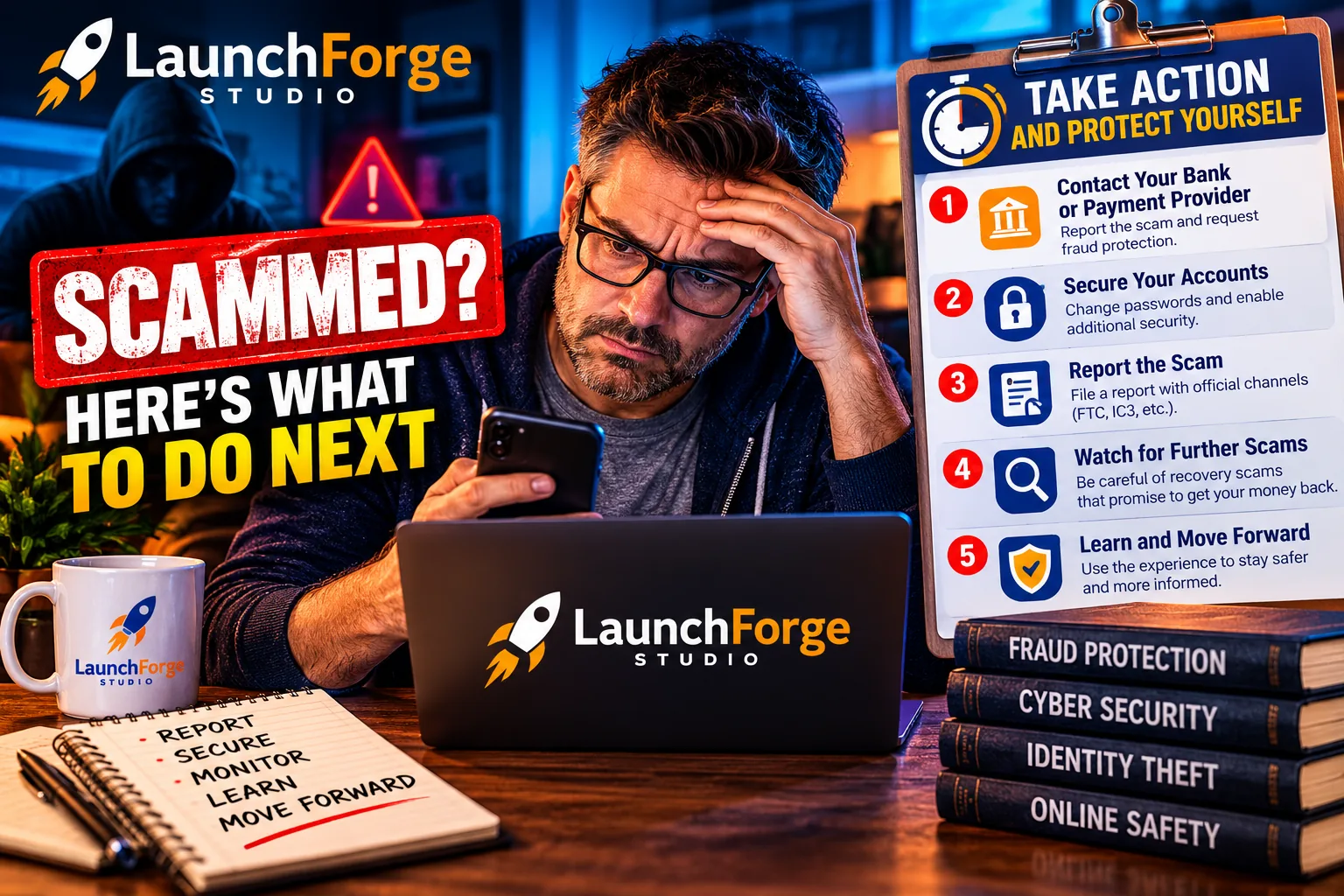
If you suspect an online scam, act promptly to contact your payment provider, secure your accounts, document the incident, and report fraud.
Discovering that you’ve fallen victim to an online scam can be frustrating, frightening, and financially devastating.
But if you suspect you’ve been scammed, the most important thing is to act quickly rather than ignore the situation.
Depending on what happened, you may still be able to limit the damage, protect your accounts, or dispute a fraudulent payment.
Contact Your Bank or Payment Provider Immediately
If you sent money to a suspected scammer, contact the bank, credit card company, or payment service involved as soon as possible.
Explain what happened and ask whether the transaction can be stopped, disputed, or reversed.
Your options will depend on how you paid and the circumstances of the transaction.
Some payments are extremely difficult to recover, particularly cryptocurrency transfers and certain wire transfers.
However, it’s still worth contacting the payment provider promptly.
The Federal Trade Commission provides specific guidance in its official instructions for what to do if you were scammed.
Secure Your Accounts and Personal Information
If you shared a password, entered personal information on a suspicious website, or gave someone access to an online account, take steps to protect yourself.
Change any compromised passwords and update other accounts where you’ve reused those credentials.
Enable two-factor authentication wherever possible.
Review your accounts for unfamiliar activity, and contact the relevant companies if you notice unauthorized changes.
If you’ve exposed sensitive identity information, visit IdentityTheft.gov for guidance appropriate to your circumstances.
Report the Scam Through Official Channels
Reporting suspicious activity can help authorities identify fraudulent operations and warn other consumers.
In the United States, you can report scams to the Federal Trade Commission at ReportFraud.ftc.gov.
Internet-related crimes can also be reported to the FBI’s Internet Crime Complaint Center at IC3.gov.
Keep copies of relevant communications, transaction records, receipts, and website addresses.
These details may be useful when contacting financial institutions or submitting reports.
Be Careful of Scammers Offering to Recover Your Money
Unfortunately, some fraudsters specifically target people who have already lost money.
They may claim to be recovery specialists, investigators, or representatives of organizations that can retrieve stolen funds.
Then they demand an upfront payment.
Be extremely cautious of anyone promising guaranteed recovery in exchange for additional money.
The FTC warns that refund and recovery scams frequently exploit people who are already dealing with financial losses.
You can learn more through its guidance on refund and recovery scams.
The takeaway: If you’ve been scammed, focus on protecting your finances, securing your information, documenting what happened, and contacting legitimate organizations for assistance.
Acting promptly cannot guarantee recovery, but it may help prevent additional harm.
Frequently Asked Questions About Online Scams
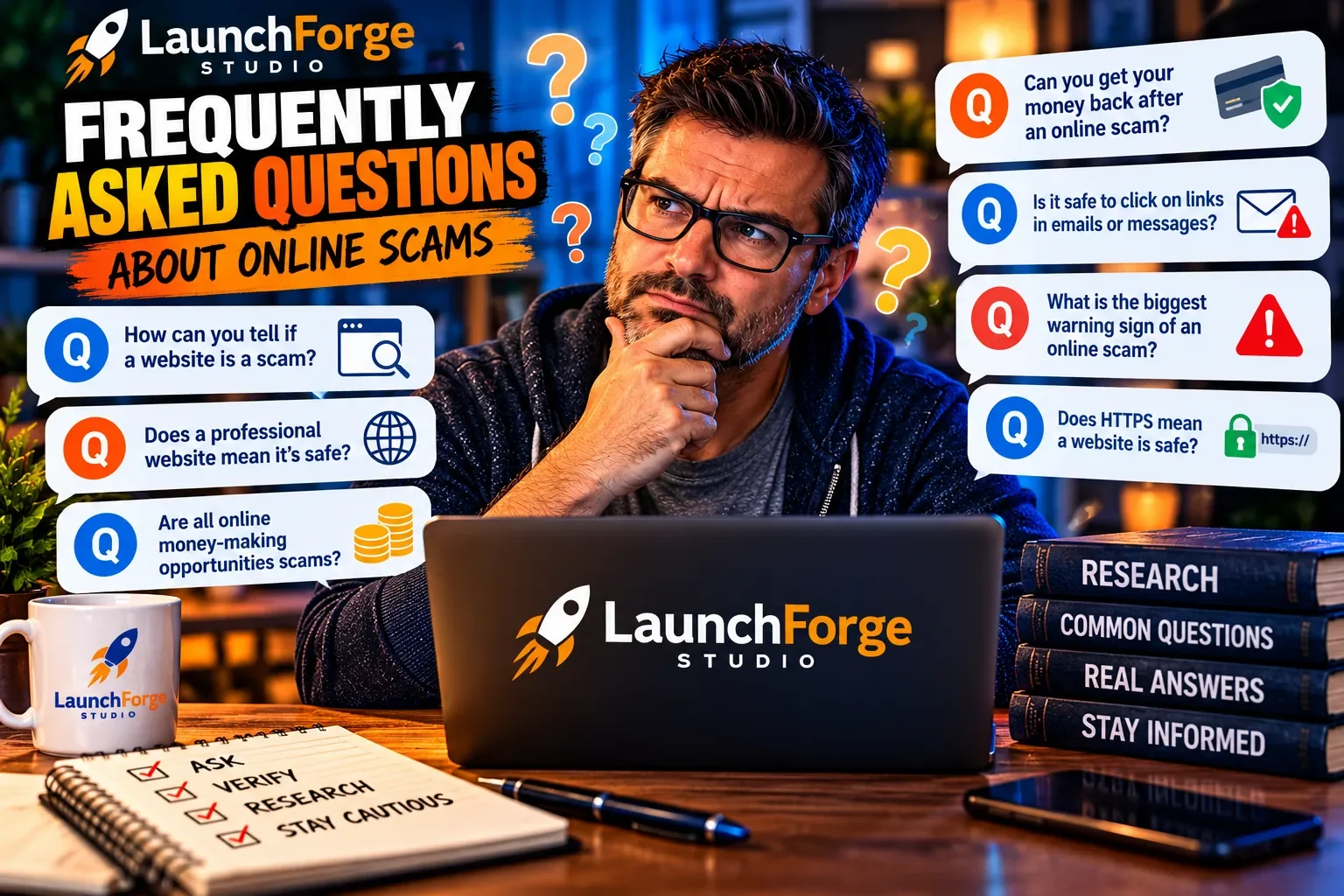
Get practical answers to common questions about suspicious websites, online money-making opportunities, HTTPS security, and recovering from scams.
How Can You Tell If a Website Is a Scam?
Start by examining the website’s address, researching the company independently, and reviewing its contact information, payment methods, and policies.
Be cautious of unrealistic promises, suspicious payment requests, and pressure to make immediate decisions.
No single warning sign proves a website is fraudulent, but several concerning details appearing together should encourage further investigation.
Does HTTPS Mean a Website Is Safe?
No. HTTPS encrypts information transmitted between your browser and a website, but it doesn’t verify whether the business operating that website is legitimate.
Scammers can create websites that use HTTPS, too.
Always investigate an unfamiliar seller before sharing sensitive information or making a purchase.
Are All Online Money-Making Opportunities Scams?
Absolutely not.
Many legitimate companies offer educational programs, business software, affiliate marketing opportunities, and other services that can help people build income-generating businesses.
However, legitimate opportunities don’t guarantee that every participant will make money.
Research the business model, understand the costs, and be skeptical of promises involving effortless income or guaranteed financial success.
Can You Get Your Money Back After an Online Scam?
Sometimes, depending on the payment method and circumstances.
Contact your bank or payment provider immediately and explain what happened. Ask whether the payment can be stopped, disputed, or reversed.
You can also report suspected fraud through ReportFraud.ftc.gov or the FBI’s Internet Crime Complaint Center.
Be cautious of anyone demanding upfront fees to recover money you’ve already lost.
What Is the Biggest Warning Sign of an Online Scam?
One of the strongest warning signs is pressure to act immediately without independently verifying important claims.
This becomes especially concerning when combined with guaranteed earnings, requests for sensitive information, or demands for unusual payment methods.
When something feels suspicious, take time to investigate.
A legitimate opportunity should make sense even after you’ve asked questions and examined the facts.
Final Thoughts: Stay Informed, Stay Cautious, and Keep Moving Forward

Knowledge, independent verification, and informed decisions help you explore online opportunities while protecting your personal information and finances.
The internet offers extraordinary opportunities to learn, connect, create, and build something meaningful. But those opportunities come with a responsibility to recognize when someone may be taking advantage of your trust.
Learning how to spot an online scam doesn’t mean becoming suspicious of every unfamiliar website, product, or business opportunity. It means developing the confidence to ask questions, investigate claims, and make decisions based on evidence rather than pressure.
As we’ve explored throughout this guide, warning signs can appear in many forms—from guaranteed income promises and misleading testimonials to suspicious payment requests, fake endorsements, and increasingly convincing AI-generated deception.
Not every disappointing purchase is fraudulent, and not every unfamiliar company deserves suspicion.
What matters is understanding the difference between legitimate business practices and tactics designed to mislead or manipulate.
At LaunchForge Studio, we believe building an online business should begin with realistic expectations, reliable information, and a commitment to creating genuine value.
That philosophy extends beyond choosing software or learning marketing strategies. It also means protecting your time, finances, and personal information while exploring new possibilities.
So before committing to your next online opportunity, remember three simple principles:
- Ask questions when something isn’t clear.
- Verify important claims before trusting them.
- Never let pressure replace your judgment.
The internet doesn’t have to be a dangerous place to explore. With the right knowledge and a little healthy skepticism, you can approach new opportunities with greater confidence.
Because the best online opportunities don’t need to hide behind unrealistic promises. They should stand up to honest questions and careful research.
And if someone promises you’ll become a millionaire by Tuesday simply by clicking a button?
Maybe give that one a second look, Muchacho.
Your wallet will thank you.