If you have spent any time learning about online marketing, you have probably heard the term sales funnel.
But what is a sales funnel, exactly?
A sales funnel is the path you create to guide someone from first discovering your business to taking a specific action. That action might be joining your email list, requesting more information, trying a product, or eventually becoming a customer.
The important word there is path.
A sales funnel is not simply a landing page, an email sequence, or a piece of software. Those can all be parts of a funnel, but the funnel itself is the larger journey connecting them.
Someone discovers your business.
They become interested in what you have to offer.
They take a small step forward.
You continue the conversation.
Eventually, some of those people decide to become customers.
That is the basic idea behind a sales funnel.
And despite the complicated diagrams, expensive software, and marketing terminology you may encounter online, the underlying concept does not have to be complicated.
In fact, we are building one right here at LaunchForge Studio.
A visitor might discover one of our articles through Google, social media, or another traffic source. They read something useful, encounter our Build Along invitation, and have the opportunity to join our email list. From there, we can continue helping them through follow-up emails, additional tutorials, tools we are actually using, and other LaunchForge resources.
We did not need to build some giant twenty-step marketing machine to make that happen.
We simply created a logical path from attention to the next useful action.
In this guide, we are going to break down how sales funnels work, the stages involved, the role landing pages and email follow-up can play, and what a simple sales funnel looks like in a real online business.
By the end, you should be able to look at your own business and start seeing the path your visitors could take next.
What Is a Sales Funnel?
A sales funnel is a structured path that moves people from discovering your business toward taking an action that matters to both them and your business.
The funnel begins with a larger group of people who become aware of you. Some of those people become interested enough to learn more. A smaller percentage take another step, such as joining your email list, exploring an offer, or comparing a product. Eventually, some decide to become customers.
That narrowing process is why marketers use the word funnel.
Picture a traditional funnel. The opening at the top is wide, while the opening at the bottom is much smaller.

A sales funnel moves people through stages of awareness, interest, consideration, conversion, and loyalty as they progress from visitors toward becoming customers.
A sales funnel works in a similar way.
You might attract 1,000 visitors to a website, but you should not expect all 1,000 people to join your email list. Of the people who subscribe, not everyone will click every email or investigate every offer. And of the people who investigate an offer, only some will decide to buy.
That does not necessarily mean the funnel failed.
It means people make decisions at different times and for different reasons.
Your job is not to somehow force every person who enters the top of the funnel to come out the bottom as a customer.
Your job is to create a useful path that helps the right people decide whether taking the next step makes sense for them.
A Sales Funnel Is a Journey, Not a Piece of Software
This distinction is important because the term sales funnel is often associated with funnel-building platforms and marketing software.
Those tools can help you build the pages, forms, emails, automations, checkout processes, and other pieces involved in a funnel.
But the software is not the funnel.
The funnel is the journey.
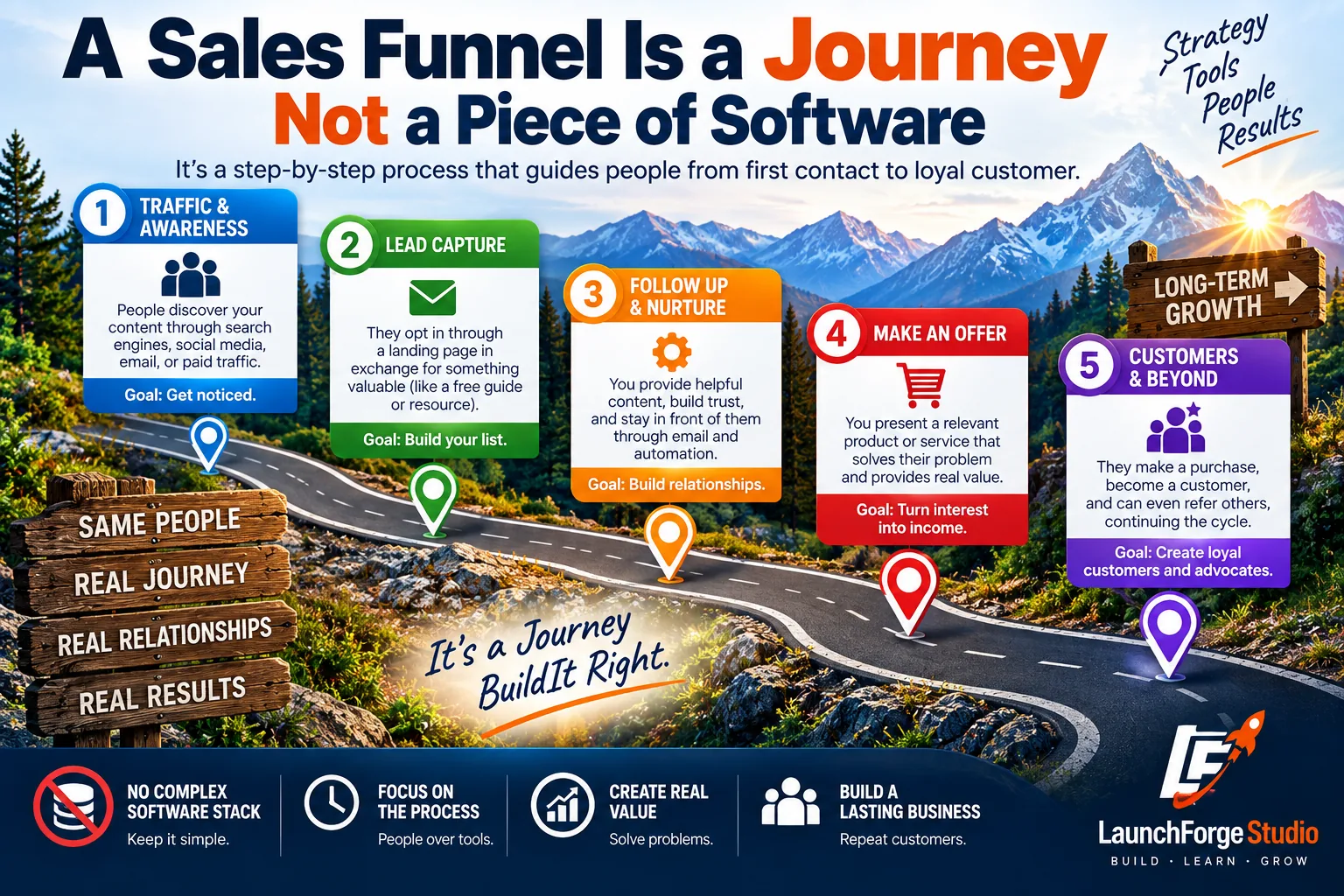
A sales funnel is a connected journey that moves people from discovery and lead capture through follow-up, relevant offers, and eventually becoming customers.
You could create a simple sales funnel using a WordPress website, a landing page, an email signup form, and an autoresponder. You could also build a much more sophisticated funnel using dedicated software, multiple landing pages, automated email sequences, upsells, order forms, and detailed tracking.
Both can still be sales funnels.
What matters is how the pieces work together to move someone toward the next logical action.
That is good news when you are building your first online business because it means you do not need an enormous collection of marketing tools before you can create a useful funnel.
Start with the journey.
Then choose the tools necessary to support it.
Why Do People Move Through a Funnel?
Most people who discover a business for the first time are not immediately ready to buy something.
They may not know who you are.
They may not understand what you offer.
They may be comparing several possible solutions.
They may simply be looking for information.
A sales funnel gives those people opportunities to learn more without requiring them to make the biggest possible commitment immediately.
Someone might first discover your business through a helpful article.
That article might lead them to another resource or an email signup form.
After joining your list, they might receive useful follow-up information that helps them understand a problem or possible solution more clearly.
Later, they may encounter an offer that makes sense for what they are trying to accomplish.
Each step builds on the one before it.
That is what makes a funnel more useful than simply dropping a visitor onto a website and hoping they somehow figure out what to do next.
The Goal Is the Next Logical Step
One of the easiest ways to overcomplicate a sales funnel is to focus too much on the final sale.
The sale matters, of course. A business eventually needs revenue.
But someone visiting your website for the first time may be several decisions away from becoming a customer.
Instead of asking only:
How do I get this person to buy?
A more useful question is:
What is the next logical step I can help this person take?
For a new visitor, that might be reading another article.
For an interested reader, it might be joining your email list.
For a subscriber, it might be learning more about a tool or solution.
For someone actively evaluating that solution, the next step might finally be making a purchase.
When those steps connect naturally, you have the beginnings of a sales funnel.
And once you understand that basic idea, the stages of the funnel become much easier to understand.
How Does a Sales Funnel Work?
A sales funnel works by giving people a series of opportunities to move from initial awareness toward a deeper relationship with your business.
Not everyone enters a funnel from the same place, and not everyone moves through it at the same speed.
Someone might discover you through Google.
Another person might click a social media post.
Someone else might follow a recommendation, see an advertisement, or arrive directly at one of your landing pages.
The entry point can change, but the basic principle remains the same.
You attract attention, provide something useful, offer a logical next step, continue the relationship, and eventually give the right people an opportunity to become customers.
To make that process easier to understand, sales funnels are usually divided into stages.
Stage 1: Awareness
Awareness happens when someone first discovers your business, content, product, or offer.
At this point, the person may know almost nothing about you.
They might find one of your articles through a search engine. They might see a post on social media. They might click an advertisement or follow a link from another website.
The goal at this stage is not necessarily to make an immediate sale.
It is to earn enough attention for the person to take another step.
That is one reason useful content can play such an important role near the top of a sales funnel.
If someone searches for an answer to a problem and your article genuinely helps them, you have created a reason for that person to stay, explore, and possibly learn more about your business.
Awareness opens the door.
The rest of the funnel gives them somewhere useful to go.
Stage 2: Interest
Once someone becomes aware of your business, some visitors will become interested enough to continue exploring.
They might read another article.
They might visit your About page.
They might look at a tool you recommend.
They might compare different solutions.
Or they might encounter an invitation to join your email list.
At this stage, the person is essentially asking:
Is there something here that can help me?
Your job is to make that answer easier to discover.
Clear navigation, useful internal links, focused landing pages, relevant calls to action, and helpful content can all move an interested visitor toward the next stage.
Stage 3: Consideration
During the consideration stage, someone is beginning to evaluate a possible solution more seriously.
They are no longer simply browsing.
They may be comparing tools, reading reviews, studying features, looking at pricing, checking examples, or trying to decide which approach makes the most sense for their situation.
This is where trust becomes especially important.
Helpful tutorials, honest product reviews, demonstrations, case studies, email follow-up, and clear explanations can help someone make a more informed decision.
Notice what we are not trying to do.
We are not trying to trick someone into buying.
We are helping them understand their options well enough to decide whether the solution is right for them.
That distinction matters.
A strong funnel should reduce confusion, not manufacture pressure.
Stage 4: Decision and Action
Eventually, some people reach the point where they are ready to make a decision.
Depending on the funnel, the desired action could be purchasing a product, starting a trial, scheduling a consultation, registering for a service, or taking another meaningful step.
This is where the funnel needs a clear call to action.
If someone has traveled through several stages, understands the offer, and is ready to move forward, the last thing you want is to make the next step confusing.
Tell them clearly what they can do.
Make the process straightforward.
And make sure the action matches what the funnel has been preparing them for.
Not Everyone Moves Through the Funnel in a Straight Line
The stages make sales funnels easier to understand, but real people do not always behave like dots moving neatly through a marketing diagram.
Someone might discover your business today, disappear for three weeks, and return later through a completely different article.
A subscriber might read several emails without clicking anything and then suddenly investigate an offer that solves a problem they are dealing with.
Someone might move quickly from awareness to action, while another person needs much more time.
That is normal.
A sales funnel gives people a path, but it does not control their journey.
This is another reason we prefer thinking about a funnel as a connected system rather than a rigid sequence.
Your website, content, landing pages, email list, follow-up, and offers can create multiple opportunities for someone to continue moving forward whenever they are ready.
The funnel provides direction.
The visitor still makes the decision.
What Are the Main Parts of a Sales Funnel?
The stages of a sales funnel describe what is happening from the visitor’s perspective.
But something still has to create that journey.
That is where the individual parts of the funnel come in.
Depending on the business, a funnel might include only a few simple pieces or a much larger collection of pages, emails, automations, offers, and follow-up systems.
For a beginner, simpler is usually better.
You do not need every marketing tool available.
You need the right pieces connected in a way that gives people a clear path forward.
Traffic Brings People Into the Funnel
Before someone can move through a sales funnel, they have to discover it.
That is the job of traffic.
Traffic can come from search engines, social media, paid advertising, email, referrals, traffic platforms, videos, online communities, or other websites.
Different traffic sources can attract people with very different levels of awareness and intent.
Someone searching Google for the solution to a specific problem may arrive with a different mindset than someone who casually encounters one of your social media posts.
That is why getting traffic is only the beginning.
The next part of the funnel needs to make sense for the people arriving through that traffic source.
Content Creates the First Connection
Content often gives visitors their first meaningful interaction with a business.
That content could be a blog article, tutorial, video, guide, social media post, product review, or another useful resource.
Good content does more than attract clicks.
It helps people solve problems, understand ideas, compare options, or make better decisions.
It can also introduce visitors to other parts of your business naturally.
Someone who finds a helpful tutorial may decide to read another article.
Someone reading a product review may want to explore the product further.
Someone learning how to solve a problem may decide they want additional help.
Content can therefore act as both an entry point and a bridge to the next stage of the funnel.
Landing Pages Focus the Next Action
A landing page gives a visitor a focused place to take a specific action.
That might mean joining an email list, downloading a resource, registering for something, learning about an offer, or making a purchase.
Unlike a general website page that may contain several navigation choices and possible directions, a landing page is usually designed around one primary goal.
That focus makes landing pages especially useful inside sales funnels.
Instead of asking the visitor to figure out what to do next, the page makes the next action clear.
The landing page is not the entire funnel.
It is one part of the path.
Lead Capture Turns Visitors Into Contacts
Until a visitor gives you a way to continue the conversation, they can leave your website and never return.
Lead capture changes that.
A lead capture page or signup form gives an interested visitor the opportunity to provide contact information, usually an email address, in exchange for something they consider worthwhile.
That might be a guide, checklist, newsletter, training resource, useful updates, or ongoing educational content.
Once someone joins your email list, the relationship changes.
You no longer have to hope they happen to find your website again.
You now have permission to continue communicating with them.
That makes lead capture one of the most important transitions in many online sales funnels.
Email Follow-Up Continues the Relationship
Capturing an email address is not the end of the funnel.
It is the beginning of another part of the relationship.
Email follow-up gives you a way to continue providing useful information after the visitor leaves your website.
You can welcome new subscribers, share relevant tutorials, explain ideas in more detail, introduce resources, answer common questions, and eventually present offers that may help them.
This is where an autoresponder or email marketing platform can become especially useful.
Instead of manually sending every message to every new subscriber, a simple automated sequence can make sure each person receives appropriate follow-up after joining your list.
The goal is not to bombard people with sales pitches.
The goal is to continue the conversation you already started.
The Offer Gives People Something to Act On
Eventually, a business needs to give interested people an opportunity to take a meaningful action.
That is where the offer enters the funnel.
An offer could be your own product or service, an affiliate product you recommend, a software platform, a membership, a consultation, or another solution.
A good funnel does not suddenly introduce a completely unrelated offer simply because someone entered an email address.
The offer should make sense within the journey that brought the person there.
If someone has spent time learning how to solve a particular problem, an offer related to that problem is a logical continuation.
The stronger the connection between the visitor’s original need and the eventual offer, the more coherent the funnel becomes.
Tracking Helps You Improve the Funnel
Once a funnel begins receiving real visitors, you can start learning from what they actually do.
How many people reach the page?
How many click the call to action?
How many join the email list?
Which traffic sources produce engaged visitors?
Where do people appear to stop moving forward?
You do not need to obsess over every possible metric when you are just getting started.
But basic tracking can show you where the funnel is working and where something may need improvement.
That is one of the biggest advantages of thinking about your marketing as a connected system.
Instead of randomly changing everything when results are disappointing, you can look at individual parts of the path and ask where the problem might actually be.
Traffic brings people in.
Content earns attention.
Landing pages focus action.
Lead capture creates a connection.
Follow-up continues the relationship.
Offers provide a way forward.
Tracking helps you improve what happens next.
Put those pieces together, and the idea of a sales funnel starts becoming much more practical.
A Simple Sales Funnel Example From LaunchForge Studio
Sales funnels become much easier to understand when you stop looking at diagrams and start looking at an actual example.
We are building a simple funnel right here at LaunchForge Studio.
It is not a massive collection of dozens of pages, complicated automations, and endless upsells.
It is a straightforward system designed to help someone discover useful content, learn more, stay connected, and continue moving through LaunchForge if they choose to.
At a high level, the path looks like this:
Traffic → LaunchForge Article → Build Along Opt-In → Email List → Follow-Up → Relevant Resources and Offers
Every piece has a job.
And because this is a system we are actually building and improving, we can look at what each part is doing rather than pretending a theoretical funnel diagram is a real business.
Step 1: Someone Discovers LaunchForge
The funnel begins when someone discovers LaunchForge Studio.
That could happen through Google, social media, a link we have shared, or another traffic source we are testing.
They might search for information about landing pages and discover one of our tutorials.
They might be researching a marketing tool and find one of our reviews.
They might encounter a LaunchForge article through something we posted on social media.
At this point, we are not assuming that person knows us or trusts us.
Our first job is much simpler.
Give them something worth reading.
Step 2: The Article Provides the Value
Once someone reaches LaunchForge, the article they landed on needs to do its job.
If they searched for information about landing pages, the article should help them understand landing pages.
If they searched for information about lead generation, we should help them understand lead generation.
If they are researching a tool, the review should help them make a more informed decision about that tool.
This matters because a funnel should not require visitors to ignore what they originally came for.
The content itself needs to deliver value.
Only then does asking someone to take another step make sense.
Step 3: The Build Along Invitation Creates a Next Step
As we continued building LaunchForge Studio, we realized that someone could read one of our articles, find it useful, and then simply leave.
There was nothing necessarily wrong with that.
But there was also an opportunity to give interested readers a clear way to continue the relationship.
So we added our Build Along opt-in to our article system.
After a reader sees what an article covers, they encounter an invitation to:
Build Smarter Alongside LaunchForge.
The invitation explains what they can expect, including step-by-step how-to guides, websites, marketing and AI, traffic and growth, tools, automation, and systems.
If that sounds useful, they can enter their name and email address.
If it does not, they can continue reading the article.
That is an important part of the design.
The opt-in provides an opportunity.
It does not block the content.
Step 4: LeadsLeap Captures the Subscriber
When someone decides to join the Build Along list, the signup form connects that visitor to the email system we are using for LaunchForge.
For our current setup, that system is LeadsLeap.
This is where a visitor becomes a lead we can communicate with again.
Instead of depending entirely on Google, social media, or another traffic source to bring that same person back, we now have a direct communication channel they chose to join.
That is a significant transition inside the funnel.
Traffic gave us the visitor.
Useful content earned some of their attention.
The opt-in offered the next step.
Lead capture turned that temporary visit into an ongoing connection.
Step 5: Follow-Up Continues the Build-Along Experience
Joining the email list should not suddenly transform the relationship into an endless stream of promotions.
The follow-up should make sense based on why someone subscribed in the first place.
For LaunchForge, that means continuing the Build Along experience.
We can share tutorials, lessons from things we are building, useful resources, new articles, tools we are testing or using, and other information that helps someone build their own online business.
Some of that communication can be automated.
Some can happen as LaunchForge continues to grow.
Either way, the purpose is to keep providing reasons for the subscriber to remain engaged.
Step 6: Relevant Offers Can Enter the Journey Naturally
LaunchForge Studio is also a business.
That means some of the tools, platforms, and resources we discuss may eventually lead to an offer.
The difference is context.
If someone is learning how to build an online business and we show them a platform we actually use to help build LaunchForge, that recommendation fits the journey.
If someone is reading about a specific marketing tool and wants to explore that tool for themselves, an affiliate link can give them that option.
The offer does not have to become the entire purpose of every interaction.
It can appear where it makes sense.
That allows monetization to become part of the system without requiring every visitor to be treated like a walking credit card.
The Funnel Can Improve as LaunchForge Grows
The funnel we are using today does not have to be the funnel we use forever.
That is part of building an online business.
We can watch what happens.
We can learn which articles attract readers.
We can see whether people respond to the Build Along invitation.
We can improve our follow-up.
We can test different traffic sources.
We can create additional resources when there is a genuine reason to create them.
And we can change parts of the funnel when the results show us something needs improvement.
That is the Build Along philosophy in action.
Build the system.
Put it to work.
Learn from the results.
Improve what matters.
A sales funnel does not have to begin as a perfectly optimized machine.
Sometimes it begins with a useful article, a clear next step, and a way to continue the conversation.
Sales Funnel vs Landing Page: What Is the Difference?
Sales funnels and landing pages are closely connected, which is why the two terms are sometimes used as though they mean the same thing.
They do not.
A landing page is a page.
A sales funnel is the larger journey that page can be part of.
That distinction sounds simple, but understanding it can prevent a lot of unnecessary confusion when you begin building your own marketing system.
A Landing Page Usually Has One Primary Goal
A landing page is generally designed around a specific action.
You might create a landing page to collect email addresses.
Another might promote a product.
Another might register people for a webinar.
Another could send visitors toward a particular offer.
The page itself has a focused job.
For example, a lead capture page might contain a headline, a short explanation of what someone receives, an email signup form, a call to action, and a few trust elements.
The visitor reaches the page and decides whether to take that action.
That is the landing page doing its job.
But what happens before and after that page can be part of something larger.
A Sales Funnel Connects Multiple Steps
A sales funnel connects the different stages of the visitor’s journey.
Someone might first discover an article through Google.
The article could lead to a landing page.
The landing page could invite them to join an email list.
Submitting the form could trigger a welcome email.
That email could lead to another useful resource.
Future follow-up might eventually introduce a relevant offer.
Now we are no longer talking about one page.
We are talking about a connected path.
That is the funnel.
A landing page can therefore be an important part of a sales funnel without being the entire sales funnel.
One Funnel Can Contain Multiple Landing Pages
A funnel does not have to contain only one landing page.
Different stages may need different pages for different purposes.
You could have a lead capture page near the beginning of the funnel.
Later, an email might send subscribers to a page explaining a particular product or service.
Someone ready to move forward could then reach an order page, registration page, or another focused page.
Each page has its own job, while the funnel connects those jobs into a larger journey.
This is one reason it helps to understand the path before building a pile of pages.
If you know what the visitor needs to do next, you can decide whether another landing page is actually necessary.
If you do not know the path, it is easy to build pages simply because marketing software gives you the ability to build them.
More pages do not automatically create a better funnel.
Do You Need a Landing Page to Have a Sales Funnel?
Not every simple funnel requires a traditional standalone landing page at every stage.
Consider the LaunchForge example we just walked through.
A visitor can discover one of our regular articles, encounter the Build Along signup form inside the article experience, join the email list, and enter our follow-up system.
The article itself is not a traditional lead capture landing page.
But it can still play an important role in the funnel.
In another situation, we might send traffic directly to a dedicated landing page because a focused page makes more sense for that particular campaign.
The right structure depends on what you want the visitor to accomplish.
This is why understanding the funnel first is so useful.
Instead of asking:
Do I need another landing page?
You can ask:
What does the visitor need at this stage of the journey?
Sometimes the answer will be a landing page.
Sometimes it will be an article.
Sometimes it will be an email.
Sometimes it will be an offer.
And sometimes the best decision is not adding anything at all.
Think About the Path Before the Page
When you start with the page instead of the journey, it is easy to become obsessed with layouts, templates, buttons, colors, software, and conversion tricks before deciding where the visitor is actually supposed to go.
Start with the path.
Where does the visitor come from?
What are they looking for?
What useful experience do they have when they arrive?
What would be a reasonable next step?
What happens if they take it?
What happens after that?
Once those questions have answers, the role of each landing page becomes much clearer.
The page serves the funnel.
The funnel should not exist merely because you built a page.
How Complicated Does a Sales Funnel Need to Be?
One of the easiest mistakes to make when learning about sales funnels is assuming that more steps automatically create better results.
You see funnel diagrams containing multiple landing pages, lead magnets, email sequences, upsells, downsells, order bumps, webinars, retargeting campaigns, segmentation rules, automation triggers, and enough arrows to make the whole thing look like an electrical schematic.
Those systems can have a purpose.
But that does not mean you need one when you are getting started.
A sales funnel only needs enough moving parts to accomplish what you are trying to accomplish.
For many online businesses, a simple funnel can be surprisingly useful.
A Simple Funnel Might Have Only a Few Steps
Imagine you publish a useful article that attracts people searching for information about a problem.
Inside that article, you offer readers an opportunity to join your email list.
Someone subscribes.
They receive a welcome email and a short series of useful follow-up messages.
One of those messages eventually introduces a relevant product, service, or resource.
That is a sales funnel.
There may be only a handful of moving parts:
Traffic.
Content.
An opt-in form.
An email list.
An offer.
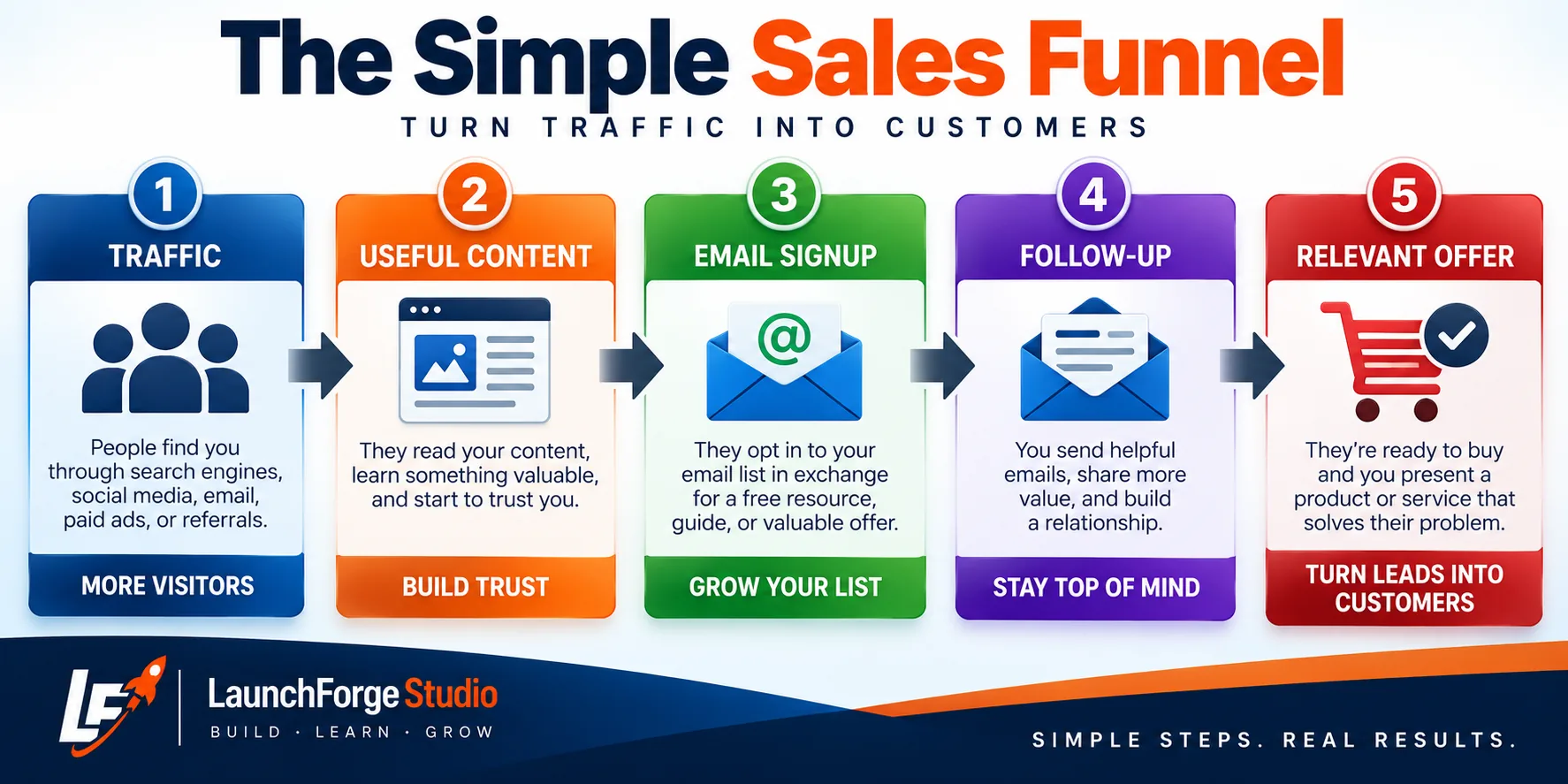
A simple sales funnel can connect traffic, useful content, email signup, follow-up, and a relevant offer into one clear customer journey.
You can always add sophistication later if the business actually needs it.
What matters in the beginning is whether the pieces you already have work together.
More Steps Create More Places for Something to Break
Every additional step in a funnel introduces another variable.
Another page needs to load correctly.
Another form needs to work.
Another email needs to be written.
Another automation needs to fire at the right time.
Another integration needs to pass information correctly.
Another metric needs to be monitored.
Complexity is not automatically bad.
But complexity has a cost.
That cost can include money, time, maintenance, troubleshooting, and the mental energy required to understand your own system.
This becomes especially important for someone building an online business by themselves.
If you spend all your time maintaining the funnel, you have less time to create useful content, generate traffic, communicate with your audience, test offers, and improve the business itself.
Build the Minimum Useful Funnel First
Instead of asking how many steps a professional sales funnel should contain, ask a simpler question:
What is the minimum useful path someone needs to move from discovery to the next meaningful action?
Maybe the answer is:
Article → Email Signup → Welcome Sequence → Relevant Offer
That is enough to start.
You can put real people through that path.
You can see whether they join the list.
You can see whether they open the emails.
You can learn which content attracts attention.
You can discover whether the offer makes sense for the audience you are attracting.
Now you have something more valuable than a beautiful funnel diagram.
You have information from an actual working system.
Add Complexity When the Results Give You a Reason
As your funnel begins generating activity, you may discover legitimate reasons to add something.
Perhaps visitors need more information before joining your list.
A dedicated lead capture page might help.
Perhaps subscribers repeatedly ask the same questions about an offer.
A detailed resource or comparison page might help.
Perhaps different groups of subscribers are interested in different subjects.
Segmentation might eventually make sense.
Perhaps one traffic source performs differently from another.
Separate landing pages could help you understand why.
Those additions now have a reason to exist.
You are solving problems you have observed instead of building complexity because somebody else’s funnel contains it.
That is a much healthier way to grow a marketing system.
Your First Funnel Is Supposed to Teach You Something
Your first sales funnel does not have to be your final sales funnel.
In fact, it probably should not be.
When you put a simple funnel in front of real visitors, you start learning things that no tutorial can tell you with certainty.
You learn what your audience actually clicks.
You learn which articles attract the right people.
You learn whether your call to action makes sense.
You learn whether visitors are willing to join your list.
You learn which emails get attention.
You learn whether your offer matches what people came looking for.
Some things will work.
Some will not.
That is not a reason to abandon the funnel.
It is information you can use to improve it.
Build First, Then Optimize
There is a point where optimization matters.
Headlines can be improved.
Calls to action can be tested.
Forms can be simplified.
Landing pages can be refined.
Email sequences can be adjusted.
Offers can be positioned more clearly.
Traffic sources can be compared.
But none of that matters very much if the basic funnel never gets built.
A simple working funnel gives you something to measure.
A complicated unfinished funnel gives you a project.
That distinction is worth remembering.
Build the path.
Put real traffic through it.
Watch what happens.
Then improve the parts that give you a reason to improve them.
Common Sales Funnel Mistakes Beginners Should Avoid
Building a sales funnel does not have to be complicated.
Unfortunately, it is very easy to make it complicated.
Many funnel problems do not come from missing some advanced marketing technique. They come from basic disconnects between the traffic, the message, the next step, and the offer.
The good news is that those problems are often easier to recognize once you understand what a funnel is supposed to accomplish.
Here are some of the biggest mistakes to watch for.
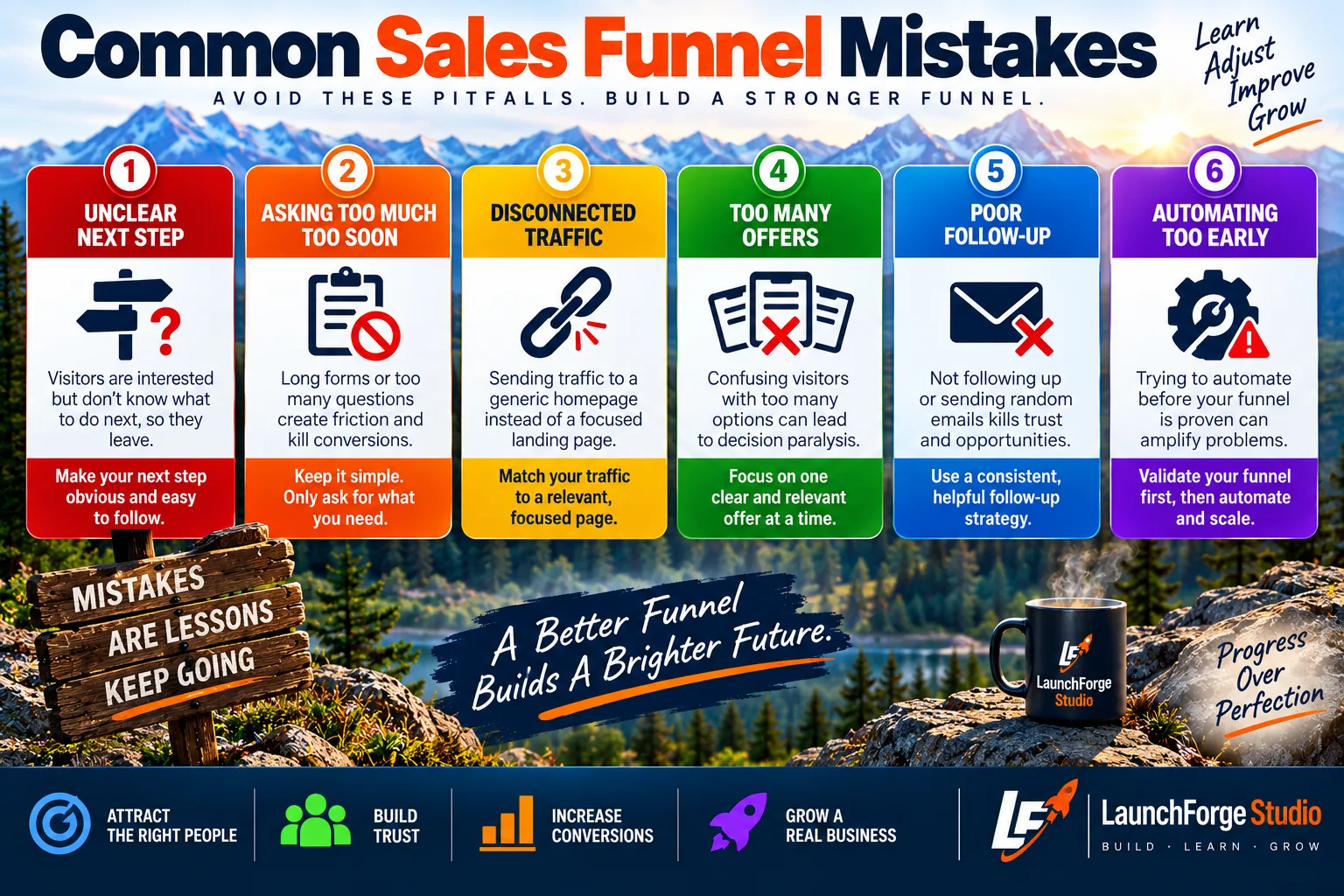
Common sales funnel mistakes can create friction, confuse visitors, weaken follow-up, and make a simple customer journey more complicated than it needs to be.
Building the Funnel Before Understanding the Visitor
It is tempting to start with the software.
You choose a funnel builder, select a template, add some pages, connect an email system, and suddenly you have something that looks like a sales funnel.
But there is a more important question to answer first:
Who is entering this funnel, and what are they trying to accomplish?
Someone searching for beginner information needs a different experience from someone who already understands the problem and is comparing products.
Someone arriving from an educational article may not be ready for the same action as someone who clicked an advertisement for a specific offer.
The funnel should make sense for the visitor entering it.
Start with the person and the problem.
Then build the path.
Sending Traffic Somewhere Without a Clear Next Step
Getting traffic feels like progress because you can see visitors arriving.
But traffic without direction can disappear just as quickly as it arrived.
Imagine someone discovers a useful article on your website.
They read it.
They like it.
Then they reach the end and have absolutely no idea what to do next.
Maybe there is no related article.
No email signup opportunity.
No relevant resource.
No meaningful call to action.
The visitor may simply leave.
That does not mean every page needs five buttons and three offers.
It means you should think about whether there is a reasonable next step for someone who wants to continue.
Sometimes that step is simply another useful piece of content.
Asking for Too Much Too Soon
A visitor who discovered your business thirty seconds ago may not be ready to make a purchase.
They may not even be ready to give you their email address.
That is normal.
Funnels become uncomfortable when every interaction immediately demands the largest possible commitment.
Buy this.
Book this.
Upgrade this.
Start this trial.
Give us your information.
Hurry before the timer reaches zero.
There are situations where urgency is legitimate, but pressure is not a substitute for relevance or trust.
Sometimes the better next step is smaller.
Read this.
Learn more.
See how it works.
Join us if you want more.
Explore the option when you are ready.
A funnel can guide people without trying to drag them through it.
Creating a Disconnect Between Traffic and the Destination
Imagine clicking a link promising a beginner’s guide to building an email list and landing on a page aggressively selling an unrelated traffic package.
The problem is not necessarily the product.
The problem is the disconnect.
The visitor expected one thing and received another.
This can happen when marketers become so focused on sending traffic that they stop thinking about what happens after the click.
Your traffic source, message, landing experience, and next action should make sense together.
If a social post promises a tutorial, send people to the tutorial.
If an advertisement promotes a specific offer, the destination should clearly continue that conversation.
If an article invites someone to receive more educational content, the follow-up should deliver what was promised.
Continuity builds trust.
Confusion destroys it.
Treating Every Lead Like They Are Ready to Buy
Someone joining your email list has taken an important step.
But an email subscriber is not automatically a customer.
They may have joined because they enjoyed an article.
They may want to learn more about a particular subject.
They may be curious about the tools you use.
They may still be months away from purchasing anything.
If every follow-up message immediately becomes another sales pitch, the experience can feel very different from the reason they subscribed.
That is why follow-up matters.
Continue providing value.
Help subscribers understand the subject that brought them into your world.
Introduce relevant resources.
And when an offer genuinely fits that journey, give them an opportunity to explore it.
The relationship does not have to become transactional the moment someone enters their email address.
Adding Too Many Offers
Another common problem is giving visitors too many directions at once.
Join this list.
Buy this product.
Watch this webinar.
Download this guide.
Try this software.
Follow these four social accounts.
Read these seven articles.
Click this flashing button because apparently we have completely lost control of the website.
At some point, choice becomes noise.
A funnel works better when the next step is understandable.
That does not mean your entire website can contain only one offer.
It means individual stages of the journey should have a clear purpose.
When someone reaches a page, ask what the primary action should be.
Everything else should support that action rather than compete with it.
Automating a Bad Funnel
Automation can make a working process more efficient.
It can also make a broken process fail automatically.
If the message is unclear, automation sends the unclear message faster.
If the follow-up does not match the visitor’s interests, automation delivers the mismatch consistently.
If an offer does not fit the audience, automation does not magically create relevance.
Before automating everything, make sure the basic journey makes sense.
Automation should support the strategy.
It should not replace the strategy.
Changing Everything at the Same Time
Eventually, you will want to improve your funnel.
Maybe the opt-in rate seems low.
Maybe people join the list but rarely open the follow-up emails.
Maybe an offer gets clicks but few conversions.
The temptation is to change the headline, form, button, page design, email sequence, offer, traffic source, and possibly the phase of the moon all at once.
Then something changes.
But you have no idea why.
When possible, make deliberate changes.
Identify the part of the funnel that appears to need attention.
Change something that could reasonably affect that result.
Then observe what happens.
You will not always have enough traffic for perfect scientific testing, especially when the business is new.
That is okay.
The goal is simply to learn rather than randomly rearrange the furniture.
Forgetting That the Funnel Exists for Real People
Behind every page view, click, subscriber, conversion rate, and analytics report is a person.
That person has their own goals.
Their own questions.
Their own skepticism.
Their own budget.
Their own timeline.
A funnel is useful because it helps organize the journey.
But the diagram is not the customer.
The automation is not the customer.
The conversion rate is not the customer.
The person is.
If you keep that in mind while building the funnel, many marketing decisions become easier.
Help people understand where they are.
Give them useful information.
Make the next step clear.
Let them decide whether they want to take it.
That is a much stronger foundation than trying to engineer every possible interaction around extracting a sale.
What Do You Need to Build a Simple Sales Funnel?
Once you understand how a sales funnel works, building one becomes much less intimidating.
You do not need every marketing tool you have ever seen advertised.
You do not need twenty landing pages.
You do not need an enormous automation system.
And you definitely do not need to spend three weeks drawing arrows between boxes before anyone can actually enter the funnel.
A basic online sales funnel needs only a few things:
A way to attract people.
A useful destination.
A clear next step.
A way to capture interested leads when appropriate.
A way to follow up.
And eventually, something relevant to offer.
The exact tools you use can change.
The jobs those tools perform are what matter.
Start With a Traffic Source
Every funnel needs an entry point.
Where will people come from?
For a new online business, that might be organic search traffic from useful website content.
It could be social media.
It could be paid advertising.
It could be an email newsletter, referral, traffic platform, video channel, online community, or another source.
You do not necessarily need ten traffic sources when you begin.
One or two sources can give you enough activity to start learning.
The important part is understanding where the visitor came from and what they were expecting when they clicked.
That expectation should connect naturally to what they see next.
Give the Visitor Somewhere Useful to Land
The destination could be a blog article, tutorial, dedicated landing page, product review, lead capture page, or another resource.
What matters is that the destination delivers on the reason the visitor arrived.
If someone searches for information, give them useful information.
If they click an advertisement for a particular offer, show them the offer they expected to see.
If a social media post promises a tutorial, do not send them somewhere unrelated.
This sounds obvious.
But it is one of the simplest ways to make a funnel feel coherent.
The visitor should not have to wonder whether they clicked the wrong link.
Decide What the Next Step Should Be
Once the visitor reaches the destination, what would you like them to do next?
This is where the funnel begins taking shape.
Maybe you want them to join your email list.
Maybe you want them to read another article.
Maybe you want them to download a resource.
Maybe you want them to compare a solution.
Maybe the visitor has already reached the point where exploring an offer makes sense.
Choose the next action based on where that person is in the journey.
Do not add a call to action merely because a marketing checklist says every page needs a button.
Give the visitor a next step that makes sense.
Create a Reason to Join Your Email List
If email lead generation is part of the funnel, visitors need a reason to subscribe.
That reason does not always have to be an enormous downloadable ebook with a dramatic name and seventy-three pages nobody asked for.
It could be a useful checklist.
A short guide.
A resource.
A training series.
Updates around a subject the reader genuinely cares about.
Or an ongoing invitation to learn alongside you.
At LaunchForge, our Build Along invitation is based on that last idea.
Someone reading our content can choose to continue following what we are building, the tools we are using, and the lessons we are learning.
The important part is that the promise is clear.
People should understand what they are signing up for.
Connect the Form to an Email System
If someone enters their email address, that information needs somewhere to go.
This is where an email marketing platform or autoresponder enters the system.
The signup form collects the information.
The email system stores the subscriber and allows you to continue communicating with them.
Depending on the platform, you may also be able to create automated sequences, organize subscribers, track email activity, and trigger different follow-up actions.
You do not need to automate every possible interaction on day one.
You need the basic connection to work reliably.
Someone subscribes.
They are added to the correct list.
They receive what you promised.
That alone is a meaningful start.
Create the First Follow-Up
One of the easiest places for a funnel to fall apart is immediately after someone subscribes.
They join the list.
Then nothing happens.
Or the first thing they receive bears almost no resemblance to what they signed up for.
Your first follow-up should confirm that the subscriber is in the right place.
Welcome them.
Deliver anything you promised.
Explain what they can expect.
And give them a useful next step if there is one.
That could be another tutorial.
A helpful resource.
A short introduction to your business.
Or simply the information they requested.
You can build a larger welcome sequence later.
The first goal is making sure the transition from visitor to subscriber feels intentional.
Have a Relevant Offer When the Time Is Right
A sales funnel eventually needs some connection to revenue if it is going to contribute to the business.
But that does not mean the offer has to appear immediately after the first click.
Think about what you are helping the visitor accomplish.
Then consider what product, service, platform, or resource could genuinely help them take the next step.
For an affiliate business, that could be a product you recommend.
For a service business, it could be a consultation or service package.
For a software business, it could be a trial or subscription.
For a digital product business, it could be a course, template, guide, or membership.
The business model can change.
The principle does not.
The offer should fit the journey.
Make Sure the Entire Path Works
Before sending significant traffic into a funnel, walk through it yourself.
Click the link.
Read the page.
Use the form.
Check what happens after submitting it.
Open the email.
Click the links inside the email.
Look at the experience on a phone.
Make sure the important pages load correctly.
If there is an offer, make sure the path to that offer works.
You do not need a laboratory full of testing equipment.
You need to experience the funnel the way a visitor will experience it.
A beautiful funnel diagram means very little if the signup form does not work.
Your First Funnel Can Be This Simple
If all of this still sounds like a lot, reduce it to the essentials.
Your first funnel could look like this:
Traffic → Useful Content → Email Signup → Welcome Email → Relevant Offer
That is enough.
You now have a way for someone to discover you.
You have something useful for them when they arrive.
You have a next step for interested visitors.
You have a way to continue the relationship.
And you have a path that can eventually contribute to revenue.
Once that system is working, you can improve it.
But now you are improving something real.
You are no longer planning a funnel.
You have one.
How Do You Know if Your Sales Funnel Is Working?
Building a sales funnel is only the beginning.
Once real people start moving through it, the funnel begins giving you information.
That information can help you understand what is working, where people are losing interest, and which parts of the journey may need improvement.
You do not need to become obsessed with dashboards or track fifty different metrics.
Start with a few basic questions.
Are people entering the funnel?
Are they taking the next step?
Are they staying engaged?
And eventually, are some of them reaching the action the funnel was designed to support?
Start by Measuring Traffic
Before evaluating conversions, you need to know whether people are actually reaching the funnel.
How many visitors are arriving?
Where are they coming from?
Which articles, landing pages, or other entry points are attracting them?
If almost nobody is entering the funnel, there may not be enough information yet to judge everything that happens afterward.
A page receiving ten visitors does not give you the same amount of information as a page receiving hundreds or thousands.
This is especially important for a new website.
Do not declare the funnel a failure before enough people have had an opportunity to use it.
Look at the First Meaningful Action
Next, look at what you asked visitors to do.
If the goal is email lead generation, how many visitors are joining the list?
If the page sends people to another resource, are they clicking through?
If the goal is exploring an offer, are visitors reaching the offer page?
This helps you evaluate the transition between one stage and the next.
For example, imagine an article receives plenty of traffic but almost nobody interacts with the email signup opportunity.
That does not automatically mean email marketing does not work.
The problem could be the invitation.
It could be the placement.
It could be the message.
It could be a mismatch between the article and what the signup offers.
Or visitors may simply need more reason to continue the relationship.
Now you have something specific to investigate.
Pay Attention to Email Engagement
If email is part of the funnel, the signup itself is only one measurement.
What happens afterward?
Are subscribers opening the emails?
Are they clicking links?
Are they returning to your website?
Are some messages generating noticeably more interest than others?
These signals can help you understand whether the follow-up is continuing the conversation effectively.
They can also teach you what your audience cares about.
An email about one subject may consistently attract more attention than another.
A particular tutorial may receive more clicks.
Subscribers may respond more strongly to practical build-along lessons than general marketing advice.
That information can influence future content as well as the funnel itself.
Track the Actions Closest to Revenue
Eventually, you also need to understand whether the funnel contributes to the business.
That does not always mean tracking only completed purchases.
Depending on your business model, useful actions might include clicks to an affiliate offer, trial registrations, consultation requests, product-page visits, checkout activity, or completed sales.
The closer someone gets to the revenue-producing action, the more useful those measurements become for understanding whether the funnel is connecting the right people with the right offer.
But context still matters.
A funnel can generate plenty of clicks and very few sales if the offer is poorly matched.
Another funnel might generate fewer clicks but attract people with much stronger intent.
This is why a single number rarely tells the entire story.
Find the Weakest Transition
One of the most useful ways to evaluate a funnel is to look at the transitions between stages.
Traffic reaches the article.
Do visitors interact with the next step?
People see the signup opportunity.
Do they subscribe?
Subscribers receive the email.
Do they open it?
They open the email.
Do they click?
They reach the offer.
Do they take action?
You are looking for places where the journey appears to weaken.
That gives you somewhere to focus.
If traffic is the problem, rewriting the welcome email probably will not solve it.
If plenty of people subscribe but nobody opens the first email, changing the landing page may not be the first priority.
If subscribers are engaged but an offer gets little interest, the offer or its relevance may deserve attention.
Diagnose before you redesign.
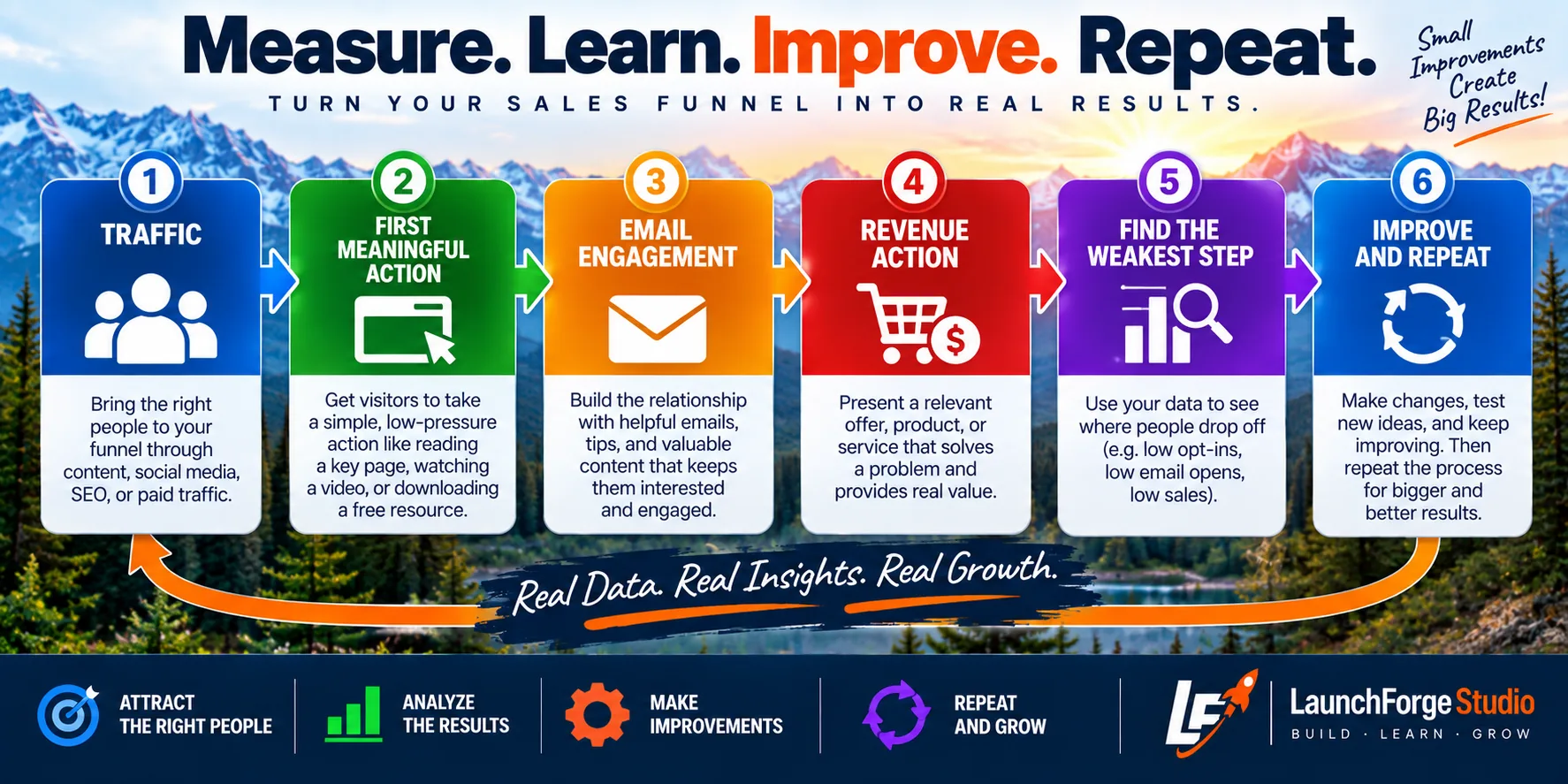
A working sales funnel improves over time by measuring traffic and engagement, identifying weak points, testing meaningful changes, and learning from the results.
Do Not Optimize Based on Tiny Amounts of Data
When a business is new, it is easy to overreact.
Three people visit a page and nobody subscribes.
Emergency redesign.
One email gets a lower open rate.
Rewrite the entire sequence.
An affiliate link receives several clicks without a sale.
Replace the offer.
That can turn optimization into random movement.
Small amounts of data can be noisy.
Give the funnel enough opportunity to produce useful information before making major conclusions.
That does not mean ignoring obvious problems.
If a form is broken, fix it.
If a link goes to the wrong page, fix it.
If the message clearly does not match the destination, fix it.
But when you are judging human behavior, patience matters.
Improve One Meaningful Thing at a Time
Once you identify something worth improving, resist the urge to rebuild the entire funnel.
Choose a meaningful variable.
Maybe the signup invitation needs a clearer benefit.
Maybe the call to action is vague.
Maybe the first follow-up email needs to better match what the subscriber expected.
Maybe the offer appears too early.
Maybe a page is difficult to use on mobile.
Improve that part.
Then observe what happens.
Over time, those improvements compound.
The funnel becomes better because you learned from actual behavior instead of trying to predict everything before launch.
A Working Funnel Is Never Really Finished
There probably will not be a moment when you announce:
The funnel is complete forever.
Traffic changes.
Content grows.
Offers change.
Your audience teaches you new things.
Technology changes.
Your own understanding of the business improves.
The funnel can evolve with all of that.
That is exactly how we are approaching LaunchForge Studio.
We build something useful.
We put it in front of real people.
We watch what happens.
We learn from the results.
Then we improve what matters.
The goal is not to create a perfect funnel.
The goal is to create a working system that gets smarter as the business grows.
Start With the Path, Not the Funnel Software
So, what is a sales funnel?
At its simplest, a sales funnel is the path that helps someone move from discovering your business to taking a meaningful action.
That path might begin with a Google search.
It might begin with a social media post.
It might begin with an advertisement, recommendation, video, email, or another traffic source.
Wherever it begins, the principle is the same.
Someone discovers you.
You give them something useful.
You provide a logical next step.
Some people take it.
You continue the relationship.
And eventually, some of those people may become customers.
That is the funnel.
You Do Not Need to Build Everything at Once
If you are new to sales funnels, the biggest lesson I would take from this guide is that you do not need to build an enormous marketing machine before you can get started.
Begin with the simplest useful path.
For example:
Traffic → Useful Content → Email Signup → Follow-Up → Relevant Offer
That is enough to begin learning.
You can add dedicated landing pages when they have a reason to exist.
You can improve your email sequence as you learn what subscribers respond to.
You can test different calls to action.
You can explore additional traffic sources.
You can add automation where automation genuinely saves time or improves the experience.
You can refine the offer as you better understand your audience.
But none of those improvements require you to build the final version of the funnel on day one.
There probably is no final version.
There is the version you are using now and the version you build next based on what you learn.
Let Each Step Earn the Next One
A useful funnel does not need to push everyone toward a purchase as quickly as possible.
It needs to make the next step make sense.
If someone discovers your business through an educational article, help them first.
If they want more, give them a clear way to continue.
If they join your email list, deliver what you promised.
If you eventually introduce an offer, make sure it fits the journey that brought them there.
Each step should earn the next one.
That creates a very different experience from treating every visitor as though they arrived with a credit card already in their hand.
Build Something Real and Learn From It
This is the approach we are taking with LaunchForge Studio.
We are not building a theoretical business and then writing about what someone else should do.
We are building the website.
Publishing the content.
Creating landing pages.
Adding lead capture.
Building the email system.
Testing traffic sources.
Connecting the pieces.
And learning what happens when real people begin moving through them.
The sales funnel we showed earlier in this guide is part of that process.
It will change.
Some parts will work better than others.
Some things we build may eventually be replaced.
New pieces will be added when they solve a real problem.
That is exactly the point.
You do not need to know everything before you begin.
You need enough of a system to start learning.
Your Sales Funnel Begins With One Question
Before opening another piece of software or downloading another funnel template, ask yourself:
What is the next useful step I want this visitor to take?
Answer that first.
Then ask what should happen after they take it.
Keep following that path.
Before long, the confusing collection of landing pages, forms, emails, content, traffic sources, and offers begins to look less like a pile of marketing tools and more like a connected system.
That is when the idea of a sales funnel really starts to make sense.
You are not building a funnel because marketers say you need one.
You are building a path that helps the right people move forward.
Start simple.
Build the path.
Put it to work.
Learn from what happens.
Then improve what matters.