
If you are trying to figure out how to choose a niche for your online business, you may already have something yesterdays version of you did not have: a general direction.
Maybe you know you want to build something around fitness, photography, guitars, personal finance, online marketing, cooking, pets, travel, or another subject you genuinely care about.
That is a good start.
But a broad interest is not yet a niche.
Saying you want to build an online business around guitars still leaves some important questions unanswered.
Who are you trying to help?
What do they want to accomplish?
What problem can you help them solve?
And why would they choose your website, content, products, or recommendations instead of the thousands of other options already available?
Those questions are where niche selection begins.
Choosing a niche does not mean finding one magical corner of the internet where nobody else has thought to build a business. It means narrowing a broader direction until you have a clearer understanding of who you want to serve and how you might create value for them.
And you do not have to get it perfect the first time.
Your first niche is a direction you can research, test, and refine as you learn more about the people you want to help.
In this guide, we are going to work through that process step by step.
We will look at how to define an audience, identify useful problems and goals, narrow a broad market without boxing yourself in, evaluate demand and competition, explore monetization possibilities, and validate your niche with something real before spending months building around it.
By the end, you should be able to describe your niche clearly enough to stop wondering what your business is supposed to be about and start testing whether that direction deserves the next brick.
What Is an Online Business Niche?
An online business niche is the specific part of a broader market your business chooses to serve.
That sounds simple, but the distinction matters.
A broad market might be fitness.
A more specific audience might be busy professionals who want to exercise at home.
A niche begins taking shape when the audience, their needs, and the value you want to provide become clearer.
For example:
Fitness → Home Fitness → Busy Professionals → Short Home Workouts for Busy Professionals
Each step gives the business more direction.
Instead of trying to create fitness content for everyone, you now have a clearer idea of who might visit the website, what questions they may ask, what content could help them, and eventually what products or services might make sense for them.
That is what a useful niche should do.
It should give your business direction.
A Niche Is More Than a Topic
One of the easiest mistakes to make is treating a topic and a niche as though they are the same thing.
They are not.
Guitar is a topic.
There are thousands of possible businesses hiding underneath it.
You could teach beginners how to play guitar.
You could review guitars and equipment.
You could create lessons specifically for adults learning later in life.
You could help home-recording musicians choose affordable gear.
You could create downloadable practice resources.
You could build content around blues guitar, acoustic guitar, metal guitar, songwriting, recording, maintenance, pedals, amplifiers, or dozens of other directions.
The topic gives you a playing field.
The niche helps determine which part of that field your business is going to play on and who you are playing for.
That distinction becomes important when you begin making almost every other decision in the business.
Your Market, Audience, and Niche Are Not Exactly the Same Thing
These terms often get thrown around as though they mean the same thing, but separating them can make choosing a niche much easier.
Your market is the larger space your business operates within.
Your audience is the group of people you want to reach within that market.
Your niche is the more specific intersection between that audience and the problems, goals, interests, or needs your business chooses to focus on.
Let’s go back to the guitar example.
The market could be:
Music
A more focused market could be:
Guitar
The audience could be:
Adults who want to learn how to play guitar
And the niche could become:
Helping adult beginners learn their first songs without complicated music theory
Now the business has much more direction.
You are no longer trying to create something for everyone interested in music or even everyone interested in guitar.
You know more about the person you are trying to reach.
You can begin imagining the questions that person might type into Google.
How difficult is guitar to learn as an adult?
What guitar should a beginner buy?
How long does it take to play your first song?
Do I need to learn music theory?
What chords should I learn first?
Those questions could become articles, videos, lessons, downloadable resources, emails, or eventually products and services.
That is one of the biggest advantages of having a defined niche.
It makes the next business decisions easier because you have a clearer picture of the person on the other side of the screen.
Why Choosing a Niche Makes Building Your Business Easier
When your business tries to help everyone, almost every decision becomes harder.
What should you write about?
What should your homepage say?
What kind of lead magnet should you create?
Which products should you recommend?
What should you email your subscribers?
Where should you look for traffic?
A niche gives those decisions context.
Imagine two websites.
The first says:
We help people get fit.
The second says:
We help busy professionals build a simple home workout routine they can actually stick with.
The first statement could describe thousands of businesses.
The second immediately tells you more about the audience, the problem, and the direction of the business.
Now imagine planning content for each one.
For the broad fitness site, almost anything could fit: bodybuilding, running, nutrition, yoga, weight loss, sports training, supplements, home gyms, workout clothes, or hundreds of other subjects.
For the second business, the possibilities become more focused.
You might create content about 20-minute home workouts, exercising before work, choosing compact exercise equipment, staying consistent with a busy schedule, or building a beginner routine without joining a gym.
You have not eliminated opportunity.
You have created clarity.
That clarity can carry through your website, content, email marketing, offers, social media, and eventually the way people remember your business.
A niche also gives you something valuable when you are starting out: boundaries.
You do not need to publish about everything.
You do not need to sell everything.
You do not need to compete for everyone’s attention.
You need to become useful to a particular group of people.
And those boundaries do not have to last forever.
As you learn more about your audience and the business grows, you can expand, adjust, or even change direction.
For now, the goal is much simpler.
Choose a direction clear enough that you can start building something useful around it.
Start With a Business Direction, Not a Perfect Niche
One reason choosing a niche can feel difficult is that beginners often believe they need to identify the perfect niche before they can move forward.
They start searching for the most profitable niche.
The least competitive niche.
The fastest-growing niche.
The niche with the best affiliate programs.
The niche nobody else has discovered yet.
Before long, they are comparing dozens of possibilities and becoming less certain than when they started.
That is not what we are trying to do.
You do not need to discover a hidden market nobody else knows about.
You need a reasonable business direction that gives you enough clarity to begin learning about an audience, the problems they are trying to solve, and the ways you might be able to help them.
That is a much more practical decision.
Your Business Idea Comes Before Your Niche
There is an important difference between choosing an online business idea and choosing a niche within that idea.
Your business idea gives you the broader direction.
Your niche makes that direction more specific.
For example, maybe you have already decided that you want to build an online business around gardening.
That is a business direction.
But gardening could lead to very different businesses.
You might help apartment dwellers grow vegetables in small spaces.
You might teach beginners how to start their first backyard garden.
You might review gardening tools and equipment.
You might focus on growing herbs indoors.
You might create resources for people trying to grow food on a limited budget.
The original idea did not change.
Gardening is still the general direction.
What changed was the audience, problem, goal, or angle the business could focus on.
That is what we are trying to uncover when we choose a niche.
If you have not chosen a broader business direction yet, that is the decision to make first.
Trying to choose a niche before you know what kind of business you are interested in building can turn the process into an endless search through lists of supposedly profitable markets.
Start broader.
Then narrow.
Turn a Broad Interest Into a Business Direction
A broad interest becomes more useful when you start asking what you could actually do with it.
Suppose your interest is cooking.
That tells us something, but not enough to build a business around yet.
Start asking questions.
What part of cooking interests you most?
Who could benefit from what you know or want to learn?
What problems do people repeatedly encounter?
What could you teach, demonstrate, review, recommend, create, or sell?
Maybe you enjoy preparing inexpensive meals.
That could lead toward helping families cook on a budget.
Maybe you have become good at preparing meals quickly after work.
That could lead toward simple weeknight cooking for busy professionals.
Maybe you love outdoor cooking.
That could lead toward grilling tutorials, equipment reviews, recipes, or beginner barbecue education.
Maybe you are learning to bake bread.
Instead of pretending to be an expert, you could document the process and build resources around the questions other beginners encounter along the same path.
The point is not to force every interest into a business.
It is to see whether a broad interest contains a direction worth investigating.
You are moving from:
I like cooking.
to:
I might be able to build something useful around helping busy people prepare simple meals at home.
That is enough direction to continue.
You still do not need every detail figured out.
You Are Choosing Something to Test, Not Something Forever
This may be the most important mindset shift in the entire niche-selection process.
You are not signing a lifetime contract.
Choosing a niche today does not mean you must still be serving exactly the same audience, creating exactly the same content, or selling exactly the same things ten years from now.
Businesses change.
Markets change.
Interests change.
Audiences teach you things you could not have known before you started.
Sometimes a niche becomes broader because the business discovers additional opportunities.
Sometimes it becomes narrower because one particular part of the audience responds much more strongly than everyone else.
Sometimes the original direction changes almost completely.
None of that means the first decision was a mistake.
The first niche gave you something to test.
Without that initial direction, there would have been nothing to learn from.
This is one of the reasons we keep coming back to the idea of building instead of waiting for certainty.
Research matters.
Thinking matters.
Validation matters.
But eventually, the market has to become part of the conversation.
You need to publish something.
Show something.
Offer something.
Ask something.
See what people click.
See what they ignore.
See which questions keep appearing.
See whether the audience you imagined actually behaves the way you expected.
That information is difficult to get while your business exists only in a notebook.
So instead of asking:
Is this the perfect niche?
Ask:
Is this a reasonable niche worth testing?
That question is much easier to answer.
And once you have a direction worth testing, the next question becomes even more important:
Who exactly are you trying to help?
Ready to Start Building Your Online Business?
Choosing your direction is only the beginning. You still need the tools and systems that turn an idea into something real.
Profit Hub System brings websites, funnels, email marketing, automation, lead generation, and other business tools together in one platform so you can focus on building instead of piecing everything together.
If you want to see how the platform works, start with the free training.
Explore Profit Hub System and Access the Training →
Decide Who You Want to Help
A niche becomes much easier to understand when you stop thinking only about topics and start thinking about people.
There is someone on the other side of every search, click, email signup, purchase, and question.
That person is not thinking:
I hope I can find a well-optimized niche website today.
They are thinking about themselves.
They have something they want to accomplish.
Something they want to understand.
Something frustrating them.
Something they want to improve.
Something they want to buy.
Or a problem they would really like to stop dealing with.
Your business becomes useful when what you create begins connecting with one or more of those needs.
That is why choosing an audience is such an important part of choosing a niche.
You are not merely deciding what your website will be about.
You are beginning to decide who the website is for.
Start With a Group of People You Understand
You do not need to know everything about your future audience before you begin.
But it helps if you can understand something about their situation.
Sometimes that comes from personal experience.
Maybe you are learning guitar as an adult, so you understand what it feels like to pick up an instrument for the first time later in life.
Maybe you spent years working in sales and understand the challenges new salespeople encounter.
Maybe you built your first WordPress website and remember exactly which parts confused you.
Maybe you have spent years cooking inexpensive meals for a family and understand the difference between recipes that claim to be budget-friendly and meals that actually are.
Experience gives you context.
But you do not necessarily have to be part of the audience yourself.
You can learn about an audience by listening.
Read the questions people ask.
Pay attention to discussions.
Look at comments.
Study reviews.
Notice what people complain about.
Notice what they wish existed.
Notice which explanations repeatedly confuse beginners.
The goal is not to invent an imaginary customer and assume you know everything about them.
The goal is to understand enough about a group of people that you can begin creating something genuinely useful for them.
Look for Problems They Are Already Trying to Solve
Problems create direction.
Suppose you decide your audience is new online business owners.
That is still broad.
Now look at the problems inside that audience.
They may struggle to choose a business idea.
They may not understand how websites, landing pages, funnels, email marketing, and traffic fit together.
They may be paying for too many disconnected tools.
They may be overwhelmed by technical terminology.
They may not know what to build first.
They may be trying to generate their first leads.
They may have traffic but no follow-up system.
Each problem creates a possible direction for useful content, tools, services, recommendations, or products.
You do not need to solve every problem the audience has.
In fact, trying to do that immediately can make your niche broad again.
Instead, look for problems that connect naturally with the business you want to build and the value you realistically believe you can provide.
That is very close to how LaunchForge Studio itself has developed.
We are not trying to solve every problem anyone could ever encounter while running a business.
Our focus is much more practical: helping people build, market, monetize, and improve an online business while documenting what we are actually building and learning along the way.
That gives us boundaries.
And those boundaries make deciding what belongs on LaunchForge much easier.
Pay Attention to Goals as Well as Problems
Not every niche has to begin with pain.
People also spend time and money pursuing things they want.
Someone may want to learn guitar because playing music sounds enjoyable.
Someone may want to grow vegetables because they love gardening.
Someone may want to improve their photography because they enjoy creating beautiful images.
Someone may want to build an online business because they want another source of income or the experience of creating something of their own.
Those are goals.
A strong niche can be built around helping an audience move toward something they want, not only away from something they dislike.
This matters because focusing exclusively on problems can sometimes make a niche feel unnecessarily negative.
Ask both questions:
What is this audience struggling with?
and:
What is this audience trying to accomplish?
The answers together can tell you much more about the people you want to serve.
Get Specific Without Making Your Audience Tiny
Specificity helps.
But there is a difference between becoming specific and shrinking an audience until almost nobody is left.
Consider this progression:
People who want to exercise
is extremely broad.
Busy professionals who want to exercise at home
is much clearer.
But:
Left-handed accountants between the ages of 43 and 47 who want to exercise in their garages on Tuesday mornings
has probably wandered into Captain Ridiculously Specific Buttcheeks territory.
The purpose of narrowing an audience is not to eliminate as many people as possible.
It is to create enough clarity that you understand who you are primarily trying to help.
People outside that exact description can still read your content, join your list, buy something, or benefit from what you create.
Your niche describes your primary direction.
It does not need to become a locked gate around the business.
A useful test is whether you can picture the person you are trying to help and imagine several real questions that person might have.
If you can do that, you are getting somewhere.
If your audience is still simply:
Everyone who wants to make money
or:
Anyone interested in health
you probably need more clarity.
And once you have a clearer picture of the person, we can start doing something very useful.
We can combine the market, audience, problem, and goal into a niche that someone can actually understand.
Turn a Broad Market Into a Clear Niche
At this point, you should be able to see why choosing a niche is not simply picking a topic from a list.
We are gradually putting pieces together.
You have a broader market or business direction.
You have people you might want to help.
You have problems they are trying to solve or goals they want to achieve.
Now we can begin combining those pieces into something much more useful.
You do not need a complicated business-school formula to do it.
You need enough specificity to answer a few basic questions:
What broader market are you entering?
Who are you primarily trying to help?
What do they want help with?
What perspective, approach, or type of solution might you bring to them?
Let’s build one from the ground up.
Start With the Broad Market
Begin with the larger subject or market that interests you.
Examples could include:
Fitness
Personal finance
Gardening
Photography
Cooking
Online business
Travel
Guitar
There is nothing wrong with starting broad.
The problem comes when you stop there.
If someone asks what your online business does and the answer is:
“Guitar.”
we still do not know very much.
Do you sell guitars?
Teach guitar?
Repair guitars?
Review guitar equipment?
Write about famous guitar players?
Help musicians record guitars?
Create downloadable guitar lessons?
The broad market gives us a place to begin.
Now we need people.
Add a Specific Audience
Take the broad market and ask:
Who within this market could I primarily help?
Using guitar, possible audiences might include:
Complete beginners
Adult beginners
Parents buying a child’s first guitar
Intermediate players
Home-recording musicians
Gigging guitarists
Acoustic players
Metal guitarists
Budget-conscious musicians
Each audience changes the business.
A website for parents buying a child’s first guitar would probably contain very different content from a website for experienced players building pedalboards.
Same broad market.
Different audience.
Now let’s choose:
Adult beginners
Our direction becomes:
Guitar for adult beginners
Better.
But we can make it more useful.
Add the Problem or Goal
Now ask what this audience is actually trying to accomplish.
An adult beginner might want to:
Learn basic chords.
Play recognizable songs.
Choose a first guitar.
Practice without feeling overwhelmed.
Understand basic equipment.
Build enough confidence to keep going.
Avoid spending money on gear they do not need.
Instead of merely:
Guitar for adult beginners
we could move toward:
Helping adult beginners learn the fundamentals and play their first songs.
Now we have an audience and an outcome.
That immediately gives us potential content ideas.
How to choose your first guitar.
The first chords a beginner should learn.
How often should a beginner practice?
Easy songs for new guitar players.
Acoustic vs electric guitar for beginners.
What equipment do you actually need to start playing?
The niche is beginning to generate the business instead of leaving us staring at a blank screen wondering what to create.
Add Your Approach or Angle
Sometimes the audience and problem are already specific enough.
Other times, an additional angle can make the direction even clearer.
Maybe our adult beginner does not want traditional lessons filled with theory before they ever get to play anything recognizable.
Our angle could become:
Helping adult beginners learn guitar through simple, practical lessons focused on playing real songs.
That tells us even more.
The business is not against music theory.
It simply has a particular teaching approach.
Another business could serve exactly the same audience with a different angle:
Helping adult beginners understand guitar through music theory and structured practice.
Neither direction is automatically better.
They simply appeal to different people.
Your angle might come from your teaching style, experience, philosophy, format, price point, personality, or the particular problem you decide to emphasize.
And you do not need to manufacture some revolutionary angle nobody has ever seen.
Sometimes the useful difference is simply being clearer about who you serve and how you intend to help.
Use a Simple Niche Formula
If you are having trouble putting the pieces together, use this as a starting point:
Broad Market + Specific Audience + Problem or Goal + Approach = Niche Direction
Not every niche needs all four pieces stated explicitly.
The formula is a thinking tool, not a law.
For our example:
Broad Market: Guitar
Specific Audience: Adult beginners
Problem or Goal: Learn the fundamentals and play recognizable songs
Approach: Simple, practical instruction without unnecessary overwhelm
Put together, that could become:
Simple guitar education for adult beginners who want to learn the fundamentals and start playing real songs without becoming overwhelmed.
That is much more useful than:
I want to start a guitar website.
Now we can begin imagining the website.
The articles.
The email list.
The lead magnet.
The products.
The affiliate recommendations.
The lessons.
Even the language used on the homepage.
That is what a clear niche can do.
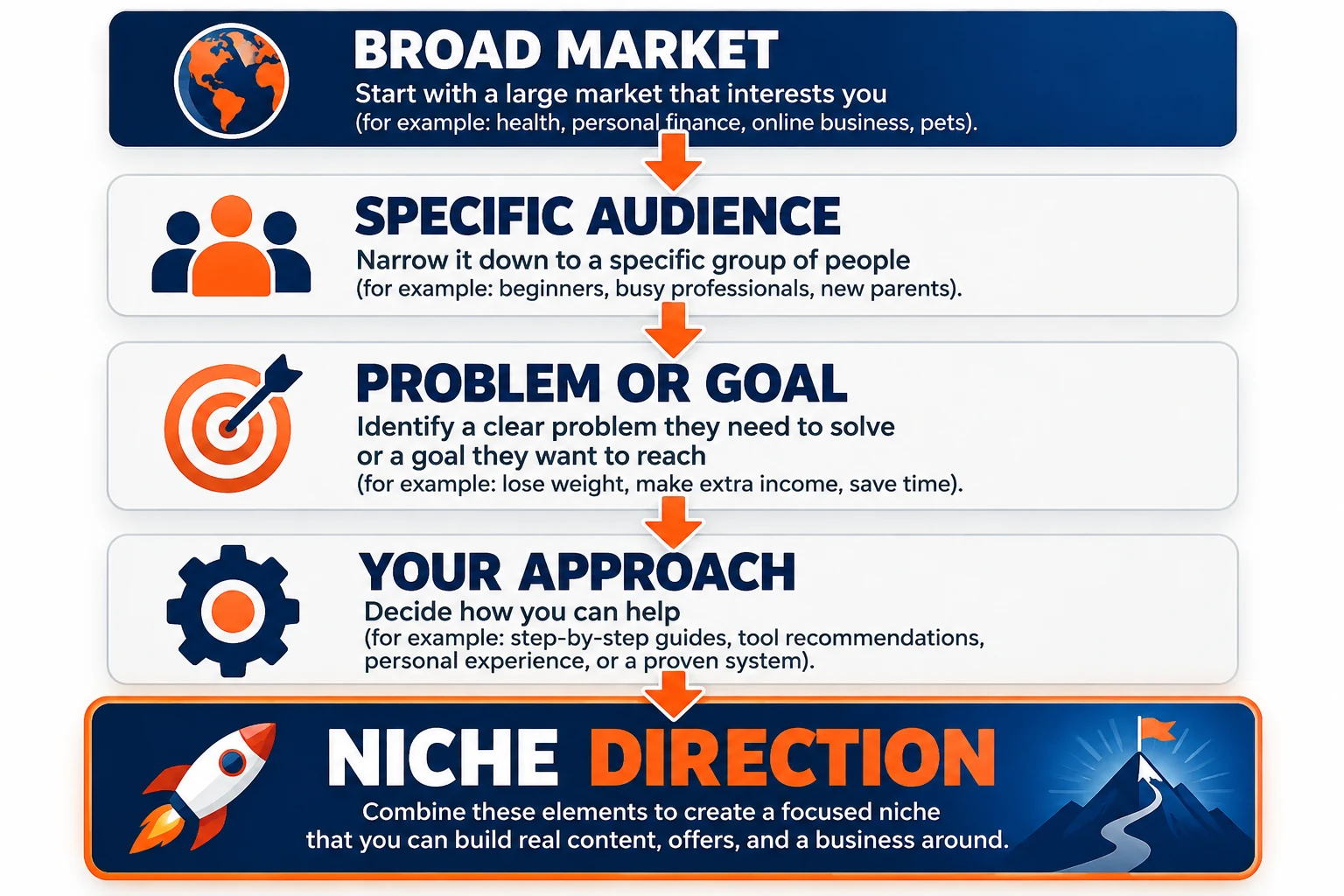
Narrow a broad market into a clear niche by defining your audience, their problem or goal, and your approach.
The Beginner Guitar Example
Let’s take the example one step further.
Imagine two people both decide to build online businesses around guitar.
The first person says:
“My niche is guitar.”
They begin publishing whatever comes to mind.
One day they review a $3,000 professional guitar.
The next day they write about beginner chords.
Then vintage amplifiers.
Then advanced jazz theory.
Then children’s guitars.
Then recording software.
Then heavy-metal pedals.
Technically, everything relates to guitar.
But it is difficult to understand who the business is primarily for.
The second person starts with:
“I help adults who have always wanted to play guitar finally get started.”
Immediately, decisions become easier.
A first-guitar buying guide makes sense.
A beginner chord guide makes sense.
A downloadable practice checklist makes sense.
An email series about getting through the frustrating first few weeks makes sense.
Reviews of affordable beginner guitars make sense.
Simple song lessons make sense.
Later, that business might expand.
Some beginners will become intermediate players.
They may eventually want better guitars, amplifiers, recording equipment, advanced lessons, or completely different resources.
The business can grow with them.
But it started somewhere clear.
And that is the lesson.
Narrowing your niche does not necessarily make the business smaller.
It can make the starting point clearer.
You are giving the business a front door.
Once people walk through that door, there can eventually be many rooms behind it.
The next question is how narrow that front door should actually be.
Because specificity helps, but narrowing a niche too far can create an entirely different problem.
How Narrow Should Your Niche Be?
Once you understand the value of choosing a specific audience, it is easy to assume that narrower is always better.
It is not.
A useful niche needs enough focus to give your business direction while still leaving enough room to create content, solve problems, develop offers, and grow.
Think of niche selection as finding a workable middle ground.
Too broad, and your business can struggle to communicate who it is for.
Too narrow, and you may eventually discover that you have limited the business more than necessary.
The goal is not to create the smallest niche possible.
The goal is to create a niche that is clear enough to guide the business and large enough to give it room to develop.
What Happens When Your Niche Is Too Broad
Broad niches often sound appealing because they appear to contain more opportunity.
Why serve one group when you could serve everyone?
The problem is that trying to reach everyone can make it difficult to speak clearly to anyone.
Imagine starting a website about:
Personal finance
That market includes an enormous range of subjects.
Budgeting.
Investing.
Retirement.
Credit cards.
Debt.
Mortgages.
Taxes.
Insurance.
Saving.
Side income.
Business finance.
A new website trying to cover all of those subjects for every possible reader has a tremendous amount of ground to cover.
Now compare that with:
Helping young adults create their first practical budget and begin saving money.
The second direction gives the business an immediate starting point.
The homepage can speak more clearly.
Content ideas become easier to identify.
A lead magnet becomes easier to imagine.
The questions the audience might ask become more predictable.
That does not mean the business must talk about beginner budgeting forever.
It means the business has somewhere specific to begin.
What Happens When Your Niche Is Too Narrow
Narrowing can also go too far.
Suppose we take our beginner guitar niche and keep adding restrictions.
We begin with:
Guitar players
Then:
Beginner guitar players
Then:
Adult beginner guitar players
Then:
Adult beginner acoustic guitar players
Then:
Adult beginner acoustic guitar players over 50
Then:
Adult beginner acoustic guitar players over 50 who only want to learn 1970s folk songs
Every additional layer makes the audience smaller.
There may be a business somewhere inside that extremely specific audience, particularly if research shows strong demand.
But specificity by itself does not make a niche better.
At some point, you need to ask whether enough people share the problem or goal to support what you want to build.
Can you create dozens of useful pieces of content?
Are there related questions you can answer?
Could products or services naturally fit the audience?
Is there room for the business to develop?
If narrowing makes those questions increasingly difficult to answer, you may have gone farther than necessary.
Look for the Useful Middle
A good starting niche often sits between a massive category and a microscopic audience.
You want someone encountering the business to understand:
This might be for me.
At the same time, you want enough room to continue helping that person as their needs develop.
Our guitar example does that reasonably well:
Practical guitar education for adult beginners who want to start playing real songs.
The audience is clear.
The starting problem is clear.
The direction is clear.
But there are still many possibilities.
Choosing a first guitar.
Learning chords.
Practicing effectively.
Playing songs.
Understanding equipment.
Changing strings.
Developing rhythm.
Learning basic music theory.
Buying an amplifier.
Recording at home.
Moving from beginner to intermediate playing.
The niche creates focus without eliminating the future.
That is the middle we are looking for.
You Can Expand as the Business Grows
Choosing a niche is a starting decision, not necessarily a permanent boundary.
As your audience grows, you will begin learning what people want next.
Maybe the adult beginners you helped during their first six months of guitar playing start asking about home recording.
That could justify creating content about microphones, audio interfaces, recording software, or simple home-studio setups.
Maybe readers begin asking for more advanced lessons.
That could become another content area.
Maybe equipment reviews perform particularly well.
That could become a larger part of the business.
Expansion becomes much easier when it is based on evidence from an audience you already understand.
Instead of beginning with fifty categories because you are afraid of missing an opportunity, you can allow opportunities to reveal themselves over time.
Start focused.
Learn.
Then expand when there is a reason to expand.
You are not trying to predict every direction your business might take before publishing your first page.
You are trying to choose a starting point that gives you enough clarity to move.
Once you have that starting point, however, there is another question we cannot answer with brainstorming alone:
Do enough people actually care about this niche?
That is where research begins.
Make Sure People Actually Care About the Niche
A niche can sound fantastic in your head and still struggle when it meets the real world.
That is why research matters.
You are not trying to prove with absolute certainty that a business will succeed. Nobody can give you that guarantee before you build it.
You are looking for evidence that real people are interested in the subject, asking questions, trying to solve problems, consuming content, and potentially spending money.
And you do not necessarily need expensive research software to begin.
Some of the most useful early signals are already sitting in places you probably use every day.
Search for the Questions People Are Asking
Start with a search engine.
Type phrases related to your possible niche and pay attention to what appears.
Suppose you are considering our adult beginner guitar niche.
You might search for things like:
how to learn guitar as an adult
best guitar for adult beginners
easy guitar songs for beginners
how long does it take to learn guitar
guitar practice routine for beginners
Do not look only at the number of results.
Look at the questions behind them.
What problems keep appearing?
What terminology do people use?
What subjects seem to have multiple articles, videos, discussions, or products built around them?
Search suggestions and related questions can also reveal additional directions people are exploring.
One search may lead to another.
Then another.
Before long, you can begin building a picture of what people inside that niche actually want to know.
Write those questions down.
They are useful for more than validation.
They may eventually become your content calendar.
Look for Existing Content
Next, look at the content already serving the audience.
Search for blogs.
YouTube channels.
Podcasts.
Newsletters.
Courses.
Social accounts.
Forums.
Communities.
You are not looking for proof that nobody else has entered the niche.
In many cases, finding active content is exactly what you want.
It tells you people are interested enough in the subject for businesses and creators to continue producing material around it.
Pay attention to what appears repeatedly.
Are multiple websites answering similar beginner questions?
Are videos being created consistently?
Are people commenting and asking follow-up questions?
Are creators building entire libraries around the subject?
Existing content can be evidence that the niche has depth.
It can also help you identify gaps.
Maybe most of the available content assumes too much experience.
Maybe explanations are unnecessarily complicated.
Maybe information is outdated.
Maybe the audience keeps asking questions that existing resources answer poorly.
You do not need to invent a completely new subject.
Sometimes the opportunity is to serve an existing audience more clearly, more practically, or from a perspective that fits them better.
Look for Products and Services Already Being Sold
Content shows interest.
Products and services can reveal commercial activity.
Look at what the audience can already buy.
Using our guitar example, that might include:
Guitars.
Strings.
Tuners.
Picks.
Amplifiers.
Online lessons.
Courses.
Books.
Practice tools.
Recording equipment.
Memberships.
Private instruction.
Downloadable resources.
You are not trying to count every dollar being spent in the market.
You are looking for evidence that businesses are already creating offers for the people you want to reach.
The same principle works in other niches.
A gardening niche might contain seeds, tools, raised beds, courses, books, memberships, or planning resources.
A photography niche might contain cameras, lenses, software, presets, courses, workshops, and accessories.
An online business niche might contain software, hosting, training, templates, services, marketing tools, and educational resources.
Existing products do not automatically mean your particular business idea will work.
But they can tell you something important:
People in this market already spend money trying to achieve certain outcomes.
That is useful information.
Competition Can Be Evidence of Demand
Beginners sometimes search for a niche with little or no competition.
That sounds logical.
If nobody else is serving the market, there should be plenty of room for you.
But there is another possibility.
Nobody is serving the market because there is not enough demand to support it.
Competition is not automatically bad.
If multiple businesses are publishing content, advertising, selling products, building email lists, creating courses, or serving customers in a niche, that can be evidence that an active market exists.
The question becomes:
Can you find a useful place inside that market?
You may serve a particular audience.
Explain things differently.
Focus on beginners.
Create better educational content.
Use a different business model.
Bring personal experience to the subject.
Document what you are learning.
Focus on a problem larger competitors barely address.
You do not necessarily need an empty market.
You need a reason for the right people to pay attention to what you create.
Look for Communities and Conversations
Search results tell you what people search for.
Communities can show you how they talk when they are talking to each other.
Look for places where the audience gathers.
That could include online forums, Reddit communities, Facebook groups, YouTube comments, question-and-answer sites, Discord communities, or other niche-specific spaces.
Do not enter those communities simply to promote something.
Listen first.
What questions appear repeatedly?
What frustrates people?
What products do they recommend?
What do they regret buying?
What terminology do they naturally use?
What advice creates disagreement?
What do beginners misunderstand?
What problems seem obvious to experienced people but confusing to newcomers?
Those conversations can reveal details that broad keyword research may miss.
They also help prevent you from building your business around assumptions.
The closer you get to the language real people use, the easier it becomes to understand what they actually care about.
Pay Attention to Problems That Keep Appearing
One question can be interesting.
A problem that appears repeatedly is much more useful.
If you notice the same frustration in search results, videos, product reviews, forums, comments, and communities, pay attention.
Repeated problems can become important clues.
Maybe adult guitar beginners repeatedly say they do not know what to practice.
That could inspire a simple practice-plan lead magnet.
Maybe new online business owners repeatedly say they are overwhelmed by having too many disconnected tools.
That could become content about simplifying a business system.
Maybe beginner gardeners repeatedly struggle with knowing what to plant and when.
That could become a planting calendar, guide, email series, or other resource.
This is where niche research begins turning into business research.
You are no longer asking only:
Are people interested in this subject?
You are beginning to ask:
What does this audience repeatedly need help with?
That question can influence your content, lead generation, email marketing, products, services, recommendations, and eventually the way your business makes money.
At this point, however, interest alone is not enough.
A niche can generate plenty of conversation without necessarily supporting the type of business you want to build.
So the next step is to look at the other side of the equation:
Can this niche support a real business?
Can the Niche Support a Real Business?
Finding an interested audience is important.
But interest and business potential are not exactly the same thing.
People can be fascinated by a subject without having much reason to spend money around it. Other audiences may regularly purchase products, services, education, software, memberships, or resources connected to the things they want to accomplish.
That does not mean you should choose a niche based only on how much money you think it could make.
It means monetization deserves to be part of your research.
If your goal is to build an online business rather than simply publish content as a hobby, you should have some idea of how that business could eventually create revenue.
You do not need the entire monetization strategy figured out today.
You simply want to know whether there are realistic possibilities worth exploring.
How Could This Audience Create Revenue?
Start with the audience rather than immediately searching for something to sell.
Ask:
What does this audience already spend money on?
What problems might they pay to solve?
What goals might they invest in reaching?
What products or services naturally support those goals?
Our adult beginner guitar audience gives us plenty of examples.
Someone learning guitar might purchase a guitar, strings, picks, a tuner, an amplifier, lessons, books, courses, software, recording equipment, practice tools, or downloadable learning resources.
That does not mean our hypothetical business should sell or promote all of them.
It means the audience participates in a market where transactions already happen.
Now compare that with a niche where you struggle to identify anything the audience buys, any problem they would pay to solve, or any natural connection between the content and a commercial opportunity.
That does not automatically make the niche impossible.
But it should encourage more research before you spend months building around it.
Products, Services, Affiliate Offers, and Other Models
A niche can often support more than one business model.
You might sell your own products.
You might provide a service.
You might create a digital product.
You might offer training or education.
You might build a membership.
You might recommend relevant products through affiliate marketing.
You might generate leads for another business.
You might monetize an audience through advertising once the audience becomes large enough.
You might eventually combine several of those approaches.
Our guitar business could begin with free educational content and affiliate recommendations for beginner equipment.
Later, it might introduce downloadable practice resources.
Then perhaps a beginner course.
Maybe private lessons.
Maybe a membership.
Maybe something entirely different based on what the audience asks for.
The niche does not force you into one monetization model.
It gives you an audience around which sensible business models can be evaluated.
And that distinction matters.
You are not asking:
What can I sell these people?
A better question is:
What could genuinely help these people that also creates a reasonable way for the business to earn revenue?
That keeps the audience and the business working in the same direction.
Does the Audience Actually Spend Money?
The existence of products is useful evidence, but look a little deeper when you can.
Are businesses actively serving the audience?
Are products receiving reviews?
Are courses being offered repeatedly?
Are people discussing purchases?
Are there established companies in the market?
Are advertisers competing for attention?
Are affiliate programs available for relevant products or services?
None of those signals guarantees that your business will make money.
But together they can help show whether commercial activity exists around the niche.
You can also look at price ranges.
An audience buying inexpensive products can still support a business, particularly if purchases happen frequently or the audience is large.
A smaller audience purchasing expensive services may support a completely different kind of business.
This is why simply asking whether a niche is “profitable” can be misleading.
The answer depends partly on how you intend to serve and monetize the audience.
Can You Create Enough Useful Content Around It?
This question is especially important if content will be part of how people discover your business.
Take a blank page and try to list useful questions your audience might ask.
Do not worry about perfect article titles yet.
Just identify problems, goals, decisions, comparisons, and questions.
Could you comfortably identify 20 useful topics?
What about 50?
Do those topics naturally lead into deeper subjects?
Could someone discover one article and reasonably want to read another?
That is exactly the kind of structure we are building with LaunchForge Studio.
Someone trying to start an online business might first need help choosing an idea.
Then choosing a niche.
Then figuring out what they actually need to get started.
Then creating a website.
Then building a landing page.
Then generating leads.
Then creating an email list.
Then bringing traffic into the system.
One question leads naturally into another.
That creates depth.
If your proposed niche gives you only three or four useful things to discuss before you begin repeating yourself, the niche may be too narrow for a content-driven business.
On the other hand, if every topic leads to five more useful questions, you may have found an audience you can continue helping for a long time.
Can the Niche Grow With You?
Think beyond the first few months without trying to predict the next ten years.
If your business succeeds in helping its initial audience, what might those people need next?
Our beginner guitar player will not always be a complete beginner.
Eventually they may want to improve their technique.
Buy better equipment.
Play with other musicians.
Record music.
Perform live.
Learn music theory.
Explore different styles.
The original niche can create natural paths into those subjects.
The same can happen in an online business niche.
Someone who begins by choosing a business idea may eventually need a domain, website, landing page, email marketing system, traffic strategy, automation, monetization plan, and more advanced tools.
The audience grows.
The business can grow alongside it.
That does not mean every niche needs an enormous expansion plan.
It simply means you should ask whether success creates additional opportunities to continue helping the audience.
A strong niche can give you a focused starting point without creating a dead end.
By now, you may have several possible directions that appear interesting, have signs of demand, and offer realistic ways to create value.
That creates a new problem.
Which one should you actually choose?
Instead of staring at the options until one magically feels perfect, we can evaluate them using the same criteria.
🔥 YES SIR — RIGHT IN THAT GAP. Screenshot confirms it. That’s prime CTA #2 real estate.
This one can be a little stronger than CTA #1 because the reader has now been thinking about whether their niche can support an actual business.
Turn Your Niche Into a Business You Can Actually Build
Choosing a niche gives you direction. The next challenge is connecting the pieces you need to build, market, and monetize the business around it.
Profit Hub System brings websites, sales funnels, email marketing, automation, lead generation, affiliate management, and other business tools together inside one platform.
It is the platform we use to build LaunchForge Studio, and it gives you a way to start connecting those pieces without assembling a separate collection of tools from scratch.
See Everything Inside Profit Hub System →
How to Evaluate Your Niche Before You Commit
Research can leave you with an unexpected problem.
Instead of having no niche ideas, you may end up with several that look promising.
Maybe you could see yourself building around beginner guitar education.
Or affordable home recording.
Or helping budget-conscious musicians choose equipment.
All three might have an audience.
All three might contain real problems and goals.
All three might have monetization potential.
So how do you decide?
You do not need a complicated spreadsheet or a perfect prediction of which niche will make the most money.
You need a consistent way to compare your strongest options.
A simple evaluation can help you move from:
These all seem interesting.
to:
This is the direction I have the strongest reason to test first.
Create Three Possible Niche Directions
Start by choosing three niche directions you would genuinely consider building.
Not twenty.
Three.
If you have a long list, narrow it using what you have already learned about audience clarity, problems, demand, and business potential.
Then write each niche as clearly as you currently can.
For example:
Option 1: Practical guitar education for adult beginners who want to start playing real songs.
Option 2: Affordable home-recording education for musicians building their first simple studio.
Option 3: Gear guides and recommendations for budget-conscious guitar players.
These are not final brand statements.
They are working directions.
Now we can evaluate each one using the same questions.
Score the Audience
First, consider how clearly you can identify the audience.
Ask:
Can I describe who this is for?
Can I find places where these people already gather?
Can I identify questions they regularly ask?
Do I understand enough about their situation to begin helping them?
You could give each niche a simple score from 1 to 5.
A score of 1 might mean the audience is still vague and difficult to identify.
A score of 5 might mean you can clearly describe the audience and already know where to begin learning more about them.
Do not obsess over the exact number.
The score exists to make you think.
Score the Problem or Goal
Next, look at what the audience wants.
Does the niche contain clear problems you could help solve?
Are there goals people actively want to achieve?
Can you identify multiple questions connected to those problems or goals?
For our adult beginner guitar niche, the goals might include choosing a first guitar, learning basic chords, developing a practice routine, and playing recognizable songs.
Those are concrete.
Compare that with a niche where you struggle to explain what the audience actually wants.
Again, score the direction from 1 to 5.
The stronger the problems and goals, the easier it becomes to imagine useful content and potential offers.
Score the Demand
Now look at the evidence you found during your research.
Are people searching for information?
Are videos being created and watched?
Are communities discussing the subject?
Are websites consistently publishing around it?
Are people asking questions?
Are businesses already serving the audience?
You are not trying to calculate the exact size of the market.
You are asking whether there are enough visible signals to justify testing the idea.
Give each direction another 1-to-5 score.
A niche with no visible demand deserves more investigation before you commit significant time or money to it.
Score the Monetization Potential
Next, consider how the niche could support a business.
Can you identify relevant products?
Services?
Affiliate programs?
Digital products?
Training?
Memberships?
Lead-generation opportunities?
Advertising potential?
You do not need to use all of them.
You simply want to know whether realistic paths to revenue exist.
A niche where you can immediately identify several natural possibilities may score higher than one where monetization feels forced or disconnected from what the audience actually wants.
Score each niche from 1 to 5 again.
And remember:
A high monetization score does not automatically make something the right niche.
Money is one part of the evaluation.
Not the entire evaluation.
Score Your Interest and Ability to Keep Learning
This part is easy to underestimate.
You may be creating content, answering questions, studying products, learning about the audience, and working inside this subject for years.
Can you imagine continuing to learn about it?
You do not need a lifelong passion.
You do need enough curiosity or connection to keep going when the initial excitement wears off.
Ask yourself:
Would I willingly spend time learning more about this?
Do I already have useful experience here?
If I am not an expert, am I genuinely interested in becoming more knowledgeable?
Can I imagine creating 20, 50, or 100 useful resources around this subject without hating my life?
Then give the niche another score from 1 to 5.
This prevents an important mistake:
Choosing a niche entirely because someone on the internet said it was profitable.
A market can look fantastic on paper and still be a terrible fit for the person who has to build the business.
Choose the Strongest Direction to Test
Now put the scores together.
If you used five categories with a maximum of five points each, every niche can receive up to 25 points.
For example:
Audience Clarity — 1 to 5
Problem or Goal — 1 to 5
Demand — 1 to 5
Monetization Potential — 1 to 5
Your Interest and Ability to Keep Learning — 1 to 5
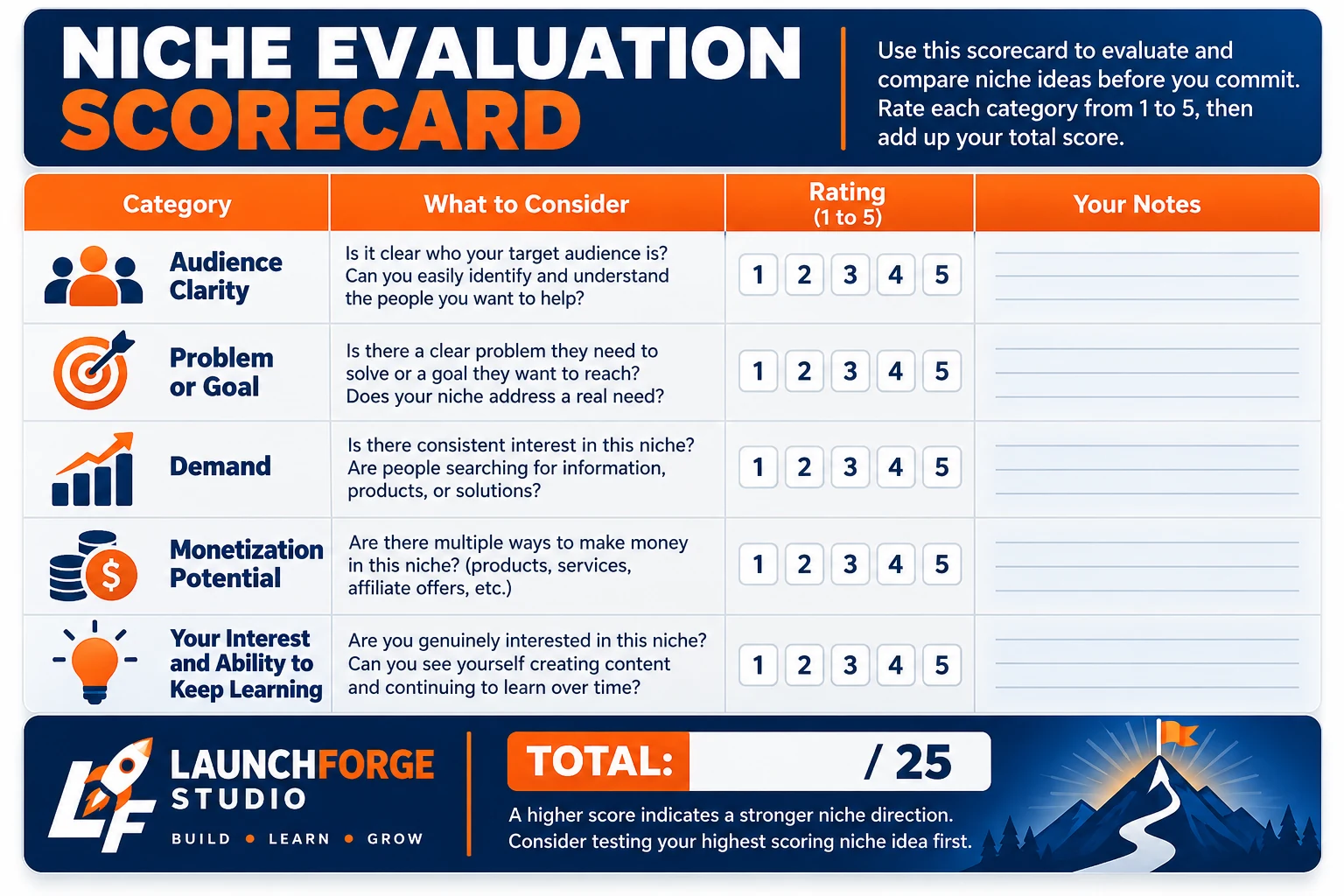
Score your niche from 1 to 5 for audience clarity, problem or goal, demand, monetization potential, and your interest in continuing to learn.
Do not treat the final number as scientific proof.
A niche scoring 22 does not come with a guarantee of success, and a niche scoring 19 is not automatically a bad business.
The value of the exercise is comparison.
It forces you to examine each idea using the same questions instead of choosing whichever one happens to sound most exciting today.
You may also discover something more useful than the final score.
Perhaps one niche has excellent demand but you have no interest in working inside it.
Perhaps another has a clearly defined audience but you cannot yet identify a realistic way to monetize it.
Maybe one idea has slightly less obvious demand but combines an audience you understand, problems you know how to help solve, and a subject you genuinely want to keep learning about.
Those differences matter.
Once you have compared the options, choose the direction that gives you the strongest overall reason to continue.
Then stop scoring.
The spreadsheet cannot build the business for you.
At some point, the niche has to leave the page and meet actual people.
That is where validation becomes much more useful than another round of brainstorming.
Validate Your Niche With Something Real
Research can help you decide whether a niche deserves further attention.
But eventually, research reaches its limit.
You can study search results, competitors, products, communities, and keywords for weeks and still not know exactly how people will respond to what you create.
At some point, you need feedback from the real world.
That does not mean spending thousands of dollars building a complete website, creating ten products, setting up complicated automation, and launching a giant advertising campaign.
Your first test can be much smaller.
The goal is to create something useful, put it in front of the audience, and learn from what happens.
Do Not Spend Months Building Before You Test
One of the easiest mistakes to make is building too much before you have learned enough.
You choose a niche.
Buy a domain.
Design an elaborate website.
Create multiple social accounts.
Build a complicated funnel.
Write dozens of emails.
Develop a product.
Spend money on software.
And only then do you discover that the audience is not responding the way you expected.
Some infrastructure will eventually be necessary.
But validation does not require the finished version of the business.
Start with the smallest useful test that can teach you something.
That might be one piece of content.
One landing page.
One lead magnet.
One simple offer.
One conversation.
One email signup form.
The question is not:
How much can I build before I launch?
It is:
What can I build that will help me learn whether this direction deserves more investment?
Publish Useful Content
Content is one of the simplest ways to begin testing a niche.
Choose a real question the audience is asking and create something genuinely useful around it.
That could be an article.
A video.
A tutorial.
A checklist.
A comparison.
A guide.
Then put it where people can find it.
You are not expecting one article to prove whether an entire business will succeed.
You are beginning to collect information.
Does anyone find it?
Do people stay long enough to consume it?
Does the subject generate additional questions?
Do some topics receive more attention than others?
Does the content naturally lead to another useful resource you could create?
Publishing begins replacing assumptions with behavior.
And behavior can teach you things brainstorming cannot.
Create a Simple Landing Page
You can also test a niche with a focused landing page.
The page does not need twenty sections and complicated design.
It needs a clear message.
Who is this for?
What are you helping them with?
What should they do next?
For example, our hypothetical guitar niche could create a page around:
A Simple 7-Day Practice Plan for Adult Beginner Guitar Players
Now we have something specific.
The audience is clear.
The resource is clear.
The next action can be clear.
If people reach the page, you can begin learning whether the message connects with the audience you intended to reach.
And because the page focuses on one action, the response becomes easier to evaluate than sending everyone to a general homepage and hoping they figure out what to do.
Offer a Lead Magnet
A lead magnet can take validation one step further.
Instead of measuring only whether someone reads your content, you can see whether they are interested enough to exchange their email address for something useful.
Our guitar business might offer:
The Adult Beginner Guitar Practice Checklist
A gardening business might offer:
Your First Vegetable Garden Planning Checklist
A budgeting business might offer:
The Simple First-Month Budget Worksheet
The resource should connect directly to the problem or goal your niche is built around.
If the audience responds, you have learned something.
If they do not, you have learned something too.
Maybe the resource is not appealing.
Maybe the message is unclear.
Maybe the wrong people are seeing it.
Maybe the niche needs adjustment.
Validation does not mean every test must succeed.
It means every useful test should teach you something.
Talk to People in the Audience
Not every form of validation needs analytics.
Sometimes one conversation can reveal something a dashboard never will.
If you can speak with people who resemble your intended audience, ask about their experience.
What are they trying to accomplish?
What frustrates them?
What have they already tried?
What do they wish were easier?
What products or resources have they used?
What would they want help understanding?
Listen carefully to the words they use.
Do not spend the conversation trying to convince them that your business idea is brilliant.
You are there to learn.
You may discover that the problem you thought mattered most is barely important to them.
You may discover another problem you had not considered.
You may learn that your terminology makes sense to you but means nothing to the audience.
That is valuable information.
Watch What People Actually Respond To
People can tell you what they think they want.
Behavior gives you another kind of evidence.
Watch what happens after you begin publishing and promoting.
Which articles receive traffic?
Which links get clicked?
Which landing pages generate signups?
Which emails receive replies?
Which subjects create questions?
Which offers receive attention?
Which posts disappear without much response?
Do not panic over tiny amounts of early data.
A new business may not have enough traffic to draw strong conclusions quickly.
Instead, look for patterns as information accumulates.
Maybe one subject repeatedly performs better than others.
Maybe readers arrive for one problem but continue into another topic.
Maybe a particular lead magnet attracts significantly more interest.
Those patterns can help you understand what the audience values.
Adjust the Niche Based on What You Learn
This is why your first niche does not need to be perfect.
You are allowed to refine it.
Suppose you begin with:
Home-recording education for beginner musicians.
After several months, you notice that most of your traffic, email signups, and questions come from guitar players trying to record at home.
Your niche might gradually become:
Helping guitar players build simple home-recording setups.
That is not failure.
It is evidence making the business clearer.
The opposite could happen too.
Maybe you start extremely narrow and discover that readers repeatedly ask questions just outside your original boundaries.
That may be evidence that the niche has room to expand.
Your niche should give the business direction without preventing you from learning.
Research gives you a hypothesis.
Building gives you evidence.
And evidence gives you a reason to adjust.
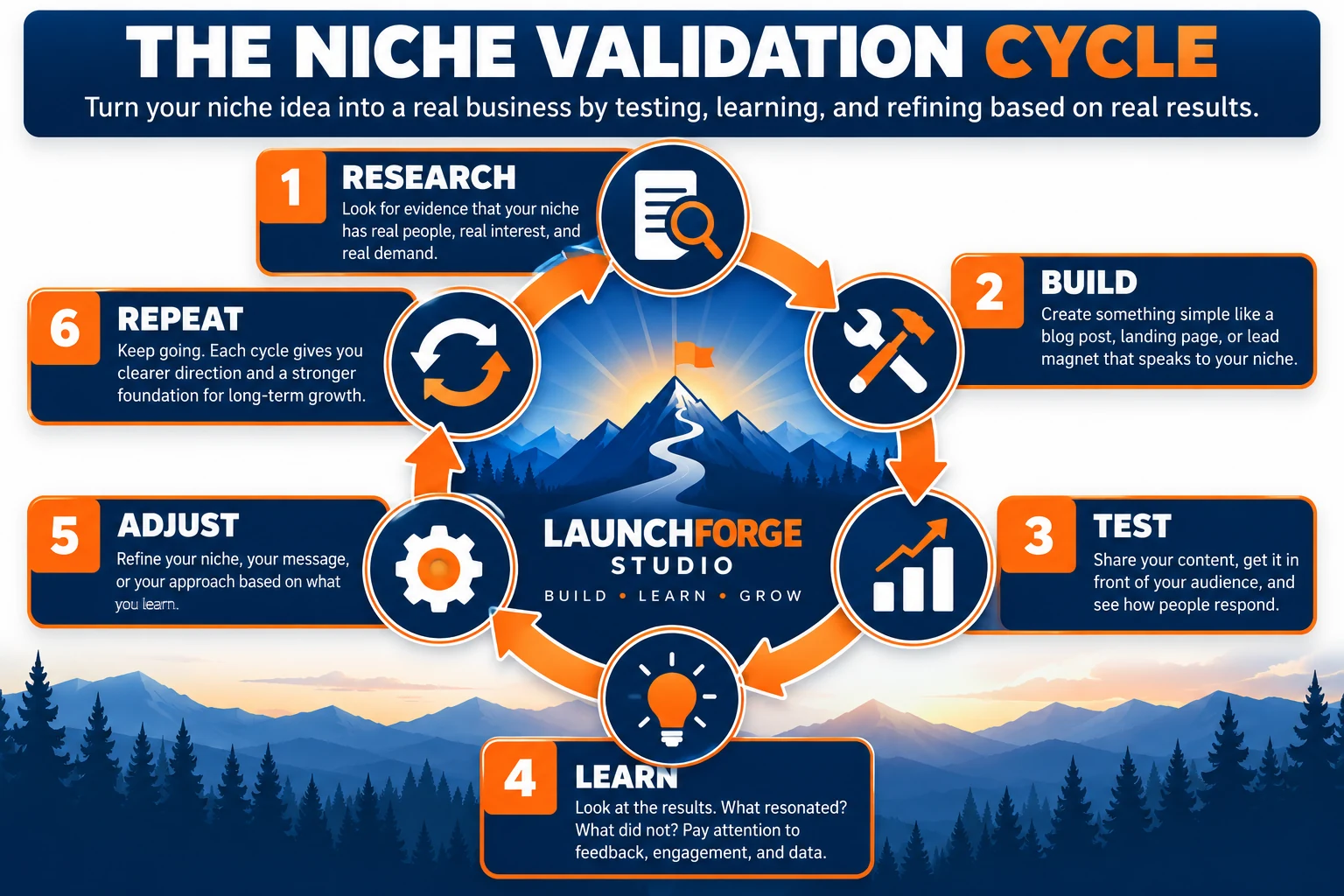
Research your niche, build something useful, test it with real people, learn from the results, adjust your direction, and repeat.
That cycle can continue long after the business launches.
The important thing is that you eventually stop trying to think your way into certainty and create something the market can actually respond to.
Once you do that, many niche-selection mistakes become easier to recognize.
And avoiding a few of the most common ones can save you a considerable amount of unnecessary work.
Common Niche Selection Mistakes Beginners Make
Choosing a niche becomes much easier when you understand that you are selecting a direction to test rather than trying to predict the future.
But there are still several mistakes that can make the process unnecessarily difficult.
Most of them come from one of two extremes.
Either you rush into a niche because it looks exciting or profitable, or you spend so much time trying to make the perfect decision that you never build anything.
Neither approach gives you much useful information.
Here are some of the most common traps to watch for.
Choosing a Niche Only Because It Looks Profitable
There is nothing wrong with considering money when choosing a business niche.
You are building a business.
Revenue matters.
The problem begins when potential profit becomes the only reason you choose a subject.
Maybe you discover that a particular industry has expensive products, attractive affiliate commissions, or customers who regularly spend large amounts of money.
That sounds promising.
But now ask yourself:
Can you understand the audience?
Can you create something genuinely useful for them?
Are you willing to learn enough about the subject to become helpful?
Can you imagine working inside this market after the initial excitement about potential income disappears?
A profitable market does not automatically create a profitable business.
You still need to attract people, earn attention, build trust, create value, and connect the audience with something worth buying.
Choosing a niche you have no interest in understanding can make all of that much harder.
Profitability should be part of the decision.
It should not be the entire decision.
Choosing Something So Broad That Nobody Knows Who It Is For
Broad niches often feel safer because they appear to give you more possibilities.
But too many possibilities can create a business without a clear identity.
Imagine visiting a website that says:
We help you live a better life.
That could mean almost anything.
Fitness?
Money?
Relationships?
Career development?
Travel?
Mental well-being?
Productivity?
The statement includes an enormous number of people, but it gives an individual visitor very little reason to believe the website was created for them.
Compare that with:
We help first-time online business owners simplify the tools and systems they need to get started.
The second statement excludes some people.
That is okay.
It also gives the right person a much stronger reason to continue reading.
Your niche does not need to describe everyone who could possibly benefit from your business.
It needs to make your primary direction understandable.
Going So Narrow That You Have Nowhere to Grow
The opposite mistake is narrowing the niche until you have almost nothing left to build.
Specificity is useful when it improves clarity.
It becomes less useful when every additional restriction exists only because someone told you that a niche should be as narrow as possible.
Ask whether the niche contains enough depth.
Can you identify plenty of useful questions?
Are there related problems you can help solve?
Could the audience have additional needs later?
Are there reasonable monetization possibilities?
Could the business expand naturally without completely abandoning its identity?
If the answer to all of those questions is no, you may have narrowed the niche too far.
You need a starting point.
You do not need a cage.
Confusing a Product With a Niche
A product is not necessarily a niche.
Suppose someone says:
My niche is protein powder.
That tells us what they might sell or discuss, but it does not tell us much about the audience.
Protein powder could be relevant to bodybuilders, endurance athletes, busy professionals, people trying to increase their protein intake, beginners starting strength training, or many other groups.
The product might fit inside several niches.
The same applies to software, courses, equipment, books, services, and other offers.
Starting with a product can also tempt you to build the entire business around whatever you currently want to promote.
Instead, ask who the product helps and why they would care about it.
A business built around an audience can potentially recommend or create many useful products over time.
A business built entirely around one product can become vulnerable if that product disappears, changes, loses popularity, or stops fitting the audience.
Start with people and their needs.
Then determine which products belong.
Copying Someone Else’s Niche Without Understanding the Audience
Successful businesses are useful research.
They can show you that an audience exists.
They can reveal content ideas, business models, products, messaging approaches, and problems worth investigating.
But seeing someone else succeed does not mean copying their niche will automatically produce the same result.
You may not have their experience.
Their audience.
Their reputation.
Their traffic.
Their relationships.
Their budget.
Their timing.
Their years of accumulated content.
Their business may also have evolved considerably from where it started.
Study competitors to understand the market.
Do not use them as a substitute for understanding the people you want to help.
The goal is not to build a weaker version of somebody else’s business.
It is to learn enough about the market to discover where your own useful contribution could fit.
Waiting for Absolute Certainty Before Starting
This may be the most expensive mistake because it can consume unlimited time.
There will always be another keyword you could research.
Another competitor you could analyze.
Another business model you could compare.
Another niche idea you could consider.
Another tool you could investigate.
Research can become a very respectable form of procrastination.
At some point, you will know enough to run a test.
That does not mean you are certain.
It means the potential value of learning from actual behavior has become greater than the value of another week spent thinking.
Choose the strongest direction you can reasonably support with the information available.
Build something useful.
Put it in front of people.
Watch what happens.
Then make the next decision with better information than you had before.
That is how uncertainty gradually becomes experience.
You do not eliminate every risk before starting.
You reduce unnecessary risk, take a reasonable step, learn from it, and adjust.
Once you understand that, choosing a niche becomes much less intimidating.
You are no longer trying to predict the entire future of your business.
You are choosing a direction clear enough to describe.
And that brings us to one final practical exercise:
Can you explain your niche in one sentence?
Write Your Online Business Niche in One Sentence
After researching audiences, problems, demand, competition, monetization, and validation, your niche can start to feel more complicated than when you began.
So let’s simplify it again.
Try describing the niche in one sentence.
You are not writing the permanent slogan for your business.
You are not creating a mission statement.
You are not trying to impress anyone.
You are creating a working statement that helps you understand three basic things:
Who are you helping?
What are you helping them do?
How are you helping them?
If you can answer those questions clearly, many other business decisions become easier.
Who Do You Help?
Start with the audience.
Be specific enough that the person can recognize themselves without narrowing the audience unnecessarily.
Instead of:
Everyone who wants to play music
you might choose:
Adult beginner guitar players
Instead of:
People interested in business
you might choose:
Beginners building their first online business
Instead of:
People who like gardening
you might choose:
First-time vegetable gardeners
Notice that none of these descriptions requires a detailed fictional customer profile.
You do not necessarily need to decide what car they drive, what television shows they watch, or what they eat for breakfast.
You need enough information to understand the people you are primarily trying to help.
What Do You Help Them Do?
Next, identify the result, problem, or goal.
What becomes easier, better, clearer, faster, or more achievable because your business exists?
Our adult beginner guitar player might want to:
Learn the fundamentals and start playing recognizable songs.
The new online business owner might want to:
Understand what to build and how the pieces fit together.
The first-time gardener might want to:
Plan, plant, and maintain a productive vegetable garden.
Try to describe something meaningful to the audience.
Avoid vague statements such as:
Reach your full potential.
or:
Transform your life.
Those phrases can sound impressive without telling the reader what the business actually helps them accomplish.
Clear usually beats clever.
How Do You Help Them?
Now consider the method.
This does not necessarily mean listing every product, service, article, email, tool, and platform you might ever use.
Keep it broad enough to allow the business to develop.
You might help through:
Practical tutorials and beginner-friendly lessons
Step-by-step guides and resources
Product reviews and recommendations
Templates and downloadable tools
Courses and training
Services
A combination of several approaches
For our guitar example, the method might be:
Simple lessons, practical guides, and beginner-focused resources.
Now we have all three pieces.
Put the Pieces Together
Combine the audience, outcome, and method.
A simple structure is:
We help [AUDIENCE] achieve [OUTCOME] through [METHOD].
Our guitar example becomes:
We help adult beginner guitar players learn the fundamentals and start playing real songs through simple lessons, practical guides, and beginner-focused resources.
Our online business example might become:
We help beginners build and improve an online business through practical guides, real-world examples, and systems we are actually using and testing.
A gardening example might become:
We help first-time vegetable gardeners plan, plant, and maintain their first garden through beginner-friendly tutorials, seasonal guides, and practical resources.
These statements are not magic.
They will not automatically generate traffic or sales.
Their value is clarity.
If you know who you help, what you help them accomplish, and generally how you intend to help them, you have something you can use to evaluate future decisions.
Does this article help that audience?
Does this lead magnet solve a relevant problem?
Does this product belong?
Does this social post speak to someone we are trying to reach?
Does this new idea move the business in the same direction?
Your niche statement becomes a filter.
That can be especially valuable when new ideas begin arriving faster than you can possibly build them.
Your Niche Statement Can Change
Do not carve your first niche statement into stone.
It is a working description of the business you currently intend to build.
The audience may become clearer.
The problem may change.
Your method may evolve.
You may discover that one part of the business creates substantially more interest than another.
You may find a new opportunity you could not have predicted when you started.
Update the statement when the evidence gives you a reason.
That is not inconsistency.
It is learning.
The purpose of writing the niche in one sentence is not to restrict everything you might become.
It is to make your current direction clear enough to act on.
And once you can do that, the endless niche search can finally stop.
You have researched.
You have compared.
You have narrowed.
You have chosen a direction worth testing.
Now there is only one useful thing left to do.
Start building.
How to Choose a Niche for Your Online Business and Start Building
Learning how to choose a niche for your online business can feel like one of the biggest decisions you will make when getting started.
In some ways, it is important.
Your niche influences the audience you serve, the content you create, the problems you solve, the products you recommend, the offers you develop, and the way people understand your business.
But it does not need to be a perfect decision.
You do not need to discover a hidden market nobody else has noticed.
You do not need to predict exactly what your business will look like five years from now.
And you do not need absolute certainty before you begin.
You need enough clarity to choose a reasonable direction, enough evidence to believe people care about it, and enough curiosity to start learning from the market.
That is a much more achievable goal.
A Good Niche Gives You Direction
The purpose of a niche is not to make your business smaller.
It is to make your starting point clearer.
When you know who you are primarily helping and what you are helping them accomplish, decisions become easier.
You have a better idea of what content to create.
You can build lead magnets around specific problems.
You can create landing pages with clearer messages.
You can evaluate products and services based on whether they actually belong.
You can write emails that speak to recognizable needs.
You can decide which opportunities fit the business and which ones are distractions.
That clarity compounds.
Instead of building a collection of unrelated pages, offers, and ideas, you begin building a connected system around an audience.
Your niche gives those pieces a reason to belong together.
Your First Niche Does Not Have to Be Your Forever Niche
One of the most useful things to remember is that your first niche is a starting point.
Businesses evolve.
Audiences evolve.
Markets evolve.
You will evolve too.
The direction that makes sense when you publish your first ten articles may look different after you have published fifty.
The problem you originally expected to focus on may lead to another problem your audience cares about even more.
A small part of your business may unexpectedly become the thing people respond to most strongly.
You may discover opportunities you could not have seen before you started.
That is normal.
Do not use the possibility of future change as an excuse to avoid making a decision today.
Choose the best direction you can with the information you currently have.
Then give yourself permission to improve that decision as you learn.
Give the Market a Chance to Teach You
There is only so much you can learn from research.
Eventually, your business needs contact with the real world.
Publish the article.
Build the landing page.
Create the lead magnet.
Send the email.
Share the resource.
Recommend the product.
Talk to the audience.
Watch what happens.
Some things will work better than expected.
Others will barely move.
A topic you thought would be popular may receive little attention.
Another subject may repeatedly attract readers, questions, signups, or customers.
Those results are information.
Use them.
The market cannot teach you very much about a business that never leaves your notebook.
This is why action is part of niche research.
You are not finished learning when you choose the niche.
In many ways, that is when the most useful learning begins.
Build Along With LaunchForge
LaunchForge Studio was not created because every part of the business had already been perfectly figured out.
It has been built one piece at a time.
The website.
The content.
The landing pages.
The lead-generation system.
The email follow-up.
The marketing tools.
The traffic experiments.
The monetization strategy.
And the lessons that come from connecting all of those pieces together.
That process continues.
It is also why we believe building can be one of the best ways to learn.
Research gives you knowledge.
Planning gives you direction.
Building gives you experience.
If you are trying to choose a niche for your online business, use what you have learned in this guide to make the strongest decision you reasonably can.
Define the audience.
Understand their problems and goals.
Look for evidence of demand.
Consider how the niche could support a business.
Compare your strongest options.
Validate the direction with something real.
Then choose.
You can refine it later.
You can expand it later.
You can change direction when the evidence gives you a reason.
But none of that can happen until there is something to learn from.
Your niche does not need to describe everything your business will ever become.
It needs to give you a clear enough place to begin.
Choose your direction. Build something useful. Learn from what happens. Then keep building.
Ready to Build Your Own Online Business?
You do not need every detail figured out before you begin. You need a direction, a system you can build with, and the willingness to learn as you go.
Profit Hub System gives you the website, funnel, email marketing, automation, lead generation, and business tools you need to start putting those pieces together in one place.
See the platform in action, go through the training, and decide whether it fits the business you want to build.