If you want to start an online business but have no idea what kind of business to build, you are not alone.
For many beginners, the hardest part is not building a website, creating a landing page, setting up email marketing, or learning how to promote something.
It is deciding what that something should be.
You may have dozens of interests.
You may have several skills you could turn into a business.
Or you may be staring at a completely blank canvas thinking:
“What kind of online business could I actually build?”
That question can stop people before they ever begin.
They search for online business ideas, scroll through enormous lists of possibilities, watch videos about the latest opportunities, investigate different niches, and eventually end up with more options than they had when they started.
Affiliate marketing sounds interesting.
So does selling digital products.
Maybe you could teach something.
Perhaps you could build a niche website.
You might have professional experience that could become a consulting or service business.
Maybe there is a hobby you know far more about than you realize.
The possibilities can feel almost endless.
And that is exactly why learning how to choose an online business idea matters.
You do not need to discover the one perfect idea that will determine the rest of your life.
You need to find a direction that makes enough sense to start.
Ideally, that direction sits somewhere between four things:
Something you are interested in.
Something you can learn, teach, create, recommend, or provide.
Something a specific group of people wants or needs.
Something that gives you a realistic way to build a business around it.
That is what we are going to work through in this guide.
We will look at how to uncover possible business ideas, choose a niche, think about the audience you want to serve, compare different online business models, and narrow your options without getting trapped in endless research.
We will also look at something that beginners sometimes overlook:
The technology available today gives you tremendous freedom over what you can build.
Your website does not have to look like everyone else’s.
Your business does not have to fit inside one predetermined template.
And the platform you use should support the direction you choose rather than choosing the direction for you.
Throughout this guide, I will show you some of the same tools, templates, website technology, and business systems we use while building LaunchForge Studio so you can see what moving from an idea to an actual online business can look like.
Most importantly, we are not going to sit around waiting for lightning to strike and reveal your perfect niche.
We are going to narrow the possibilities until you have something much more useful:
A business idea you can actually begin building.
Let’s find it.
You Do Not Need the Perfect Online Business Idea
One of the easiest ways to delay starting an online business is to convince yourself that you need to find the perfect idea first.
The perfect niche.
The perfect product.
The perfect audience.
The perfect business model.
The perfect domain name.
The perfect plan that guarantees you will never change direction later.
That business probably does not exist.
Most businesses evolve.
What you start with today may look very different a year from now because you will know more about your audience, your market, your own strengths, and the kind of work you actually enjoy doing.
That is not failure.
That is learning how to build a business.
Your First Idea Is a Starting Point
Think of your first online business idea as a direction rather than a permanent destination.
You need enough clarity to take the next step.
You do not need enough clarity to predict every step that comes after it.
This distinction matters because beginners often put enormous pressure on their first decision.
They think:
“What if I choose the wrong niche?”
“What if I change my mind?”
“What if this idea does not work?”
Those are reasonable questions, but none of them require you to remain stuck.
An idea can be tested.
A niche can be refined.
An audience can become clearer.
An offer can change.
A website can evolve.
And an entire business can move in a different direction as you learn what works.
You Are Choosing What to Test
A useful way to think about your first business idea is this:
You are not choosing what you must do forever. You are choosing what you are willing to build and test next.
That changes the decision completely.
Instead of asking:
“Is this the perfect business for me?”
Ask:
“Is this a business idea I am interested enough in to explore?”
Then:
“Is there a group of people I could potentially help?”
“Do those people have problems, goals, interests, or needs I understand or could learn more about?”
“Can I imagine creating content, products, services, recommendations, or resources for them?”
“Is there a realistic way this could eventually generate revenue?”
You do not need perfect answers yet.
You are simply looking for enough positive signals to continue investigating.
Starting Creates Information
There is another reason endless planning can become a trap.
Some questions cannot be answered through research alone.
You may think you would love running a particular kind of business until you begin doing the work.
You may overlook a niche that turns out to be fascinating once you start interacting with the audience.
You may discover that people respond strongly to a topic you originally considered a small part of your business.
You may build one offer and realize customers are asking for something slightly different.
That information appears because you started.
Building creates feedback.
Feedback creates clarity.
And clarity helps you make better decisions.
Changing Direction Does Not Mean Starting Over
This is especially important if you are building your first online business.
The skills you develop tend to travel with you.
Learning WordPress does not disappear because you change niches.
Learning how landing pages work still matters.
Building an email list still matters.
Understanding traffic, content marketing, lead generation, follow-up, automation, and conversion still matters.
Those skills become part of your toolbox.
Even if the business changes, the experience comes with you.
That is why your first online business does not need to become your forever business.
It needs to teach you enough to build the next version better.
Give Yourself Permission to Begin
The goal of this guide is not to pressure you into choosing an idea before you are ready.
It is to help you stop demanding certainty that no beginner can realistically have.
We are going to make the decision smaller.
Instead of trying to discover your perfect business, we are going to look for the intersection between:
What interests you.
What you know or are willing to learn.
Who you could help.
What problems or goals those people have.
How you could create value for them.
How that value could eventually become a business.
That gives us something much more practical to work with.
So before we start looking at niches, templates, platforms, websites, funnels, or business models, we need to begin somewhere closer to home.
We need to look at you.
Start With What You Already Know, Enjoy, or Want to Learn
When people start searching for an online business idea, they often look everywhere except at themselves.
They search for trending niches.
They look for lists of profitable businesses.
They watch videos about what other entrepreneurs are doing.
They ask which market is growing fastest or which business model has the greatest income potential.
There is nothing wrong with researching opportunities.
But before you chase someone else’s idea, take inventory of what you already bring to the table.
Your experience, interests, skills, curiosity, hobbies, professional background, and even problems you have personally learned how to solve can all point toward possible business ideas.
You may be sitting on more possibilities than you realize.
Start With Your Interests
Ask yourself a simple question:
What do I genuinely enjoy talking about, learning about, or doing?
Do not worry about whether every answer sounds like a business yet.
Write them down.
Maybe you love:
- Guitars
- Cooking
- Fitness
- Gardening
- Photography
- Dogs
- Travel
- Personal finance
- Technology
- Home improvement
- Crafts
- Gaming
- Beauty
- Fashion
- Cars
- Sports
- Writing
- Music
- Marketing
The list could go almost anywhere.
An interest alone does not automatically make a good business.
But it gives you somewhere to begin looking.
If you are going to spend months or years creating content, learning about an audience, improving your skills, building offers, and developing a business, having some genuine interest in the subject can make that process much easier to sustain.
Look at the Skills You Already Have
Next, think about what you know how to do.
Do not limit yourself to impressive-sounding professional credentials.
Useful skills are everywhere.
Maybe you know how to:
- Build websites
- Repair things
- Play an instrument
- Train a dog
- Organize a household
- Prepare meals
- Use particular software
- Take photographs
- Manage projects
- Grow vegetables
- Create spreadsheets
- Design graphics
- Exercise safely
- Write clearly
- Sell products
- Manage people
- Teach beginners
- Research complicated topics
- Make something by hand
Something that feels ordinary to you may be extremely useful to someone who has not learned it yet.
That is easy to overlook.
When you have done something for years, you can forget what it felt like not to know how.
But somewhere online, another person may be typing a question into a search engine because they are trying to learn exactly what you already understand.
Your Work Experience Counts Too
Your current or previous career can also reveal opportunities.
Think about the industries you have worked in.
What do people in those industries struggle with?
What processes do you understand?
What questions do customers repeatedly ask?
What mistakes do beginners make?
What tools do people use?
What products do they buy?
What information is difficult to find?
You do not necessarily have to build a business identical to your day job.
Instead, your professional experience may give you insight into an audience or problem that someone outside the industry would never notice.
That knowledge can become an advantage.
Problems You Have Solved Can Become Ideas
Some business ideas begin with frustration.
You struggled with something.
You searched for answers.
You tried different approaches.
Eventually, you found something that worked.
That experience may help someone else who is currently standing where you once stood.
Think about problems you have solved in your own life or work.
Maybe you learned how to build your first website without knowing how to code.
Maybe you figured out how to organize a complicated project.
Maybe you found a simpler way to perform a repetitive task.
Maybe you taught yourself a skill that initially seemed intimidating.
Maybe you compared dozens of tools before finding a combination that worked.
The important question becomes:
Are other people trying to solve this problem too?
If they are, there may be an audience worth investigating.
You Do Not Have to Be an Expert Yet
This is another place beginners sometimes get stuck.
They think:
“Who am I to build a business around this? I am not an expert.”
You do need to be truthful about your experience.
You should never pretend to have qualifications or results you do not have.
But you also do not need to be the world’s leading authority on a subject before you can create something useful.
Sometimes you are simply further along than the person you are helping.
You can document what you are learning.
You can organize information.
You can share your experience.
You can create beginner-friendly resources.
You can recommend tools you genuinely use.
You can interview people who know more than you.
And you can continue developing your expertise while the business develops with you.
Curiosity Can Be a Starting Point
You may also discover that your best idea is something you do not know much about yet.
Maybe there is a subject you have wanted to learn for years.
That can still be worth exploring.
Ask yourself:
Would I enjoy becoming better at this even if the business took time to grow?
That question matters.
Building an online business usually requires learning anyway.
If the niche gives you a reason to develop skills you genuinely want, the process itself can become valuable.
Build Your Personal Idea Inventory
Before moving forward, create a quick list under these five headings:
Interests
What subjects do you naturally enjoy?
Skills
What can you already do reasonably well?
Experience
What industries, jobs, projects, or life experiences have taught you something useful?
Problems You Have Solved
What have you figured out that other people may still be struggling with?
Things You Want to Learn
What subjects would you enjoy becoming significantly better at?
Do not judge the ideas yet.
Do not ask whether every one of them can make money.
And do not start buying domain names simply because one idea suddenly sounds exciting.
For now, we are collecting possibilities.
Because the next question changes everything.
It is not simply:
What am I interested in?
It is:
Who could I help with what I know, enjoy, or want to learn?
That is where an interest begins moving toward a niche.
Ready to See What You Could Build?
If some of those ideas are already starting to feel like real possibilities, you do not have to wait until the end of this guide to explore what building one could look like.
Profit Hub System is the platform we use to build and grow LaunchForge Studio, and it brings the website, funnels, marketing tools, and business systems together in one place.
If you are ready to take a closer look, you can explore Profit Hub System and see whether it fits the kind of online business you want to build.
Choose the People You Want to Help
An interest gives you a subject.
A niche gives that subject direction.
That difference matters.
You could say:
“I want to build a business about fitness.”
That is an interest, but it is incredibly broad.
Fitness for whom?
Someone trying to lose weight?
Busy professionals who only have 20 minutes to exercise?
People building a home gym?
Beginners who have never followed a workout program?
Runners preparing for their first 5K?
The subject may be the same, but each of those audiences has different goals, questions, problems, and needs.
The same thing happens in almost every market.
Cooking could become simple meals for busy families.
Photography could become beginner photography for new camera owners.
Gardening could become vegetable gardening for people with small backyards.
Travel could become budget travel for families.
Guitars could become electric guitar guidance for complete beginners buying their first setup.
Web design could become helping small-business owners build their first WordPress website.
The more clearly you understand who you want to help, the easier it becomes to decide what your business should actually do.
A Niche Is More Than a Topic
One useful way to think about a niche is:
Audience + Problem or Goal + Your Approach
For example:
New guitar players + choosing their first equipment + beginner-friendly buying guides
Or:
Busy parents + preparing meals faster + simple weekly meal plans
Or:
New online entrepreneurs + building their first website + beginner-friendly WordPress tutorials
Now we are getting somewhere.
Instead of trying to become another enormous website about “music,” “food,” or “business,” you are giving yourself a specific group of people to understand.
That makes practically everything easier.
Your content becomes easier to plan.
Your website becomes easier to position.
Your lead magnets become easier to create.
Your emails become more relevant.
Your offers make more sense.
And visitors can understand much faster whether your business is meant for them.
Think About the Person on the Other Side of the Screen
Imagine one person discovering your website for the first time.
Who are they?
What are they trying to accomplish?
What are they confused about?
What have they already tried?
What are they searching for?
What would make them say:
“This is exactly what I needed.”
You do not need to invent an imaginary customer with a favorite breakfast cereal, shoe size, and the name of their childhood goldfish.
You simply need enough clarity to understand the kind of person you want to serve.
For a beginner business, that can be surprisingly powerful.
Look for Questions You Can Help Answer
Questions are one of the best clues that a potential niche exists.
People search online because they want something.
They want to learn.
They want to compare.
They want to fix something.
They want to buy something.
They want to make a decision.
They want to accomplish a result.
Suppose you were interested in baking.
People might be searching for:
- How to bake bread at home
- Best baking equipment for beginners
- How to decorate a birthday cake
- Easy desserts for beginners
- Gluten-free baking recipes
- How to start a home bakery
- Best stand mixer for home baking
Suddenly, “baking” is not one business idea.
It is the beginning of many possible directions.
The same principle works whether you are interested in technology, pets, fitness, crafts, marketing, gardening, music, education, travel, or almost anything else.
Problems and Goals Give a Niche Purpose
People do not necessarily need another website about a broad topic.
They need help getting somewhere.
That destination might involve solving a problem.
But it can also involve achieving something they want.
Someone learning guitar may not have a painful problem.
They may simply want to play their favorite songs.
Someone interested in photography may want to take better family photos.
Someone learning gardening may want to grow their first tomatoes.
Someone starting an online business may want to build something of their own.
This is important because a useful business does not always have to begin with frustration.
It can begin with aspiration.
Your job is to understand the change the person wants to make.
You Can Start Narrow Without Staying Small Forever
Some beginners resist choosing a niche because they are afraid it will trap them.
They think:
“If I choose something specific now, what happens if I want to expand later?”
You can expand.
Your first niche is a starting point, not a prison sentence.
In fact, starting with a clearer audience can make expansion easier because you have somewhere to establish yourself first.
A website that tries to serve everybody from day one can struggle to communicate why anyone should pay attention.
A website that clearly helps a particular type of person accomplish something useful has a much stronger foundation.
As the audience grows, you can learn what else they need.
Then your content, products, services, affiliate recommendations, email marketing, and other offers can grow with them.
Do Not Choose a Niche Only Because Someone Says It Is Profitable
This deserves special attention.
You will find plenty of lists online telling you about the “most profitable niches.”
Finance.
Health.
Technology.
Relationships.
Business.
Travel.
And plenty more.
Yes, market demand matters.
We are going to examine that.
But choosing a market solely because someone told you there is money in it can create another problem:
You may end up building a business you cannot stand working on.
Remember what you are actually signing up for.
You may eventually write dozens of articles about this subject.
You may create videos, emails, guides, landing pages, social posts, resources, and offers around it.
You may answer questions about it for years.
That does not mean you need to wake up every morning screaming your niche from the rooftop.
But having some genuine interest, experience, curiosity, or connection to the market gives you a much better reason to keep building when the initial excitement wears off.
Create Three Possible Niche Directions
Now combine what you discovered in the previous section with the people you might help.
Write down three possibilities.
Use this simple formula:
I want to help [AUDIENCE] achieve or solve [RESULT/PROBLEM] by helping them with [TOPIC/APPROACH].
For example:
I want to help beginner guitar players choose their first electric guitar setup through simple equipment guides and tutorials.
I want to help busy families prepare affordable meals through simple recipes and weekly meal-planning resources.
I want to help new entrepreneurs build their first online presence through beginner-friendly website and online business guidance.
These are not permanent commitments.
They are candidates.
And that distinction is important.
Because before we choose one and start building a business around it, we need to answer another question:
Are people actually interested in what we want to help them with?
That is where we stop guessing and start looking for evidence.
Validate Your Online Business Idea Before You Build It
You now have a few possible niche directions.
That is progress.
But before you register a domain, build a website, create 50 pieces of content, and announce your new business to the world, it makes sense to do a little research.
You want to know whether there are actual people interested in what you are considering.
This process is often called market validation.
That may sound complicated.
It does not have to be.
For a beginner, validation simply means looking for evidence that people are already interested in the topic, asking questions about it, searching for information, buying related products, or paying for solutions.
You are not trying to predict the future with perfect accuracy.
You are gathering enough evidence to make a more informed decision.
Start With a Simple Google Search
One of the easiest places to begin is the same place your future audience may begin:
Google.
Search for the topics you are considering.
Pay attention to what appears.
Are there established websites covering the subject?
Are companies selling products or services related to it?
Are there tutorials, reviews, comparison articles, videos, forums, or other resources?
Look at the suggested searches Google provides as you type.
Look at related searches.
Look at the questions appearing in search results.
These can reveal the language people use when searching for information about your potential niche.
Do not worry if other websites already exist.
That is not automatically bad news.
In many cases, competition is evidence that a market exists.
Competition Can Be a Good Sign
Beginners sometimes search for a business idea and become discouraged when they discover other people are already doing it.
They think:
“Someone already built this. I missed my chance.”
Probably not.
Imagine searching for restaurants in a city and finding none.
Would you immediately assume you discovered an incredible untapped restaurant market?
Or would you wonder why nobody has opened one?
Existing businesses can demonstrate that people are already spending money in a market.
The goal is not necessarily to find something nobody on Earth has ever thought of before.
You can enter an established market with your own perspective, personality, experience, approach, audience, positioning, or combination of resources.
You do not have to invent the category.
You need to find your place within it.
Look at What People Are Asking
Questions are valuable market research.
Search your potential topic and pay attention to what people repeatedly want to know.
You can look at:
- Google search suggestions
- Related searches
- YouTube search suggestions
- Forums and discussion communities
- Social media groups
- Blog comments
- Product reviews
- Frequently asked questions
- Questions people ask in your everyday conversations
You are looking for patterns.
If you repeatedly see people asking similar questions, those questions may eventually become:
- Blog articles
- Videos
- Lead magnets
- Email content
- Tutorials
- Product ideas
- Service ideas
- Affiliate content
- Landing pages
This is where niche research begins turning into business-building material.
Instead of asking:
“What should I create?”
You begin asking:
“What are people already telling me they need help with?”
That is a much stronger question.
Look for Existing Products and Services
Next, look at what people can already buy in the market.
Depending on the niche, that could include:
- Physical products
- Digital products
- Software
- Memberships
- Courses
- Coaching
- Consulting
- Freelance services
- Books
- Templates
- Tools
- Subscriptions
You do not need every one of these to exist.
You are simply looking for evidence of commercial activity.
If companies are advertising products, creators are recommending tools, businesses are offering services, and customers are leaving reviews, there is probably money changing hands somewhere in that market.
That matters.
A hobby can become the subject of a website.
A viable business eventually needs some way to generate revenue.
Search for Affiliate Opportunities
If affiliate marketing may become part of your business, check whether companies in the niche have affiliate or referral programs.
This can be especially useful for beginners who do not have their own product yet.
Suppose you build a website around home recording.
You might eventually find affiliate opportunities involving:
- Audio interfaces
- Microphones
- Studio monitors
- Headphones
- Recording software
- Plugins
- Instruments
- Online music courses
Your content can help people understand those products and make better decisions while giving you a potential way to earn commissions from qualifying purchases or referrals.
The same principle can apply to countless markets.
You do not necessarily need to create a product before your business has something relevant to recommend.
Check Whether Content Is Being Consumed
Another useful signal is whether people are actively consuming content about the subject.
Search YouTube.
Look at blogs.
Look at podcasts.
Look at newsletters.
Look at communities built around the topic.
You are not trying to obsess over somebody else’s follower count.
You are looking for evidence of attention.
Are people watching?
Reading?
Commenting?
Sharing?
Asking follow-up questions?
Joining communities?
If people consistently spend their time learning about a subject, that tells you something.
Attention alone does not guarantee a profitable business.
But it can be another useful piece of evidence.
Pay Attention to Problems People Still Complain About
Competition tells you what already exists.
Complaints can tell you where opportunities may still exist.
Read reviews.
Look at discussions.
Pay attention when people say things like:
“I wish this were easier.”
“I cannot find a beginner-friendly explanation.”
“This is too expensive.”
“Everything I find assumes I already know what I am doing.”
“I wish someone would compare these options.”
Those frustrations may reveal gaps.
You may not need to create an entirely new market.
You may simply need to serve part of an existing market better.
For LaunchForge Studio, one of the recurring problems we recognized was how complicated building an online business can become when beginners are told they need one tool for websites, another for funnels, another for email, another for automation, and several more systems just to connect everything together.
That problem helped shape how we think about the business we are building.
Your research can help shape yours too.
Do Not Let Competition Scare You Away From Your Own Experience
There may be people in your potential niche with more experience than you.
There may be enormous websites.
There may be companies with large advertising budgets.
There may be creators who have been publishing for ten years.
That does not automatically mean there is no room for you.
You may understand a particular beginner because you recently were that beginner.
You may explain something differently.
You may document your own journey.
You may focus on a smaller audience.
You may combine interests in a way somebody else has not.
You may simply be willing to create genuinely useful content consistently.
You do not need to be the world’s leading authority before you are allowed to help someone.
But you should be truthful about what you know, what you have experienced, and what you are still learning.
Trust matters more than pretending to be something you are not.
You Do Not Need Perfect Numbers
This is where market research can become another form of procrastination.
You can spend weeks comparing keyword volumes, market-size reports, competitor traffic estimates, social media statistics, advertising costs, and revenue projections.
Those tools can become useful.
But we are trying to choose a reasonable first direction, not prepare a presentation for a room full of venture capitalists.
For now, look for multiple positive signals.
Are people searching for the topic?
Are they asking questions?
Is useful content being created and consumed?
Are businesses operating in the market?
Are products or services being sold?
Are there affiliate opportunities?
Can you identify problems, goals, or decisions people need help with?
Do you have enough interest in the subject to continue learning and creating around it?
If several of those answers are yes, you may have something worth testing.
Score Your Three Ideas With a Simple Reality Check
Take the three niche possibilities you created earlier.
For each one, ask:
Am I genuinely interested in this subject?
Can I imagine creating useful content about it for the next year?
Can I clearly describe the audience?
Can I identify problems or goals that audience has?
Can I find evidence that people are searching for information about it?
Are products or services already being purchased in the market?
Can I see at least one realistic way the business could eventually make money?
You are not looking for a mathematically perfect winner.
You are looking for the idea that gives you enough reasons to take the next step.
Because there is something else beginners often misunderstand about choosing an online business idea.
Your niche does not automatically determine how your business has to make money.
Two people could enter the exact same niche and build completely different businesses.
And understanding that opens up far more possibilities than most beginners realize.
Your Niche Does Not Determine Your Business Model
Choosing a niche gives your business direction.
It does not lock you into one specific way of making money.
This distinction is important because beginners sometimes assume that once they choose a topic, there is only one obvious type of business they can build around it.
That is not how it works.
Your niche and your business model are two different decisions.
Your niche identifies the market, audience, interest, problem, or subject your business will focus on.
Your business model determines how that business will create value and potentially generate revenue.
The same niche can support several completely different business models.
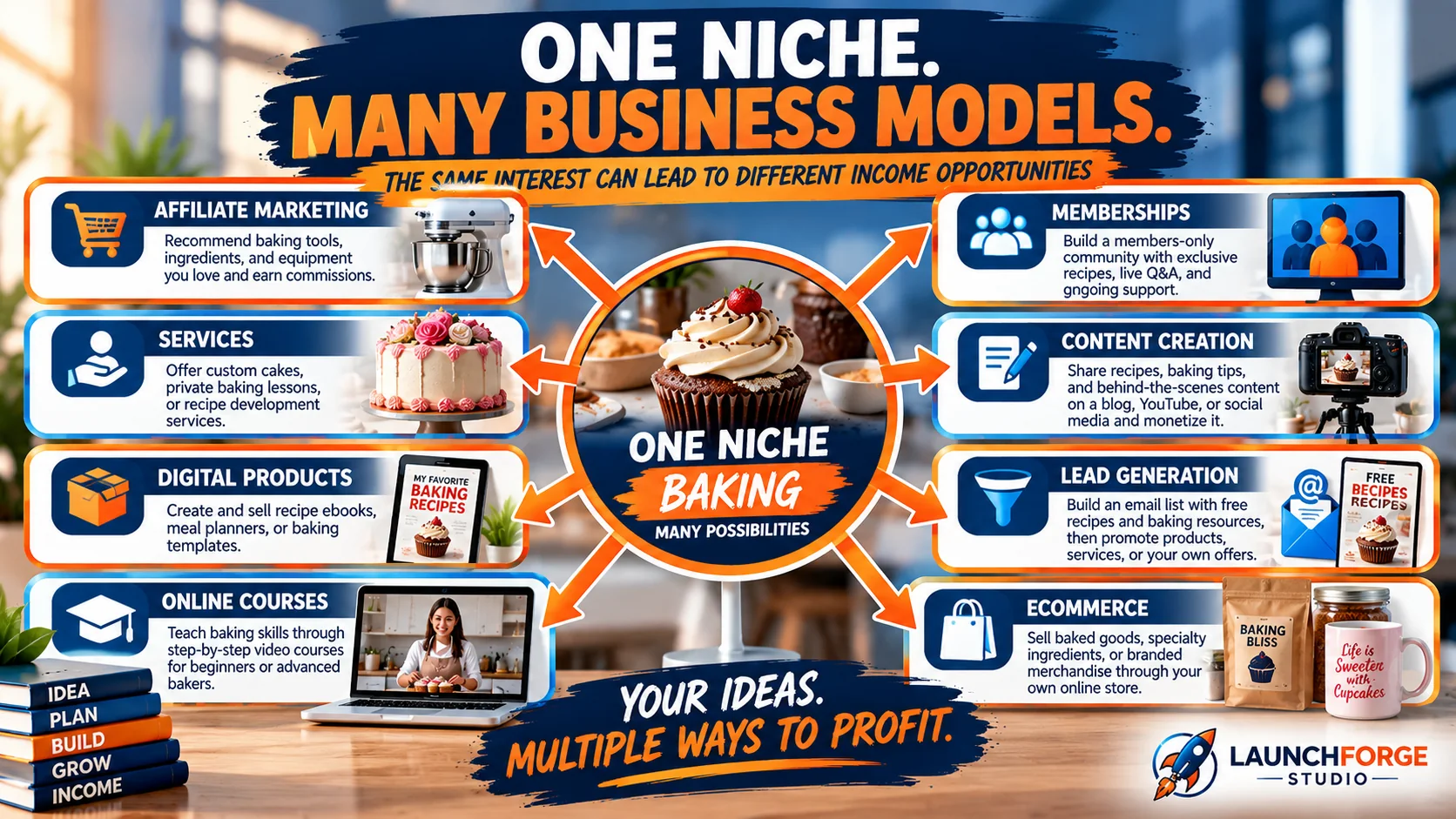
One niche can support many business models, including affiliate marketing, services, digital products, courses, memberships, content creation, lead generation, and ecommerce.
That gives you far more flexibility than you might realize.
One Interest Can Become Many Different Businesses
Let’s use guitar as an example.
Someone interested in guitar could build an online business around that subject in many different ways.
They could create a website that publishes beginner guitar lessons.
They could review guitars, amplifiers, pedals, recording equipment, and accessories while using affiliate links to recommend products.
They could create downloadable chord charts, practice planners, backing tracks, or other digital resources.
They could offer private online guitar lessons.
They could build a paid membership containing lessons and practice material.
They could create a course teaching beginners how to play their first songs.
They could specialize further and build a website entirely around guitar effects, home recording, blues guitar, metal guitar, acoustic guitar, songwriting, or another part of the larger market.
Same broad interest.
Very different businesses.
That is why choosing a niche should not feel like choosing a prison cell.
You are choosing a direction.
There can still be many roads inside it.
Affiliate Marketing
Affiliate marketing can be one of the simplest business models to understand.
You create useful content around a market and recommend relevant products or services.
When someone follows your referral link and completes a qualifying purchase or action, you may earn a commission according to the terms of that affiliate program.
Your content might include:
- Product reviews
- Tutorials
- Comparisons
- Buying guides
- Resource pages
- Case studies
- Recommended tools
- Educational articles
This model can work across many different niches because you do not necessarily need to create the underlying product yourself.
You are helping connect the right audience with products or services that may solve their problems.
The important part is maintaining trust.
Recommending everything with a commission attached to it is not a strategy we want to build around.
Recommend things because they make sense for the audience.
A Service Business
Maybe your knowledge or skill can become a service.
Someone interested in websites might offer website design.
A writer might offer copywriting or content creation.
A bookkeeper might help small businesses organize their finances.
A photographer might offer editing services.
A musician might offer remote recording or mixing.
A marketer might help businesses create landing pages or email campaigns.
The possibilities depend on what you can genuinely provide.
A service business can also begin relatively simply because you do not necessarily need thousands of visitors.
You need the right people to understand what you do and how you can help them.
Digital Products
Another option is creating something once that can be delivered digitally.
Examples could include:
- Templates
- Checklists
- Guides
- Worksheets
- Printables
- Spreadsheets
- Design assets
- Presets
- Digital planners
- Training resources
- Ebooks
The product should solve a specific problem or help the buyer achieve a useful result.
And once again, the niche determines what kinds of digital products make sense.
Someone building a business around gardening might create a seasonal planting planner.
Someone teaching budgeting might create a household budget spreadsheet.
Someone helping new online entrepreneurs might create a website-launch checklist.
The format changes.
The principle does not.
Online Courses and Training
If you know how to help someone move from one point to another, structured training may eventually make sense.
That could be a full course.
But it could also be much smaller.
You might create:
- A mini-course
- A workshop
- A webinar
- A tutorial series
- A paid training library
- A guided challenge
You do not need to begin by creating a 97-module video empire with dramatic background music and Captain Knowledge Pants descending from the ceiling.
Start with the problem.
Then determine how much training is actually necessary to solve it.
Memberships and Communities
Some niches benefit from ongoing support rather than a one-time product.
That can create opportunities for memberships or communities.
People might pay for continuing access to:
- Training
- Resources
- New content
- Group coaching
- Community discussions
- Templates
- Tools
- Events
- Accountability
This model can make sense when the audience has continuing needs rather than one problem that disappears after a single purchase.
Content-Based Businesses
Content itself can become the foundation of the business.
A website, newsletter, YouTube channel, podcast, or combination of platforms can attract an audience around a specific subject.
That audience might eventually support the business through several revenue sources.
For example:
Content → Audience → Email List → Affiliate Offers → Products → Services
You do not have to activate every part of that system on day one.
In fact, you probably should not.
Build the audience and infrastructure first.
Add monetization methods when they make sense.
Lead Generation
Another possibility is building a business that generates leads for a particular market.
Imagine creating useful local content around a service people regularly search for.
Instead of performing that service yourself, the website could connect potential customers with businesses that provide it.
Lead generation can take many forms, and the exact arrangements vary.
But the underlying idea is simple:
Attract people with a specific need and connect them with an appropriate solution.
Your website becomes part of that connection.
Ecommerce
Some niches naturally lend themselves to physical products.
You might eventually build an ecommerce store selling your own products, products sourced from suppliers, handmade goods, merchandise, or another appropriate product line.
This model generally introduces additional considerations such as:
- Inventory
- Shipping
- Payment processing
- Returns
- Customer service
- Product sourcing
That does not make ecommerce a bad choice.
It simply means the business model has different requirements.
Understanding those requirements before jumping in can save you a lot of headaches later.
You Can Combine Business Models
This is where things become especially interesting.
Your business does not necessarily have to choose only one model forever.
A content website could use affiliate marketing while also building an email list.
Later, the owner might create a digital product.
Eventually, they might add a course.
Or consulting.
Or a membership.
The business can evolve.
LaunchForge Studio itself is being built around that kind of thinking.
We create educational content.
We document what we are building.
We recommend tools and platforms we actually use or have researched carefully.
We build an email audience.
And over time, the business can continue developing additional ways to help that audience.
The pieces can work together.
Do Not Build Everything at Once
There is a trap hiding inside all these possibilities.
Once beginners realize how many ways an online business can make money, they sometimes decide to build all of them immediately.
Affiliate site.
Course.
Membership.
YouTube channel.
Newsletter.
Digital products.
Consulting.
Ecommerce store.
Podcast.
And probably a coffee mug with their logo on it before the website has received its tenth visitor.
That is not diversification.
That is chaos wearing a business hat.
Choose a simple starting point.
You can always add more later.
Match the Business Model to the Life You Want
There is another question worth considering.
What kind of business do you actually want to operate?
A service business may require working directly with clients.
A course business may require creating substantial educational material.
A membership may require ongoing content and community management.
Ecommerce may involve inventory and customer support.
Affiliate marketing may depend heavily on creating useful content and attracting traffic.
Every model has tradeoffs.
Do not choose something simply because someone online told you it is the fastest way to make money.
Think about the work involved.
Think about what you enjoy.
Think about the skills you want to develop.
Think about the amount of interaction you want with customers.
Think about how much time you realistically have.
The goal is not merely to choose a business that could work.
You want to choose something you are willing to continue building.
Your First Business Model Does Not Have to Be Your Forever Business Model
This matters enough to repeat.
You are not signing a lifetime contract.
You can start with one model because it makes sense with the skills, resources, and experience you have today.
Then you can evolve.
You might begin with affiliate content because you do not have a product.
Later, after working with the audience and understanding its problems better, you might create your own digital resource.
That could eventually lead to training.
Or a membership.
Or a service.
Your audience can help reveal what should come next.
You do not need to know the entire future of the business before you begin building the first version.
Now We Have to Turn the Idea Into Something Real
At this point, we have moved considerably further than:
“I want to start an online business.”
We have looked at your interests.
We have considered the people you might help.
We have identified problems and opportunities.
We have narrowed possible niches.
We have looked for evidence that a market exists.
And we have considered different ways the business could generate revenue.
Now comes the part that stops many beginners.
They have an idea.
They know approximately what they want to build.
Then they look at everything they supposedly need to put the business online.
Website.
Hosting.
Landing pages.
Funnels.
Email marketing.
Automation.
Lead capture.
Customer management.
Analytics.
Traffic tools.
Affiliate systems.
And suddenly that exciting business idea starts looking like a pile of software subscriptions and technical problems.
This is exactly where choosing the right infrastructure becomes important.
Because your technology should help you build the business.
It should not become the business.
Ready to Start Building?
If you have reached the point where your business idea is becoming something you genuinely want to build, the next step is finding the tools and infrastructure that can support it.
Profit Hub System is the platform we use to build LaunchForge Studio. It brings websites, funnels, marketing tools, automation, and other business systems together so you can focus more of your attention on building the business itself.
If you are ready to see the platform in action and explore what is available, take a look at Profit Hub System.
You Have the Business Idea. Now You Need a Way to Build It.
Once you have chosen a direction for your online business, the next question becomes much more practical:
How do I actually build this thing?
That question can lead beginners into another maze.
You start researching websites.
Then hosting.
Then landing page builders.
Then sales funnels.
Then email marketing platforms.
Then automation tools.
Then lead capture.
Then contact management.
Then affiliate systems.
Then traffic and marketing tools.
Before long, you may have ten browser tabs open and a growing list of monthly subscriptions for tools you have not even learned how to use yet.
This is one of the reasons building an online business can feel much more complicated than it needs to be.
The problem is not always the business idea.
Sometimes the problem is the collection of disconnected tools people think they need before they can even begin.
Start With the Business, Not the Software
Remember the order we have been following throughout this guide.
Interest → Audience → Problem or Goal → Niche → Business Model → Business System
Technology comes after the business direction.
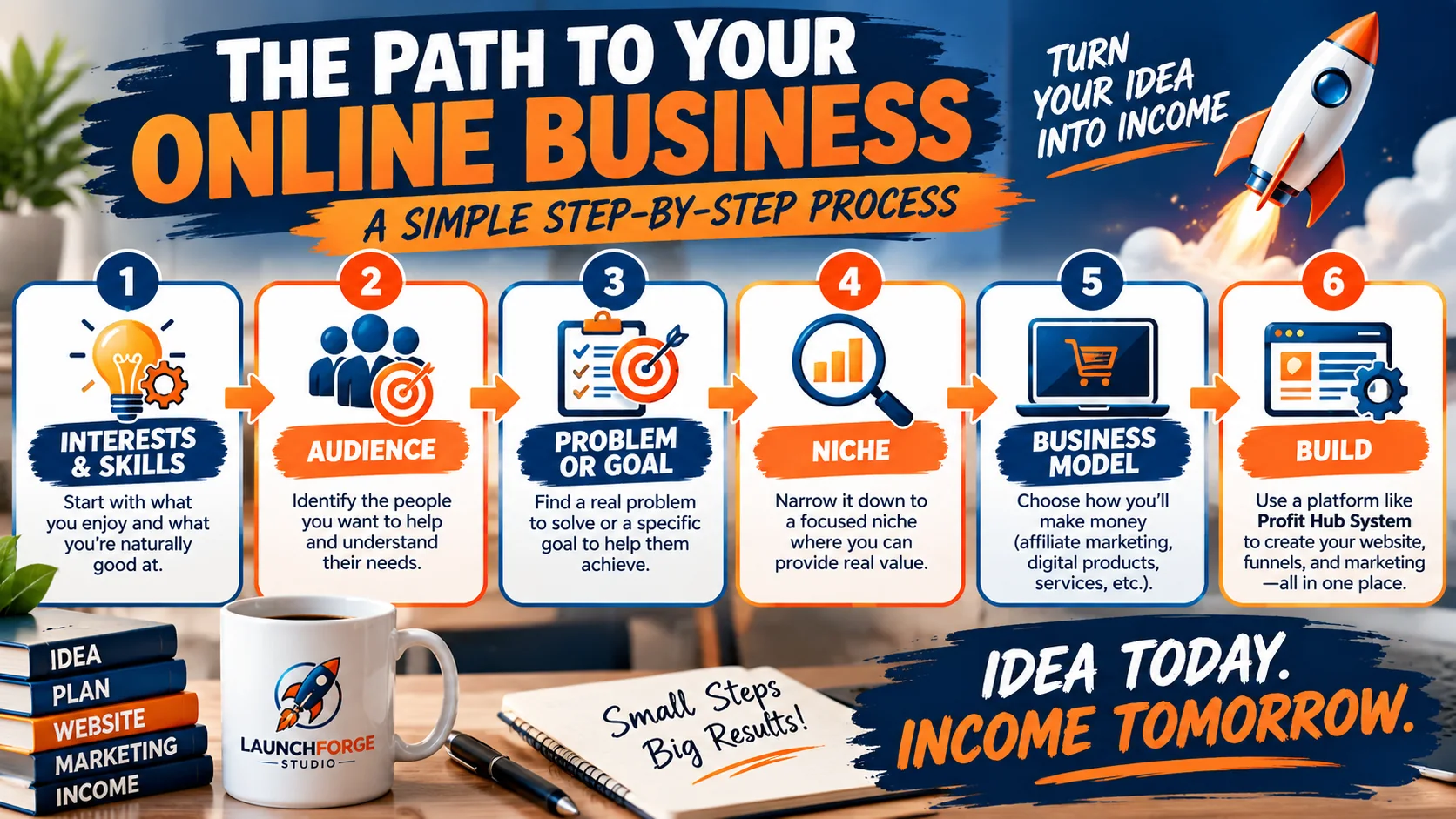
A simple path from your interests and skills to choosing an audience, identifying a problem, finding your niche, selecting a business model, and starting to build.
That matters.
You should not have to choose a niche because your software happens to include a template for it.
You should choose the business you want to explore and then look for technology flexible enough to support that direction.
That is an important distinction.
A fitness coach and an affiliate marketer may need different pages and offers.
A local bakery and a digital course creator may need completely different websites.
A consultant may want appointment requests.
An ecommerce business may need product pages.
A content-based business may focus heavily on articles, email subscribers, and affiliate recommendations.
The businesses are different.
But many of the systems underneath them are surprisingly similar.
They need a place online.
They need pages.
They need ways to attract visitors.
They may need to capture leads.
They may need email communication.
They may need automation.
They need some way to present an offer.
And eventually, they need a way to turn attention into revenue.
This Is Where an Integrated Business Platform Can Help
LaunchForge Studio is built using Profit Hub System as the foundation of our online business infrastructure.
That does not mean Profit Hub System decided what LaunchForge Studio would become.
We decided what we wanted to build.
Then we used the platform and the tools available to us to begin building it.
That is the relationship I want you to understand.
Your business idea comes first.
The platform helps you build the system around it.
Profit Hub System brings multiple online-business tools together instead of requiring you to assemble every part from unrelated services.
That can give a beginner a much clearer starting point.
Instead of asking:
“Which ten pieces of software do I need?”
You can begin asking:
“Which parts of this platform do I actually need for the business I am building?”
That is a much more manageable question.
Templates Can Give You a Starting Point
One of the easiest ways to see the possibilities is by looking at templates.
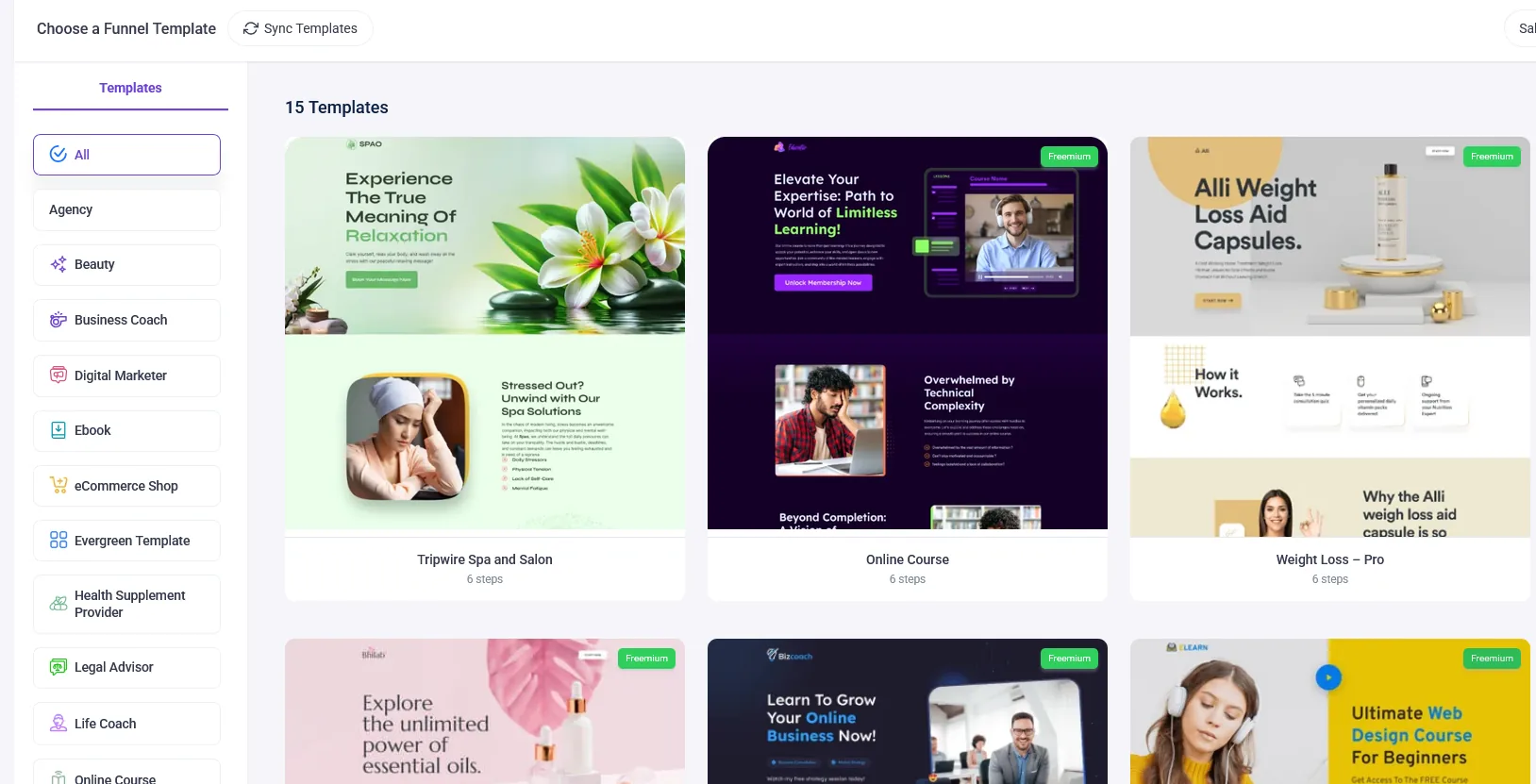
Profit Hub System provides funnel templates for a variety of online business models and niches.
Profit Hub System includes funnel templates designed around different types of businesses and offers.
You can find starting points covering areas such as:
- Business coaching
- Digital marketing
- Ebooks
- Ecommerce
- Health-related offers
- Legal services
- Life coaching
- Online courses
- Fitness
- Pet care
- Local and professional services
The point is not that you must choose one of those businesses.
The point is that the underlying funnel structure can be adapted.
A landing page needs to communicate an offer.
A lead-capture page needs to give someone a reason to respond.
A sales page needs to explain value and help someone make a decision.
A thank-you page needs to tell the visitor what happens next.
Those principles can work across many different niches.
The words, images, offers, audience, and positioning change.
The underlying purpose of the page often does not.
A Template Is a Starting Point, Not Your Business Identity
This is important.
You should not look at a template library and think:
“I guess these are the only businesses I can build.”
A template gives you structure.
You supply the business.
You can change the copy.
You can change the images.
You can change the branding.
You can change the offer.
You can change the audience.
You can change the calls to action.
You can change the way the pages connect.
That flexibility is what makes templates useful.
They can help a beginner avoid staring at a completely blank page while still leaving room to create something that belongs to their own business.
Your Website Opens the Possibilities Even Further
Funnels are only part of the picture.
Your main website can be built around the niche you choose.
This is where WordPress becomes especially useful.
WordPress has an enormous ecosystem of themes, page-building tools, plugins, designs, and resources covering an equally enormous range of business types.
Search for website designs around a particular industry and you may be surprised by what you find.
Bakery.
Photography.
Construction.
Music.
Fitness.
Restaurants.
Consulting.
Education.
Real estate.
Travel.
Pets.
Beauty.
Automotive.
Home services.
And countless other directions.
You are not limited to finding a theme with the exact name of your niche either.
A design created for one industry can often inspire or be adapted to another when the layout fits what you need.
That is why the technology should not dictate your business idea.
It should give you room to express it.
Think About the Bakery Example
Suppose someone decides they want to build an online presence around baking.
Maybe they want to operate a local bakery.
Maybe they want to sell specialty baked goods.
Maybe they want to publish recipes.
Maybe they want to teach cake decorating.
Maybe they want to recommend baking equipment through affiliate marketing.
Maybe they want to sell digital recipe collections.
Those are different business models inside a related market.
Now imagine searching WordPress for bakery-related website designs.
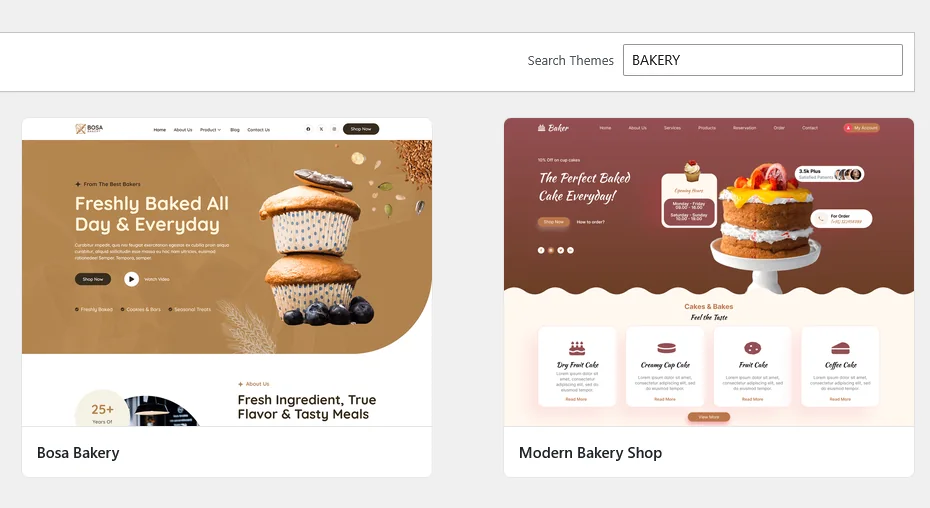
A single business niche can support very different website designs, as these WordPress bakery theme examples demonstrate.
Instead of beginning with an empty white screen, you can immediately see different ways a bakery or baking-focused website might be presented.
That does not build the business for you.
But it makes something important happen:
The idea begins to feel real.
You can start imagining your own logo.
Your own photographs.
Your own products.
Your own articles.
Your own lead magnet.
Your own email list.
Your own offers.
That is the moment when an abstract idea begins turning into something you can actually see yourself building.
Your Business Can Look Like Your Business
This matters more than it may seem.
A platform should provide infrastructure without forcing every business using it to look identical.
LaunchForge Studio does not need to look like a bakery.
A bakery does not need to look like a marketing website.
A guitar education business should not look like a legal consulting firm.
The technology underneath those businesses may share similarities.
But what the customer experiences should reflect the business itself.
That includes:
- Brand
- Colors
- Typography
- Images
- Messaging
- Content
- Offers
- Navigation
- Calls to action
- Customer journey
Those decisions are where your niche and your understanding of the audience come back into the picture.
Build Only What Your Business Needs
Having many tools available does not mean you need to activate every one of them immediately.
This is worth repeating because tool overload can happen even inside an all-in-one platform if you convince yourself that every feature must be used on day one.
It does not.
Your first version might need:
A website.
One useful piece of content.
A landing page.
A way to capture an email address.
A simple follow-up email.
That may be enough to begin.
Later, you might add:
- More funnels
- Automation
- Additional lead magnets
- More sophisticated email sequences
- Affiliate systems
- Sales pages
- Traffic campaigns
- Conversion tools
- Additional products or services
Build according to the needs of the business.
Do not build features merely because they exist.
This Is How We Approach LaunchForge Studio
LaunchForge Studio did not appear fully built overnight.
We have been building it piece by piece.
Website.
Content.
Landing pages.
Lead capture.
Email follow-up.
Marketing.
Traffic.
Monetization.
Then we document what we learn and use those experiences to create resources like the guide you are reading now.
That is the idea behind Build Along With LaunchForge.
We are not standing on the sidelines describing a theoretical online business.
We are building one.
And that experience continually reinforces something important:
You do not need every piece finished before you can begin.
You need the next useful piece.
Then you build from there.
Do Not Let the Platform Become the Pitch
There is one more distinction I want to make before we continue.
Profit Hub System is the platform we use to build LaunchForge Studio, and it is one of the options you can explore when deciding how to build your own business.
But the purpose of this guide is not to convince you that choosing a platform is the same thing as choosing a business.
It is not.
Software cannot decide what you care about.
It cannot decide who you want to help.
It cannot decide which problems you understand.
It cannot create your experience.
It cannot choose your voice.
And it cannot replace the work of learning about your audience.
Those pieces belong to you.
The platform provides tools.
You provide the direction.
And once you understand that distinction, the possibilities become much larger.
Because instead of asking:
“What business can this software let me build?”
You can begin asking:
“What business do I want to build, and how can I use these tools to help me build it?”
That is the question that moves us into the next part of this guide.
Because now that you understand how flexible the infrastructure can be, we can look at some specific online business ideas and see how different interests, niches, and business models can come together.
Online Business Ideas for Beginners
At this point, you may understand how to evaluate an idea but still be wondering:
“Okay, but what could I actually build?”
Let’s look at some possibilities.
Instead of giving you an enormous list of random online business ideas, I want to organize them around something more useful:
What do you actually want to do?
Do you enjoy creating?
Teaching?
Recommending?
Providing a service?
Selling?
Building an audience?
Your answer can help point you toward a business model that fits not only the market but also the kind of work you might enjoy doing.
And remember:
These categories can overlap.
You are looking for a starting direction, not another permanent decision.
If You Like Creating
Maybe you enjoy making things.
That could mean writing.
Designing.
Photography.
Music.
Templates.
Crafts.
Digital resources.
Software.
Videos.
Or something completely different.
A creator-focused online business could eventually include:
- Digital products
- Templates
- Printables
- Ebooks
- Photography
- Design assets
- Music or audio resources
- Downloadable guides
- Educational resources
- Physical products
- Creative services
Suppose you enjoy photography.
You might create Lightroom presets, photography guides, printable reference cards, stock photography, tutorials, or educational resources.
You could also recommend equipment through affiliate programs or eventually create a photography course.
The creative skill becomes the starting point.
The business model determines how you package that skill into something useful.
If You Like Teaching
Maybe your strength is explaining things.
That can be extremely valuable online.
Think about subjects people regularly want to learn.
Music.
Software.
Fitness.
Cooking.
Languages.
Marketing.
Photography.
Crafts.
Business skills.
Technology.
Professional skills.
Hobbies.
You could potentially build around:
- Tutorials
- Courses
- Workshops
- Webinars
- Coaching
- Educational articles
- Video training
- Memberships
- Downloadable learning resources
Teaching does not always require a formal classroom.
If you can help someone understand something they currently find confusing, you may have the beginning of an educational business.
The key is being honest about your knowledge and staying within areas where you can provide responsible, useful guidance.
If You Like Recommending and Reviewing
Some people genuinely enjoy researching products.
They compare features.
They read specifications.
They test things.
They investigate alternatives.
They enjoy helping other people make better buying decisions.
That can become a business direction too.
Affiliate marketing often fits naturally here.
Potential niches could include:
- Technology
- Musical equipment
- Software
- Photography gear
- Outdoor equipment
- Home improvement tools
- Kitchen equipment
- Hobby supplies
- Business software
- Website tools
A useful review business is not simply a collection of affiliate links.
The value comes from helping someone understand what they are considering.
Who is the product for?
Who is it not for?
What problem does it solve?
What alternatives exist?
What should someone know before spending money?
Trust becomes the asset.
If readers believe you are helping them make a good decision rather than simply trying to collect a commission, they have a reason to return.
If You Like Helping People Directly
Maybe you would rather work with people than spend months building a large content library.
A service business may be worth considering.
Think about skills you already have or skills you would genuinely like to develop.
Possibilities might include:
- Website design
- Graphic design
- Writing
- Editing
- Virtual assistance
- Bookkeeping
- Social media support
- Video editing
- Photography
- Consulting
- Marketing services
- Administrative support
- Technical assistance
A service business can be especially attractive because you may not need a massive audience to get started.
You need a clear service.
A specific type of customer.
A reason that customer should trust you.
And a simple way for that person to contact you or take the next step.
Your website can support that process by explaining what you do, who you help, and how someone can work with you.
If You Like Building an Audience
Maybe you enjoy writing, publishing, sharing ideas, or creating media around a subject.
A content-focused business could be a natural fit.
You might build:
- A niche website
- A blog
- A newsletter
- A YouTube channel
- A podcast
- A social media brand
- A combination of several channels
The audience becomes the foundation.
Monetization can develop around it later through:
- Affiliate marketing
- Sponsorships
- Digital products
- Services
- Courses
- Memberships
- Advertising
- Your own products
This model often takes patience.
An audience usually does not appear overnight.
But content can become a long-term business asset because useful material can continue introducing new people to your business long after you publish it.
That is a major part of the strategy behind LaunchForge Studio.
Every useful article gives someone another possible doorway into the business.
If You Like Selling Products
Perhaps you are more interested in products than content or services.
That can lead toward ecommerce.
You might sell:
- Handmade products
- Specialty products
- Branded merchandise
- Products sourced from suppliers
- Your own physical inventions or creations
- Digital products
- Niche-specific goods
Your niche still matters.
A store that tries to sell random products to everyone has a very different challenge from a business built around a specific audience.
Imagine a store created specifically for home recording enthusiasts.
The products, content, branding, email marketing, and recommendations could all revolve around that audience.
Now the store has a reason to exist beyond simply having products for sale.
If You Like Solving a Specific Problem
Sometimes the best business idea does not begin with a hobby.
It begins with a problem.
You notice something people struggle with and think:
“There has to be an easier way to do this.”
That can lead to many different businesses.
The solution might become:
- A service
- A digital tool
- A template
- A guide
- A course
- A software product
- A consulting offer
- A physical product
- A specialized website
This is one reason paying attention to frustrations can be so valuable.
Problems create opportunities for useful solutions.
You do not have to invent a revolutionary technology.
Sometimes making something simpler, clearer, faster, easier to understand, or more accessible is enough to create value.
If You Want to Build Around a Hobby
Do not automatically dismiss hobbies because they do not sound like traditional businesses.
People spend significant amounts of time and money on things they enjoy.
Think about:
- Guitar
- Fishing
- Camping
- Gardening
- Woodworking
- Photography
- Baking
- Sewing
- Gaming
- Cycling
- Running
- Collecting
- Painting
- Home recording
- Crafts
- Travel
Each one contains smaller niches.
Each niche contains questions.
Those questions can lead to content.
The content can attract an audience.
The audience may buy products, tools, training, resources, services, or other solutions related to the hobby.
A hobby does not automatically become a business simply because you enjoy it.
But it can give you a market worth investigating.
If You Have Professional Experience
Your career may contain business ideas you have never considered.
Suppose you have spent years working in:
- Manufacturing
- Sales
- Customer service
- Construction
- Real estate
- Healthcare
- Hospitality
- Education
- Accounting
- Human resources
- Technology
- Logistics
- Retail
You have probably learned things people outside that field do not know.
You understand terminology.
You understand common problems.
You know what beginners misunderstand.
You may know what businesses buy.
You may know which tools are useful.
You may understand processes that other people find confusing.
That experience could potentially become educational content, consulting, training, resources, services, or a niche website.
You do not have to reveal confidential information or build a business that conflicts with your employment.
You are simply recognizing that years of professional experience can contain valuable knowledge.
If You Are Still Not Sure, Combine Two Ideas
Sometimes an interesting niche appears when two interests overlap.
Maybe you like:
Travel + Photography
That could become travel photography.
Fitness + Busy Professionals
That could become short workouts for people with demanding schedules.
Cooking + Budgeting
That could become affordable meal planning.
Music + Technology
That could become home recording.
Gardening + Small Spaces
That could become balcony or container gardening.
Business + WordPress
That could become beginner website-building education for entrepreneurs.
You are not inventing an audience out of thin air.
You are looking for a more specific angle inside a broader market.
That can make your business easier to explain and your content easier to focus.
The Best Idea on Paper Still Has to Fit You
After looking at all these possibilities, you may be tempted to ask:
“Which one makes the most money?”
That is understandable.
You are building a business.
Revenue matters.
But potential revenue is only one part of the decision.
The business still requires someone to build it.
That someone is you.
If you hate creating content, a business dependent on publishing three articles every week may be difficult to sustain.
If you dislike working directly with clients, a high-touch service business may become exhausting.
If you do not want to manage inventory and shipping, a physical ecommerce operation may not fit the life you want.
If you love teaching, explaining, and helping beginners understand complicated subjects, an educational business might feel much more natural.
There is no universal answer.
You are looking for alignment between:
The market.
The audience.
The opportunity.
The business model.
And the kind of work you are willing to do consistently.
Narrow It Down to One Idea You Can Test
Now go back to the ideas you have collected throughout this guide.
Do not choose ten.
Choose one.
Not because the other ideas are bad.
Not because you can never revisit them.
Choose one because focus gives you the ability to move.
Write down:
My business idea:
What am I building?
My audience:
Who am I trying to help?
Their problem or goal:
What are they trying to solve or accomplish?
My starting business model:
How might this eventually generate revenue?
My first useful offer or resource:
What could I create that would help this audience?
My first traffic source:
How might people initially discover me?
You may not have perfect answers.
That is fine.
The purpose is to turn a cloud of possibilities into something you can begin testing.
Because eventually, researching business ideas stops being productive.
Eventually, you have to build one.
Turn Your Online Business Idea Into a Simple First Plan
Choosing an online business idea is important.
But an idea sitting in a notebook is still only an idea.
At some point, you need to turn it into something people can see, use, read, join, buy, or respond to.
This is where your first simple plan comes in.
Notice that I said simple.
You do not need a 50-page business plan before you can begin.
You do not need every product created.
You do not need a complicated sales funnel.
You do not need six months of scheduled content.
And you definitely do not need every piece of technology available to you connected before the first visitor arrives.
You need enough structure to begin learning from the real world.
Step 1: Write Your Business Idea in One Sentence
If you cannot explain what you are trying to build simply, the idea may still be too broad.
Try this:
I am building [TYPE OF BUSINESS] to help [AUDIENCE] achieve [RESULT] through [METHOD, CONTENT, PRODUCT, OR SERVICE].
For example:
I am building an educational website to help beginner guitar players choose equipment and learn the fundamentals through tutorials, buying guides, and recommended resources.
Or:
I am building a content business to help people grow vegetables in small spaces through beginner gardening guides, product recommendations, and downloadable resources.
Or:
I am building a service business to help local businesses establish a professional online presence through WordPress website design and related support.
Your sentence can change later.
Right now, its job is to give you direction.
Step 2: Choose One Primary Audience
Do not try to serve everyone immediately.
Choose the group you understand best or feel most interested in helping.
That does not mean nobody else can visit your website.
It means your messaging has someone specific in mind.
When you know who you are talking to, decisions become easier.
What should you write about?
What should your homepage say?
What kind of lead magnet might be useful?
Which products should you recommend?
What problems should your service solve?
What kind of language should you use?
Your audience helps answer those questions.
Step 3: Decide What Your Business Will Help Them Do
What change are you helping the audience make?
Try to make this more useful than simply naming your topic.
A gardening website is about gardening.
But maybe your business helps apartment dwellers grow food in small spaces.
A guitar website is about guitar.
But maybe your business helps complete beginners confidently choose their first equipment and start playing.
A marketing website is about marketing.
But maybe your business helps new entrepreneurs simplify the systems they need to launch and grow online.
The clearer the result becomes, the easier it becomes to decide what your business should create.
Step 4: Choose One Starting Business Model
You already saw how many business models can exist inside the same niche.
Now resist the temptation to build all of them.
Choose one logical starting point.
Maybe you will begin with:
Content + Affiliate Marketing
You publish useful content and recommend relevant products or services.
Maybe:
Website + Service
Your site explains a specific service and gives potential customers a way to contact you.
Maybe:
Content + Email List
You build useful resources, attract an audience, and begin developing a relationship through email before deciding what products or services to offer.
Maybe:
Content + Digital Product
You teach around a specific problem and create a resource that helps solve it.
The model can expand later.
For now, simplicity makes it easier to tell whether you are actually making progress.
Step 5: Create One Useful Piece of Content or One Simple Offer
Your business needs something useful.
Not 100 things.
One.
If you are building a content business, publish an article that answers an important question your audience is already asking.
If you are offering a service, create a clear page explaining what you provide, who it is for, and how someone can contact you.
If you are planning a digital product, begin with the specific problem that product will solve.
If you are building an affiliate business, create a genuinely useful resource that helps someone make a decision rather than publishing a page filled with links.
The goal is to move from planning to creating.
That first useful asset gives you something real to improve.
Step 6: Give Visitors a Next Step
Someone discovers your business.
Now what?
Do not leave them standing at the end of the page wondering where to go.
Their next step could be:
- Read another related article
- Join your email list
- Download a useful resource
- Request information
- View your service
- Compare recommended tools
- Watch a training
- Visit a product page
- Contact you
The right next step depends on the business.
It does not have to be a purchase.
For a new business, earning permission to continue the relationship can be incredibly valuable.
That is one reason building an email list can become such an important part of an online business.
A visitor who disappears may never return.
A subscriber gives you another opportunity to help them.
Step 7: Choose One Way to Bring People In
Your website existing does not automatically mean people will find it.
You need some form of traffic.
Again, do not try to master everything at once.
Your first traffic strategy might involve:
- Search-focused content
- Social media
- Online communities
- Email marketing
- Referral relationships
- Paid traffic
- Video
- Networking
- Existing professional relationships
Choose something you can realistically learn and use.
Then pay attention to what happens.
Where are visitors coming from?
What are they reading?
What do they click?
What questions do they ask?
What gets ignored?
Traffic is not only about numbers.
It gives you information.
Step 8: Build a Simple Follow-Up System
If someone joins your email list, do not make them wonder whether the form worked.
Start with a simple welcome message.
Deliver whatever you promised.
Introduce the business.
Help them take another useful step.
Over time, that can grow into a larger follow-up system.
But the first version does not need to be complicated.
Even a small system begins creating something valuable:
A relationship that does not depend on the visitor remembering to return to your website.
That is a much stronger foundation than constantly chasing new visitors while doing nothing with the people who already raised their hands.
Step 9: Watch What Happens Before Adding More
This step may save you a tremendous amount of unnecessary work.
Once the first version exists, give it a chance to teach you something.
Do people visit?
Which content attracts attention?
Do they subscribe?
Do they click your calls to action?
Are people asking questions?
Does one topic consistently perform better than another?
Are visitors interested in something you did not expect?
That feedback can help determine what you build next.
Without feedback, it is easy to spend months creating things nobody asked for.
Build.
Observe.
Learn.
Improve.
Then build the next piece.
Step 10: Let the Business Earn Its Complexity
This may be one of the most useful principles in this entire guide.
Let the business earn its complexity.
Do not begin with complicated systems simply because established businesses use them.
They may have teams.
They may have thousands of customers.
They may have years of data.
They may have reasons for that complexity that do not apply to you yet.
Your first business system can be much simpler.
For example:
Useful Content → Landing Page → Email Subscriber → Follow-Up → Relevant Offer
That is already a business system.
Later, you can add segmentation.
Automation.
Additional funnels.
More traffic sources.
More products.
More content.
More sophisticated conversion tools.
But those additions should solve real problems or create useful opportunities.
Complexity should arrive because the business needs it.
Not because you are afraid your business looks too simple without it.
Your First Version Is Supposed to Be a First Version
There is something liberating about accepting this.
Your first website will not be your best website.
Your first landing page will not be your best landing page.
Your first email will not be your best email.
Your first article will probably not be your best article.
Your first offer may change.
Your audience may become more specific.
Your niche may evolve.
Your business model may expand.
That is normal.
The only way to reach the later versions is to build the first one.
You Are Looking for Momentum, Not Perfection
At the beginning of this guide, learning how to choose an online business idea may have felt like one enormous decision.
Now look at what we have done.
We broke that decision into smaller ones.
What interests you?
What do you know?
What would you like to learn?
Who could you help?
What problems or goals do they have?
Is there evidence that a market exists?
What business model fits?
What technology do you actually need?
What is the first useful thing you can create?
How will someone find it?
What should they do next?
Those questions turn uncertainty into a process.
And processes can be worked through one step at a time.
You do not need to see the entire road.
You need enough clarity to take the next useful step.
Then another.
Then another.
That is how an online business stops being something you are thinking about starting someday.
It becomes something you are actually building.
Choose a Direction and Start Building
If you came to this guide hoping someone would simply tell you which online business you should start, you may have noticed something.
I did not give you that answer.
That is because the right answer depends on you.
Your interests.
Your experience.
Your skills.
The people you want to help.
The problems you understand.
The things you want to learn.
The kind of business you want to operate.
And the amount of time, money, and energy you are realistically willing to put into building it.
Nobody else’s list of profitable niches can make those decisions for you.
But you now have something much more useful than another list.
You have a process for making the decision yourself.
You Do Not Need Complete Certainty
You may still have doubts.
That is normal.
You may be deciding between two niches.
You may not know exactly what your first product will be.
You may still be learning WordPress.
You may have no email subscribers.
You may have never built a landing page.
You may not know which traffic source will work best.
None of that prevents you from beginning.
You are allowed to learn while you build.
In fact, that is exactly what you will have to do.
No guide can eliminate every unknown before you start.
At some point, experience has to take over from research.
Pick the Idea That Gives You a Reason to Continue
When you compare your remaining ideas, do not look only at potential income.
Ask yourself:
Which idea am I most interested in exploring further?
Which audience do I understand or want to understand better?
Where can I see myself creating something genuinely useful?
Which idea has evidence of real interest or demand?
Which business model fits the kind of work I am willing to do?
Which idea can I realistically begin testing with the resources I have now?
You are not trying to guarantee success.
You are choosing which direction deserves your next effort.
That is a decision you can actually make.
Then Make the Idea Real
Give the business a name if it needs one.
Choose your platform.
Build the first page.
Publish the first useful article.
Create the first landing page.
Set up the first email.
Make the first offer.
Talk to the first potential customer.
Study the first results.
Then improve something.
The individual action may seem small.
But there is an enormous difference between:
“I want to start an online business someday.”
and:
“I am building an online business.”
The difference is action.
Build Along With LaunchForge
That is also why we use the phrase Build Along With LaunchForge.
LaunchForge Studio is not being built from some imaginary finish line where every system is perfect and every question has already been answered.
We are building it while documenting the process.
We build.
We test.
We learn.
We improve.
And when something we learn can help another person building an online business, we turn that experience into something useful.
That might be a guide.
A tutorial.
A review.
A case study.
A resource.
Or an honest look at something we are still figuring out ourselves.
You do not need to copy the business we are building.
That is not the point.
The point is that you can build yours too.
Use Technology to Support the Business You Choose
Throughout this guide, we have also looked at the role technology plays in turning an idea into an actual online business.
The tools matter.
But the order matters more.
Do not begin with a pile of software and then try to invent a business that justifies it.
Start with the audience.
Understand what they need.
Choose how you can create value.
Decide how the business might generate revenue.
Then build the system that supports those decisions.
For LaunchForge Studio, Profit Hub System provides much of the infrastructure we use to put those pieces together.
Websites.
Funnels.
Lead generation.
Email marketing.
Automation.
Marketing tools.
And other systems we can use as the business develops.
If you are interested in seeing why we chose it, how we use it, and where we think it fits for someone building an online business, you can explore our full Profit Hub System review.
But whether you use the same platform we do or choose something completely different, remember the larger principle:
The tools should support your business. Your business should not exist merely to support your tools.
Your Online Business Idea Does Not Need to Be Perfect
It needs to be good enough to test.
Good enough to research.
Good enough to build something useful around.
Good enough to introduce you to an audience.
Good enough to teach you something.
Good enough to take the next step.
Some ideas will grow.
Some will change.
Some may lead you somewhere completely unexpected.
And occasionally, an idea will teach you that you should build something else.
That information has value too.
The biggest mistake is not necessarily choosing an imperfect first idea.
It is spending so much time searching for certainty that you never give any idea the opportunity to become real.
Start With What You Have
You do not need to know everything.
You do not need every tool.
You do not need a huge audience.
You do not need a giant advertising budget.
You do not need 100 articles waiting to publish.
You do not need the perfect logo.
You do not need the perfect funnel.
You do not need to know what the business will look like five years from now.
Start with what you know.
Start with what interests you.
Start with someone you can help.
Start with one useful thing.
Then build the next piece.
Your first online business begins long before everything is perfect.
It begins when you stop asking whether you are completely ready and decide that you are ready enough to start building.
Ready to Turn Your Idea Into Something Real?
You do not need to have every detail figured out before you begin.
You need an idea worth exploring, someone you want to help, and a practical way to start building.
If you are ready to take that next step, Profit Hub System is the platform we use to build and grow LaunchForge Studio. It brings the website, funnels, marketing tools, automation, and other business systems together so you can spend less time piecing together technology and more time building your business.
You have already done the thinking.
Now you can start building.