
Why You Need a Content Marketing System
Content marketing becomes much easier when every article, email, social post, and idea is part of a larger process instead of another isolated task.
The purpose of a content marketing system is to give those individual pieces a job and a path to follow. Instead of creating something, publishing it once, and immediately moving on, you build a process that helps each useful idea reach more people and continue creating value over time.
That process starts by changing the way you think about creating content in the first place.
Content Marketing Should Not Feel Like Starting Over Every Day
Creating content for an online business sounds simple until you actually try to do it consistently.
You sit down to write an article.
Then you need an image.
Then you start thinking about SEO.
Then you remember you should probably share the article on social media.
Maybe you should send it to your email list too.
And before long, something that started as a simple idea has turned into a dozen disconnected tasks.
That is exactly why building a content marketing system matters.
A good system does not mean producing more content just for the sake of staying busy. It means creating a repeatable process that helps you turn one useful idea into content that can continue working across your website, email list, search engines, and social channels.
I have been learning this firsthand while building LaunchForge Studio.
Every article we publish gives us more than another page on the website. It gives us something we can optimize for search, share with our audience, send through email, connect to other articles, use in future content, and learn from.
The article becomes an asset.
And when you repeat that process consistently, individual pieces of content begin working together instead of standing alone.
That is when content marketing starts becoming a system.
The Goal Is Not to Become a Content Machine
One of the easiest mistakes to make with content marketing is believing that success comes from publishing constantly.
Write another article.
Create another social post.
Send another email.
Make another graphic.
Then wake up tomorrow and start all over again.
That approach can quickly become exhausting, especially when you are building a business by yourself or with a small team.
The better goal is not to become a content machine.
The goal is to make each useful piece of content work harder.
A strong article might begin on your website, but it does not have to end there.
Ideas from that article can become social posts.
A section can inspire an email.
The article can answer a question you hear repeatedly from your audience.
It can link readers to another useful guide on your website.
It can introduce a tool you are actually using or testing.
And months later, you can update the article as your experience and knowledge grow.
Instead of constantly asking, “What should I create next?”
You begin asking a much better question:
“How can I get more value from what I have already created?”
That shift alone can make content marketing far more manageable.
Start With a Simple Content Marketing Cycle
You do not need an enormous content calendar, a complicated workflow, or ten different marketing platforms to build an effective system.
You need a process you can actually repeat.
The system I want to show you in this guide follows a simple cycle:
Create → Publish → Optimize → Distribute → Repurpose → Measure → Improve
Each step has a specific job.
Create something genuinely useful for the audience you want to reach.
Publish it somewhere you control, such as your website.
Optimize it so people and search engines can understand what it is about.
Distribute it through the channels where your audience can discover it.
Repurpose the strongest ideas instead of constantly starting from zero.
Measure what people actually respond to.
Improve the system using what you learn.
Then you repeat the cycle.
There is no requirement that every business follow exactly the same schedule or use exactly the same tools.
In fact, I would argue the opposite.
Your content marketing system should fit the way you actually work.
If you can realistically publish one useful article each week, build around that.
If one substantial article every two weeks gives you enough time to create something genuinely valuable, start there.
Consistency does not mean publishing every day.
It means developing a process you can continue using without burning yourself out.
And once that process exists, content creation becomes much easier because you are no longer reinventing your marketing every time you sit down at the computer.

A simple content marketing system turns one useful idea into a repeatable cycle of creating, publishing, optimizing, distributing, repurposing, measuring, and improving.
Build Your Content Around a Purpose
Then directly underneath it, add this introduction:
Creating content becomes much easier when you know what each piece is supposed to accomplish.
Not every article needs to sell something. Not every email needs to generate a click. And not every social media post needs to send someone directly to an offer.
Different pieces of content can serve different purposes.
Some content attracts people who are discovering you for the first time. Some answers questions. Some teaches. Some builds trust. And some helps people take the next logical step.
The important part is knowing why you are creating something before you create it.
When every piece of content has a purpose, your content marketing system becomes much more focused. Instead of publishing simply because you think you should, you begin building content that supports the larger direction of your business.
Start With the Problem Your Audience Is Trying to Solve
One of the easiest ways to create useful content is to stop asking, “What should I write about?”
Instead, ask:
“What problem is someone in my audience trying to solve?”
That small change can completely change the way you approach content.
People usually do not search for articles because they want more content to consume. They are looking for answers.
They want to know how to build something.
Fix something.
Choose something.
Improve something.
Or understand something that currently feels confusing.
That means your best content ideas are often hiding inside the questions your audience is already asking.
For LaunchForge Studio, those questions might involve building a website, generating leads, choosing business tools, creating a marketing system, using AI, setting up automation, or finding better ways to grow an online business.
The problem becomes the starting point.
Your content then becomes the bridge between where the reader is now and where they want to go.
And when you consistently create content around real problems instead of random topics, your website gradually becomes something much more valuable than a collection of articles.
It becomes a resource people can actually use. 🚀
Give Each Piece of Content One Primary Job
A single piece of content can accomplish several things, but it helps to give it one primary job.
Maybe the goal is to attract someone through search.
Maybe it is to answer a common question.
Maybe it is to teach a process.
Maybe it is to introduce a useful tool.
Or maybe it is to help someone understand the next step they should take.
When you know the primary job before you start creating, decisions become easier.
You know what information belongs in the article.
You know which examples make sense.
You know what other resources you should link to.
And you have a much clearer idea of what the reader should understand or be able to do when they reach the end.
This also prevents every piece of content from turning into a sales pitch.
Sometimes the most valuable thing you can do is simply help someone solve the problem that brought them to your website.
Trust can come before the sale.
And over time, a library of genuinely useful content can become one of the strongest marketing assets your business owns.
Create with a purpose first. Let the next step follow naturally.
Create Content That Can Keep Working After You Publish It
One of the biggest advantages of content marketing is that useful content does not have to disappear after the day you publish it.
A good article can continue attracting visitors through search.
It can become something you share again on social media.
A section of it can become an email.
An idea inside it can become another article.
It can answer a question you receive from a customer or subscriber.
And it can naturally introduce readers to another useful resource on your website.
That means one strong piece of content can continue creating value long after you finish writing it.
This is an important shift from thinking about content as something you constantly have to produce.
Instead of asking how much content you can create, start thinking about how much value you can get from the content you already have.
That is exactly what I am beginning to do while building LaunchForge Studio.
Each article becomes another piece of the larger system. Articles connect to guides. Guides introduce useful tools. Emails can bring people back to those resources. Social posts can introduce the same ideas to people who may never have discovered them through search.
The goal is not to create something once and forget about it.
The goal is to create something useful enough that you can continue building on it.
That is when content stops feeling disposable and starts becoming a real business asset.
Turn One Idea Into Multiple Pieces of Content
One of the biggest benefits of having a content marketing system is realizing that you do not need a completely new idea every time you want to publish something.
A strong idea can have more than one life.
An article can become an email.
A key lesson can become a social media post.
A list of steps can become a visual.
A question raised in one article can become the topic of the next guide.
And an older piece of content can be updated when you learn something new.
This is not about copying and pasting the same message everywhere.
It is about taking one useful idea and adapting it to the way people consume information on different channels.
I am already doing this while building LaunchForge Studio.
An article published on the website does not have to sit there waiting for someone to discover it. I can introduce the idea through email, share parts of it through social media, connect it to another LaunchForge guide, and eventually revisit the topic with new lessons from actually putting it into practice.
That gives one piece of work several opportunities to reach the right person.
Create once does not have to mean use once.
When you start thinking this way, the pressure to constantly invent something new begins to disappear—and your existing content library becomes a source for what you create next.
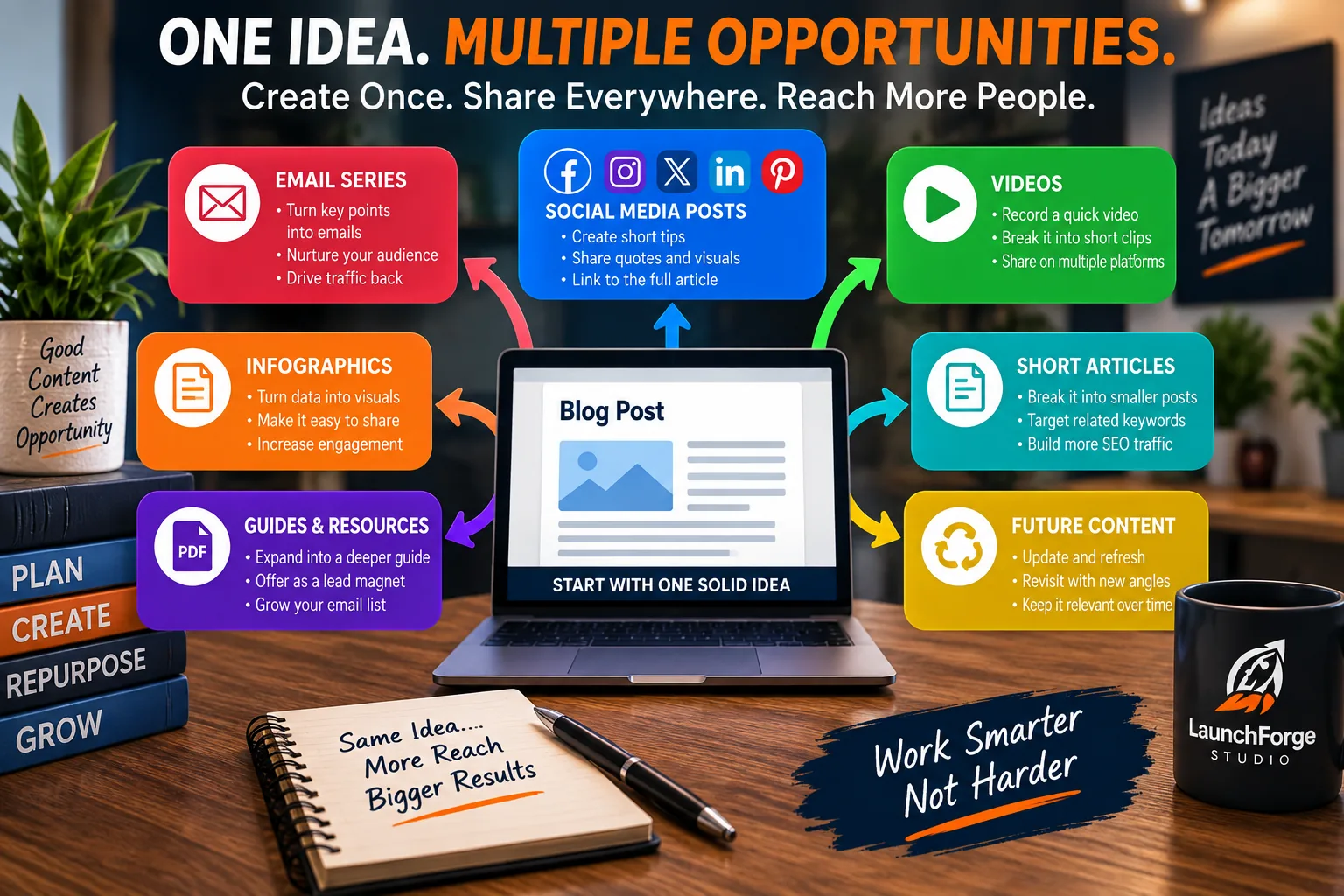
One strong content idea can be repurposed into emails, social posts, videos, visuals, guides, and future content to reach more people without constantly starting over.
Repurpose the Idea, Not Just the Words
Repurposing content does not mean copying the first few paragraphs of an article and pasting them everywhere you can find a text box.
Different platforms give people different reasons to pay attention.
Someone reading your website may be willing to spend several minutes working through a detailed guide.
Someone scrolling through social media may give you only a few seconds to earn their attention.
An email subscriber may respond better to a personal observation, question, or lesson that leads them back to the larger article.
The core idea can stay the same while the presentation changes.
For example, imagine you publish an article explaining five ways to improve a landing page.
That one article could also become a short email focused on the biggest mistake.
Each of the five tips could inspire a separate social post.
One of the tips could become a more detailed tutorial.
A before-and-after example could become a visual.
And questions from readers could reveal entirely new topics worth covering.
You are not creating five copies of the same content.
You are finding five different ways to make the original idea useful.
That distinction matters.
Good repurposing respects the platform and the person consuming the content while allowing you to get more value from the research, experience, and thinking you already put into the original piece.
And that is one of the simplest ways to make your content marketing system more efficient without sacrificing quality.
Let Your Best Content Create Your Next Content
Once you have been publishing for a while, you should not always have to stare at a blank screen wondering what to create next.
Your existing content can start giving you the answers.
Look at the articles people are finding through search.
Pay attention to the links people click.
Notice which emails generate responses.
Watch which social posts get engagement.
And most importantly, pay attention to the questions people ask after consuming your content.
Those signals can tell you where your audience wants you to go deeper.
For example, a broad article about generating leads might reveal that readers are especially interested in landing pages.
That could lead to a landing page guide.
The guide might introduce questions about follow-up.
That could lead to an email marketing article.
And eventually those connected pieces begin forming a useful collection of content around the same subject.
One useful piece of content can create the roadmap for several more.
This is also why I do not want LaunchForge Studio to become a website filled with random articles chosen simply because a keyword looks attractive.
The content should connect.
One article should naturally lead to another question, another lesson, another experiment, or another useful resource.
Over time, that creates something much stronger than a pile of individual blog posts.
It creates a growing knowledge base built around what your audience actually needs.
And the longer you use the system, the less often you have to guess what to create next.
Build a Simple Distribution Routine
Publishing is not the finish line.
You can create the most useful article on your website, but if nobody knows it exists, you are depending almost entirely on people discovering it by accident.
That is why distribution needs to be part of your content marketing system from the beginning.
The good news is that distribution does not need to become another complicated marketing project.
Create a simple routine you can repeat every time you publish.
For example, when I publish a new article on LaunchForge Studio, the process does not stop when I click Publish.
The article can be submitted to Google Search Console so Google knows there is a new URL to crawl.
It can be shared through LaunchForge social channels.
It can be introduced to an email audience.
It can be linked from relevant existing articles and guides.
And later, individual ideas from the article can be brought back through additional posts, emails, or related content.
The exact channels you use may be different.
You might focus heavily on email.
You might have an active social audience.
Search traffic may be your long-term priority.
Or you may eventually use several channels together.
What matters is having a repeatable checklist instead of deciding what to do from scratch every time you publish.
For LaunchForge, that routine is still evolving as the business grows.
And that is perfectly fine.
A content marketing system does not need to be finished before it becomes useful.
Start with the channels you can realistically manage.
Learn what happens.
Then improve the process as your audience, content library, and experience grow.
Publishing creates the asset. Distribution gives that asset a chance to work.
Optimize Your Content So It Can Be Found
Then directly underneath it:
Creating useful content is the foundation, but useful content still needs a way to reach people who are actively searching for the information you provide.
That is where search engine optimization becomes part of the system.
SEO does not have to mean stuffing the same keyword into every paragraph or writing articles for an algorithm instead of a human being.
The reader still comes first.
The goal is to make it clear what your content is about while giving search engines enough information to understand when that content might be useful.
That can include choosing a clear primary keyword, writing a descriptive title, creating a useful meta description, organizing the article with logical headings, using relevant internal links, optimizing images, and making sure the page works well on both desktop and mobile.
I am doing exactly that with LaunchForge Studio as the content library grows.
Every new article gives me another opportunity to target a specific question or topic while connecting that article to the larger subjects LaunchForge covers.
And those connections matter.
An article about a content marketing system can naturally connect to guides about AI, online marketing, lead generation, business tools, and other parts of building an online business.
SEO works best when it supports useful content instead of controlling it.
Create something worth finding first.
Then make it easier to find.
That keeps optimization where it belongs: inside the content marketing system, not in charge of it.
Choose a Keyword Based on What the Reader Actually Wants
Keywords matter, but the phrase itself is only part of the picture.
Before choosing a keyword, think about what someone typing that phrase into a search engine is actually trying to accomplish.
That is called search intent.
Someone searching for a product review probably wants help deciding whether a tool is worth using.
Someone searching for a tutorial wants instructions.
Someone searching for a comparison is likely trying to choose between different options.
And someone searching for a phrase like content marketing system may be looking for a practical way to organize how they create, publish, and distribute content.
The keyword tells you what they searched. Search intent tells you why they searched it.
Understanding that difference can help you create much better content.
It also means you do not need to be afraid of using words or phrases that appear elsewhere on your website.
Several LaunchForge articles can naturally discuss online business, marketing, websites, AI, traffic, or automation.
The important thing is that each article has a clear primary purpose and does not simply duplicate another article trying to answer the exact same question.
That is how related content can support each other instead of competing with each other.
Start with the reader’s question.
Choose a keyword that accurately represents that question.
Then create the best answer you realistically can.
SEO becomes much easier when the keyword follows the purpose of the content instead of becoming the purpose of the content.
Use Internal Links to Build a Connected Content Library
Every new article you publish creates another opportunity to connect the useful information already living on your website.
That is where internal linking becomes powerful.
An internal link simply takes someone from one page on your website to another relevant page on the same website.
But when used intentionally, it does much more than help someone navigate.
Internal links help turn individual articles into a connected library of information.
If you mention lead generation, you can point readers toward a deeper guide about building a lead generation system.
If you discuss choosing business tools, you can connect them to an article that explores that topic in more detail.
If AI comes up naturally, you can direct readers to a guide explaining how to use AI as a business partner without giving up control of the business.
The reader gets an easy path to continue learning without forcing every article to explain every subject from the beginning.
Search engines also use links to discover pages and better understand how content across a website relates.
That means internal linking can help both the reader and the overall structure of your site.
The key is relevance.
Do not add links simply because you want more internal links.
Add them when the destination genuinely helps the reader take the subject one step further.
This is something I am becoming increasingly intentional about with LaunchForge Studio.
As the library grows, each new article gives me more opportunities to connect related guides, tools, lessons, and experiments.
And those connections become more valuable over time.
A strong content library is not just a collection of pages. It is a network of useful paths a reader can follow.
Optimize for People Before You Optimize for a Score
SEO tools can be incredibly useful.
They can remind you to include your focus keyword, improve your title, write a meta description, structure your headings, add internal links, optimize images, and check other details that are easy to overlook.
I use those kinds of checks while building LaunchForge Studio.
But there is a trap.
You can become so focused on improving an SEO score that you accidentally make the article worse for the person reading it.
A tool might suggest using your keyword more often.
That does not mean you should force the phrase into sentences where it sounds unnatural.
It might recommend adding more links.
That does not mean every paragraph needs to send the reader somewhere else.
And a score of 100 does not automatically mean you created the best article.
The score is feedback.
It is not the reader.
The person visiting your website does not care whether an SEO plugin gave your article 82, 91, or 100 points.
They care whether the article answered their question.
They care whether it was easy to understand.
They care whether they learned something useful.
And they care whether continuing to read feels worth their time.
That is why I treat SEO tools as assistants rather than decision makers.
Use them to catch problems.
Use them to improve the technical side of your content.
Use their recommendations when those recommendations make sense.
But do not sacrifice clarity, personality, or usefulness simply to turn another little indicator green.
The best optimization happens when search engines can understand your content and humans actually want to read it.
That is the balance worth chasing.
Measure What Is Working and Improve the System
Then directly underneath it:
A content marketing system should never become something you build once and follow blindly forever.
The whole point of having a system is that it gives you something you can observe, measure, and improve.
Once you have published enough content, patterns begin to appear.
Some articles may attract more search traffic.
Some subjects may generate more clicks from email.
Certain social posts may consistently get more attention.
One guide might keep visitors on your website longer, while another sends people deeper into related pages.
And sometimes an article you thought would perform well barely moves at all.
That information is not failure. It is feedback.
You do not need to obsess over every number or check your analytics twenty times a day.
Instead, look for useful signals that can help you make better decisions about what to create next and how to improve what you already have.
That is something I am learning while building LaunchForge Studio.
The site is still growing, which means I do not have years of data telling me exactly what will work.
But every article published, search impression earned, email click generated, and visitor interaction gives me another piece of information.
Over time, those pieces begin telling a story.
The goal is not to predict everything correctly before you start.
The goal is to create, publish, learn from what happens, and make the next version better.
That is how a content marketing system becomes more valuable over time.

Consistent content gives you more opportunities to build visibility, reach your audience, measure what works, and improve your marketing over time.
Measure the Numbers That Help You Make Decisions
Analytics can give you an enormous amount of information.
Page views.
Search impressions.
Clicks.
Engagement.
Email open rates.
Click-through rates.
Traffic sources.
Time spent on a page.
Conversions.
And enough charts to keep you staring at a dashboard until you forget why you opened it in the first place.
More data does not automatically mean better decisions.
The numbers worth paying attention to are the ones that help you understand whether your content is doing the job you created it to do.
If an article was designed to attract people through search, impressions, rankings, and organic clicks may matter.
If you sent an article to your email audience, the number of people who clicked through can tell you something about how strongly the topic connected with them.
If the goal is to move readers toward another resource, you may want to know whether people are actually following those links.
And if a page is meant to generate leads, the number of visitors alone matters far less than whether some of those visitors take the next step.
Start with the purpose of the content, then choose the numbers that help you evaluate that purpose.
This keeps analytics useful instead of overwhelming.
You also do not need enormous amounts of traffic before you can begin learning.
LaunchForge Studio is still growing its audience, but even early data can reveal patterns.
Which topics are beginning to appear in search?
Which articles are getting impressions?
Which links are people clicking?
Which emails are generating traffic?
Which subjects seem to get more attention when they are shared?
Those are clues.
As the audience grows, those clues become stronger.
Measure enough to learn—not so much that measuring replaces creating.
Improve What You Already Have Before Creating More
Content marketing does not always require publishing something new.
Sometimes the best next move is improving something you have already created.
An older article may begin appearing in search but not receive many clicks.
A guide might contain information that has become outdated.
You may discover a better example after gaining more experience.
Or another article you published later might create a perfect new internal-linking opportunity.
That existing content is not finished just because you clicked Publish.
Go back to it.
Improve the title if necessary.
Strengthen a weak section.
Add a useful internal link.
Update screenshots or examples.
Improve the images.
Clarify something that readers may find confusing.
Or expand a section when you realize the topic deserves more explanation.
This is another reason a content library becomes more valuable as it grows.
You are not constantly throwing old work away and replacing it with something new.
You are building on what already exists.
I expect this to become increasingly important with LaunchForge Studio.
Some of the articles I publish today will probably look different a year from now because I will have more experience, more data, more tools I have tested, and more lessons from actually building the business.
That is a good thing.
Your content should be allowed to evolve alongside your business.
Creating new content expands the library.
Improving existing content strengthens it.
A healthy content marketing system makes room for both.
Put Your Content Marketing System Into Action
Then directly underneath it:
A content marketing system does not become valuable because it looks good on a planning document.
It becomes valuable when you actually use it.
You do not need to build every part of the system at once.
Start with one useful idea.
Create something that solves a real problem.
Publish it somewhere you control.
Optimize it so people can understand and find it.
Share it through the channels you already use.
Look for ways to repurpose the strongest ideas.
Pay attention to what happens.
Then use what you learn to make the next piece better.
Create → Publish → Optimize → Distribute → Repurpose → Measure → Improve
That is the entire system.
The tools you use around that process will probably change.
Your audience will grow.
Your marketing channels may change.
You will discover new technology.
You will abandon things that do not work.
And you will become better at recognizing what deserves your time.
But the underlying process can continue working.
That is one of the biggest lessons I am learning while building LaunchForge Studio.
I do not have every future article planned.
I do not know which marketing channel will eventually become the biggest source of traffic.
And I certainly do not know every tool I will be using a year from now.
What I do have is a process I can continue improving.
Every article teaches me something.
Every email gives me another opportunity to connect with an audience.
Every social post gives an idea another chance to be discovered.
Every result gives me information I can use the next time around.
You do not need a perfect content marketing system before you begin.
You need one that is simple enough to use, flexible enough to improve, and useful enough to keep moving your business forward.
Start with what you can manage today.
Build the process around the way you actually work.
Then improve it as you learn.
Because eventually, you stop looking at content as something you constantly have to create.
You start seeing it as something you are building.
And one useful piece at a time, that content can become an increasingly valuable part of your business.
Create with purpose. Build the system. Let the system get better with you. 🚀