
Building an online business can get complicated surprisingly fast.
You start with a website.
Then you need traffic.
Then you need a way to capture leads.
Then comes email marketing, follow up, automation, content, analytics, and eventually a way to turn all of that activity into customers.
Before long, you are not really managing a marketing strategy anymore.
You are managing a collection of disconnected tools and tasks.
The problem is not necessarily that you need fewer ways to market your business.
The problem is that those pieces need to work together as part of a simple online marketing system.
Instead of treating your website, traffic, lead generation, email marketing, follow up, and offers as separate activities, you can connect them into one clear process.
A visitor discovers your business.
They arrive somewhere useful.
They have an opportunity to become a lead.
Your follow up continues the conversation.
And when the time is right, they are given a logical next step.
That is what we are going to build in this guide.
Not an enormous marketing machine with dozens of complicated automations.
Just a practical online marketing system that connects the important pieces and gives your business a clear path from attention to lead to customer.
Why You Need an Online Marketing System
Marketing becomes much easier to understand when you stop thinking about individual tactics and start thinking about how those tactics work together.
A website by itself is not a marketing system.
Traffic by itself is not a marketing system.
An email list, social media account, landing page, or sales funnel is not a marketing system either.
Each one is simply a piece of a larger process.
The real value appears when those pieces begin working together.
Think about what happens when someone discovers your business for the first time.
Maybe they find one of your articles through Google.
Maybe they click an advertisement.
Maybe they see a social media post, receive a recommendation, or follow a link from another website.
That first interaction creates attention.
But attention alone does not build a business.
You need somewhere useful to send that person, a reason for them to stay, and a way to continue the relationship after their first visit.
That is where an online marketing system begins to make a difference.
Instead of hoping that individual marketing activities somehow produce results, you create a deliberate path that connects them.
Someone discovers your business.
They visit your website or landing page.
They find useful information.
They have an opportunity to become a lead.
You continue communicating with them.
Eventually, you introduce a product, service, resource, or other next step that makes sense for where they are in the relationship.
Each part supports the next.
And that is the real purpose of a marketing system.
It turns a collection of separate marketing activities into a process that can be understood, measured, improved, and repeated.
The Core Parts of a Simple Online Marketing System
A successful online marketing system does not need dozens of complicated tools or endless automation.
At its core, the system only needs to accomplish a few important things.
It needs to attract attention.
It needs somewhere useful to send that attention.
It needs a way to turn interested visitors into leads.
It needs a process for continuing the conversation.
And eventually, it needs to guide the right people toward an appropriate offer or next step.
When these pieces are connected, marketing begins to feel much less random.
Instead of constantly asking, “What should I do next?” you can look at your system and understand exactly how people are moving through your business.
Here are the five core parts we are going to focus on.
1. Traffic and Attention
Every marketing system needs a starting point.
People have to discover your business before anything else can happen.
That attention might come from search engines, social media, advertising, email marketing, referrals, online communities, or other websites.
You do not necessarily need to be everywhere.
You need one or more reliable ways to put your business in front of people who may actually be interested in what you offer.
The important part is understanding where that traffic is going next.
Sending people somewhere without a purpose can create plenty of clicks without creating much business.
2. A Useful Destination
Once you earn someone’s attention, you need somewhere worthwhile to send them.
That might be your homepage, a helpful article, a landing page, a product page, a sales funnel, or another focused resource.
The destination should match the reason the person clicked in the first place.
If someone clicks because they want to learn how to generate leads, sending them to an unrelated offer creates friction.
Sending them to a useful guide about lead generation creates continuity.
Your website should not simply receive traffic.
It should help visitors understand where they are, what you can help them with, and what they can do next.
3. Lead Generation
Most visitors will not become customers during their first interaction with your business.
That makes lead generation one of the most important connections in your marketing system.
Instead of allowing an interested visitor to disappear forever, you give them an opportunity to continue the relationship.
That could mean joining an email list, requesting information, registering for something, creating an account, downloading a useful resource, or completing another relevant action.
The objective is not to capture every visitor.
It is to create a natural next step for people who want to hear more from you.
4. Follow Up and Relationship Building
Once someone becomes a lead, the marketing process should not suddenly stop.
This is where follow up becomes important.
You can answer questions, provide useful information, share relevant resources, introduce new ideas, and help people better understand the problems your business can solve.
Some of this communication can be automated.
Some may happen personally.
The strongest systems often use a combination of both.
The purpose is not to bombard people with promotions.
It is to remain useful and relevant while giving the relationship time to develop.
5. The Offer and Next Step
Eventually, your marketing system needs somewhere to lead.
That does not always mean an immediate sale.
The next step might be viewing a service, attending a webinar, reading a product review, requesting more information, starting a trial, scheduling a conversation, or purchasing something.
What matters is that the next step makes sense.
When traffic, content, lead generation, and follow up have already helped someone understand what you offer, the transition to an offer feels much more natural.
That creates a simple path:
Attention → Destination → Lead → Follow Up → Offer
And once you can see that path clearly, you have the foundation of an online marketing system that can actually be improved and grown.
How the Pieces of Your Online Marketing System Work Together
The individual parts of an online marketing system are important, but the real power comes from the connections between them.
This is where many businesses run into trouble.
They may have a website.
They may be buying traffic.
They may have an email list.
They may even have landing pages, automation, and several different offers.
But those pieces are often operating independently.
Traffic gets sent to pages with no clear next step.
Leads enter an email list without receiving meaningful follow up.
Content gets published without connecting readers to another useful resource.
Offers are promoted before enough trust or interest has been built.
There is plenty of activity, but very little flow.
A better approach is to think about your marketing as one connected journey.

A connected online marketing system guides people from traffic to your website, into lead generation and follow up, and eventually toward becoming customers.
Traffic Should Have a Destination
Every source of traffic should have a purpose.
Before sending visitors anywhere, ask yourself what you want them to discover when they arrive.
Someone searching Google for an answer to a specific problem may be better served by a helpful article.
Someone clicking an advertisement about a particular solution may need a focused landing page.
Someone who already knows your business may be ready to explore a product, service, or recommended tool.
The destination should make sense based on what brought the visitor there.
That simple connection can make your traffic much more useful.
Your Destination Should Have a Next Step
Once someone reaches your website, do not leave them wondering what to do next.
Give them options that naturally continue their journey.
That might be another related article.
It could be an invitation to join your email list.
It might be a link to a guide, resource, service, product review, or other useful page.
Not every visitor needs to take the same action.
But every important page should help people understand where they can go next.
Lead Generation Should Connect to Follow Up
Capturing a lead is not the finish line.
It is the beginning of a new part of the relationship.
When someone gives you permission to continue communicating with them, your online marketing system should have a plan for what happens next.
A welcome message can acknowledge their action.
Additional messages can provide useful information.
Related resources can help them explore the subject further.
Over time, relevant offers can be introduced when they make sense.
This connection prevents leads from simply becoming names sitting inside a database.
Follow Up Should Lead Somewhere
Follow up should provide value, but it should also have direction.
If every message simply delivers information without ever giving someone a meaningful next step, the system can become a never-ending conversation that produces little action.
That does not mean every message needs to sell something.
Far from it.
It means your communication should occasionally help people move forward.
Read another guide.
Explore a solution.
Watch a demonstration.
Compare options.
Visit a product page.
Take whatever next step makes sense for the relationship.
Your Offers Should Feed the System Again
A good marketing system does not necessarily end when someone reaches an offer.
Some people will buy.
Some will not be ready.
Others may discover that a particular offer is not right for them.
That does not mean the relationship has to end.
They can continue receiving useful content, discover other resources, return to your website, and re-enter different parts of your marketing system later.
That creates something much more valuable than a straight line.
It creates a connected marketing ecosystem where each piece can support the others.
And once those connections are in place, you are no longer relying on isolated tactics to grow your business.
You are building a system.
How to Build Your Online Marketing System Step by Step
Once you understand how the pieces connect, building your system becomes much easier.
You do not need to create everything at once.
Trying to build everything simultaneously is often one of the reasons building an online business feels so complicated.
In fact, trying to build an elaborate marketing machine before you understand the basic flow can create exactly the complexity you are trying to avoid.
Start with the simplest version that can move someone from discovering your business to taking a meaningful next step.
Then improve it as you learn what your audience actually needs.
Step 1. Decide Who You Want to Reach
Before choosing traffic sources, building funnels, or creating automation, get clear about the people you are trying to attract.
You do not need an enormous customer profile filled with dozens of demographic details.
Start with something simpler.
What problem are they trying to solve?
What are they trying to accomplish?
What questions are they asking?
What would make their situation easier?
When you understand those things, your marketing becomes more focused.
Your content can address relevant problems.
Your advertisements can speak to specific needs.
Your landing pages can continue the same conversation.
And your offers can provide logical solutions.
The clearer you are about who you want to help, the easier it becomes to build the rest of your system around them.
Step 2. Choose How You Will Attract Attention
Next, decide how people are going to discover you.
This could include search engine traffic, social media, paid advertising, email marketing, referrals, online communities, content marketing, or other channels.
You do not need to master every traffic source.
Starting with a few manageable channels often makes more sense than spreading yourself across ten different platforms.
The important question is not simply:
“How can I get more traffic?”
A better question is:
“Where can I reach people who are likely to care about what I offer?”
One hundred relevant visitors can be more valuable than thousands of visitors who have little interest in your business.
Step 3. Give That Traffic Somewhere Useful to Go
Once you know where attention will come from, decide where you want to send it.
Match the destination to the visitor’s intent.
If your advertisement promises information about building an email list, send the visitor somewhere that delivers on that promise.
If someone discovers you through an article about choosing business tools, give them related resources or recommendations.
If someone is searching for a specific product, a detailed review may be more useful than sending them to your homepage.
Every destination should answer two questions:
Why should the visitor stay?
And what can they do next?
If you cannot answer those questions, the page probably needs a clearer purpose.
Step 4. Create a Way to Capture Interested Leads
Now decide how interested visitors can continue the relationship.
This is where lead generation enters your online marketing system.
You might offer a useful resource.
You might invite visitors to subscribe for additional information.
You could provide access to training, a webinar, a newsletter, a tool, or another reason to stay connected.
Whatever you choose, make the value clear.
People are increasingly protective of their inboxes and personal information.
“Join my list” is rarely compelling by itself.
Give them a reason to want the next conversation.
Step 5. Build a Simple Follow Up Process
Once someone becomes a lead, determine what should happen next.
Start with the basics.
Welcome them.
Deliver whatever they requested.
Provide useful information related to why they joined.
Answer common questions.
Point them toward relevant resources.
Then introduce appropriate next steps when they make sense.
You do not need fifty automated messages to begin.
A short, useful follow up sequence that actually gets sent is far more valuable than an enormous automation system that never gets finished.
Step 6. Connect Relevant Offers
Your offers should fit naturally into the journey you have created.
Someone reading about lead generation may be interested in a lead-generation tool.
Someone researching website platforms may want a detailed comparison or review.
Someone struggling with business complexity may be interested in a platform that brings several tools together.
Context matters.
Instead of promoting everything to everyone, connect people with offers that relate to what they are already trying to accomplish.
That makes marketing feel less like interruption and more like assistance.
Step 7. Measure What Happens
Once the system is operating, start paying attention to what people actually do.
Which traffic sources bring visitors?
Which pages hold their attention?
Which calls to action get clicked?
Where are leads coming from?
Which follow up messages generate engagement?
Which offers produce action?
You do not need to obsess over every metric.
Focus on the numbers that help you understand whether people are successfully moving from one part of the system to the next.
Step 8. Improve One Connection at a Time
You will probably discover weak spots.
That is normal.
Maybe traffic is arriving but very few visitors become leads.
Maybe people become leads but rarely engage with your follow up.
Maybe your emails receive clicks but the offer does not convert.
Instead of rebuilding everything, identify the weakest connection and improve that part.
Change the landing page.
Strengthen the call to action.
Improve the follow up.
Clarify the offer.
Test another traffic source.
Small improvements across a connected system can compound over time.
That is one of the biggest advantages of building an online marketing system in the first place.
You stop randomly adding more marketing tactics and start improving the system you already have.
Keep Your Online Marketing System Simple
One of the easiest ways to make marketing harder than it needs to be is to confuse complexity with progress.
It happens gradually.
You add another traffic source.
Then another landing page.
Then another email tool.
Then another automation.
Then another dashboard.
Before long, you are spending more time managing your marketing technology than actually marketing your business.
This is one of the biggest reasons an online business becomes too complicated in the first place.
A good online marketing system should reduce that friction, not create more of it.
The goal is not to build the most impressive system.
The goal is to build a system you can actually understand, manage, and improve.
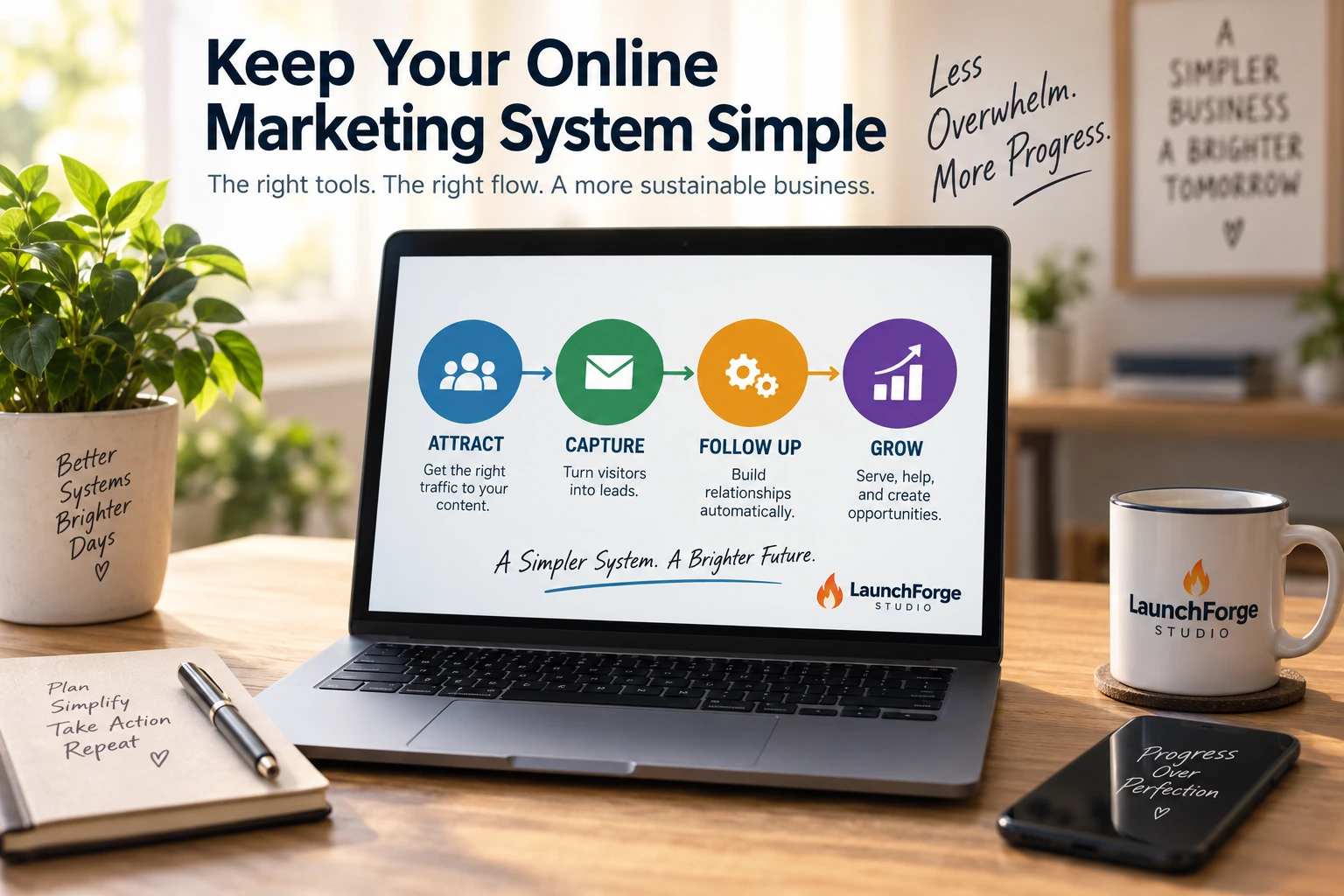
A simple online marketing system connects traffic, lead capture, follow up, and growth into one clear process.
Start With the Essential Pieces
You do not need every marketing feature available on day one.
Start with what moves people through the basic journey:
Traffic → Destination → Lead → Follow Up → Offer
If those five pieces are working together, you already have the foundation of a functional marketing system.
Everything else should earn its place.
This same principle applies to your entire online business system. The goal is not to keep adding more pieces, but to make the right pieces work better together.
Before adding another tool, platform, automation, or marketing channel, ask whether it improves one of those connections.
If it does, it may be useful.
If it simply gives you another dashboard to manage, think twice.
Avoid Tool Collecting
New online business tools are constantly appearing.
Some of them are genuinely useful.
The problem begins when buying and testing tools becomes a substitute for building the business.
A new tool can feel productive because it gives you something new to configure, explore, and learn.
But more software does not automatically create better marketing.
Sometimes the better decision is to get more value from the tools you already have.
Before adding something new, ask:
What specific problem will this solve?
Where does it fit into my existing system?
Will it replace something I already use?
Will it simplify the process or make it more complicated?
Those questions can prevent a surprisingly large amount of unnecessary complexity.
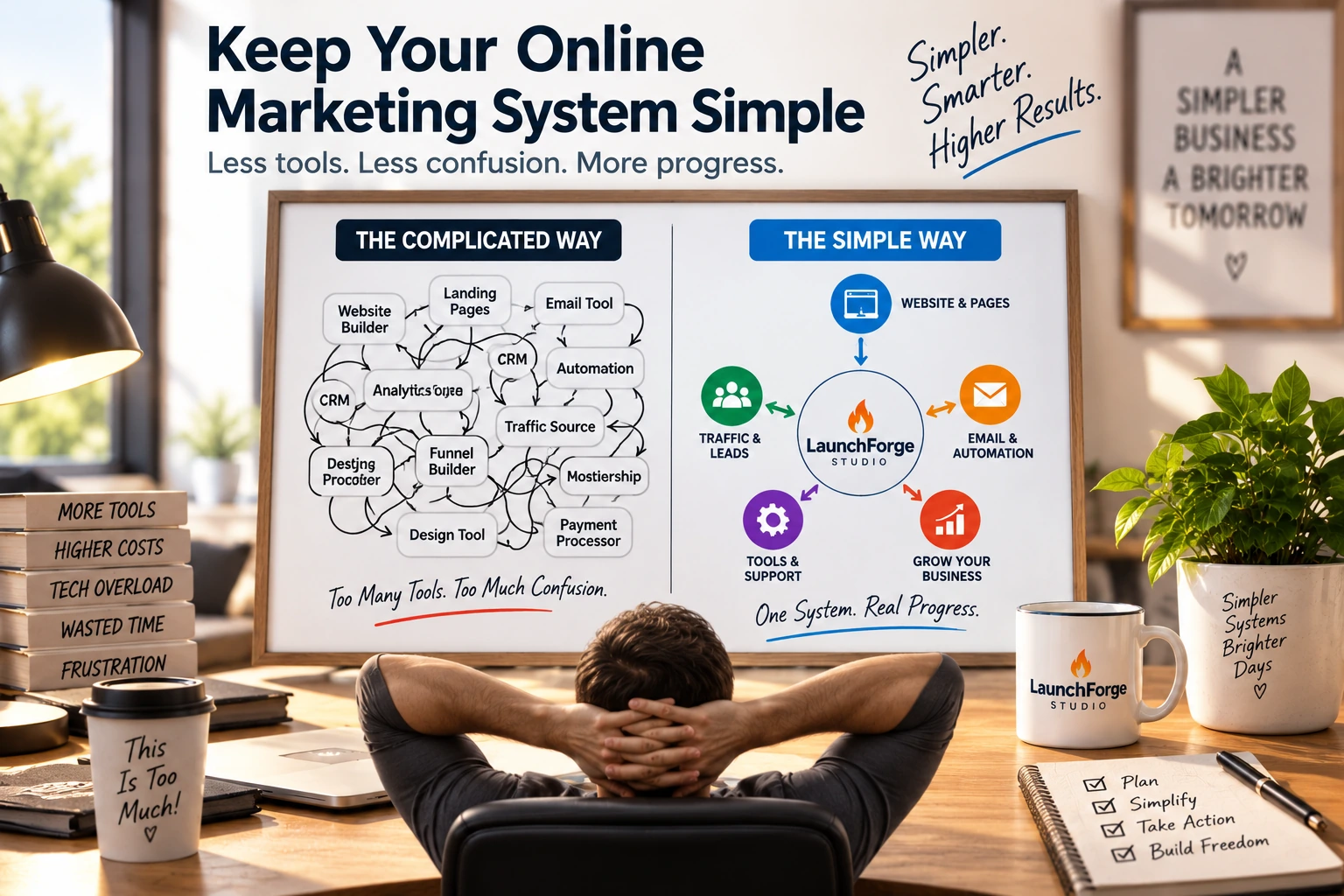
A simpler online marketing system connects the essential pieces without creating unnecessary tool overload and complexity.
Use Automation Where It Actually Helps
Automation can make an online marketing system considerably easier to manage.
But automation works best when it handles predictable, repetitive tasks.
Sending a welcome message.
Delivering a requested resource.
Starting a follow up sequence.
Tagging or organizing leads.
Triggering communication based on an action.
Those are practical uses of automation because they reduce repetitive work while keeping the system moving.
Problems arise when automation becomes the objective instead of the tool.
You do not need an enormous maze of triggers, conditions, tags, and workflows simply because the software allows you to build one.
Automate what saves time or improves consistency.
Keep the rest simple.
Reduce Unnecessary Handoffs Between Tools
Every time information has to move from one platform to another, there is another connection to manage.
Your landing page sends information to one system.
That system sends it to another.
Another application handles email.
Another tracks leads.
Another manages automation.
Another handles analytics.
Each tool may work perfectly on its own, but the overall system can become fragile.
This is why integrated platforms can sometimes be valuable.
One example is Profit Hub System, the platform I use to help build and operate LaunchForge Studio.
When several important business functions can operate within the same environment, there may be fewer integrations, logins, subscriptions, and technical connections to maintain.
That does not mean one platform is automatically right for every business.
It means simplicity itself has value.
Build for the Business You Have Today
It is easy to build systems around the business you imagine having three years from now.
You may start creating complicated segmentation, advanced automation, multiple funnels, and elaborate customer journeys before you have enough traffic or leads to justify them.
Build for the business you have today.
When traffic grows, expand the traffic system.
When your list grows, improve segmentation.
When you have enough data, introduce more sophisticated automation.
When your offers expand, create additional customer journeys.
Let complexity arrive because the business genuinely requires it.
Do not manufacture complexity in anticipation of growth.
A simple system that works today can evolve into a more advanced system tomorrow.
And because you understand how the original pieces fit together, that growth becomes much easier to manage.
How Content Fits Into Your Online Marketing System
Content is often treated as a separate marketing activity.
Write a blog post.
Create a social media post.
Send an email.
Publish a video.
Then move on to the next piece of content.
But content becomes much more valuable when it has a specific role inside your online marketing system.
Instead of creating content simply because you feel like you should be publishing something, you can use it to attract the right people, answer their questions, build trust, generate leads, and guide visitors toward useful next steps.
That turns content from an ongoing chore into part of the system.
Content Can Attract the Right Traffic
Helpful content gives people another way to discover your business.
Someone searching Google may find an article that answers a question they already have.
Following Google Search Essentials can also help you understand the fundamentals Google recommends for creating content that can be discovered through search.
Someone may discover a guide through social media.
Another person might receive one of your articles from a friend or see it shared inside an online community.
The important difference is intent.
Instead of interrupting someone who may or may not care about your business, useful content can attract people who are already interested in a subject connected to what you do.
That makes content particularly valuable at the beginning of your marketing system.
Every Piece of Content Should Have a Purpose
Not every article needs to sell something.
In fact, most probably should not.
But every important piece of content should have a reason for existing.
Maybe its purpose is to attract search traffic.
Maybe it answers a common customer question.
Maybe it explains a problem your audience is experiencing.
Maybe it helps readers understand a particular strategy.
Maybe it introduces a useful tool or resource.
The purpose determines what should happen next.
If someone finishes an article about generating leads, another guide about following up with those leads may be a logical next step.
If someone reads about simplifying their business tools, a platform review might make sense.
Content can create pathways through your website instead of becoming a collection of isolated pages.
Use Internal Links to Continue the Journey
Internal links are not only useful for search engines.
They help real people navigate your marketing system.
When you mention a subject that you have explained in greater detail elsewhere, linking to that resource gives the reader an opportunity to continue learning.
One article can lead to another.
A guide can lead to a recommended resource.
A resource can lead to an offer.
A visitor who originally arrived through one Google search may eventually explore several different areas of your website.
That is much more valuable than attracting a visitor to one page and giving them nowhere else to go.
Content Can Support Your Follow Up
The content you create can also become part of your email and follow up strategy.
You do not have to invent something completely new every time you communicate with your audience.
If you have already created a useful guide, article, tutorial, comparison, or resource, you can introduce it to leads who would benefit from it.
That creates another connection inside the system.
Your website content supports your email marketing.
Your email marketing brings people back to your website.
Your website introduces additional resources and next steps.
Each part begins supporting the others.
Build a Library That Becomes More Valuable Over Time
One useful article may generate a few visits.
A library of connected articles can become something much more powerful.
As you continue publishing around the problems your audience cares about, your website develops a deeper collection of useful information.
New articles can connect to older ones.
Older articles can be updated with links to newer resources.
Your follow up system gains more material to share.
Search engines gain more context about the subjects your website covers.
Visitors have more reasons to stay and explore.
You are no longer starting from zero every time you publish.
You are adding another piece to an existing system.
That is why content marketing works particularly well when you stop thinking about individual posts and start thinking about the connected library you are building around your business.
How Automation Supports an Online Marketing System
As your marketing system begins to grow, some tasks will happen repeatedly.
A new lead joins your list.
A welcome message needs to be sent.
Someone requests a resource.
A prospect clicks a particular link.
A customer takes an action that should trigger another step.
Handling every one of those activities manually may work when your audience is small, but it becomes increasingly difficult as your business grows.
That is where automation can support your online marketing system.
The key word is support.
Automation should make your system easier to operate. It should not turn a simple marketing process into a technical puzzle that only you understand.
Automate Repetitive Actions
Start by identifying tasks that happen the same way every time.
If someone subscribes to receive a resource, that resource can be delivered automatically.
If a new lead joins your list, a welcome email can be triggered.
If someone completes a form, their information can be added to the appropriate contact list.
If a customer completes a purchase, they can receive the appropriate confirmation and follow up.
These are ideal candidates for automation because the action is predictable.
You are not trying to automate a relationship.
You are simply allowing technology to handle repetitive steps reliably.
Use Triggers to Connect Different Parts of the System
Triggers can help one action lead naturally to another.
For example, imagine someone discovers an article through Google and decides to join your email list.
That single action could trigger several things:
Their information is stored.
A welcome message is sent.
A requested resource is delivered.
A follow up sequence begins.
Future communication can then guide them toward additional content or relevant offers.
The visitor does not see a complicated technical process.
From their perspective, everything simply works.
That is what good automation should feel like.
Let Behavior Provide Useful Signals
Not every lead will be interested in the same things.
Someone repeatedly reading articles about website design may have different needs than someone exploring traffic generation or email marketing.
Behavior can provide useful clues.
Clicks, page visits, form submissions, downloads, purchases, and other actions can sometimes help determine what information should come next.
That does not mean you need to track every movement someone makes.
Use behavioral data when it genuinely helps make communication more relevant.
The objective is not to create an enormous surveillance machine.
It is to avoid treating every person as though they arrived for exactly the same reason.
Keep Human Communication in the System
Automation is useful precisely because it can handle tasks that do not require your personal attention.
That gives you more time for the interactions that do.
Questions.
Replies.
Customer support.
Conversations.
Feedback.
Relationships.
When email is part of your follow up system, it is also important to follow established email marketing compliance requirements for commercial messages.
Those interactions often provide insights that automation never will.
They show you what people are confused about, what they value, what objections they have, and what they are trying to accomplish.
That information can then help you improve the automated parts of your system.
Technology handles repetition.
People provide understanding.
A strong marketing system can use both.
Do Not Automate a Broken Process
Automation makes processes faster.
That includes bad processes.
If your landing page is confusing, automation will not fix it.
If your follow up messages provide little value, sending them automatically will not make them better.
If your offer does not match what people want, adding more triggers will not solve the problem.
Build the basic process first.
Make sure the journey makes sense.
Then automate the parts that benefit from consistency and speed.
Start With a Few Useful Automations
You do not need an elaborate automation map covering your entire business.
Start with a few processes that provide obvious value.
A welcome sequence.
Lead delivery.
Basic follow up.
Contact organization.
Simple behavioral triggers when appropriate.
Once those are working, you can expand as the business requires it.
The best automation is often the automation you barely notice.
It quietly keeps your online marketing system moving while you concentrate on the parts of your business where your attention matters most.
How to Measure Whether Your Online Marketing System Is Working
Building the system is only the beginning.
Once people start moving through it, you need a way to understand what is actually happening.
The good news is that you do not need to track hundreds of statistics.
A handful of useful measurements can tell you whether the major connections inside your online marketing system are doing their jobs.
The goal is not to stare at dashboards all day.
The goal is to identify where people are moving forward and where they are getting stuck.
Traffic
Start with the beginning of the journey.
How many people are reaching your website, landing pages, articles, or other destinations?
More importantly, where are those visitors coming from?
Tools such as Google Analytics can help you understand how visitors discover your website and how they interact with your content.
Search engines.
Advertisements.
Social media.
Email.
Referrals.
Other websites.
Knowing which sources are producing traffic helps you understand where your attention and resources are having an effect.
But traffic alone does not tell you whether the system is working.
It only tells you that people arrived.
Engagement
Next, look at what visitors do after they arrive.
Are they reading your content?
Are they visiting additional pages?
Are they clicking important links?
Are they interacting with your calls to action?
Engagement helps you determine whether the destination is continuing the conversation that brought the visitor there.
If an advertisement generates plenty of traffic but nearly everyone leaves immediately, the problem may not be the traffic source.
There may be a disconnect between the message in the advertisement and what visitors find after clicking.
Lead Conversion
One of the most useful measurements is how effectively interested visitors become leads.
If 1,000 people visit a page and almost nobody takes the next step, something deserves attention.
Maybe the call to action is difficult to find.
Maybe the reason to subscribe is unclear.
Maybe the offer does not match the visitor’s intent.
Maybe the page is attracting the wrong audience.
Do not immediately assume you need more traffic.
Sometimes improving what happens with the traffic you already have produces a much larger improvement.
Follow Up Engagement
Once someone becomes a lead, look at how they respond to your communication.
Are people opening messages?
Are they clicking through to useful resources?
Are they replying?
Are they unsubscribing quickly?
Are they continuing to interact with your business?
No single metric tells the entire story.
For example, an email click can often tell you more about genuine interest than an open alone.
The purpose is to understand whether your follow up is successfully continuing the relationship.
Offer Engagement
Eventually, some people will reach your offers.
Pay attention to what happens there.
Are people clicking through to learn more?
Are they requesting information?
Are they starting trials, registering, scheduling conversations, or purchasing?
If people move successfully through the earlier parts of your system but consistently stop at the offer, that gives you a useful clue.
The offer may need to be clearer.
It may not match the audience.
The transition may be happening too early.
Or visitors may need additional information before making a decision.
Conversions
Conversions are the actions that matter most to your particular business.
A conversion could be a sale.
It could also be a qualified lead, completed registration, booked appointment, trial signup, affiliate referral, or another meaningful action.
Define what a successful outcome looks like for your system.
Otherwise, it is easy to become distracted by numbers that look impressive but have little connection to your actual business goals.
Ten thousand page views may look exciting.
But if none of those visitors become leads, customers, or take another useful action, the number needs context.
Look for the Weakest Connection
The greatest value of measurement is discovering where the system needs improvement.
Imagine this:
Traffic is growing.
Visitors are engaging with your content.
Lead generation is working.
People are opening and clicking your follow up messages.
But very few are taking action on your offers.
That tells you something.
You probably do not need to rebuild your website or immediately buy more traffic.
You have identified a much narrower area to investigate.
The same principle works throughout the system.
If traffic is weak, work on discovery.
If engagement is weak, examine the destination.
If lead conversion is weak, examine the lead-generation step.
If follow up engagement is weak, improve the communication.
If offer conversion is weak, examine the offer and the transition leading into it.
This is how measurement helps simplify marketing.
Instead of changing everything at once, you identify the weakest connection and work on that.
Then measure again.
Over time, those improvements can make the entire online marketing system stronger.
Common Mistakes That Break an Online Marketing System
Even a well-designed marketing system can become less effective over time.
Usually, it is not because the entire strategy is wrong.
It is because small problems begin appearing between the different parts of the system.
Knowing what to watch for can help you catch those problems before your marketing becomes unnecessarily complicated.
Sending Traffic Without a Clear Purpose
Getting more visitors can feel like progress.
But traffic is only valuable when there is a reason for sending it somewhere.
If you buy advertising, share links, post on social media, or work to improve your search visibility without thinking about what happens after the click, you may generate activity without creating meaningful results.
Before sending traffic to any page, know what you want the visitor to find and what logical next step is available.
Do not buy clicks just to watch a visitor counter increase.
Give those clicks somewhere useful to go.
Sending Everyone to Your Homepage
Your homepage has an important job, but it does not need to be the destination for every marketing campaign.
Someone clicking an advertisement about lead generation may be better served by a lead-generation guide.
Someone searching for information about a particular platform may want a detailed review.
Someone interested in simplifying their marketing tools may need content specifically addressing that problem.
The more closely the destination matches the reason someone clicked, the smoother the journey becomes.
Your homepage can introduce your overall business.
Focused pages can continue specific conversations.
Asking for the Sale Too Quickly
Sometimes a visitor is ready to buy immediately.
Many are not.
They may have discovered your business thirty seconds ago.
They may still be researching the problem.
They may be comparing alternatives.
They may not even fully understand what they need yet.
Trying to force every visitor directly into a purchase ignores the different stages people may be in.
Give people useful ways to move forward without requiring an immediate sale.
Content, email subscriptions, demonstrations, reviews, comparisons, webinars, and other resources can help people learn before making a decision.
Capturing Leads and Then Ignoring Them
Generating a lead does not accomplish much if nothing happens afterward.
Someone has shown enough interest to give you permission to continue the conversation.
Use that opportunity.
Welcome them.
Deliver what you promised.
Provide useful information.
Answer common questions.
Introduce relevant resources.
Stay connected.
A smaller list receiving thoughtful follow up can be far more valuable than a huge database of contacts that rarely hears from you.
Promoting Too Many Things at Once
When every page, email, and advertisement presents several competing offers, people may have difficulty deciding what to do.
More choices do not always create more action.
Sometimes they create hesitation.
Try to give each important marketing asset a primary purpose.
An article may lead to another guide.
An email may encourage one particular click.
A landing page may focus on one conversion.
A product review may help someone decide whether that specific product is appropriate for them.
Your overall business can have many offers while individual steps remain focused.
Adding Tools Instead of Fixing Problems
When something is not working, buying another tool can be tempting.
Traffic is low?
Buy another traffic platform.
Leads are low?
Buy another funnel builder.
Email engagement is weak?
Switch autoresponders.
Conversions are disappointing?
Add another automation tool.
Sometimes new technology really is the answer.
Often it is not.
Identify the actual problem before choosing the solution.
If your landing page has a weak message, another page builder will not necessarily fix it.
If your follow up provides little value, moving those emails to different software will not suddenly make them compelling.
Fix the process before expanding the technology.
Automating Everything
Automation can save enormous amounts of time, but not every interaction should feel automated.
People still appreciate useful answers, personal communication, thoughtful recommendations, and genuine assistance.
Use automation for consistency and repetitive work.
Use human communication where judgment, understanding, and conversation matter.
Your system should help you build relationships more efficiently, not remove the relationship from marketing entirely.
Changing Too Many Things at Once
When results are disappointing, the natural reaction is often to start changing everything.
The headline.
The page.
The traffic source.
The emails.
The offer.
The call to action.
The automation.
The problem is that if performance improves, you may have no idea which change actually helped.
And if performance gets worse, you may not know what caused it.
Make deliberate improvements.
Measure what happens.
Learn from the result.
Then make the next improvement.
A strong online marketing system is rarely created through one giant breakthrough.
It is usually built through a series of small improvements that make each connection work a little better.
Your Online Marketing System Should Grow With Your Business
The online marketing system you build today does not need to be the system you use forever.
Your business will change.
Your audience may grow.
You may discover new traffic sources, create additional content, introduce new offers, or find better ways to communicate with your leads and customers.
That is a good thing.
The goal is not to create a perfect system and never touch it again.
The goal is to create a strong foundation that can evolve without forcing you to rebuild everything every few months.
Start Simple and Expand With Purpose
In the beginning, your system might be extremely straightforward.
You attract visitors.
They reach useful content.
Some become leads.
Your follow up continues the relationship.
Relevant offers provide the next step.
That may be all you need.
As the business grows, you can add additional traffic sources, landing pages, follow up sequences, automation, content, and offers when there is a genuine reason to do so.
Growth should create the need for additional complexity.
Complexity should not be added simply because the technology makes it possible.
Pay Attention to What Your Audience Tells You
Some of the best improvements to your marketing system may come directly from the people moving through it.
Pay attention to the questions they ask.
Notice which articles receive attention.
Watch which links people click.
Look at which resources generate leads.
Listen to customer feedback.
Notice where confusion repeatedly appears.
Those signals can tell you what your system needs next.
A frequently asked question might become a new article.
A popular article might deserve a stronger lead-generation opportunity.
A common objection might need to be addressed in your follow up.
A heavily visited topic might reveal demand for a new resource or offer.
Your audience can help show you where the system should grow.
Remove What No Longer Serves a Purpose
Growth is not always about adding things.
Sometimes the smartest improvement is removing them.
An old landing page may no longer be necessary.
An automation may have become redundant.
A subscription may duplicate functionality you already have somewhere else.
A traffic source may consume time without producing meaningful visitors.
A complicated process may have a much simpler alternative.
Periodically look at your system and ask whether every major piece still has a job.
If something no longer contributes to the journey, you do not have to keep it simply because you spent time building it.
Learning how to simplify your online business can be just as valuable as adding something new.
Build a System You Can Actually Manage
There is little value in creating a sophisticated marketing operation that requires constant maintenance just to keep functioning.
Your system should support the way you realistically run your business.
That matters especially when you are building the business yourself or working with a small team.
You have limited time.
Every hour spent troubleshooting unnecessary integrations, switching between platforms, or maintaining complicated workflows is an hour you cannot spend creating, communicating, serving customers, or growing the business.
The best online marketing system is not necessarily the one with the most features.
It is the one that reliably helps the right people discover your business, continue the relationship, and take meaningful next steps.
Build that foundation first.
Then let the system grow alongside the business.
Build the System Before You Build More Marketing
It is easy to believe that growing an online business means constantly doing more.
More traffic.
More content.
More tools.
More funnels.
More emails.
More automation.
More advertising.
But more marketing activity does not automatically create a better business.
Sometimes the biggest improvement comes from connecting what you already have.
That is the purpose of building a simple online marketing system.
You create a clear path that allows people to discover your business, find something useful, become a lead, continue the relationship, and eventually take a meaningful next step.
The basic framework is simple:
Attention → Destination → Lead → Follow Up → Offer
Your traffic creates attention.
Your website gives that attention somewhere useful to go.
Your lead-generation process gives interested visitors a way to stay connected.
Your follow up builds the relationship.
Your offers give people an opportunity to move forward.
And measurement helps you identify where the system can be improved.
None of those pieces needs to be overly complicated.
They simply need to work together.
Start with what you have. If you need help building the individual pieces, explore our online business guides and tools for practical tutorials, strategies, and recommended resources.
Connect the pieces.
Fix the weakest links.
Automate repetitive tasks where it makes sense.
Remove unnecessary complexity.
And continue improving the system as your business grows.
You do not need to build the perfect marketing machine overnight.
You need a system you understand, a system you can manage, and a system that gives every new visitor a logical path forward.
Because when your marketing begins working together instead of operating as a collection of disconnected activities, you are no longer simply generating traffic, publishing content, collecting leads, or sending emails.
You are building a business that has a system behind it.