
Getting people to visit your website is an important milestone.
Whether they arrive through a search engine, social media, an email, a referral, or another traffic source, every visitor represents something you worked to achieve: someone found your business.
But getting the visitor is only the beginning.
A person can land on your website, read a page or article, look around for a few minutes, and leave without ever taking another step.
They may have enjoyed what they found. They may even have been interested in what you offer.
But if there wasn’t a clear reason for them to continue, that visitor can disappear just as quickly as they arrived.
That’s where learning how to turn website visitors into leads becomes important.
A lead is more than another number in your website traffic. It’s someone who has shown enough interest in your business to take a meaningful next step.
That could mean joining your email list, downloading a useful resource, completing a contact form, requesting additional information, registering for something, or taking another action that allows the relationship to continue.
The goal isn’t to pressure every person who visits your website into handing over their information.
It’s to make sure the right visitors understand what you offer, recognize how it can help them, and have a clear path forward when they’re ready to take the next step.
That distinction matters.
Getting traffic answers one question:
How do I get people to my website?
Turning visitors into leads answers the next:
What should happen after they arrive?
In this guide, we’ll look at that second part of the journey.
You’ll learn what separates a website visitor from a lead, why interested visitors sometimes leave without taking action, how to give people a compelling reason to stay connected, and how to create a clearer path from simply visiting your website to becoming part of your audience or business.
You don’t need to rebuild your entire website or cover every page with forms and buttons.
You need to understand what you want your visitors to do next and make that next step easy to see, easy to understand, and worth taking.
What Does It Mean to Turn a Website Visitor Into a Lead?
Before you can improve the number of leads your website generates, it helps to understand exactly what you’re trying to accomplish.
A website can receive hundreds or even thousands of visitors, but traffic alone doesn’t tell you whether those visitors are moving any closer to your business.
Traffic tells you that people arrived.
A lead tells you that someone was interested enough to take another step.
That difference is important because most people who arrive on your website begin as anonymous visitors. You may know how many people visited a page or where some of that traffic came from, but you don’t necessarily know who those people are.
Unless they take some kind of action, you may never have another opportunity to communicate with them.
Turning a visitor into a lead changes that.
What Is a Website Visitor?
A website visitor is simply someone who arrives on your website.
They might discover you through a search engine, social media post, email, referral, advertisement, online community, another website, or by entering your web address directly.
But not every visitor arrives for the same reason.
One person might be researching a problem.
Another might be comparing different solutions.
Someone else may already know about your business and be looking for something specific.
Another visitor may simply be curious about something they saw in a social media post.
This is why the number of visitors your website receives only tells part of the story.
One hundred visitors don’t necessarily represent one hundred people who are ready to buy something.
Some may only be looking for information.
Some may not be a good fit for your business.
Others may be genuinely interested but aren’t ready to make a decision yet.
Your job isn’t to force every visitor toward the same destination.
It’s to make sure interested visitors have a useful place to go next.
What Is a Lead?
A lead is someone who has moved beyond simply visiting your website and has shown enough interest to take a meaningful next step.
Exactly what qualifies as a lead can depend on the type of business you’re building.
For one business, a lead might be someone who joins an email list.
For another, it could be someone who completes a contact form.
A service business might consider someone a lead when they request a consultation, quote, or additional information.
Another business might capture a lead when someone requests a free guide, checklist, training resource, or other useful content.
The specific action can vary.
What matters is that the visitor has intentionally done something that allows the relationship to continue.
In simple terms, they’ve raised their hand and said:
I’m interested enough to hear more.
That doesn’t automatically make them a customer.
It doesn’t guarantee they’ll eventually buy anything.
But it creates an opportunity that didn’t exist while they were simply an anonymous visitor.
When Does a Visitor Become a Lead?
The transition from visitor to lead usually happens when someone completes a meaningful action that gives your business an opportunity to continue the conversation.
That could happen when a visitor:
- Subscribes to your email list
- Completes a contact or inquiry form
- Requests a free resource
- Registers for a webinar or training
- Requests a quote or consultation
- Creates an account
- Asks for additional information
The action itself will depend on your business and what you’re offering.
What’s more important is the intent behind it.
Someone clicking around your website isn’t necessarily a lead.
Someone intentionally providing their information because they want something useful, want to learn more, or want your business to contact them has taken a different kind of step.
They’ve moved from simply consuming information to actively continuing the relationship.
Not Every Visitor Will Become a Lead
One of the most important things to understand about website conversion is that not every visitor will become a lead—and they shouldn’t have to.
People arrive at websites for different reasons and at different stages of their journey.
Someone might read one of your articles today, remember your website, return two weeks later, read something else, and only then decide to subscribe or contact you.
Another visitor might immediately find exactly what they need and take action during their first visit.
Someone else may decide your business simply isn’t right for them.
That’s normal.
The goal isn’t to pressure every visitor into giving you their information.
The goal is to make sure visitors who are interested have a clear and useful opportunity to continue.
Instead of asking:
How do I make every visitor become a lead?
A much better question is:
How can I make it easier for the right visitors to take the next step?
Once you start looking at your website that way, you can begin identifying what may be preventing those interested visitors from moving forward.
Why Website Visitors Leave Without Taking Action
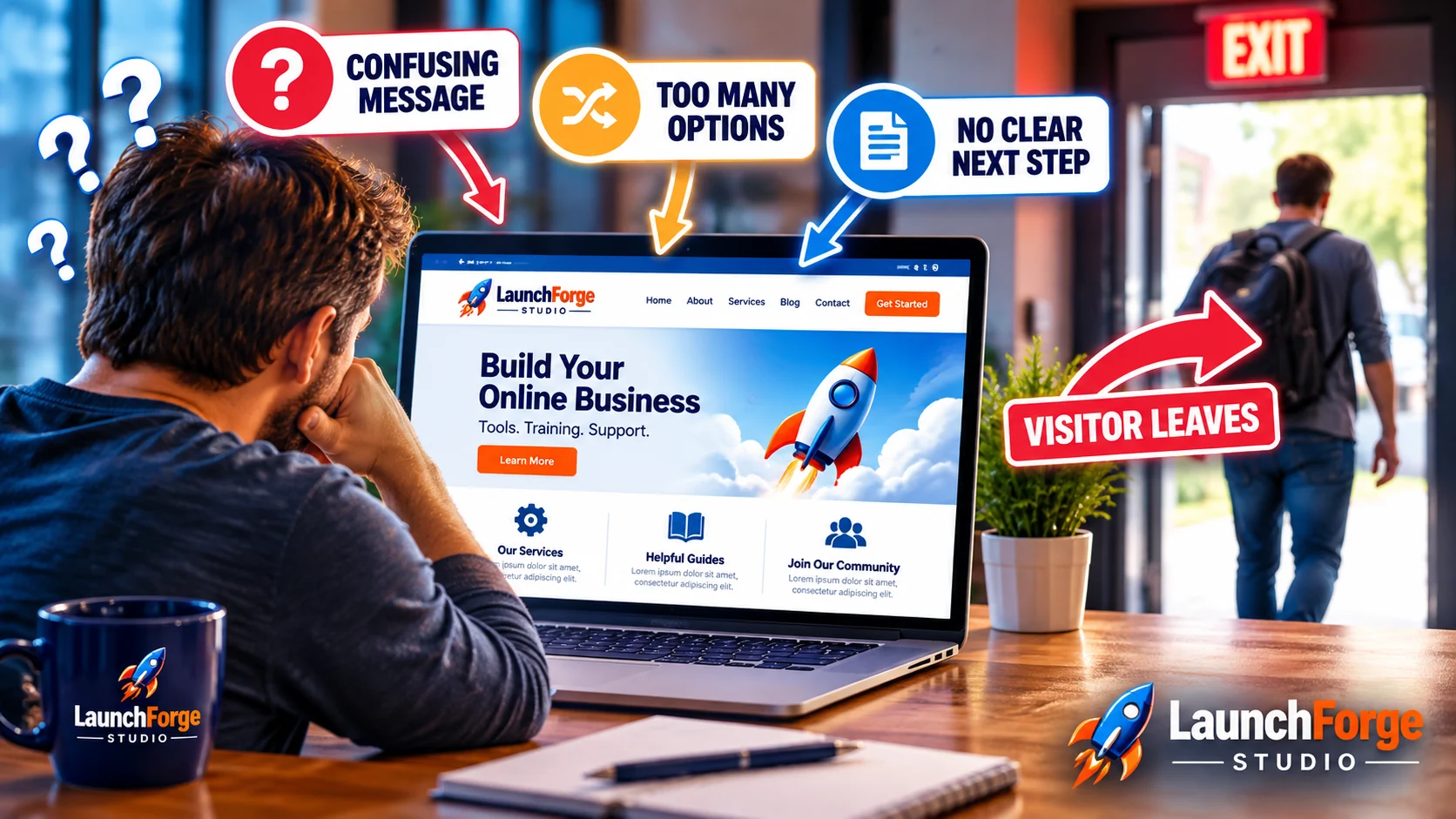
Confusing messages, too many choices, and no clear next step can cause interested website visitors to leave.
Getting someone to your website doesn’t guarantee they’ll take another step.
A visitor may arrive with genuine interest, spend time reading your content, and still leave without subscribing, contacting you, requesting information, or taking any other action.
Sometimes that’s completely normal.
They may have found the answer they needed. They may not be ready to move forward yet. They may even decide that what you offer isn’t right for them.
But when interested visitors consistently leave without taking action, there may be something on the website making that next step harder than it needs to be.
Understanding those obstacles can help you improve the experience without immediately assuming you need more traffic.
They Don’t Immediately Understand What You Offer
When someone arrives on your website for the first time, they shouldn’t have to solve a puzzle to figure out what you do.
Within a relatively short amount of time, a visitor is likely trying to answer questions such as:
What is this website about?
Is this relevant to what I’m looking for?
Can this help me solve my problem or reach my goal?
If the page doesn’t make those answers reasonably clear, the visitor may leave before ever considering your call to action.
That doesn’t mean every page needs to contain a giant sales pitch.
It means the purpose of the page should be understandable.
Clear headlines, straightforward language, useful supporting information, and an organized page can help visitors recognize whether they’ve arrived in the right place.
Before you worry about convincing someone to take action, make sure they understand what you’re offering in the first place.
Clarity comes before conversion.
They Don’t See a Reason to Take the Next Step
Putting a button or form on a page doesn’t automatically give someone a reason to use it.
Visitors need to understand what they’ll gain by taking the next step.
If a button simply says Subscribe, the visitor knows what you’re asking them to do.
But they may still wonder:
Why should I?
Maybe you’re offering a useful resource.
Maybe subscribers receive practical information related to the problem they’re trying to solve.
Maybe completing a form gives them access to additional details they couldn’t get from the page alone.
Whatever the reason is, make the value of taking action understandable.
You’re asking someone to exchange something for that next step. It might be their email address, personal information, time, attention, or simply the effort required to complete a form.
Give them a worthwhile reason to make that exchange.
There Are Too Many Choices
Giving visitors options can be helpful.
Giving them too many competing options can make it difficult to recognize what matters most.
Imagine arriving on a page that asks you to join an email list, download a guide, follow several social media accounts, watch a video, read five related articles, schedule a call, check out a product, click an advertisement, and sign up for something else.
Every one of those options might make sense on its own.
Together, they can create confusion.
When everything on a page is fighting for attention, the visitor may not know which action they’re actually supposed to take.
This is why important pages benefit from having a clear primary goal.
You can still offer navigation, related content, and other useful options, but the main next step shouldn’t be buried beneath a dozen competing requests.
Sometimes improving conversion isn’t about adding another button.
It’s about deciding which button actually matters.
The Website Doesn’t Build Enough Trust
Taking action on a website requires some level of trust.
Even providing an email address can cause someone to hesitate if they aren’t sure what will happen afterward.
A visitor may wonder whether they’ll immediately receive a flood of promotional emails.
They might question whether the business is legitimate.
They may be unsure how their information will be used.
Or they simply may not have seen enough yet to feel comfortable taking the relationship any further.
Trust isn’t created by telling people to trust you.
It’s built through the experience you provide.
Useful content, realistic promises, clear information, professional presentation, consistency, accessible contact information, and transparency about what happens next can all help visitors feel more comfortable.
The more you’re asking from someone, the more important that trust becomes.
The Next Step Requires Too Much Effort
Every additional requirement between interest and action creates another opportunity for a visitor to stop.
Suppose someone wants a simple downloadable checklist, but the form asks for their name, email address, phone number, company name, job title, annual revenue, mailing address, and half their family history.
That’s a lot of commitment for a checklist.
The information you request should make sense for the action the visitor is taking.
A business preparing a detailed custom quote may legitimately need more information.
A simple email subscription probably doesn’t.
Reducing friction doesn’t mean you should never ask questions or collect useful information.
It means removing requirements that aren’t necessary for that particular next step.
The easier the action is to understand and complete, the less opportunity there is for unnecessary friction to get in the way.
The Website Experience Gets in the Way
Sometimes the offer makes sense and the visitor is interested, but the website itself creates the obstacle.
A call-to-action button may be difficult to find.
A form might be frustrating to complete on a phone.
Text could be difficult to read.
Navigation may be confusing.
A popup might interrupt the visitor before they’ve even had a chance to understand the page.
The page may contain so many competing elements that it’s difficult to know where to look.
These problems can be surprisingly easy to miss when you’re reviewing your own website.
You already know where everything is.
You know what every button does.
You know where the form is located.
You know what you’re trying to communicate.
A first-time visitor doesn’t have any of that knowledge.
They experience the page exactly as it appears in front of them.
That’s why one of the simplest questions you can ask when reviewing an important page is:
If I had never seen this website before, would I know what to do next?
If the answer isn’t immediately clear, you may have found an opportunity to make the path forward easier.
And before changing everything on the page, there’s one thing you need to decide first:
What do you actually want the visitor to do?
Decide What You Want Your Visitors to Do
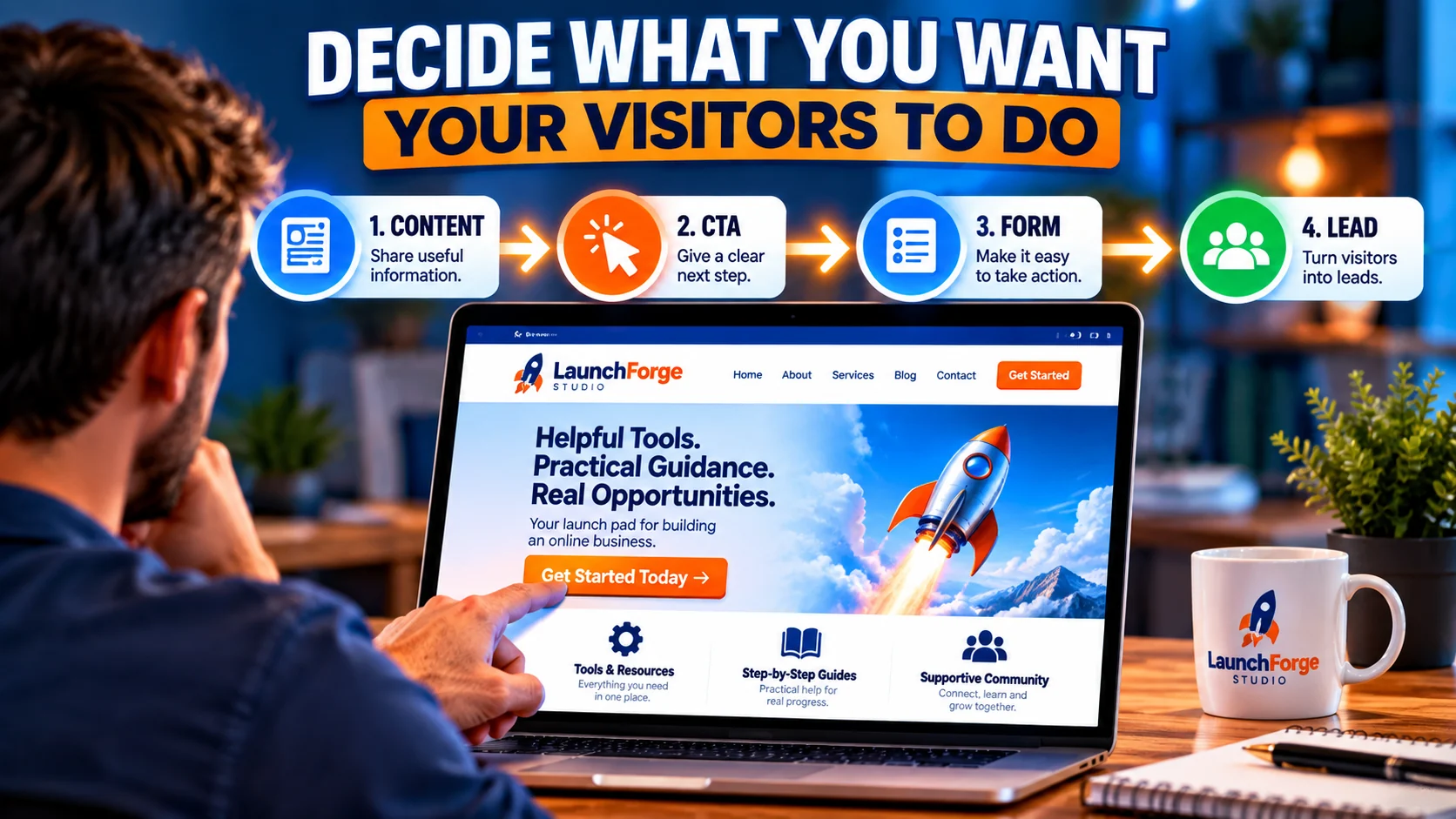
A clear conversion goal gives website visitors one logical next step to follow.
Before you can turn more website visitors into leads, you need to decide what you actually want those visitors to do.
That sounds obvious, but it’s easy to build a page first and think about its purpose afterward.
You add some content.
Then a button.
Then an email form.
Maybe another call to action farther down the page.
Before long, the page contains several possible next steps without one clearly standing out as the most important.
A better approach is to start with the goal.
Ask yourself:
If someone reaches this page and finds it useful, what is the most logical next step I want them to take?
Once you know the answer, it becomes much easier to build the rest of the page around that action.
Choose One Primary Goal
An important page should usually have one primary goal.
That doesn’t mean the visitor can only do one thing.
Your website may still have navigation, related articles, social links, additional resources, and other places people can explore.
But one action should generally have priority.
For example, the primary goal of a blog article might be encouraging an interested reader to join your email list.
A landing page might be designed specifically to get someone to request a resource.
A service page might encourage visitors to contact the business or request more information.
The right goal depends on the purpose of the page.
What’s important is that you know what that goal is.
Without a primary goal, it’s easy to keep adding elements that compete with one another.
When you know the goal, you can make better decisions about what belongs on the page and what may simply be creating noise.
Match the Goal to the Visitor’s Stage
Not every visitor is ready for the same next step.
Someone who has just discovered your business through an educational article may be at a very different stage than someone who intentionally visits a page describing a specific product or service.
The first visitor might simply be trying to understand a problem.
Asking them to make a major purchase immediately may be too large a jump.
But offering another useful resource or an opportunity to stay connected might make perfect sense.
Someone visiting a detailed service page may already be much closer to making a decision. For that person, requesting additional information, asking for a quote, or contacting the business could be a natural next step.
This is why the same call to action doesn’t necessarily belong everywhere on your website.
Think about why someone is likely to be on the page.
Then give them a next step that makes sense from where they are now.
Make the Next Step Clear
Once you’ve decided what you want visitors to do, don’t make them hunt for it.
Your call to action should make the next step understandable.
A visitor shouldn’t have to wonder what a button does, where a form leads, or what will happen after they submit their information.
Clear language usually beats clever language.
If someone is getting a free guide, tell them they’re getting the guide.
If they’re joining an email list, explain what they’ll receive.
If they’re requesting information, make that clear.
You don’t need to turn every call to action into a paragraph.
You simply need enough clarity that the visitor understands both the action and the reason for taking it.
The easier that decision is to understand, the easier it becomes for an interested visitor to move forward.
Don’t Ask for Too Much Too Soon
One of the easiest ways to lose an interested visitor is to ask for a level of commitment that doesn’t match the relationship yet.
Think about the size of the step you’re asking someone to take.
A person reading their first article on your website may be willing to download a helpful resource or join an email list.
They may not be ready to schedule a sales call, provide detailed personal information, or make a purchase.
That doesn’t mean those larger actions shouldn’t exist.
It means they should appear where they make sense.
You can think of the process as a series of reasonable steps rather than one giant leap.
A visitor discovers your content.
They find it useful.
You offer another relevant opportunity.
They decide to take it.
Now you’ve created the possibility of continuing the relationship.
That progression feels much more natural than asking someone who just met your business to immediately make the biggest commitment available.
And once you know what reasonable next step you want visitors to take, the next question becomes just as important:
Why should they want to take it?
Give Visitors a Reason to Become Leads
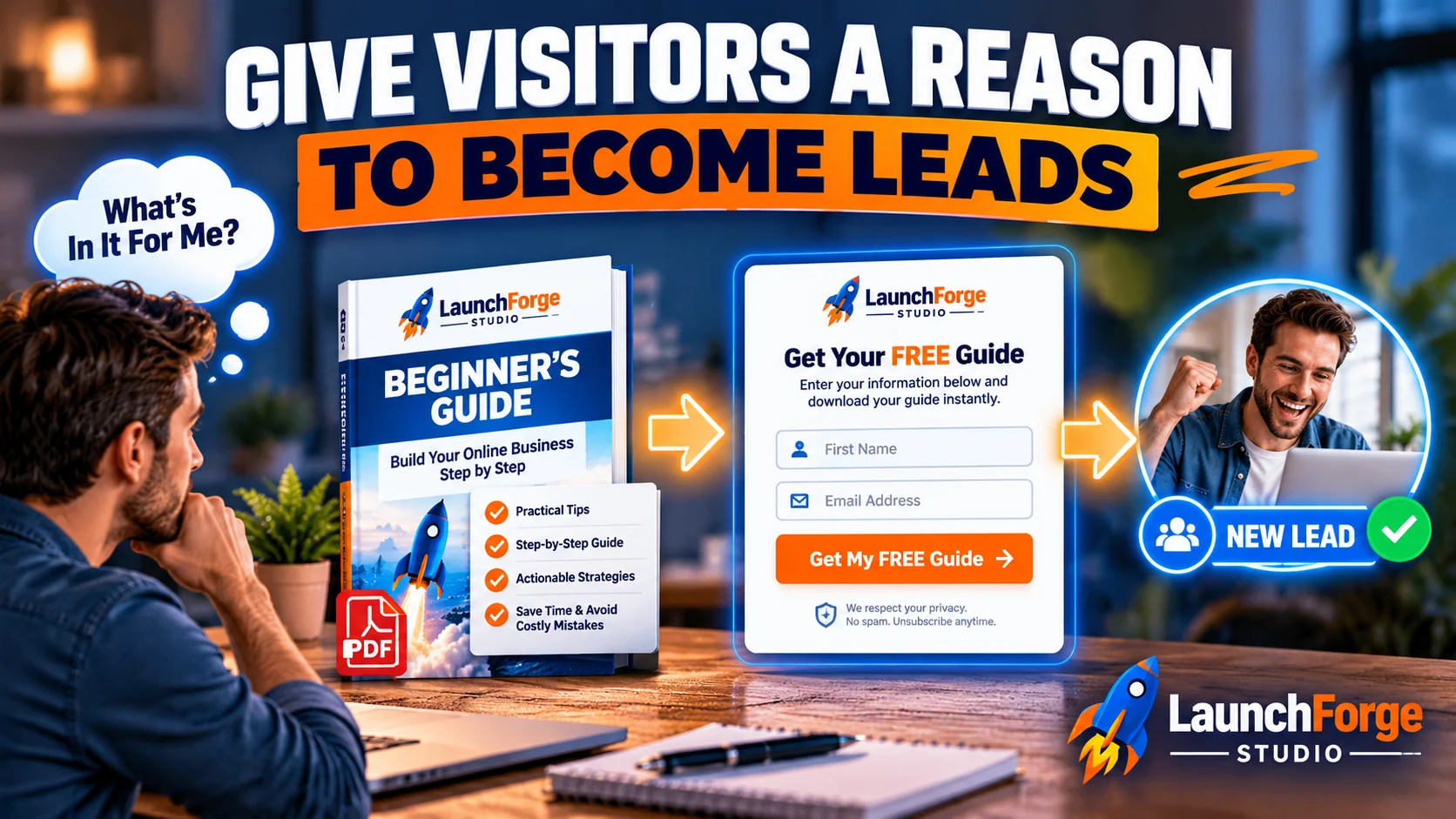
Offering something genuinely useful gives interested visitors a reason to take the next step and become leads.
Once you know what you want visitors to do, the next question is simple:
Why should they do it?
A visitor isn’t going to become a lead just because you placed a form on the page.
They need a reason to take that next step.
That reason doesn’t have to be complicated, expensive, or incredibly elaborate. It simply needs to offer enough value that continuing the relationship makes sense to the visitor.
The stronger the connection between what brought someone to your website and what you’re offering next, the more natural that decision can feel.
Offer Something Useful
One of the simplest ways to encourage a visitor to take another step is to offer something that helps them.
That could be information, a resource, access to something useful, additional guidance, or an opportunity to learn more about a solution they’re already interested in.
The key word is useful.
You don’t need to create something simply because you’ve heard that every website needs a free download.
Think about what would genuinely help the person you’re trying to reach.
If your audience is trying to solve a particular problem, perhaps a checklist would help them get started.
If they’re learning a process, a simple guide might help them understand the next steps.
If they need more personalized information, an inquiry or consultation might make more sense.
The offer should support what the visitor is already trying to accomplish.
When it does, becoming a lead doesn’t feel like an unrelated marketing request.
It feels like the logical next step.
Solve a Specific Problem
Broad offers can be difficult for visitors to evaluate.
Specific offers are usually easier to understand.
Consider the difference between offering:
Free business information
and offering:
A checklist to help you plan the pages for your first business website
The second example immediately tells the visitor who the resource is for and what problem it helps address.
Specificity helps people decide whether something is relevant to them.
Think about the questions your audience asks.
What are they struggling with?
What small obstacle could you help them overcome?
What information would make their next decision easier?
You don’t necessarily need to solve their biggest problem immediately.
Sometimes helping with one smaller, clearly defined problem is enough to demonstrate your value and give someone a reason to stay connected.
Make the Value Easy to Understand
Visitors shouldn’t have to investigate your entire website to figure out why they should take action.
If you’re offering something useful, explain what it is and why it matters.
That could mean describing what they’ll receive, what they’ll learn, what problem it can help solve, or what happens after they complete the action.
For example, telling someone to Join Our Newsletter explains the action.
But telling them they’ll receive practical beginner tips for building and growing an online business gives them a better idea of what they’re actually signing up for.
The goal isn’t to write an enormous sales pitch around every form.
It’s to answer the visitor’s natural question:
What’s in this for me?
The clearer that answer is, the easier it becomes for someone to decide whether the next step is worthwhile.
Use Lead Magnets When They Make Sense
A lead magnet is something useful you offer in exchange for a visitor’s contact information, usually an email address.
Common examples include:
- Checklists
- Guides
- Templates
- Worksheets
- Resource lists
- Tutorials
- Reports
- Free training
Lead magnets can work well because they give the visitor an immediate reason to take action.
But creating one simply for the sake of having one isn’t enough.
A useful lead magnet should connect closely with the reason the visitor came to your website in the first place.
Someone reading about building their first website may be interested in a website planning checklist.
Someone learning about email marketing may be more interested in an email campaign template.
Someone researching traffic strategies may want a resource that helps them plan where and how they’ll promote their website.
The closer the offer matches the visitor’s current interest, the more relevant the next step becomes.
And you don’t need a giant ebook or an elaborate course to make a lead magnet valuable.
Sometimes a short resource that solves one specific problem is more useful than something much larger that tries to cover everything.
The purpose isn’t to impress visitors with how much content you can give away.
It’s to help them make progress.
Once you’ve given visitors a worthwhile reason to take action, the next challenge is making sure there is a clear path for them to actually do it.
Create a Clear Path From Visitor to Lead
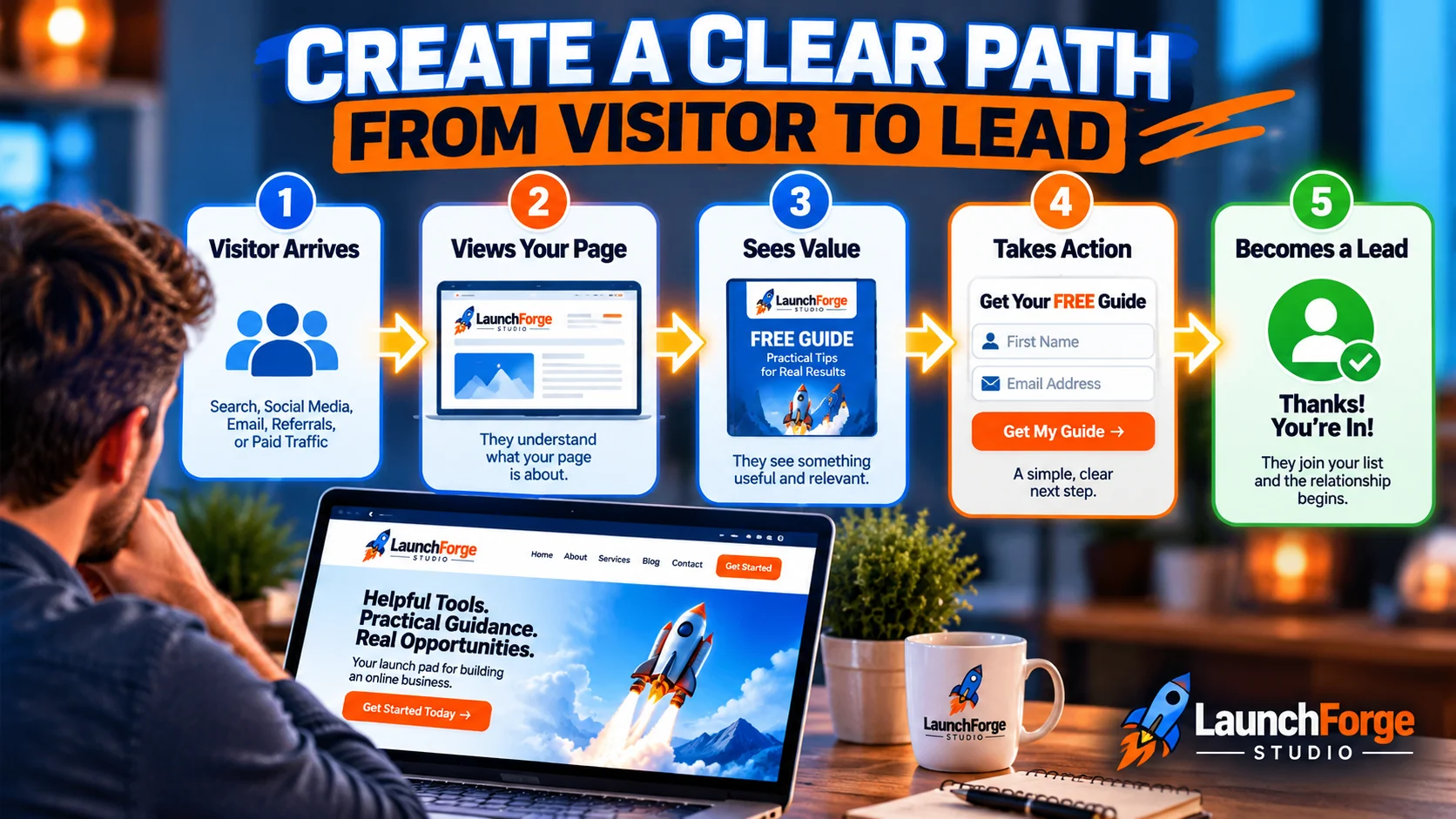
A clear conversion path helps visitors understand the value, take the next step, and become leads.
Giving visitors a good reason to take action is important, but the offer is only part of the process.
They also need a clear path from the page they’re viewing to the action you want them to take.
If that path is confusing, hidden, or unnecessarily complicated, even an interested visitor may never complete it.
Think of the process from the visitor’s perspective.
They arrive on a page.
They understand what the page is about.
They see something valuable.
They decide they’re interested.
Now they need to know exactly what to do next.
The fewer unnecessary questions they have to answer along the way, the easier it becomes to move from visitor to lead.
Start With the Page They Land On
Visitors don’t always enter your website through the homepage.
Someone might discover a blog article through Google.
Another person might click a social media post and arrive directly on a landing page.
Someone else could follow a referral link to a specific service page.
That means every important entry point should make sense on its own.
A visitor shouldn’t need to visit three other pages before understanding why they’re there or what opportunity is available to them.
Look at the pages that attract visitors and ask:
What is someone likely looking for when they arrive here?
Then consider whether the next step on that page supports what brought them there.
A person reading an educational article might benefit from another useful resource.
Someone viewing a service page might want more information about that service.
A visitor on a landing page may already be there specifically because they’re considering the offer presented on it.
The starting page and the next step should feel connected.
Use a Clear Call to Action
A call to action tells the visitor what you want them to do next.
It might encourage someone to download a resource, join an email list, request information, register for something, contact your business, or take another meaningful action.
Whatever the goal is, the call to action should be easy to understand.
Avoid making visitors guess what happens when they click.
A vague button such as Click Here may technically tell someone what to do, but it doesn’t tell them why they’re doing it.
A more descriptive call to action can connect the action with the result.
Examples might include:
Get the Free Checklist
Join the Email List
Request More Information
Register for the Free Training
See How It Works
The exact wording will depend on the page and the offer.
The important thing is that the visitor understands what they’re being asked to do.
Send Visitors to the Right Destination
A good call to action can still fail if it sends visitors somewhere that doesn’t match what they expected.
If someone clicks a button offering a free checklist, they shouldn’t suddenly arrive on a page trying to sell them something unrelated.
If they click to learn more about a particular service, they shouldn’t be sent to a generic homepage and forced to find the information themselves.
The destination should continue the journey that the call to action started.
This creates consistency.
The visitor sees an opportunity.
They click because they’re interested.
The next page confirms they’re in the right place and gives them a clear way to continue.
Every unnecessary detour creates another opportunity for someone to leave.
Use Landing Pages When You Need a Focused Conversion
Sometimes a regular website page is enough to move visitors toward the next step.
Other times, a dedicated landing page makes more sense.
Landing pages are useful when you want the visitor to focus on one specific offer or action without being distracted by everything else happening on the website.
For example, you might use a landing page for a lead magnet, webinar registration, special offer, advertising campaign, or another focused promotion.
The page can explain the offer, show the visitor why it’s useful, answer important questions, and provide a clear way to take action.
That doesn’t mean every call to action needs its own complicated landing page.
Use one when having a focused destination improves the visitor’s experience and makes the next step easier to understand.
Make Forms Simple
For many websites, a form is the point where the visitor actually becomes a lead.
That makes the form an important part of the conversion path.
But more fields don’t automatically create better leads.
Every field should have a reason to exist.
If all you need to deliver a resource is an email address, you may not need to ask for much more.
If someone is requesting a detailed quote or consultation, collecting additional information might be necessary.
The form should match the action.
It’s also helpful to make the form itself easy to understand.
Visitors should know what information you’re requesting, which fields are required, and what they’re submitting the form to receive.
The goal isn’t simply to collect as much information as possible.
It’s to collect the information you actually need without making the visitor work harder than necessary.
Confirm What Happens Next
The conversion path shouldn’t suddenly end after someone clicks a button or submits a form.
Tell the new lead what happens next.
If a resource is being emailed to them, let them know.
If they need to check their inbox and confirm their subscription, explain that.
If someone from the business will contact them, give them an idea of what to expect.
If they’re being redirected to another page, make sure that page confirms the action was successful.
This small step can make the experience feel much more complete.
The visitor has trusted you enough to take action.
Don’t reward that trust with confusion.
A clear confirmation reassures them that everything worked and helps prepare them for whatever comes next.
At this point, the basic path is in place:
The visitor arrives, understands the opportunity, sees a relevant next step, takes action, and receives confirmation.
Now we can look at another important part of that path—removing the unnecessary friction that can stop someone before they reach the end.
Reduce the Friction That Stops Visitors From Converting
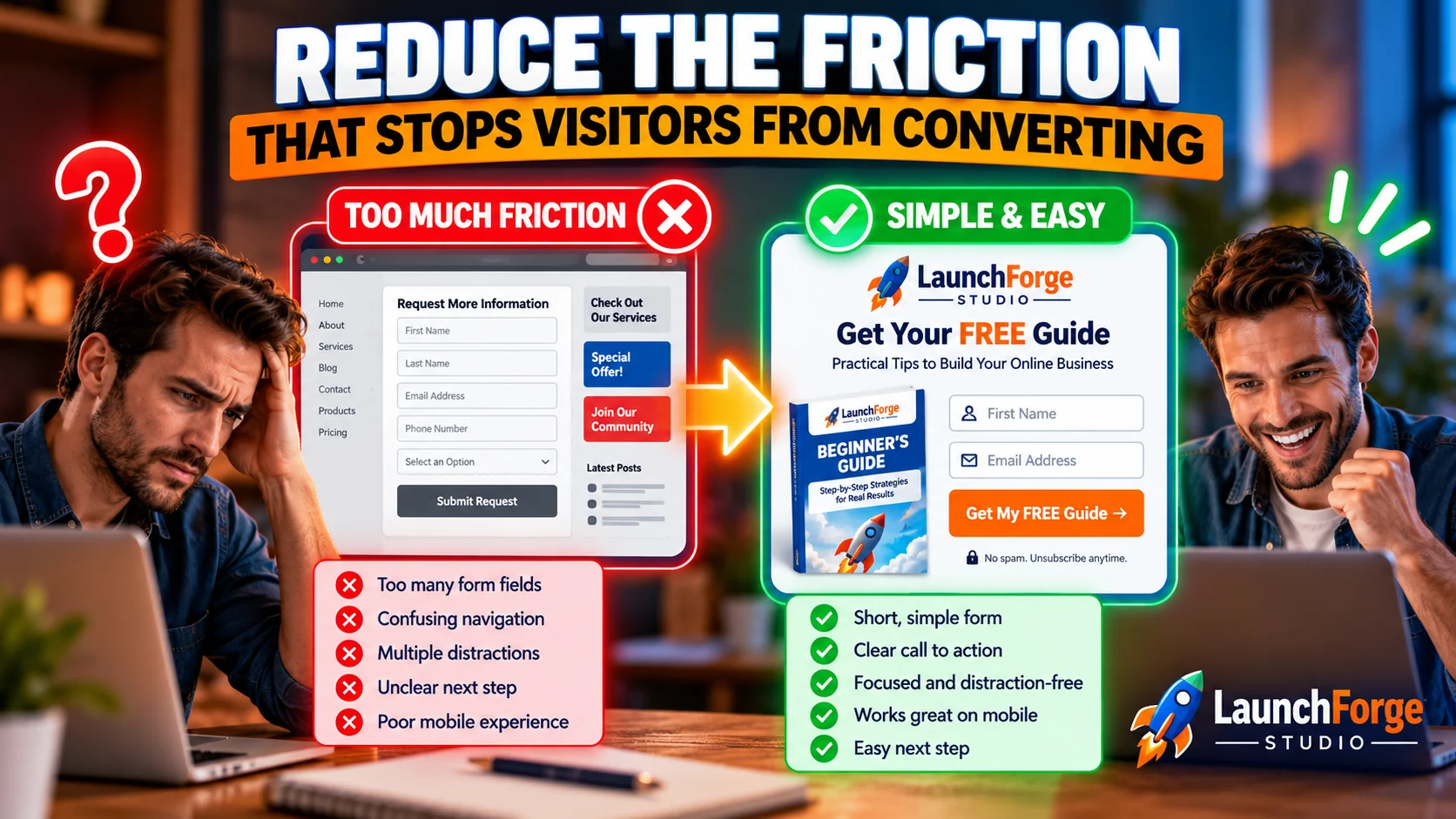
Simple forms, clear calls to action, and fewer distractions make it easier for website visitors to take the next step.
Sometimes a visitor understands what you offer, sees the value, and is interested in taking the next step—but something small gets in the way.
That’s conversion friction.
Friction is anything that makes an action feel more difficult, confusing, time-consuming, or risky than it needs to be.
It can appear in obvious ways, such as a form that doesn’t work properly.
But it can also be subtle.
Too many form fields.
A call to action that’s difficult to find.
A page overloaded with distractions.
A poor mobile experience.
Instructions that leave the visitor wondering what they’re supposed to do.
Individually, these problems might seem minor.
But every unnecessary obstacle gives an interested visitor another reason to stop before completing the action.
The goal isn’t to remove every decision from your website.
It’s to remove the obstacles that don’t need to be there.
Keep Forms as Short as They Need to Be
We’ve already touched on the importance of simple forms, but it’s worth looking at the idea from the visitor’s perspective.
Every piece of information you request creates a small decision.
Do I want to give them my phone number?
Why do they need my address?
Do I really want to answer all these questions just to receive this resource?
The more information you request, the more value the visitor may expect in return.
That’s why the length of the form should match the size of the action.
If someone is downloading a simple resource, an email address may be enough.
If they’re requesting a personalized quote or consultation, asking for additional information can make sense because you need enough detail to respond appropriately.
Don’t collect information simply because your form builder gives you the option.
Ask for what you actually need.
You can always learn more about a lead later as the relationship develops.
Remove Unnecessary Distractions
A conversion page doesn’t need to feel empty, but everything on it should have a reason to be there.
If a visitor is considering one specific action, too many unrelated elements can pull their attention in different directions.
This doesn’t mean stripping every page down to a headline and a button.
Helpful explanations, supporting information, images, testimonials, navigation, and related content can all have a purpose.
The question is whether those elements support the visitor’s decision or compete with it.
Look at the page and ask:
Does this help someone understand or take the next step?
If the answer is no, consider whether the element really needs to be there.
Sometimes improving a page is less about adding something new and more about removing something that was never helping.
Make Your Calls to Action Easy to Find
A strong call to action can’t do much if nobody notices it.
Visitors shouldn’t have to search the page to figure out how to continue.
Placement matters.
On a short page, one clearly positioned call to action may be enough.
On a longer page or article, it may make sense to provide another relevant opportunity after the visitor has had time to learn more.
The important thing is to keep the experience natural.
You don’t need a flashing button after every paragraph.
You simply want the next step to be available when the visitor is likely to need it.
The call to action should also stand apart enough from the surrounding content that someone scanning the page can recognize it.
Clear wording and sensible placement usually accomplish more than trying to make every button scream for attention.
Make the Experience Mobile Friendly
Your conversion path needs to work when someone visits from a phone, not just when you’re looking at it on a desktop computer.
A page that looks great on a large screen can become frustrating when everything is compressed onto a smaller display.
Forms may become difficult to complete.
Buttons may be too small or awkwardly positioned.
Text may require constant zooming.
Images or other elements might push important content farther down the page than expected.
Even something as simple as excessive spacing can make a visitor feel like they’re scrolling forever just to reach the next step.
Test important pages on a mobile device.
Look at them as a visitor would.
Can you read the page comfortably?
Can you find the call to action?
Can you complete the form without fighting with it?
Can you tell what happens next?
A mobile visitor shouldn’t receive a worse conversion path simply because they’re using a smaller screen.
Make the Next Step Feel Easy
The best conversion paths often feel simple because the visitor always understands what comes next.
They aren’t forced to stop and figure out the process.
The page explains the opportunity.
The call to action makes sense.
The form asks for reasonable information.
The visitor submits it.
The website confirms what happened.
That’s a straightforward experience.
Compare that with a visitor who has to search for the button, open another page, create an account, complete a long form, figure out an unclear error message, and then wonder whether the submission actually worked.
Even someone who started with strong interest may give up.
Reducing friction isn’t about manipulating people into taking action faster.
It’s about respecting their time and removing unnecessary difficulty.
When someone is ready to take the next step, your website shouldn’t be the thing standing in their way.
But ease alone isn’t enough.
A simple form and a clear button can make taking action easier, but the visitor still needs to feel comfortable taking that action in the first place.
That’s where trust becomes an important part of the conversion process.
Build Enough Trust for Visitors to Take the Next Step
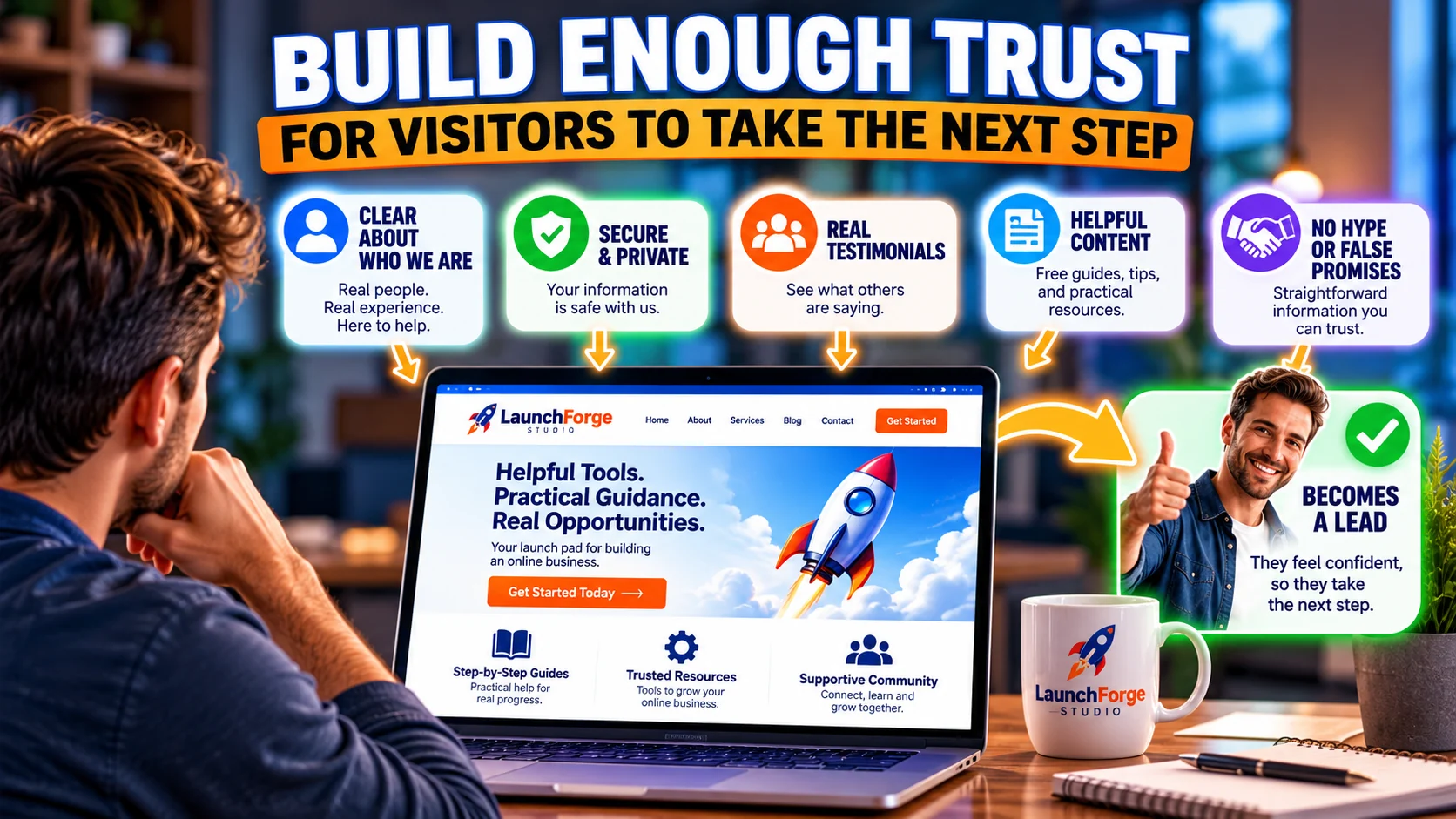
Clear information, useful content, appropriate trust signals, and realistic promises can help visitors feel confident taking the next step.
A visitor can understand your offer, see a clear call to action, and still hesitate before taking the next step.
That’s because conversion isn’t only about convenience.
It’s also about trust.
When someone gives you their email address, fills out a form, requests information, or shares any other personal details, they’re making a small decision about whether they feel comfortable continuing the relationship.
The more you’re asking from them, the more important that decision becomes.
You don’t need to be a huge company or an established brand to build trust.
You need to give visitors enough information and consistency to feel confident about what they’re doing and who they’re doing it with.
Explain Who You Are and What You Do
Visitors shouldn’t have to investigate your entire website to figure out who’s behind it.
Give people a reasonable way to understand who you are, what your business does, and who you’re trying to help.
That information might appear on your About page, service pages, homepage, author information, or other relevant areas of your website.
You don’t need to tell your entire life story on every page.
But your business shouldn’t feel anonymous.
This can be especially important for a newer online business.
You may not have years of testimonials, thousands of customers, or a recognizable brand name yet.
That’s okay.
Clear communication about who you are and what you’re building can still create credibility.
Being real and understandable is a much better starting point than trying to make a small business look like a giant corporation.
Be Clear About What Visitors Are Signing Up For
If you’re asking for someone’s information, tell them what they’re agreeing to.
If they’re joining an email list, explain what kind of emails they can expect.
If they’re requesting a resource, tell them how they’ll receive it.
If they’re submitting an inquiry, explain what will happen afterward.
Uncertainty creates hesitation.
Imagine seeing a form asking for your name and email address with no explanation beyond:
Submit
Submit for what?
What happens after clicking?
Will someone contact you?
Will you receive something?
Did you just accidentally volunteer to help somebody move a couch this weekend? 😂
A visitor shouldn’t have to guess.
Clear expectations make the decision easier and help establish trust before the relationship even begins.
Use Helpful Content to Demonstrate Value
One of the strongest ways to build trust is to be useful before asking for anything.
Helpful articles, guides, tutorials, videos, resources, and other educational content give visitors an opportunity to experience the value your business provides.
Instead of simply telling people that you know what you’re talking about, you can show them.
This is particularly useful for visitors who aren’t ready to take action immediately.
Someone may discover one article today and leave without becoming a lead.
Later, they may find another useful resource from your website.
Over time, those experiences can create familiarity.
When that person eventually encounters an opportunity to subscribe, request information, or take another step, your business is no longer completely unfamiliar.
You’ve already helped them.
Content doesn’t have to contain a sales pitch every few paragraphs to contribute to lead generation.
Sometimes the value of the content itself is what gives visitors a reason to trust the next step you offer.
Use Appropriate Trust Signals
Trust signals are elements that help reassure visitors that they’re dealing with a legitimate business and that taking action is reasonable.
Depending on your business, these might include:
- Genuine testimonials or reviews
- Clear contact information
- An About page
- Privacy information
- Secure website connections
- Accurate business information
- Real examples of your work
- Clear policies or expectations
- Consistent branding and presentation
Not every business needs every possible trust signal.
Use the ones that actually make sense.
And don’t add something simply because you’ve seen other marketers use it.
A trust signal only helps when it’s legitimate.
A real testimonial from an actual customer can be useful.
A collection of vague quotes from unidentified people probably doesn’t accomplish much.
The goal isn’t to decorate the page with symbols of credibility.
It’s to give visitors reasonable evidence that your business is what it claims to be.
Don’t Make Promises You Can’t Support
Trust can take time to build and seconds to damage.
One of the quickest ways to create doubt is to make claims that sound unrealistic.
You don’t need to promise instant results, guaranteed income, effortless success, or dramatic transformations to convince someone to become a lead.
In many cases, those promises can have the opposite effect.
People have seen plenty of exaggerated marketing online.
Being specific and realistic can make your message stronger.
Explain what you’re offering.
Explain who it may help.
Explain what someone can reasonably expect.
And if there are limitations, don’t be afraid to acknowledge them.
Your goal isn’t to convince every visitor that your offer is perfect for everyone.
It’s to help the right visitor decide whether taking the next step makes sense.
That approach may not produce the flashiest marketing claim on the internet.
But it gives you something much more valuable to build on:
credibility.
And once visitors understand what you offer, see value in it, and trust the next step, your existing content can become one of the most useful places to create opportunities for those visitors to stay connected.
Turn Your Content Into Lead Opportunities
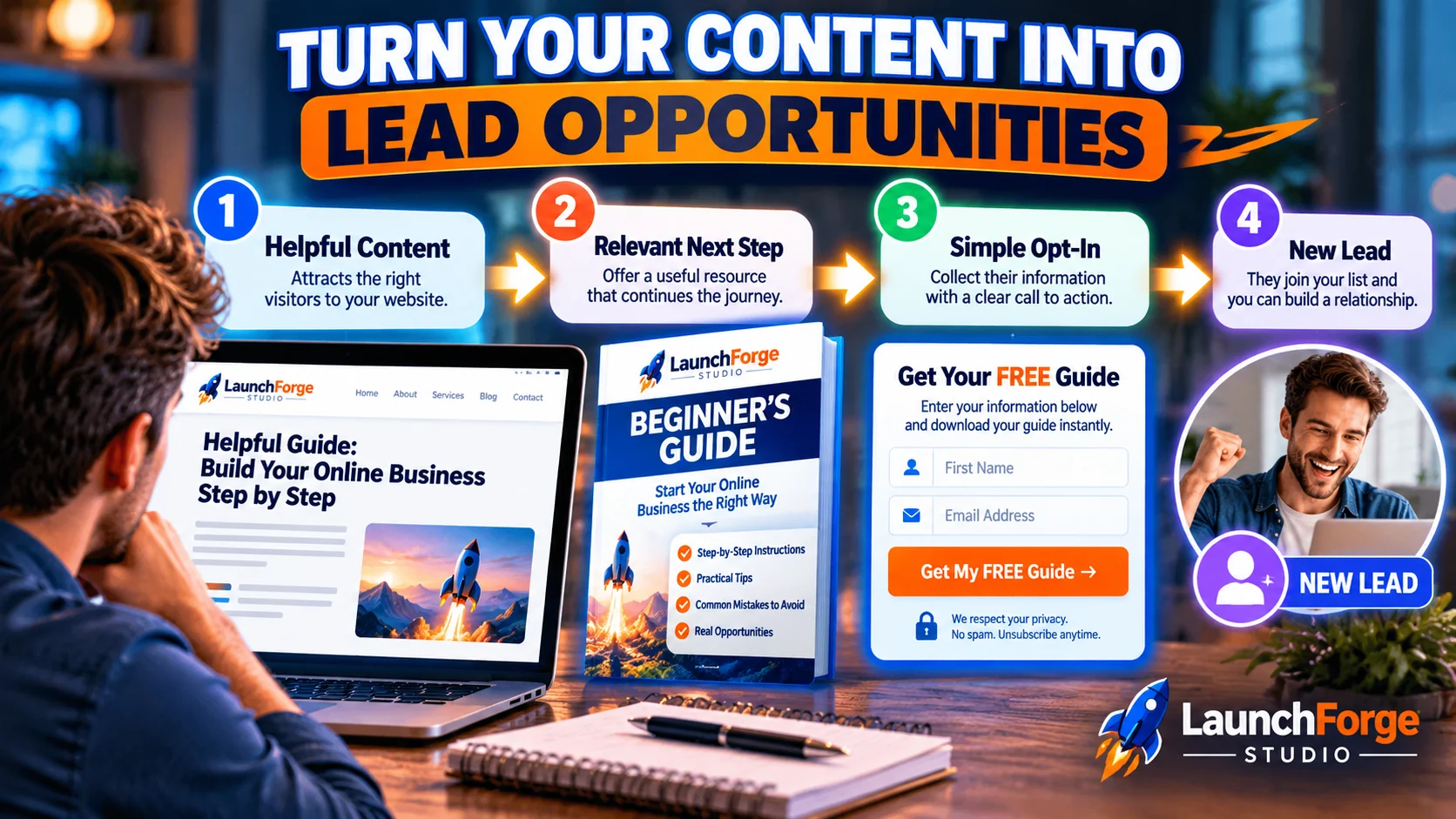
Helpful content can naturally guide interested visitors toward a relevant resource, simple opt-in, and an opportunity to stay connected.
Every piece of useful content on your website has the potential to do more than attract visitors.
It can also give those visitors a reason to stay connected.
This doesn’t mean turning every blog post into a sales page or interrupting readers every few paragraphs with another offer.
It means recognizing that someone who is already reading your content has shown interest in a subject related to your business.
That’s an opportunity.
If the content helps them solve a problem, understand something more clearly, or make a better decision, the next step should build naturally on what they’ve already found useful.
Give Educational Visitors a Logical Next Step
People who arrive through educational content may not be ready to buy something.
And that’s perfectly fine.
They may be researching a problem, learning how something works, comparing approaches, or simply trying to figure out what they should do next.
Instead of forcing those visitors toward a decision they aren’t ready to make, give them an opportunity that matches where they are.
Someone reading a beginner’s guide might be interested in another related guide.
A visitor learning how to accomplish something might appreciate a checklist or resource that helps them put the information into practice.
Someone who has found several of your articles useful may be ready to join your email list so they can continue learning from you.
The next step doesn’t need to be enormous.
It needs to be relevant.
When the next action feels like a continuation of the content rather than an interruption, the visitor has a much clearer reason to consider it.
Connect Related Content
Not every visitor is ready to become a lead during their first visit.
That doesn’t mean you should send them on their way.
Related content gives visitors another opportunity to explore your website and learn more about the subjects that matter to them.
If someone finishes an article about getting website traffic, another article about turning those visitors into leads could be a logical next step.
If they’re learning about landing pages, they may want to understand calls to action, lead capture forms, or sales funnels.
These connections help visitors move through your website with purpose.
They also give your content library more value.
Instead of every article standing alone, your website begins to function as a collection of connected resources.
A visitor who discovers one useful article can find another.
Then another.
With each helpful interaction, they’re learning more about the subject and becoming more familiar with your business.
That familiarity can make taking a future conversion step feel much more natural.
Place Calls to Action Where They Make Sense
Calls to action don’t need to appear everywhere to be effective.
They need to appear where they make sense.
A visitor who has just finished reading a detailed section about a problem may be receptive to a resource that helps solve that problem.
Someone reaching the end of a useful guide may be interested in staying connected.
A visitor reading about a particular service may be ready to learn more about that service.
Context matters.
Rather than asking:
Where can I squeeze another call to action onto this page?
Ask:
Where would taking the next step feel natural for the reader?
That change in perspective can help you create calls to action that support the experience instead of constantly interrupting it.
And remember that every article doesn’t necessarily need the same call to action.
The opportunity should make sense for the content and the person reading it.
Invite Visitors to Stay Connected
Sometimes the most appropriate next step is simply giving visitors a way to hear from you again.
This is where an email list can become especially valuable.
Someone may enjoy your content without being ready to purchase anything or contact your business.
An email subscription gives that person a lower-commitment way to stay connected.
You can continue sharing useful information, new resources, relevant updates, and other content that gives them reasons to return.
The important part is to make the invitation worthwhile.
Don’t assume someone wants more email simply because they visited your website.
Explain what they’ll receive and why it may be useful.
And then deliver what you promised.
Turning content into lead opportunities isn’t about transforming every reader into a prospect before they reach the bottom of the page.
It’s about making sure that when someone finds your content useful and wants to continue the relationship, there’s an obvious way for them to do it.
Once those opportunities are in place, you can begin learning which pages and conversion paths are actually producing results.
Measure What Happens After Visitors Arrive
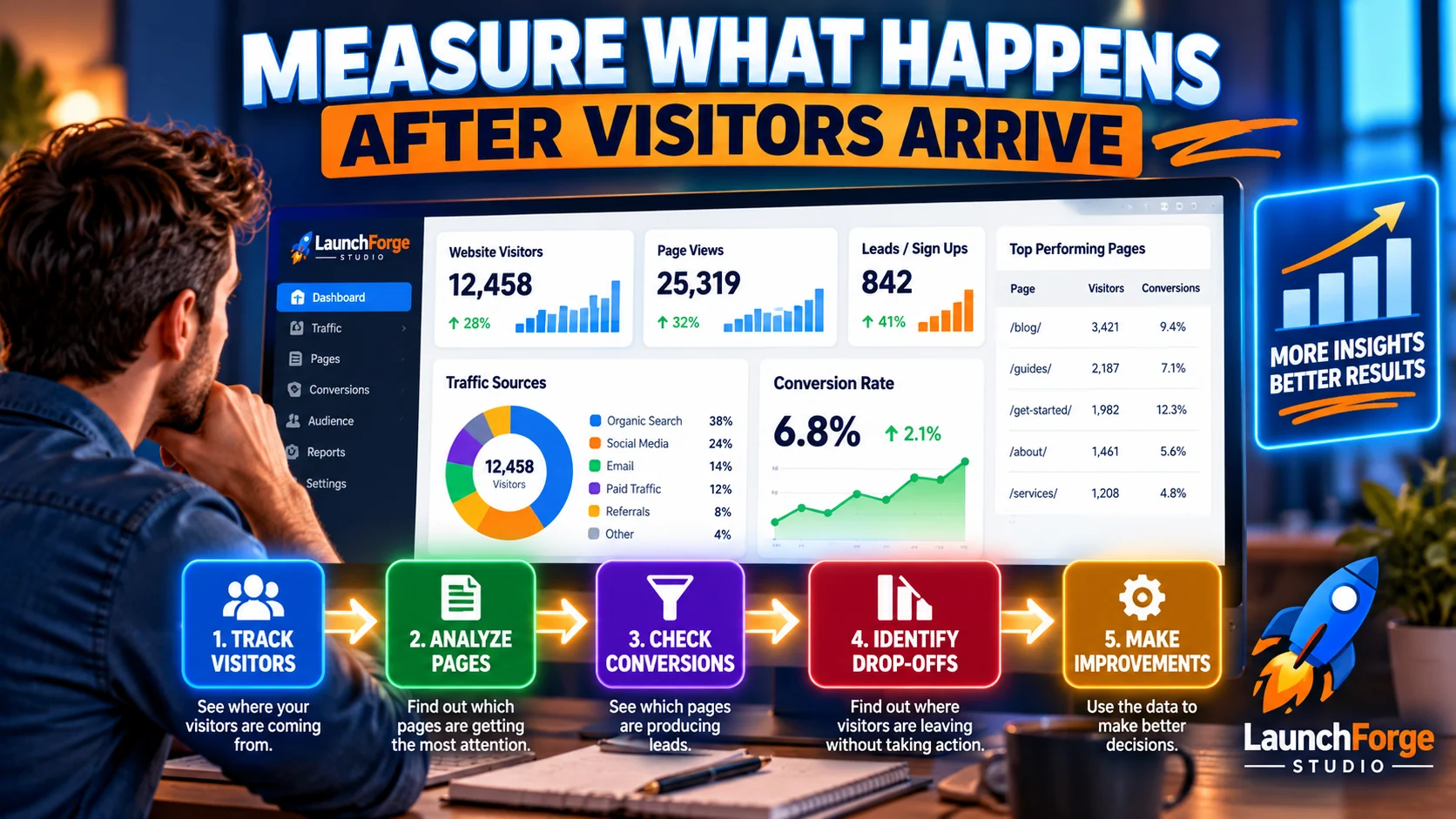
Tracking visitors, pages, conversions, and drop-off points helps you understand what is working and where to improve.
Once your website has clear opportunities for visitors to become leads, you need a way to understand whether those opportunities are actually working.
You don’t need to become an analytics expert.
You don’t need to watch every visitor move through your website.
And you definitely don’t need to spend your entire day staring at numbers instead of building your business.
You simply need enough information to answer a few useful questions.
Where are visitors coming from?
Which pages are they visiting?
Which pages are producing leads?
And where might interested visitors be leaving without taking the next step?
Those answers can help you make better decisions based on what visitors actually do rather than what you assume they do.
Track Which Pages Attract Visitors
Start by understanding which pages are bringing people into your website.
You may discover that one blog article attracts considerably more visitors than another.
A particular landing page might receive traffic from a social media campaign.
A guide could begin appearing in search results and bringing in new visitors over time.
Knowing which pages attract traffic helps you identify where conversion opportunities may matter most.
If an article receives very little traffic, improving its call to action may not immediately produce many additional leads.
But if another article consistently attracts visitors and gives them no meaningful next step, that could represent a much larger opportunity.
Traffic data gives you context.
It helps you decide where to focus your attention first.
Track Which Pages Generate Leads
A page attracting visitors and a page generating leads are not necessarily the same thing.
One article might receive substantial traffic but produce very few conversions.
Another page could receive fewer visitors but generate leads much more consistently.
That distinction matters.
You want to know not only where people arrive, but where they actually take action.
Look at the pages containing your important forms, offers, or calls to action.
Which ones are producing signups, inquiries, downloads, registrations, or whatever action you’ve defined as a lead?
Over time, patterns may begin to appear.
Perhaps one topic attracts visitors who are more interested in staying connected.
Maybe one offer performs better than another.
You might discover that visitors arriving on certain pages are much more likely to take the next step.
Those patterns can help you understand what your audience actually responds to.
Pay Attention to Conversion Rate
Raw lead numbers can be useful, but they don’t always tell the entire story.
Suppose one page receives 1,000 visitors and generates 20 leads.
Another receives 100 visitors and generates 10 leads.
The first page generated more leads overall.
But the second page converted a much larger percentage of its visitors.
That’s where conversion rate becomes useful.
In simple terms, your conversion rate tells you what percentage of visitors completed the action you wanted them to take.
You don’t need to obsess over finding some universal “perfect” conversion rate.
Different pages, traffic sources, audiences, offers, and types of businesses can produce very different results.
Instead, use your own numbers as a starting point.
If a page is converting some visitors today, can you make a thoughtful improvement and see whether it performs better over time?
That’s a much more useful question than comparing every page on your website with somebody else’s numbers.
Look for Places Where Visitors Drop Off
Sometimes the most useful information isn’t where people convert.
It’s where they stop.
Maybe visitors reach a landing page but rarely complete the form.
Perhaps they click a call to action but leave when they see how much information you’re requesting.
Maybe an important page receives plenty of traffic, but very few visitors interact with the next step.
Those patterns can point toward possible friction.
They don’t automatically tell you exactly what the problem is.
A low-performing form doesn’t necessarily mean the form itself is responsible. The offer might not be relevant enough. The page may not explain the value clearly. The traffic could be coming from people who aren’t a good match.
Use the data as a clue rather than an instant diagnosis.
Then look at the experience surrounding that point and ask what might be getting in the visitor’s way.
Improve One Thing at a Time
When you discover a page that could perform better, resist the temptation to change everything at once.
If you rewrite the headline, replace the offer, redesign the page, change the button, shorten the form, move the call to action, and alter the traffic source all at the same time, you may improve the results.
But you won’t necessarily know why.
Instead, make thoughtful changes.
You might simplify a form.
Clarify a headline.
Strengthen the explanation around an offer.
Make a call to action easier to find.
Then give the change enough time and traffic to tell you something useful.
This approach isn’t as exciting as completely rebuilding a page every time the numbers disappoint you.
But it gives you something much more valuable:
information you can actually learn from.
The goal isn’t to create a perfect conversion system on your first attempt.
It’s to build something useful, observe what happens, improve what needs attention, and keep learning from the people who actually use your website.
And as you make those improvements, there are several common mistakes worth watching for—because even a good offer can struggle when the surrounding conversion strategy works against it.
Common Mistakes That Keep Website Visitors From Becoming Leads
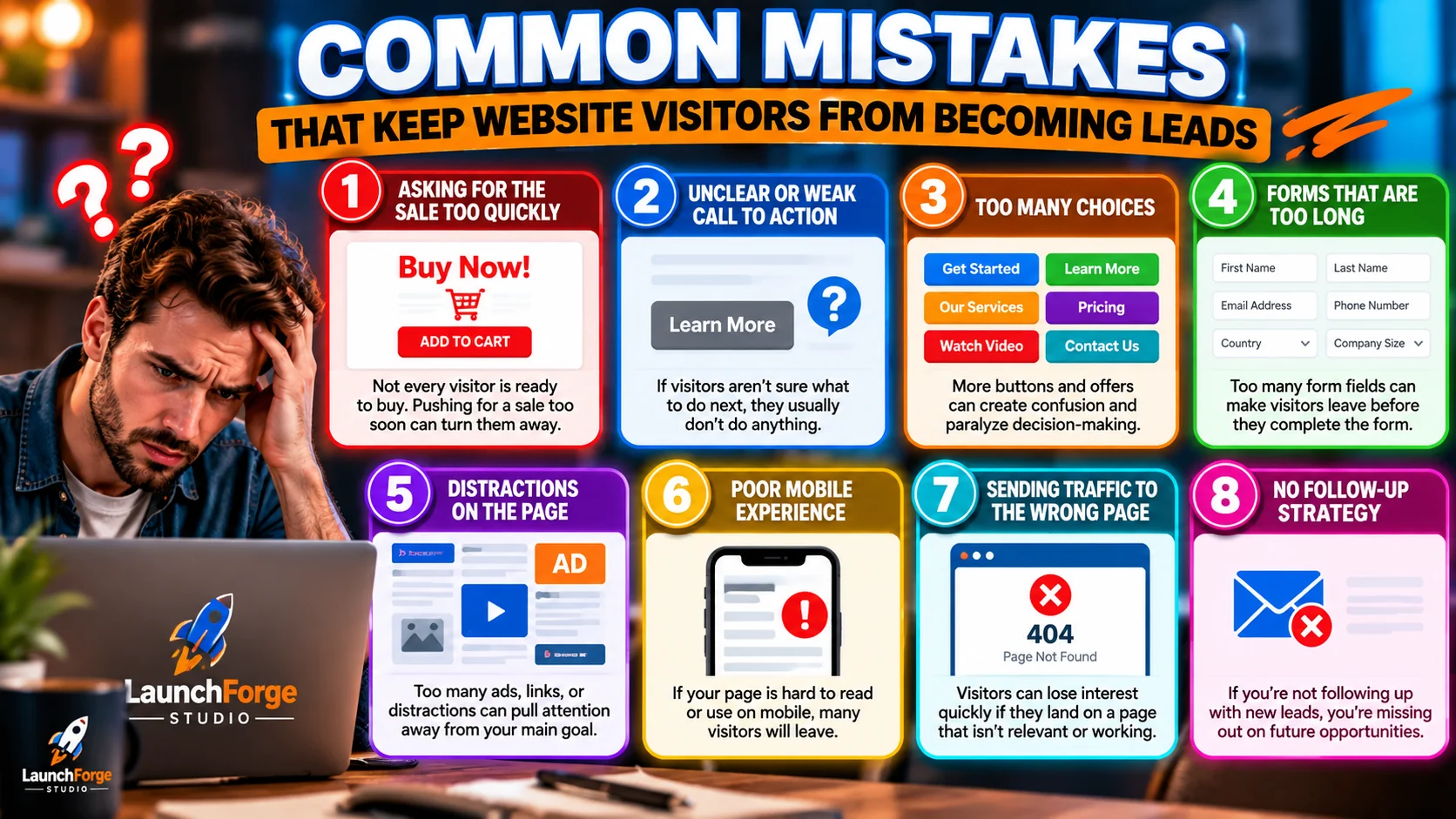
Weak calls to action, too many choices, long forms, distractions, and poor visitor experiences can prevent interested people from becoming leads.
Sometimes the problem isn’t that your website lacks opportunities to generate leads.
The problem is that those opportunities are working against the visitor instead of helping them move forward.
It’s easy to make conversion more complicated than it needs to be, especially when you’re trying to follow several different marketing strategies at once.
More forms, more buttons, more offers, and more aggressive calls to action don’t automatically create more leads.
In some cases, they create more confusion.
Knowing what to avoid can be just as useful as knowing what to add.
Asking for the Sale Too Quickly
Not every visitor who reaches your website is ready to buy.
Someone discovering your business for the first time may still be trying to understand their problem, explore possible solutions, or decide whether they trust the information they’re finding.
Immediately pushing that person toward a purchase can create too large of a jump.
This is especially important with educational content.
If someone arrives because they searched for an answer to a beginner question, give them the answer.
Help them.
Then provide a reasonable next step.
There will be places on your website where asking for the sale makes perfect sense.
But every visitor doesn’t need to be treated as if they’re standing at the checkout counter with their wallet already open.
Sometimes the better conversion is simply creating an opportunity to continue the relationship.
Using Weak or Vague Calls to Action
A call to action should help visitors understand what happens next.
Generic wording such as Click Here, Submit, or Learn More isn’t always wrong, but it can become unclear when the surrounding page doesn’t provide enough context.
The visitor shouldn’t have to guess what they’re clicking for.
Whenever possible, connect the action to the result.
Get the Free Guide is clearer than Click Here.
Request More Information communicates more than Submit.
Join the Email List tells the visitor exactly what they’re doing.
Clarity is more important than trying to make every button sound creative.
If people understand the next step, they can make an informed decision about whether they want to take it.
Offering Too Many Next Steps
One page doesn’t need to solve every marketing objective your business has.
Trying to get the same visitor to subscribe, buy, follow, download, register, contact you, watch a video, and read six other pages can weaken the action that matters most.
Decide what the primary goal of the page is.
Then make sure the other elements don’t overwhelm it.
This doesn’t mean removing every secondary option.
It means creating enough hierarchy that visitors can tell which action is most important.
If five different calls to action are all screaming for attention, none of them may receive it.
Asking for Too Much Information
Every form field should earn its place.
If you need information to fulfill the visitor’s request, ask for it.
If you don’t need it yet, consider whether collecting it is worth adding another step.
Someone requesting a detailed service quote may expect to answer several questions.
Someone downloading a simple checklist probably won’t.
Match the amount of information you’re requesting to the value and complexity of the action.
You don’t have to learn everything about a new lead during the first interaction.
Sometimes an email address and permission to continue the conversation are enough to begin.
Hiding Forms and Calls to Action
Visitors can’t take a next step they never see.
A form buried at the bottom of a long page may be missed by people who were ready to act much earlier.
A call to action that blends into everything around it may be overlooked.
And a visitor shouldn’t need to navigate through several pages just to find the opportunity you want them to take.
Review important pages from the perspective of someone who has never seen them before.
Is the next step visible?
Does it appear at a logical point?
Can someone understand what it does?
You don’t need to cover the page with buttons.
You simply need to make sure the important ones aren’t hiding.
Sending Every Visitor to the Same Place
Different visitors arrive with different needs.
Sending everyone toward one generic destination may ignore the reason they came to your website.
Someone reading about email marketing may respond to a different next step than someone researching website design.
A visitor interested in a particular service may need different information than someone who just discovered your educational content.
You don’t need a completely unique funnel for every person who visits.
But your conversion opportunities should have some relationship to the page and the visitor’s likely intent.
Relevance makes the next step easier to understand.
Ignoring Mobile Visitors
A conversion path that works beautifully on your computer can fall apart on a phone.
Forms can become awkward.
Buttons may be difficult to tap.
Popups can cover important content.
Spacing can push the call to action far down the page.
Even a small usability problem can become a bigger obstacle on a smaller screen.
Don’t assume that because your website is technically responsive, every conversion element provides a good mobile experience.
Test the important paths yourself.
Open the page on your phone.
Try the form.
Tap the buttons.
Follow the entire process from arrival to confirmation.
If something annoys you while you’re testing it, there’s a good chance it will annoy a visitor too.
Focusing on Traffic While Ignoring Conversion
More traffic can create more opportunities.
But sending more people into a weak conversion path doesn’t necessarily solve the underlying problem.
If 100 visitors reach a page and almost nobody understands what to do next, bringing another 1,000 visitors to the same page may simply create 1,000 more missed opportunities.
Traffic and conversion work together.
You need people to discover your website.
But once they arrive, the website needs to help interested visitors continue.
That’s why getting your first website visitors is only one part of building an online business.
The next question is what happens after those visitors arrive.
And once someone finally does take that step and becomes a lead, another stage of the relationship begins.
What Happens After a Visitor Becomes a Lead?
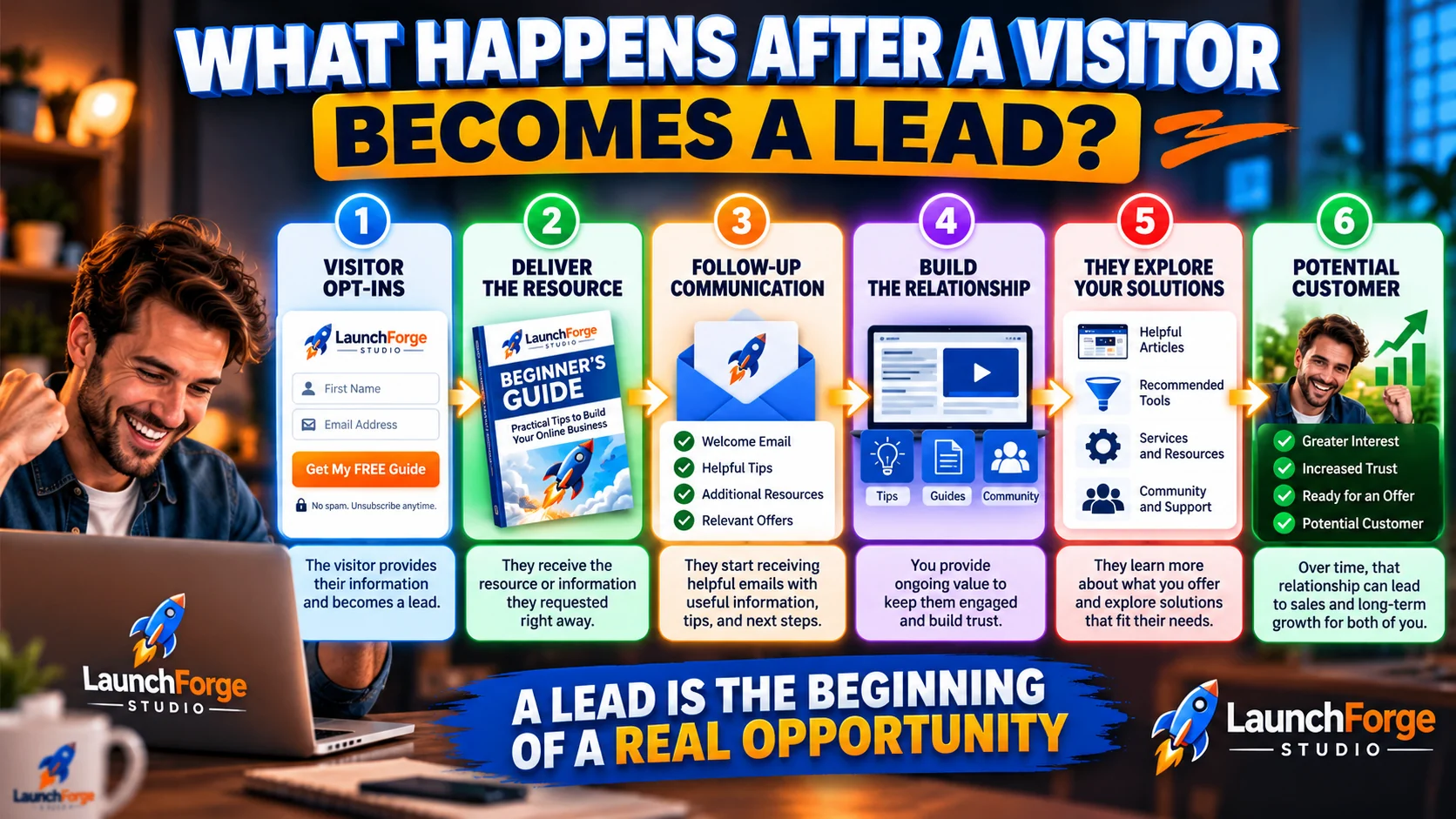
Becoming a lead is only the beginning of a relationship built through useful follow-up, continued value, and trust.
Getting a visitor to become a lead is an important step.
But it isn’t the end of the process.
The person has shown enough interest to take an action, but that doesn’t necessarily mean they’re ready to become a customer.
They may still have questions.
They may want to learn more.
They may need time to decide whether what you offer is right for them.
This is where the relationship begins to move beyond the website visit itself.
And what you do next can influence whether that initial interest continues or disappears.
Capturing the Lead Is Only the Beginning
It’s easy to focus so heavily on generating leads that you forget why you wanted those leads in the first place.
A name or email address sitting inside a contact list isn’t the ultimate goal.
The real opportunity is being able to continue communicating with someone who has already expressed an interest in your business.
That person has taken a step toward you.
Now you have an opportunity to keep providing value and help them determine whether there’s a reason to move forward.
This is also why lead quality matters more than simply collecting the largest number possible.
A smaller group of people who are genuinely interested in what your business offers can be much more valuable than a large list of people who signed up for something unrelated and never engage again.
The goal isn’t just to capture information.
It’s to begin a useful relationship.
Follow Up With a Clear Purpose
Once someone becomes a lead, your follow-up should connect naturally with the action they just took.
If they requested a resource, make sure they receive it.
If they asked for information, provide it.
If they registered for something, send the details they need.
If they joined your email list, begin delivering the kind of content you told them to expect.
That first interaction matters.
The visitor took action because you gave them a reason to believe something useful would happen next.
Follow through on that promise.
You don’t need to immediately bombard a new lead with promotional messages.
Start by delivering what they asked for and making the next part of the experience clear.
Continue Providing Value
A new lead may not be ready to become a customer today.
That doesn’t make the lead unsuccessful.
People make decisions at different speeds.
Some may need more information.
Others may want to see how consistently your business provides useful content.
Some may simply need the right solution at a later time.
Continuing to provide relevant value gives those people a reason to stay connected.
That could include educational emails, useful articles, new resources, answers to common questions, product or service information, or other content that makes sense for your audience.
The purpose is not to endlessly contact someone simply because you have their email address.
It’s to continue the relationship in a way that supports the reason they became a lead in the first place.
How you build that follow-up process deserves its own strategy.
For now, the important thing to understand is that converting a visitor into a lead creates an opportunity.
What happens after that determines what you do with it.
And if you’re just getting started, you don’t need to build an enormous conversion system across your entire website before you can begin seeing what works.
You can start much smaller.
Start Turning More of Your Visitors Into Leads
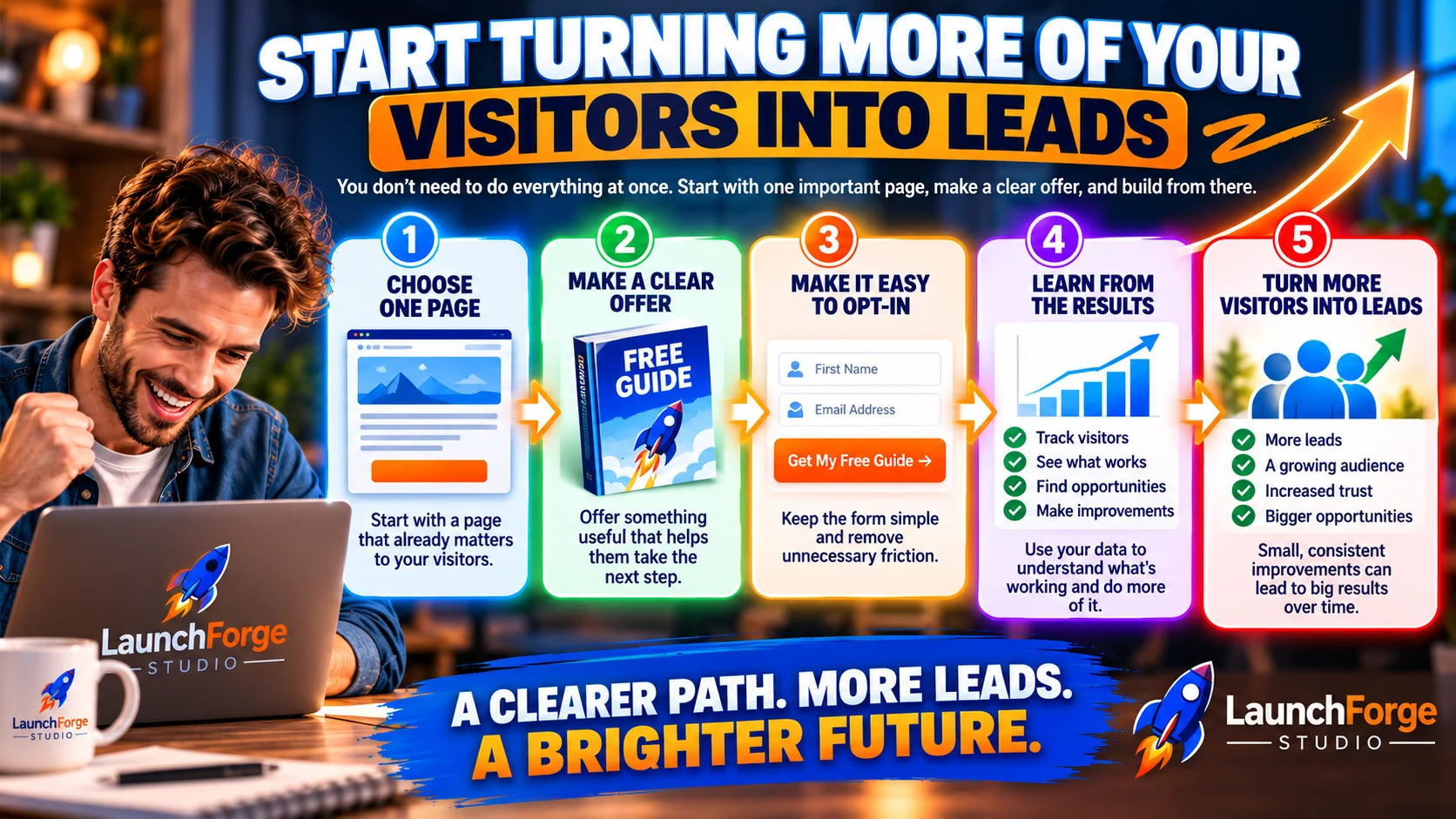
Start with one important page, create one clear next step, and improve the process as you learn what visitors respond to.
After everything we’ve covered, improving your website’s ability to generate leads might sound like a major project.
It doesn’t have to be.
You don’t need to redesign your entire website, create a dozen lead magnets, rebuild every form, or develop complicated conversion funnels before you can make progress.
Start with something smaller.
Choose one important page, decide what you want visitors to do, and make that next step as clear and useful as possible.
Then learn from what happens.
Start With One Important Page
Instead of trying to optimize your entire website at once, begin with one page that already matters.
That might be a popular article, an important service page, a landing page, or another page that regularly receives visitors.
Look at it from beginning to end.
Ask yourself whether a first-time visitor can understand what the page is about, recognize the value it provides, and identify a logical next step.
If those things aren’t clear, start there.
Improving one important page gives you something manageable to work with and something specific to measure.
Choose One Meaningful Conversion Goal
Decide what successful conversion means for that page.
Maybe you want visitors to join your email list.
Maybe you want them to request a useful resource.
Maybe the appropriate action is contacting your business or requesting additional information.
Choose the goal that makes sense for the visitor and the purpose of the page.
You don’t need every visitor to take every possible action.
You need the right visitors to recognize the next step that matters.
Create One Clear Next Step
Once you’ve chosen the goal, make the path toward it obvious.
Give visitors a reason to take action.
Use a clear call to action.
Ask only for the information you actually need.
Explain what happens afterward.
Then test the entire process yourself.
If you can move through it without confusion, you’ve created a much stronger starting point than simply adding more marketing elements and hoping something works.
Learn From What Your Visitors Do
Your first version doesn’t need to be perfect.
It needs to give you something to learn from.
Watch what happens.
Are people finding the page?
Are some of them taking the next step?
Does one offer seem to attract more interest than another?
Are there places where visitors appear to stop?
Use those observations to improve the experience gradually.
That’s how a conversion process becomes better over time.
You build something useful.
You see how real visitors respond.
You improve what needs attention.
Then you repeat the process.
Turning website visitors into leads doesn’t require mastering every conversion strategy before you begin.
It starts by giving one interested visitor a clear, worthwhile reason to take one meaningful next step.
And when you can consistently do that, website traffic begins to become much more than a number on an analytics screen.
Final Thoughts: Traffic Matters More When It Leads Somewhere
Getting people to your website matters.
Every visitor represents an opportunity for someone new to discover your content, learn about your business, explore what you offer, or find an answer they were searching for.
But traffic becomes much more valuable when those visitors have somewhere meaningful to go next.
That’s the difference between simply attracting attention and beginning to build a relationship.
You don’t need to turn every visitor into a lead.
You don’t need aggressive popups covering every page, complicated funnels behind every button, or dozens of different offers competing for attention.
You need to make the journey clear for the people who are genuinely interested.
Help them understand what you offer.
Give them something useful.
Show them a logical next step.
Remove unnecessary friction.
Give them reasons to trust you.
And when they decide they’re ready to continue, make it easy for them to do so.
Some visitors will take that step immediately.
Others may read several articles, return to your website multiple times, or spend weeks learning from you before they’re ready.
That’s okay.
Building an online business isn’t about forcing everyone through the same path at the same speed.
It’s about creating opportunities for the right people to move forward when the time makes sense for them.
Start with one important page.
Choose one meaningful conversion goal.
Create one clear next step.
Then pay attention to what happens and improve from there.
Your website doesn’t need to become a perfectly optimized conversion machine overnight.
It needs to become a little more useful, a little clearer, and a little easier for interested visitors to navigate toward the next step.
Because getting the visitor is only the beginning.
Giving that visitor a reason to stay connected is where the relationship starts.
Ready to Turn More Website Visitors Into Leads?
Getting traffic to your website is an important step.
But as you’ve seen throughout this guide, what happens after someone arrives matters just as much.
Your website, landing pages, forms, email marketing, automation, and follow-up all work better when they’re connected as part of the same business system.
And trying to piece all of those tools together separately can make building an online business more complicated than it needs to be.
That’s one of the reasons I use Profit Hub System to build LaunchForge Studio.
Profit Hub System brings many of the tools needed to build, market, and grow an online business into one platform, including websites, landing pages, funnels, email marketing, automation, lead generation tools, and more.
Instead of trying to assemble everything from a collection of disconnected services, you can build the foundation in one place and focus more of your time on creating value, attracting visitors, and turning those visitors into real opportunities.
If you’re looking for a simpler way to build the systems behind your online business, take a closer look at what Profit Hub System provides.