
Starting an online business can feel overwhelming, especially when you’re trying to figure out which opportunities are legitimate, which tools you actually need, and where to begin.
If you’ve been researching how to start affiliate marketing for beginners, you’ve probably encountered everything from helpful tutorials to bold promises about making money while you sleep.
Let’s clear something up right away: affiliate marketing is a legitimate business model, but it’s not a magic money machine. It requires learning, patience, consistency, and a willingness to provide genuine value to other people.
The good news? You don’t need to manufacture your own products, manage warehouses, or become a technology expert to get started.
Affiliate marketing allows you to recommend products or services offered by other businesses and potentially earn commissions when someone makes a qualifying purchase or completes another eligible action through your referral.
Sounds straightforward, right?
The basic concept is simple. Building a reliable system around it is where the real work begins.
And that’s exactly what we’re going to explore.
In this beginner-friendly guide, you’ll learn how affiliate marketing works, how to choose a niche, where to find affiliate programs, and how to build an online presence that attracts the right audience.
We’ll also explore websites, helpful content, traffic generation, email marketing, common beginner mistakes, and the realistic costs involved in getting started.
More importantly, we’ll look at how these pieces work together.
Because successful affiliate marketing isn’t simply about collecting referral links and scattering them across the internet like confetti at a parade.
It’s about understanding people’s needs, providing useful information, earning trust, and connecting the right person with the right solution.
Here at LaunchForge Studio, we believe that building an online business starts with a strong foundation. That means learning the fundamentals before spending money on unnecessary tools or chasing every exciting opportunity that comes along.
Whether you’re completely new to online marketing or you’ve already experimented with affiliate programs and aren’t sure what to do next, this guide will help you take a more organized approach.
Ready to learn how affiliate marketing works and how to build your first real strategy?
Let’s get started.
What Is Affiliate Marketing and How Does It Work?

Affiliate marketing connects businesses, helpful content creators, and interested customers through tracked referrals and qualifying commissions.
Affiliate marketing is a business model where an individual or company promotes another business’s products or services and earns a commission when someone completes a qualifying action through their referral.
That action might be purchasing a product, subscribing to a service, signing up for a trial, or completing another requirement established by the affiliate program.
In simple terms, you connect people with products or services that may help them, and the business compensates you when your referral meets its commission requirements.
You don’t necessarily need to create the product yourself, process customer payments, maintain inventory, or handle shipping.
Instead, your main responsibilities involve understanding your audience, recommending suitable solutions, creating useful content, and helping potential customers make informed decisions.
But there’s an important distinction.
Affiliate marketing isn’t simply about persuading someone to click a link.
It’s about becoming a useful resource for people who are researching solutions to real problems.
The Four Main Participants in Affiliate Marketing
Most affiliate marketing arrangements involve four participants.
1. The Merchant or Product Creator
This is the business that owns the product or service being promoted.
Merchants may sell physical products, software subscriptions, online courses, website hosting, business tools, or professional services.
For example, a company offering website-building software might operate an affiliate program that rewards approved partners for referring customers.
2. The Affiliate Marketer
That’s the person or business promoting the merchant’s offer.
An affiliate marketer might publish tutorials, product reviews, comparisons, educational videos, email newsletters, or helpful website content.
The goal is to introduce relevant solutions to people who may benefit from them.
3. The Customer
This is the person researching, evaluating, or purchasing a product or service.
Customers might discover an affiliate recommendation through a search engine, social media, a YouTube video, or an educational website.
A responsible affiliate marketer helps customers understand whether an offer fits their needs rather than pressuring them into making an unnecessary purchase.
4. The Affiliate Network or Tracking Platform
Some merchants manage their own affiliate programs, while others use third-party affiliate networks.
These systems typically provide referral links, tracking technology, reporting dashboards, and commission records.
When someone follows an affiliate link, tracking technology may help the merchant attribute a qualifying action to the appropriate affiliate.
Not every referral results in a commission. Programs have specific eligibility rules, attribution methods, and payment conditions.
A Simple Example of Affiliate Marketing in Action
Imagine someone wants to start an online business but has never built a website.
They search Google for information about choosing a website-building platform.
During their research, they discover a helpful article explaining what beginners should look for in a website builder.
The article discusses features such as ease of use, hosting, page design, support, pricing, and marketing integrations.
It also introduces a website-building platform that the author has personally researched or used.
The article includes a clearly disclosed affiliate link to that platform.
Here’s what might happen next:
- The visitor reads the article and decides the platform meets their needs.
- They click the affiliate link to learn more.
- They review the merchant’s offer and make a qualifying purchase.
- The affiliate tracking system attributes the eligible sale to the referring affiliate.
- The affiliate may earn a commission according to the program’s terms.
The visitor gets access to a product they’ve chosen, the merchant gains a customer, and the affiliate receives compensation for an eligible referral.
That’s the basic concept.
However, commissions aren’t guaranteed, and the tracking and payment rules vary between programs.
How Do Affiliate Marketers Actually Make Money?
Affiliate programs use different compensation structures.
Pay Per Sale (PPS)
The affiliate earns a commission when a referred customer completes a qualifying purchase.
This is a common model for software, digital products, online services, and physical goods.
Pay Per Lead (PPL)
The affiliate may receive compensation when a referred visitor completes a qualifying action, such as submitting an eligible inquiry or signing up for an approved service.
Not every registration counts as a payable lead. Each program defines its own requirements.
Recurring Commissions
Some subscription-based businesses pay affiliates for qualifying customer renewals or ongoing subscriptions.
Recurring commissions can be attractive, but they depend on the program’s policies, customer retention, and continued eligibility. They should never be treated as guaranteed future income.
Fixed-Amount Commissions
Some programs offer a set payment for each qualifying referral rather than calculating compensation as a percentage of the sale.
Understanding these different structures matters because two affiliate programs offering similar products may have very different payment terms.
A higher advertised commission doesn’t automatically make one program better.
Product quality, customer support, refund policies, reputation, and relevance to your audience are equally important considerations.
Why Affiliate Marketing Appeals to Beginners
One reason affiliate marketing attracts new entrepreneurs is that it allows people to explore online business without developing an original product first.
Instead of spending months creating software or building a product line, a beginner can focus on understanding a particular audience and recommending existing solutions.
Other potential advantages include:
- Lower initial overhead: You may be able to start with relatively modest expenses, depending on your chosen approach.
- Flexible content options: Websites, blogs, videos, newsletters, and social platforms can all support affiliate marketing.
- A wide range of niches: Affiliate programs exist across many industries and interests.
- Opportunities to develop valuable skills: Content creation, search engine optimization, audience research, and digital marketing are useful beyond affiliate promotions.
- Room for gradual growth: Beginners can start with a focused topic and expand their content as their skills and understanding improve.
But there’s another side to the equation.
Affiliate marketing can be highly competitive. Traffic may take time to develop, commissions may be inconsistent, and some programs change their terms or discontinue offers.
Many beginners earn little or nothing, particularly during the early stages.
That’s why it’s important to approach affiliate marketing as a business activity that requires ongoing work rather than a guaranteed source of income.
Affiliate Marketing Works Best When Trust Comes First
Let’s say you’re comparing two websites that recommend the same business tool.
The first website repeatedly tells you to buy immediately, offers little useful information, and claims the software will make you rich.
The second explains the tool’s features, discusses its limitations, identifies who it may be suitable for, and provides realistic examples.
Which website would you feel more comfortable trusting?
For most people, the second approach offers considerably more value.
That’s the philosophy we’re building around here at LaunchForge Studio.
Help people understand their options first. Let informed decisions follow.
Being transparent about affiliate relationships is part of that trust. If you might earn a commission from a recommendation, that relationship should be disclosed clearly and conspicuously.
You should also avoid promising results that a product cannot reliably deliver.
A sustainable affiliate marketing strategy depends on providing useful information, maintaining credibility, and developing content that continues helping readers over time.
And once you understand how affiliate marketing works, the next question becomes much more practical:
How do you actually get started?
That’s where we’ll turn the concept into a step-by-step plan.
How to Start Affiliate Marketing: 10 Steps for Beginners
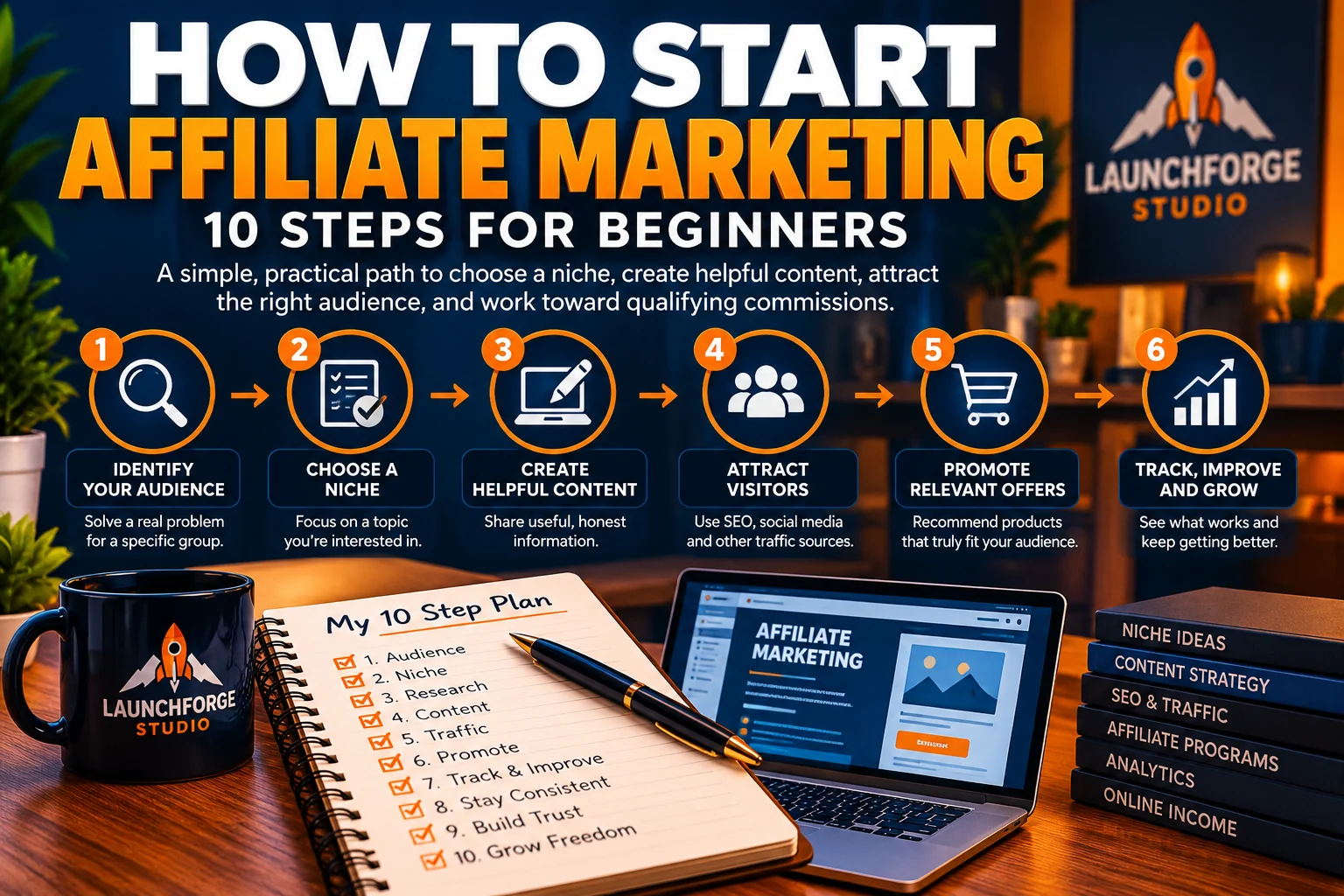
A practical affiliate marketing roadmap starts with understanding your audience, choosing a niche, creating helpful content, and building consistently.
Learning how to start affiliate marketing for beginners becomes much easier when you break the process into manageable steps.
You don’t need to build a complicated website, subscribe to a dozen marketing platforms, and join twenty affiliate programs before you’ve even figured out whom you want to help.
In fact, trying to do everything at once is one of the fastest ways to become overwhelmed.
A better approach is to build your affiliate marketing business one piece at a time.
The following ten steps provide a practical roadmap for going from an initial idea to a basic affiliate marketing system.
Step 1: Identify the Audience You Want to Help
Before choosing an affiliate product, think about the people you want to reach.
What problems do they experience?
What questions are they asking?
What products or services might help them achieve a particular goal?
For example, you might want to help:
- Beginners building their first website.
- Small business owners trying to attract customers online.
- People looking for affordable productivity software.
- New content creators learning video editing.
- Homeowners researching practical improvement projects.
Each audience has specific needs, challenges, and buying considerations.
Your goal is to understand those needs before attempting to recommend anything.
A common beginner mistake is finding an affiliate program with a large advertised commission and then trying to convince everyone to purchase the product.
That approach often leads to unfocused marketing.
Instead, start with a defined audience and identify offers that genuinely relate to their interests.
The more clearly you understand whom you’re helping, the easier it becomes to create useful content.
Step 2: Choose a Specific Affiliate Marketing Niche
A niche is a focused subject area that connects your content with a particular audience.
For example, “technology” is an enormous category.
“Affordable website-building tools for first-time business owners” is much more specific.
That narrower topic gives you a clearer direction for research, content creation, and product recommendations.
When evaluating a potential niche, consider three questions:
Do you have an interest in the subject?
You don’t need to be an expert, but you should be willing to research, learn, and discuss the topic regularly.
Are people actively looking for information about it?
Search engines, online communities, product marketplaces, and frequently asked questions can help reveal what people want to know.
Are there legitimate products or services that address those needs?
A niche with interesting topics but few suitable products may provide limited affiliate opportunities.
On the other hand, a niche with hundreds of products but little personal interest can become exhausting to maintain.
The objective is to find a reasonable balance between audience needs, product availability, and your willingness to create helpful content.
Don’t spend months searching for a mythical perfect niche.
Choose a promising direction, research it carefully, and refine your focus as you learn.
Step 3: Research Affiliate Programs Before Joining
Once you’ve chosen your niche, begin researching companies that offer relevant products or services.
Some businesses operate their own affiliate programs. Others manage their programs through affiliate networks.
Before applying, look beyond the advertised commission amount.
Consider:
- Product quality and customer reviews.
- The company’s reputation and support.
- Commission structure and eligibility requirements.
- Payment thresholds and payout schedules.
- Tracking and attribution rules.
- Refunds, cancellations, and commission reversals.
- Restrictions on advertising methods.
- Whether the program accepts beginners or requires an established audience.
For example, a program advertising a generous commission might seem attractive until you discover that its payment requirements are difficult to meet or its customers frequently request refunds.
A smaller commission from a reputable company offering a genuinely useful product may be a better fit.
Choose affiliate partners based on audience value and business credibility, not commission size alone.
Also remember that an affiliate application isn’t always approved automatically.
Some programs review your website, traffic sources, content quality, or marketing experience before allowing you to participate.
That’s another reason to build a credible online presence early.
Step 4: Select One Primary Offer to Understand Thoroughly
New affiliate marketers sometimes join multiple programs immediately because they don’t want to miss an opportunity.
Before long, they’re juggling different products, tracking links, dashboards, and promotional messages.
Meanwhile, they haven’t developed a clear understanding of any single offer.
A more manageable starting point is to choose one primary product or service that fits your audience.
Study its features, pricing, limitations, intended customers, and alternatives.
If you can reasonably use the product yourself, firsthand experience may help you create more informative content.
However, never claim personal experience you don’t actually have.
If you’re recommending something based on research rather than firsthand use, be transparent about that distinction.
Ask yourself:
What problem does this product solve, and who should probably avoid buying it?
That second question is especially valuable.
Knowing who a product isn’t suitable for can make your recommendations more credible.
You can expand into complementary products later, once you’ve established a useful foundation.
Step 5: Choose Where You’ll Publish Your Content
You don’t necessarily need a website to begin affiliate marketing.
Some affiliates use YouTube, social media, newsletters, or other platforms that permit affiliate promotions.
However, each approach has advantages and limitations.
A social media account may provide a convenient starting point, but your reach depends partly on the platform’s policies and algorithms.
A YouTube channel can support demonstrations and tutorials, but producing quality videos requires time and effort.
An email newsletter helps you maintain contact with consenting subscribers, but you still need a reliable method for attracting them.
A website gives you greater control over how you organize your content, display your recommendations, and guide visitors toward additional resources.
For beginners who want to develop a long-term educational presence, building a website around a focused niche is often worth considering.
That doesn’t mean you need an elaborate website with fifty pages.
A simple structure might include:
- A homepage explaining whom you help.
- An About page establishing your purpose and background.
- A collection of useful guides or articles.
- Relevant product reviews and comparisons.
- A contact method and appropriate legal disclosures.
The goal is to create a useful home for your content, not to impress visitors with unnecessary complexity.
Step 6: Create Helpful Content Before Focusing on Sales
Content is how many affiliate marketers attract potential customers and establish credibility.
But not all content serves the same purpose.
Someone searching “what is a landing page” is usually looking for an explanation.
Someone searching “best landing page builder for beginners” may be comparing products.
And someone searching for a particular software platform’s pricing may be closer to making a purchase decision.
These different searches reflect different stages of the customer journey.
A balanced affiliate content strategy can include:
Educational Articles
Explain basic concepts, answer common questions, and help readers develop useful knowledge.
Step-by-Step Tutorials
Show people how to complete specific tasks, solve problems, or understand a process.
Product Reviews
Examine a product’s features, benefits, drawbacks, pricing, and suitability for different users.
Product Comparisons
Help readers understand meaningful differences between competing solutions.
Troubleshooting Guides
Address problems that people encounter while using particular tools or completing specific projects.
For example, a website about beginner email marketing could explain how email lists work, demonstrate how to create signup forms, and review tools that help manage subscriber communication.
Each piece of content supports a different informational need.
The key is to create articles that would still provide value even if a reader never clicks an affiliate link.
That’s how you begin building an audience that has a reason to return.
Step 7: Learn How to Attract Relevant Visitors
Even excellent affiliate content needs an audience.
Traffic generation is the process of helping people discover your website, videos, newsletters, or other resources.
Beginners commonly explore several traffic sources.
Search Engine Optimization (SEO)
Create helpful pages targeting subjects and search questions relevant to your audience.
Search engines may discover, index, and display those pages when users search for related information.
Organic search traffic can take time to develop, and rankings aren’t guaranteed.
Social Media
Share useful information, participate in relevant discussions, and introduce interested people to your content.
The objective should be meaningful engagement rather than repeatedly posting promotional links.
Email Marketing
Invite interested visitors to subscribe voluntarily so you can provide useful follow-up information.
Online Communities
Participate in communities where your audience asks questions, while respecting each community’s rules about promotion.
Paid Advertising
Some affiliates use paid traffic to test offers or reach specific audiences.
However, paid advertising introduces financial risk. Advertising expenses can easily exceed commissions, particularly when you’re still learning.
For beginners with limited budgets, starting with useful content and carefully selected promotional methods may be more manageable than immediately paying for large advertising campaigns.
Whatever traffic method you choose, measure the quality of your visitors rather than focusing only on the number of clicks.
A hundred genuinely interested visitors can be more useful than thousands of people who have no interest in your subject.
Step 8: Give Interested Visitors a Reason to Stay Connected
Most visitors won’t make a purchase the first time they encounter a recommendation.
Some are still researching. Others need more information or simply aren’t ready to act.
That’s normal.
Instead of expecting every visitor to make an immediate decision, consider creating a way for interested readers to stay connected.
An email newsletter is one option.
You might offer a helpful resource, such as:
- A beginner’s checklist.
- A short planning workbook.
- A practical tutorial.
- A product comparison worksheet.
- A downloadable guide addressing a common problem.
Visitors who want that resource can choose to subscribe.
From there, you can send useful information, practical tips, relevant educational articles, and occasional product recommendations.
Your emails should accurately explain what subscribers are signing up for and provide a straightforward way to unsubscribe.
The purpose of follow-up communication is to continue helping people, not to pressure them into purchasing something.
A thoughtful email sequence can strengthen relationships over time.
And it can help you avoid the exhausting cycle of constantly searching for new visitors while forgetting about the people who’ve already shown interest.
Step 9: Track What Works and Improve Your Strategy
Affiliate marketing involves experimentation.
You may publish a detailed tutorial that attracts steady visitors but generates few affiliate clicks.
Another article might receive less traffic yet attract readers who are actively comparing products.
Without measuring performance, it’s difficult to understand the difference.
Useful metrics include:
Website Traffic
How many people visit your content, and where do they come from?
Search Impressions and Clicks
Are your pages appearing in search results, and are people choosing to visit them?
Affiliate Link Clicks
Which articles or recommendations encourage readers to investigate the products you discuss?
Conversions
How many referred visitors complete qualifying actions reported by your affiliate programs?
Commissions and Expenses
How much eligible revenue is actually earned, and what does it cost to operate your marketing activities?
Subscriber Growth
Are interested visitors choosing to stay connected through your email list?
Be careful when interpreting results.
A high click count doesn’t necessarily mean an article is profitable.
A large email list doesn’t automatically indicate an engaged audience.
And a single commission payment doesn’t prove a marketing campaign will continue performing at the same level.
Look for patterns over time.
Then improve the pages, recommendations, and traffic methods that appear most promising.
Step 10: Build a Repeatable Routine and Stay Consistent
Once you’ve established the basics, your next challenge is consistency.
You don’t need to work around the clock to make progress.
You do need a realistic routine that fits your schedule and responsibilities.
For example, a beginner working a full-time job might organize the week around a few manageable activities:
- Researching questions that potential readers are asking.
- Creating or improving one useful piece of content.
- Sharing that content through an appropriate promotional channel.
- Reviewing basic traffic and engagement data.
- Learning more about the products being recommended.
The exact routine matters less than whether you can maintain it.
Many beginners become discouraged because they expect substantial traffic or commission income after publishing only a handful of articles.
But building a useful website, developing search visibility, and earning audience trust can take considerable time.
There is no universal timeline for success.
Some approaches may never become profitable, and results depend on many factors outside your control.
That’s why you should evaluate progress realistically, keep operating costs manageable, and avoid spending money based on unverified income promises.
Success comes from hard work, but hard work also needs direction, patience, and a willingness to learn.
At LaunchForge Studio, that’s the approach we’re working to demonstrate: build a useful foundation, test practical methods, and improve as experience grows.
Putting the Ten Steps Together
These ten steps aren’t ten unrelated tasks.
They’re parts of one connected process.
You identify an audience, choose a niche, research suitable products, and build a place where people can find helpful information.
Then you create content, attract relevant visitors, develop relationships, measure results, and continue improving.
You don’t have to master every step before getting started.
And you certainly don’t need to purchase every marketing tool advertised to beginners.
Start with the essentials.
Understand what you’re building and why.
Then add new capabilities when you have a clear reason to use them.
Affiliate marketing becomes easier to manage when you stop treating it as a collection of random promotional tactics and start treating it as a connected business system.
Now that we’ve covered the overall process, let’s examine one of the most important decisions you’ll make: choosing affiliate products that are genuinely worth recommending.
How to Choose Affiliate Products Worth Promoting
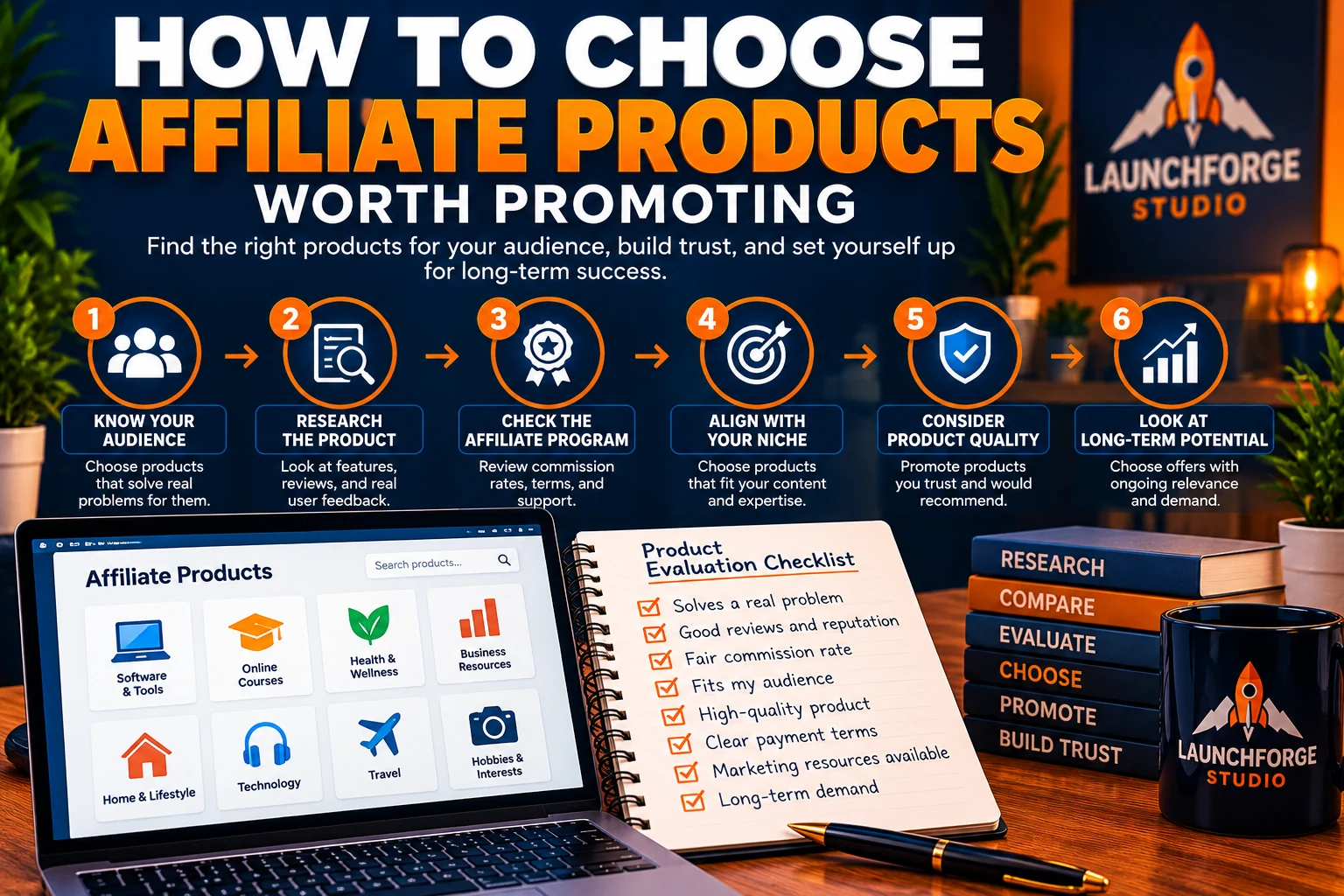
Choose affiliate products based on audience needs, trustworthy companies, product quality, and clear commission terms—not just the highest payout.
Choosing the right affiliate products can make a significant difference in how useful your content becomes and how effectively your affiliate marketing strategy serves your audience.
It’s tempting to join a program offering a large commission and immediately start promoting it.
After all, who wouldn’t be interested in earning more for each qualifying referral?
But there’s a problem with choosing products based entirely on their advertised commissions.
A generous commission means very little if the product doesn’t solve a genuine problem, the company provides poor support, or your audience has no reason to purchase it.
When learning how to start affiliate marketing for beginners, product selection should be treated as a business decision rather than a race to find the highest payout.
Your reputation is connected to the products you recommend.
That’s why it’s worth taking the time to evaluate potential affiliate offers before introducing them to your readers.
Start With Your Audience’s Problems, Not the Commission
The best starting point is understanding what people need help with.
Imagine your website focuses on helping beginners establish an online business.
Your readers might be trying to:
- Create their first website without hiring a developer.
- Build a landing page that explains an offer clearly.
- Collect email subscribers and follow up with them.
- Understand how sales funnels work.
- Find affordable marketing tools.
- Attract relevant visitors without wasting money on advertising.
These are specific problems that different products or services may help address.
A website-building platform might be relevant to someone who needs a website.
An email marketing service might help someone who’s ready to organize subscribers.
A traffic-related service might be worth investigating once a beginner understands their audience and has somewhere useful to send visitors.
However, recommending all three immediately could overwhelm someone who hasn’t even chosen a niche.
A suitable affiliate product should match the reader’s current needs, not simply your desire to earn a commission.
This distinction is important because beginners often have limited budgets and may not understand which tools are necessary at different stages.
Helping them avoid unnecessary purchases can actually strengthen your credibility.
Evaluate the Product Before You Recommend It
Before promoting a product, investigate what it actually delivers.
Start with the company’s official website, product documentation, pricing information, and support resources.
Then examine independent feedback where available.
Consider the following questions:
What problem does the product solve?
A useful product should have a clearly defined purpose.
If its marketing materials rely heavily on vague promises without explaining what customers actually receive, that’s a reason to investigate further.
Who is the product designed for?
A sophisticated marketing platform might be excellent for experienced businesses but unnecessarily complicated for someone building their first landing page.
Likewise, a basic beginner tool might not meet the needs of an established organization.
What does the customer actually receive?
Look beyond promotional headlines.
Review included features, usage limits, technical requirements, and whether essential functions require additional purchases.
How much does it cost over time?
A low introductory price can look attractive until renewal fees, upgrades, or required add-ons enter the picture.
Consider both immediate and ongoing costs.
What happens if something goes wrong?
Customer support, documentation, refund policies, and cancellation procedures can influence the customer experience.
A product isn’t necessarily a good recommendation simply because it works well when everything goes according to plan.
Personal Experience Can Make Your Content More Valuable
One advantage of reviewing products you’ve actually used is that you can discuss details that promotional pages may overlook.
For example, suppose you’ve spent time using a traffic-generation platform.
Instead of repeating its sales claims, you could explain:
- How the account setup works.
- Which advertising features you’ve tested.
- Whether the interface is beginner-friendly.
- What limitations you’ve encountered.
- What types of users might benefit from the service.
- Which features require additional payment.
This kind of firsthand information can help readers evaluate the product more realistically.
But personal experience doesn’t mean every review needs to be positive.
In fact, explaining what you dislike about a product can be just as useful as describing its strengths.
At LaunchForge Studio, that’s an important part of how we approach reviews of marketing tools.
A balanced review should help readers decide whether something fits their needs—even when that decision is not to purchase it.
And if you haven’t personally used a product, don’t pretend otherwise.
You can still publish research-based comparisons or educational overviews, provided you’re transparent about the sources and limitations of your assessment.
Understand the Affiliate Program’s Payment Terms
Once you’ve determined that a product may be suitable for your audience, examine the affiliate agreement.
Different programs can have very different rules.
Some pay a percentage of qualifying sales.
Others provide fixed commissions, recurring payments, or compensation for approved leads.
But the advertised commission amount rarely tells the whole story.
Pay attention to:
Attribution Windows
Some programs use tracking windows to determine whether a referral qualifies for credit. Others have different attribution rules or restrictions.
Minimum Payout Thresholds
A program may require you to accumulate a certain amount of approved commissions before receiving payment.
Commission Approval
Sales may remain pending while the merchant checks eligibility, refunds, cancellations, or other conditions.
Payment Schedules
A qualifying commission might not be paid immediately. Programs may issue payments weekly, monthly, or according to another schedule.
Promotional Restrictions
Some merchants prohibit certain advertising methods, paid search terms, email tactics, or uses of their brand names.
Changes to Program Terms
Commission rates and participation requirements can change. A merchant may also discontinue its affiliate program.
These details matter because a commission shown in an affiliate dashboard is not necessarily money available in your bank account.
Beginners should avoid budgeting around expected affiliate earnings before those commissions are approved and paid.
Compare the Total Value, Not Just the Payout
Imagine two affiliate programs offering website-building services.
The first advertises a larger commission but provides limited documentation, confusing pricing, and poor customer support.
The second pays a smaller commission but offers a clearer product, accessible training materials, responsive support, and pricing that fits your audience’s budget.
Which one should you recommend?
There’s no universal answer, but the commission alone shouldn’t decide.
Consider the complete customer experience.
A product that helps your audience achieve a practical goal can support a more trustworthy long-term content strategy.
You should also consider whether the service fits naturally into the educational topics your website already covers.
For example, if your content teaches beginners about websites, landing pages, email follow-up, and marketing automation, an integrated business platform might be worth evaluating.
But an all-in-one platform isn’t automatically the best choice for everyone.
Some beginners may prefer individual tools, while others may benefit from having multiple functions within one system.
The appropriate recommendation depends on features, costs, limitations, and the customer’s circumstances.
Watch for Warning Signs Before Promoting an Offer
Affiliate marketers need to protect their audiences from misleading products and questionable business opportunities.
Potential warning signs include:
- Promises of guaranteed income or effortless financial success.
- Unverifiable earnings testimonials.
- Pressure to purchase immediately without understanding the offer.
- Hidden subscription charges or unclear refund conditions.
- Products that provide little practical value beyond recruitment.
- Misleading claims about what software or training can accomplish.
- Difficulty finding credible information about the company.
Not every unfamiliar product is a scam, and a high commission isn’t automatically suspicious.
However, unusual claims deserve careful scrutiny.
Remember that your credibility can suffer when you recommend a product that turns out to be misleading or unsuitable.
Taking time to investigate offers is part of treating affiliate marketing responsibly.
Build a Small Collection of Relevant Offers
You don’t need dozens of affiliate partnerships to build a useful website.
In many cases, a carefully selected group of complementary products provides a clearer experience for readers.
For example, a beginner-focused online business website might eventually discuss:
- A website-building or hosting solution.
- An email marketing platform.
- A landing page or funnel builder.
- Analytics and performance tools.
- Relevant traffic-generation services.
These categories address different parts of an online business.
However, you should only recommend tools that are relevant to your content and that you’ve evaluated sufficiently.
Avoid adding products simply because another affiliate marketer is promoting them.
And periodically review existing recommendations to make sure product details, pricing, and affiliate links remain accurate.
The objective isn’t to create the largest collection of affiliate links on the internet.
It’s to develop a useful collection of resources your audience can evaluate with confidence.
Make Your Affiliate Relationships Clear
Transparency is essential when recommending products that may generate commissions.
Readers deserve to know when you have a financial relationship with the business you’re discussing.
Under U.S. Federal Trade Commission guidance, material connections that could affect how people evaluate an endorsement should be clearly and conspicuously disclosed.
For affiliate content, that generally means providing an understandable disclosure near the relevant recommendation, rather than relying entirely on a disclosure hidden elsewhere on the website.
A straightforward statement might say:
This article contains affiliate links. If you purchase through one of these links, we may earn a commission.
The exact disclosure should accurately reflect your relationship with the merchant and how the promotion works.
Transparency doesn’t weaken an honest recommendation.
It helps readers understand the relationship and make informed decisions.
The Best Affiliate Product Is One You Can Recommend With Confidence
Let’s bring everything together.
A worthwhile affiliate offer generally has several things going for it:
It addresses a real audience need, delivers identifiable value, comes from a business you’ve reasonably investigated, and has terms you understand.
Just as importantly, it’s something you can discuss honestly.
You should be comfortable explaining its limitations, identifying whom it may not suit, and recommending alternatives when appropriate.
Because building trust is more important than squeezing a commission out of every visitor.
When your readers believe your recommendations are thoughtful and transparent, you establish a stronger foundation for future content.
And once you’ve selected products worth promoting, another important question follows:
Where should you build the online presence that introduces people to those products?
Do You Need a Website to Start Affiliate Marketing?

A website offers greater control over content and branding, while social media and video platforms provide alternative ways to begin affiliate marketing.
One of the most common questions beginners ask is whether they need a website to start affiliate marketing.
The short answer is no, a website isn’t always required.
Some affiliate marketers promote products through YouTube, social media, email newsletters, and other approved marketing channels without operating a traditional website.
However, just because you can start without a website doesn’t necessarily mean it’s the best long-term approach for your particular goals.
If you’re serious about building an educational presence, developing credibility, and creating content that people can discover over time, having your own website offers several advantages.
The important thing is understanding what each approach can realistically accomplish.
Starting Affiliate Marketing Without a Website
You can begin exploring affiliate marketing through several online platforms.
For example, you might create videos demonstrating products, publish educational social media posts, or build a newsletter around a specific topic.
Each method provides a way to connect with potential customers.
YouTube
Video content can be useful for product demonstrations, tutorials, comparisons, and firsthand reviews.
A viewer researching software might appreciate watching someone explain its features and show how it works.
Affiliate links may be included where permitted, along with clear disclosures.
Social Media
Platforms such as Facebook, Instagram, and other social networks can help creators share educational content and engage with interested audiences.
However, promotional rules vary, and repeatedly posting affiliate links without providing value can discourage potential readers.
Email Newsletters
An email newsletter can help you share useful information and recommendations with people who have voluntarily subscribed.
You’ll still need an effective way to attract subscribers and comply with applicable email marketing requirements.
Online Communities
Relevant communities can help you understand what people are asking and which problems they encounter.
The best approach is to participate genuinely and respect each community’s promotional rules.
Regardless of the platform you choose, verify that both the platform and your affiliate program permit your intended promotional methods.
Some affiliate programs require an approved website or restrict particular traffic sources.
Why Having Your Own Website Can Be Valuable
Social platforms and third-party services can provide useful exposure, but they don’t offer the same level of control as a website you manage.
A website allows you to organize educational material, publish detailed reviews, develop topic-specific resources, and connect related articles.
For example, imagine someone discovers your article explaining how landing pages work.
That person might also be interested in learning how to build a landing page, collect email subscribers, or compare landing page software.
Instead of sending them to unrelated promotional messages, your website can guide them toward additional resources addressing those questions.
This creates a more useful experience for visitors and gives your content a consistent home.
A website may also offer several practical benefits:
- Greater control over content: You decide how your educational resources are organized and presented.
- Search visibility opportunities: Helpful pages may appear in relevant search results, although rankings and traffic aren’t guaranteed.
- Clearer branding: Your website can communicate what your business stands for and whom it serves.
- Organized affiliate recommendations: You can connect appropriate offers to relevant educational content.
- Email list integration: Interested visitors can subscribe to receive additional information.
- Room to expand: Your website can support future guides, digital products, services, or additional resources.
Of course, managing a website still involves hosting costs, maintenance, security, and ongoing content development.
Owning a website doesn’t eliminate the need to attract visitors or earn their trust.
You Don’t Need a Complicated Website to Begin
A common mistake is assuming that an affiliate marketing website must look like a large corporate platform before it can become useful.
That’s simply not the case.
A beginner can start with a modest website focused on one clear subject.
For example, a website about beginner-friendly productivity tools might initially contain a homepage, an About page, several educational articles, and a few carefully researched product reviews.
As the content library grows, additional tutorials and comparisons can support related questions.
The key is to create something organized and genuinely useful.
A website with ten thoughtful articles can provide more value than a website with a hundred rushed promotional pages.
Avoid spending weeks perfecting decorative features while neglecting the information your visitors actually need.
A straightforward layout, readable content, intuitive navigation, and mobile-friendly design are more important than unnecessary complexity.
Should Beginners Start With a Website or Social Media?
There’s no universal answer because people have different skills, budgets, schedules, and interests.
If you’re comfortable creating videos, YouTube might be a natural starting point.
If you already have an engaged social media audience, you may prefer to develop educational content there while learning more about affiliate marketing.
If you enjoy writing, researching, and building organized resources, a website may be especially appealing.
You can also combine approaches.
For instance, you might publish a detailed tutorial on your website and share a short explanation through social media.
The social post introduces the topic, while your website provides the more complete resource.
An interested reader may then decide to explore other articles or subscribe to your newsletter.
The best starting platform is one that fits your capabilities and that you can maintain consistently.
Don’t feel obligated to build every channel simultaneously.
Choose a manageable approach and expand when you have a clear reason to do so.
Our Approach at LaunchForge Studio
LaunchForge Studio is an example of building an educational website around a focused group of related subjects.
Rather than creating a separate promotional page for every product, we’re developing resources that explain websites, landing pages, sales funnels, traffic generation, email marketing, and other practical business topics.
That approach allows readers to explore different aspects of building an online business at their own pace.
We also review selected marketing tools and business platforms when they’re relevant to the subjects we’re discussing.
The goal isn’t to persuade every visitor to purchase something.
It’s to help people understand their options and make informed decisions.
We use an integrated website and marketing platform to support our own operations, but that doesn’t mean every beginner needs the same setup.
Your tools should support your strategy, budget, and current stage of development.
And whether you begin with a website, videos, social media, or a combination of channels, remember that your long-term value comes from the information and experience you provide—not simply the platform you use.
The Bottom Line: A Website Is Optional, but a Strategy Isn’t
You can start affiliate marketing without building a website.
However, you still need a defined audience, relevant products, an approved promotional channel, useful content, and a realistic approach to attracting interested people.
For beginners who want to build a long-term educational resource, a website can become a valuable foundation.
It gives your articles, tutorials, comparisons, and recommendations a place to work together.
And that brings us to the next question:
If you decide to build a website, how do you turn it into a helpful resource around your affiliate offers instead of another collection of sales pages?
How to Build an Authority Website Around Your Affiliate Offers

An affiliate authority website connects useful guides, honest reviews, internal links, and audience relationships into one organized educational resource.
An authority website is a website that aims to become a useful, credible resource within a particular subject area.
Instead of focusing exclusively on selling products, it provides educational articles, tutorials, comparisons, and practical information that help visitors solve problems.
For affiliate marketers, this approach offers an important opportunity.
You can build an entire educational experience around the problems your affiliate products are designed to solve.
That doesn’t mean creating hundreds of articles just to make your website look impressive.
It means publishing relevant, trustworthy content that supports a clear audience and purpose.
Start With One Core Subject
Imagine you’re promoting a platform that helps people build websites, create landing pages, and manage online marketing activities.
You could simply publish a sales page encouraging visitors to purchase the platform.
But what happens when someone doesn’t understand landing pages, email marketing, or sales funnels?
They may leave because they aren’t ready to make a decision.
An authority-building approach starts by answering those questions.
For example, you could publish educational content about:
- Creating a website for a small business.
- Understanding landing pages and their different purposes.
- Building a basic sales funnel.
- Collecting email subscribers.
- Developing an email follow-up strategy.
- Measuring website performance and conversions.
These subjects naturally relate to the platform you’re discussing.
More importantly, they help visitors understand what they’re trying to accomplish before evaluating the tools available to them.
Organize Your Website Into Related Content Topics
A useful authority website shouldn’t feel like a collection of unrelated articles.
Think of your content as a connected library.
Start with a broad educational guide covering an important subject. Then develop supporting articles that answer more specific questions.
For example, a comprehensive guide to building a website might connect to tutorials on choosing hosting, designing pages, improving navigation, and optimizing mobile performance.
This approach is sometimes described as a topic cluster.
A topic cluster consists of a central subject supported by related content that explores individual aspects in greater detail.
Internal links help readers discover those resources and help search engines understand relationships between pages.
However, simply creating topic clusters doesn’t guarantee higher rankings.
Your content still needs to be accurate, useful, original, and responsive to what people are actually searching for.
Combine Educational Content With Buyer-Intent Articles
Not every visitor arrives at your website ready to purchase something.
Some are learning basic concepts.
Others are comparing solutions.
And some are researching a specific product because they’re considering a purchase.
An effective authority website can serve all three audiences.
Educational content introduces concepts and solves common problems.
Product comparisons help visitors understand differences between available solutions.
Detailed reviews explore particular products, including their advantages, limitations, costs, and suitability.
This creates opportunities to connect readers with relevant information without turning every article into an advertisement.
For example, someone reading about email marketing might eventually want to compare email automation tools.
A relevant internal link can guide that reader toward a helpful comparison.
The recommendation follows the reader’s interests rather than interrupting the educational experience.
Use Your Experience to Make Content More Valuable
One of the strongest ways to differentiate your website is to incorporate genuine observations from your own work.
That might include describing how you configured a website, explaining the challenges you encountered while building a funnel, or sharing what you learned from testing a marketing tool.
You don’t need extraordinary results to offer useful insights.
Sometimes explaining what didn’t work is more helpful than presenting an idealized success story.
At LaunchForge Studio, we’re developing our website using the same types of tools and strategies we discuss in our educational content.
That gives us opportunities to share practical examples while remaining transparent about our experience and results.
Real learning, honest observations, and useful explanations can help establish credibility over time.
Build Trust Before Expecting Commissions
An authority website doesn’t become authoritative simply because its owner calls it one.
Trust develops through consistent actions.
Publish accurate information. Update outdated material. Explain limitations. Disclose affiliate relationships. Correct mistakes when you discover them.
And when a product isn’t suitable for a particular reader, be willing to say so.
Your objective should be to create a website that people find helpful regardless of whether they make a purchase.
As your content library grows, visitors may begin discovering your website through different search questions and educational topics.
Some may eventually explore your product recommendations.
Others may subscribe to your newsletter or return for another article.
None of those outcomes is guaranteed, but they provide a practical foundation for developing a long-term online presence.
The goal isn’t simply to promote an affiliate offer. It’s to build something valuable around the audience that offer is intended to serve.
Once you’ve established that foundation, the next challenge is helping the right visitors discover your content.
How to Get Traffic to Your Affiliate Content

Explore different ways to attract relevant visitors to affiliate content, from search engines and social media to email marketing and performance tracking.
Creating helpful affiliate content is an important first step, but people still need a way to discover it.
Traffic generation is where many beginners become frustrated. They publish a few articles, share some links, and expect visitors to arrive immediately.
Unfortunately, attracting an audience rarely works that way.
The goal isn’t simply to generate more clicks. It’s to attract people who are genuinely interested in the information and solutions you’re providing.
Focus on Search Intent Before Traffic Volume
Before choosing a traffic strategy, consider why someone would visit your content.
A person searching for “how affiliate marketing works” probably wants to learn the basics.
Someone searching for “best affiliate marketing website builders” may be comparing different tools.
And someone searching for a particular platform’s pricing is likely researching a more specific purchasing decision.
These differences matter.
A successful traffic strategy connects the right content with the right audience at the appropriate stage of their research.
Instead of targeting every popular keyword, identify questions your website can answer particularly well.
Start With One or Two Traffic Sources
Beginners often spread themselves too thin by attempting to master search engine optimization, social media, paid advertising, video marketing, and email promotion simultaneously.
A more manageable approach is to select one primary traffic source and one supporting channel.
For example, you might focus on publishing useful, search-optimized articles while sharing those resources through social media.
As you gain experience, you can explore other promotional methods.
Whatever approach you choose, remember that traffic quality matters more than impressive-looking visitor counts.
A visitor who genuinely needs your information is more valuable to your strategy than someone who clicks an advertisement out of curiosity and immediately leaves.
Measure Traffic and Improve What Already Exists
You don’t always need another article to improve your website’s performance.
Sometimes the best opportunity is updating content you’ve already published.
Review your website analytics and search performance to identify:
- Articles attracting search impressions but relatively few clicks.
- Pages appearing for relevant queries but ranking below prominent search positions.
- Tutorials that could benefit from clearer explanations or updated examples.
- Articles that would be more helpful with links to related educational resources.
Tools such as Google Search Console can help you understand which searches are exposing your pages to potential visitors.
However, search visibility doesn’t guarantee traffic, and traffic doesn’t guarantee affiliate commissions.
Use the information to make thoughtful improvements rather than chasing every fluctuation in your statistics.
Think Beyond the First Visit
Attracting visitors is only part of the process.
Once someone arrives, provide an easy way to explore related resources.
Clear navigation, relevant internal links, useful recommendations, and optional email subscriptions can help interested readers continue learning.
Avoid overwhelming visitors with aggressive promotions or unnecessary distractions.
At LaunchForge Studio, our objective is to connect educational content with the tools and resources readers may need as they progress.
Instead of constantly asking how to get more traffic, also ask how to provide more value to the visitors you’re already attracting.
That simple shift can make your entire affiliate marketing strategy more purposeful.
Frequently Asked Questions About Starting Affiliate Marketing
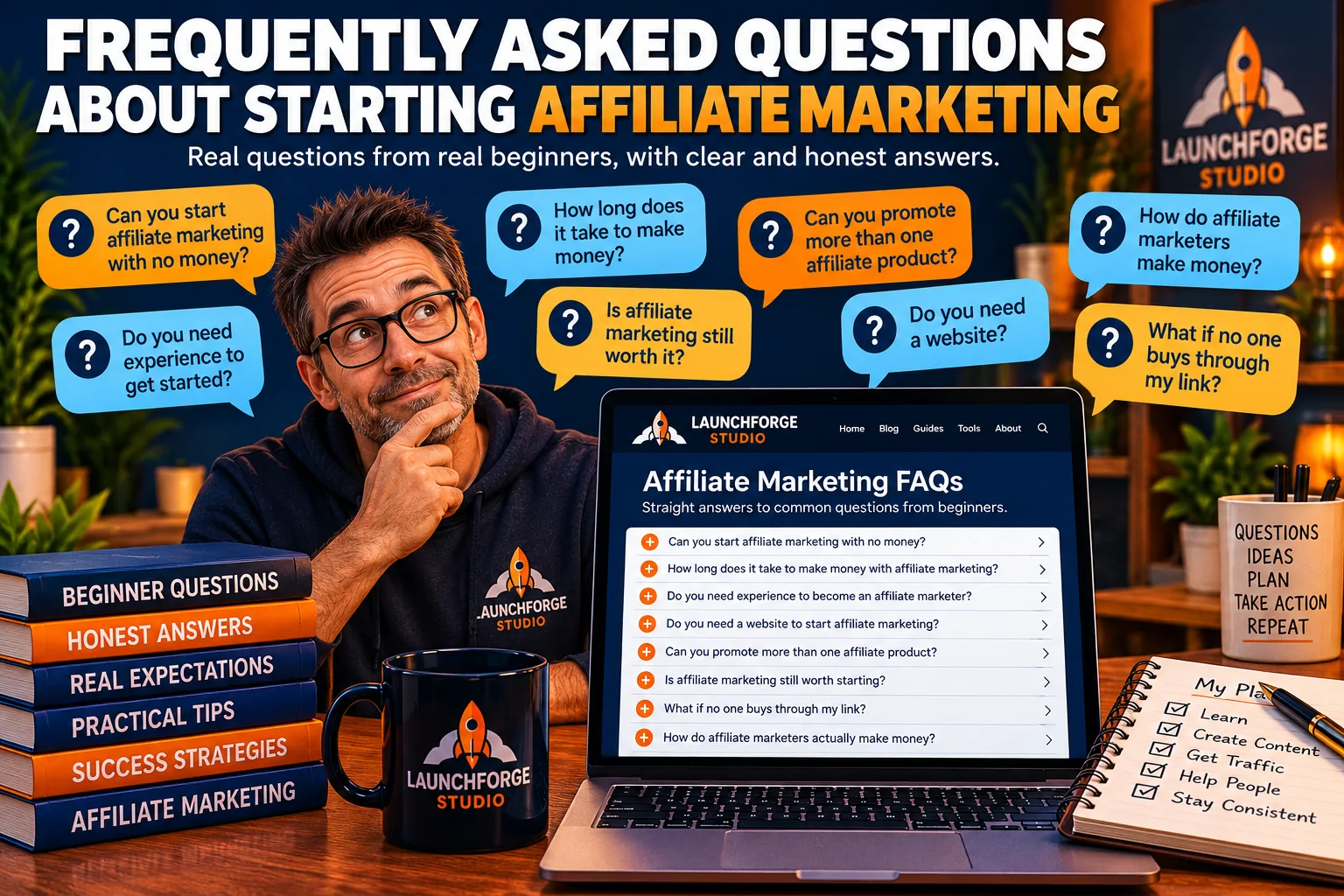
Answers to common beginner questions about affiliate marketing, including costs, experience, earning commissions, and building a realistic strategy.
Can You Start Affiliate Marketing With No Money?
It’s possible to begin creating affiliate content using free platforms, but costs may arise as your business develops. Website hosting, domain registration, email marketing tools, and advertising are examples of potential expenses. Start with what you can afford and avoid borrowing money based on expectations of future commissions.
How Long Does It Take to Make Money With Affiliate Marketing?
There’s no guaranteed timeline. Some beginners earn commissions relatively quickly, while others spend months developing content and attracting visitors without generating income. Results depend on audience interest, competition, traffic quality, and the relevance of your recommendations.
Do You Need Experience to Become an Affiliate Marketer?
No previous marketing experience is necessarily required. However, you’ll need to develop skills such as audience research, content creation, product evaluation, and traffic generation. Beginners can learn these skills gradually through practice.
Can You Promote More Than One Affiliate Product?
Yes, provided your affiliate programs permit your promotional methods. However, beginners often benefit from focusing on one primary offer before introducing complementary products. Relevance and quality matter more than the number of programs you join.
Is Affiliate Marketing Still Worth Starting?
Affiliate marketing can be a legitimate way to build an online business, but it isn’t guaranteed to be profitable. It’s most worth considering when you’re interested in helping a particular audience, willing to learn, and prepared to invest consistent effort without expecting immediate results.
Final Thoughts: Build Trust Before You Chase Commissions

Successful affiliate marketing begins with helping people, earning trust, and consistently providing genuine value—not chasing quick commissions.
Learning how to start affiliate marketing for beginners isn’t about discovering a secret formula or finding the highest-paying referral program.
It’s about understanding an audience, recommending suitable solutions, and creating useful content that helps people make informed decisions.
Start with one niche. Research your products carefully. Choose a manageable publishing platform and focus on delivering genuine value.
As your experience grows, you can expand your content, improve your traffic strategy, and build systems that support your long-term goals.
Remember that progress isn’t always measured by commissions. Developing practical skills, learning from mistakes, and earning audience trust are meaningful achievements too.
At LaunchForge Studio, we believe that successful online businesses are built through patience, integrity, consistent effort, and a willingness to help others.
Build trust first. Let your recommendations earn their place. And keep moving forward—one practical step at a time.