
Learning how to get traffic to your online business is one of the first challenges every new online business owner faces.
If you’ve ever built a website and then wondered where the hell everybody was, you’re not alone.
Getting an online business up and running is one thing.
Getting people to actually find it is another.
You can have a great website, useful information, a product or service you’re proud of, and a business model that makes sense. But none of those things matter very much if nobody knows your business exists.
That’s where traffic comes in.
Traffic is what brings people to your website, landing pages, content, offers, and other parts of your online business.
And if you’re just getting started, this is where things can become confusing.
Search for ways to get traffic and you’ll find recommendations for SEO, social media, content marketing, email marketing, paid advertising, traffic exchanges, referrals, online communities, video, and plenty of other strategies.
Before long, you can start thinking you need to do all of them.
You don’t.
One of the biggest mistakes a beginner can make is trying to build a traffic strategy around every method available before understanding which ones actually make sense for their business.
I’ve learned that building an online business becomes much more manageable when you stop trying to do everything at once.
The goal isn’t to get every possible visitor.
The goal is to get the right people to discover your business.
From there, you need somewhere useful to send them, a clear next step, and a way to continue the relationship with the people who are genuinely interested.
That’s what we’re going to look at in this article.
We’ll break down the major ways you can get traffic to your online business, what each traffic source is actually good for, the difference between free and paid traffic, and how to decide where you should focus your time and money.
We’ll also look at something that’s easy to overlook:
Getting traffic is only the beginning.
What happens after someone arrives can be just as important as getting them there in the first place.
You don’t need thousands of visitors tomorrow.
You need to start building a repeatable way for the right people to find you.
And you can build that process one piece at a time.
What Is Online Business Traffic?
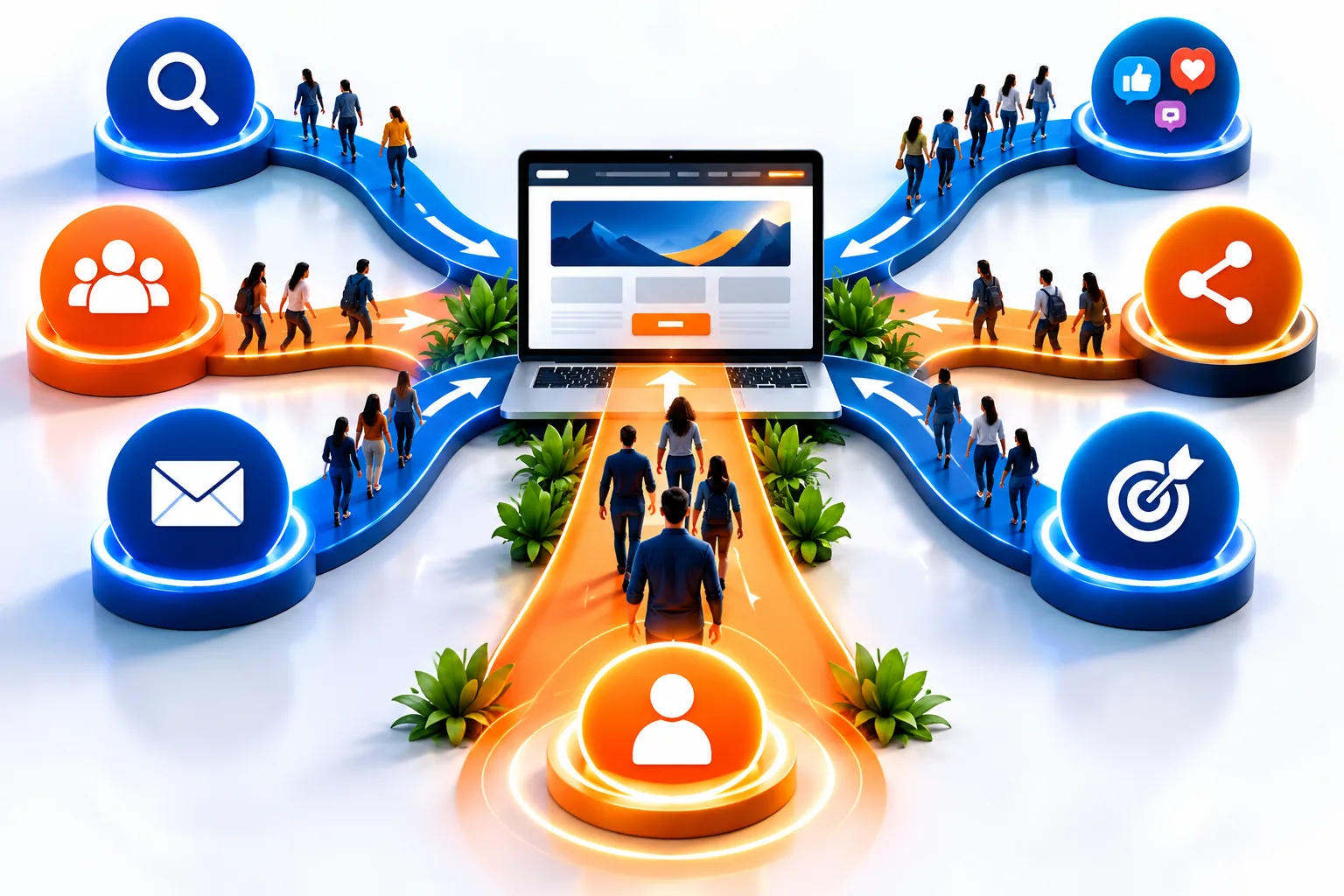
Online business traffic can come from multiple sources and lead visitors toward your website.
At its simplest, online business traffic is the people who visit your website or interact with something you’ve put online.
Someone searches for an answer on Google and finds one of your articles.
That’s traffic.
Someone sees one of your social media posts and clicks through to your website.
That’s traffic too.
Someone receives an email from you and clicks a link.
Someone finds your website through a referral.
Someone clicks on an advertisement.
All of those people are arriving through different traffic sources, but they have one thing in common:
They found their way to your business.
That sounds simple enough, but there’s an important distinction that every online business owner should understand.
Traffic is not the same thing as leads.
And traffic is certainly not the same thing as customers.
Traffic Is the Beginning, Not the Destination
Think about what happens when someone visits your website.
They may read an article and leave.
They may look around your website and come back later.
They may sign up for your email list.
They may click through to an offer.
They may contact you.
Or they may become a customer.
The visitor’s first interaction with your business is simply the beginning of the journey.
You can think of it like this:
Traffic → Interest → Action → Lead → Customer
Not every visitor will make it all the way through that process.
That’s normal.
Someone might need several visits before they trust your business enough to take action. Someone else might be ready to buy the first time they discover you.
Your job isn’t to force every visitor to become a customer.
Your job is to give the right visitors a reason to continue.
Why More Traffic Isn’t Always Better
This is where the idea of “more traffic” can become misleading.
Imagine you have two websites.
The first website receives 5,000 visitors in a month, but almost none of them are interested in what the business offers.
The second website receives 500 visitors, but those visitors are actively looking for the type of information, product, or service the business provides.
Which website has the better traffic?
The second one may.
Five thousand visitors sounds impressive.
But if those visitors have no interest in the business, the number doesn’t mean much.
Meanwhile, 500 relevant visitors can create opportunities for conversations, leads, sales, referrals, and relationships.
That’s why you shouldn’t judge your traffic strategy only by the number of people arriving.
You also need to consider who those people are and why they’re visiting.
The Right Traffic Matters
Imagine that you sell website design services for small businesses.
Getting your website in front of 10,000 people who have absolutely no interest in building a website isn’t necessarily a great result.
Getting your website in front of 500 business owners who are actively trying to improve their online presence could be much more valuable.
The difference is relevance.
Good traffic has some connection to what you’re offering.
The visitor may have a problem you can help solve.
They may be searching for information you provide.
They may already be interested in your industry.
They may have discovered your business through someone they trust.
Whatever the source, there is a reason for the visitor to be there.
That gives you an opportunity.
Traffic Can Come From Many Different Sources
One of the best things about building an online business is that you’re not limited to one way of attracting people.
You can build traffic through search engines.
You can publish helpful content.
You can use social media.
You can build an email list.
You can develop referral relationships.
You can participate in relevant communities.
You can create videos.
You can use paid advertising.
You can experiment with traffic platforms and networks.
Some of these methods cost money.
Some primarily require time.
Some can produce results relatively quickly.
Others can take months to build momentum.
There isn’t one traffic source that is automatically right for every business.
The best traffic strategy depends on your audience, your resources, your goals, and what you’re actually trying to accomplish.
That’s why the next step isn’t to run out and try everything.
It’s to understand the major traffic sources and what each one can do for you.
Once you understand that, you can make much better decisions about where to put your time and effort.
Your Website Needs a Reason to Receive Traffic
There’s one more thing worth remembering.
Traffic doesn’t exist in isolation.
You can spend hours trying to attract visitors, but eventually those visitors need somewhere useful to go.
Your website should explain what you do.
Your content should provide value.
Your landing pages should have a purpose.
Your offers should make sense.
And visitors should have a clear next step when they’re ready to take one.
That’s what turns traffic from a simple visitor count into something that can actually support a business.
Traffic brings people to the door.
What you do after they arrive determines what happens next.
And once you understand that, getting traffic becomes much more than simply trying to make your website more popular.
It becomes part of a larger system for getting your business discovered, building relationships, generating leads, and eventually creating customers.
Where Does Online Business Traffic Come From?
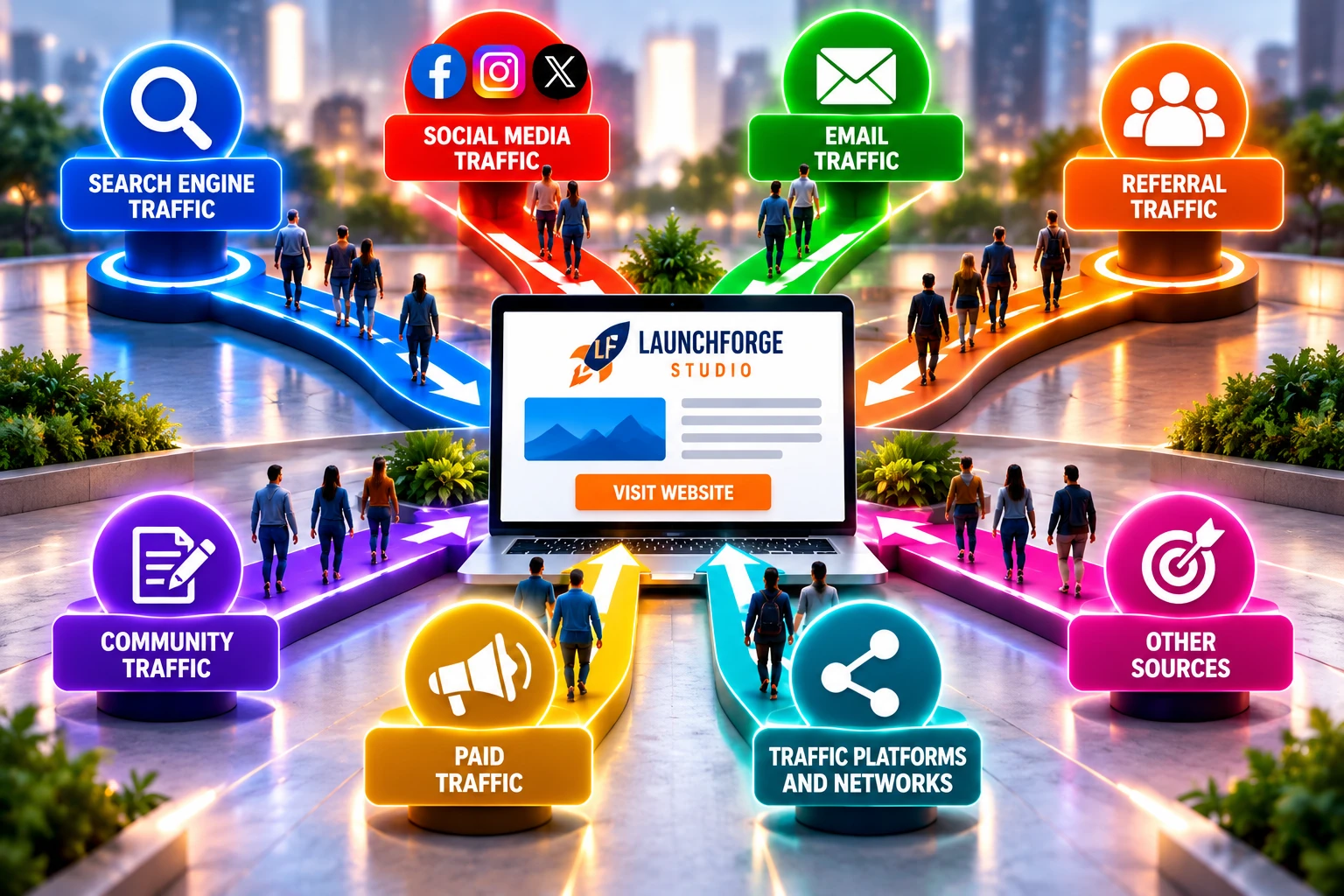
Online business traffic can come from search, social media, email, referrals, communities, paid traffic, and other sources.
Once you understand what traffic actually is, the next question is obvious:
Where do these people come from?
There are more traffic sources available today than most beginners realize.
That can be both good and bad.
It’s good because you have options.
It’s bad because seeing dozens of different traffic methods can make you feel like you need to use all of them.
You don’t.
A better approach is to understand the major categories first and then decide which ones make sense for your business.
Search Engine Traffic
Search engine traffic comes from people actively searching for information.
Someone might search for:
- how to start an online business
- how to build a business website
- how to create a landing page
- how to generate leads
- how to get traffic to a website
If your content answers that question and appears in the search results, the person may click through to your website.
This type of traffic can be particularly valuable because the visitor has already demonstrated an interest in a specific topic.
The challenge is that building search traffic generally takes time.
You need useful content, a website that search engines can understand, and consistency.
You shouldn’t expect to publish one article today and suddenly have thousands of visitors tomorrow.
Search traffic is often a long-term traffic asset.
Social Media Traffic
Social media can put your business in front of people who may never have discovered your website through a search engine.
You can share:
- Articles
- Tips
- Short-form content
- Videos
- Images
- Questions
- Educational information
- Offers
The important thing is that your social media activity should give people a reason to pay attention.
Simply posting a link and saying “Buy this” over and over isn’t necessarily going to build much interest.
Helpful content can create curiosity.
Curiosity can create a click.
And that click can bring someone back to your website.
Social media can also help you build familiarity with your audience over time.
Email Traffic
Email is another powerful source of traffic because you aren’t starting from zero every time you want someone to visit your website.
When someone voluntarily joins your email list, you have an opportunity to communicate with that person again.
You can send them:
- Helpful information
- New articles
- Resources
- Recommendations
- Updates
- Offers
The important word here is relationship.
Your email list isn’t simply a collection of addresses.
It’s an audience you’ve been given permission to communicate with.
That makes email especially useful when you’re building a business over the long term.
Referral Traffic
Referral traffic happens when someone discovers your business through another website, person, organization, or online resource.
For example, another website might mention one of your articles and link to it.
A business owner might recommend your website to someone they know.
A creator might mention your resource in a video or social media post.
The visitor isn’t finding you because they searched for your website directly.
They’re finding you because someone or something else pointed them in your direction.
That can make referral traffic particularly interesting because the recommendation itself can provide a degree of credibility.
Community Traffic
Online communities can also become a source of visitors.
Depending on your industry, that could include forums, discussion groups, professional communities, social groups, or other places where people gather around a common interest.
The key is participation.
If you join a community solely to drop promotional links everywhere, people will notice.
Instead, contribute something useful.
Answer questions.
Share experiences.
Point people toward helpful resources when appropriate.
Build a reputation for actually being helpful.
Traffic can follow naturally from that participation.
Paid Traffic
Paid traffic is another option.
Instead of waiting for people to discover your content organically, you pay to put your message in front of an audience.
This can include different forms of online advertising and paid traffic services.
The obvious advantage is speed.
You can potentially put an offer in front of people much faster than waiting for organic traffic to develop.
But speed comes with responsibility.
If you pay for traffic without understanding your audience, your offer, your landing page, or your conversion process, you can spend money without getting the result you want.
Paid traffic should therefore be approached as a business investment rather than simply buying clicks.
Traffic Platforms and Networks
There are also dedicated traffic platforms and networks designed specifically to help businesses and marketers generate exposure.
These can provide another way to get your website, landing page, or offer in front of people.
Some focus on specific types of traffic.
Others combine different promotional methods.
The important thing is to understand what you’re actually receiving.
A large number of clicks doesn’t automatically mean a large number of customers.
Before using any traffic source, you should understand its audience, delivery method, costs, targeting options, and what you’re ultimately trying to accomplish with the traffic.
You Don’t Need Every Traffic Source
This is probably the most important lesson in this entire section.
You don’t need to use every traffic source available.
In fact, trying to do that can become another form of tool overload.
You could spend your entire week creating social posts, writing articles, sending emails, testing advertisements, joining communities, purchasing traffic, creating videos, and experimenting with another dozen methods.
At the end of the week, you might have been incredibly busy without making meaningful progress.
Instead, choose a few traffic sources that make sense for your business.
Learn them.
Use them consistently.
Measure what happens.
Then improve.
You can always add another traffic source later.
Your goal isn’t to be everywhere.
Your goal is to be where the right people can find you.
Start With the Traffic You Can Actually Manage

A simple traffic strategy is easier to manage, measure, and improve.
Knowing where traffic comes from is useful.
Knowing where to start is even more useful.
One of the easiest mistakes to make when you’re building an online business is trying to pursue every traffic source at the same time.
You see someone talking about SEO.
Someone else says you need short-form video.
Another person tells you email is the answer.
Then you hear about paid advertising, traffic exchanges, solo ads, social media, communities, referrals, and dozens of other strategies.
Before you know it, you’re spending more time researching traffic than actually creating it.
That’s not the goal.
The goal is to choose a traffic approach you can realistically maintain.
Start With What Fits Your Business
There isn’t one traffic source that is automatically perfect for every online business.
Your choice depends on what you’re selling, who you’re trying to reach, how much time you have available, and whether you have a budget for paid promotion.
For example, someone who enjoys writing may naturally gravitate toward content and search traffic.
Someone who enjoys creating videos may find social platforms and video content more appealing.
Someone with an established email list may have an entirely different starting point.
And someone with a marketing budget may choose to test paid traffic much earlier.
None of these approaches is inherently wrong.
The important thing is choosing something you can actually work consistently.
Don’t Confuse Activity With Traffic
This distinction is easy to overlook.
You can spend hours working on your business without actually putting your business in front of anyone.
You can redesign your website.
Change your logo.
Install another plugin.
Rewrite your homepage.
Research another marketing strategy.
Watch another tutorial.
And at the end of the day, you may have accomplished a lot of work without generating a single new visitor.
That’s why traffic needs to become an actual activity rather than something you hope happens eventually.
If your goal is to get visitors, you need to spend some of your time doing things that can reasonably put your business in front of people.
That might mean publishing an article.
Sharing useful content.
Sending an email.
Creating a video.
Participating in a relevant community.
Promoting a landing page.
Testing a paid traffic source.
The specific activity can vary.
The principle doesn’t.
You need to consistently create opportunities for people to discover you.
Pick One or Two Primary Traffic Sources
You don’t have to build your entire traffic strategy around one method forever.
But when you’re starting out, narrowing your focus can make the process much easier.
Choose one or two primary traffic sources.
Then give them enough attention to determine whether they can work for your business.
For example, you might decide that your initial strategy will be:
Content + Social Media
You create useful articles on your website and then use your social channels to help distribute that content.
Or perhaps:
Email + Content
You publish helpful information and use your email list to bring people back to your website.
Another business might choose:
Paid Traffic + Landing Pages
The business sends targeted traffic to a landing page and measures what happens next.
The point isn’t which combination you choose.
The point is that you have a deliberate starting point.
Give Your Traffic Strategy Time to Work
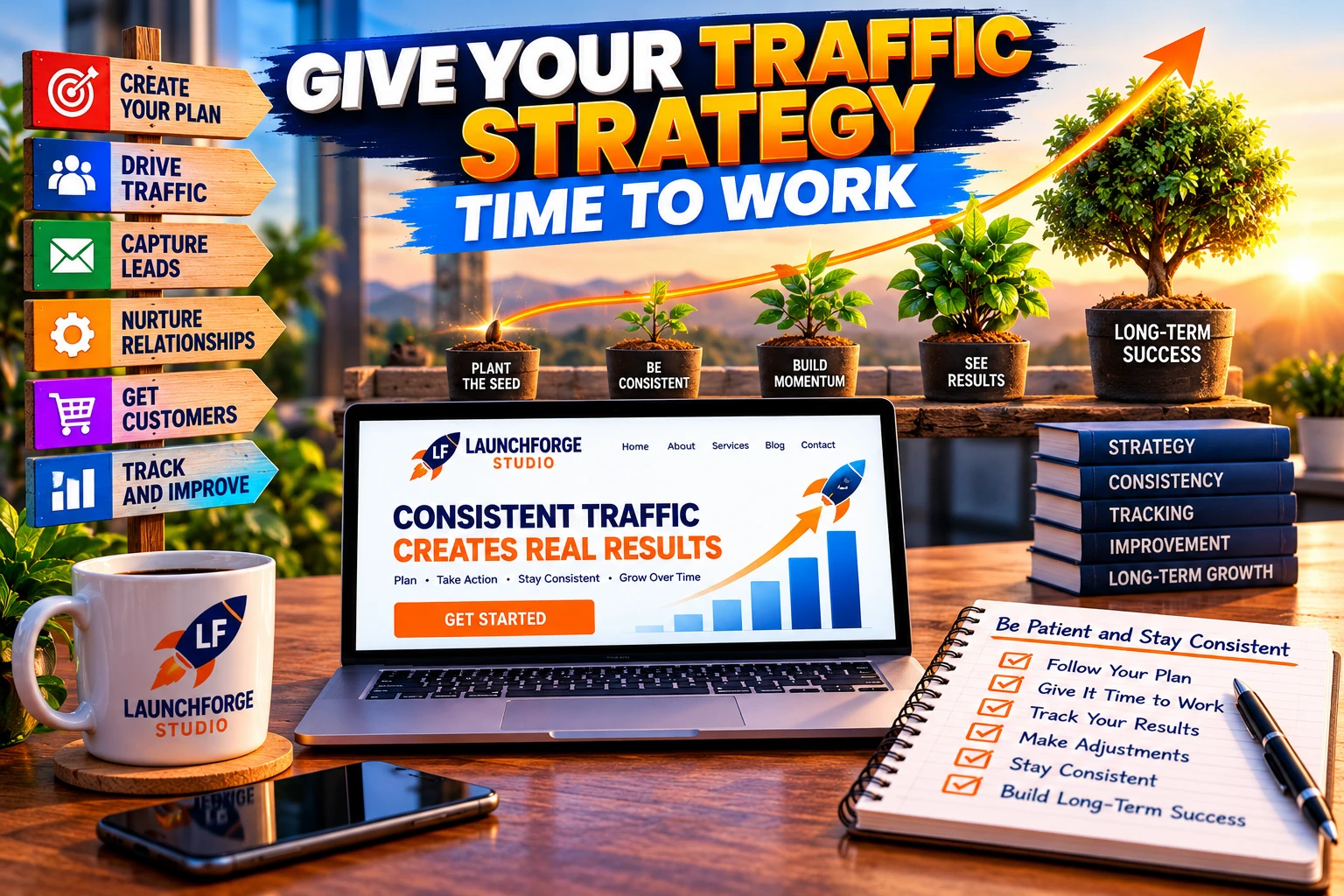
Give your traffic strategy time to develop, measure results, and improve.
Another common mistake is abandoning a traffic source before you’ve given yourself enough time to learn anything from it.
You publish a few pieces of content and don’t get much traffic.
You make several social posts and don’t see many clicks.
You send a couple of emails and don’t get many responses.
Then you decide the strategy doesn’t work.
Sometimes the strategy really isn’t working.
But sometimes you simply haven’t given yourself enough information to make that conclusion.
Traffic is something you need to observe over time.
Look at what you’re publishing.
Look at where visitors are coming from.
Look at which topics attract attention.
Look at which pages people visit.
Look at what they do once they arrive.
Then use that information to improve your approach.
Traffic Is Only the Beginning
There’s another important point here.
Getting someone to your website is not the same thing as building a customer.
Traffic gets someone through the door.
What happens next matters.
If someone arrives at your website and immediately leaves, the traffic hasn’t had much opportunity to produce a result.
That’s why traffic needs to connect with the rest of your business.
Your visitor should be able to understand:
- What your business is about
- Who you help
- What problem you solve
- What they should do next
- Why they should continue engaging with you
This is where your website, content, landing pages, lead capture, follow-up, offers, and conversion process begin working together.
Traffic brings the opportunity.
Your business needs to know what to do with that opportunity.
Build the System Before You Chase More Traffic
This is one of the biggest lessons I’ve learned while building LaunchForge Studio.
It can be tempting to think that the answer to every business problem is more traffic.
Sometimes it is.
But sometimes the problem isn’t traffic at all.
Maybe the landing page isn’t clear.
Maybe there’s no obvious next step.
Maybe visitors aren’t being captured as leads.
Maybe there is no follow-up.
Maybe the offer doesn’t match the audience.
Maybe the website is confusing.
Sending more people into a system that isn’t ready for them doesn’t necessarily solve the problem.
It can simply give you more people leaving the same system.
That’s why traffic should be viewed as one part of a larger business process.
First, give people a reason to visit.
Then give them a reason to stay.
Then give them a reason to take the next step.
Keep Your First Traffic Strategy Simple
You don’t need a complicated traffic machine on day one.
You need a process you can understand and repeat.
For example:
Create something useful → Put it where people can find it → Bring visitors to your website → Give them a clear next step → Capture the relationship → Follow up → Improve based on what happens.
That’s a system.
It doesn’t require you to master every marketing platform on the internet.
It requires you to consistently execute the pieces that matter.
And as your business grows, you can add additional traffic sources without rebuilding everything from scratch.
Start with what you can manage.
Learn from the results.
Improve the process.
Then expand.
Turn Traffic Into Something You Can Build On
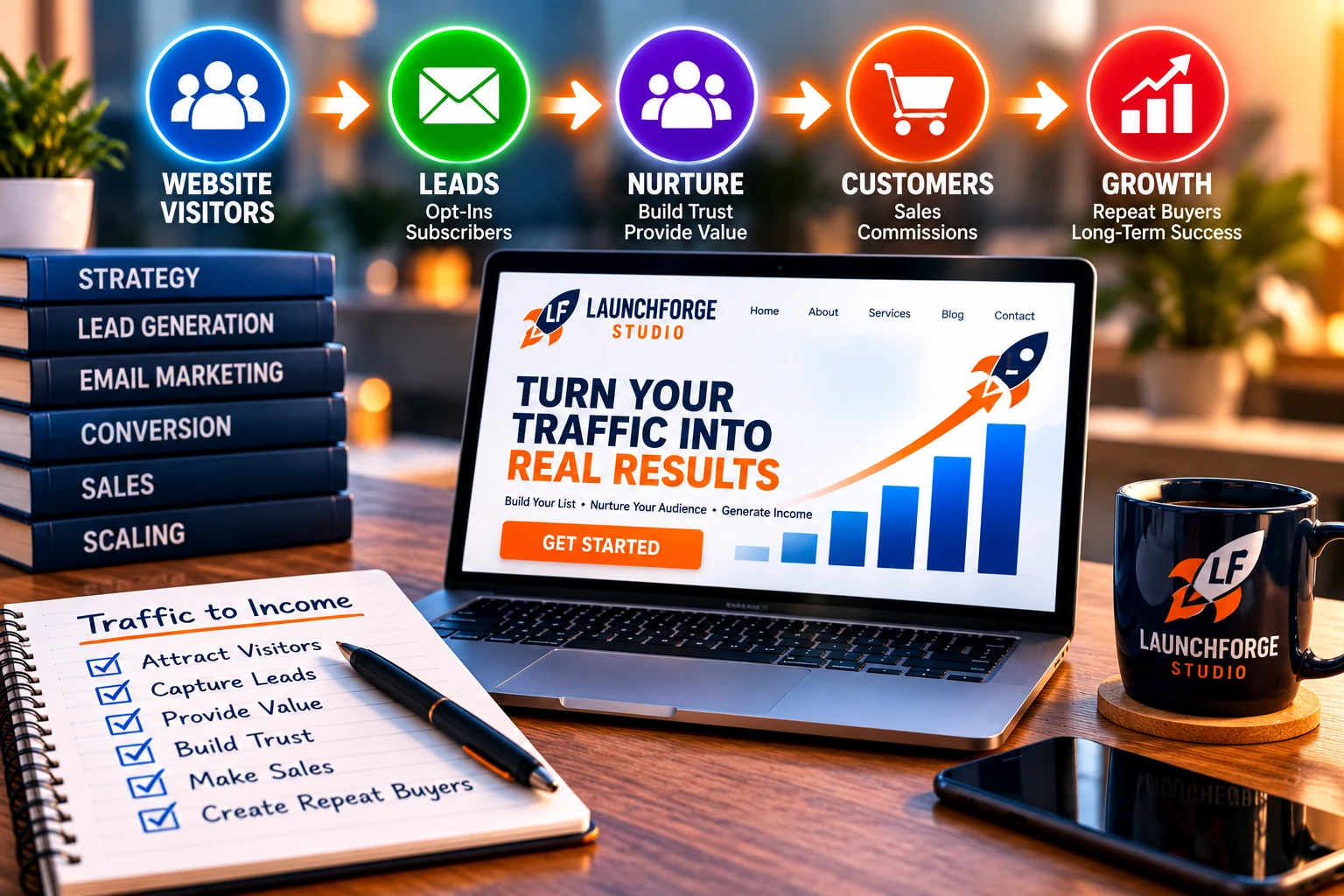
Traffic becomes more valuable when it connects to a clear path from visitor to customer.
Getting visitors to your website is a great start.
But if every visitor arrives, looks around, and disappears, you have to start the process all over again with the next visitor.
That’s why one of the most important things you can do with your traffic is give people a reason to stay connected with your business.
This is where lead capture becomes important.
Instead of thinking only about how many people visited your website, start thinking about how many people you were able to turn into potential future customers, subscribers, or contacts.
Not Everyone Is Ready to Buy
This is an important reality of online business.
Someone can be genuinely interested in what you offer without being ready to purchase it today.
They might need more information.
They might be comparing options.
They might want to learn more about you.
They might simply not trust the business yet.
That doesn’t mean the visitor was worthless.
It means the visitor wasn’t ready for the next step yet.
If your only option is “buy now,” you may lose people who could have become customers later.
A simple way to address this is to provide another step.
That might be joining an email list, downloading a useful resource, requesting information, registering for something, or simply continuing the relationship through your content.
Give Visitors a Reason to Continue
People are naturally more willing to take action when they understand what they’re getting in return.
That’s why your lead capture should have a clear purpose.
Instead of simply asking someone to “Join My List,” explain why joining is worthwhile.
Perhaps they’ll receive useful information.
Maybe you’ll send them new articles.
Perhaps you’ll provide a guide, checklist, training, or other resource.
The exact incentive depends on your business.
But the principle is simple:
Give people a reason to take the next step.
Make the Next Step Obvious
When someone arrives on your website, don’t make them guess what they’re supposed to do.
Your pages should guide visitors toward an appropriate next action.
That doesn’t mean every page needs to scream at the visitor with multiple buttons.
It means the path should make sense.
If someone is reading an educational article, the next step might be another related article.
If someone is interested in a solution, the next step might be learning more about that solution.
If someone isn’t ready to buy, the next step might be joining your email list.
If someone is ready to move forward, the next step might be your offer.
Good online business design isn’t about forcing people through a particular path.
It’s about making the useful next step easy to recognize.
Your Website Should Work With Your Traffic
This is where your website becomes more than an online business card.
Your website is one of the places where your traffic and your business systems come together.
Someone might discover you through a search engine.
They might click one of your social posts.
They might receive one of your emails.
They might hear about you from another person.
Regardless of where they came from, your website should help them understand what happens next.
That means your pages should support the journey.
Your content can educate.
Your landing pages can focus attention.
Your lead forms can capture information.
Your follow-up can continue the conversation.
Your offers can give people an opportunity to become customers.
Each piece has a purpose.
Don’t Waste the Traffic You Worked to Get
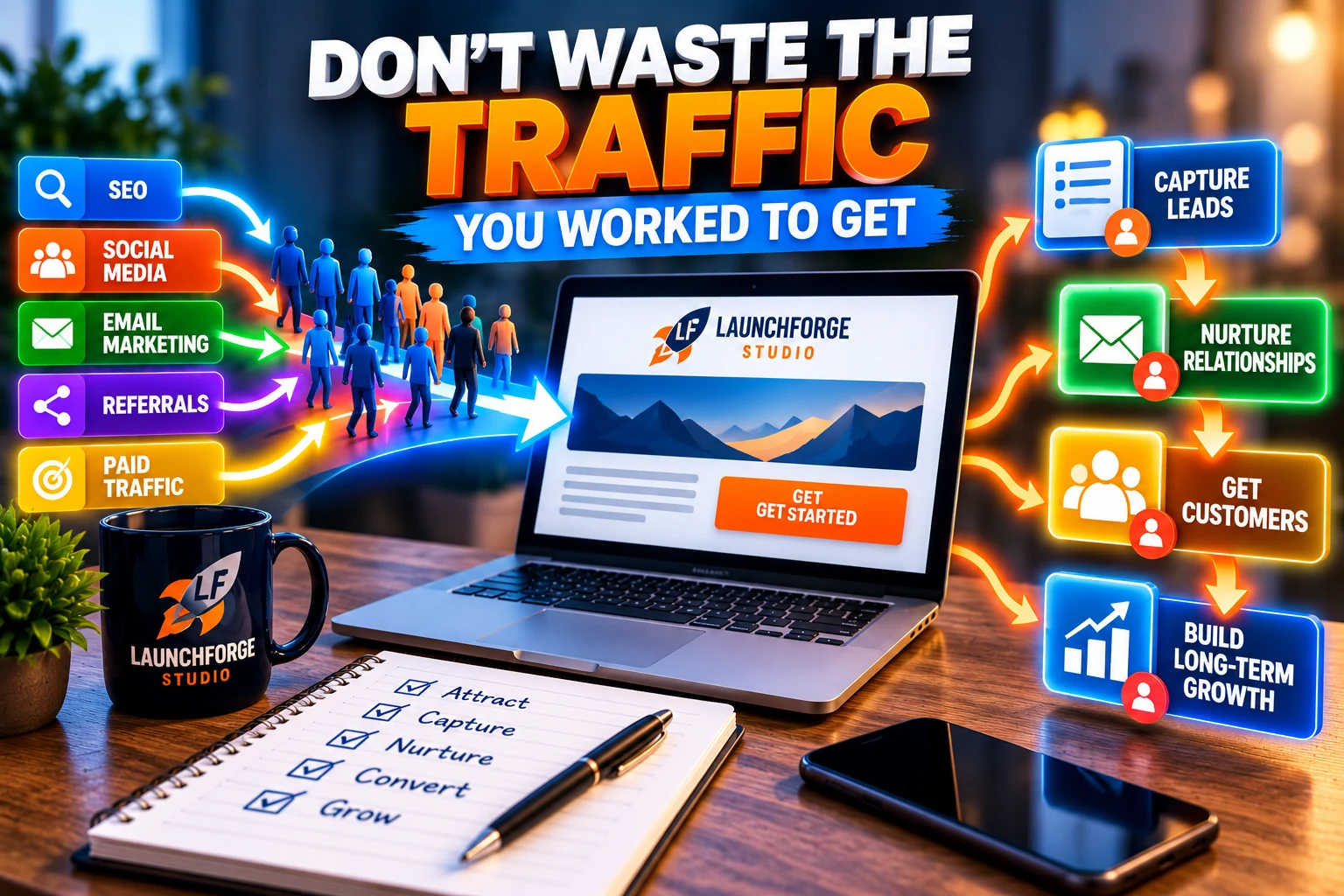
Turn website traffic into leads, relationships, customers, and long-term growth.
Traffic takes effort.
Whether you’re writing articles, creating social content, sending emails, participating in communities, or paying for advertising, you’re putting resources into getting people through the door.
That’s why it makes sense to think about what happens after they arrive.
You don’t necessarily need to convert every visitor.
That’s unrealistic.
But you should give interested visitors an opportunity to continue the relationship.
Otherwise, you may constantly find yourself asking the same question:
“How do I get more traffic?”
When a better question might be:
“What am I doing with the traffic I already have?”
That small change in perspective can make a big difference.
Think Beyond the Click
A click is only the beginning.
The visitor has now given you something valuable: attention.
What you do with that attention matters.
You can use helpful content to build trust.
You can give the visitor another useful resource.
You can invite them to become a subscriber.
You can introduce them to an appropriate offer.
You can give them another reason to return.
Over time, those individual interactions can become a relationship.
And relationships are much more valuable than a pile of anonymous clicks.
Build a Traffic Path, Not Just a Traffic Source
Instead of thinking about traffic as:
“I need people to visit my website.”
Think about it as a path:
Discovery → Visit → Engagement → Lead → Follow-Up → Customer → Relationship
Not every visitor will travel through every stage.
Some will leave immediately.
Some will read several articles.
Some will subscribe.
Some will buy right away.
Others may need considerably more time.
That’s normal.
Your job isn’t to force everyone through the same journey.
Your job is to make sure the journey exists for the people who are interested.
Traffic Becomes More Valuable When You Build Around It
The more effectively you connect your traffic to the rest of your business, the more useful that traffic becomes.
A visitor can become a lead.
A lead can become a customer.
A customer can become a repeat customer.
And a satisfied customer can potentially become a referral source.
That’s why getting traffic shouldn’t be viewed as the finish line.
It’s the beginning of the process.
The real goal isn’t simply getting people to your website. It’s building something that gives those people a reason to keep moving forward with you.
Organic Traffic: Getting Found Without Paying for Every Visitor
When people talk about getting traffic to an online business, you’ll often hear the term organic traffic.
Organic traffic generally refers to visitors who discover your business naturally rather than arriving because you paid for a specific advertisement or placement.
Search engines are one of the most familiar examples.
Someone has a question.
They search for it.
Your content appears.
They click.
You get a visitor.
But organic traffic isn’t limited to search engines.
People can discover your business through social media posts, referrals, communities, shared content, and other unpaid channels as well.
The common thread is that you’re not paying for every individual visitor to arrive.
That doesn’t mean organic traffic is free.
You’re usually investing something else:
Time.
SEO and Search Traffic
Search engine optimization, or SEO, is one of the most commonly discussed methods of building organic traffic.
The basic idea is straightforward.
You create useful content that answers questions or addresses problems your audience is searching for.
Search engines discover that content and determine where it may belong in their results.
Someone searches for a related topic.
If your page appears and they choose to visit it, you’ve earned that traffic rather than directly purchasing the click.
That can make search traffic particularly attractive for an online business.
But there’s an important catch.
SEO takes time.
A new website shouldn’t necessarily expect immediate search traffic simply because it published a few articles.
Your website needs to establish itself.
Your content needs to be discovered.
You need to understand what people are searching for.
And you need to consistently create useful information that deserves attention.
That’s why SEO should generally be viewed as a long-term strategy rather than a quick traffic trick.
Create Content People Actually Want
One of the strongest ways to support organic traffic is to create content around questions your audience genuinely has.
Think about the problems your ideal visitor is trying to solve.
What are they searching for?
What confuses them?
What are they trying to learn?
What mistakes are they trying to avoid?
What decisions are they trying to make?
Those questions can become content opportunities.
For example, if you help beginners build online businesses, there are countless questions they may have before they’re ready to buy anything.
They might want to know how to choose a business idea.
They might want to understand how websites work.
They might be trying to figure out how landing pages, funnels, email, leads, traffic, and sales fit together.
Those questions aren’t simply obstacles.
They’re opportunities to become useful.
When you consistently answer the questions your audience is already asking, you create more potential entry points into your business.
Don’t Write for Search Engines Alone
It’s easy to become obsessed with keywords, rankings, and SEO scores.
Those things can be useful.
But there’s a bigger question you should ask:
Would a real person find this helpful?
If the answer is no, ranking for a keyword isn’t going to make the article very valuable.
Your content should be written for people first.
Search engines are simply one of the ways those people can discover it.
That means your content should be:
- Useful
- Clear
- Relevant
- Easy to understand
- Organized
- Focused on a real question or problem
You don’t need to stuff the same keyword into every paragraph.
You don’t need to make every sentence sound like it was written for a search algorithm.
You need to provide a genuinely useful answer.
Organic Traffic Can Compound
One of the reasons businesses invest in organic traffic is that useful content can continue attracting visitors long after it was originally published.
Think about an article you publish today.
It may receive very little traffic during its first week.
Then someone discovers it through search a month later.
Another person finds it several months after that.
Someone else discovers it through a link from another article.
Over time, your website can accumulate a library of useful content.
Each piece becomes another potential doorway into your business.
That doesn’t mean every article will become a traffic superstar.
Some won’t.
That’s okay.
The goal is to build a collection of useful resources that can continue creating opportunities for discovery.
Organic Doesn’t Mean Passive
There’s another misconception worth clearing up.
Organic traffic may not require you to pay for every click, but that doesn’t mean you can publish something once and forget about it.
You still need to:
- Create useful content
- Share it
- Improve older content
- Understand what your audience wants
- Monitor what is getting attention
- Build relationships
- Keep publishing consistently
Organic traffic is often an investment in assets rather than individual clicks.
You’re building content, relationships, visibility, and credibility that can potentially continue working for you.
Give Organic Traffic Time
If you’re building a new online business, patience matters.
You may publish an article and see very little activity at first.
That doesn’t automatically mean the article failed.
It may take time for people to discover it.
It may take time for search engines to understand where it fits.
It may take time for you to learn which topics your audience responds to.
And it may take time for your website to build authority.
Instead of asking:
“Why didn’t this article bring me hundreds of visitors immediately?”
ask:
“What can I learn from this article, and what can I improve next?”
That mindset keeps you focused on building rather than chasing instant results.
Organic Traffic Is One Piece of the Puzzle
Organic traffic can be extremely useful, but it doesn’t have to carry your entire business.
You can combine it with social media.
You can share your content with your email subscribers.
You can encourage referrals.
You can participate in communities.
You can eventually add paid traffic.
The goal isn’t to find one magical source that does everything.
The goal is to build several sensible paths that allow people to discover your business.
Organic traffic can be one of those paths.
And for many businesses, the content created while building organic visibility can become one of the most valuable long-term assets they own.
Which Traffic Source Should You Start With?
Once you understand the different ways to get traffic, the next question is probably the most important one:
Which one should you actually use?
The answer depends on your business, your audience, your available time, and your budget.
You don’t need to choose every traffic source.
In fact, trying to work on everything at once can make it much harder to determine what’s actually helping your business.
If you have more time than money, organic methods such as content, SEO, and social media may be a practical starting point.
If you already have an email audience, communicating with that audience can be one of the simplest ways to bring people back to your website.
If your audience is active in a particular online community, participating there may make more sense than trying to build a presence everywhere else.
And if you have a budget and a proven offer, paid traffic may be worth testing.
The important word is testing.
Don’t assume a traffic source will work simply because someone online says it does.
Try it.
Measure the results.
Learn what happens.
Then decide whether it deserves more of your time or money.
Start With One Primary Strategy
You don’t have to build your entire traffic machine on day one.
Pick one primary traffic source that fits your situation and learn how to use it effectively.
Once you understand what works, you can add another source.
For example:
can create long-term organic visibility.
Social media + content
can help distribute what you’re creating.
Email + content
can bring people back to your website.
Paid traffic + a focused landing page
can help you test an offer with a specific audience.
There is no universal combination.
Start with what you can realistically manage.
Then build from there.
Don’t Waste the Traffic You Worked to Get
Getting someone to your website is only half the job.
Once a visitor arrives, you need to give them a reason to stay and a clear idea of what they can do next.
That doesn’t mean every visitor needs to buy something.
Maybe they need more information.
Maybe they want to read another article.
Maybe they’re interested in joining your email list.
Maybe they’re ready to look at an offer.
The important thing is that the next step makes sense.
Give Visitors Somewhere Useful to Go
Imagine clicking an advertisement for a specific solution and landing on a page that doesn’t explain what you clicked for.
Or finding an article that answers your question but provides no way to learn more.
That’s a missed opportunity.
Your traffic source and your destination should make sense together.
If someone clicks because they want to learn something, send them somewhere educational.
If they’re interested in an offer, give them a focused page that explains that offer.
If they’re not ready to buy, give them another way to stay connected.
Don’t make visitors figure out what to do next.
Make the next step obvious.
Traffic Needs a Purpose
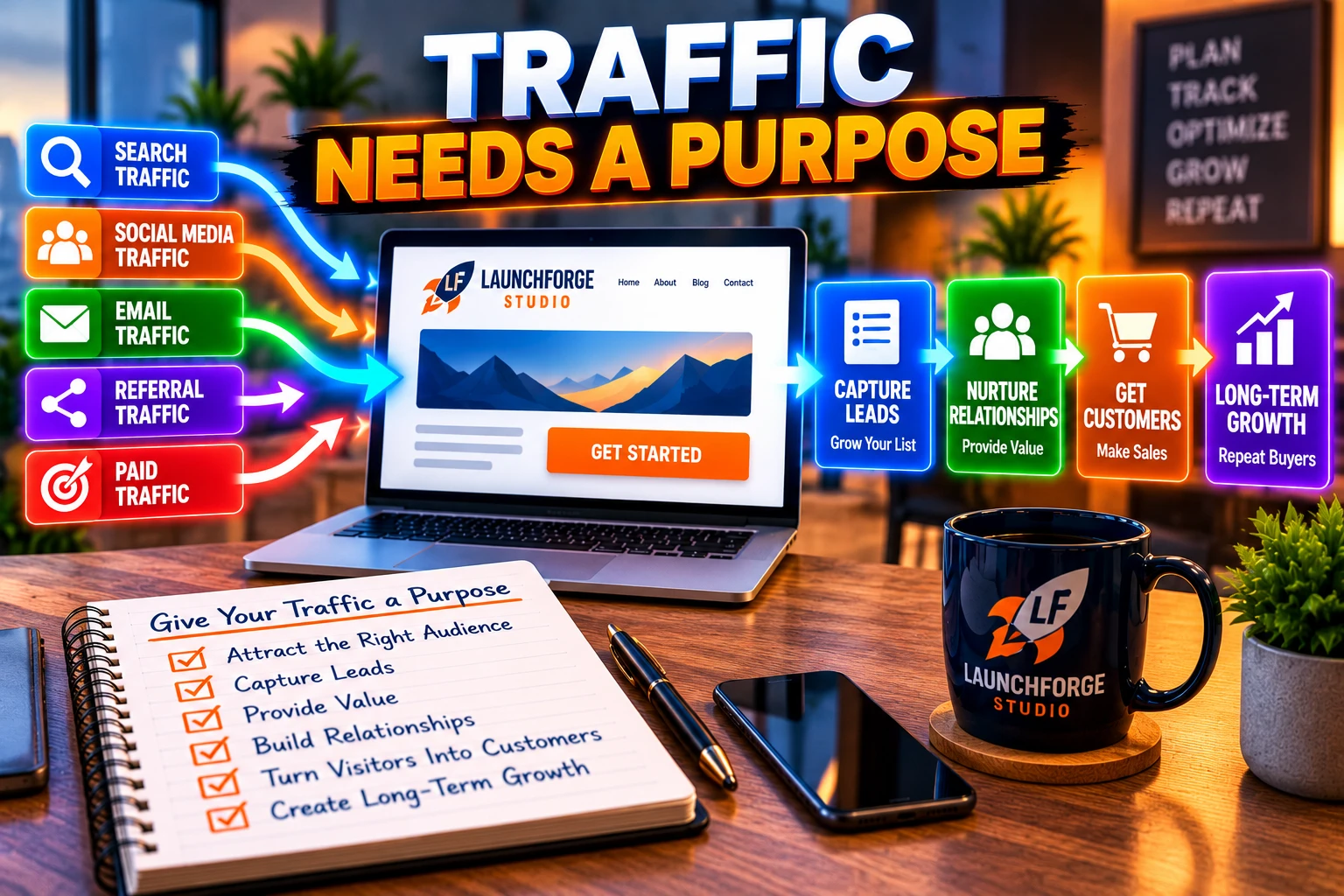
Traffic becomes more valuable when every visitor has a clear next step.
Before sending traffic anywhere, ask yourself:
What do I want this visitor to do?
Maybe the answer is simply to read your content.
Maybe it’s to join your email list.
Maybe it’s to request information.
Maybe it’s to purchase.
Whatever the answer is, knowing it beforehand helps you build a better experience.
Traffic becomes much more valuable when it has somewhere useful to go.
And when your traffic, website, content, lead capture, follow-up, and offers all work together, you’re no longer just collecting visitors.
You’re building a business around them.
Build a Traffic System, Not Just a Traffic Source
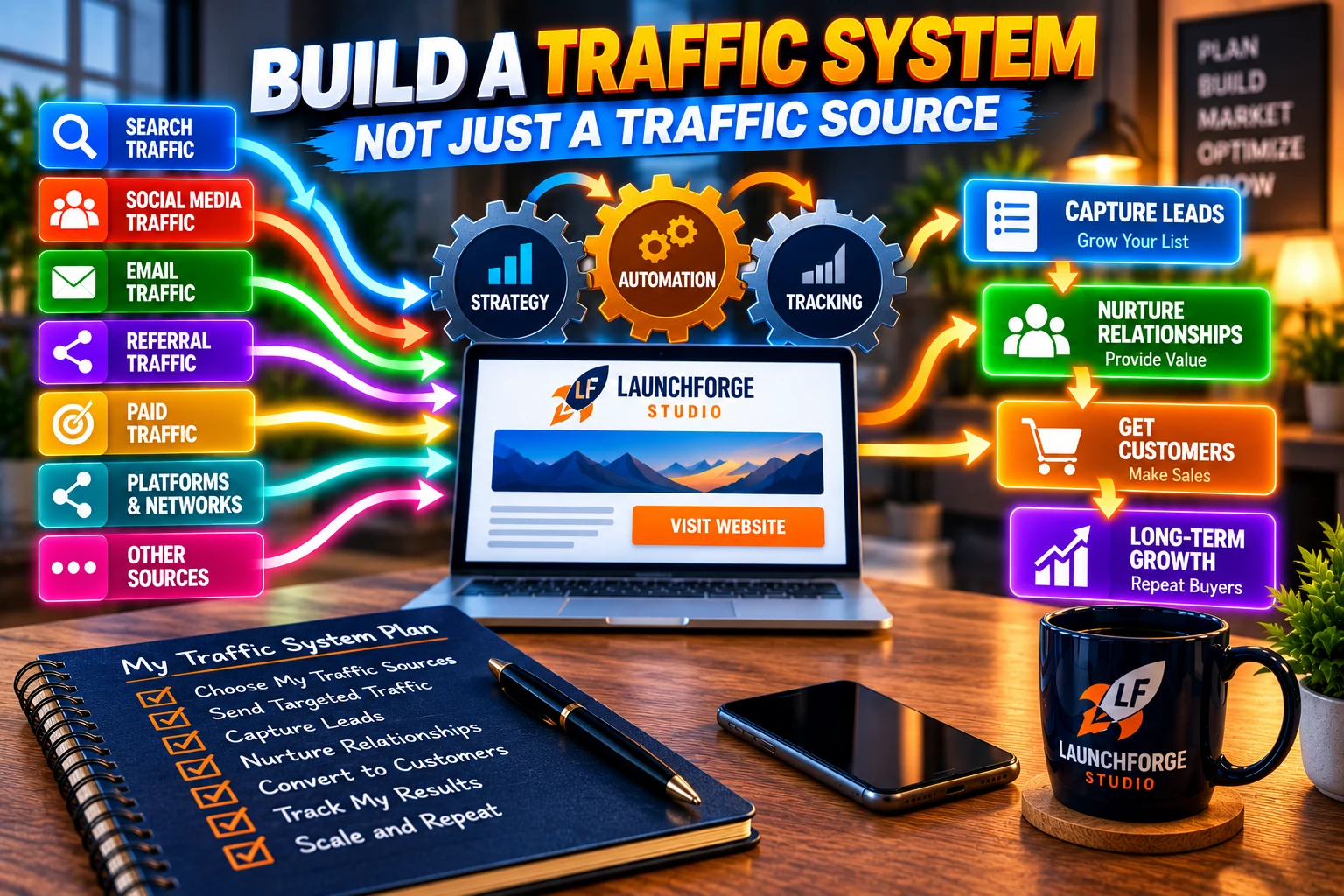
A traffic system connects visitors to the next steps that turn attention into business growth.
A traffic source is simply a way people discover your business.
A traffic system connects that discovery to everything that happens afterward.
Think of it this way:
Create something useful → Get it in front of people → Bring visitors to your website → Give them a clear next step → Build the relationship → Improve the process
That could mean publishing an article and sharing it on social media.
It could mean sending an email that brings subscribers back to your website.
It could mean running an advertisement that sends visitors to a focused landing page.
The specific method can change.
The system stays the same.
Don’t Try to Build Everything at Once
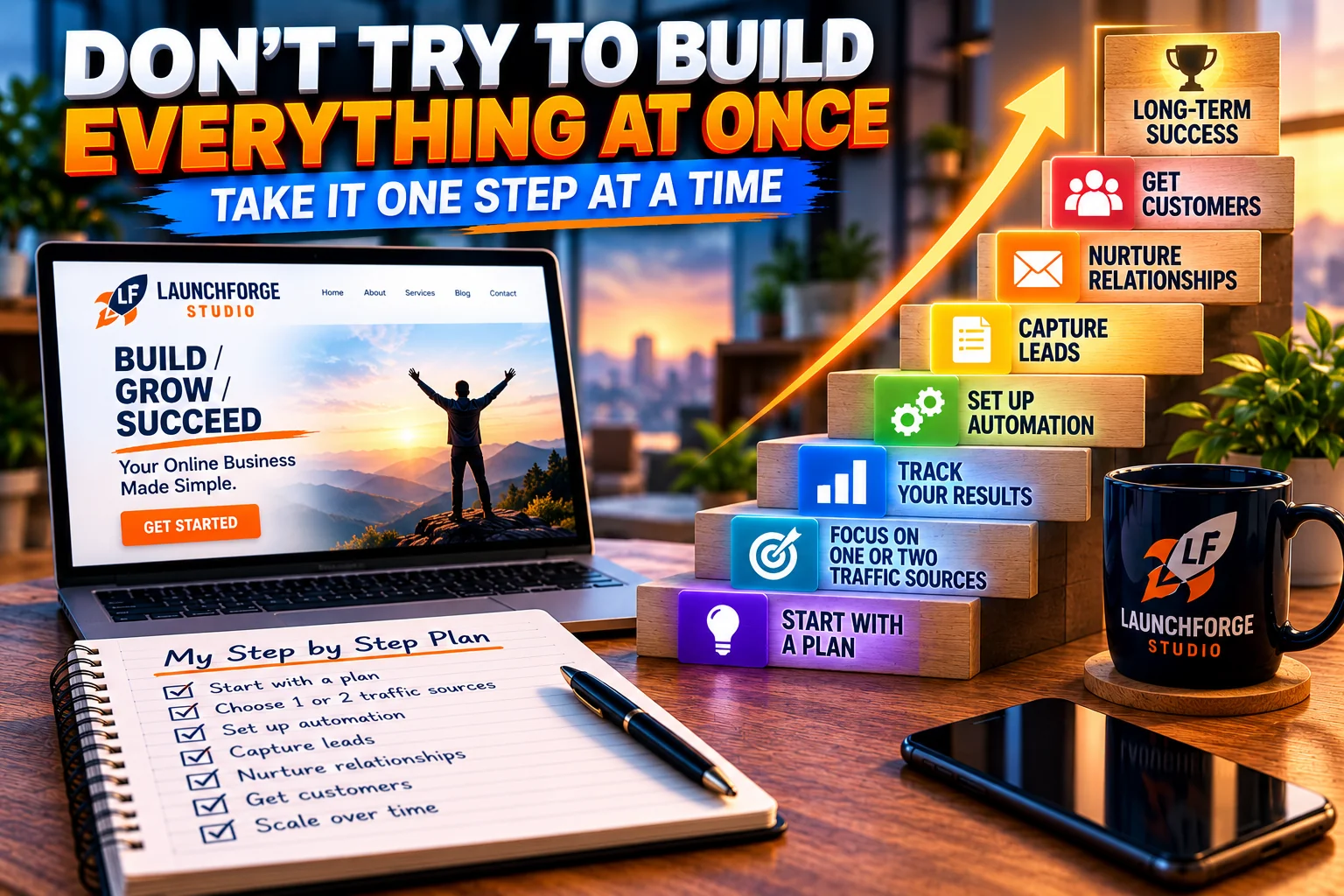
Build your traffic system one manageable step at a time.
You can start with something as simple as:
One audience.
One useful destination.
One primary traffic source.
One clear next step.
Then pay attention to what happens.
Where did your visitors come from?
What did they look at?
Did they take the next step?
Did they become leads?
Did they eventually become customers?
Those answers help you determine what deserves more attention.
Over time, you can add additional traffic sources and connect them to the process.
That’s how a collection of individual marketing activities can become a system that supports your business.
You’re not trying to chase traffic forever.
You’re building a repeatable way for the right people to find you.
Give Your Traffic Strategy Time to Work
One of the hardest parts of building traffic is accepting that results don’t always happen immediately.
You may publish an article and see very little traffic at first.
You may share content on social media and get only a few clicks.
You may try a paid traffic source and discover that your first campaign needs improvement.
That doesn’t automatically mean the strategy failed.
Sometimes you simply need more information.
Measure Before You Abandon
Instead of asking only:
“Did this make me money?”
look at the smaller signals too.
Are people clicking?
Are they staying on the page?
Are they visiting other pages?
Are they joining your email list?
Are certain topics attracting more attention than others?
These clues can help you understand what’s working and what needs to change.
You don’t need complicated analytics to begin learning from your traffic.
Start by paying attention to where visitors are coming from and what they do once they arrive.
Give Yourself Something to Improve
Your first attempt doesn’t have to be perfect.
In fact, it probably won’t be.
That’s part of building an online business.
You try something.
You learn from it.
You make an adjustment.
Then you try again.
Over time, those small improvements can turn an inconsistent traffic effort into something much more predictable.
Don’t confuse slow progress with no progress.
Give your strategy enough time to produce useful information, learn from what you see, and keep improving.
Common Traffic Mistakes Beginners Should Avoid
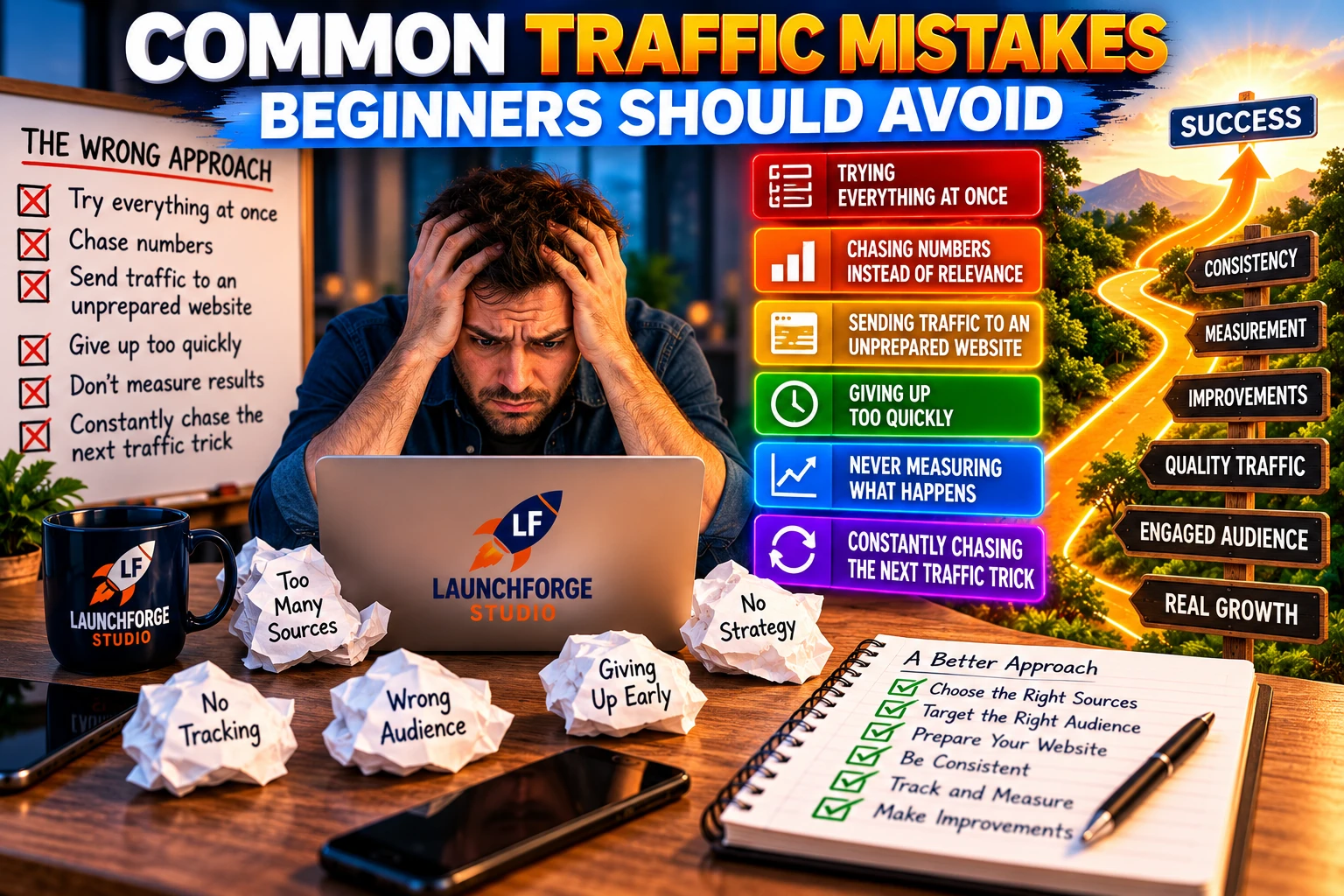
Avoid common traffic mistakes and build a simpler, more sustainable strategy.
Getting traffic isn’t necessarily difficult because there aren’t enough strategies.
Sometimes it’s difficult because beginners make the process much more complicated than it needs to be.
Here are some of the biggest mistakes to watch for.
Trying Everything at Once
Jumping between ten different traffic sources makes it difficult to know what’s actually working.
Choose a starting point and give it your attention.
Chasing Numbers Instead of Relevance
A large number of visitors may look impressive, but traffic is much more valuable when those visitors are actually interested in what you offer.
Focus on the right people, not just more people.
Sending Traffic to an Unprepared Website
Before you promote your business, make sure visitors can understand what you do and what they should do next.
More traffic won’t fix a confusing website or a weak offer.
Giving Up Too Quickly
Some traffic strategies take time to develop.
Don’t abandon something after a handful of attempts simply because you didn’t see immediate results.
Look at what you’ve learned and make adjustments.
Never Measuring What Happens
You need to know where your visitors are coming from and what they do after they arrive.
Even basic information can help you make better decisions about where to spend your time and money.
Constantly Chasing the Next Traffic Trick
There’s always another strategy promising instant traffic.
You don’t need to chase every new tactic.
Consistency with a strategy you understand is usually more useful than constantly starting over.
The goal isn’t to find a magical source of traffic.
It’s to build a process you can actually maintain.
Your First Traffic Plan Doesn’t Need to Be Complicated
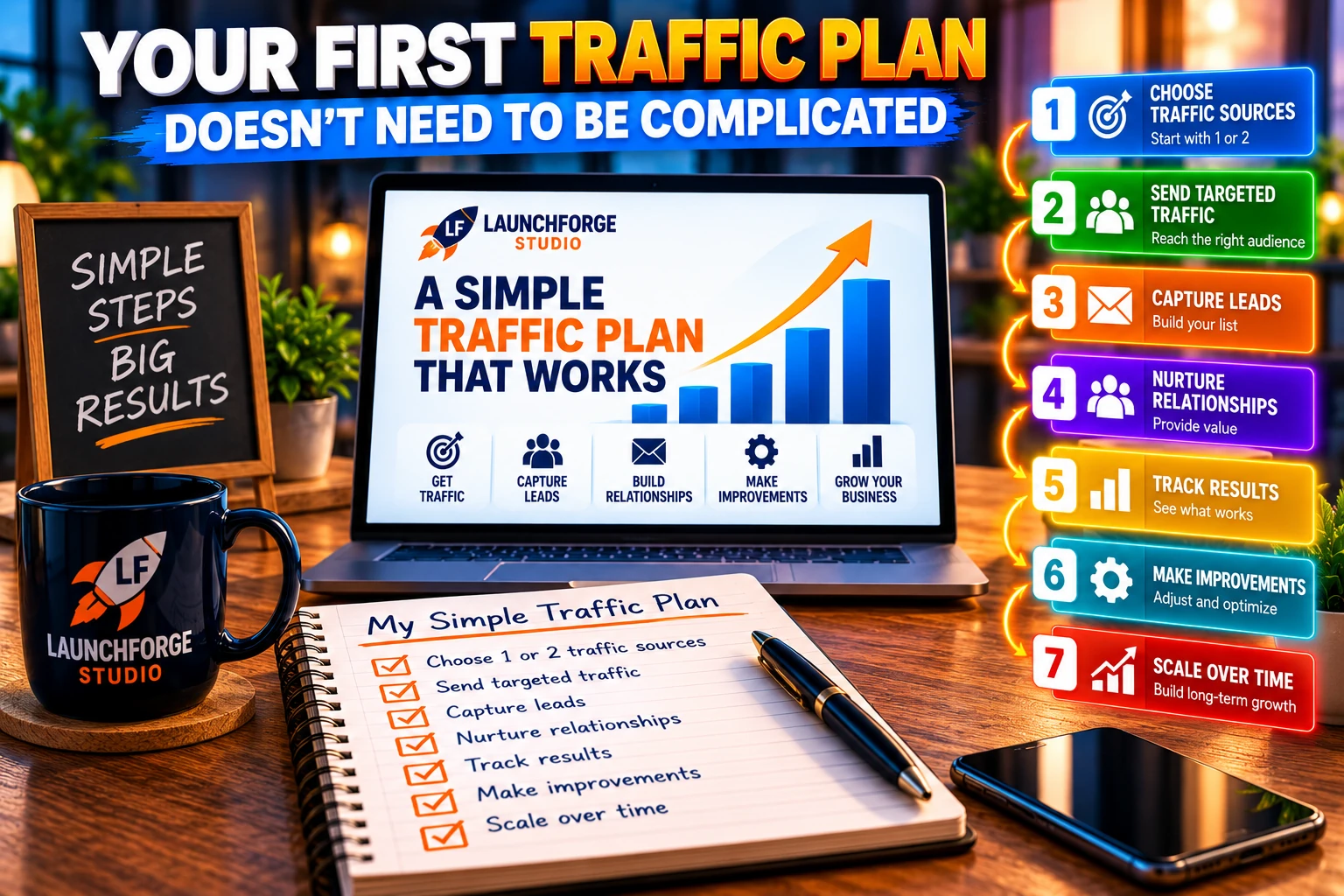
Start with a simple traffic plan you can understand, follow, measure, and improve.
If you’re just starting out, don’t worry about building a massive traffic machine.
Start with a simple plan you can actually follow.
Step 1: Know who you want to reach.
Understand the people your business is designed to help and the problems they’re trying to solve.
Step 2: Choose one primary traffic source.
Pick a method that fits your audience, your skills, your available time, and your budget.
Step 3: Create something worth visiting.
That could be a helpful article, landing page, resource, video, or offer.
Step 4: Give visitors a clear next step.
Don’t leave people wondering what they’re supposed to do after they arrive.
Step 5: Pay attention to the results.
Look at where your visitors came from, what they did, and whether they continued engaging with your business.
Step 6: Improve before adding more.
Once you understand what’s working, make it better.
Then, when you’re ready, add another traffic source.
That’s it.
You don’t need to master everything at once.
You need a process you can understand, repeat, and improve.
One audience. One traffic source. One useful destination. One clear next step.
Start there.
Start Getting Traffic One Step at a Time
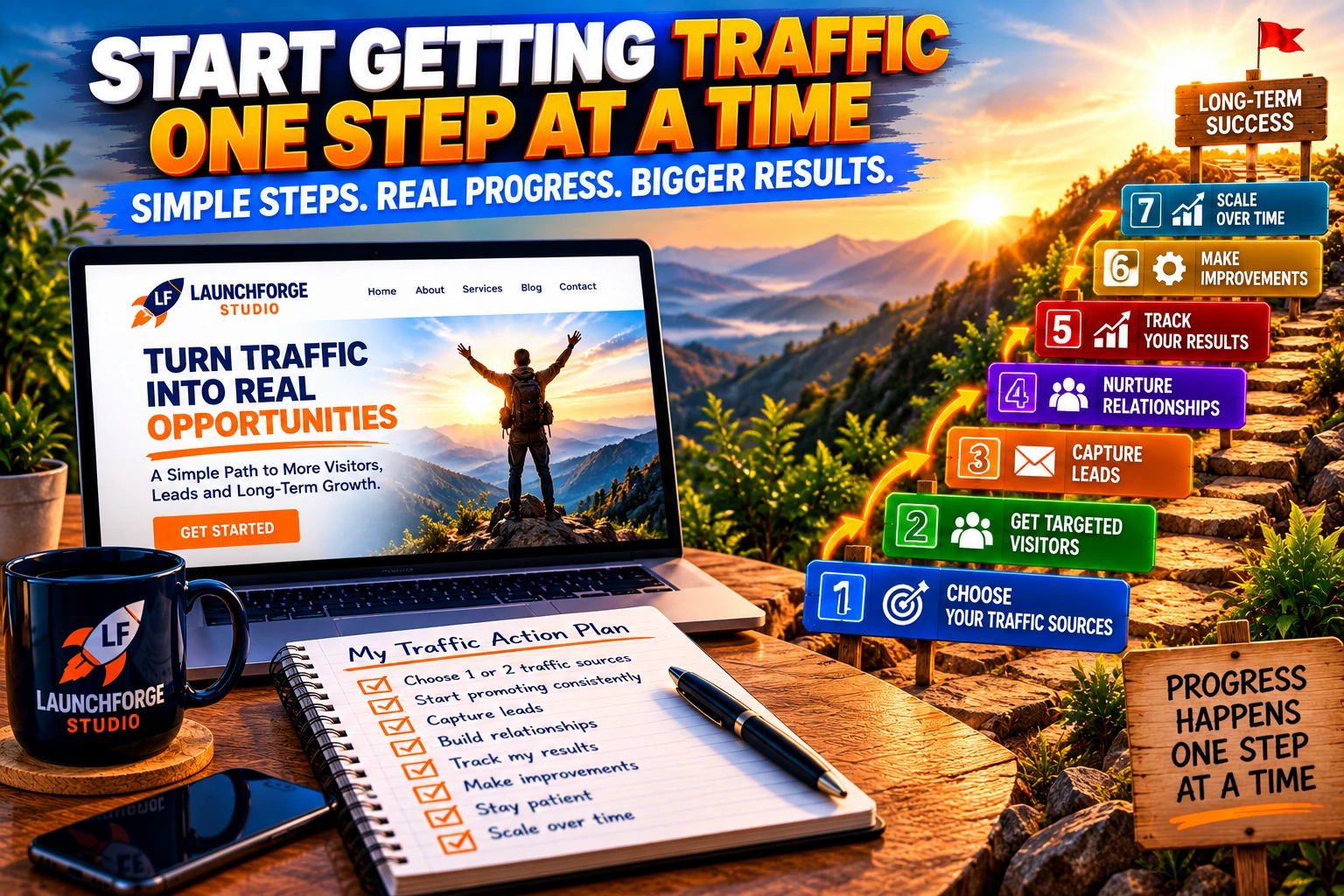
Build your traffic strategy one manageable step at a time.
Getting traffic to your online business doesn’t have to mean mastering every marketing channel available.
You don’t need to be everywhere.
You don’t need to spend a fortune.
And you don’t need thousands of visitors before you can start making progress.
Start by understanding who you want to reach.
Then choose a traffic source that makes sense for your audience and your situation.
Create something useful.
Give people a reason to visit.
Give them a clear next step when they arrive.
Pay attention to what happens.
Then improve your process and keep going.
Over time, you can add additional traffic sources and connect them to the other parts of your business.
The important thing is to start.
Traffic is not the destination. It’s the beginning of the journey.
When the right people discover your business, you have an opportunity to educate them, build trust, generate leads, develop relationships, and eventually turn those relationships into customers.
You don’t have to build the entire system today.
Build one useful piece at a time.
Then give people a way to find it.
Ready to Build Your Online Business?
Getting traffic is one piece of the puzzle. Having the right tools and systems behind that traffic can make building an online business much easier.
That’s one of the reasons I chose Profit Hub System as the platform behind LaunchForge Studio.
If you’re looking for a place to build your website, funnels, marketing, automation, and other parts of your online business, take a look at the platform I’m using.