
If you want to build an email list, one of the first questions you need to answer is simple:
Why should someone give you their email address?
Most people are not going to subscribe just because a website has a box that says “Join Our Newsletter.” They need a reason. They need to understand what they will receive and why it is worth allowing another business into their inbox.
That is where a lead magnet comes in.
Learning how to create a lead magnet does not mean you need to write a massive ebook, design an expensive course, or spend weeks building something complicated. A good lead magnet can be surprisingly simple.
It just needs to solve a useful problem for the right person.
A checklist can do that.
A short guide can do that.
A template, worksheet, resource list, tutorial, or quick-start plan can do it too.
What matters is not how large the lead magnet is. What matters is whether the person you want to reach looks at it and thinks:
“That would help me.”
In this guide, we are going to walk through the entire process of creating your first lead magnet—from choosing the problem it should solve and deciding what format to use to creating it, connecting it to your email system, delivering it to new subscribers, and putting it to work in your business.
And we are going to approach it the same way we approach most things at LaunchForge Studio:
Build the first useful version. Get it working. Then improve it.
You do not need the perfect lead magnet to start building an email list.
You need a useful one.
Let’s build it.
What Is a Lead Magnet?
A lead magnet is something valuable you offer to a visitor in exchange for their contact information, usually an email address.
Mailchimp similarly describes a lead magnet as a resource or offer used to provide value in exchange for a potential customer’s contact information.
Instead of simply asking someone to “subscribe,” you are giving them a specific reason to take that step.
The basic exchange looks like this:
You provide something useful → The visitor provides their email address → They become a subscriber
That useful resource is the lead magnet.
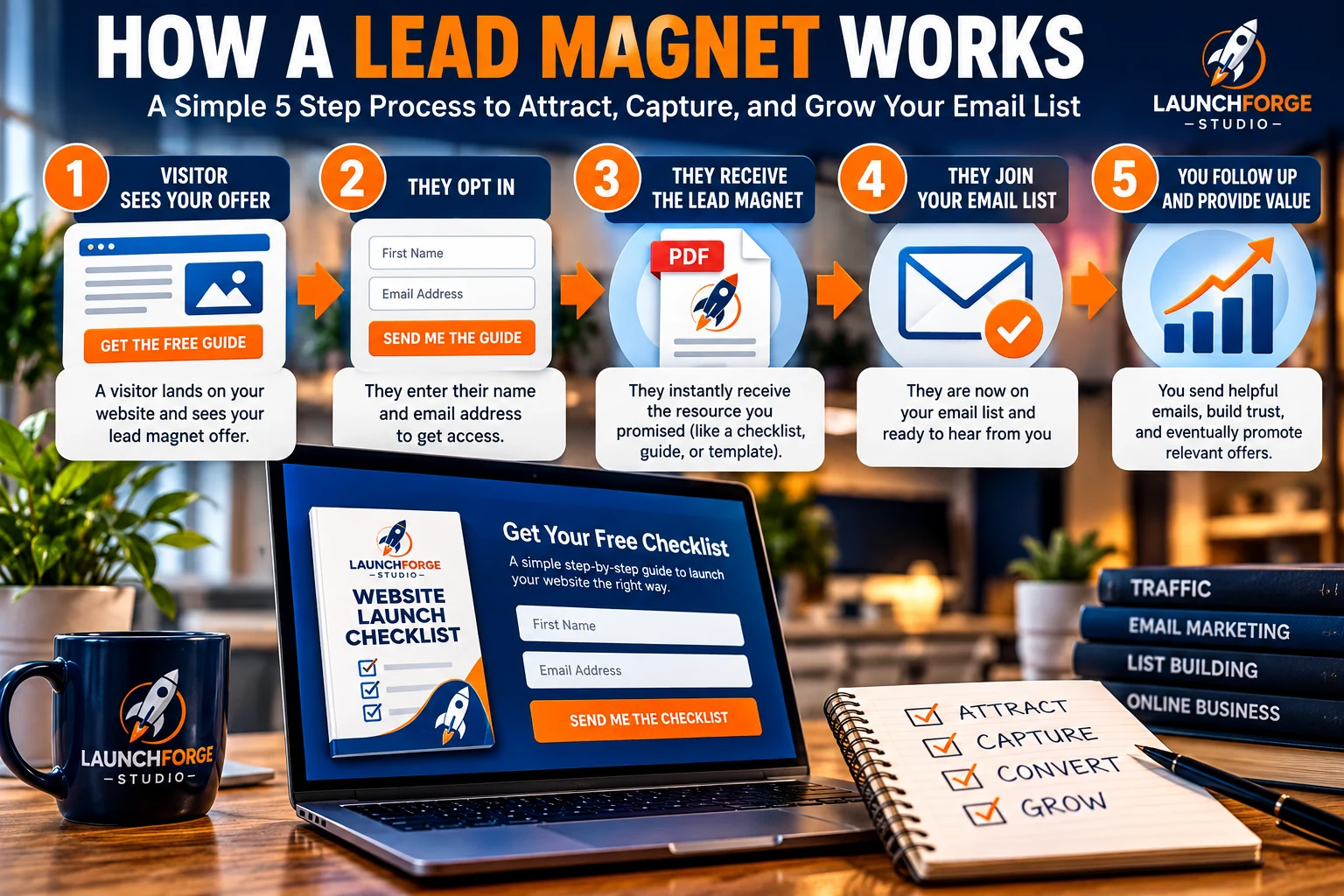
A lead magnet turns a visitor into a subscriber through a simple process: present a useful offer, capture the opt-in, deliver the resource, add the subscriber to your email list, and continue providing value.
For example, imagine you run a website that helps beginners start an online business.
You could offer:
- A startup checklist
- A simple business planning worksheet
- A list of recommended tools
- A beginner’s guide
- A website launch checklist
- A downloadable template
- A quick-start action plan
Someone visiting your website may not be ready to buy anything from you.
They may not even know much about your business yet.
But if you offer something that helps solve the problem they are dealing with right now, giving you an email address in exchange can feel like a reasonable next step.
That is what makes a lead magnet different from simply placing a newsletter signup form on a website.
You are creating an exchange of value.
A Lead Magnet Is the Beginning, Not the Entire System
This distinction matters.
Creating a lead magnet does not automatically build an email list.
The lead magnet is one piece of a larger system.
You still need a way to attract people to your website or landing page. You need a signup form that captures their information. You need an email platform that stores the subscriber and delivers the resource. And you need follow-up communication that continues the relationship afterward.
The complete process might look something like this:
Traffic → Lead Magnet → Signup Form → Subscriber → Delivery Email → Follow-Up
Each piece has a job.
The lead magnet’s job is to give the visitor a compelling reason to move from simply consuming your content to becoming part of an audience you can communicate with again.
That is why the best lead magnets are not necessarily the biggest or most impressive.
They are the ones that make the next step feel worthwhile.
Why People Actually Download Lead Magnets
A lead magnet only works when the person visiting your website sees enough value in it to exchange their email address for access.
That sounds obvious, but it is where a lot of lead magnets go wrong.
Businesses sometimes create something because they want more subscribers rather than starting with what the visitor actually wants.
Those are two very different perspectives.
The business is thinking:
“I need their email address.”
The visitor is thinking:
“What am I getting in return?”
Your lead magnet has to answer that second question.
Solve a Specific Problem
One of the strongest characteristics of a useful lead magnet is specificity.
Trying to solve everything usually makes the offer less clear.
Imagine someone is trying to launch their first website.
An offer called:
The Complete Guide to Everything You Need to Know About Building an Online Business
might contain plenty of information, but it also sounds like a commitment.
Compare that with:
The 10-Point Website Launch Checklist
Now the visitor immediately understands what the resource is and what it can help them accomplish.
The promise is smaller.
But the value is clearer.
That is an important principle when learning how to create a lead magnet:
You do not need to solve every problem your audience has.
Solve one problem well.
Make the Result Easy to Understand
People should not have to investigate your lead magnet to figure out why they might want it.
The title and description should communicate the benefit quickly.
A useful way to think about it is:
Problem + Useful Resource + Clear Result
For example:
Problem: I do not know whether my website is ready to launch.
Resource: Website launch checklist.
Result: I can quickly check the important pieces before publishing.
That is much easier to understand than simply offering a vague “free resource.”
Help Someone Make Progress Quickly
A lead magnet can become more appealing when the subscriber can use it without spending hours figuring out what to do.
This is one reason checklists, templates, worksheets, resource lists, and quick-start guides can work so well.
They reduce friction.
Someone can download the resource and immediately begin using it.
That quick progress matters because the lead magnet is often one of the first direct experiences someone has with your business.
If the resource is genuinely useful, you have already started the relationship by helping instead of immediately asking for a sale.
Relevance Matters More Than Size
A 50-page ebook is not automatically more valuable than a one-page checklist.
If the checklist solves the visitor’s immediate problem better, the checklist may be the stronger lead magnet.
That is good news when you are creating your first one.
You do not have to disappear for three weeks and emerge from Captain PDF Mountain carrying a 97-page masterpiece.
You need something relevant.
Something useful.
Something your audience can understand quickly.
And something that naturally connects with the kind of help your business provides.
Once you understand that, choosing what your first lead magnet should actually be becomes much easier.
Start With the Problem Your Audience Wants to Solve
Before you choose a lead magnet format, start with the problem.
This is one of the easiest places to overcomplicate the process.
You might immediately start wondering:
Should I create an ebook?
A checklist?
A template?
A video?
A worksheet?
Those questions matter, but they come later.
The first question should be:
What problem is my audience trying to solve?
Your lead magnet should begin there.
Think About the Person You Want to Attract
A lead magnet does more than collect email addresses.
It also helps determine who joins your email list.
If your business helps beginners build websites, a checklist for launching a first WordPress site could attract exactly the kind of person you want to reach.
If your business teaches email marketing, a welcome email template could attract people who are beginning to build an email list.
If your business helps affiliate marketers, a checklist for evaluating affiliate offers could attract people interested in improving their affiliate marketing.
The closer the lead magnet is to the problems your ideal audience is already trying to solve, the more naturally it fits into your business.
That matters because building a large email list filled with people who have little interest in what you actually do is not particularly useful.
You want relevant subscribers.
Look at the Questions People Are Already Asking
You do not always have to invent a lead magnet idea from scratch.
Often, the ideas are already hiding inside the questions your audience asks.
Look at:
- Questions you receive from customers or readers
- Problems discussed in communities related to your topic
- Search queries people use to find your website
- Topics that repeatedly appear in your industry
- Questions you had when you were starting
- Articles on your website that already attract interest
Those questions can reveal small problems that could become useful lead magnets.
For example, if people repeatedly ask:
“What pages does my business website actually need?”
you may have the beginning of a lead magnet:
The Essential Business Website Pages Checklist
The question revealed the problem.
The lead magnet provides a practical way to solve it.
Choose a Problem Small Enough to Solve
Your first lead magnet does not need to transform someone’s entire business.
In fact, trying to accomplish too much can make creating it considerably harder.
Instead, look for a problem that can produce a clear, useful result.
Rather than:
Build a Successful Online Business
narrow it to:
Plan the Essential Pages for Your First Business Website
Instead of:
Master Email Marketing
narrow it to:
Write Your First Welcome Email
Instead of:
Get More Website Traffic
narrow it to:
Create a Simple Promotion Checklist for Every New Blog Post
Each smaller problem gives you something concrete to build around.
Make Sure the Problem Connects to Your Business
There is another reason to choose the problem carefully.
A good lead magnet should create a logical bridge between what the subscriber needs now and what your business can help them with later.
Imagine you run a website about building an online business but offer a free guide about improving your golf swing because golf happens to be popular.
You might collect email addresses.
But you probably have not built a very useful audience for your business.
Your lead magnet should attract people who are likely to benefit from the content, tools, products, or services you provide.
That creates a much healthier path:
Relevant Problem → Useful Lead Magnet → Relevant Subscriber → Continued Help
You are not simply trying to get an email address.
You are beginning a relationship with someone whose goals overlap with what your business exists to help them accomplish.
Write Down One Problem Before You Build Anything
Before opening a design tool or writing the first page of your lead magnet, try completing this sentence:
My audience needs help with ____________________.
Then ask:
Can I create something simple that helps them make progress with that problem?
If the answer is yes, you have the foundation for a lead magnet.
You still have to decide what form that solution should take.
And that is our next step.
Choose the Right Lead Magnet Format
Once you know the problem you want to solve, the next step is choosing the best format for delivering the solution.
This is where it can be tempting to assume that bigger means better.
It does not.
The best format is the one that makes the information easy for your audience to understand and use.
Sometimes that might be a detailed guide.
Other times, one page is enough.
Instead of asking:
“What kind of lead magnet looks the most impressive?”
ask:
“What is the simplest useful format for solving this problem?”
That question can save you a tremendous amount of unnecessary work.
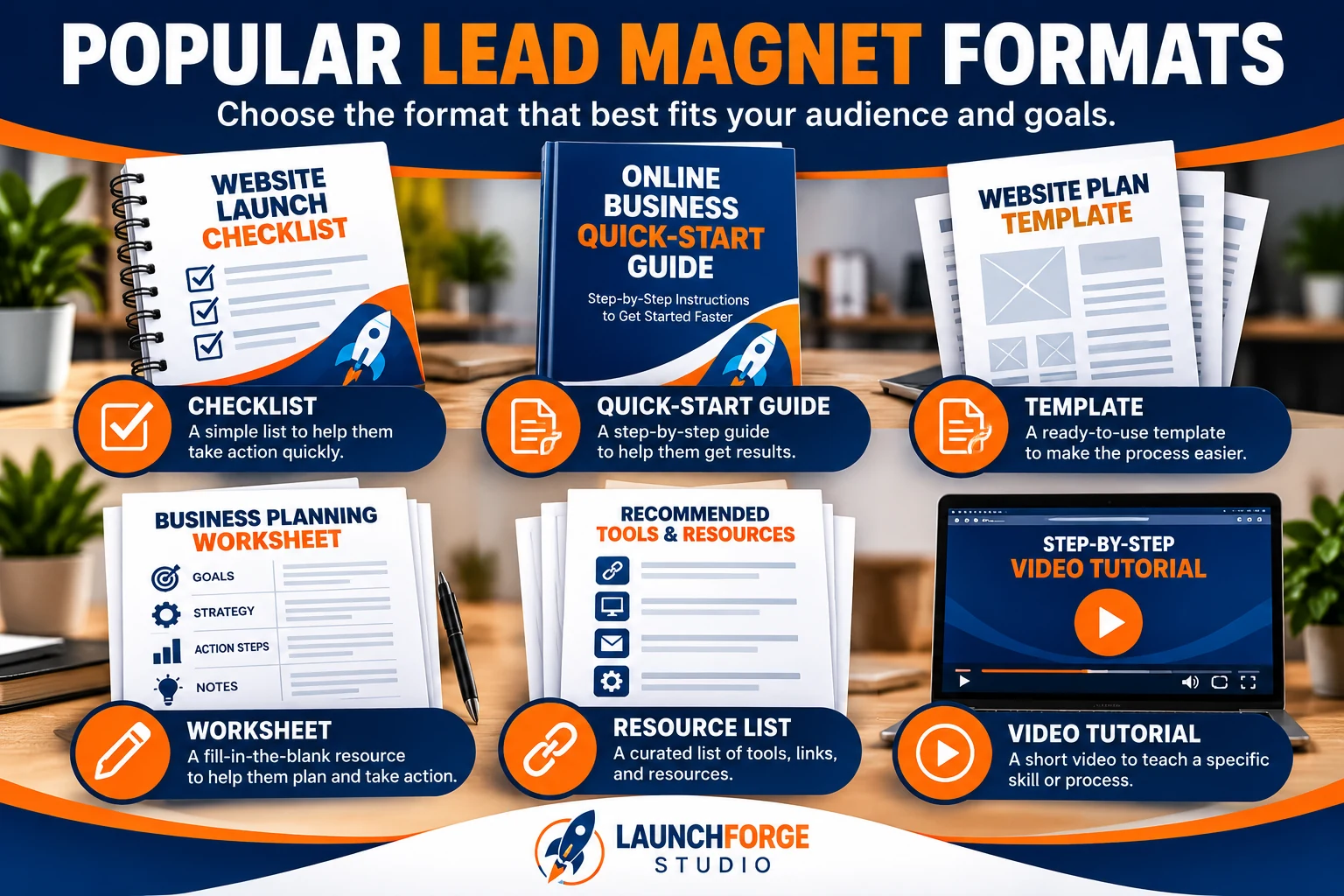
Lead magnets can take many forms, including checklists, guides, templates, worksheets, resource lists, and video tutorials. Choose the format that best fits the problem your audience wants to solve.
Checklist
A checklist works well when someone needs to complete a process or make sure they have not forgotten an important step.
For example:
- Website launch checklist
- Blog post publishing checklist
- Landing page review checklist
- Email campaign checklist
- Online business startup checklist
Checklists are particularly useful when the reader already understands the general goal but needs help organizing the steps.
They are easy to scan, easy to use, and can turn a complicated process into something that feels manageable.
Quick-Start Guide
A quick-start guide can work well when someone needs a little more explanation than a checklist provides.
Instead of covering everything about a subject, it helps the reader accomplish one specific task.
Examples might include:
- Quick-start guide to launching a WordPress website
- Beginner’s guide to setting up an email list
- Quick-start guide to creating your first landing page
- First-week online business action plan
The key word here is quick.
A quick-start guide should help someone begin, not require them to complete a textbook before taking action.
Template
Templates are useful because they give someone a starting point instead of asking them to create something from a blank page.
Examples could include:
- Welcome email template
- Landing page outline
- Blog post planning template
- Customer follow-up email template
- Simple content calendar
A good template reduces the amount of thinking required to begin.
The subscriber can adapt it to their own situation rather than starting from zero.
Worksheet
A worksheet works well when the reader needs to think through a decision, organize information, or create a plan.
For example:
- Business idea worksheet
- Ideal customer worksheet
- Lead magnet planning worksheet
- Website planning worksheet
- Offer creation worksheet
Worksheets can be especially helpful when the problem does not have one universal answer.
Instead of simply telling the reader what to do, you help them work through the answer for themselves.
Resource List
A resource list can be valuable when your audience is trying to decide which tools, platforms, or resources they need.
Examples might include:
- Beginner website tool list
- Online business startup resources
- Email marketing resources
- Content creation tools
- Recommended WordPress resources
The important part is curation.
A resource list should reduce confusion, not replace one overwhelming list of choices with another overwhelming list of choices.
Explain why each resource is included and who it is useful for.
Cheat Sheet or Reference Guide
A cheat sheet works well when someone needs information they may want to reference repeatedly.
That could include:
- Common website image sizes
- Email marketing terminology
- Landing page elements
- Basic SEO checklist
- Content formatting reference
These resources are often compact, which can make them extremely practical.
A lead magnet does not need to take an hour to consume to be valuable.
Sometimes the ability to find an answer in 30 seconds is the value.
Video or Mini Tutorial
Not every lead magnet has to be a document.
If the problem is easier to solve by showing rather than explaining, a short video or mini tutorial may be a better fit.
For example, showing someone how to configure a WordPress setting may be easier to understand in a short walkthrough than in several pages of written instructions.
The same principle still applies:
Keep the result specific.
A focused 10-minute tutorial that solves one problem may be more useful than a two-hour course someone never finishes.
Email Course or Short Email Series
You can also deliver the lead magnet over several emails.
For example:
Day 1: Choose your business idea
Day 2: Identify the audience
Day 3: Plan the website
Day 4: Create the first offer
Day 5: Build a simple marketing plan
This format has an additional advantage.
Instead of delivering everything at once, you create a natural reason to continue communicating with the subscriber.
However, the series still needs to deliver the value you promised.
Do not turn a five-day educational series into five consecutive sales pitches wearing tiny educational hats.
Which Lead Magnet Format Should You Choose?
You do not need to use the format everyone else is using.
Match the format to the problem.
If the reader needs to remember steps, consider a checklist.
If they need a starting structure, consider a template.
If they need to make decisions, consider a worksheet.
If they need instruction, consider a guide or tutorial.
If they need recommendations, consider a curated resource list.
If the solution makes more sense delivered gradually, consider an email series.
The goal is not to create the fanciest lead magnet.
The goal is to make the solution easy to consume and easy to use.
Once you have chosen the format, we can move from planning the lead magnet to deciding exactly what goes inside it.
Decide What Your Lead Magnet Should Include
You have identified the problem.
You have chosen the format.
Now comes the part where you actually build the thing.
This is another point where a simple lead magnet can suddenly turn into a giant project.
You start with the idea of creating a checklist.
Then you think:
Maybe I should add an introduction.
And examples.
And a worksheet.
And a resource section.
And a video.
And three bonus templates.
Before long, your simple checklist has developed its own zip code.
You do not need to do that.
Your lead magnet should contain enough information to deliver the result you promised without burying the subscriber under unnecessary material.
Start With the Result
Before writing anything, define what someone should be able to do after using your lead magnet.
Complete this sentence:
After using this lead magnet, the reader should be able to ____________________.
For a website launch checklist:
After using this lead magnet, the reader should be able to check whether the essential pieces of their website are ready before launch.
For a welcome email template:
After using this lead magnet, the reader should be able to draft a simple welcome email for new subscribers.
For a lead magnet planning worksheet:
After using this lead magnet, the reader should be able to choose a problem, audience, format, and promise for their first lead magnet.
That result becomes your filter.
Every section you consider adding should support it.
If something does not help the reader reach that result, you probably do not need it.
Build the Simplest Path to That Result
Once the result is clear, work backward.
What does the reader need to know or do to get there?
Imagine you are creating a website launch checklist.
The structure might be:
- Check the essential pages
- Test the navigation
- Review the site on mobile
- Test forms and links
- Check basic SEO settings
- Review page speed
- Confirm contact information
- Perform a final launch review
That is already a useful framework.
You can add a short explanation underneath each item if necessary, but you do not need to turn every checkbox into a 2,000-word lesson.
The lead magnet has a specific job.
Let it do that job.
Give the Reader Something They Can Use
Information can be valuable.
Actionable information is usually more useful.
Look for opportunities to help the subscriber do something rather than simply read something.
That might mean including:
- Checkboxes they can mark
- Questions they can answer
- Blank spaces for planning
- Steps they can follow
- Examples they can adapt
- Templates they can customize
- Resources they can reference
The more easily someone can put the lead magnet to work, the more likely it is to feel useful.
Keep the Content Focused
One of the easiest ways to improve a lead magnet is often to remove material rather than add more.
Ask yourself:
Does the reader need this to achieve the promised result?
If the answer is no, consider leaving it out.
That does not mean the information is bad.
It may simply belong somewhere else.
A detailed explanation could become a blog article.
Another problem could become a second lead magnet.
An advanced strategy could become part of a follow-up email.
You do not have to fit your entire business into one download.
Include a Clear Next Step
When the reader reaches the end of the lead magnet, do not leave them wondering what happens next.
Give them a logical next action.
That could be:
- Read a related tutorial
- Complete the checklist
- Reply to an email
- Visit a relevant resource
- Begin the next step in the process
- Watch a supporting tutorial
- Use another tool or resource you have created
The next step should make sense based on what they just accomplished.
If someone downloaded a website launch checklist, sending them to a tutorial about improving their website is logical.
Immediately sending them to an unrelated offer is not.
Do Not Turn the Lead Magnet Into a Sales Brochure
Your business can absolutely benefit from the lead magnet.
That is part of the reason you are creating it.
But the subscriber should receive the value you promised.
If someone exchanges their email address for a checklist and receives eight pages explaining why they should buy something from you followed by half a page of actual checklist, you have weakened the exchange.
Help first.
Introduce your business naturally.
Then give the reader a relevant next step.
That approach aligns with something we are building throughout LaunchForge Studio:
Create value before asking for value in return.
A lead magnet is an excellent place to demonstrate that principle.
Draft the Content Before You Worry About Design
You do not need to begin inside a design tool.
Start with the content.
Write the checklist.
Build the template.
Outline the guide.
Create the worksheet questions.
Determine the steps.
Make sure the resource actually solves the problem.
Once the substance is there, you can make it look polished.
A beautiful lead magnet that does not help anyone is still a weak lead magnet.
A simple resource that solves a real problem already has something much more important:
A reason to exist.
Now that the content is taking shape, we can turn it into something people can actually read, use, and recognize as part of your business.
Design and Package Your Lead Magnet
Once the content is finished, the next step is turning it into something your subscriber can easily read and use.
This is where design matters.
But design does not mean your lead magnet needs to look like it came from an expensive creative agency.
It needs to be clear.
Readable.
Consistent.
And easy to use.
The purpose of the design is to support the content, not compete with it.
Give Your Lead Magnet a Clear Title
The title should tell someone what the resource is and why they might want it.
Avoid making people decode a clever name before they understand the benefit.
Compare:
The Ultimate Success Blueprint
with:
The 10-Point Website Launch Checklist
The first might sound impressive, but it is vague.
The second tells you exactly what you are getting.
A simple title formula can help:
Specific Topic + Format or Result
For example:
Online Business Startup Checklist
First Welcome Email Template
Lead Magnet Planning Worksheet
Website Launch Checklist
Beginner’s Landing Page Quick-Start Guide
Clarity usually beats cleverness.
Make It Look Like It Belongs to Your Business
Your lead magnet is another interaction someone has with your brand.
It should feel connected to the website or business where the subscriber discovered it.
That does not require complicated branding.
A few consistent elements can go a long way:
- Your business name
- Your logo
- Your primary brand colors
- Consistent fonts
- Your website address
- A simple visual style
The goal is recognition.
If someone downloads your resource today and opens it again three weeks from now, they should be able to tell where it came from.
Make It Easy to Read
Readability matters more than decorative design.
Use clear headings.
Keep paragraphs manageable.
Leave enough space between sections.
Use bullet points where they make information easier to scan.
Avoid cramming every inch of the page with content.
White space is not wasted space.
It helps organize information and makes the resource easier to use.
This becomes especially important when someone opens the lead magnet on a phone or tablet.
Design for the Way It Will Be Used
Think about what the subscriber will actually do with the resource.
A checklist should have boxes that are easy to mark.
A worksheet should provide enough room to write or type answers.
A template should make the customizable sections obvious.
A reference guide should make information easy to locate quickly.
A PDF guide should have clear sections and a logical reading order.
Design should support the purpose of the lead magnet.
Do not add something merely because it looks impressive.
Choose a Practical File Format
PDF is a common format for downloadable lead magnets because it can preserve the layout across different devices.
But it is not your only option.
Depending on what you are creating, the resource might be:
- A PDF
- A document
- A spreadsheet
- A template
- A web page
- A video
- An email series
- A combination of formats
Choose the format that makes the resource easiest for the subscriber to use.
If a spreadsheet is the best way to solve the problem, do not force the information into a 20-page PDF just because PDFs are common.
Keep File Size in Mind
If your lead magnet is downloadable, avoid making the file unnecessarily large.
Huge images and graphics can create a file that loads slowly or becomes inconvenient to open on a mobile device.
Compress images when appropriate.
Use graphics intentionally.
Then test the finished file yourself.
Open it on a computer.
Open it on a phone.
Click the links.
Read the text.
Make sure everything works before handing it to subscribers.
Include Your Website and a Relevant Next Step
Your lead magnet should make it easy for someone to find your business again.
Include your website address somewhere appropriate, such as the cover, footer, final page, or resource section.
Then give the reader a useful next step.
For example:
Ready to build the next piece? Read our guide to creating your first landing page.
Or:
Want to continue building your email list? Visit our beginner’s email marketing resources.
This is not about stuffing advertisements into the resource.
It is about helping the subscriber continue the journey.
Polish It Without Getting Trapped in Perfection
Review the content.
Check the spelling.
Test the links.
Make sure the layout works.
Fix anything that makes the resource difficult to understand or use.
Then publish it.
Your first lead magnet does not have to become the permanent version.
You can improve the design later.
You can add better examples.
You can clarify instructions.
You can update outdated resources.
You can even replace the lead magnet entirely as you learn more about your audience.
That is one of the advantages of building an online business.
You are allowed to improve things after you launch them.
Useful and published beats perfect and permanently sitting in a draft folder.
Once your lead magnet is ready, however, we still have an important problem to solve.
People need a way to request it.
That means our next step is building the signup path that turns the lead magnet into an actual list-building system.
Build the Signup Path for Your Lead Magnet
Creating the lead magnet is only half the job.
Now people need a way to request it.
This is where your lead magnet becomes part of an actual list-building system rather than simply being a file sitting somewhere on your computer.
At its simplest, the process looks like this:
Visitor → Lead Magnet Offer → Signup Form → Email List → Lead Magnet Delivery → Follow-Up
Every piece needs to connect.
The good news is that your first version does not have to be complicated.
Create a Clear Signup Opportunity
First, decide where people will discover your lead magnet.
That might be:
- A dedicated landing page
- A signup form inside a blog article
- A form near the top or bottom of your website
- A call to action within relevant content
- A resource page
- A popup or notification
- A link shared through social media
- A page created specifically for a marketing campaign
Wherever you place it, the visitor should quickly understand what they are being offered.
A basic lead magnet offer might contain:
Headline: Get the 10-Point Website Launch Checklist
Description: Make sure the essential pieces of your business website are ready before you launch.
Form: First Name + Email Address
Button: Send Me the Checklist
Nothing about that is complicated.
The visitor knows what the resource is, what it helps them accomplish, and what they need to do to receive it.
Keep the Signup Form Simple
Every additional field you request gives the visitor another decision to make.
For many beginner lead magnets, you may only need an email address.
You might also request a first name if you plan to personalize future emails.
But ask yourself whether you actually need each piece of information.
If you do not need someone’s phone number, company size, mailing address, favorite breakfast cereal, and childhood nickname to deliver a checklist, do not ask for them.
Collect the information necessary for the relationship you are beginning.
You can learn more about the subscriber later.
Connect the Form to Your Email System
When someone submits the form, their information needs somewhere to go.
That is usually your email marketing platform or autoresponder.
The basic process is:
Form Submitted → Subscriber Added → Automation Triggered
This connection is important.
You do not want to manually notice every new subscriber and send the lead magnet yourself.
The system should be able to handle the basic delivery process automatically.
That means testing the connection before sending traffic to the page.
Submit the form yourself.
Make sure the subscriber appears where expected.
Confirm the correct automation begins.
Then check the email inbox.
Do not assume everything works because the form looks good.
Deliver What You Promised
Once someone gives you their email address, deliver the lead magnet promptly.
If you promised a checklist, send the checklist.
If you promised a template, send the template.
If you promised the first lesson in an email course, send the first lesson.
This sounds obvious, but it is an important moment.
The subscriber has just trusted you with access to their inbox.
Following through immediately helps confirm that the exchange was worthwhile.
A simple delivery email might include:
Subject: Here’s Your Website Launch Checklist
Then:
Thanks for requesting the checklist. You can access it here:
[Download the Checklist]
You can add a brief introduction and explain what happens next, but the resource should be easy to find.
Do not hide the thing someone requested underneath fourteen paragraphs of promotion.
Decide Where the Lead Magnet Will Live
If your lead magnet is a downloadable file, you need a reliable place to host it.
Depending on your setup, that could be your website, email platform, file storage system, or another delivery service.
You could also send subscribers to a dedicated download or thank-you page.
Whatever method you use, make sure:
- The link works
- The subscriber has permission to access it
- The page or file works on mobile
- The download is easy to understand
- The resource can be accessed without unnecessary obstacles
Test the experience as though you were the subscriber.
Use a Thank-You Page Intentionally
After someone submits the signup form, consider what they see next.
A simple thank-you page can confirm that the signup worked and tell them what to expect.
For example:
You’re In!
Check your inbox for your Website Launch Checklist. It should arrive shortly.
That immediately removes uncertainty.
The thank-you page can also provide a relevant next step.
You might point the subscriber toward a useful article, tutorial, or resource while they wait for the email.
Again, relevance matters.
The goal is to continue helping, not immediately ambush a brand-new subscriber with every offer you have.
Test the Entire Experience Yourself
Before promoting your lead magnet, walk through the complete process.
Start where a visitor would start.
Find the offer.
Read the headline.
Submit the form.
Check the thank-you page.
Open the email.
Click the delivery link.
Open the lead magnet.
Then ask:
Did everything happen the way I expected?
Also test it on mobile.
A broken delivery link can turn a good lead magnet into a frustrating first impression.
Your Lead Magnet Is Now a System
Once these pieces are connected, something important has changed.
You no longer simply have a downloadable resource.
You have a working subscriber path:
Traffic → Offer → Signup → Subscriber → Delivery
And that path can continue working while you are doing something else.
But there is still one piece missing.
Getting the lead magnet into someone’s hands should not be the end of the relationship.
It should be the beginning.
That is where follow-up enters the system.
Follow Up After Someone Downloads Your Lead Magnet
Someone downloaded your lead magnet.
Excellent.
But that email address is not the finish line.
It is the beginning of the relationship.
This is an important distinction because it is easy to focus so heavily on getting subscribers that you forget what happens after they subscribe.
A person did not join your email list because they woke up that morning hoping another business would send them marketing emails.
They joined because you offered something they believed could help them.
Your follow-up should continue that exchange of value.
Start With a Welcome Email
Your first email has a simple job.
Welcome the subscriber and make sure they receive what you promised.
That email can:
- Thank them for subscribing
- Provide the lead magnet
- Remind them why the resource is useful
- Introduce your business briefly
- Explain what kind of emails they can expect
- Give them one logical next step
You do not need to tell your entire life story in the first email.
Think of it as an introduction.
The subscriber has opened the door.
You are beginning the conversation.
Continue the Topic They Were Interested In
One of the easiest ways to decide what to send next is to look at the lead magnet they requested.
It already told you something about their interests.
If someone downloaded a website launch checklist, your next emails could help them with:
- Testing their website
- Improving mobile usability
- Understanding basic SEO
- Creating landing pages
- Generating their first website traffic
If someone downloaded a welcome email template, you could continue with:
- How to write effective subject lines
- What to include in a welcome sequence
- How often to email subscribers
- How to organize follow-up emails
The lead magnet gives you context.
Use it.
Build a Simple Welcome Sequence
You do not need a 47-email automation to follow up with a new subscriber.
Start small.
A simple sequence might look like this:
Email 1: Deliver the Lead Magnet
Give the subscriber what they requested and welcome them.
Email 2: Help Them Use It
Provide a tip, example, or explanation that makes the resource more useful.
Email 3: Solve the Next Problem
Introduce another challenge that naturally follows the problem the lead magnet addressed.
Email 4: Share a Helpful Resource
Point toward a relevant article, tutorial, tool, or resource.
Email 5: Present a Logical Next Step
If you have a product, service, platform, or recommendation that genuinely connects with what the subscriber is trying to accomplish, this can be an appropriate place to introduce it.
The exact number of emails is less important than the progression.
Each message should have a reason to exist.
Do Not Make Every Email a Pitch
Your email list can absolutely help generate revenue.
That is one of the reasons businesses build email lists.
But if every message immediately asks the subscriber to buy something, the relationship can become one-sided very quickly.
Continue helping.
Teach something.
Share an example.
Answer a common question.
Point toward useful content.
Recommend something when it makes sense.
Your offers become part of the relationship instead of the entire relationship.
Connect the Lead Magnet to Your Larger Content System
This is where the pieces of an online business begin working together.
A subscriber might discover a blog article through Google.
That article introduces a relevant lead magnet.
The lead magnet brings the reader onto your email list.
Your welcome sequence points them toward another useful tutorial.
That tutorial helps solve the next problem.
Eventually, the reader may encounter a tool, service, or offer that can help them continue.
The journey might look like this:
Search → Article → Lead Magnet → Email List → Follow-Up → Helpful Content → Relevant Offer
Instead of each piece operating separately, they begin supporting one another.
That is the kind of system we are working toward with LaunchForge Studio.
Our articles are not intended to exist as isolated pages.
Our email list is not intended to exist separately from the website.
Our landing pages, content, follow-up, tools, and recommendations should connect wherever that connection genuinely helps the person moving through the system.
Give Subscribers a Reason to Keep Opening
The lead magnet got the first email address.
Your future emails have to earn continued attention.
That does not mean every email needs to contain something extraordinary.
It means the subscriber should generally understand why hearing from you is worthwhile.
Be useful.
Be relevant.
Be clear.
And when you recommend something, explain why you believe it fits the problem being discussed.
Over time, that consistency can turn a one-time download into something much more valuable:
A reader who comes back.
A subscriber who opens your emails.
A person who trusts your recommendations.
And potentially, a customer.
That relationship is worth considerably more than simply adding another number to an email list.
Now that we have the lead magnet, signup path, delivery system, and follow-up working together, we can look at a real-world example of this strategy in action.
A Real-World Lead Magnet Example
It can be easier to understand how a lead magnet works when you see the strategy being used in a real business.
Profit Hub System provides an example that connects directly with the ideas we have covered in this guide.
As part of its webinar promotion, Profit Hub System offers attendees a free traffic-boosting app that it describes as having a $197 value.
The offer is straightforward:
Attend the webinar and unlock the traffic-boosting app as an attendee gift.
The promotional material describes the app as being designed to help attract attention, increase response, and generate more leads.
That makes the offer particularly useful as an example because the incentive is closely connected to the audience being attracted.
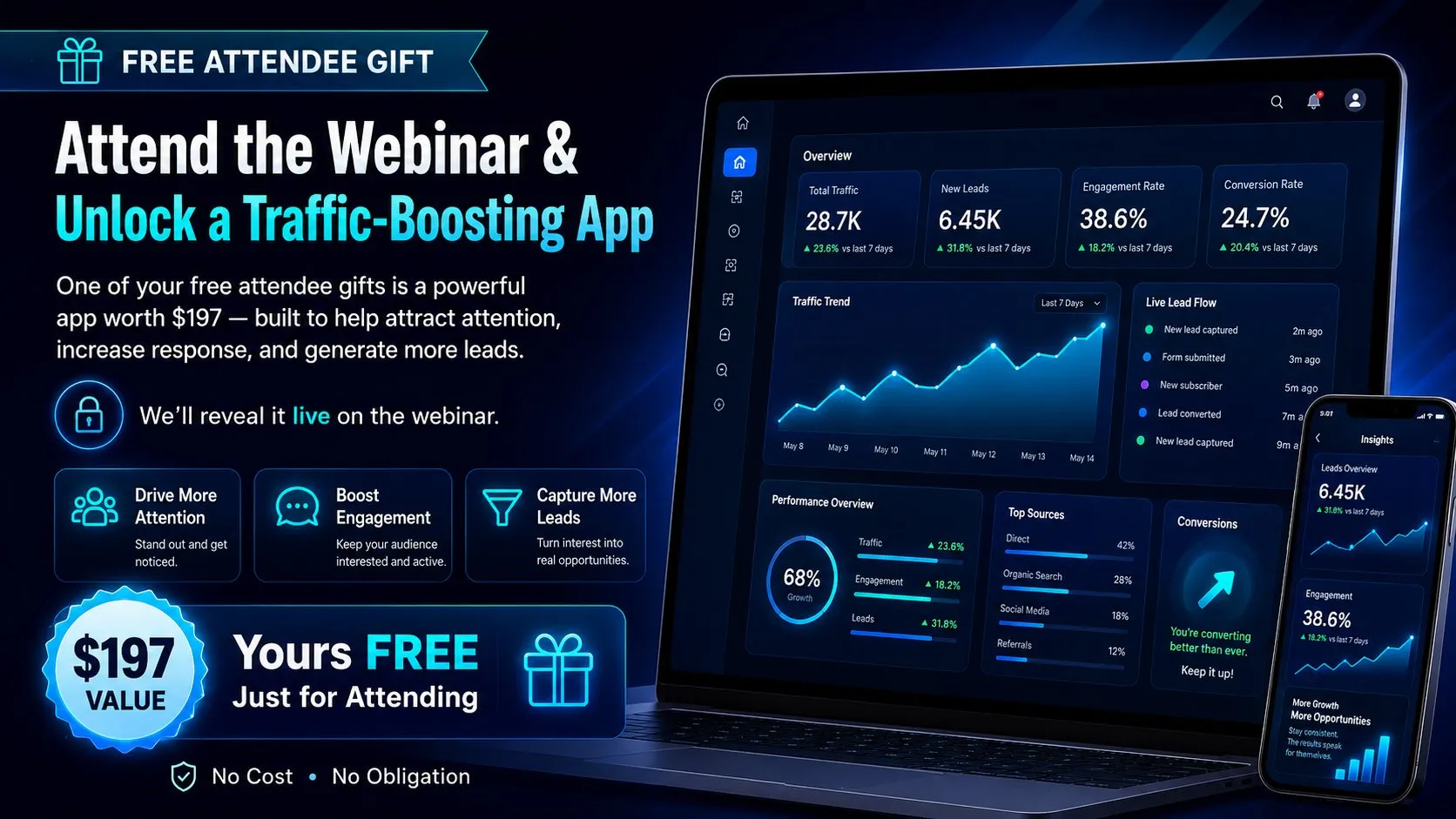
Profit Hub System offers webinar attendees a traffic-boosting app described as a $197 value, providing a real-world example of an incentive connected directly to the audience it serves.
The Incentive Matches the Audience
Think about the people who are likely to be interested in a business and marketing platform.
Many of them are trying to answer questions such as:
How do I get more attention?
How do I generate leads?
How do I get more people into my marketing system?
A traffic and lead-generation tool fits naturally with those interests.
The incentive is not something unrelated that was added simply because it was free.
It connects with a problem the intended audience is already trying to solve.
The Value Exchange Is Easy to Understand
The offer also makes the exchange clear.
The visitor is invited to attend the webinar.
In return for attending, they can unlock the traffic-boosting app as a free attendee gift.
That is a useful principle to remember when creating your own lead magnet.
The person encountering the offer should be able to understand quickly:
What am I getting?
What could it help me do?
What do I need to do to get it?
If those answers are difficult to find, the offer becomes harder to evaluate.
The Lead Magnet Connects to the Larger Offer
There is another important lesson here.
The attendee gift makes sense in the context of Profit Hub System because both relate to building and marketing an online business.
Someone interested in generating traffic and leads may also be interested in learning about the larger business platform presented during the webinar.
That creates a logical progression:
Interest in Growing an Online Business → Webinar → Attendee Gift → Continued Exposure to the Platform
The incentive and the larger offer support the same general goal.
That is much stronger than attracting people with something that has little connection to what the business ultimately provides.
Your Lead Magnet Can Follow the Same Principle
You do not need to give away an app or attach a specific dollar value to create an effective lead magnet.
The underlying principle is what matters.
Offer something useful that helps the kind of person your business is trying to reach.
A WordPress educator might offer a website launch checklist.
An email marketer might offer a welcome email template.
A business coach might offer a planning worksheet.
An affiliate marketing site might offer an offer-evaluation checklist.
The resource changes.
The principle does not:
Attract the right person by helping solve a relevant problem.
That is the lesson worth taking from this example.
Promote Your Lead Magnet Where the Right People Can Find It
You can create an excellent lead magnet, connect the signup form, automate the delivery, and build a useful follow-up sequence.
But none of that matters very much if nobody sees the offer.
Once the system works, the next job is getting the lead magnet in front of people who are likely to benefit from it.
That does not mean putting the signup form everywhere you possibly can.
It means creating relevant opportunities for the right visitors to discover it.
Start With Your Existing Website
Your website is one of the most logical places to promote a lead magnet because visitors are already interacting with your content.
Look for places where the lead magnet naturally connects with what someone is reading.
For example, imagine you created:
The 10-Point Website Launch Checklist
An article about building a business website would be an obvious place to mention it.
An article about writing email subject lines probably would not.
Context matters.
When the lead magnet helps someone take the next step from the content they are already consuming, the offer feels useful rather than intrusive.
Place It Inside Relevant Blog Content
Blog articles can create excellent opportunities for lead generation.
Someone finds an article because they are trying to solve a problem.
Your article helps them understand that problem.
Then your lead magnet gives them something practical they can use to continue.
The progression might look like this:
Google Search → Helpful Article → Relevant Lead Magnet → Email Subscriber
That is one reason content marketing and email list building can work so well together.
The article attracts the visitor.
The lead magnet creates an opportunity to continue the relationship.
Create a Dedicated Landing Page
A dedicated landing page can give your lead magnet a focused destination of its own.
Instead of sending someone to a homepage containing navigation, articles, services, and several competing calls to action, you can send them to a page built around one decision:
Do I want this resource?
The page can explain:
- What the lead magnet is
- Who it is for
- What problem it helps solve
- What the subscriber will receive
- How to get it
Then provide the signup form.
This can be particularly useful when promoting the lead magnet through social media, advertising, email signatures, guest content, or other external traffic sources.
Use Calls to Action Throughout Your Content
You do not necessarily need a large signup form every time you mention your lead magnet.
Sometimes a simple contextual call to action is enough.
For example:
Getting ready to launch your first website? Download our free Website Launch Checklist and review the essentials before you publish.
That call to action can link to the dedicated landing page or signup form.
The important part is that the offer makes sense where it appears.
Promote It Through Social Media
If you already use social media to distribute your content, your lead magnet can become part of that system.
Instead of every post sending people directly toward a product or service, some posts can offer the free resource.
For example:
Launching a new business website? I put together a simple checklist to help you review the essentials before you hit publish.
Then link to the landing page.
You are still promoting something.
But the first step is useful rather than transactional.
Link to It From Related Emails
Your existing subscribers may also benefit from a new resource.
If you create a lead magnet after people have already joined your list, you can introduce it in a relevant email.
You might also reference it inside an automated sequence when it helps solve the next problem being discussed.
This allows one useful resource to support several parts of your marketing system.
Do Not Confuse More Traffic With Better Traffic
A lead magnet does not need to attract everyone.
It needs to attract the people you are equipped to continue helping.
Imagine two lead magnets.
One attracts 1,000 subscribers who have little interest in the subject your business covers.
The other attracts 100 subscribers who are actively trying to solve the exact problems your business helps with.
The larger number may look more impressive.
The smaller audience may be considerably more useful.
That is why promotion and relevance need to work together.
Build More Than One Entry Point Over Time
Your first lead magnet does not have to serve every visitor.
As your content library grows, you may eventually create several lead magnets for different problems.
A website-building article could point toward a website checklist.
An email-marketing article could point toward a welcome email template.
A landing-page article could point toward a conversion checklist.
Each resource becomes another entry point into your email system.
Over time, your website can develop several paths that all lead toward the same larger goal:
Turning anonymous visitors into people you can continue helping.
But before you start creating seven lead magnets and placing them across every corner of your website, there is something more important to do.
Get the first one working.
Then measure what happens.
Measure and Improve Your Lead Magnet
Once your lead magnet is live and people can find it, you finally have something more useful than guesses.
You have real behavior to learn from.
This does not mean you need a complicated analytics dashboard or a spreadsheet containing 47 columns of numbers you never look at.
Start with a few basic questions.
Are people seeing the offer?
Are they subscribing?
Are they opening the delivery email?
Are they accessing the resource?
Are they continuing to engage afterward?
Those answers can help you identify where the system is working and where it may need improvement.
Track How Many People See the Offer
Before judging whether a lead magnet is successful, you need some idea of how many people actually had an opportunity to see it.
Suppose five people subscribe this month.
That number means very little by itself.
If only 20 relevant visitors saw the offer, five subscribers could represent a very different situation than if 5,000 visitors saw it.
This is why context matters.
Depending on your setup, you might track visits to the lead magnet landing page, views of the page containing the signup form, or another reasonable measure of exposure.
You do not need perfect data to begin.
You need enough information to understand what is happening.
Watch Your Signup Conversion Rate
One useful measurement is the percentage of visitors who see the signup opportunity and complete it.
The basic calculation is:
Number of Signups ÷ Number of Visitors × 100 = Signup Conversion Rate
For example, if 200 people visit your lead magnet landing page and 20 subscribe:
20 ÷ 200 × 100 = 10%
The purpose of calculating this is not to obsess over whether your number matches someone else’s benchmark.
Different audiences, traffic sources, offers, pages, and industries can produce very different results.
Use the number primarily to establish your own baseline.
Then see whether your changes improve it.
Look Beyond the Signup
A signup tells you that the offer was interesting enough for someone to provide an email address.
That is useful.
But it does not tell you everything.
You can also look at what happens afterward.
For example:
- Did subscribers open the delivery email?
- Did they click the link to access the lead magnet?
- Did they open later emails?
- Did they click through to related content?
- Did they reply or otherwise engage?
- Did they unsubscribe immediately?
These signals can help you understand whether you attracted people who actually wanted what you offered.
Pay Attention to Subscriber Quality
A huge number of subscribers is not automatically the goal.
Relevant subscribers are more important.
Imagine one lead magnet generates hundreds of signups, but very few subscribers ever open another email.
Another generates fewer signups, but those subscribers regularly read your emails, visit your content, and explore your recommendations.
The second lead magnet may be building a more useful audience even though the first produces the larger number.
That is why evaluating a lead magnet only by total downloads can be misleading.
The goal is not simply:
Get the email address.
The larger goal is:
Begin a relevant relationship.
Improve One Thing at a Time
If the lead magnet is not performing the way you hoped, resist the urge to rebuild everything immediately.
Change one meaningful element.
You might test:
- The lead magnet title
- The headline on the landing page
- The description of the benefit
- The signup button
- The location of the form
- The amount of information requested
- The traffic source
- The delivery email
- The lead magnet itself
Changing one major element at a time makes it easier to understand what may have influenced the result.
If you replace the headline, redesign the page, change the lead magnet, rewrite the button, and send completely different traffic at the same time, you have learned very little about which change mattered.
Listen to What Subscribers Tell You
Numbers are useful, but direct feedback can reveal things analytics cannot.
Subscribers may ask questions.
They may reply to an email.
They may tell you which part of the resource helped them.
They may reveal something that confused them.
Those responses can give you ideas for improving the lead magnet and creating future content.
You can even ask.
A simple follow-up question such as:
“Was there anything you expected this resource to include that it didn’t?”
can produce useful information.
Let the Lead Magnet Evolve
Your first version is not carved into stone.
As you learn more, you can improve it.
You might add a better example.
Simplify a confusing section.
Replace an outdated recommendation.
Improve the design.
Change the title.
Add a useful worksheet.
Remove something nobody needs.
That is not evidence that the first version failed.
It is what happens when you build something, put it in front of real people, and learn from the results.
The same principle applies throughout an online business:
Build → Measure → Learn → Improve
Your lead magnet can follow that cycle too.
And before we bring everything together, there are several common mistakes worth avoiding—especially when you are building your first one.
Lead Magnet Mistakes Beginners Should Avoid
By this point, you have probably noticed that creating a lead magnet is not particularly complicated.
Most of the important decisions come down to relevance, usefulness, clarity, and execution.
But there are several mistakes that can weaken an otherwise good idea.
Knowing them ahead of time can save you a lot of unnecessary work.
Trying to Solve Too Many Problems
One of the easiest mistakes is making the lead magnet too broad.
You begin with one useful idea and keep adding more until the resource is trying to solve every problem your audience might ever encounter.
That usually makes the promise harder to understand.
Instead of:
The Complete Guide to Building, Marketing, Growing, Automating, and Monetizing an Online Business
consider something focused like:
Your First Online Business Website Checklist
The smaller promise may actually be more attractive because the result is easier to understand.
Solve one useful problem first.
Choosing a Topic That Does Not Match Your Audience
A lead magnet can generate signups and still attract the wrong people.
That happens when the incentive is interesting but has little connection to the business behind it.
Before creating the resource, ask:
If someone wants this lead magnet, are they also likely to benefit from the content and solutions my business provides?
If the answer is yes, you probably have a reasonable match.
If the answer is no, you may be building an audience that becomes difficult to serve.
Making the Lead Magnet Too Complicated
More pages do not automatically create more value.
More bonuses do not automatically create more value.
More design does not automatically create more value.
Sometimes complexity simply creates more work for you and more work for the subscriber.
If a two-page checklist solves the problem, let it be a two-page checklist.
Do not turn it into a 40-page ebook because you think a free resource needs to look enormous to be worthwhile.
Using a Weak or Vague Title
Your audience should not need to guess what they are getting.
Titles such as:
The Ultimate Success Formula
or:
Unlock Your Potential
might sound exciting, but they do not explain much.
Compare those with:
The 10-Point Website Launch Checklist
or:
Your First Welcome Email Template
Specificity helps the visitor understand the offer quickly.
Tell them what it is.
Tell them what it helps with.
Then let them decide whether they want it.
Asking for Too Much Information
Remember the value exchange.
If someone wants a simple checklist and the signup form asks for their name, email address, phone number, company, job title, annual revenue, website address, and seventeen other pieces of information, the exchange may begin to feel unbalanced.
Ask for what you actually need.
For many beginner lead magnets, an email address may be enough.
A first name can also be useful if you intend to personalize your emails.
Anything beyond that should have a reason.
Forgetting to Test the Delivery Process
A beautiful lead magnet is useless if the subscriber cannot receive it.
Before promoting the offer, test everything.
Submit the form.
Check the subscriber record.
Open the delivery email.
Click the link.
Download or access the resource.
Test it on mobile.
Make sure the entire experience works.
Never let your first real subscriber become the person who discovers that your download button goes nowhere.
Delivering the Lead Magnet and Then Disappearing
Another common mistake is treating delivery as the end of the process.
Someone downloads the resource.
They receive it.
Then they never hear from the business again.
Months later, another promotional email suddenly appears in their inbox and they cannot remember who sent it or why they subscribed.
A simple follow-up sequence can prevent that disconnect.
Continue the conversation while the original interaction is still fresh.
Turning the Follow-Up Into an Immediate Sales Barrage
The opposite problem can happen too.
The subscriber downloads one free resource and immediately receives a rapid series of aggressive promotional emails.
Remember why they subscribed.
They wanted help with a particular problem.
Continue helping with that problem.
There is nothing wrong with eventually presenting a relevant product, service, or recommendation.
But give the relationship room to develop.
Creating It and Never Promoting It
Sometimes the lead magnet is finished, the automation works, and everything looks great.
Then the creator barely mentions it anywhere.
Put the resource where relevant people can find it.
Connect it to related articles.
Give it a landing page.
Share it through appropriate marketing channels.
A lead magnet cannot generate many subscribers while hiding in a forgotten corner of your website.
Chasing Downloads Instead of Building an Audience
Downloads are easy to count.
That makes them tempting to treat as the primary measure of success.
But the real question is what happens after the download.
Are you attracting people who care about the subjects your business covers?
Do they engage with your emails?
Do they return to your content?
Do they continue through the system?
A lead magnet is not successful simply because a file was downloaded.
Its larger purpose is to help turn relevant visitors into an audience you can continue serving.
Waiting for the Perfect Lead Magnet
This may be the biggest mistake for beginners.
You can spend weeks researching formats, studying examples, redesigning covers, rewriting titles, and wondering whether the idea is good enough.
Meanwhile, you still have nothing live.
Your first lead magnet is allowed to be your first version.
Create something genuinely useful.
Make sure it works.
Put it in front of people.
Then learn.
You will have more useful information after 50 real visitors interact with the offer than you will after another week of imagining what those visitors might do.
Build it. Launch it. Learn from it. Improve it.
That is a much better foundation than waiting indefinitely for perfect.
Your First Lead Magnet: A Simple Step-by-Step Action Plan
We have covered a lot.
But creating your first lead magnet does not require doing everything at once.
If you are looking at all the pieces and wondering where to begin, use this simple action plan.
The goal is to move from an idea to a working lead magnet system without turning the project into something bigger than it needs to be.
Step 1: Choose the Audience
Start with the person you want the lead magnet to help.
Do not try to create something for everyone.
Ask:
Who am I trying to attract?
You might choose:
Beginners building their first business website.
That gives you a specific person to keep in mind while making every decision that follows.
Step 2: Choose One Problem
What is that person trying to accomplish?
Keep the problem focused enough that your lead magnet can genuinely help.
For example:
I want to launch my business website, but I am worried I will forget something important.
Now you have a problem you can build around.
Step 3: Define the Result
Decide what should happen after someone uses the resource.
Complete this sentence:
After using this lead magnet, the subscriber should be able to ____________________.
For our example:
After using this lead magnet, the subscriber should be able to review the essential pieces of their website before launching it.
Now the purpose is clear.
Step 4: Choose the Simplest Useful Format
What is the easiest way to help someone achieve that result?
For this example, a checklist makes sense.
You do not need a course.
You do not need a 50-page ebook.
You need something that allows the person to review important items and mark them complete.
So our lead magnet becomes:
The 10-Point Website Launch Checklist
Step 5: Create the Content
Write the information the subscriber actually needs.
Stay focused on the result.
For the website checklist, that might include:
- Essential pages are published
- Navigation works correctly
- Contact information is accurate
- Forms have been tested
- Links work
- Mobile layout has been reviewed
- Images are optimized
- Basic SEO settings are complete
- Site speed has been checked
- A final launch review has been completed
Now you have the foundation of the resource.
Step 6: Package the Lead Magnet
Turn the content into something easy to use.
Add your business name and branding.
Make the text readable.
Organize the information clearly.
Include your website address.
Add a relevant next step.
Then export or publish it in the format that makes the most sense.
Do not spend three weeks deciding whether an icon should move four pixels to the left.
Make it clean.
Make it useful.
Move forward.
Step 7: Create the Signup Opportunity
Give visitors a clear way to request the resource.
Your offer might say:
Launching Your First Business Website?
Download the free 10-Point Website Launch Checklist and review the essentials before you hit publish.
Then provide a simple signup form.
Step 8: Connect the Email Delivery
Connect the form to your email system.
Create the delivery email.
Add the link to the resource.
Then test it.
Your basic automation might be:
Signup Form → Subscriber Added → Delivery Email Sent → Lead Magnet Accessed
Do not send traffic until you know that process works.
Step 9: Create the Follow-Up
Decide what happens after the resource is delivered.
Start simple.
A few helpful emails that continue the same topic are enough to begin.
For our website checklist example, the sequence might help subscribers improve their mobile layout, understand landing pages, begin basic SEO, or generate traffic to the new website.
The lead magnet started the relationship.
The follow-up continues it.
Step 10: Put the Lead Magnet in Front of People
Now promote it.
Add it to relevant articles.
Create a landing page.
Mention it through social media.
Link to it where the context makes sense.
You do not need traffic from everywhere.
Start by putting the offer in front of people who are already interested in the problem it solves.
Step 11: Measure What Happens
Watch what real visitors do.
Are they reaching the page?
Are they subscribing?
Are they opening the delivery email?
Are they accessing the resource?
Are they engaging with the follow-up?
You now have information you can use.
Step 12: Improve the System
Do not immediately rebuild everything.
Look for the weakest point.
If people visit but do not subscribe, examine the offer or signup page.
If they subscribe but do not access the resource, examine the delivery email.
If they download the resource but disappear afterward, examine the follow-up.
Improve one piece.
Measure again.
Then continue.
Your First Version Is Enough to Start
Look at what we actually built through those steps:
Audience → Problem → Result → Lead Magnet → Signup Form → Delivery → Follow-Up → Promotion → Measurement
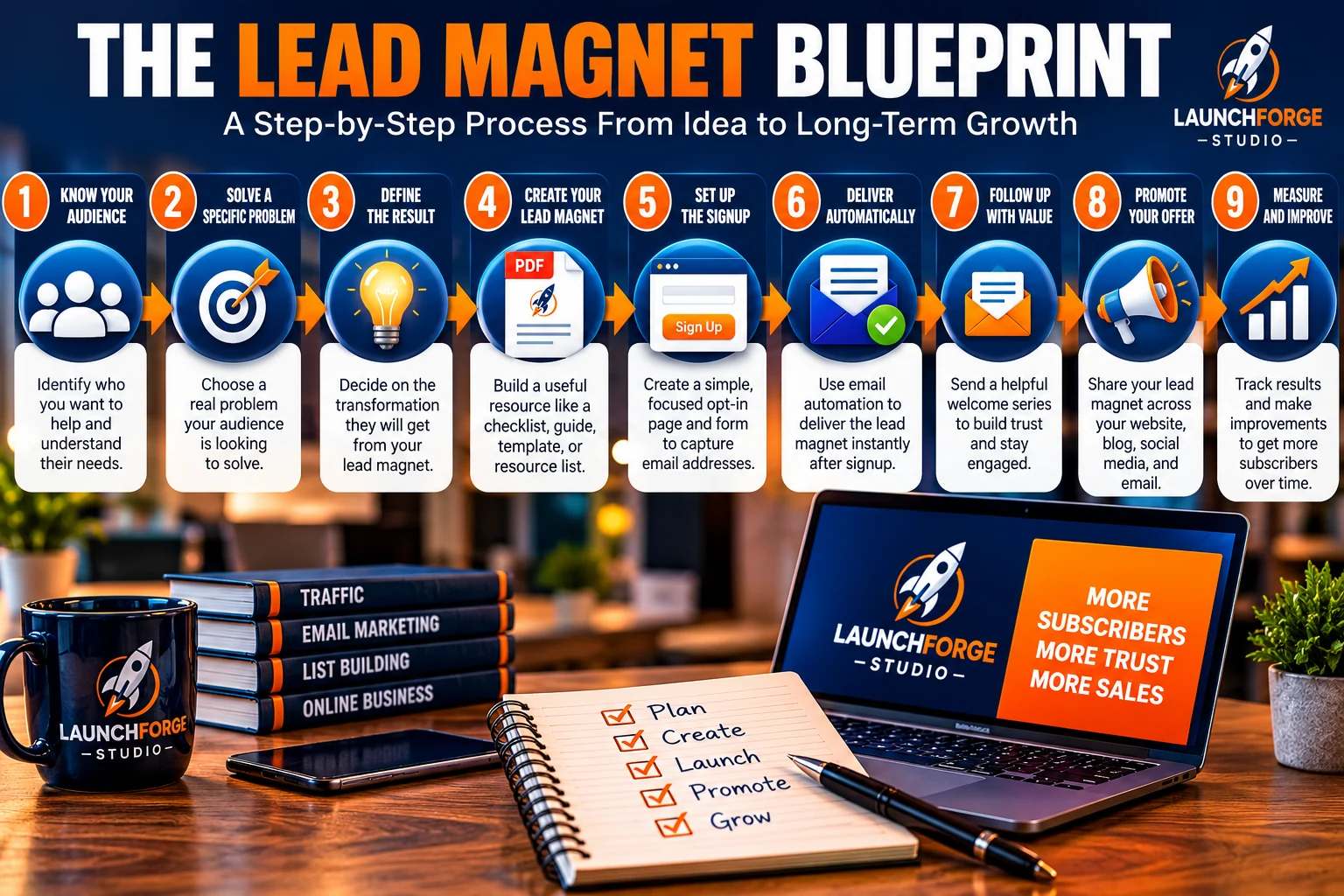
A successful lead magnet starts with understanding your audience and solving a specific problem, then connects signup, delivery, follow-up, promotion, and measurement into one working system.
That is a real system.
It may begin with one checklist and one simple automation.
That is fine.
You can add sophistication later.
The important part is getting the first complete version working from beginning to end.
Because once the system works for one subscriber, you have something you can begin improving for the next one.
Final Thoughts: Build the First Useful Version
Learning how to create a lead magnet can seem complicated when you first start looking at everything involved.
You need an idea.
You need something useful to offer.
You need a signup form.
You need an email system.
You need delivery.
You need follow-up.
You need traffic.
And eventually, you need to measure what happens.
But you do not have to perfect all of those pieces before you begin.
Start with one person.
One problem.
One useful resource.
Then build the simplest working path that gets that resource into the hands of someone who needs it.
That is your first lead magnet system.
Remember What the Lead Magnet Is Really For
It is easy to become focused on conversion rates, subscriber counts, downloads, and email-list growth.
Those things matter.
But behind every signup is a person who decided your resource looked useful enough to exchange their email address for it.
That is the relationship you are trying to build.
The lead magnet creates the introduction.
What you do afterward determines whether that introduction becomes something more.
Deliver what you promised.
Continue helping.
Send useful emails.
Recommend relevant resources.
Respect the subscriber’s attention.
And give them reasons to want to hear from you again.
You Can Improve Everything Later
Your first lead magnet probably will not be your best lead magnet.
That is okay.
Your first landing page probably will not be your best landing page either.
Neither will your first email sequence, first article, first offer, or first marketing campaign.
You learn by building.
You learn by putting something in front of real people.
You learn by seeing what works, what does not, and what needs to change.
That is exactly how we continue building LaunchForge Studio.
We build something useful.
We put it to work.
We learn from what happens.
Then we make the next version better.
Start With One Subscriber
You do not need 10,000 subscribers to prove that your lead magnet system works.
Start with one.
Can one relevant visitor discover the offer?
Can they understand what they will receive?
Can they submit the form?
Does the email arrive?
Can they access the lead magnet?
Does the resource actually help them?
Do they know what to do next?
If the answer to those questions is yes, you have built something real.
Then you can work on bringing the second person through the system.
Then the tenth.
Then the hundredth.
Growth comes after the system works.
So if you have been waiting because you think your lead magnet needs to be bigger, more impressive, more polished, or more complicated before you launch it, start smaller.
Choose one problem your audience wants to solve.
Create one useful resource that helps them solve it.
Connect it to your email system.
Put it in front of people.
Then learn from what happens.
Build the first useful version.
Get the first subscriber.
Then build from there.