
Get rich overnight. It’s one of the most tempting promises in online business marketing. But behind the flashy advertisements, luxury lifestyles, and effortless income claims is a reality that deserves a much closer look.
MAKE $10,000 WHILE YOU SLEEP!
QUIT YOUR JOB BY FRIDAY!
PUSH ONE BUTTON AND WATCH THE MONEY ROLL IN!
WELCOME TO THE INTERNET, LADIES AND GENTLEMEN!
The magical kingdom where apparently nobody has to work anymore, everybody owns a Lamborghini, and some mysterious millionaire posing in front of a mansion wants to share the secret to unlimited wealth for just $27.
What a generous fellow.
If you’ve spent more than five minutes exploring online business opportunities, you’ve probably encountered some version of these promises.
One advertisement claims you can earn thousands of dollars without experience. Another introduces a revolutionary automated system that supposedly does everything for you. And somewhere, someone is inviting you to join an exclusive challenge that could change your financial future in a matter of days.
All you have to do is enter your email address, watch a presentation, and discover the secret.
Apparently, building a successful business has become easier than ordering a pizza.
At least that’s what certain sales pages would like you to believe.
According to some corners of the internet, you don’t need customers, experience, a business plan, or even a particularly good idea.
Just purchase the system, activate the automation, and prepare for a lifestyle filled with tropical beaches, expensive watches, and suspiciously enthusiastic testimonials.
There’s just one tiny problem.
Real businesses don’t usually work that way.
Somewhere behind those beautiful sales pages, someone still has to create something valuable, attract an audience, earn trust, deliver a product or service, manage expenses, and solve problems when things go wrong.
Apparently, those details didn’t fit on the promotional banner.
And while it’s possible for an online business to grow quickly under the right circumstances, rapid success is very different from guaranteed success.
That’s where the idea of getting rich overnight deserves a closer look.
The Dream Isn’t the Problem
Before we go any further, let’s make something absolutely clear.
There’s nothing wrong with wanting to make more money.
There’s nothing wrong with dreaming about financial independence, leaving a stressful job, spending more time with your family, or building something that gives you greater control over your future.
Those are legitimate ambitions.
And the internet has created real opportunities for everyday people to build businesses, sell products, provide services, publish educational content, and connect with customers around the world.
You don’t necessarily need a traditional storefront, a warehouse full of inventory, or an enormous startup budget to begin exploring those possibilities.
That’s genuinely exciting.
But there’s an important difference between recognizing an opportunity and believing that purchasing access to an opportunity guarantees a particular outcome.
The problem isn’t wanting success. The problem is being convinced that success requires almost no effort, uncertainty, or risk.
That’s when a dream can become an expensive misunderstanding.
A polished sales presentation can make an uncertain business opportunity appear practically guaranteed.
A dramatic testimonial can make an unusual success story look like something everyone should expect.
A countdown timer can convince someone that a decision involving hundreds or thousands of dollars must be made before the clock reaches zero.
And a carefully chosen earnings screenshot can create excitement without explaining the expenses, advertising costs, experience, or circumstances behind the numbers.
Suddenly, you’re no longer evaluating a business opportunity.
You’re afraid of missing one.
The Rise of the Magic Money Button
Technology has made building and operating an online business more accessible than ever.
Website builders can simplify design. Marketing automation can help manage repetitive tasks. Artificial intelligence can assist with brainstorming, research, drafting, and organizing information.
These tools can be genuinely useful.
I use technology and automation while building LaunchForge Studio, so I’m certainly not going to pretend that software doesn’t make a difference.
But there’s a distinction that deserves repeating:
Automating part of a business is not the same as automating the creation of business success.
An email autoresponder can send messages to subscribers.
It cannot guarantee that people will subscribe.
A landing page builder can help you publish a professional-looking offer.
It cannot guarantee that visitors will purchase anything.
An AI writing assistant can help you organize and draft content.
It cannot guarantee that people will find that content valuable or that search engines will send visitors to it.
And no legitimate piece of software can promise that every person who purchases it will become wealthy.
Yet the marketing sometimes makes it sound as though technology has eliminated the need for business fundamentals.
Just activate the system.
Let the automation run.
Come back tomorrow and admire your bank balance.
If only someone had told the world’s struggling entrepreneurs that all they needed was the correct button!
The reality is less glamorous, but far more useful.
Technology can help people execute a business strategy. It doesn’t eliminate the need for a strategy in the first place.
What We’re Really Going to Talk About
This isn’t another article declaring that every online business opportunity is a scam.
It isn’t an argument that making money online is impossible.
And it certainly isn’t a lecture suggesting that anyone who dreams of financial independence is foolish.
Quite the opposite.
I believe people deserve the opportunity to explore their ambitions without being manipulated by exaggerated promises.
That’s why we’re going to examine the fascinating, sometimes ridiculous, and occasionally troubling world of overnight-income marketing.
We’ll explore why these promises attract so much attention, how sales presentations create urgency, and why impressive screenshots and testimonials don’t always tell the complete story.
We’ll also examine how artificial intelligence and automation have become the latest ingredients in the magic-money-button pitch.
More importantly, we’ll look at the costs, responsibilities, and uncertainties that deserve attention before anyone purchases a business opportunity, training program, or marketing system.
And we’ll discuss what honest online business opportunities look like, including how to evaluate realistic claims and recognize the difference between useful tools and unsupported promises.
Because there’s a world of difference between buying something that helps you build a business and buying the fantasy that you won’t have to build one.
And if somebody promises that you’ll be wealthy by Thursday simply because you clicked a button, you might want to ask what happens on Friday.
At LaunchForge Studio, our philosophy is straightforward.
Help people solve real problems.
Create something useful.
Lead with generosity, authenticity, and integrity.
Keep learning, improving, and putting in the work.
We believe dreams are powerful motivation. They give us something worth pursuing and remind us why the effort matters.
But dreams alone don’t build websites, serve customers, or create lasting value.
The dream is free. The work gives it wings.
Now, let’s pull back the curtain on the overnight-riches circus and find out why those extraordinary promises can be so difficult to resist.
The Overnight Riches Fantasy: Why We Want to Believe It

Dreaming of a better future is natural. Turning that dream into a business requires planning, learning, and action.
Imagine this.
It’s Sunday evening. You’ve had a long week, the bills are piling up, and tomorrow morning your alarm clock is going to remind you that another workweek is waiting.
You’re scrolling through your phone when suddenly an advertisement appears.
“I Made $12,487 in Seven Days Using This Simple Online System!”
There’s a smiling entrepreneur standing beside a luxury vehicle. Behind them is a beautiful house, possibly overlooking the ocean.
And somewhere near the bottom of the advertisement is a bright button inviting you to discover how they did it.
For a brief moment, something happens.
You stop scrolling.
Not necessarily because you believe every word.
But because a small part of you wonders:
“What if something like that could actually happen for me?”
And that, right there, is where the overnight-riches fantasy gets its power.
It doesn’t begin with software.
It begins with hope.
Financial Freedom Is an Emotionally Powerful Dream
Money isn’t just about buying expensive things.
For many people, money represents security, flexibility, independence, and the ability to make choices without constantly worrying about financial consequences.
It can mean paying bills without anxiety.
Having more time with family.
Building a savings cushion.
Leaving a job that no longer feels rewarding.
Or finally pursuing a business idea that’s been sitting in the back of your mind for years.
Those motivations are real, personal, and often deeply meaningful.
That’s why an advertisement promising financial freedom can be so powerful.
It isn’t necessarily selling a software platform or a training course.
It’s selling the possibility of a different life.
And when someone is exhausted, frustrated, or struggling financially, the possibility of rapid change can feel especially attractive.
There’s nothing foolish about wanting things to improve.
But wanting an outcome and having reliable evidence that an offer can produce that outcome are two very different things.
The Bigger the Promise, the More Powerful the Fantasy
Consider the difference between these two marketing messages.
Message A:
“Learn how to build a website, research your audience, create useful content, and develop a marketing strategy over time.”
Message B:
“Discover the Secret System That Could Have You Earning Thousands Before Next Weekend!”
Which one do you think is more likely to interrupt someone’s scrolling?
Probably the second.
It offers excitement, speed, and the possibility of an extraordinary reward.
The first sounds suspiciously like work.
And let’s face it: work isn’t always the easiest thing to sell.
The problem is that the less exciting description may be much closer to what building an online business actually involves.
Businesses generally need customers, useful offers, effective operations, and some method of attracting attention.
Those fundamentals don’t disappear simply because someone packages software inside a colorful dashboard.
An extraordinary promise should invite extraordinary scrutiny, not automatic belief.
Why Success Stories Are So Persuasive
Human beings connect with stories.
A detailed account of someone overcoming challenges and achieving a meaningful goal can be genuinely inspiring.
That’s one reason testimonials and personal success stories are common in online marketing.
Imagine seeing someone explain how they went from working a traditional job to operating a profitable online business.
They describe the frustrations they experienced, the opportunities they discovered, and the moment things finally started improving.
It’s easy to imagine yourself following a similar path.
And sometimes those stories are legitimate.
But there’s an important question that often goes unanswered:
How representative is that person’s experience?
Perhaps they already had an established audience.
Maybe they invested thousands of dollars in advertising.
They might have spent years developing the skills required to produce their results.
Or perhaps their earnings represent an unusually successful period rather than a typical outcome.
Without that context, a genuine success story can still create unrealistic expectations.
One person’s achievement is evidence of what happened to that person.
It isn’t proof that everyone purchasing the same product will achieve similar results.
The Fear of Missing Out Makes Everything More Urgent
Now let’s add another ingredient to our overnight-riches recipe.
A countdown timer.
You’ve probably seen them.
“SPECIAL OFFER ENDS IN 09:47!”
“ONLY THREE SPOTS REMAIN!”
“DON’T MISS YOUR CHANCE TO CHANGE YOUR LIFE!”
Suddenly, the decision doesn’t feel like ordinary research anymore.
It feels like an emergency.
The message suggests that hesitation could cost you an extraordinary opportunity.
And instead of asking whether the platform is suitable, you may find yourself wondering whether you’ll regret not purchasing it.
This is the emotional power of fear of missing out, commonly called FOMO.
Scarcity and deadlines aren’t automatically dishonest. A legitimate business can have limited capacity or a genuine promotional period.
But when urgency is manufactured, misleading, or used to prevent reasonable investigation, it becomes a serious concern.
A business opportunity worth considering should be able to withstand thoughtful questions.
You should have enough information to understand what you’re purchasing, what it costs, and what realistic outcomes might involve.
If someone insists that you must make a financial commitment before you have time to investigate, that pressure deserves attention.
Hope Is Valuable. Desperation Can Be Exploited.
Here’s where I want to make an important distinction.
Hope can be an extraordinary motivator.
It encourages people to learn new skills, pursue ambitious goals, and keep working toward a better future.
Without hope, many worthwhile businesses might never get started.
But when someone feels desperate for financial relief, a promise of fast income can appear more attractive than it otherwise would.
That’s why responsible marketing matters.
There’s a meaningful difference between encouraging someone to explore a legitimate opportunity and convincing them that purchasing a particular system will solve their financial problems.
An honest business offer should explain its capabilities, costs, and limitations without depending on unrealistic expectations.
And consumers should feel comfortable asking questions without being made to feel that skepticism means they lack ambition.
Being cautious doesn’t mean you’ve stopped believing in your dreams. It means you’re protecting the resources you’ll need to pursue them.
The Real Question Behind the Dream
Before responding to an extraordinary online income promise, ask yourself something.
“Am I interested in this opportunity because I understand the business model, or because I’m excited about the lifestyle being advertised?”
That’s a powerful distinction.
A beautiful house doesn’t explain how a business earns revenue.
An expensive car doesn’t demonstrate profitability.
A screenshot of a payment notification doesn’t reveal operating expenses.
And a motivational presentation doesn’t replace a realistic business plan.
If the opportunity interests you, investigate what you’ll actually be doing.
Find out how customers are acquired, what products or services are provided, what expenses are involved, and which skills you’ll need to develop.
You don’t have to abandon the dream.
You simply need to separate the dream from the evidence.
Because the most dangerous part of the overnight-riches fantasy isn’t wanting a better future.
It’s allowing the promise of that future to replace the questions you should be asking today.
And now that we understand why these promises can be so appealing, let’s examine how the sales pitches themselves are constructed.
The Anatomy of a Get-Rich-Quick Sales Pitch

Extraordinary promises, effortless income claims, and urgent calls to action deserve a closer look before you buy.
Picture this.
You’re browsing the internet, minding your own business, when suddenly you’re greeted by a headline that practically jumps off the screen.
“MAKE $1,000 IN THE NEXT 11 DAYS!”
Below it, there’s a video featuring an enthusiastic entrepreneur who apparently discovered a revolutionary system that ordinary people can use to transform their financial futures.
There’s a countdown timer.
A bright red button.
A few glowing testimonials.
And somewhere in the presentation, you’ll probably hear a familiar sentence:
“I’m going to show you something the experts don’t want you to know!”
Oh, wonderful.
Apparently, there’s an international committee of wealthy people whose sole responsibility is keeping the secret money button away from the rest of us.
And this generous stranger has finally decided to expose the conspiracy.
For $27.
All jokes aside, this style of sales presentation can be remarkably persuasive.
Not necessarily because the underlying business opportunity is legitimate or illegitimate, but because the presentation is designed to capture attention, build excitement, and encourage action.
Let’s examine the ingredients.
Step 1: Start With an Extraordinary Earnings Claim
The first ingredient is usually a financial promise that sounds too exciting to ignore.
Perhaps it’s $500 per day.
Maybe it’s $10,000 per month.
Or perhaps it’s an invitation to earn your first $1,000 in less than two weeks.
The specific amount varies, but the structure is familiar.
A desirable financial outcome combined with an unusually short timeframe.
Why is that combination so powerful?
Because it makes a complicated goal feel immediate and achievable.
Instead of thinking about developing skills, attracting customers, and building a business, the reader begins imagining the result.
What would an extra $1,000 mean this month?
What if the system really worked?
What if this were finally the opportunity that changed everything?
Those questions create emotional momentum.
But an earnings claim raises important questions of its own.
Is the advertised amount revenue or profit?
Does it represent a typical customer outcome or an exceptional example?
How much time, money, and experience were required?
And what evidence supports the claim?
The bigger and more specific the earnings promise, the more important it becomes to understand the evidence behind it.
An ambitious marketing headline isn’t proof of a deceptive offer.
But it isn’t proof of the advertised outcome, either.
Step 2: Make the Process Sound Almost Effortless
Next comes the promise of simplicity.
You might see phrases such as:
- “No experience necessary!”
- “No technical skills required!”
- “Just copy and paste!”
- “The system does everything for you!”
- “Set it up once and watch the income roll in!”
These statements aren’t all automatically false.
Some modern business tools genuinely reduce technical barriers.
A beginner-friendly website builder can simplify creating web pages. Templates can reduce design work. Automation can handle repetitive tasks.
But simplifying a task is very different from eliminating the work required to build a business.
For example, a landing page template might help someone publish a professional-looking page.
It doesn’t automatically provide a compelling offer, a trustworthy reputation, or interested customers.
Likewise, an email automation system can send messages according to a schedule.
It cannot guarantee that subscribers will purchase anything.
When a sales presentation suggests that technology eliminates nearly every responsibility involved in earning money, investigate exactly what the buyer will still need to do.
The answer may be substantially more complicated than the headline suggests.
Step 3: Introduce the Mysterious Secret
This is where things get entertaining.
Apparently, the internet is overflowing with secret methods that have somehow escaped the attention of every major business school, entrepreneur, and financial institution on the planet.
You may encounter promises involving a hidden formula, a little-known traffic source, a private algorithm, or a revolutionary marketing loophole.
Sometimes the presenter insists the method is so powerful that established businesses don’t want ordinary people discovering it.
Cue the dramatic music.
THE SECRET HAS BEEN REVEALED!
Except you still haven’t learned what the actual business model is.
Here’s a useful principle:
A legitimate business opportunity should be explainable in understandable terms.
You should be able to identify what product or service is offered, who the customers are, how revenue is generated, and what responsibilities belong to the business owner.
A company may reasonably protect proprietary technology or confidential processes.
But that doesn’t justify withholding essential information about what someone is purchasing.
If a presentation spends more time describing how extraordinary the secret is than explaining what the business actually does, that’s a reason to investigate further.
You don’t need every proprietary detail.
You do need enough information to make an informed decision.
Step 4: Add a Countdown Timer and a Little Panic
Now that the sales presentation has captured your imagination, it’s time to make sure you don’t leave.
Enter the countdown timer.
“YOUR EXCLUSIVE DISCOUNT EXPIRES IN 08:59!”
Suddenly, you’re expected to make a financial decision before you’ve had time to compare alternatives, read the terms, or calculate the full cost.
Countdown timers can serve legitimate purposes.
Real promotional offers have deadlines. Events have registration periods. Limited-capacity services may genuinely have a restricted number of openings.
But a timer becomes questionable when the urgency it communicates is misleading.
For example, imagine a website claiming that an offer disappears in ten minutes, only for the same countdown to restart whenever the page reloads.
That would be an important reason to question the promotion’s credibility.
The central issue isn’t the presence of a timer.
It’s whether the scarcity or deadline is genuine and accurately represented.
If you’re considering a purchase, ask whether you understand the offer well enough to make a sensible decision.
If you don’t, the remaining seconds on a webpage shouldn’t determine how you spend your money.
Step 5: Surround the Offer With Success Stories
Next, the presentation introduces people who supposedly followed the system and achieved remarkable results.
Someone earned thousands during their first month.
Another claims to have replaced their employment income.
A third appears beside an expensive sports car, presumably because ordinary transportation is no longer appropriate for someone who purchased a $27 digital product.
Now, testimonials can be genuinely helpful.
Real customer experiences can provide valuable insight into how a product works.
But testimonials deserve context.
Were the results independently verified?
What expenses were involved?
How long did the person work toward those results?
Did they already have an audience, technical experience, or other advantages?
And are their outcomes reasonably representative of what purchasers should expect?
Consider a hypothetical example.
A marketer displays a screenshot showing $15,000 in sales.
That might be an impressive achievement.
But what if the business spent $12,000 on advertising, $2,000 on software and contractors, and hundreds of hours managing campaigns?
The sales figure would tell a very different story once those expenses were considered.
Revenue screenshots aren’t the same as evidence of profit, and individual testimonials aren’t proof of typical results.
We’ll explore this distinction in greater detail in the next section.
Step 6: Reveal the Surprisingly Affordable Price
After showing you extraordinary financial possibilities, the presentation finally introduces the product.
And wouldn’t you know it?
The secret system supposedly worth thousands of dollars is available today for only $27.
Or perhaps $47.
Maybe $97 if the mysterious algorithm is feeling particularly expensive.
The exact price isn’t the issue.
Plenty of legitimate digital products are inexpensive, and a low-cost educational resource can provide genuine value.
The concern arises when the presentation encourages you to judge the purchase based on an enormous promised financial outcome rather than the product’s actual capabilities.
For example:
“If this system can make you $10,000, isn’t $27 practically nothing?”
That sounds persuasive until you notice the word if is doing an extraordinary amount of work.
A product’s value should be evaluated using what it actually provides, the costs involved, the quality of its information, and whether it fits your needs.
Not simply the amount of money a promotional presentation invites you to imagine earning.
An affordable price doesn’t make an unsupported earnings promise more reliable.
And a relatively small purchase can become expensive if it leads to additional memberships, upgrades, or advertising expenses that weren’t clearly explained.
Step 7: Make Skepticism Feel Like a Personal Failure
Here’s a tactic that deserves special attention.
Sometimes, instead of addressing legitimate questions, a presentation turns the buyer’s hesitation into a supposed character flaw.
You might hear statements implying that only unsuccessful people ask too many questions.
Or that anyone who doesn’t purchase immediately lacks the mindset required for success.
Perhaps the presenter insists that wealthy people take action while everyone else makes excuses.
There’s a grain of truth in the idea that progress requires action.
But responsible action and impulsive spending are not the same thing.
A thoughtful entrepreneur asks questions, evaluates risks, reviews expenses, and considers alternatives.
That’s not a weakness.
That’s part of making informed business decisions.
A legitimate opportunity shouldn’t require you to prove your ambition by ignoring reasonable concerns.
If asking about pricing, typical results, or refund conditions produces more motivational pressure instead of meaningful answers, consider what that tells you about the sales process.
The Question That Cuts Through the Hype
After watching an exciting presentation, it’s easy to feel energized.
That’s not necessarily a bad thing.
Marketing can introduce useful opportunities and inspire people to explore new possibilities.
But before making a purchase, return to one simple question:
“What exactly am I buying, and how will it help me create real value for customers?”
If the answer involves a useful software tool, a practical training resource, or a clearly explained service that fits your goals, the offer may deserve further consideration.
If the answer remains vague and the entire presentation depends on screenshots, secrets, artificial urgency, and extraordinary income expectations, keep investigating.
You don’t need to be cynical about every opportunity.
You need to be curious about the evidence.
Because the best business opportunities don’t need to hide behind the fantasy of effortless wealth. They can explain the value they provide.
And speaking of evidence, let’s examine the flashy screenshots, luxurious lifestyles, and glowing testimonials that make these promises look so convincing.
The Screenshots, Supercars, and Testimonials That Sell the Dream

Impressive income screenshots, luxury lifestyles, and glowing testimonials can attract attention, but they don’t automatically prove typical business results.
Ah, yes. The luxury lifestyle.
Apparently, the first requirement for becoming a successful online entrepreneur is finding an expensive sports car, parking it in front of an enormous house, and taking a photograph while wearing sunglasses that cost more than your monthly grocery bill.
Bonus points if there’s a swimming pool.
Double bonus points if you’re holding a laptop.
And if you can somehow include a tropical beach, a private jet, and a screenshot showing $38,742 in earnings before breakfast?
Congratulations.
You’ve officially assembled the internet’s favorite get-rich-quick marketing starter kit.
But behind the humor is a serious question:
How much of what you’re seeing actually proves that an online business opportunity works?
The answer depends on the evidence, the context, and whether the information accurately represents what ordinary purchasers can reasonably expect.
Let’s examine some of the most recognizable ingredients.
The Luxury Lifestyle Isn’t a Financial Statement
Imagine watching a promotional video featuring an entrepreneur stepping out of a bright red Lamborghini.
Behind them stands a beautiful mansion.
They explain that everything changed when they discovered a particular online business system.
The message is obvious.
Purchase the system, follow the instructions, and perhaps one day you’ll enjoy the same lifestyle.
It’s an emotionally powerful presentation.
But consider what the photograph doesn’t establish.
Does the person own the car?
Is the house their residence?
Was the vehicle rented for a promotional shoot?
Did the person earn their money through the business opportunity being advertised, or through an entirely different source?
And even if every luxury item genuinely belongs to them, what does that tell you about the results an average customer might achieve?
Not much.
Someone can be financially successful without having developed a useful training program.
And someone can develop an excellent educational product without owning a sports car.
Lifestyle imagery can demonstrate an aspiration. It doesn’t automatically demonstrate the effectiveness of the product being sold.
There’s nothing inherently dishonest about displaying success or enjoying expensive possessions.
The concern arises when those images are used to imply financial results that haven’t been adequately supported.
The Famous Earnings Screenshot
Now let’s move from supercars to something that looks a little more convincing.
The earnings dashboard.
You’ve probably seen these images in advertisements, sales presentations, and social media posts.
A screenshot displays thousands of dollars in sales, commissions, or account activity.
Perhaps there’s a bright green number showing an impressive daily total.
Maybe the presenter circles the amount with a giant red arrow.
And underneath it, the caption reads:
“THIS COULD BE YOU!”
Well, perhaps.
But before getting excited, we need to understand what the number actually represents.
An earnings screenshot might show revenue, commissions, pending transactions, gross sales, or another financial metric.
Those aren’t necessarily interchangeable.
And the screenshot alone may not explain what it cost to produce that result.
Revenue Is Not the Same as Profit
This distinction is essential for evaluating online income claims.
Let’s imagine a hypothetical entrepreneur promoting a digital product.
Their dashboard shows:
Total sales: $20,000
That’s an impressive-looking number.
But suppose the business also incurred these expenses:
- Paid advertising: $9,000
- Software subscriptions: $1,200
- Contractors and creative services: $3,000
- Transaction fees and refunds: $1,000
- Other operating expenses: $1,800
Those expenses total $16,000.
The remaining amount is $4,000 before considering any additional obligations, such as taxes.
That’s still a positive hypothetical result, but it tells a very different story than simply announcing:
“I MADE $20,000!”
And if expenses exceeded revenue, the same impressive sales screenshot could accompany an overall financial loss.
Here’s the lesson:
An impressive revenue number doesn’t tell you how profitable a business actually is.
When evaluating claims, ask whether the advertised amount represents gross revenue, net profit, commissions earned, or money actually received.
Also investigate the timeframe, expenses, refunds, and resources required to generate the result.
The details matter.
Can Earnings Screenshots Be Misleading?
Absolutely.
But that doesn’t mean every earnings screenshot is fake.
Some people genuinely earn substantial revenue through online businesses, and legitimate marketers may share authentic records of their performance.
The problem is that screenshots are often difficult for outsiders to verify.
An image can be cropped to remove important context.
A dashboard can display a particularly successful day without revealing less successful periods.
A screenshot may show pending commissions that haven’t been finalized.
And digital images can be manipulated or fabricated.
Even a completely authentic screenshot doesn’t automatically establish that the same result is typical, repeatable, or reasonably achievable by someone purchasing a particular product.
The question isn’t simply whether the screenshot is real. It’s what the screenshot actually proves.
If someone claims that ordinary beginners can achieve similar results, that broader claim needs evidence beyond one impressive image.
Testimonials: Real People, Incomplete Stories
Testimonials can provide valuable information.
A customer explaining how a product helped them solve a specific problem may offer useful insight into its practical benefits.
For example, someone might describe how a website builder simplified their design process or how a training course helped them understand a particular marketing technique.
Those are concrete experiences worth considering.
But testimonials become more complicated when they involve extraordinary financial outcomes.
Imagine seeing a customer declare:
“I Earned $7,500 During My First Month!”
Naturally, that statement attracts attention.
But what else would you want to know?
Did the customer already have an established audience?
Were they experienced in marketing or sales?
How much did they spend on advertising?
Were they working full-time on the project?
Was the $7,500 revenue, commission income, or profit?
Did the result continue in subsequent months?
And how did other customers perform?
Without those details, it’s difficult to determine whether the testimonial offers useful evidence or simply presents an appealing success story.
A testimonial can be sincere and still create unrealistic expectations when important context is missing.
That doesn’t mean you should automatically dismiss testimonials.
It means you should evaluate what they demonstrate and what they leave unanswered.
The Problem With Showing Only the Winners
Suppose 1,000 people purchase an online business training program.
A handful report impressive results.
Others achieve modest progress.
Some struggle to implement the material.
And others never complete the training.
Now imagine the promotional page features only the most successful participants.
The stories might all be genuine.
But would those selected examples accurately represent the experiences of the broader customer group?
Not necessarily.
This is a form of selection bias.
When only the most impressive outcomes receive attention, viewers may develop unrealistic expectations about how frequently those outcomes occur.
A more informative presentation would provide meaningful context about the range of results, relevant expenses, and what typical customers can reasonably expect.
For certain business opportunities and advertising claims, consumer protection rules impose specific substantiation or disclosure requirements.
Not every online product is subject to the same rules, but the principle remains important:
Exceptional outcomes shouldn’t be presented in a way that misleadingly suggests they’re ordinary results.
The Social Media Illusion of Constant Success
Social media adds another layer to this problem.
People naturally tend to share their achievements more often than their setbacks.
A successful launch becomes a celebratory post.
A profitable month becomes a screenshot.
A new car becomes a photo opportunity.
Meanwhile, unsuccessful advertising campaigns, technical problems, financial losses, and months of experimentation may never appear.
The result can be a distorted view of what running an online business looks like.
You see the victories.
You don’t necessarily see the process behind them.
And when you’re comparing your own early progress with someone else’s carefully selected highlights, it’s easy to feel as though you’re falling behind.
But you’re not seeing the entire picture.
You’re seeing what someone chose to publish.
That distinction matters whether the person is promoting a product or simply documenting their entrepreneurial journey.
What Credible Evidence Should Look Like
So how can you evaluate impressive income claims without becoming suspicious of everything?
Start by asking questions that make the evidence more meaningful.
1. What exactly is being measured?
Is the figure gross sales, profit, commissions, or another metric?
2. What period does the result cover?
One unusually successful day is different from consistent performance over several months.
3. What expenses were required?
Advertising, software, outsourcing, refunds, and other operating costs can dramatically change the financial picture.
4. How much experience did the person have?
A beginner starting from zero may face different challenges than someone with years of business experience or an established audience.
5. How representative is the example?
Does the promoter provide credible information about results beyond a handful of standout success stories?
6. Can the important claims be verified?
Look for clear explanations, supporting documentation when appropriate, and transparent disclosures.
You may not receive every detail of someone’s private finances, and businesses aren’t necessarily obligated to reveal confidential records simply because a consumer asks.
However, if a promoter makes specific earnings claims, you can reasonably expect those claims to be accurate and appropriately supported.
If essential information isn’t available, consider that uncertainty before making a purchase.
Don’t Let Someone Else’s Lifestyle Become Your Buying Decision
There’s nothing wrong with being inspired by another person’s achievements.
Success stories can encourage us to set ambitious goals and explore possibilities we hadn’t previously considered.
But inspiration shouldn’t replace evaluation.
A Lamborghini doesn’t tell you whether a training course is useful.
A mansion doesn’t prove that a software platform is suitable for your business.
And a screenshot of $50,000 in sales doesn’t explain whether an ordinary beginner can reasonably expect anything similar.
Before purchasing, return to the fundamentals.
What are you buying?
What does it actually provide?
How much will it cost?
What work will you need to perform?
And what credible evidence supports the claims being made?
Your future shouldn’t depend on how convincingly someone else presents their lifestyle.
It should depend on making informed decisions, developing useful skills, and creating something people genuinely value.
And now that we’ve explored the traditional luxury-lifestyle playbook, it’s time to look at the latest twist in the overnight-riches story.
Because apparently, the magic money button has received a software update.
This time, it’s powered by artificial intelligence.
When AI and Automation Become the New Magic Money Buttons

AI and automation can simplify business tasks, but no magic button can guarantee online income or replace a real business strategy.
Ladies and gentlemen, the internet’s favorite get-rich-quick system has received a major technological upgrade.
Apparently, the old-fashioned magic money button wasn’t magical enough.
Now it has artificial intelligence.
“LET AI BUILD YOUR BUSINESS WHILE YOU SLEEP!”
“AUTOMATE YOUR WAY TO $10,000 A MONTH!”
“NO EXPERIENCE! NO SELLING! NO WORK! JUST LET THE ROBOTS DO EVERYTHING!”
Well, isn’t that wonderful?
Apparently, we’ve reached a point in human civilization where all you need to become financially independent is a laptop, an internet connection, and a robot that never complains about working overtime.
Somewhere, a hardworking entrepreneur is developing products, helping customers, and improving their marketing strategy.
Meanwhile, according to certain sales pitches, another person is sitting beside a swimming pool while an army of invisible AI assistants builds an empire without supervision.
If only building a business were that simple.
But here’s where the conversation gets interesting.
Artificial intelligence and automation really can be powerful business tools.
The problem isn’t the technology.
It’s the extraordinary promises sometimes attached to it.
AI Can Help Build a Business. It Cannot Guarantee a Successful One.
Let’s start by giving artificial intelligence the credit it deserves.
Modern AI tools can assist with research, brainstorming, writing, coding, customer communication, design concepts, data analysis, and many other business activities.
They can help entrepreneurs work more efficiently, organize information, and complete certain tasks that previously required considerably more time.
That’s meaningful progress.
At LaunchForge Studio, we use AI as part of our content development and digital business workflow.
It helps us explore ideas, organize educational material, refine messaging, and work through technical challenges.
But here’s something important.
The AI doesn’t decide whether our business succeeds.
We still have to evaluate its output.
We still have to verify important information.
We still have to create useful content, make decisions, maintain our website, understand our audience, and improve what isn’t working.
AI can assist with these responsibilities.
It doesn’t eliminate them.
And it certainly doesn’t guarantee customers will appear simply because we activated a subscription.
The Fully Automated Income Fantasy
One of the most appealing promises in online business marketing is the idea of a completely automated income stream.
The sales presentation might describe a system that creates content, attracts visitors, captures leads, follows up with prospects, and generates sales.
All without requiring much attention from the owner.
Now, some of those activities really can be automated.
For example, email marketing software can send a planned sequence of messages to subscribers.
A scheduling tool can publish approved social media content.
A website can process certain purchases automatically.
And AI can assist with preparing content or responding to routine requests.
Those capabilities can be valuable.
But consider what must happen before the automation produces meaningful business results.
Someone has to develop an offer worth considering.
Someone has to understand the audience.
Someone has to configure the tools, test the processes, and ensure the information being delivered is accurate.
And somebody needs to monitor what happens when something stops working.
Automating the delivery of a sales message doesn’t guarantee anyone wants to buy what you’re selling.
That’s the part the magic-money-button advertisements sometimes leave out.
Automation can improve a functioning business process.
It cannot automatically make an ineffective business model profitable.
The AI Content Factory: More Doesn’t Always Mean Better
Another popular idea involves using artificial intelligence to produce enormous amounts of online content.
Why spend time developing a thoughtful article when AI could generate dozens of pages in a fraction of the time?
Why build a carefully researched website when you could publish hundreds of posts?
And why bother understanding your audience when a prompt supposedly handles everything?
Well, here’s one possible problem.
Publishing more content doesn’t automatically mean publishing content people find valuable.
Imagine producing 200 articles that repeat the same generic advice, contain unverified information, or fail to address the questions readers actually have.
You’ve certainly produced a lot of material.
But have you created something genuinely useful?
Not necessarily.
The same principle applies to AI-generated videos, social posts, product descriptions, and promotional emails.
The technology can accelerate production.
Quality still requires judgment.
Accuracy still matters.
Original experience still has value.
And readers still need a reason to trust the information you’re providing.
A smaller collection of carefully developed resources may serve an audience better than hundreds of pages created simply to reach an impressive publishing number.
Content volume is a production metric. It isn’t proof of audience value or business success.
The Difference Between a Useful AI Tool and an AI Income Scheme
Here’s where consumers need to pay particularly close attention.
There’s a meaningful difference between purchasing software that performs identifiable tasks and purchasing an opportunity marketed primarily through extraordinary income claims.
Consider two hypothetical offers.
Offer A:
“This AI writing assistant can help you outline articles, develop content drafts, and organize your research. You’ll still need to review the output, verify information, and publish the finished material.”
That’s a description of a tool and its intended functions.
Offer B:
“Our revolutionary AI system automatically creates a profitable online business that generates thousands of dollars while you sleep. No experience, customers, or effort required!”
That’s a much broader financial claim.
The first offer can be evaluated by testing the software’s capabilities.
The second raises additional questions about the evidence supporting its promised financial outcomes.
How does the business generate revenue?
What expenses are involved?
What responsibilities remain with the purchaser?
How many customers have achieved the advertised results?
And are those results typical or exceptional?
The words AI-powered don’t answer any of those questions.
Adding artificial intelligence to a sales pitch doesn’t make an unsupported income claim more credible.
Beware of the Automation Stack That Never Ends
Here’s another situation that deserves attention.
You purchase a business platform because it’s advertised as a convenient way to launch an online operation.
Then you discover you need an additional AI subscription.
And an email marketing service.
And a premium automation connector.
And a paid traffic package.
And perhaps an upgraded membership to unlock the features demonstrated in the sales presentation.
Before long, your supposedly effortless business has developed a recurring software bill worthy of a small corporate headquarters.
Meanwhile, you still haven’t established whether anyone wants your product.
Now, using multiple tools isn’t automatically a mistake.
Many legitimate businesses depend on specialized software and outside services.
The concern arises when essential costs and technical dependencies aren’t clearly explained before purchasing.
If a promotional system claims to provide everything you need, find out what everything actually includes.
Does it require additional subscriptions?
Are there usage limits?
Will you need paid advertising?
Does the automation depend on third-party software?
What happens if one of those services increases its pricing or stops working?
A collection of automated tools is still a business expense, even when the dashboard looks impressive.
What Happens When the Robots Get It Wrong?
Let’s imagine you’ve created an AI-assisted marketing workflow.
Your system generates articles, prepares email messages, and schedules promotional content.
Everything seems to be running smoothly.
Then an AI-generated message includes an inaccurate product claim.
Or an automation sends subscribers to an outdated landing page.
Perhaps a software integration fails, and your leads stop entering the correct follow-up sequence.
These are examples of why human oversight still matters.
Automated systems can repeat mistakes just as efficiently as they repeat successful actions.
And when inaccurate information reaches customers, the fact that AI helped produce it doesn’t remove your responsibility to address the problem.
That’s why a sensible automation strategy includes testing, reviewing, monitoring, and correcting errors.
The objective should be to reduce unnecessary manual work, not eliminate accountability.
Technology works best when it supports responsible decision-making.
Not when it becomes an excuse to stop paying attention.
How We Approach AI and Automation at LaunchForge Studio
I want to share a practical perspective from building LaunchForge Studio.
We use a combination of website technology, content tools, lead-capture systems, and automation to support our online business activities.
Our website runs on WordPress, and we use Divi to develop and maintain its design.
We create educational articles, guides, and reviews intended to help readers understand online business tools and strategies.
We also use email and distribution tools to support communication and promotion.
AI assists us throughout parts of that process.
But none of those tools removes the need to do the work.
We still plan our content.
We still review information, improve articles, troubleshoot technical problems, and evaluate how our website is performing.
Sometimes things work as expected.
Sometimes they don’t.
And when something doesn’t work, we investigate, learn, and make adjustments.
That’s the reality of using digital business tools.
They’re helpful resources.
They’re not magical guarantees.
The real advantage of automation is having more time and capacity to focus on activities that create value—not pretending those activities no longer matter.
Your AI Hype Detector: Five Questions Before You Buy
Before purchasing an AI-powered business system, ask yourself five practical questions.
1. What does the AI actually do?
Look for specific functions rather than vague promises about effortless income.
2. What business model generates the revenue?
Identify the products, services, customers, and transactions involved.
3. What work will I still need to perform?
Determine your responsibilities for setup, content, marketing, quality control, and customer service.
4. What is the complete cost?
Include software subscriptions, integrations, upgrades, advertising, and other necessary expenses.
5. What evidence supports any earnings claims?
Distinguish demonstrated software capabilities from claims about financial outcomes.
If the seller can explain these details clearly, you’ll have a more useful basis for evaluating the offer.
If the presentation avoids these questions and repeatedly returns to extraordinary income promises, that uncertainty should influence your decision.
The Bottom Line: AI Is a Tool, Not a Business Model
Artificial intelligence is changing how entrepreneurs work.
It can simplify tasks, improve productivity, and make certain technical capabilities more accessible.
Those are legitimate reasons to explore it.
But a business still needs a way to create and deliver value.
It still needs customers or an audience.
It still has expenses, competition, risks, and responsibilities.
And it still requires someone to make informed decisions.
The opportunity isn’t to let AI magically make you rich. It’s to learn how AI can help you build and operate something worthwhile.
Dream about what technology might make possible.
Experiment with tools that fit your goals.
Use automation where it genuinely improves your workflow.
But don’t confuse an impressive demonstration with proof of financial success.
Because no matter how futuristic the software becomes, an old-fashioned principle still applies:
A business doesn’t become valuable simply because the work is automated. It becomes valuable because the work produces something people actually need.
And speaking of the work involved, there’s another part of the overnight-riches fantasy we haven’t fully explored.
The expenses.
The subscriptions.
The advertising bills.
The upgrades.
And all those little costs that somehow never make it into the giant red earnings headline.
Let’s take a closer look at what building an online business can really cost.
The Real Costs Nobody Mentions in the Sales Pitch.

A low introductory price may be only the beginning. Understand the complete costs of building an online business before making a purchase.
The $27 Purchase That Turns Into a $500 Commitment
Let’s build a hypothetical example.
Suppose someone purchases an online business training product for just $27.
At first glance, that doesn’t seem like a particularly large financial commitment.
But after purchasing, they discover that following the recommended business model involves several additional expenses.
First, they need website setup and hosting, which we’ll estimate at $80.
Next comes email marketing software at $29.
Then there’s an automation or premium tool subscription costing another $49.
During the training, they’re introduced to an optional advanced package for $97.
And because the strategy involves attracting visitors, they decide to set aside $250 for an initial advertising test.
Now let’s look at what they’ve spent.
Their original $27 purchase has been joined by $80 for website setup, $29 for email marketing, $49 for automation, $97 for optional training, and $250 for advertising.
Total first-month commitment: $532.
That’s nearly twenty times the original purchase price.
And we haven’t even assigned a dollar value to the hours they’ll spend learning the system, building their website, and managing their marketing activities.
Now, these numbers are hypothetical. They aren’t the actual prices of any particular online business opportunity.
And to be fair, some of these purchases might be genuinely useful. The optional upgrade might not be necessary at all.
The issue isn’t that building an online business costs money.
The issue is whether someone understands those costs before making the initial purchase.
A $27 training product might provide excellent value.
But if following its recommended strategy requires hundreds of dollars in additional spending, that’s information a prospective buyer should know.
A low introductory price isn’t necessarily a problem. Discovering essential expenses after you’ve committed can be.
How to Recognize an Honest Online Business Opportunity
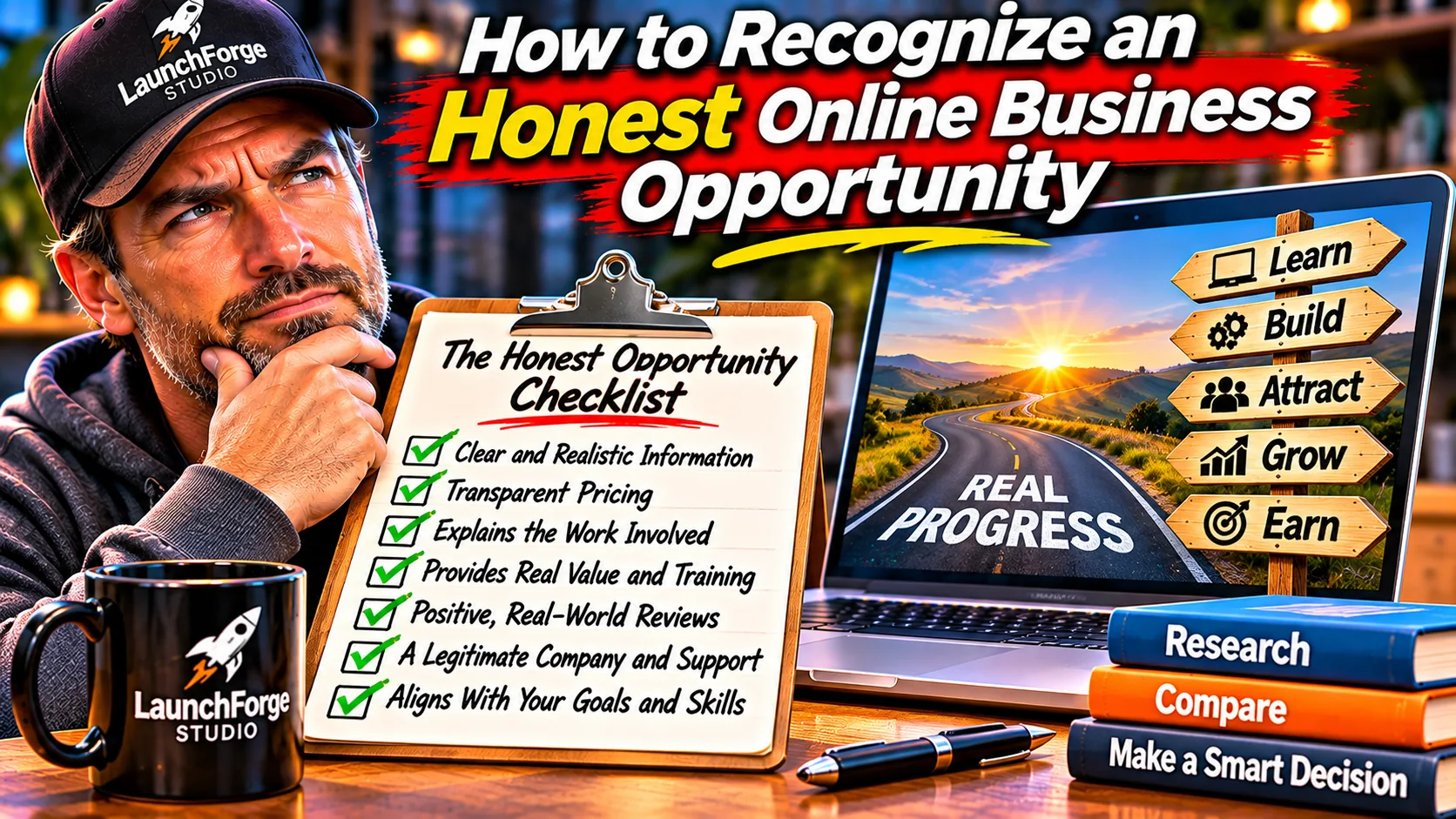
Honest online business opportunities explain the work, disclose costs, offer genuine value, and encourage informed decisions instead of unrealistic income expectations.
After everything we’ve discussed, you might be wondering whether it’s possible to find a legitimate online business opportunity without encountering outrageous income promises, mysterious systems, or someone posing beside a sports car.
The answer is yes.
There are real businesses, useful educational programs, legitimate affiliate opportunities, and software platforms that help people develop valuable skills and build something meaningful.
Not every entrepreneur selling a course is dishonest.
Not every digital product is overpriced.
And not every exciting marketing presentation is hiding something suspicious.
Sometimes a genuinely useful opportunity is exactly what it appears to be.
But here’s the important part.
A credible opportunity should give you enough information to understand what you’re purchasing, how it works, and what responsibilities you’ll have.
You shouldn’t need to suspend common sense, ignore financial risks, or believe extraordinary income claims to recognize its potential value.
So how do we separate genuine opportunities from exaggerated promises?
Let’s look at what trustworthy business offers tend to have in common.
A Clear Explanation of How the Business Works
One of the strongest signs of a credible opportunity is clarity.
You should be able to understand what the business actually does.
What products or services will you offer?
Who are your potential customers?
How will you reach those customers?
Where will the revenue come from?
And what responsibilities will you have as the business owner?
Those questions shouldn’t require a secret password, a three-hour motivational webinar, or a premium membership upgrade.
Consider a straightforward affiliate marketing business.
The business owner creates useful content about a particular subject, recommends relevant products, and may earn commissions when readers make qualifying purchases through affiliate links.
That’s an understandable model.
It still requires work, marketing, and an audience.
Earnings are uncertain.
But the underlying process can be explained.
Now compare that with a presentation promising thousands of dollars from a mysterious automated system without identifying the customers, products, or revenue source.
Which opportunity gives you a stronger foundation for making an informed decision?
If you cannot explain how an opportunity creates value and generates revenue, you probably don’t understand it well enough to purchase it yet.
That doesn’t automatically make the offer fraudulent.
It means more investigation is appropriate.
Realistic Expectations Instead of Guaranteed Riches
An honest opportunity doesn’t need to promise that everyone will earn a fortune.
It can explain what the product does, what skills are required, and what challenges someone might encounter.
For example, a website-building course might explain that students can learn how to create and manage a WordPress website.
A marketing platform might demonstrate tools for creating landing pages, capturing leads, or organizing email follow-up.
An affiliate training program might teach participants how to research products, publish useful content, and promote relevant offers.
Those are identifiable capabilities or learning objectives.
Whether they lead to financial success depends on many additional factors.
An opportunity becomes more concerning when its central selling point shifts from what buyers will receive to how much money they’re supposedly guaranteed to make.
Useful tools can support business activities. They cannot promise identical financial outcomes for everyone who uses them.
Look for marketing that acknowledges the effort, learning, uncertainty, and potential costs involved.
That kind of transparency may not be as exciting as a promise of instant wealth.
But it gives you a more realistic basis for making a decision.
Transparent Pricing and Membership Terms
We’ve already discussed how a small introductory purchase can lead to a much larger financial commitment.
That’s why pricing transparency matters.
Before purchasing, you should understand the full cost of getting started.
Is there a one-time payment?
A recurring subscription?
A setup or activation fee?
Are certain features available only through a premium membership?
Will you need additional software or outside services?
Are there cancellation requirements, renewal terms, or other financial obligations?
A trustworthy seller should communicate material pricing information clearly enough for buyers to evaluate the offer.
That doesn’t mean every possible future expense must be included in the original purchase price.
Businesses often use optional upgrades and third-party services.
The distinction is whether essential costs and restrictions are being accurately represented.
A good opportunity shouldn’t become financially unrecognizable immediately after checkout.
And if important pricing details are unclear, ask for clarification before entering your payment information.
Training That Teaches Skills Instead of Selling Motivation
Motivation can be useful.
Sometimes people need encouragement to pursue their goals, develop confidence, and take the next step.
But encouragement and education aren’t the same thing.
Imagine purchasing a course that promises to teach you how to build an online business.
You open the training and discover hours of enthusiastic speeches about positive thinking, financial freedom, and believing in yourself.
Those messages might be inspiring.
But eventually, you’re going to need to know how the actual business works.
How do you identify your target audience?
How do you set up your website?
How do you create a useful offer?
How do you attract potential customers?
How do you measure whether your efforts are producing results?
A training program should teach the skills it promises to teach.
Look for practical demonstrations, clear instructions, realistic examples, and information you can apply.
A good educational product doesn’t necessarily need hundreds of videos or an enormous library of resources.
Sometimes a concise, well-organized guide can be more useful than a massive course filled with repetitive material.
The important question is whether the training helps you understand and perform the activities described in the offer.
Support That Exists Beyond the Sales Page
Here’s another consideration that deserves attention.
What happens after you purchase?
Before making a sale, some companies provide enthusiastic answers, promotional emails, and quick responses to questions.
But buyers should also understand what assistance is available afterward.
Does the product include customer support?
Is there a knowledge base or instructional documentation?
Can you submit technical questions?
Are support hours or response expectations explained?
Does the company distinguish between software assistance, educational guidance, and personalized business coaching?
Those details matter.
A technical support team may help troubleshoot a software problem without providing advice about your entire business strategy.
A training community may offer peer discussion without guaranteeing individual coaching.
And a course creator may provide educational materials without offering ongoing personal consultations.
None of those arrangements is automatically unreasonable.
The important thing is knowing what support you’re actually paying for.
A clearly described support structure helps prevent disappointment and makes it easier to determine whether the product fits your experience level.
Reviews That Discuss Limitations, Not Just Benefits
When researching an online business opportunity, pay attention to how independent information is presented.
Does every review sound like an advertisement?
Are the benefits described in extraordinary language while the drawbacks receive almost no attention?
Does the reviewer explain whether they’ve actually used the product?
Do they disclose affiliate relationships or other relevant financial connections?
A credible review should help readers understand a product’s strengths and weaknesses.
For example, a business platform might offer useful website-building tools but require additional subscriptions for certain marketing functions.
A training course might provide excellent beginner instruction but lack advanced material.
An automation product might save time on repetitive tasks while requiring technical setup and ongoing monitoring.
Those limitations don’t necessarily make the product a poor choice.
They help buyers understand whether it’s appropriate for their circumstances.
An honest review should make you better informed, not simply more excited.
At LaunchForge Studio, that’s the standard we aim to follow when discussing tools we use and recommend.
We want readers to understand what a product can do, where its limitations matter, and why it may or may not fit their goals.
Beware of Pressure Disguised as Opportunity
An honest seller can encourage people to take action.
There’s nothing inherently wrong with offering a discount, announcing a product launch, or explaining why a service may be useful.
But the purchasing process shouldn’t depend on preventing someone from thinking clearly.
Be cautious when a presentation repeatedly suggests that asking questions demonstrates a lack of ambition.
Or that declining an offer means you’re choosing to remain unsuccessful.
Or that waiting until you understand the costs will permanently destroy your financial future.
Those messages can shift attention away from the actual product and toward emotional pressure.
You don’t have to prove your entrepreneurial commitment by buying something immediately.
A reasonable purchasing decision should reflect your goals, budget, research, and readiness.
If the product fits, that’s worth considering.
If it doesn’t, walking away is a legitimate choice.
Look for Value Before You Look for Income
Here’s one of the most useful questions you can ask about any online business opportunity:
“What value will this help me create for other people?”
That question gets to the heart of how sustainable businesses operate.
A website may help customers discover useful information.
A digital product may teach someone a valuable skill.
A service business may solve a problem that customers are willing to pay to have addressed.
An affiliate website may help readers compare products and make better purchasing decisions.
The methods differ, but the central principle remains:
Businesses need a reason for people to care about what they offer.
If an opportunity explains how you’ll create value, reach an audience, and operate a business, you have something meaningful to evaluate.
If it focuses almost entirely on the money you’ll supposedly receive without explaining what customers will receive in return, important information may be missing.
Revenue is an outcome of business activity. It isn’t a substitute for understanding the business itself.
A Legitimate Opportunity Still Comes With Risk
There’s one final point worth emphasizing.
Even a completely legitimate business opportunity may not produce the results you hope for.
You might purchase excellent training and discover that the business model doesn’t suit your interests.
You might use reliable software but struggle to attract visitors.
You could develop a useful product that takes longer than expected to find customers.
And you might need to change direction after learning more about your audience or market.
Those experiences don’t automatically mean someone sold you a fraudulent product.
Business involves uncertainty.
The goal of careful research isn’t to eliminate every possible risk.
It’s to understand the risks well enough to make a reasonable decision.
A credible opportunity gives you information to evaluate. It doesn’t promise to eliminate uncertainty.
Your Honest Opportunity Checklist
Before purchasing, consider whether you can answer these questions:
1. Can I explain how the business generates revenue?
You should understand the basic model without depending on mysterious claims.
2. Do I know what I’m purchasing?
Identify the actual tools, training, services, or memberships included.
3. Do I understand the complete financial commitment?
Account for upfront payments, recurring costs, and essential outside services.
4. Are the claims realistic and appropriately supported?
Be particularly careful with specific earnings promises and claims about typical results.
5. Do I know what work I’ll need to perform?
Understand the setup, marketing, learning, and ongoing responsibilities.
6. Have I examined the limitations?
Look for restrictions, technical requirements, support boundaries, and potential drawbacks.
7. Am I making this decision because the opportunity fits my goals?
Or am I reacting to urgency, excitement, and the fear of missing out?
If you can answer these questions clearly, you’ll be in a stronger position to evaluate the offer.
If important answers are missing, continue researching.
And if the opportunity doesn’t make sense for your situation, don’t feel obligated to purchase it.
The right opportunity should support the business you’re trying to build—not pressure you into building a business around something you don’t understand.
Now that we’ve discussed what a credible opportunity looks like, there’s one more truth we need to address.
It’s not nearly as glamorous as the Lamborghini advertisements.
It doesn’t involve a secret button.
And it’s definitely not something you can purchase for $27.
It’s the everyday work of building a real online business.
The Less Glamorous Truth About Building a Real Online Business

Behind every real online business is work that rarely appears in flashy advertisements: planning, publishing, learning, measuring results, and making improvements.
You know what you don’t see very often in those glamorous online business advertisements?
Someone sitting at their computer on a Tuesday evening trying to figure out why a website button suddenly stopped working.
Or a business owner spending hours researching an article that receives almost no visitors during its first week.
Or an entrepreneur discovering that a carefully designed landing page looks fantastic on a desktop computer but resembles a collapsed lawn chair on a mobile phone.
No Lamborghini.
No private jet.
No mysterious millionaire announcing that you can retire by Thursday.
Just somebody trying to make something work.
WELCOME TO THE LESS GLAMOROUS SIDE OF BUILDING AN ONLINE BUSINESS!
And believe it or not, this is where a lot of meaningful progress happens.
Because despite what certain promotional videos might suggest, building a legitimate online business usually involves more than purchasing software and waiting for the money to arrive.
It involves learning, experimenting, solving problems, and developing something people genuinely find useful.
Sometimes the process is exciting.
Sometimes it’s frustrating.
And sometimes you spend an entire afternoon adjusting a website element that absolutely refuses to cooperate.
But here’s something worth remembering.
The absence of instant results doesn’t mean the work has no value.
It may simply mean you’re still building the foundation.
Real Businesses Begin With Real Problems
Let’s start with a principle that doesn’t require expensive software or secret training.
A business needs a reason to exist.
Ideally, that reason involves helping people solve problems, satisfy needs, or accomplish something they value.
A website designer helps businesses establish an online presence.
A bookkeeping service helps customers organize financial information.
An educational publisher helps readers develop useful knowledge.
An affiliate marketer can help people discover and compare relevant products.
Different business models provide value in different ways.
But they share an important characteristic.
Someone has to care enough about the result to become a customer, subscriber, reader, or client.
That’s the part that gets lost when an opportunity focuses exclusively on how much money the owner might earn.
A business isn’t simply a system for collecting payments.
It’s an organized effort to provide something of value.
And the more clearly you understand the people you’re trying to serve, the easier it becomes to make sensible decisions about your products, content, and marketing.
Before investing in elaborate systems, ask yourself:
Who am I helping?
What problem am I addressing?
And why would someone choose my solution?
Those questions may not sound as exciting as an overnight-income headline.
But they’re considerably more useful when you’re trying to build something sustainable.
Building a Website Is Only the Beginning
Let’s talk about websites.
Modern website builders have made it easier to establish an online presence.
You can choose templates, customize layouts, add images, publish articles, and create landing pages without developing every component from scratch.
That’s wonderful.
But publishing a website is not the same as attracting an audience.
A brand-new website doesn’t automatically arrive with thousands of visitors waiting outside the digital front door.
People still need a reason to discover it.
Search engines need to find and evaluate its pages.
Readers need to understand what the website offers.
And visitors need to find information or services that make their time worthwhile.
That’s why website development should include more than visual design.
Clear navigation matters.
Mobile usability matters.
Helpful content matters.
Page performance matters.
Trustworthy information matters.
And consistency matters.
A beautiful website with no useful purpose is still a beautiful website with no useful purpose.
The objective isn’t simply to launch something that looks impressive.
It’s to create a resource that serves the people you’re trying to reach.
The Unexciting Work of Creating Useful Content
If you’re building a content-driven business, here’s something that deserves special attention.
Creating genuinely helpful content takes work.
You need to understand the topic.
You need to identify what readers are trying to accomplish.
You need to organize the information logically.
You need to explain complicated ideas clearly.
And when you’re discussing products, platforms, or business strategies, you need to distinguish facts from promotional claims.
Artificial intelligence can assist with parts of that process.
But responsible publishing still requires human judgment, research, and editorial review.
At LaunchForge Studio, content development involves more than typing a headline and pressing Publish.
We work through topics, organize sections, review explanations, improve readability, add supporting visuals, and connect readers to relevant resources.
We also evaluate how articles are presented in search results and look for opportunities to make them more useful.
Does every article become an immediate traffic success?
Of course not.
Publishing helpful content is a business activity, not a guaranteed traffic machine.
Some articles may attract attention relatively quickly.
Others may take longer to gain visibility.
And some may never perform as expected.
That’s why useful content should be created with genuine reader value in mind, alongside realistic expectations about distribution and discovery.
Search Engine Visibility Doesn’t Arrive With a Purchase Receipt
Here’s another important reality.
You can purchase excellent website software, choose a professional design, and publish a detailed article.
That doesn’t mean Google will automatically reward you with a top search ranking.
Search visibility depends on many factors, including relevance, content quality, technical accessibility, competition, and how well a page satisfies the needs of searchers.
And those conditions can change over time.
Search engines don’t guarantee first-page rankings simply because a website uses a particular platform or optimization plugin.
Search engine optimization can help you improve your website’s accessibility, structure, and usefulness.
But SEO isn’t a magic switch.
It involves ongoing evaluation.
Sometimes that means improving a headline.
Sometimes it means updating outdated information.
Sometimes it means fixing a technical issue.
And sometimes it means recognizing that a particular topic faces substantial competition or limited search demand.
A good SEO tool can help you improve a page. It cannot guarantee that people will search for it, discover it, or click it.
That’s why search performance should be evaluated through actual data rather than assumptions.
Impressions, clicks, search queries, click-through rates, and other measurements can provide useful information about what’s happening.
Those numbers may not always be exciting.
But they give you something more valuable than hype.
They give you evidence.
What Building LaunchForge Studio Has Taught Me
Let me bring this discussion closer to home.
I’m building LaunchForge Studio around a simple philosophy:
Help people understand online business tools, develop practical skills, and build something useful one step at a time.
The website includes educational guides, tutorials, product reviews, and resources for people exploring online business opportunities.
We use WordPress and Divi to develop the website.
We also use additional tools for content creation, lead capture, communication, and marketing activities.
And yes, artificial intelligence is part of our workflow.
But building LaunchForge Studio hasn’t been a matter of purchasing one system and watching the results magically appear.
There have been pages to design.
Articles to research.
Images to prepare.
Search engine settings to configure.
Marketing tools to connect.
And technical problems to investigate.
We’ve also had to make decisions about which tools are worth using, how to organize resources, and how to communicate with readers without overwhelming them.
Some improvements are immediately visible.
Others require patience before their effects can be evaluated.
And there are always new things to learn.
That’s what building an online business looks like from my perspective.
It’s not a story about earning enormous amounts of money overnight.
It’s a story about developing a website, learning new skills, testing ideas, and trying to create something genuinely helpful.
And that experience has reinforced one of my strongest beliefs.
Useful tools matter. But the willingness to learn and consistently apply them matters just as much.
Small Improvements Can Be More Meaningful Than Big Promises
The internet loves dramatic success stories.
A business goes from zero to six figures.
A creator supposedly earns thousands during a single weekend.
Someone claims their latest system has completely transformed their life.
Those stories attract attention because they’re extraordinary.
But meaningful progress doesn’t always announce itself with fireworks.
Sometimes progress means improving a confusing website page.
Sometimes it means publishing a better explanation of a difficult subject.
Sometimes it means discovering that your current marketing approach isn’t reaching the right audience.
And sometimes it means recognizing that a product you’ve been considering simply isn’t worth purchasing.
Those accomplishments may not make impressive social media headlines.
But they can help you make better decisions and improve how your business operates.
Not every valuable business milestone can be measured by immediate revenue.
Learning a useful skill has value.
Improving a customer experience has value.
Avoiding an unnecessary expense has value.
And developing a clearer understanding of your audience can influence many future decisions.
Of course, financial performance ultimately matters for a business that intends to be profitable.
But judging every action by whether it produces money immediately can lead to poor decisions.
A healthier approach is to connect short-term activities to longer-term goals while measuring results realistically.
Consistency Matters, but It Isn’t a Guarantee
Let’s talk about a phrase that appears frequently in motivational business content.
“Just stay consistent, and success will come!”
It’s encouraging.
But it needs a little clarification.
Consistency can help you develop skills, maintain a publishing schedule, improve processes, and learn from experience.
However, repeating an ineffective activity indefinitely doesn’t guarantee a better outcome.
If your website isn’t reaching the intended audience, you may need to reconsider your content strategy.
If advertising consistently costs more than it returns, you may need to change the campaign.
If customers aren’t interested in your offer, you may need to improve the offer or investigate whether sufficient demand exists.
Consistency becomes more valuable when it’s combined with feedback, learning, and thoughtful adjustments.
The goal isn’t to work endlessly without questioning the results.
It’s to keep making informed improvements.
Sometimes that means continuing with a strategy.
Sometimes it means changing direction.
And occasionally, it means walking away from an idea that no longer makes sense.
That isn’t failure.
It’s part of responsible business management.
The Reality of Building While Working a Full-Time Job
Here’s a situation many aspiring entrepreneurs understand.
You have a regular job.
You have bills to pay.
You have responsibilities outside work.
And somewhere between everything else, you’re trying to build an online business.
You may only have a few hours available during the week.
Perhaps you work on your website in the morning, research ideas during a lunch break, or spend some time developing content in the evening.
That’s a very different experience from the lifestyle portrayed in certain promotional videos.
There’s no unlimited free time.
No personal assistant managing every task.
And no guarantee that the project will quickly replace your employment income.
But that doesn’t mean progress is impossible.
It means your expectations and plans need to fit your circumstances.
You might begin with one clearly defined project.
Learn the essential tools.
Develop a small collection of helpful resources.
And expand gradually as your experience, available time, and business needs evolve.
Building a business around your existing responsibilities may require patience, but it can also encourage a more deliberate approach.
You don’t have to purchase every tool or pursue every opportunity immediately.
And you don’t have to abandon financial stability simply because an advertisement insists that serious entrepreneurs take dramatic risks.
The Value of Serving Before Selling
Here’s where I believe online business marketing could benefit from a major change in perspective.
Instead of asking:
“How can I make as much money as possible from this audience?”
Start by asking:
“How can I genuinely help these people?”
That doesn’t mean earning money is wrong.
A business needs revenue to support its activities, compensate people for their work, and remain financially sustainable.
But revenue and service don’t need to be opposing goals.
A useful educational resource can build trust.
An honest product review can help someone make a better purchasing decision.
A clearly explained service can help a customer understand what they’re paying for.
And a thoughtful recommendation can connect someone with a tool that genuinely fits their needs.
The relationship between helping people and earning revenue isn’t always immediate or guaranteed.
But approaching business with generosity and integrity can help establish the kind of reputation worth developing.
At LaunchForge Studio, that’s the direction we want to follow.
Provide value first. Treat people fairly. Be honest about limitations. And let purchasing decisions belong to the people making them.
It’s not as flashy as promising a Lamborghini by Friday.
But it’s a business philosophy I can stand behind.
The Business You Build Is More Important Than the Fantasy You Buy
After all the talk about magic systems, automated riches, expensive cars, and extraordinary earnings claims, let’s return to one simple question.
What are you actually trying to build?
A useful website?
An educational business?
A product that solves a problem?
A service that people need?
A content platform that helps readers make informed decisions?
Whatever your direction, the important work involves developing something of value and finding a responsible way to operate it.
The tools you purchase should support that process.
They shouldn’t become substitutes for understanding it.
And the promises you encounter should be evaluated against the realities of your goals, budget, experience, and available time.
There’s no rule saying every business must take years to produce meaningful results.
Some entrepreneurs find traction quickly.
Others progress more gradually.
And some discover that their original idea needs substantial changes.
But none of those possibilities justifies assuming that purchasing a system guarantees a specific financial outcome.
You don’t need to abandon your ambitions. You need to give those ambitions a realistic foundation.
Because when the promotional countdown timer reaches zero, the expensive sports car drives away, and the motivational music finally stops, one question remains.
What are you prepared to build when the sales presentation is over?
And that brings us to the most important message of this entire article.
Dream big.
Believe that your future can improve.
Explore opportunities.
Learn new skills.
But don’t let the promise of overnight riches convince you that meaningful progress has to happen overnight.
Final Thoughts: Dream Big, But Don’t Buy the Fantasy

Dream big, but don’t buy the fantasy. Building a meaningful online business starts with realistic expectations, consistent action, and genuine value.
So, here we are.
We’ve traveled through the fascinating world of overnight millionaires, mysterious income systems, automated money machines, luxury sports cars, countdown timers, and enough extraordinary promises to make a lottery advertisement look modest.
And after all that excitement, we’re left with a surprisingly simple conclusion.
You don’t need to stop dreaming about financial freedom. You need to stop treating someone else’s income promises as a guarantee of your future.
There’s nothing wrong with wanting more from life.
Maybe you want to earn additional income, build something of your own, develop greater financial stability, or eventually create a business that gives you more flexibility.
Those goals matter.
But the path toward them deserves more than a dramatic sales presentation and a flashing BUY NOW button.
The Difference Between Inspiration and Evidence
An inspiring success story can encourage you to explore new possibilities.
A useful software demonstration can show you how technology might simplify certain tasks.
And a well-designed training program can help you develop skills you didn’t previously have.
Those are legitimate reasons to become interested in an opportunity.
But none of them automatically proves that you’ll achieve a particular financial result.
Inspiration gives you a reason to explore. Evidence gives you a reason to make an informed decision.
Before purchasing an online business system, understand what it provides, how the business model works, what expenses are involved, and what responsibilities will remain yours.
If someone makes extraordinary earnings claims, ask what credible information supports them.
And if a sales presentation relies more heavily on emotional pressure than clear explanations, remember that you have the right to walk away.
The Internet Doesn’t Need Another Magic Money Button
We have access to extraordinary technology.
AI can assist with research and content creation.
Automation can help organize business processes.
Website builders can make publishing more accessible.
And online platforms can connect businesses with customers around the world.
Those capabilities are genuinely valuable.
But the existence of powerful tools doesn’t eliminate the fundamentals of business.
You still need a reason for people to care about what you’re offering.
You still need to understand your audience.
You still need to make responsible financial decisions.
And you still need to evaluate whether your efforts are producing meaningful results.
Technology can help you do the work. It can’t promise that the work will make you wealthy.
That’s a distinction worth remembering every time another revolutionary money-making system appears in your inbox.
Your Dreams Deserve Better Than Empty Promises
Here’s something I believe strongly.
It costs absolutely nothing to dream, and dreams make excellent motivation to keep building.
But dreams also deserve protection.
Protect them by asking questions.
Protect them by understanding the costs before making commitments.
Protect them by learning skills instead of chasing shortcuts.
And protect them by refusing to confuse someone’s carefully constructed marketing presentation with proof of what you’ll personally achieve.
You don’t have to become cynical about every business opportunity.
You don’t have to dismiss every entrepreneur who shares a success story.
And you don’t have to assume that building an online business must be endlessly difficult.
You simply need to approach opportunities with ambition, curiosity, and realistic expectations.
Sometimes the right decision will be to buy a useful tool.
Sometimes it will be to wait until you’re better prepared.
And sometimes the smartest decision will be to walk away.
All three can represent progress when they’re based on thoughtful evaluation.
The Final Word From LaunchForge Studio
At LaunchForge Studio, we’re building around a philosophy that doesn’t require exaggerated income claims.
Lead with generosity. Create genuine value. Treat people with integrity. Keep learning. And put people before promises.
We’re not interested in convincing readers that a particular software subscription will magically change their lives.
We’re interested in helping people understand their options, make better decisions, and develop something worthwhile.
If you’re exploring an online business idea, start with a clear plan and a realistic understanding of the work involved.
Focus on providing something useful.
Choose tools that support your actual needs.
And remember that meaningful progress doesn’t have to arrive overnight to be valuable.
The internet will always have another extraordinary opportunity waiting around the corner.
Another secret formula.
Another limited-time offer.
Another enthusiastic millionaire standing next to a very expensive car.
And somewhere, inevitably, another button promising to automate your financial future.
Before you click it, ask yourself one question:
“Am I buying something that helps me build a business, or am I buying the fantasy that I won’t have to build one?”
That question alone could save you money, frustration, and disappointment.
Because your future is worth more than someone else’s promotional headline.
Dream big. Stay curious. Make informed decisions. And keep building.
The dream is free. The work gives it wings.