Building an online business gives you an incredible amount of freedom.
You can choose what you want to build, which tools you want to use, how you want to market it, what kind of content you want to create, and where you want the business to go.
That freedom is exciting.
It can also become one of the biggest reasons you lose focus.
There is always another idea to explore. Another tool to try. Another marketing strategy to learn. Another website improvement you could make. Another article you could write. Another traffic source you could test.
Before long, you can spend an entire day working on your business without being completely sure whether you actually moved it forward.
Learning how to stay focused in business is not about forcing yourself to ignore every new idea or following a rigid schedule that never changes.
It is about learning how to decide what deserves your attention right now.
That distinction has become increasingly important to me while building LaunchForge Studio.
There are always more things I could be working on than I have time to complete. I could work on the website, write another article, research a new tool, improve an existing page, promote content, study traffic strategies, build another system, or chase one of the new ideas that inevitably shows up along the way.
Some of those ideas may be worth pursuing.
But they cannot all be the priority at the same time.
That is where mindset, focus, and organization begin working together.
Your mindset helps you accept that you do not need to accomplish everything today.
Focus helps you decide what matters most.
Organization helps you keep everything else from disappearing while you work on it.
And execution is what finally turns those plans into something real.
If you are trying to build an online business while juggling a job, family, responsibilities, or simply the rest of your life, this becomes even more important. Your available time has value. Spending it constantly switching between ideas can make building a business feel much harder than it needs to be.
You do not need to eliminate every distraction.
You do not need the perfect productivity system.
And you definitely do not need to have your entire business figured out before you move forward.
You need a practical way to keep returning to the work that matters.
That is what we are going to work through in this article.
Why Staying Focused in Business Is Harder Than It Looks
Staying focused sounds simple when you describe it from the outside.
Pick something important, work on it, finish it, and move on to the next thing.
If only building an online business worked that neatly.
The reality is that you are constantly surrounded by things competing for your attention. Some are legitimate responsibilities. Others are new opportunities. Some are problems that genuinely need to be solved. And plenty of them are simply interesting enough to pull you away from whatever you were already doing.
The challenge is that many of these distractions do not look like distractions.
They look like work.
Researching another marketing strategy feels productive.
Watching another training video feels productive.
Trying another business tool feels productive.
Redesigning something that already works can feel productive.
Even planning can become a form of procrastination when you spend more time creating the perfect plan than executing the one you already have.
That is why learning how to stay focused in business requires more than telling yourself to work harder.
You need to recognize where your attention is actually going.
There Is Always Something Else You Could Be Doing
An online business rarely gives you a shortage of things to work on.
You may need to create content, improve your website, generate traffic, build an email list, follow up with leads, research products, manage social media, learn new software, improve conversions, study analytics, and figure out what you are going to build next.
Then something new appears.
Maybe it is a new AI tool.
Maybe it is a traffic source you have never tried.
Maybe someone sends you an offer that sounds incredible.
Maybe you discover a strategy that makes you question everything you have already built.
Suddenly, today’s priority starts looking a little less interesting.
This is where focus begins to disappear.
The problem is not necessarily that the new idea is bad. It might actually be useful.
The problem is allowing every potentially useful idea to immediately become today’s priority.
When everything deserves your attention, nothing really has your attention.
More Information Does Not Always Create More Progress
Learning is an important part of building a business.
I spend plenty of time researching tools, strategies, marketing ideas, website improvements, and different ways to grow LaunchForge Studio.
But there is a point where learning stops helping if you never turn what you learn into action.
You can watch twenty videos about building landing pages and still not have a landing page.
You can read dozens of articles about email marketing and still not have a follow-up system.
You can compare every business platform available and still not have a business running on one.
Eventually, information has to become implementation.
That does not mean you should stop learning.
It means learning should support what you are building instead of constantly replacing it.
If your current priority is improving your website, learn what helps you improve the website.
If you are building a lead generation system, focus your research around generating and capturing leads.
If you are creating content, learn what helps you create better content and get it in front of the right people.
Give your learning a job.
Being Busy and Moving Forward Are Not the Same Thing
This may be one of the easiest traps to fall into.
You can work for hours and feel completely exhausted at the end of the day while accomplishing very little that actually moves the business forward.
You answered messages.
You checked statistics.
You rearranged a few things on the website.
You watched a training video.
You researched three new tools.
You opened twelve browser tabs.
You made another list.
You were busy.
But what did you finish?
That question can be uncomfortable, but it is useful.
Progress usually leaves something behind.
A published article.
A finished landing page.
An email sequence that is now running.
A problem that has been solved.
A campaign that has been launched.
A system that works better than it did yesterday.
Not every productive day has to produce something enormous. Some important work happens behind the scenes.
But over time, your effort should create completed work that moves the business somewhere.
Being busy tells you that you spent time.
Progress tells you that the time built something.
Learning the difference can completely change the way you approach your online business.
Your Mindset Shapes the Way You Build
Before organization comes mindset.
You can have calendars, task lists, project boards, folders, reminders, and every productivity tool imaginable, but none of them will completely solve the problem if you constantly feel like you should be doing something else.
That is one of the strange parts about building an online business.
You are making decisions while you are still learning how to make those decisions.
You choose a platform before you understand every platform.
You create content before you know exactly which content will perform best.
You test traffic before you know which traffic source will become the most valuable.
You build pages before you know which version will convert better.
There is uncertainty built into the process.
If you believe you must eliminate that uncertainty before moving forward, you can spend months researching without ever giving anything enough time to work.
A better mindset is accepting that some answers only appear after you start building.
Stop Expecting Yourself to Have Everything Figured Out
There is a huge difference between having a direction and having every step mapped out.
You need direction.
You do not need a perfect map.
When I started building LaunchForge Studio, I did not have every page, article, marketing system, tool, or future opportunity planned from beginning to end.
I still don’t.
What I have instead is a clearer understanding of what LaunchForge is trying to become and a growing body of real work that helps determine where it should go next.
That distinction matters.
Waiting until you know everything creates an impossible standard because the business itself will teach you things you could not have known at the beginning.
A page may need to change after you see it on a phone.
An article may reveal another topic worth exploring.
A tool may seem useful until you actually try fitting it into your workflow.
A strategy may sound perfect until real-world results tell you otherwise.
Those are not necessarily signs that you made a mistake.
They are information.
The goal is not to predict every lesson before you encounter it.
The goal is to learn without allowing every lesson to completely derail you.
Progress Is Usually Messier Than the Plan
Plans look beautiful before the work starts.
Everything fits neatly into categories. Tasks happen in the correct order. Projects get completed on schedule. Nothing unexpected appears.
Then you start building.
Something takes twice as long as expected.
A technical problem shows up.
An idea you thought would work needs to be changed.
You discover a better way to accomplish something halfway through doing it.
Another responsibility takes away the time you planned to use.
That does not mean the plan failed.
It means the plan met reality.
One of the mindset shifts that has helped me while building LaunchForge is treating the plan as a direction rather than a prison.
I still want structure.
I still want priorities.
I still want to know what we are building and why.
But I also want enough flexibility to respond when the work teaches me something.
That allows the business to evolve without turning every adjustment into another complete restart.
Give Yourself Permission to Learn While Building
There is a temptation to believe you should become an expert before you begin.
Learn everything about WordPress before building the website.
Master SEO before publishing an article.
Understand every traffic strategy before promoting anything.
Know every feature of a marketing platform before using it.
Become an expert marketer before trying to market.
That sounds responsible.
Taken too far, it becomes another reason not to move.
Building and learning do not have to happen separately.
They can happen together.
Learn enough to take the next meaningful step.
Take the step.
Pay attention to what happens.
Then learn what you need for the next one.
That creates a completely different relationship with mistakes and uncertainty.
Instead of asking, “How do I make sure I never get this wrong?”
You begin asking, “What can I learn from doing this?”
That question keeps you moving.
And movement creates experience that another week of endlessly researching the perfect approach never could.
The mindset behind staying focused is not believing that you chose the perfect path.
It is being willing to give a worthwhile path enough attention to find out where it leads.
Watch Out for Shiny Object Syndrome
One of the fastest ways to lose focus while building an online business is to become addicted to whatever looks exciting next.
A new tool launches.
A new business opportunity appears.
Someone introduces a new traffic strategy.
An email lands in your inbox promising a better system.
A video shows you how someone else is building their business.
Suddenly, the thing you were excited about last week starts looking old.
This is often called shiny object syndrome, and online business creates the perfect environment for it.
There is always something new competing for your attention.
The difficult part is that some of those new opportunities really are good.
That is what makes shiny object syndrome so dangerous.
If every new idea were obviously terrible, ignoring it would be easy.
The real challenge is learning how to recognize a potentially useful idea without automatically abandoning what you are already building.

Every new idea does not need your attention. Staying focused on your current priorities helps turn consistent work into real progress.
New Opportunities Always Look Exciting
New ideas have an advantage over existing projects.
They have not become difficult yet.
You have not encountered the technical problems.
You have not spent hours creating the content.
You have not had to troubleshoot anything.
You have not discovered the limitations.
You are seeing the possibility without experiencing the work.
Meanwhile, the project already sitting in front of you may be right in the middle of the difficult part.
That makes the new opportunity incredibly attractive.
I have experienced this while building LaunchForge Studio.
There is no shortage of tools, platforms, traffic sources, affiliate programs, content ideas, marketing strategies, and potential directions I could explore.
Some deserve further investigation.
Others do not.
But if I changed direction every time something interesting appeared, LaunchForge would become a collection of half-finished experiments instead of a business.
That does not mean ignoring opportunities.
It means giving them the right place in the process.
Every New Idea Has a Cost
When we think about trying something new, we usually think about what we might gain.
We do not always think about what the new idea will interrupt.
Every project requires something.
Time.
Attention.
Energy.
Money.
Learning.
Setup.
Testing.
Maintenance.
And perhaps most importantly, it takes focus away from something else.
That does not make the new project a bad decision.
It simply means the decision has a cost.
If I decide to spend the next three hours investigating a new marketing platform, those are three hours I cannot spend finishing an article, improving the website, promoting existing content, or completing another priority.
The question therefore should not only be:
“Is this a good idea?”
A better question is:
“Is this more important than what I am already working on?”
Those are very different questions.
There are thousands of good ideas.
You do not need all of them.
You need the ones that make sense for the business you are actually trying to build.
Do Not Confuse Changing Direction With Making Progress
Changing direction can feel incredibly productive.
You get a new plan.
A fresh dashboard.
A different strategy.
New goals.
Maybe even a new domain, funnel, platform, or set of tools.
Everything feels possible again.
But starting over creates its own kind of momentum.
It is the momentum of beginning rather than the momentum of finishing.
If you repeatedly replace the current plan before giving it enough time to produce useful information, you never really discover whether the plan could have worked.
You just become very experienced at starting things.
Sometimes changing direction is absolutely the right decision.
I have changed direction myself when better information showed me that something no longer made sense.
But there is an important difference between making an informed adjustment and constantly jumping toward whatever looks exciting.
One is adaptation.
The other is distraction wearing a business suit.
Learning how to stay focused in business means becoming comfortable saying:
“That looks interesting. I do not need to do it right now.”
You are not rejecting the idea forever.
You are protecting the priority you already chose.
And sometimes that simple decision is exactly what allows something worthwhile to finally get finished.
Decide What Deserves Your Attention Right Now
Once you accept that you cannot work on everything at the same time, the next question becomes obvious.
What should you work on?
That sounds simple until you are staring at a list filled with twenty things that all seem important.
The website needs work.
You need more traffic.
You should probably write another article.
Your email follow-up could be improved.
There are social posts to create.
Analytics need to be checked.
There is a new tool you wanted to research.
And somewhere in the middle of all that, you are supposed to actually grow the business.
This is where organization becomes more than keeping a neat task list.
Good organization helps you make decisions.
It helps you separate what deserves your attention now from what can wait until later.
Choose One Main Priority
One of the simplest ways to regain focus is to identify one main priority.
Not the only thing you are allowed to work on.
The main thing you want to move forward.
That distinction matters because running a business will always involve smaller responsibilities. Emails still need to be answered. Problems still appear. Routine tasks still need attention.
But underneath those responsibilities, there should be something you are intentionally trying to advance.
For LaunchForge Studio, that priority might be building out a specific area of the website.
At another time, it might be creating a connected group of articles around an important topic.
Later, it could be improving lead generation, expanding traffic, strengthening email follow-up, or testing a new marketing system.
The priority can change.
What matters is knowing what it is.
When you know the main priority, new decisions become easier.
Instead of asking whether something sounds useful, you can ask:
“Does this help move the current priority forward?”
If the answer is yes, it probably deserves consideration.
If the answer is no, it may still be a good idea.
It just might not be today’s idea.
Know What Finished Looks Like
A vague priority can create almost as much confusion as having no priority at all.
“Work on marketing” is vague.
“Improve the website” is vague.
“Create more content” is vague.
You can work on goals like those indefinitely without ever experiencing the satisfaction of completing anything.
Give the priority a finish line.
Instead of “create more content,” the goal might be to complete and publish one useful article.
Instead of “work on the website,” it might be to finish a specific page and test it on desktop and mobile.
Instead of “improve email marketing,” it might be to write the next three messages in your follow-up sequence and activate them.
Instead of “get more organized,” it might be to create one place where you track current projects and future ideas.
A finish line gives your attention somewhere to go.
It also gives you a moment to stop, review what you accomplished, and decide what deserves attention next.
Without that moment, one project can slowly blend into another until your entire business feels like one enormous unfinished task.
Separate Important Work From Interesting Work
This one can be difficult because interesting work is usually more fun.
Interesting work gives you novelty.
Important work often asks you to finish something you have already been staring at for three days.
You may want to experiment with a new AI tool while the article you started yesterday is still unfinished.
You may want to redesign your homepage while the lead capture system you were building still needs to be connected.
You may want to investigate a new traffic source while you have not fully used the traffic opportunities already available to you.
None of those new ideas are automatically wrong.
But interesting and important are not the same thing.
When I catch myself looking at another possible direction for LaunchForge, one useful question is:
What happens if I do not do this right now?
Sometimes the answer is important.
A problem may be blocking something else.
A deadline may be approaching.
A page may genuinely need to be fixed.
But sometimes the answer is:
Nothing.
The idea will still be there tomorrow.
That realization can remove a surprising amount of pressure.
You do not have to pursue every good idea the moment you have it.
Sometimes the most productive thing you can do with a good idea is save it, return to the work in front of you, and give the current priority the chance to become something real.
Create a Place for Ideas That Can Wait
One reason new ideas become so distracting is that we are afraid we will lose them.
You think of a new article.
You discover a tool you want to investigate.
You see a marketing strategy you might want to test.
You notice something on the website that could be improved.
Your brain immediately starts telling you:
“Do something with this before you forget it.”
So you stop what you are doing.
You open another tab.
You start researching.
Twenty minutes later, the original task is sitting unfinished while you are halfway down an entirely different rabbit hole.
There is a simple alternative.
Give the idea somewhere to go.
Capture the Idea Instead of Chasing It
You do not have to choose between acting on an idea immediately and forgetting about it completely.
Write it down.
That sounds almost ridiculously simple, but it changes your relationship with new ideas.
Once the idea has been captured somewhere you trust, you no longer have to keep carrying it around mentally.
You can return to what you were doing.
For LaunchForge Studio, ideas appear constantly.
An article can lead to three more article ideas.
Research can uncover a tool worth investigating.
Working on one part of the website can reveal something somewhere else that could be improved.
A conversation about marketing can suddenly produce an idea for email, social media, traffic, content, or an entirely new experiment.
If every one of those ideas immediately became a project, very little would ever get finished.
Capturing the idea lets me acknowledge it without allowing it to take control of the day.
Build a Later List
Your system does not need to be complicated.
In fact, if organizing your ideas requires another complicated system that you have to constantly maintain, you may have simply created a new distraction.
A basic list can be enough.

Capture the idea without chasing it. An idea parking lot gives good ideas somewhere to wait while you finish the work that matters now.
You might call it:
Future Ideas.
Later.
Things to Test.
Content Ideas.
Business Experiments.
Whatever makes sense to you.
The name does not matter.
The purpose does.
This is where potentially useful ideas can wait without competing with the current priority.
If you discover an interesting traffic source while writing an article, add it to the list.
If you think of a website improvement while building an email sequence, add it to the list.
If somebody recommends a tool that might be useful six months from now, add it to the list.
Then go back to what you were doing.
The list becomes a parking lot rather than another to-do list.
That distinction is important.
A to-do list says:
“I need to do these things.”
A later list says:
“These ideas may deserve consideration.”
Not every idea you capture needs to become a project.
Some will look brilliant when you write them down and completely unnecessary two weeks later.
That is perfectly fine.
You have lost nothing by waiting.
Review Ideas Instead of Reacting to Them
Once you have somewhere to store ideas, you can evaluate them when you are in a better position to make decisions.
Instead of reacting in the moment, review the list intentionally.
Maybe you look at it after completing a major project.
Maybe you review it once a week.
Maybe you return to it when you are deciding what the next business priority should be.
Now you can ask better questions.
Does this still seem useful?
Does it support what I am building?
Do I have the time to do it properly?
What would I have to stop doing to make room for it?
Does it solve a real problem?
Is there evidence that I actually need it?
And perhaps the most useful question:
Is this still exciting after it has been sitting here for a while?
Time has a wonderful way of removing the shine from shiny objects.
An idea that felt urgent on Tuesday may look completely ordinary by Friday.
Another idea may still look valuable weeks later.
That is useful information.
You are giving ideas a chance to survive evaluation before they consume your time.
This does not make you less creative.
It actually gives creativity some structure.
You can continue noticing opportunities, exploring possibilities, and thinking about where the business could go without allowing every thought to become an immediate command.
Capture it.
Park it.
Finish what matters now.
Then come back and decide whether the idea has earned its turn.
Organize Your Business Around the Work That Matters
Organization should make it easier to work.
That sounds obvious, but it is surprisingly easy to turn organization into another project.
You create multiple task lists.
Then you create categories for the task lists.
Then you create a calendar to manage the categories.
Then you find a project management tool that promises to organize everything better.
Three hours later, your organizational system looks incredible and the work you originally needed to finish is still sitting there waiting for you.
The purpose of getting organized is not to create the most impressive system.
It is to reduce friction between deciding what matters and actually doing it.
You should be able to look at your system and quickly understand three things:
What am I working on?
What needs to happen next?
What can wait?
If your system answers those questions, it is already doing something valuable.
Keep Your System Simple Enough to Use
The best organizational system is not necessarily the one with the most features.
It is the one you will actually use.
For one person, that might be a project management platform.
For someone else, it could be a spreadsheet.
Another person may prefer a calendar, digital notes, a notebook, or a simple list.
There is no prize for having the most sophisticated setup.
Your business does not care whether the task was tracked inside an advanced project management dashboard or written on a piece of paper.
It cares whether the task gets finished.
Start with the simplest system that gives you enough structure to stay focused.
You can always improve it later if the business genuinely outgrows it.
That principle applies to more than organization.
One lesson I keep seeing while building LaunchForge Studio is that complexity has a tendency to sneak into a business.
Another tool.
Another system.
Another process.
Another place where information lives.
Each addition may seem small by itself, but eventually you spend more time managing the machinery than using it.
Organization should reduce that complexity, not add another layer to it.
Break Large Projects Into Smaller Actions
Large projects can become difficult to start because the task itself does not tell you what to do.
“Build the website.”
Where do you begin?
“Create a marketing system.”
What do you actually do first?
“Grow traffic.”
Okay. How?
Large goals describe a destination.
They do not always provide the next action.
Break them down until the work becomes obvious.
If the project is publishing a new article, the smaller actions might include choosing the topic, researching search intent, outlining the article, writing the content, adding internal links, creating images, reviewing the page, publishing it, and promoting it.
Now the project has movement.
You are no longer staring at “write article” wondering where to begin.
You can identify the next unfinished piece and work on that.
This also makes limited periods of time more useful.
If you only have thirty minutes available, you may not be able to complete an entire project.
But you might be able to complete one meaningful part of it.
Those smaller completions accumulate.
Eventually, the large project gets finished because you repeatedly knew what to do next.
Know What You Are Working on Before You Start
A surprising amount of time can disappear simply deciding what to do.
You sit down at the computer.
Check your email.
Open your website.
Look at analytics.
Check social media.
Remember something you wanted to research.
Open another tab.
Then another.
Twenty minutes later, you still have not actually started the work you intended to do.
One way to reduce that drift is to decide what you are going to work on before the work session begins.
It does not have to be elaborate.
“Tonight I am finishing the article introduction.”
“Tomorrow morning I am testing the landing page on mobile.”
“This afternoon I am writing the next email in the sequence.”
“Saturday I am reviewing the pages that need internal links.”
Now when you sit down, there is less negotiation.
You already gave the time a purpose.
That does not mean unexpected problems can never change the plan.
They will.
But there is a big difference between changing a plan because something genuinely important happened and never having a plan in the first place.
Good organization creates a starting point.
Focus keeps you there long enough to make progress.
And when the work is broken into clear actions, even a limited amount of available time can move the business forward.
Finish More of What You Start
Starting something feels good.
There is energy at the beginning of a new project.
You have an idea. You can picture what it might become. Progress feels fast because everything is new.
Finishing is different.
By the time you reach the final stretch, the excitement may have faded. You have already made dozens of decisions. You have probably run into problems. The project may no longer look exactly the way you imagined it would when you started.
And somewhere nearby, another exciting idea is waiting.
That is often when focus gets tested the most.
The ability to finish does not mean stubbornly continuing with something that clearly makes no sense.
It means recognizing when a worthwhile project has reached the less exciting part of the process and continuing long enough to get it across the finish line.
Stop Restarting Every Time You Learn Something New
Learning while building creates an interesting problem.
The more you learn, the more things you notice that you could have done differently.
You publish a few articles and discover a better way to structure them.
You build part of a website and learn a better design technique.
You create a funnel and later understand something about the customer journey that you did not understand before.
Your first instinct may be to go back and rebuild everything.
Be careful.
If every new lesson forces you to restart the work that came before it, you can spend your entire business life rebuilding the beginning.
Sometimes older work genuinely needs improvement.
But not every improvement needs to happen immediately.
Use what you learned on the work you are doing now.
Keep a note about what may need attention later.
Then continue moving forward.
Over time, your newer work will naturally become better because your experience is growing.
That is progress.
You do not need to erase every earlier version of yourself before you are allowed to create the next one.
Get the Current Version Across the Finish Line
Perfection can become another form of distraction.
There is always another sentence you could rewrite.
Another design adjustment you could make.
Another image you could replace.
Another feature you could add.
Another piece of research you could read.
Another opinion you could ask for.
At some point, the current version needs to become real.
Publish the article.
Launch the page.
Activate the email.
Start the campaign.
Send the traffic.
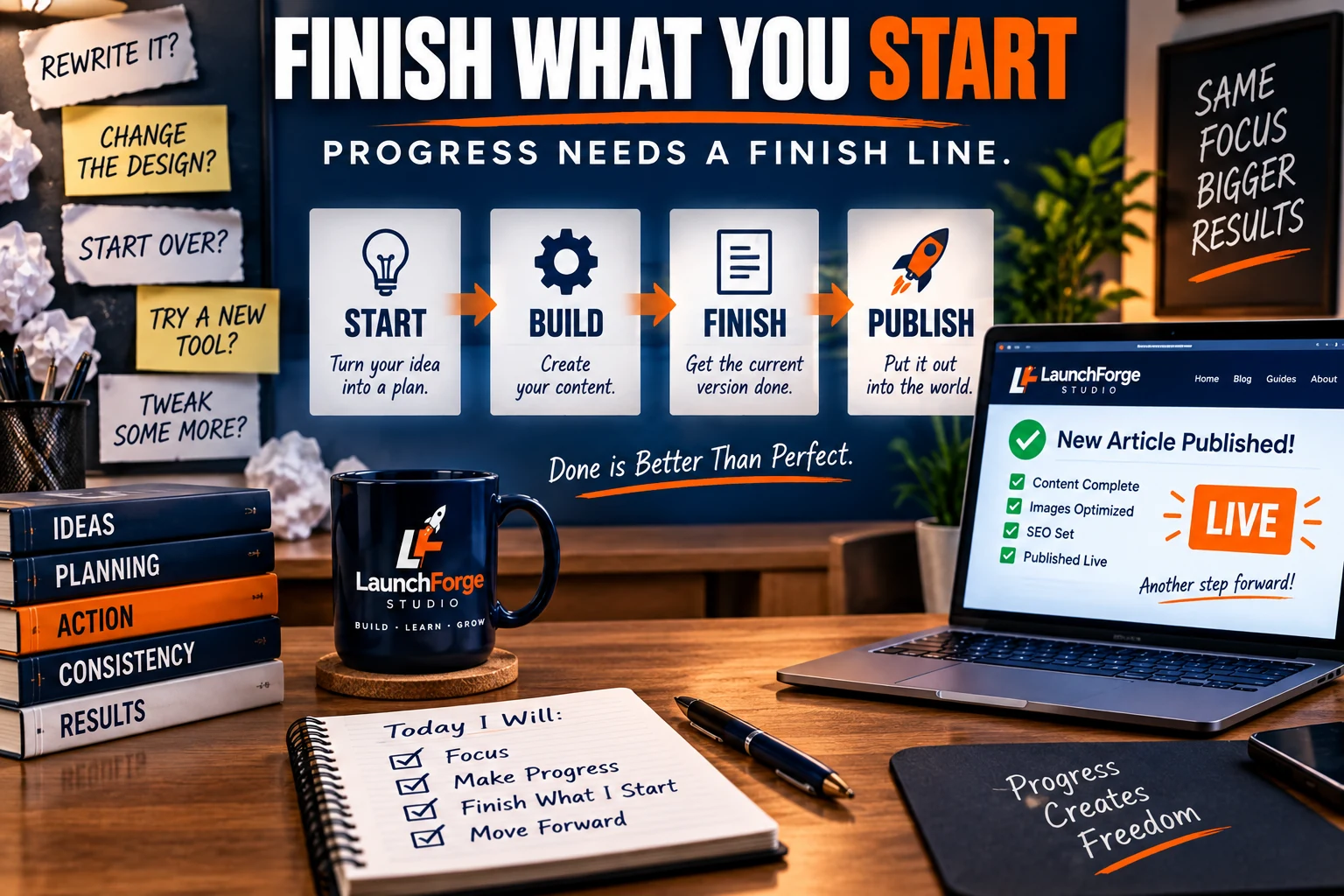
Progress needs a finish line. Complete the current version, put it into the world, and improve it from there.
Then see what happens.
This is something we have practiced repeatedly while building LaunchForge Studio.
We try to make the work useful and solid before it goes live, but the goal is not to pretend that anything we publish can never be improved again.
The goal is to build the best version we reasonably can with what we know now, finish it, and let the next lesson come from reality.
A finished version gives you something an unfinished version never can.
Feedback.
Data.
Experience.
Results.
Even disappointing results teach you more than a project that remains permanently hidden because you were waiting for it to become perfect.
Improve What Exists Instead of Constantly Replacing It
There is a powerful advantage to having something already built.
You can improve it.
A website with twenty useful articles can be strengthened with better internal linking.
An existing landing page can be tested with a different headline.
A working follow-up sequence can be improved after you see where people stop responding.
A published article can be updated when you learn something new.
An existing traffic strategy can be measured and adjusted.
You are building on a foundation instead of returning to an empty canvas every time.
That is one reason finishing matters so much.
Finished work compounds.
One useful article can support another.
One page can link to another.
One system can connect with the next system.
One lesson can improve the next project.
Eventually, you are no longer starting from zero.
You are improving an asset that already exists.
That is a very different way to build a business.
Starting creates possibilities.
Finishing creates assets.
And when you begin collecting finished pieces that work together, the business starts becoming something larger than any individual task that created it.
Stay Focused When You Are Building Around a Day Job
Building an online business is challenging enough when it has your full attention.
Building one while working a day job is a different experience.
Your business does not automatically receive the best hours of your day.
Sometimes it gets the early mornings.
Sometimes it gets evenings.
Sometimes it gets weekends.
And sometimes you finally sit down ready to work on your business only to realize that the job, commute, responsibilities, and everything else that happened that day have already drained most of your energy.
That can be frustrating, especially when you know what you are trying to build.
You may eventually want the business to provide more freedom, flexibility, or control over how you spend your time.
But wanting that future badly does not create more hours today.
You still have to build with the time you actually have.
That makes focus even more valuable.
Accept That Your Time Is Limited
Limited time does not mean you cannot build something meaningful.
It means you have to become more intentional about what receives that time.
If you only have an hour available, spending forty-five minutes deciding what to work on is expensive.
So is spending that hour researching another opportunity when you already have an important project halfway finished.
When time is limited, priorities become clearer.
You begin asking different questions.
What can I realistically accomplish today?
What is the next important piece of the project?
What can wait?
What would create meaningful progress with the time I have available?
There will be days when the answer is something small.
Maybe you write one section of an article.
Maybe you fix one problem on the website.
Maybe you schedule one piece of content.
Maybe you research one question that has been blocking the next step.
That still counts.
You do not have to complete an enormous project every time you work on the business.
You need to keep giving the business meaningful pieces of your attention.
Protect the Time You Do Have
If your available business time is limited, treat it like it matters.
That does not mean creating a schedule so rigid that your life has no room to breathe.
It means recognizing that the time you have intentionally set aside can disappear very quickly if you allow everything else to claim it.
Email can wait sometimes.
Social media can wait.
That interesting video can wait.
The new tool you discovered can wait.
Even some business tasks can wait if they are not connected to the priority you chose.
This is another reason knowing your next action before you begin can be so useful.
If you sit down knowing that your goal is to finish a specific section of the website, you can begin working almost immediately.
You are not spending your limited time wandering around the business looking for something productive to do.
You already know.
I experience this with LaunchForge Studio regularly.
There are days when I would much rather spend all of my time building LaunchForge, but other responsibilities still exist.
That reality makes the hours I can spend on the business more important, not less important.
I want those hours building something.
That might mean finishing an article instead of investigating another idea.
It might mean improving something that already exists instead of starting another project.
It might mean saying no to an opportunity simply because it is not the right opportunity right now.
Focus becomes a way of protecting the future you are trying to create.
Small Consistent Progress Can Build Something Much Bigger
When you look at a large website, a content library, a marketing system, or an established online business, it is easy to see the finished structure and forget how it was built.
One page at a time.
One article at a time.
One email at a time.
One improvement at a time.
One decision at a time.
LaunchForge Studio did not suddenly appear with a growing library of articles, landing page resources, marketing systems, business pages, and connected tools.
Those pieces accumulated.
Some days produced a lot.
Other days produced less.
But completed work remained completed.
That is one of the encouraging things about building digital assets.
The article you finish tonight can still be working months from now.
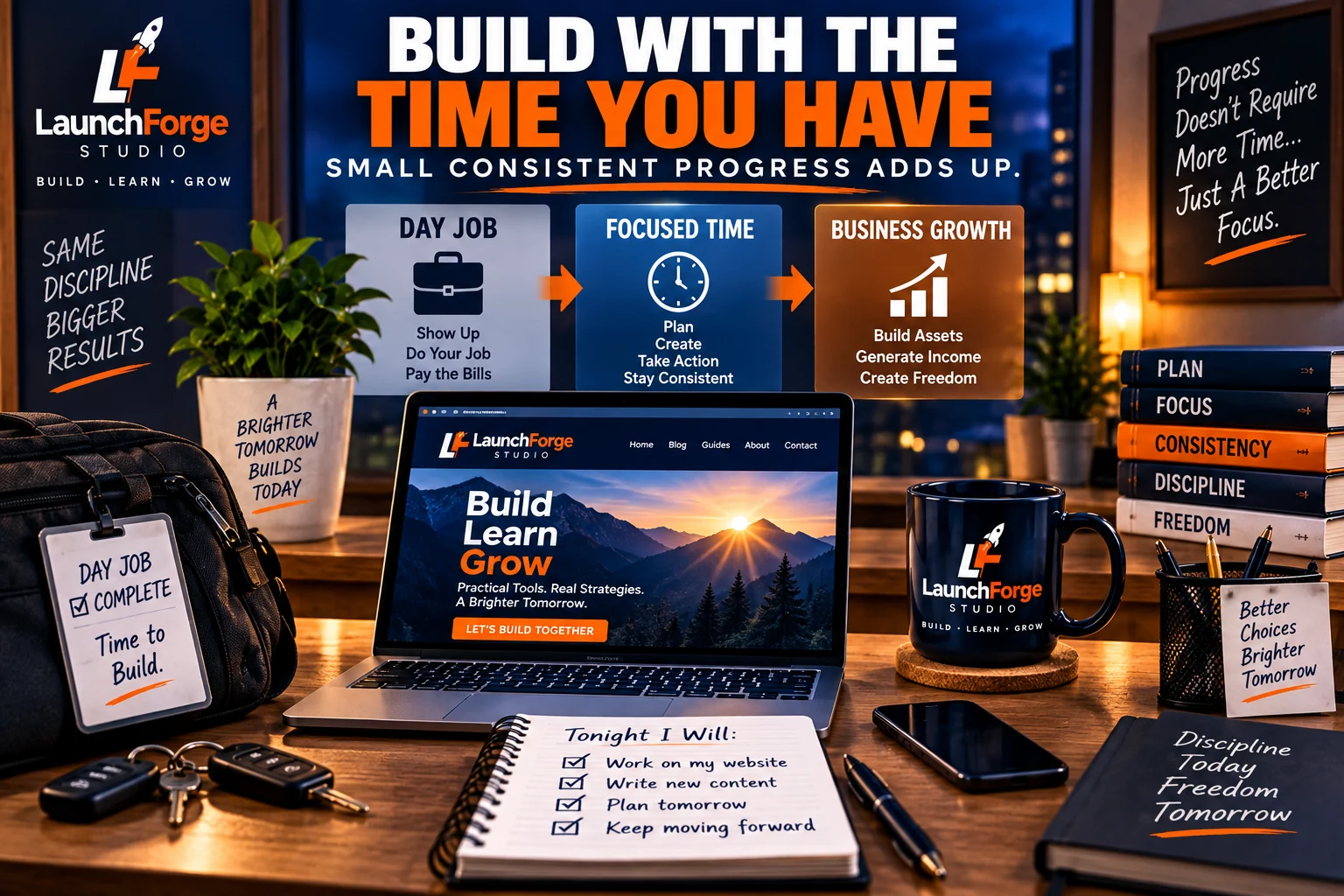
You do not need unlimited time to keep building. Focused, consistent work can turn the hours you have into meaningful progress.
The page you complete this weekend becomes part of the website.
The email sequence you finish does not disappear when you go back to your day job Monday morning.
The work begins stacking.
That is why consistency can matter more than occasional bursts of extreme productivity.
You may not control how quickly every result arrives.
You may not know exactly when the business will reach the level you ultimately want.
But you can control whether today’s available time moves it another step forward.
Do not underestimate what can happen when you repeatedly give a meaningful project focused attention over a long enough period.
An hour can look small.
One finished task can look small.
One article can look small.
But those pieces do not have to stay small.
They can become part of something much bigger.
Know When Changing Direction Actually Makes Sense
Staying focused does not mean refusing to change.
That is an important distinction.
There are times when changing direction is exactly what a business needs.
You learn something important.
A tool no longer fits what you are trying to accomplish.
A strategy is consuming more time than it is worth.
Your audience responds differently than you expected.
A better opportunity becomes clear after you have gathered enough information to evaluate it properly.
The problem is not changing direction.
The problem is changing direction so frequently that nothing receives enough time, attention, or effort to teach you anything.
Focus and flexibility can exist together.
You can commit to a direction while remaining willing to adjust when there is a legitimate reason to do so.
Focus Does Not Mean Refusing to Adapt
There is a difference between persistence and stubbornness.
Persistence says:
“This still makes sense, so I am going to keep working on it.”
Stubbornness says:
“I am going to keep doing this because I already started.”
Those are not the same thing.
Sometimes the smartest decision is to stop.
Maybe you tested a tool and discovered that it adds unnecessary complexity.
Maybe you explored a business opportunity and realized it does not fit the direction you want to take.
Maybe you created a process that worked when the business was smaller but has become inefficient as things have grown.
Maybe your original assumption was simply wrong.
That happens.
Changing direction in those situations is not a failure of focus.
It is the result of paying attention.
The key is having a reason for the change that goes deeper than:
“This new thing looks more exciting.”
Look at What You Are Learning
One advantage of finishing projects and testing ideas is that you begin accumulating evidence.
You stop making every decision based entirely on imagination.
You can look at what actually happened.
Did people visit the page?
Did they click?
Did the content get indexed?
Did the traffic source send visitors?
Did the email get opened?
Did the system save time?
Did the tool solve the problem you bought it to solve?
Did the project support the larger direction of the business?
Not every question will have a clean numerical answer.
Some lessons come from experience.
A process may technically work while being so frustrating that you know you do not want to build your business around it.
A platform may have impressive features but create more complexity than it removes.
A strategy may produce activity without producing the kind of progress you actually want.
That information matters too.
The important part is allowing what you learn to influence what you do next.
When something works, build on it.
When something shows potential, improve it.
When something clearly does not fit, reconsider it.
When you do not have enough information yet, resist the temptation to manufacture a conclusion simply because you are impatient.
Sometimes the correct decision is to keep testing.
Change the Plan Without Abandoning the Mission
This may be one of the most useful mindset shifts in the entire process.
Your plan can change without your larger mission changing.
The tools can change.
The marketing strategy can change.
The content plan can change.
The traffic sources can change.
The way you organize your work can change.
Even parts of the business model can evolve as you gain experience.
That does not automatically mean you are starting over.
LaunchForge Studio has evolved while I have been building it.
Ideas have been tested.
Priorities have shifted.
Some directions became more important.
Others became less important.
The website has grown.
The content strategy has become clearer.
The way different pieces of the business connect has continued to improve.
That evolution is not the opposite of focus.
It is what can happen when you remain focused on the larger mission while allowing the route to improve.
Think of it this way.
Your destination may remain the same even when you discover a better road.
Changing roads because you found a better route is adaptation.
Changing roads every five minutes because another one looks interesting is distraction.
The skill is learning to recognize the difference.
Before making a major change, ask yourself:
Am I changing direction because of something I have learned?
Or am I changing direction because I am tired of doing the work required by the current plan?
That question will not make every decision easy.
But it can reveal a lot.
Focus is not about chaining yourself to yesterday’s plan.
It is about making today’s decisions in a way that still serves what you are trying to build tomorrow.
What Building LaunchForge Studio Has Taught Me About Focus
One of the reasons I wanted to include this section is that everything I have written about focus sounds much easier when it remains theoretical.
Building LaunchForge Studio has given me plenty of opportunities to experience the messy version.
There is always more that could be done.
There are pages I could improve, articles I could write, tools I could investigate, traffic sources I could test, social media accounts I could grow, marketing systems I could refine, and new ideas I could explore.
The list never really ends.
What has changed is the way I look at that list.
I no longer expect everything on it to become today’s project.
That has been an important shift.
Depth Requires Staying With Something
A recent example came from building out our content around landing pages and sales funnels.
We could have written one article about landing pages, checked the topic off the list, and immediately jumped somewhere else.
Instead, we stayed with it.
We explored what a landing page is, different types of landing pages, the difference between a landing page and a website, how to build one, how headlines and calls to action work, lead capture, mobile optimization, sales funnels, and how those pieces connect.
One article became part of a larger body of useful information.
That only happened because we kept returning to the subject instead of constantly chasing the next unrelated topic.
Eventually, however, something else became obvious.
Another part of LaunchForge needed attention.
Our Blog & Insights content had not received the same recent attention as our growing library of guides and tutorials.
So we changed the immediate priority.
That is a small example, but it demonstrates something important about focus.
Focus does not mean working on one subject forever.
It means staying with something long enough to accomplish what you intended, then intentionally deciding where your attention should go next.
Not Every Opportunity Needs to Become a LaunchForge Project
Another lesson has come from the sheer number of opportunities that exist online.
Affiliate programs.
Software platforms.
Traffic systems.
AI tools.
Marketing services.
Training programs.
Business ideas.
You could spend every day investigating something new and never run out of options.
I have looked at opportunities that initially seemed interesting and later decided they did not belong in the direction I wanted LaunchForge to take.
That is part of building too.
Sometimes progress comes from adding something.
Sometimes it comes from deciding what you are not going to pursue.
That decision can be surprisingly freeing.
When something clearly does not fit, I do not need to keep giving it attention simply because I already spent time looking at it.
I can take whatever I learned from the experience and return that attention to the business.
The goal is not to collect every possible opportunity.
The goal is to build LaunchForge.
Finishing Creates Momentum You Can See
There is something different about looking at a growing collection of finished work.
An individual article may not feel enormous while you are writing it.
A single page may not feel like a major milestone.
One internal link, one image, one SEO improvement, or one social post can seem small while you are doing it.
But finished work accumulates.
Eventually, you can look at the website and see a library where there used to be an empty section.
You can see topics beginning to connect.
You can see the business taking shape.
That visible progress creates a different kind of motivation than constantly starting something new.
You are no longer motivated only by what the business might become.
You can see evidence of what it is becoming.
That matters.
It reminds you that the small pieces were not actually small when they were allowed to stack together.
Focus Does Not Require Ignoring the Bigger Picture
There is another lesson I have learned from working this way.
You can concentrate on one project without forgetting the rest of the business.
While we were building out one area of LaunchForge content, the rest of the website still existed.
Other ideas still existed.
Future opportunities still existed.
We simply were not trying to work on all of them simultaneously.
Then we stepped back.
We looked at what had been built.
We looked at what had not received attention recently.
And we chose the next priority.
That rhythm has become increasingly useful:
Focus.
Build.
Finish.
Review.
Choose again.
It is simple, but it prevents the business from becoming a collection of random reactions.
And that may be the biggest lesson LaunchForge has taught me about staying focused so far.
You do not need to know every project you will work on six months from now.
You need to know what deserves your attention now, give it meaningful effort, finish enough of the work to create something real, and then look at the business again with better information than you had before.
That is how the plan becomes clearer.
Not by standing still until you can see the entire road.
By building far enough to see the next part of it.
A Simple Focus and Organization System You Can Use
You do not need a complicated productivity system to stay focused.
You need a repeatable way to decide what matters, work on it, and keep everything else from constantly pulling you away.
The system I have found most useful while building LaunchForge can be reduced to six steps:
Choose. Define. Park. Finish. Review. Choose again.
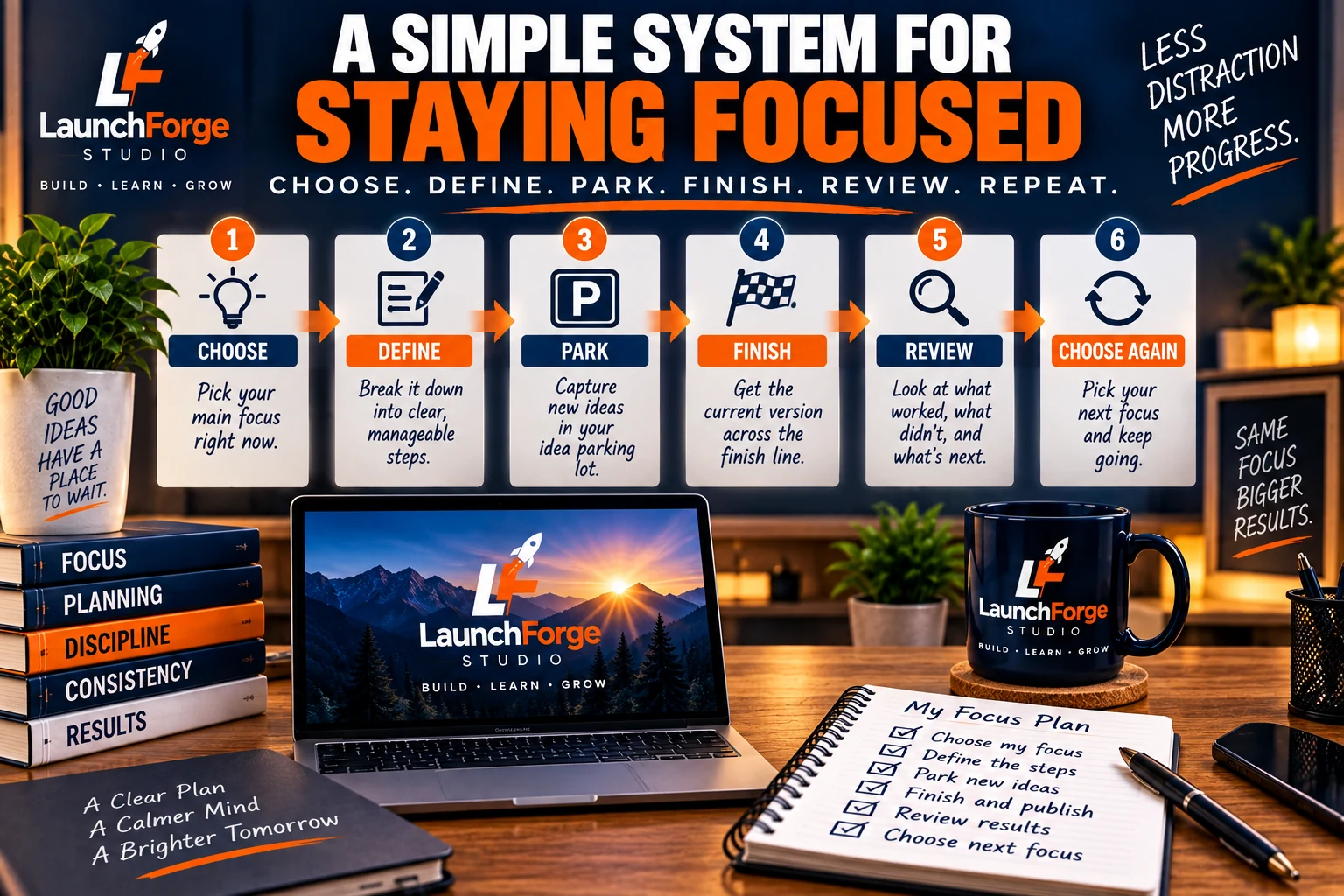
Choose the priority, define the work, park distractions, finish, review the results, and choose what comes next.
That is it.
There can be task lists, calendars, notes, tools, and other systems underneath those steps, but the basic process does not need to become more complicated than that.
The value comes from repeating it.
Choose the Priority
Start by choosing what deserves your attention.
Not everything you want to accomplish this month.
Not every improvement the business could possibly use.
One meaningful priority.
Ask yourself:
What would make the biggest difference if I moved it forward?
What is currently unfinished?
Is something blocking another important part of the business?
What have I been avoiding because something newer keeps distracting me?
Your answer does not have to represent the most important project you will ever complete.
It simply needs to be important enough to deserve focused attention now.
Once you choose it, make a temporary agreement with yourself:
This gets priority until I reach the finish line I define.
That agreement removes some of the daily decision-making that can drain your attention.
You already decided.
Now you can build.
Define the Next Action
Knowing the priority is not always enough.
You also need to know what you are going to do next.
If your priority is “build my email list,” you still have to translate that into action.
Maybe the next action is creating the lead capture page.
Maybe it is connecting the form.
Maybe it is writing the first follow-up email.
Maybe it is choosing where traffic will come from.
Make the next step small enough that you can actually begin it.
This is especially useful when you have limited time.
You may not have three hours to “work on marketing.”
But you might have thirty minutes to write one email.
You may not have an entire Saturday to “improve the website.”
But you might have an hour to finish one page.
Specific actions make it easier to start.
And starting the right thing is much more useful than spending your available time deciding what the right thing might be.
Park Everything Else
This is where your later list earns its keep.
While you work on the priority, other ideas will appear.
Expect them.
Do not waste energy pretending they will not.
When something useful occurs to you, capture it.
Then ask whether it actually needs your attention right now.
If it does not, park it.
You are not saying no forever.
You are saying:
“Not yet.”
That is one of the most useful phrases I have found for staying focused.
Not yet.
Not every opportunity needs an immediate yes or no.
Not every idea needs to become a project today.
Not every problem needs to interrupt what you are doing.
Some things simply need to wait their turn.
Finish the Work
Now give the priority enough attention to reach the finish line you defined.
This is where the temptation to wander usually becomes strongest.
The project is no longer new.
You have probably encountered a few problems.
Something more interesting may have appeared.
Keep going.
If the project still makes sense, finish the current version.
Do not turn every obstacle into a reason to abandon it.
Solve what needs to be solved.
Learn what needs to be learned.
Adjust what needs to be adjusted.
Then get the work across the line.
Finished does not have to mean permanently perfect.
It means you reached the point where the thing can begin doing the job you created it to do.
Review What Happened
Once something is finished, do not immediately sprint toward the next idea.
Look at what happened.
What worked?
What took longer than expected?
What did you learn?
What would you do differently next time?
Did finishing the project reveal another problem?
Did it create a new opportunity?
Did it make another priority more obvious?
This review does not need to become a three-hour meeting with yourself and a forty-seven-page report.
Sometimes five minutes is enough.
The point is to carry the lesson forward.
Otherwise, you can remain extremely busy while repeatedly making the same decisions and encountering the same problems.
Experience becomes much more valuable when you actually use it.
Choose What Comes Next
Now return to the business as it exists today.
Not as it existed when you chose the previous priority.
Something has changed.
You finished something.
You learned something.
You may have collected new ideas.
You probably understand the business a little better.
Now choose again.
Maybe the next priority is obvious.
Maybe one of the ideas sitting on your later list has earned its turn.
Maybe the work you just completed created a logical next step.
Or maybe another area of the business has been waiting patiently while you focused elsewhere.
Choose the next priority based on what you know now.
Then repeat the process.
Choose. Define. Park. Finish. Review. Choose again.
That cycle gives you structure without locking you into a rigid plan.
It allows new ideas without letting every idea hijack the business.
It allows you to adapt without constantly starting over.
And it gives you something incredibly valuable when building an online business:
A way to keep moving forward even when there are a hundred other things you could be doing.
You Do Not Need to Do Everything to Build Something
One of the easiest ways to become overwhelmed while building an online business is to look at everything you could be doing at once.
There will always be another strategy to learn.
Another tool to investigate.
Another page to improve.
Another article to write.
Another traffic source to test.
Another idea that sounds promising.
Another person online telling you what you absolutely must be doing.
If you measure yourself against all of it, you will probably feel behind no matter how much progress you make.
But building a business does not require doing everything.
It requires doing enough of the right things consistently enough for them to begin working together.
That is a very different goal.
Focus Is About Returning, Not Being Perfect
You are going to get distracted sometimes.
I do.
You will spend longer than you intended researching something.
You will discover an idea that temporarily pulls your attention somewhere else.
You will have days when your plan falls apart.
You will occasionally realize that you spent an hour doing something that really did not matter very much.
That does not mean you failed at staying focused.
The important skill is learning how to return.
Return to the priority.
Return to the next action.
Return to the project you decided was worth finishing.
You do not need perfect focus.
You need a reliable way back when your attention wanders.
That is much more realistic, and it is something you can practice.
Organization Should Give You More Freedom, Not Less
The same principle applies to organization.
Your system should not make you feel trapped inside another set of rules.
It should reduce the number of things you have to keep in your head.
It should help you see what matters.
It should give future ideas somewhere to wait.
It should make it easier to begin working when you finally have time available.
Most importantly, it should help you spend more time building and less time figuring out what you are supposed to be building.
If your organizational system becomes harder to manage than the work itself, simplify it.
You are building a business.
You are not building a museum dedicated to perfectly organized task lists.
Let the Business Grow One Finished Piece at a Time
When I look at LaunchForge Studio today, I do not see one enormous project that somehow appeared fully formed.
I see pieces.
Pages.
Articles.
Systems.
Experiments.
Improvements.
Lessons.
Some of those pieces took hours.
Some took days.
Some required going back and fixing things we did not understand the first time.
Some ideas changed along the way.
And there are still plenty of things left to build.
But that is the point.
The business does not have to be finished for the progress to be real.
Every useful piece that gets completed becomes part of the foundation for whatever comes next.
That is why I have become less interested in trying to do everything and more interested in finishing the things that deserve attention now.
Choose something meaningful.
Define what you are trying to accomplish.
Park the distractions.
Do the work.
Finish what you reasonably can.
Learn from what happened.
Then decide what deserves your attention next.
And repeat.
That may not sound as exciting as discovering the next secret strategy or revolutionary business shortcut.
But it builds something.
Keep Building
If you are working a job while trying to build something of your own, your progress may sometimes feel slower than you want it to.
If you are learning as you go, you may occasionally wonder whether you know enough yet.
If you have more ideas than time, you may feel like you are constantly leaving opportunities on the table.
That is okay.
You do not need to build every possible business.
You need to build yours.
Give it your attention when you can.
Protect that attention when it matters.
Stay open to learning.
Stay willing to adapt.
Keep your ideas without allowing every idea to become an emergency.
And keep finishing pieces.
Because one finished piece may not look like much by itself.
But one finished piece connected to another, and another, and another, eventually stops looking like a collection of tasks.
It starts looking like a business.