
Building an email list can sound like one of those things you are supposed to already understand when you start an online business.
Choose an email platform. Create a form. Build a landing page. Write some emails. Find traffic. Get subscribers.
Simple enough, right?
Then you actually try to put all of those pieces together.
Suddenly, you are figuring out where people should subscribe, what you should offer them, which emails they should receive, how the signup form connects to your email system, and how you are supposed to get anyone to the page in the first place.
That is where something relatively simple can start feeling complicated.
If you are trying to figure out how to build an email list from scratch, you do not need an enormous audience, a complicated funnel, or twenty different marketing tools before you can begin.
You need a simple system that gives the right people a reason to subscribe and gives you a way to continue the conversation after they do.
At its most basic, that system looks like this:
Traffic → Signup Opportunity → Subscriber → Welcome and Follow-Up → Relationship → Offer
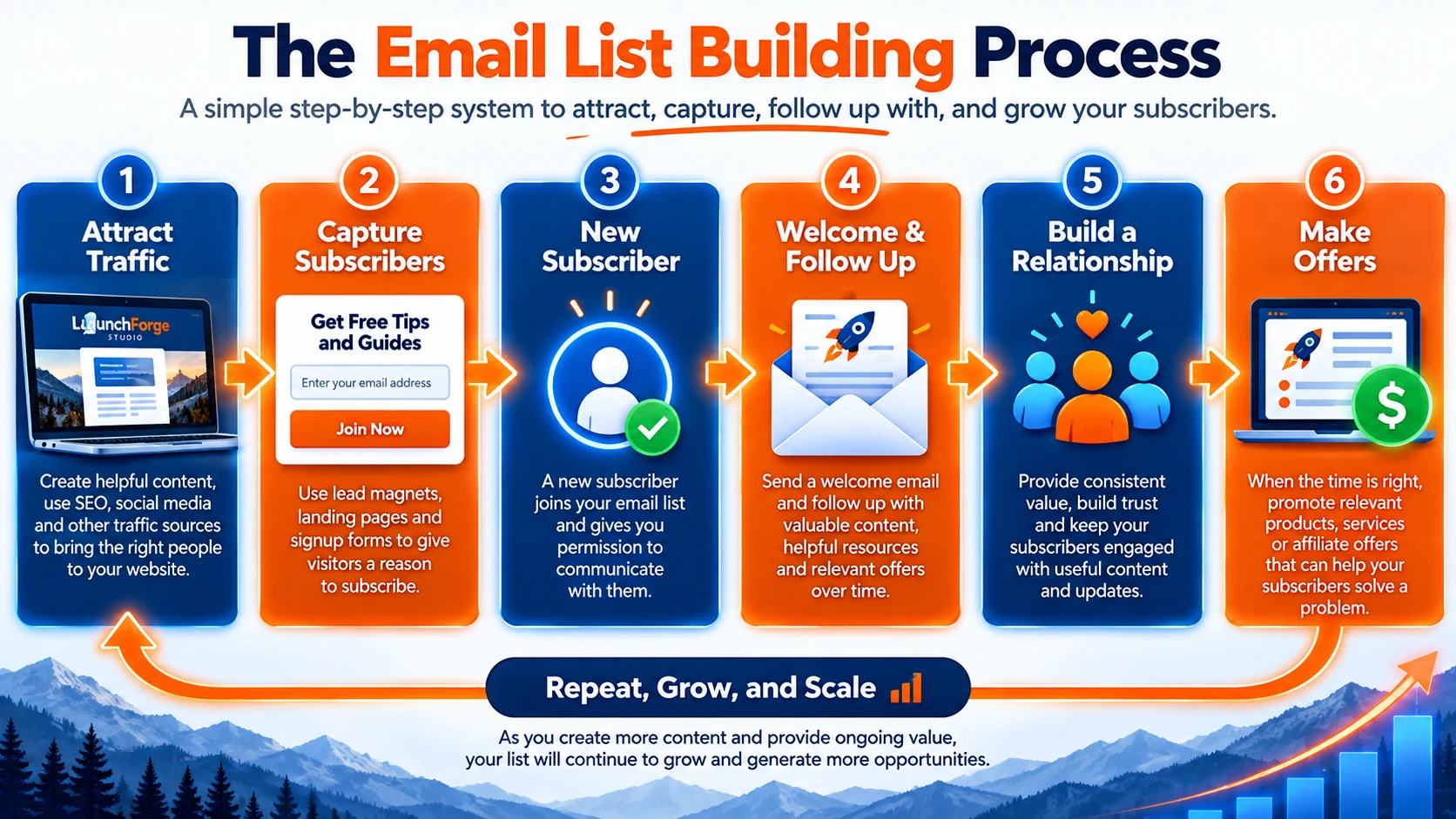
A simple email list-building system connects traffic, subscriber capture, follow-up, relationship building, and relevant offers.
That is the same basic process we are continuing to build here at LaunchForge Studio.
As the site has grown, we have been connecting more of the pieces together: publishing useful content, creating opportunities for visitors to join our list, using LeadsLeap to capture and follow up with subscribers, and learning from what happens as the system gets used in the real world.
And that last part matters.
You do not need to build the perfect email marketing machine before your first subscriber arrives.
You need to build something simple enough to start using.
Then you can test it.
Learn from it.
Improve it.
In this guide, we are going to walk through how to build an email list from the ground up, including what you need before you start, how to create signup opportunities, how to connect those subscribers to your email system, what happens after someone joins, and how to begin growing the list without making the process more complicated than it needs to be.
By the end, you should understand not only how the individual pieces work, but how they connect to create a practical email list-building system you can continue improving as your online business grows.
Let’s start at the beginning.
What Does It Mean to Build an Email List From Scratch?
Building an email list from scratch means creating your first group of subscribers without starting with an existing audience or database of contacts.
You are beginning at zero.
And that is completely normal.
Every email list starts with a first subscriber.
The goal is not to collect as many email addresses as possible. The goal is to create a simple system that attracts the right people, gives them a reason to subscribe, and allows you to continue communicating with them after they leave your website.
That distinction matters.
Website traffic can come and go. Someone might discover one of your articles, read it, and disappear five minutes later.
An email subscriber gives you another opportunity to continue the relationship.
Instead of hoping they remember to return to your website, you now have a way to reach them again with useful content, updates, resources, and relevant offers.
That is why building an email list is not just about adding another marketing tool to your business.
It is about creating a connection you can continue developing over time.
You Do Not Need a Large Audience to Begin
One of the easiest mistakes to make is believing you should wait until your website receives significant traffic before starting an email list.
But waiting creates a different problem.
Every visitor who arrives before your signup system exists has no obvious way to stay connected with you.
Your first list might begin with one subscriber.
Then five.
Then twenty.
Those numbers may not look impressive compared with established businesses, but that is not the point.
You are building the system first.
Once the system works, additional traffic has somewhere to go.
Your Email List Should Have a Purpose
Before worrying about forms, automation, subject lines, or email sequences, decide why someone should join your list in the first place.
What will they receive?
What problem will you help them solve?
Why should they give you access to their inbox?
At LaunchForge Studio, our goal is not simply to collect email addresses.
We want subscribers to be able to build alongside us as we research, test, create, and improve the systems behind an online business.
That gives the list a purpose beyond sending promotional emails.
Your purpose may be different.
You might share tutorials, industry insights, product updates, special offers, case studies, resources, or lessons from your own experience.
Whatever you choose, the important part is giving people a clear reason to stay connected.
Why an Email List Still Matters for an Online Business
There are more ways than ever to reach people online.
You can publish articles, post on social media, create videos, run ads, participate in communities, and generate traffic from search engines.
All of those channels can help people discover your business.
But discovery and connection are not the same thing.
Someone can see one of your social posts today and never see another one.
A visitor can find your website through a search engine, read an article, close the tab, and never return.
An email list gives you a way to continue the conversation.
When someone chooses to subscribe, they are giving you permission to communicate with them beyond that first visit.
That makes email an important part of a larger online business system.
Traffic brings people in.
Your signup opportunity gives interested visitors a reason to raise their hand.
Email gives you a way to keep helping them after they leave.
You Are Building a Relationship, Not Just a Database
It is easy to look at an email list as a number.
100 subscribers.
500 subscribers.
1,000 subscribers.
But those numbers represent actual people who decided they wanted to hear from you again.
That changes how you should think about list building.
The objective is not simply to make the number bigger.
The objective is to build trust with the people already on the list.
That means sending emails that have a reason to exist.
Teach something useful.
Share something you learned.
Point subscribers toward a resource that can help them.
Show them what you are building.
Introduce an offer when it genuinely fits what they are trying to accomplish.
A smaller list of people who understand why they subscribed can be far more useful to your business than a larger list of people who barely remember who you are.
Email Connects Different Parts of Your Business
One of the reasons we consider email important at LaunchForge Studio is that it does not have to operate by itself.
It can connect several parts of the business together.
An article can attract a visitor.
A signup form can turn that visitor into a subscriber.
A welcome email can introduce LaunchForge Studio.
Future emails can bring that subscriber back to another useful article, guide, resource, or offer.
That creates a continuing path instead of a single visit.
And that is the bigger idea behind building an email list from scratch.
You are not just collecting email addresses.
You are building another piece of the system that allows your business to keep the conversation going.
What You Need Before You Start Building an Email List
One of the easiest ways to make email marketing more complicated than it needs to be is to start collecting subscribers before deciding what is supposed to happen after they join.
You do not need an elaborate system.
But you should have a few basic pieces in place.
At minimum, you need:
- A reason for someone to subscribe
- A place where they can subscribe
- An email marketing platform that stores and manages your subscribers
- A welcome message or simple follow-up sequence
- A plan for what you will communicate after the initial welcome
That is enough to get started.
You can improve each piece as you learn more about your audience and see how people actually interact with your system.
Give People a Clear Reason to Subscribe
A visitor usually needs a reason to give you their email address.
That reason does not always have to be a massive downloadable lead magnet.
It could be access to useful updates.
A checklist.
A short guide.
A resource.
A training series.
New articles and tutorials.
Or simply the opportunity to follow along as you build and share what you are learning.
The important part is making the value clear.
Someone looking at your signup form should be able to understand what they are signing up for and why they might want it.
Choose an Email Marketing Platform
You also need somewhere to manage the people who subscribe.
An email marketing platform gives you a place to store subscribers, create forms, send emails, and manage follow-up communication.
Depending on the platform, you may also be able to create automations, segment subscribers, build landing pages, and track how people interact with your emails.
At LaunchForge Studio, we currently use LeadsLeap as part of our own email marketing and follow-up system.
That does not mean you need to use the same platform.
The important thing is choosing something that gives you the basic functionality you need without making the process unnecessarily complicated.
Especially when you are starting out, a system you understand and actually use is more valuable than a sophisticated platform filled with features you never touch.
Decide What Happens Immediately After Someone Subscribes
Do not wait until your first subscriber arrives to figure out what they should receive.
At the very least, have a welcome email ready.
That email can confirm that the subscription worked, introduce you or your business, remind the subscriber why they joined, and tell them what they can expect next.
It does not need to be complicated.
It simply needs to continue the conversation you started on the signup page or form.
From there, you can build a longer follow-up sequence over time.
Know What You Plan to Send
You do not need six months of emails written before launching your list.
You should, however, have a general idea of why you will be emailing people.
For LaunchForge Studio, that can include new guides, tutorials, lessons from building the business, useful resources, tools we are testing or using, and relevant offers.
Your own mix may look completely different.
The important part is having a purpose beyond collecting addresses.
Because building an email list is only the beginning.
The real value comes from what happens after someone joins.
Give People a Reason to Join Your Email List
You can put a signup form on every page of your website, but that does not automatically give someone a reason to use it.
Before asking for an email address, think about the exchange from the visitor’s perspective.
What are they going to receive?
Why would it be useful?
And why should they want it badly enough to invite you into their inbox?
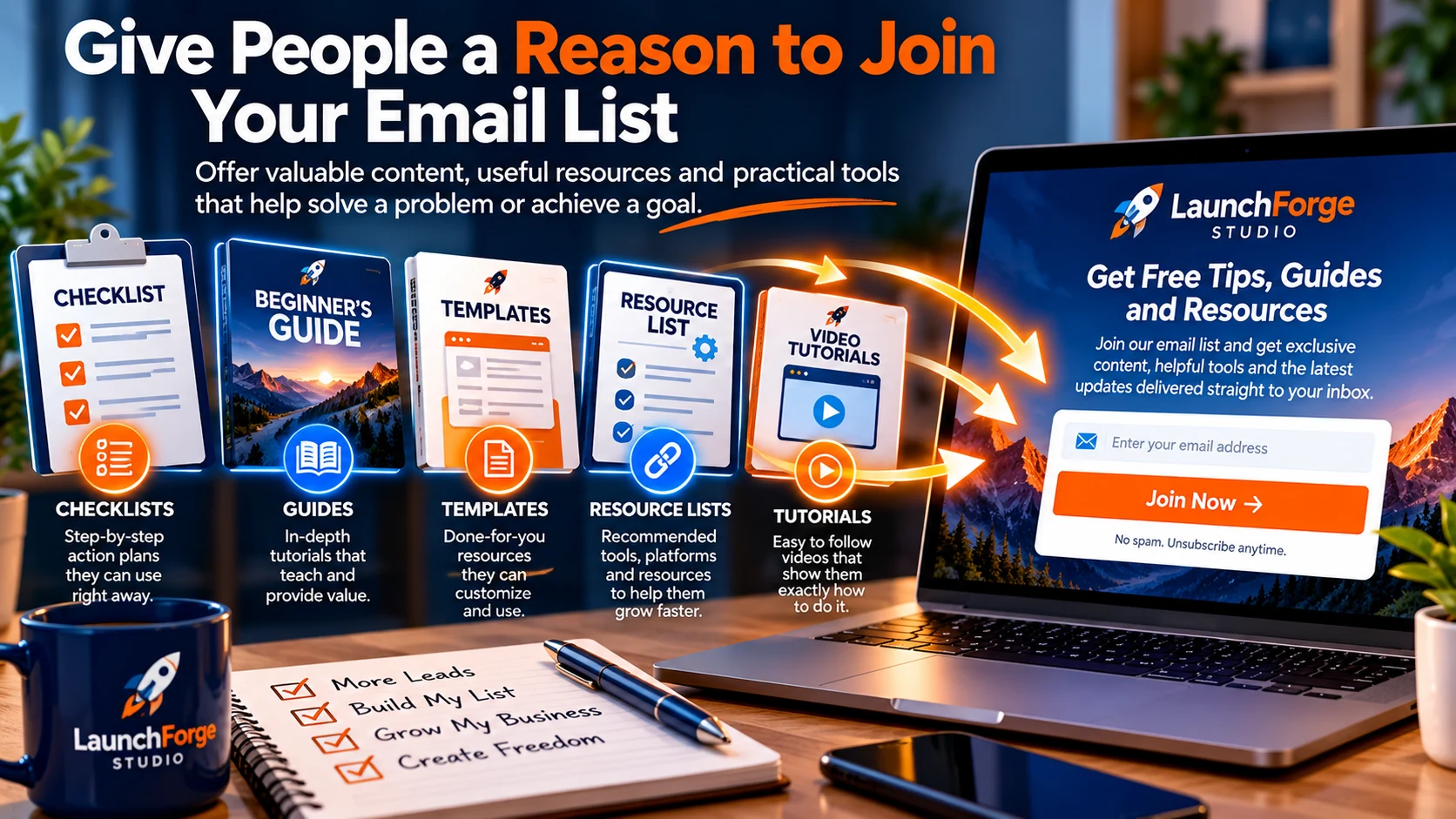
Useful checklists, guides, templates, resource lists, and tutorials can give visitors a clear reason to subscribe to your email list.
The answer does not need to be complicated.
It needs to be clear.
Start With the Person You Want to Help
A good signup offer usually begins with understanding what your visitor is trying to accomplish.
What problem are they working through?
What question brought them to your website?
What would help them take the next step?
If your audience is trying to build an online business, for example, they may be interested in practical guides, business-building resources, marketing tips, tutorials, checklists, tools, or lessons from someone actively building alongside them.
The closer your signup offer is to the reason someone visited your website, the more natural the invitation becomes.
Instead of saying:
Join my email list.
You are giving them a reason to think:
I want more of this.
That is a very different conversation.
You Do Not Always Need a Huge Lead Magnet
Lead magnets are commonly used to encourage email signups.
A lead magnet is simply something useful you provide in exchange for someone’s contact information.
That might be:
- A checklist
- A short guide
- A template
- A worksheet
- A resource list
- A mini-course
- A tutorial
- A collection of useful tools
Those can work well.
But do not fall into the trap of believing you need to spend weeks creating a 75-page ebook before you can collect your first subscriber.
Sometimes a simple promise of useful, relevant communication is enough.
The key is making that promise specific.
Make the Signup Offer Match the Content
Context matters.
Imagine someone arrives at an article about building a landing page.
An invitation to receive more practical website, landing page, and online business tutorials makes sense.
Now imagine that same visitor suddenly sees an unrelated offer about something completely different.
The transition feels disconnected.
Whenever possible, your signup opportunity should feel like a natural extension of what the visitor is already reading or doing.
That does not mean you need a different email list for every article.
It means the invitation should make sense within the journey.
What We Are Doing at LaunchForge Studio
Our own approach continues to evolve as LaunchForge Studio grows.
We currently use a Build Along With LaunchForge signup invitation across our articles.
The idea fits the larger direction of the site.
We are building LaunchForge Studio in the real world, documenting what we learn, publishing practical guides, testing tools and systems, and continuing to improve the business as we go.
The email invitation gives readers an opportunity to continue following that process instead of having the relationship end when they finish one article.
It also gives us something we can actually learn from.
Do people subscribe?
Which pages generate signups?
What messages connect with readers?
What happens after someone joins?
Those answers will help us improve the system over time.
That is part of the build-along philosophy itself:
Build something useful.
Put it to work.
Learn from what happens.
Then improve what matters.
Keep the Promise Simple
Whatever you decide to offer, make sure you can actually deliver it.
Do not promise daily masterclasses if you have no intention of sending daily emails.
Do not promise exclusive resources that do not exist.
And do not create an enormous content obligation just because you think your signup offer needs to sound impressive.
A simple promise you consistently keep is better than an ambitious promise you eventually abandon.
Your first signup offer does not need to be perfect.
It needs to give the right person a clear reason to take the next step.
Create a Place Where People Can Subscribe
Once you have given people a reason to join your email list, they need an obvious way to do it.
This sounds simple, but it is an important part of the system.
Someone should not have to search your website trying to figure out how to subscribe.
The opportunity should appear naturally where interested visitors are already spending time.
There are several ways to create those opportunities.
You can use a dedicated lead capture page.
You can place a signup form inside an article.
You can include one on important pages of your website.
You can direct traffic from social media or advertising to a landing page designed specifically for capturing leads.
You may eventually use several of these approaches together.
When you are starting from scratch, however, you do not need to put a form everywhere.
Start with one or two places that make sense and make sure they actually work.
Use a Dedicated Lead Capture Page
A lead capture page is a page built around one primary action:
Getting the visitor to provide their contact information.
Instead of surrounding someone with navigation choices, multiple offers, unrelated content, and competing calls to action, the page keeps the next step clear.
That makes a lead capture page useful when you are sending targeted traffic from an advertisement, social post, email promotion, traffic source, or specific marketing campaign.
The visitor arrives.
They see what you are offering.
They decide whether the value is relevant to them.
Then they either subscribe or leave.
Simple.
Your first lead capture page does not need an elaborate design.
It needs a clear message, a reason to subscribe, a simple form, and a strong call to action.
Add Signup Opportunities Inside Your Content
Your articles can also become part of your email list-building system.
Think about what is already happening when someone reads a useful article.
They discovered your website.
They chose a topic that interested them.
They spent time consuming your content.
If they find the article useful, that can be a natural moment to invite them to stay connected.
That is exactly why we added the Build Along With LaunchForge signup opportunity to our own article system.
Rather than manually inserting the form into every article, we incorporated it into the global post template used across LaunchForge Studio.
That means our current articles and future articles can automatically include the same signup opportunity.
One change to the system created another list-building entry point across the entire content library.
That is the kind of leverage we like.
Not because every visitor will subscribe.
They will not.
But because every useful article now has the opportunity to do more than generate a pageview.
It can potentially turn a reader into someone we can continue helping.
Keep Your Signup Form Simple
A signup form does not need to interrogate someone.
Every additional field creates another decision for the visitor.
For many beginner email lists, an email address may be enough.
You might also ask for a first name if you have a reason to use it.
But think carefully before asking for phone numbers, company names, job titles, addresses, favorite breakfast cereal, mother’s maiden name, and the coordinates of their childhood treehouse.
You are building an email list, not conducting a federal background investigation.
Ask for what you actually need.
A simpler form can make the decision easier for the visitor and make the signup process feel less intrusive.
Make the Call to Action Clear
The button on your signup form matters too.
Generic language such as:
Submit
technically works.
But it does not communicate much value.
Depending on what you are offering, your call to action might say:
Get the Guide
Send Me the Checklist
Join the Build Along
Get the Updates
Start Learning
The wording should reinforce what happens after the visitor clicks.
The objective is clarity, not cleverness.
People should understand what they are agreeing to and what they can expect next.
Test the Signup Experience Yourself
Before sending traffic anywhere near your form, subscribe to your own list.
Use the page like a visitor would.
Enter your information.
Click the button.
See what happens.
Does the form submit correctly?
Does the subscriber appear in your email system?
Does the correct welcome email arrive?
Do the links inside that email work?
Does the experience make sense on a phone?
Testing your own system can uncover problems that are almost invisible while you are building it.
A beautiful signup page that does not actually add people to your list is not a lead-generation system.
It is decoration.
Build it.
Test it.
Then let real visitors use it.
Connect Your Signup Form to Your Email System
A signup form is only the front door.
Something still needs to happen after a visitor enters their information and clicks the button.
Their email address needs to reach the system that will store the subscriber, manage the contact, and send whatever communication you have planned next.
This is where your signup form and email marketing platform need to work together.
The exact setup will depend on the platform you use, but the basic process is usually similar.
A visitor completes the form.
The form sends their information to your email system.
The subscriber is added to the appropriate list, campaign, or audience.
Then your welcome message or follow-up automation begins.
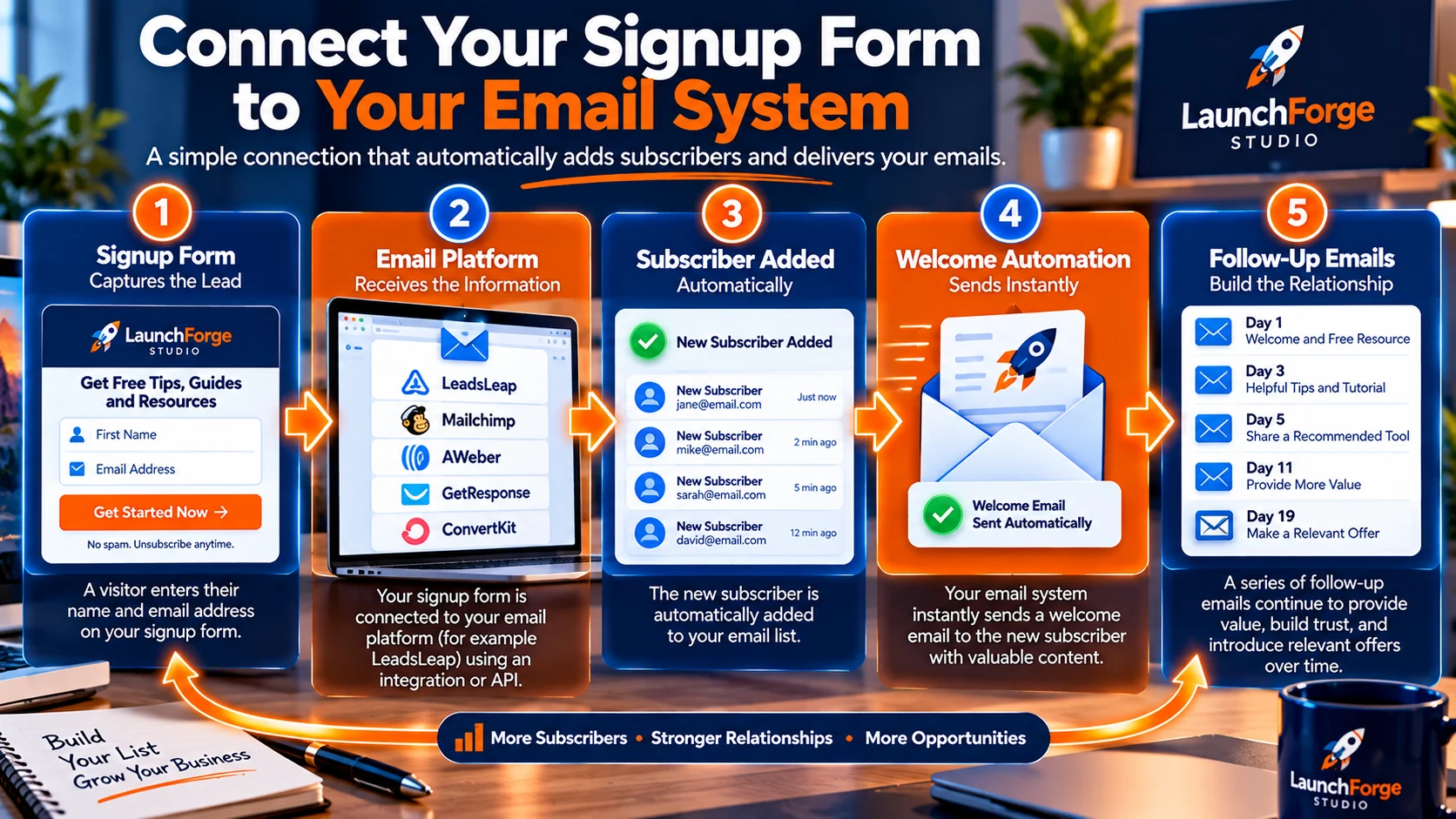
Connecting your signup form to an email platform allows new subscribers to be added automatically and receive welcome and follow-up emails.
When those pieces are connected correctly, the process can happen automatically.
Choose Where New Subscribers Should Go
Before connecting a form, decide where the people who use it should be added.
Depending on your email platform, this might be called a list, campaign, audience, group, tag, or something similar.
The terminology is less important than the organization behind it.
You want to know where a subscriber came from and what they signed up to receive.
If you eventually have several signup offers, knowing the difference can become useful.
Someone who requested a landing page checklist may have different interests from someone who subscribed for general business-building updates.
You do not need an elaborate segmentation system on day one.
You simply need enough organization that you understand what is happening inside your own list.
Connect the Form to the Correct Follow-Up
Once you know where the subscriber belongs, determine what should happen next.
For a basic setup, that might mean triggering one welcome email.
For a more developed system, the subscriber might enter a short sequence of messages delivered over several days.
The important thing is making sure the follow-up matches the reason the person subscribed.
If you promised a resource, deliver the resource.
If you invited someone to receive business-building updates, introduce what those updates will include.
If they joined a specific training sequence, start that training.
Do not make someone solve a mystery after giving you their email address.
The transition from signup to follow-up should feel like one continuous experience.
Use Automation to Handle the Repetitive Part
This is where automation becomes genuinely useful.
Without automation, you would need to notice every new subscriber and manually send them the appropriate welcome message.
That may be possible when you have three subscribers.
It becomes ridiculous as the list grows.
A basic automation can handle that repetitive work for you.
Someone subscribes.
The system recognizes the new contact.
The appropriate email is sent.
The next scheduled message can follow automatically.
You are not automating the relationship.
You are automating the predictable steps that allow you to manage the relationship more consistently.
That distinction matters.
Automation should help you communicate more reliably, not turn your business into a collection of robotic messages nobody wants to read.
How We Are Connecting the Pieces at LaunchForge Studio
At LaunchForge Studio, we currently use LeadsLeap for our signup and email follow-up system.
Our Build Along With LaunchForge form is connected to the campaign we use for subscribers who want to continue following what we are building and learning.
We then embedded that signup opportunity into our global article template.
That creates a simple chain:
LaunchForge Article → Build Along Signup → LeadsLeap → Follow-Up Emails
The visitor does not need to understand any of the technology behind that process.
They simply see an opportunity to stay connected.
If they subscribe, the systems behind the page handle the next steps.
That is what good automation should do.
The machinery can be complicated behind the scenes.
The experience for the visitor should not be.
Test the Entire Connection From Beginning to End
Do not assume everything works because the form looks correct.
Run through the entire process yourself.
Use an email address you can access and subscribe exactly as a visitor would.
Then follow the trail.
Did the form accept the submission?
Did the contact appear in the correct place inside your email platform?
Was the right campaign or automation triggered?
Did the welcome email arrive?
Did it arrive when you expected?
Did the email display correctly?
Did the links work?
What happened when you clicked them?
Testing the complete journey matters because each individual piece can appear to work while the connection between two pieces is broken.
A form can submit successfully without putting the subscriber where you expected.
An automation can exist without being triggered.
A welcome email can be active but connected to the wrong list.
Those are small technical problems with potentially large consequences.
You could be spending time and money generating traffic while new subscribers quietly fall through a crack in the system.
Captain Invisible Broken Automation does not announce his arrival.
He just sits there eating your leads.
Keep the First Version Manageable
Your first email system does not need twenty tags, twelve automations, seven lists, fourteen conditional branches, and a control panel that looks like you are preparing to launch a satellite.
Start with the simplest version that accomplishes the job.
One signup opportunity.
One destination for the subscriber.
One welcome process.
One clear reason to continue communicating.
Once that works, you have something you can improve.
That is much easier than trying to troubleshoot a complicated system you never needed in the first place.
Build a Simple Welcome and Follow-Up System
Getting someone to subscribe is an important milestone.
But it is not the finish line.
It is the beginning of the relationship.
Someone just decided your business was interesting or useful enough to give you access to their inbox.
What happens next can influence whether they continue opening your emails or forget why they subscribed in the first place.
That is why your welcome and follow-up system deserves attention from the beginning.
You do not need a complicated twenty-email sequence.
You need a useful first experience.
Start With a Welcome Email
Your welcome email should arrive soon after someone subscribes.
Its job is simple.
Acknowledge the subscription.
Welcome the person.
Deliver anything you promised.
Explain what they can expect from you.
Give them a useful next step.
Think of it as the digital equivalent of someone walking through the front door of your business.
You would not invite them inside and then disappear into the back room for three weeks.
Your email system should not do that either.
Remind Subscribers Why They Joined
People subscribe to things all the time.
They may not remember your business name several days later when another email appears in their inbox.
Your welcome email can help establish that connection immediately.
Remind them where they signed up and what they asked to receive.
If they joined through a particular guide, resource, or signup offer, reference it.
If they joined because they want ongoing tutorials or updates, reinforce that expectation.
Clarity reduces confusion.
And confused subscribers are much more likely to ignore your messages or unsubscribe.
Deliver What You Promised Immediately
If you offered something in exchange for the signup, make it easy to access.
Do not make subscribers jump through another five hoops.
If you promised a checklist, provide the checklist.
If you promised a guide, provide the guide.
If you promised a training series, explain when the first lesson will arrive.
This is one of the first opportunities you have to demonstrate that your business does what it says it will do.
That may seem like a small thing.
It is not.
Trust is built through small experiences repeated consistently.
Give the Subscriber a Useful Next Step
Your welcome email does not have to end after saying hello.
You can give the subscriber somewhere useful to go next.
That might be one of your best beginner guides.
A useful resource.
An important page on your website.
Another article related to what they were already reading.
A short introduction to your business.
The goal is not to immediately throw ten offers at them.
The goal is to continue helping them move forward.
One clear next step is usually enough.
Build a Simple Follow-Up Sequence
After the welcome email, you can begin creating a short sequence of follow-up messages.
There is no universal number of emails you must send.
What matters more is whether each message has a purpose.
A simple beginner sequence might introduce your business, share useful educational content, answer a common question, point toward another helpful resource, and eventually introduce a relevant product or service.
Each email should give the subscriber another reason to recognize your name and understand what you can help them with.
You are gradually building familiarity.
That is very different from collecting an email address and immediately blasting promotional messages at it.
Do Not Make Every Email a Sales Pitch
Your email list can absolutely become part of how your business generates revenue.
That is one of the reasons email marketing can be valuable.
But monetization does not mean every message needs to scream:
BUY THIS RIGHT NOW.
If every email exists only to extract a click or a sale, subscribers have very little reason to keep paying attention.
Mix useful communication with relevant offers.
Teach.
Share.
Help.
Recommend.
And when you have something that genuinely fits what your subscribers are trying to accomplish, explain the offer clearly.
Selling and helping do not have to be opposites.
A useful recommendation can do both.
Let Your Follow-Up System Improve Over Time
Your first email sequence is not carved into stone.
As your list grows, you can learn from what happens.
Which emails get opened?
Which links get clicked?
Which topics generate responses?
Where do subscribers stop engaging?
Which resources consistently attract attention?
Those signals can help you improve future emails and revise existing ones.
This is another reason we prefer building the system first instead of waiting until everything feels perfect.
Real subscribers give you information that planning alone cannot provide.
How We Approach Follow-Up at LaunchForge Studio
Our own follow-up system has evolved as LaunchForge Studio has evolved.
That is exactly what we would expect.
The website has grown.
The content library has grown.
Our understanding of what we want LaunchForge Studio to become has grown.
The email system should be allowed to grow with it.
Rather than pretending we designed the perfect sequence before we had real subscribers moving through it, we can continue reviewing and improving the experience as we learn.
That is the build-along approach applied to email marketing.
Build the first useful version.
Put real people through it.
Pay attention.
Improve it.
Then repeat.
An email list becomes far more valuable when the system behind it continues getting better.
How to Build an Email List From Scratch and Grow It
Once the basic system works, you need people to discover it.
This is where traffic and list building come together.
You can have an excellent signup offer, a beautiful lead capture page, and a carefully written follow-up sequence, but none of those things can grow your list if nobody sees them.
The good news is that you do not need thousands of visitors before you can begin.
You need relevant people reaching your signup opportunities consistently.
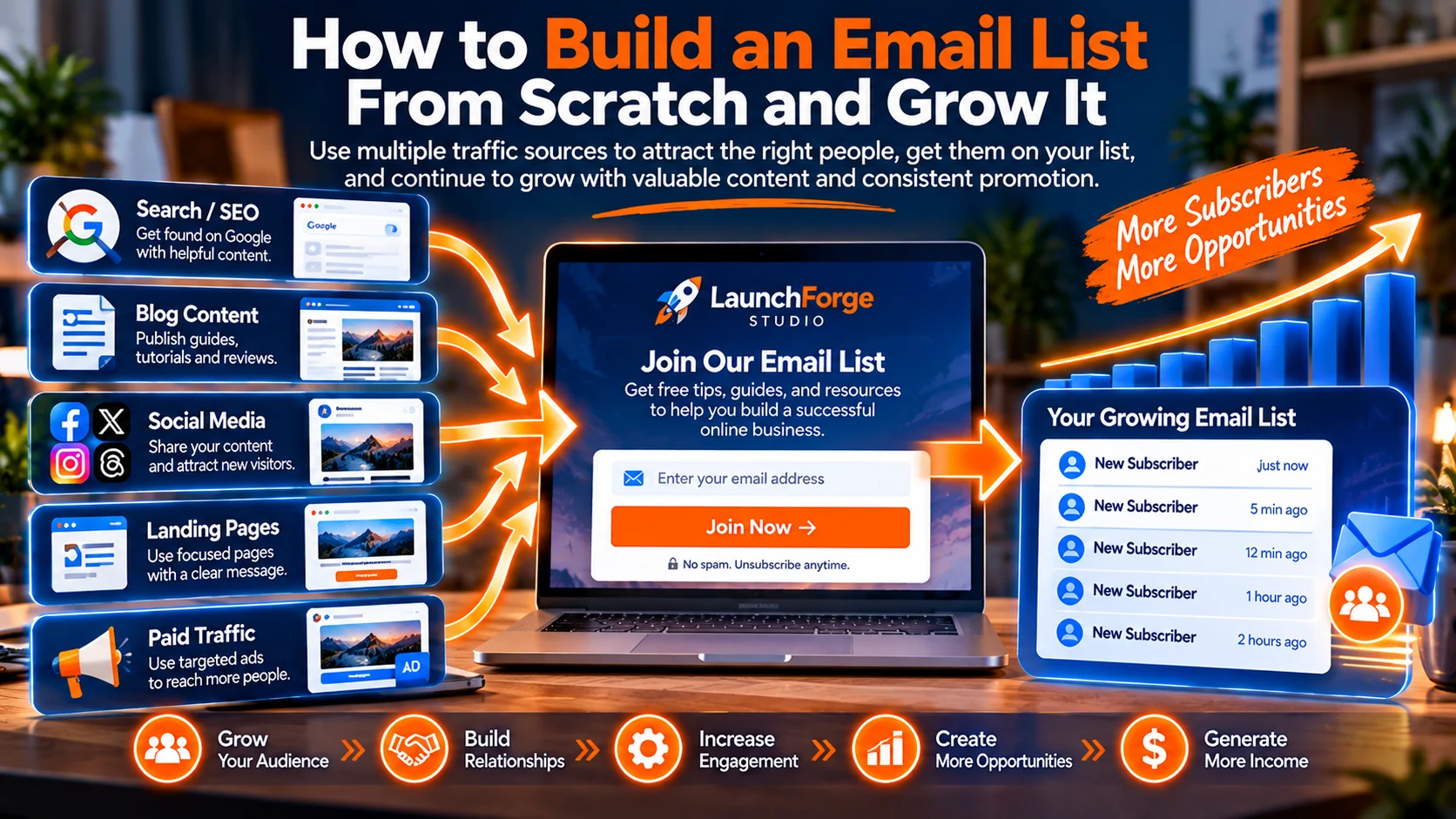
SEO, blog content, social media, landing pages, and paid traffic can all bring relevant visitors into your email list-building system.
That traffic can come from several places.
Turn Your Existing Content Into a List-Building Asset
If you already publish useful content, you already have one potential source of subscribers.
Every article creates another opportunity for someone to discover your business.
Search engines may send visitors.
Social media posts can send visitors.
You can link to articles from emails, communities, advertisements, or other websites.
Once someone arrives, your content has a job to do.
Help them.
If the article solves a problem or answers a question, you have already started demonstrating why someone might want to hear from you again.
That is where a relevant signup opportunity can continue the relationship.
This is one reason we added our Build Along With LaunchForge signup form to the global article template.
As we publish more useful content, we are also creating more potential entry points into the email system.
One article may attract a few visitors.
Another may eventually rank in search.
Another might receive attention through social media.
Over time, the content library itself can become part of the list-building engine.
Use Search Traffic to Attract the Right Visitors
Search engine traffic can be particularly useful because people are actively looking for information.
Someone searching for how to build a landing page, generate leads, create a sales funnel, or start an email list already has a problem or goal in mind.
If your content answers that question well, you have an opportunity to introduce them to the rest of your business.
This is where content marketing and email marketing begin working together.
The article attracts the visitor.
The content provides value.
The signup opportunity gives them a way to stay connected.
The email system continues the relationship.
Instead of treating SEO, content, lead generation, and email as completely separate marketing strategies, you can connect them into one larger system.
Promote Your Content on Social Media
Social media can provide another path into your email list.
You do not necessarily need to send every social media visitor directly to a signup form.
Sometimes the better first step is sending them to something useful.
Share an article.
Answer a question.
Publish a useful observation.
Show something you are building.
Then give interested people a path from that content into your website and eventually into your email system.
That approach can make social media part of a larger journey instead of treating every post like an advertisement.
At LaunchForge Studio, this is something we continue building through the content we publish and distribute across our social channels.
The individual post is not the entire strategy.
It is another doorway into the system.
Create Dedicated Landing Pages for Specific Campaigns
Sometimes you do want to send traffic directly to a signup opportunity.
That is where a dedicated landing page or lead capture page can be useful.
Instead of sending someone to your homepage and hoping they figure out what to do next, you can create a page around one specific invitation.
This can work especially well when promoting a particular resource, guide, training, checklist, newsletter, or other signup incentive.
It can also make your results easier to understand.
If you send a specific source of traffic to a dedicated page, you can begin evaluating what happens after those visitors arrive.
Are people subscribing?
Is the offer clear?
Is the page doing its job?
Those questions become much easier to answer when the path is intentional.
Use Paid Traffic Carefully
Paid traffic can also grow an email list.
But buying traffic does not fix a weak signup system.
It simply sends more people through it.
Before spending heavily on advertising, make sure the basic process works.
Your page should load correctly.
The offer should be understandable.
The form should work.
The subscriber should enter the correct email system.
The welcome and follow-up process should trigger correctly.
Then you can begin testing traffic against a functioning system.
Start small.
Measure what happens.
Improve the page or offer when necessary.
Then decide whether sending more traffic makes sense.
There is little value in pouring more traffic into a funnel that is quietly leaking subscribers out the bottom.
Look for Traffic You Already Have
When people think about growing an email list, they often immediately start looking for a brand-new traffic source.
Before doing that, look at what you already have.
Do people visit your website?
Read your articles?
Follow you on social media?
Click links in your profiles?
Visit particular pages more often than others?
Interact with content you publish elsewhere?
Those existing touchpoints may already contain opportunities to introduce your email list.
Sometimes the next subscriber does not require another marketing platform.
They require a better path through the system you already built.
Focus on Consistency Before Scale
When you are starting from zero, your first objective does not need to be:
How do I get 10,000 subscribers?
A better question is:
How can I consistently attract the next right subscriber?
Then another.
Then another.
That mindset keeps you focused on the process rather than an impressive-looking number.
Build useful content.
Create clear signup opportunities.
Generate relevant traffic.
Follow up with the people who subscribe.
Learn what works.
Then do more of what works.
Growth becomes much easier to understand when you stop treating it like one giant event and start treating it like a repeatable system.
Build Trust With the People on Your Email List
Getting someone onto your email list is only part of the job.
Keeping their attention is another.
When someone subscribes, they are giving you permission to communicate with them.
That permission has value.
Treat it that way.
You do not need every email to be groundbreaking.
You do need to give subscribers a reason to continue recognizing your name, opening your messages, and paying attention to what you send.
That happens gradually.
Trust is rarely created by one brilliant email.
It is built through repeated experiences.
Send Emails That Have a Purpose
Before sending an email, ask yourself a simple question:
Why am I sending this?
Maybe you published a useful new guide.
Maybe you learned something your subscribers could benefit from.
Maybe you found a resource worth sharing.
Maybe you want to explain a mistake you made and what you learned from it.
Maybe you have an offer that genuinely fits the audience.
Those are reasons.
Sending an email simply because somebody told you that you must email your list three times every week is not much of a strategy.
Frequency matters less than having something worthwhile to communicate.
Teach What You Are Learning
You do not need to position yourself as someone who knows everything.
In fact, trying to do that can make creating content unnecessarily difficult.
You can teach from experience.
Share what you tried.
Explain why you tried it.
Show what worked.
Talk about what did not.
Explain what you would change next time.
That approach is especially important to what we are building at LaunchForge Studio.
We are not standing at the finish line pretending the entire business appeared fully formed.
We are building it.
The website evolves.
Our marketing evolves.
Our content strategy evolves.
Our email system evolves.
And the lessons from that process can become useful information for someone building alongside us.
You can apply the same principle to your own business.
Your experience can become part of the value you provide.
Write Like You Are Communicating With a Person
An email list may contain hundreds or eventually thousands of subscribers.
But each email is still opened by one person at a time.
Write accordingly.
You do not need every message to sound like a corporate press release.
You also do not need to stuff every email with marketing language designed to manufacture excitement.
Be clear.
Be useful.
Be human.
If your normal communication has personality, let some of that personality through.
People subscribed to hear from your business, not from Captain Generic Marketing Robot 3000.
Be Careful With Constant Promotion
There is nothing wrong with promoting products or services through email.
For many businesses, that is one of the reasons the list exists.
But there is a difference between monetizing an audience and exhausting one.
If every message is another urgent promotion, subscribers may eventually stop paying attention.
Give them reasons to open emails even when you are not selling something.
Useful articles.
Practical tips.
Lessons.
Resources.
Updates.
Experiments.
Answers to common questions.
Then when you do recommend something, the recommendation exists within a relationship you have been building rather than appearing out of nowhere.
Protect the Expectations You Set
Remember the promise you made when someone subscribed.
If you told people they would receive practical business-building information, send practical business-building information.
If they joined for a particular resource or topic, do not immediately flood them with unrelated messages.
That does not mean your content can never evolve.
Businesses change.
Audiences change.
LaunchForge Studio certainly has.
But your communication should still make sense to the person who originally decided to subscribe.
Trust grows when expectations and reality remain reasonably aligned.
Make It Easy for People to Leave
This might sound strange in a section about growing an email list.
But people should be able to unsubscribe.
You do not want to trap people on your list.
Someone who no longer wants your emails is not helping you by remaining there.
Respect unsubscribe requests and the permission-based nature of email communication.
A healthy list is not simply the largest number of addresses you can accumulate.
It is a group of people who have chosen to receive what you send.
That distinction is important.
Think Beyond the Subscriber Count
It can be exciting to watch the number of subscribers increase.
But the number alone does not tell you whether your email system is working.
A growing list that nobody opens is not particularly useful.
A smaller list where people read, click, respond, return to your website, and occasionally purchase something can be far more meaningful.
So celebrate growth.
But also pay attention to the relationship behind the number.
Because the real objective is not simply to build an email list.
It is to build an audience you can continue serving, learning from, and communicating with as your business grows.
Common Email List Building Mistakes to Avoid
Building an email list from scratch is not particularly complicated.
But there are plenty of ways to make it complicated.
Some mistakes prevent people from subscribing.
Others create a poor experience after they join.
And some result from trying to build an advanced email marketing operation before the basic system even works.
Here are several mistakes worth watching for as you build your first list.
Waiting Until You Have More Traffic
It is easy to tell yourself that you will build your email list later.
After the website gets more traffic.
After you publish more articles.
After your social audience grows.
After everything looks more established.
The problem is that visitors may already be arriving.
Even if the number is small, those visitors represent opportunities to begin learning how your signup system performs.
You do not need massive traffic before creating a list.
Build the basic system early so it is ready when traffic increases.
Asking People to Subscribe Without Giving Them a Reason
A box that says Subscribe to Our Newsletter may work for some businesses.
But it leaves an important question unanswered:
Why?
Give people some idea of what they will receive.
Useful tutorials.
Business-building insights.
New resources.
A specific lead magnet.
Exclusive updates.
Whatever your promise is, communicate it.
People are much more likely to make a decision when they understand what they are agreeing to.
Creating Too Many Signup Offers at Once
Personalization and segmentation can become powerful as your email strategy develops.
But beginners can easily go too far.
One lead magnet becomes five.
Five become twelve.
Now there are multiple forms, landing pages, lists, tags, automations, and follow-up sequences that all need to be maintained.
Captain Email Octopus has entered the building.
Start with one useful path.
Get it working.
Then expand when there is a reason to expand.
Complexity should solve a problem.
It should not be the goal.
Collecting Subscribers Without Following Up
Imagine someone finds your website, likes what they see, subscribes, and then hears absolutely nothing from you for two months.
When an email finally arrives, there is a good chance they will not remember who you are.
Your welcome email helps establish the relationship while the signup is still fresh in their mind.
Even a simple follow-up system is better than allowing new subscribers to disappear into a database and hoping you remember them later.
Sending Too Much Too Quickly
The opposite problem can happen too.
Someone subscribes and suddenly receives seven emails in two days.
Welcome.
Offer.
Reminder.
Another offer.
Last chance.
Final last chance.
Seriously, this time it is the final last chance.
That can become exhausting very quickly.
Give your emails room to breathe.
There may be situations where a short, concentrated sequence makes sense, but frequency should support the experience rather than overwhelm the subscriber.
Buying an Email List
Building a list can feel slow in the beginning.
That can make shortcuts tempting.
Buying a database of email addresses may make your subscriber count larger, but those people did not choose to hear from you.
They do not know your business.
They did not ask for your emails.
And a giant spreadsheet of addresses is not the same thing as an audience.
Build permission-based relationships instead.
It may take longer, but you are building something far more useful.
Ignoring Mobile Visitors
Your signup experience needs to work on a phone.
A form that looks beautiful on a desktop can become a mess on a smaller screen.
Buttons can become difficult to tap.
Text can become hard to read.
Forms can extend beyond the screen.
Popups can cover everything.
Test the page yourself on mobile.
The same principle applies to the emails you send.
Subscribers should not need to perform finger gymnastics just to read your message or click a link.
Adding Too Many Form Fields
Every piece of information you request creates another step.
Do you actually need someone’s company size before they can download a checklist?
Probably not.
Collect the information necessary for the experience you are providing.
You can learn more about your audience over time.
Your first signup form does not need to double as the United States Census.
Forgetting to Test the System
We have mentioned testing several times in this guide for a reason.
A broken email system can be surprisingly quiet.
Nobody calls you to announce:
Hello. I attempted to become lead number 37 today, but your automation failed between steps three and four. Thought you should know.
They simply disappear.
Test forms.
Test emails.
Test links.
Test automations.
Test pages on different devices.
And test them again after making significant changes.
Obsessing Over the Subscriber Number
Your first ten subscribers matter.
So do your first fifty.
Do not become discouraged because another business has 50,000 people on its list.
You are looking at a different stage of their journey.
Concentrate on building your own system.
Can people discover you?
Can they subscribe?
Does the technology work?
Do they receive what you promised?
Are you sending communication worth opening?
Can you gradually bring more relevant people into that process?
If those pieces are working, you have something worth growing.
Trying to Make Everything Perfect Before Launching
This may be the biggest trap of all.
You can spend months adjusting forms, rewriting welcome emails, redesigning landing pages, comparing email platforms, and planning elaborate automation maps without collecting a single subscriber.
Eventually you have to put the system into the real world.
Your first version will probably change.
Ours has.
And it will continue changing.
That is not evidence that the first version failed.
It is evidence that you are learning.
Build the useful version you can create today.
Let people use it.
Then make the next version better.
Measure What Is Working and Improve Your Email List
Once people begin moving through your email list-building system, you have something you did not have when you started.
Real information.
You can see where subscribers are coming from.
You can see whether people are joining.
You can see whether emails are being opened.
You can see which links receive attention.
And over time, you can use that information to improve the system.
You do not need to become a data scientist.
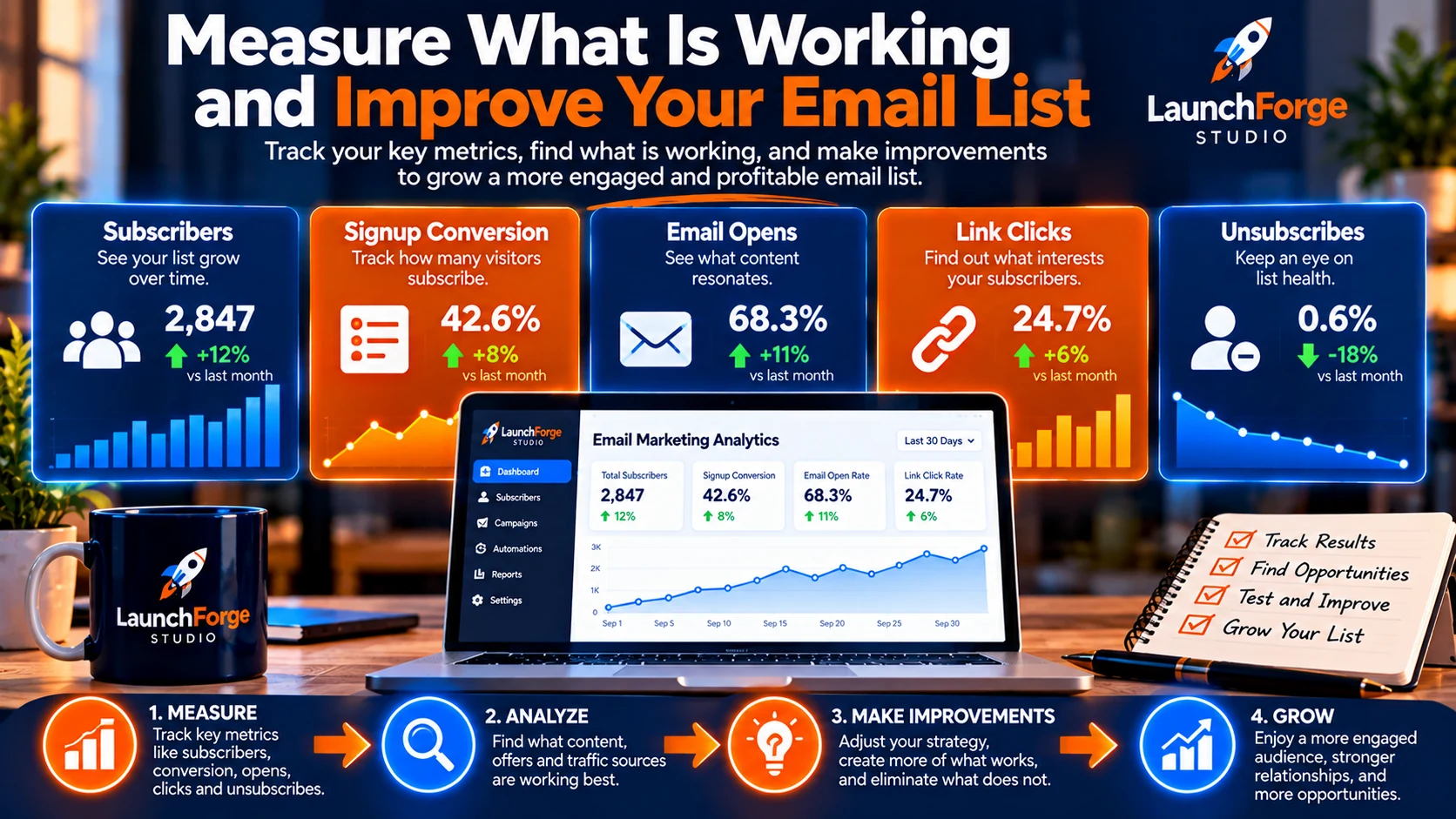
Tracking subscribers, signup conversions, email opens, link clicks, and unsubscribes can help you identify what is working and improve your email list over time.
A few useful measurements can tell you a lot.
Track Where Your Subscribers Come From
Start by understanding which parts of your business are generating subscribers.
Maybe people are joining from articles.
Maybe a dedicated lead capture page performs particularly well.
Maybe social media sends visitors who subscribe.
Maybe one topic consistently generates more interest than others.
Knowing where subscribers originate can help you decide where to spend more time.
If one article repeatedly attracts visitors and generates signups, that is useful information.
You may be able to publish related content, improve the signup opportunity on that page, or send additional traffic to it.
Without tracking anything, you are relying on assumptions.
Pay Attention to Signup Conversion
Traffic alone does not tell you whether your signup system is working.
Imagine two pages.
One receives 1,000 visitors and generates five subscribers.
Another receives 200 visitors and generates twenty subscribers.
The first page has more traffic.
The second page is doing a much better job of turning visitors into subscribers.
That is why it can be useful to think about conversion rate.
The basic calculation is:
Number of Subscribers ÷ Number of Visitors × 100 = Conversion Rate
For example, if 20 people subscribe from 500 visitors:
20 ÷ 500 × 100 = 4%
You do not need to obsess over a universal benchmark.
Different traffic sources, offers, audiences, and pages can produce very different results.
The useful comparison is often against your own previous performance.
Can you make the page clearer?
Can you improve the signup offer?
Can you strengthen the call to action?
Can you attract visitors who are a better match for what you offer?
Test improvements against what actually happens.
Watch Email Opens With Some Perspective
Most email marketing platforms provide some form of open tracking.
This can help you understand whether subscribers are noticing and opening your messages.
But open rates should not be treated as perfect measurements.
Privacy features, image loading, email clients, and other technical factors can affect how opens are recorded.
Use the metric as a signal rather than absolute truth.
If one type of subject line consistently appears to generate more engagement, that may be worth investigating.
If opens suddenly fall across several emails, that may also deserve attention.
Look for patterns instead of panicking over one number.
Track Which Links People Click
Clicks can tell you what subscribers are interested enough to investigate further.
If you send an email containing a link to a tutorial and people click it, that is useful feedback.
If another topic repeatedly receives little attention, that tells you something too.
Clicks can help you understand which resources, topics, and offers resonate with your audience.
That information can influence more than email.
It can help shape future articles, guides, resources, and offers across the rest of your business.
Your email list can become another source of information about what your audience actually cares about.
Pay Attention to Unsubscribes
People will unsubscribe.
That is normal.
Interests change.
Inboxes become crowded.
People move on.
An unsubscribe does not automatically mean you did something wrong.
But patterns matter.
If a particular email suddenly produces significantly more unsubscribes than usual, look at it.
Was the message different from what subscribers normally receive?
Was the subject misleading?
Was the offer irrelevant?
Did you dramatically increase sending frequency?
Use unsubscribes as information rather than treating every departure like Captain Personal Rejection showed up and kicked you in the butt-cheese.
Do Not Change Everything at Once
When something underperforms, the temptation is to rebuild the entire system.
New headline.
New form.
New offer.
New button.
New landing page.
New email sequence.
New traffic source.
New logo.
New font.
New business.
At that point, you have no idea which change affected the result.
Make meaningful changes one at a time when possible.
Then observe what happens.
This makes it easier to learn from the experiment instead of creating a giant bowl of marketing spaghetti.
Keep a Simple Record of What You Learn
You do not need an enormous analytics operation.
Keep notes.
What did you change?
When did you change it?
What happened afterward?
Which pages generated subscribers?
Which emails received clicks?
Which topics attracted attention?
Which experiments went nowhere?
Over time, those notes become valuable.
You stop making decisions entirely from memory and begin building from evidence gathered inside your own business.
Improvement Is Part of the System
The goal is not to build an email list once and declare it finished.
The system should evolve.
Your audience may change.
Your content will change.
Your offers may change.
Your business will change.
The email list should be able to evolve with them.
That is how we think about the systems we build at LaunchForge Studio.
We are not trying to create something once and pretend it will never need another adjustment.
We build.
We use it.
We measure what happens.
We learn.
Then we improve the next version.
That cycle is not a sign that something went wrong.
That cycle is how the system gets better.
A Simple Email List Building System You Can Use
We have covered a lot of ground.
But when you strip away the platforms, forms, automations, landing pages, analytics, and marketing terminology, building an email list from scratch comes down to a fairly simple process.
You need to attract the right people.
Give them a reason to subscribe.
Provide an easy way to join.
Follow up after they do.
Continue giving them reasons to stay connected.
Then learn from what happens and improve the system.
Put together, the process looks something like this:
Useful Content or Traffic → Signup Opportunity → Subscriber → Welcome Email → Follow-Up → Relationship → Relevant Offer
That is your basic email list-building system.
You can make it more sophisticated later.
You can add additional lead magnets.
You can create multiple landing pages.
You can segment subscribers.
You can build more advanced automations.
You can test different offers and traffic sources.
But none of those additions change the basic job the system needs to perform.
Step 1: Attract the Right People
Start with traffic.
That traffic might come from search engines, useful content, social media, advertising, referrals, communities, or other marketing channels.
You do not need traffic from everybody.
You want people who are reasonably aligned with the problems your business helps solve.
Step 2: Give Them a Reason to Subscribe
Create a clear invitation.
Tell visitors what they will receive and why it might be useful.
That could be a resource, checklist, guide, training, newsletter, ongoing tutorials, or another relevant reason to stay connected.
Keep the promise understandable.
Step 3: Make Joining Easy
Give visitors an obvious place to subscribe.
That could be a form inside your content, a dedicated lead capture page, or another strategically placed signup opportunity.
Ask only for the information you actually need.
Then make sure the form works.
Step 4: Welcome the Subscriber
Once someone joins, acknowledge them.
Deliver what you promised.
Remind them why they subscribed.
Explain what they can expect.
Give them a useful next step.
Do not leave your brand-new subscriber standing alone in Captain Digital Waiting Room wondering whether the signup actually worked.
Step 5: Continue the Conversation
Use your follow-up system to remain useful.
Share educational content.
Answer questions.
Send people toward helpful resources.
Show them what you are learning.
Introduce relevant products or services when appropriate.
The relationship should continue beyond the initial signup.
Step 6: Bring More People Into the System
Once the process works from beginning to end, continue generating relevant traffic.
Publish more useful content.
Promote it.
Improve existing pages.
Test new traffic sources when appropriate.
Create additional entry points when there is a genuine reason to do so.
You are no longer simply trying to get traffic.
You are bringing people into a system capable of continuing the relationship.
Step 7: Measure and Improve
Finally, pay attention to what happens.
Which pages generate subscribers?
Which signup offers perform well?
Which emails receive attention?
Which links get clicked?
Where does the process break down?
Use those answers to decide what deserves improvement.
Then make the next version better.
Build the System Before You Try to Scale It
This may be the most important principle in the entire process.
Do not worry about building a massive email list before you have built a functioning email system.
Make sure one person can travel through the entire journey successfully.
Can they discover your content?
Can they find the signup opportunity?
Can they subscribe?
Does their information reach the correct email platform?
Do they receive the welcome email?
Does the follow-up work?
Can they return to your website through your emails?
If the answer is yes, you have built something real.
Now you can work on bringing more people through it.
That is a much stronger foundation than chasing thousands of subscribers while the machinery behind the list is held together with digital duct tape.
How We Are Building the LaunchForge Studio Email List
Everything we have discussed in this guide connects directly to something we are building ourselves.
LaunchForge Studio did not begin with a massive email audience.
We are building the list alongside the rest of the business.
That makes it a useful real-world example of what starting from scratch actually looks like.
We Started With the Basic Infrastructure
Before worrying about advanced email marketing strategies, we needed the basic pieces to work together.
We needed useful content that could attract visitors.
We needed a signup opportunity.
We needed somewhere to store and manage subscribers.
We needed a way to follow up after someone joined.
And we needed those pieces connected well enough that a visitor could move through the system without us manually handling every step.
For our current setup, LeadsLeap provides the email capture and follow-up functionality behind the system.
That gave us the infrastructure.
But infrastructure alone does not build an audience.
We still needed to connect it to the rest of LaunchForge Studio.
We Connected Email to Our Content Strategy
As our article library grew, we realized those articles could do more than answer questions and attract traffic.
They could also provide opportunities for readers to stay connected.
That led to the Build Along With LaunchForge signup invitation that now appears as part of our article system.
Instead of treating email marketing as a completely separate project, we connected it to something we were already doing:
Publishing useful content.
Now the journey can continue beyond a single article.
A visitor can discover LaunchForge Studio through content.
They can read the article.
They can decide whether they want to continue following what we build.
If they subscribe, our email system can continue the relationship.
That is much closer to the kind of connected business system we want to create.
We Are Still Learning From the System
This is not a case study written five years after everything was perfected.
We are building it now.
That means there will be things we change.
Signup messaging may improve.
Follow-up emails may change.
New resources may create additional signup opportunities.
Some ideas will probably work better than others.
That is exactly why we document the process.
There is value in seeing what happens between the first version and the mature version.
Most businesses do not begin with perfectly optimized systems.
They build something.
They learn.
They make adjustments.
And gradually, the pieces become stronger.
Build Along Instead of Waiting for Perfect
If you are starting your own email list at zero, you may be closer to our situation than to the businesses showing screenshots of enormous subscriber databases.
That is okay.
You do not need their list to start building yours.
You need the first working version of your system.
Create the signup opportunity.
Connect it to your email platform.
Write the welcome message.
Test the process.
Start attracting people.
Then pay attention to what happens.
That is what we are doing with LaunchForge Studio.
And as the system grows, we will have something even more useful than a theory about building an email list.
We will have the lessons that came from actually building one.
Start Building Your Email List One Subscriber at a Time
Building an email list from scratch can seem like a much bigger project than it actually needs to be.
You do not need thousands of visitors.
You do not need an enormous lead magnet.
You do not need complicated automation.
And you definitely do not need to understand every advanced email marketing strategy before you begin.
You need a simple system that works.
Give the right people a reason to subscribe.
Create an easy way for them to join.
Connect that signup opportunity to your email platform.
Welcome them when they arrive.
Continue sending communication worth receiving.
Bring more relevant people into the system.
Then learn from what happens and improve it.
That is how an email list begins.
Your First Subscriber Matters
When you are starting at zero, it is easy to focus on the numbers you do not have yet.
You see businesses talking about lists containing thousands or even hundreds of thousands of subscribers and wonder how your first handful could possibly matter.
But every large permission-based email list started in the same place.
Zero.
Then someone subscribed.
Your first subscriber proves the system can work.
Your tenth gives you more information.
Your hundredth gives you even more.
The objective is not to magically jump from zero to thousands.
It is to create a process capable of supporting growth when it happens.
Keep the System Simple Enough to Use
There will always be another tool you could add.
Another automation you could build.
Another funnel you could create.
Another traffic source you could test.
Another segmentation strategy you could implement.
Those things may eventually make sense.
But more moving parts do not automatically create a better business.
Start with what you need.
Make it work.
Understand it.
Then add complexity only when that complexity solves a real problem.
A simple email system you consistently use is far more valuable than an elaborate system you never finish building.
Build, Learn, and Improve
That principle extends far beyond email marketing.
It is one of the biggest lessons we continue learning while building LaunchForge Studio.
You do not have to see the entire road before taking the first step.
Build the next useful piece.
Connect it to what you already have.
Put it into the real world.
See what happens.
Then use what you learn to decide what comes next.
Your email list will not be finished the day you launch it.
Neither will your website.
Neither will your marketing.
Neither will your business.
They are systems you continue improving.
So if you have been waiting for the perfect strategy, the perfect platform, the perfect lead magnet, or the perfect time to start building your email list, begin with something simpler.
Build the first working version.
Get your first subscriber.
Then build from there.
One subscriber at a time.