
How to Get Your First 100 Website Visitors
Learning how to get your first 100 website visitors is one of the first real challenges you face after launching an online business.
You can build the website.
You can create your offer.
You can publish your first articles.
You can even have everything looking great and ready to go.
Then you sit back and realize something:
Nobody knows you’re there yet.
And honestly, that’s normal.
Getting your first visitors isn’t about discovering some secret traffic button that suddenly sends thousands of people to your website. It’s about learning where your potential audience spends time, giving them a reason to pay attention, and making it easy for them to take the next step.
The good news is that you don’t need thousands of visitors to get started.
You need the right first visitors.
Those first 100 people can teach you a tremendous amount about your business. They can show you what content gets attention, which messages connect with people, where your traffic is coming from, and what visitors do once they arrive.
More importantly, getting those first visitors gives you something every new online business needs:
Momentum.
This guide is going to walk you through practical strategies you can use to start bringing people to your website without trying to master every traffic source at the same time.
We’ll look at search engines, social media, content, email, referrals, communities, paid traffic, and other ways people can discover your business.
But we’re also going to talk about something that often gets overlooked:
What happens after someone arrives.
Because traffic by itself isn’t the goal.
You want visitors to find something useful, understand what you offer, and have a clear reason to continue the relationship.
So if you’re staring at your new website wondering where those first visitors are going to come from, you’re in the right place.
Let’s start with the foundation.
You don’t need everyone to find your website. You just need to start getting the right people through the door.
What Is Online Business Traffic?
Online business traffic is simply the people who visit your website, landing page, sales funnel, or other online business assets.
That’s it.
Every visitor represents an opportunity.
Some visitors may be discovering your business for the first time.
Others may already know who you are and be returning for more information.
Some may be ready to buy.
Others may simply be researching, comparing options, or trying to solve a problem.
Not every visitor will become a customer.
And that’s perfectly normal.
The goal isn’t to turn every single visitor into a buyer.
The goal is to consistently put your business in front of people who have a legitimate reason to care about what you’re offering.
Traffic Is the Beginning, Not the Destination
It’s easy to look at traffic as the ultimate goal.
More visitors must mean more success, right?
Not necessarily.
You could send thousands of people to a website and still generate very little business if those visitors aren’t interested in what you’re offering.
On the other hand, a smaller amount of highly relevant traffic can sometimes produce much better results.
That’s because traffic only gets people through the door.
What happens after they arrive matters just as much.
A visitor might read an article.
They might join your email list.
They might download a resource.
They might check out your products or services.
They might return another day.
Eventually, some of those visitors may become customers.
That’s why it’s useful to think of traffic as the beginning of a relationship rather than the finish line.
Why More Traffic Isn’t Always Better
More traffic sounds great.
And obviously, having more qualified visitors can create more opportunities.
But chasing traffic numbers without paying attention to relevance can create a very different problem.
You can end up with plenty of visitors and very little progress.
Imagine getting 1,000 visitors who have absolutely no interest in your business.
That number might look impressive in a report.
But it doesn’t necessarily help you build an audience, generate leads, or make sales.
Now compare that with 100 visitors who are actively looking for information, solutions, products, or services related to what you offer.
Those 100 people may be far more valuable.
This is why the question shouldn’t simply be:
“How do I get more traffic?”
A better question is:
“How do I get the right people to visit my business?”
That small change in perspective can completely change how you approach marketing.
The Right Traffic Matters
The right traffic is traffic that has some logical connection to your business.
If you sell website services, you want people interested in websites, online businesses, digital marketing, or related solutions.
If you sell fitness products, you want people interested in fitness and improving their health and performance.
If you publish educational content, you want people who are actively looking for the information you’re providing.
The closer the connection between the visitor’s interest and your offer, the more useful that traffic can become.
This doesn’t mean every visitor will buy.
It means you’re giving yourself a much better starting point.
Traffic Can Come From Many Different Sources
One of the biggest mistakes beginners make is assuming there is one magic traffic source.
There isn’t.
People can discover your business through search engines.
They can find you through social media.
They can arrive through email.
They can discover your content through referrals.
They can find you in online communities.
They can click through paid advertising.
They can discover you through other websites.
They can even come directly to your website because they’ve seen your business before and remembered your name.
Each source works differently.
Each has advantages and disadvantages.
And each may make more or less sense depending on your business, audience, budget, skills, and available time.
That’s good news.
You don’t need to master all of them.
You need to understand your options well enough to choose where you should focus.
Your Website Needs a Reason to Receive Traffic
Before you start chasing visitors, take a step back and look at the destination you’re sending them to.
Why should someone visit your website?
What will they find when they get there?
What problem are you helping them solve?
What information are you providing?
What action should they take next?
Getting traffic to a website that isn’t ready for visitors can waste the effort you’re putting into marketing.
A visitor should be able to understand what your business is about without having to figure everything out for themselves.
Your pages should be useful.
Your navigation should make sense.
Your calls to action should be clear.
And there should be an obvious next step for someone who wants to learn more.
Traffic works much better when the destination is prepared to receive it.
Where Does Online Business Traffic Come From?
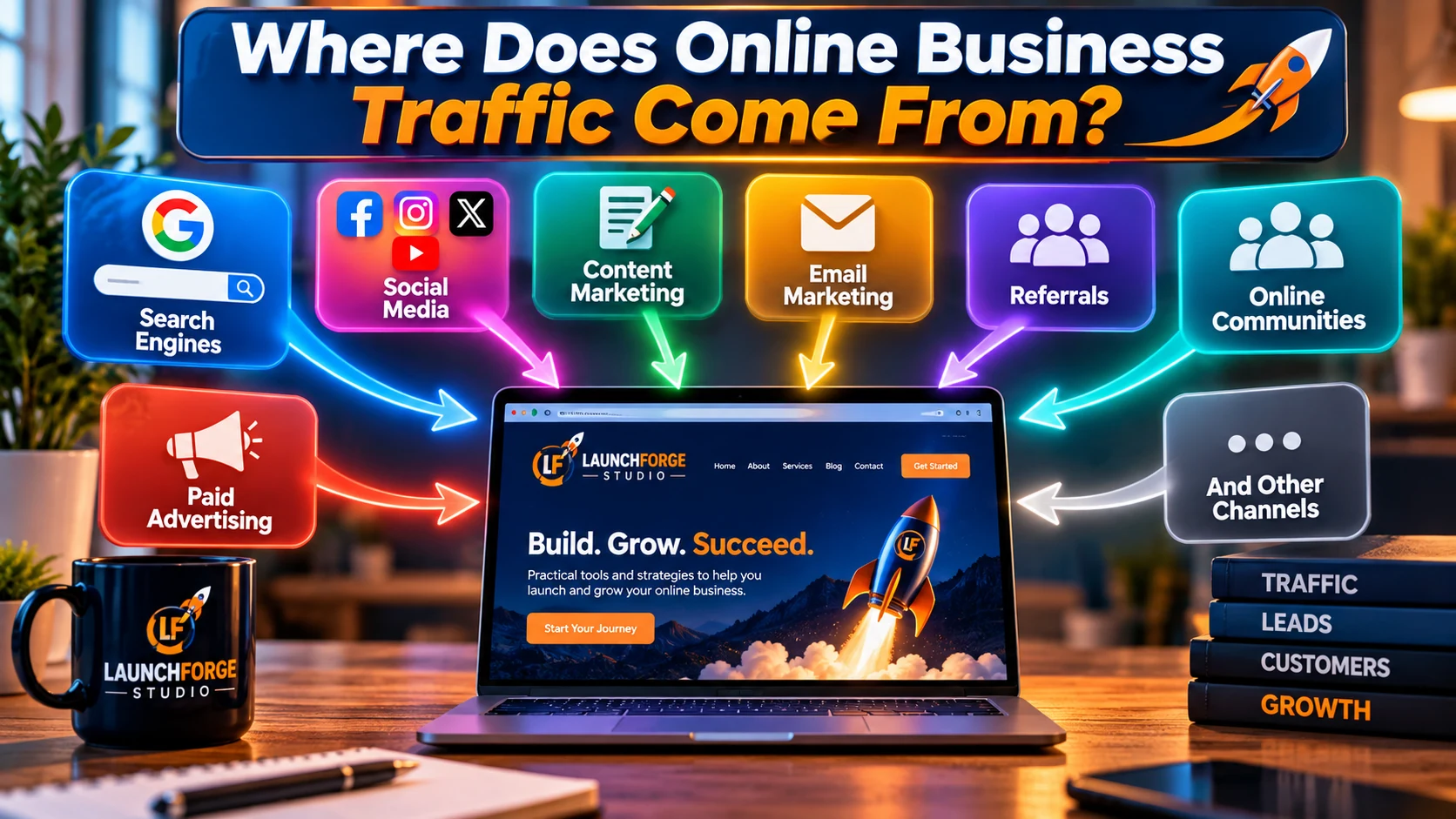
Online business traffic can come from search engines, social media, content marketing, email, referrals, online communities, paid advertising, and other channels.
Once you understand what traffic actually is, the next question is pretty obvious:
Where do these visitors come from?
The short answer is: a lot of different places.
People can discover your online business through search engines, social media, content, email, referrals, online communities, paid advertising, and several other channels.
There isn’t one universal traffic source that works perfectly for every business.
What works for one person may not make sense for another.
Your audience, budget, experience, business model, available time, and goals all play a role in deciding where you should focus.
The good news is that you don’t have to figure out everything at once.
You can start with one or two traffic sources, learn how they work, see what kind of response they generate, and expand from there.
Let’s look at some of the most common ways people find online businesses.
Search Engine Traffic
Search engines can become a valuable source of visitors when your website contains useful information that answers questions people are already searching for.
Someone might search for a problem they’re trying to solve.
They might search for a product they’re considering.
They might search for instructions, comparisons, reviews, or ideas.
If your content provides a useful answer, that person may discover your website through the search results.
This is one reason content and search engine optimization can be powerful long-term strategies.
You’re not simply putting something online and hoping someone happens to find it.
You’re creating resources around topics your audience is already interested in.
The downside is that search traffic usually takes time to build.
A new website shouldn’t expect to publish a handful of articles and immediately receive a flood of visitors from search engines.
SEO is a longer-term strategy.
But once useful content begins attracting search traffic, it can continue bringing visitors without requiring you to pay for every individual click.
Social Media Traffic
Social media is another way people can discover your business.
Platforms such as Facebook, X, Instagram, Threads, LinkedIn, TikTok, and others give businesses opportunities to share information and connect with potential audiences.
You can share articles.
You can publish short educational posts.
You can answer questions.
You can participate in conversations.
You can demonstrate your expertise.
You can introduce people to your brand.
And when someone finds your content useful or interesting, they may decide to visit your website.
Social media can be especially useful when you’re starting out because you can begin creating and sharing content without needing a large advertising budget.
But there is an important distinction to understand.
Having followers isn’t the same thing as having traffic.
A large audience doesn’t automatically mean people will visit your website or become customers.
The goal is to create content that gives people a reason to take the next step.
Content Marketing Traffic
Content marketing overlaps with SEO and social media, but it deserves to be looked at separately.
Content can include blog articles, tutorials, guides, videos, checklists, case studies, reviews, and other useful resources.
The basic idea is simple:
Create something people find useful.
Then give them a way to discover it.
A helpful article might attract someone through Google.
A social media post might introduce someone to that article.
An email might bring an existing subscriber back to your website.
Someone might even share your content with another person who needs the same information.
One piece of useful content can therefore create multiple opportunities for discovery.
That’s one reason building a library of helpful content can become an important part of a long-term traffic strategy.
Email Traffic
Email works a little differently because you’re usually communicating with people who have already given you permission to contact them.
Instead of constantly trying to find new visitors, you can bring existing subscribers back to your website.
You might send an email about a new article.
You might share a helpful tip.
You might introduce a product or service.
You might provide a useful resource.
You might simply continue building the relationship.
This is one of the biggest advantages of building an email list.
You aren’t completely dependent on someone discovering your social media post or finding your website in a search result.
You have another channel for communicating with people who have already shown some level of interest.
Of course, getting people onto your email list requires giving them a good reason to subscribe in the first place.
That’s where lead magnets, useful content, offers, and clear calls to action can become important.
Referral Traffic
Referral traffic happens when someone reaches your website from another website or online source.
For example, another website might mention one of your articles and link to it.
A blogger might recommend your resource.
A business might mention your website to its audience.
Someone might share your content with their own network.
These visitors can be valuable because the person sending them your way has essentially introduced your business to them.
That introduction can provide a level of trust that a completely unfamiliar advertisement may not have.
Building referral traffic usually starts with creating something worth recommending.
If your website consistently provides useful information, resources, tools, or solutions, other people have a reason to share it.
Online Communities
Online communities can also become a source of traffic when approached correctly.
These might include forums, discussion groups, industry communities, Facebook groups, Reddit communities, professional networks, or other places where people gather around a shared interest.
The key word here is participation.
Joining a community simply to drop links to your website everywhere is usually a poor strategy.
People recognize promotional behavior quickly.
Instead, contribute.
Answer questions.
Share useful information.
Help solve problems.
Participate in conversations.
When appropriate, point people toward a resource that genuinely helps with the question they’re asking.
The goal isn’t to walk into a community shouting about your business.
The goal is to become someone people recognize as useful.
That can create opportunities for people to discover your website naturally.
Paid Traffic
Paid traffic is exactly what it sounds like.
You pay for advertising or placement designed to send people toward your website, landing page, funnel, product, or offer.
This can include search advertising, social media advertising, display advertising, sponsored placements, solo ads, and other paid traffic methods.
The biggest advantage is speed.
Instead of waiting for organic traffic to develop, you can potentially put an offer in front of an audience much faster.
But speed comes with a price.
If you’re paying for every click or visitor, you need to pay attention to what happens after that person arrives.
A campaign that generates inexpensive clicks isn’t necessarily a successful campaign.
Those visitors still need to find something relevant when they arrive.
This is why paid traffic should be approached as part of a larger system rather than simply a way to buy visitors.
Direct Traffic and Returning Visitors
Not every visitor will arrive through a search engine, social media post, advertisement, or referral.
Some people will type your website address directly into their browser.
Others may have bookmarked your site.
And some may simply remember your business and return later.
Returning visitors are particularly interesting because they already know something about you.
They may be coming back because they found your content useful.
They may want to continue reading.
They may be considering an offer.
They may be checking for something new.
That means your traffic strategy shouldn’t focus only on getting people through the door once.
You should also think about giving visitors reasons to come back.
How to Choose the Right Traffic Sources for Your Online Business
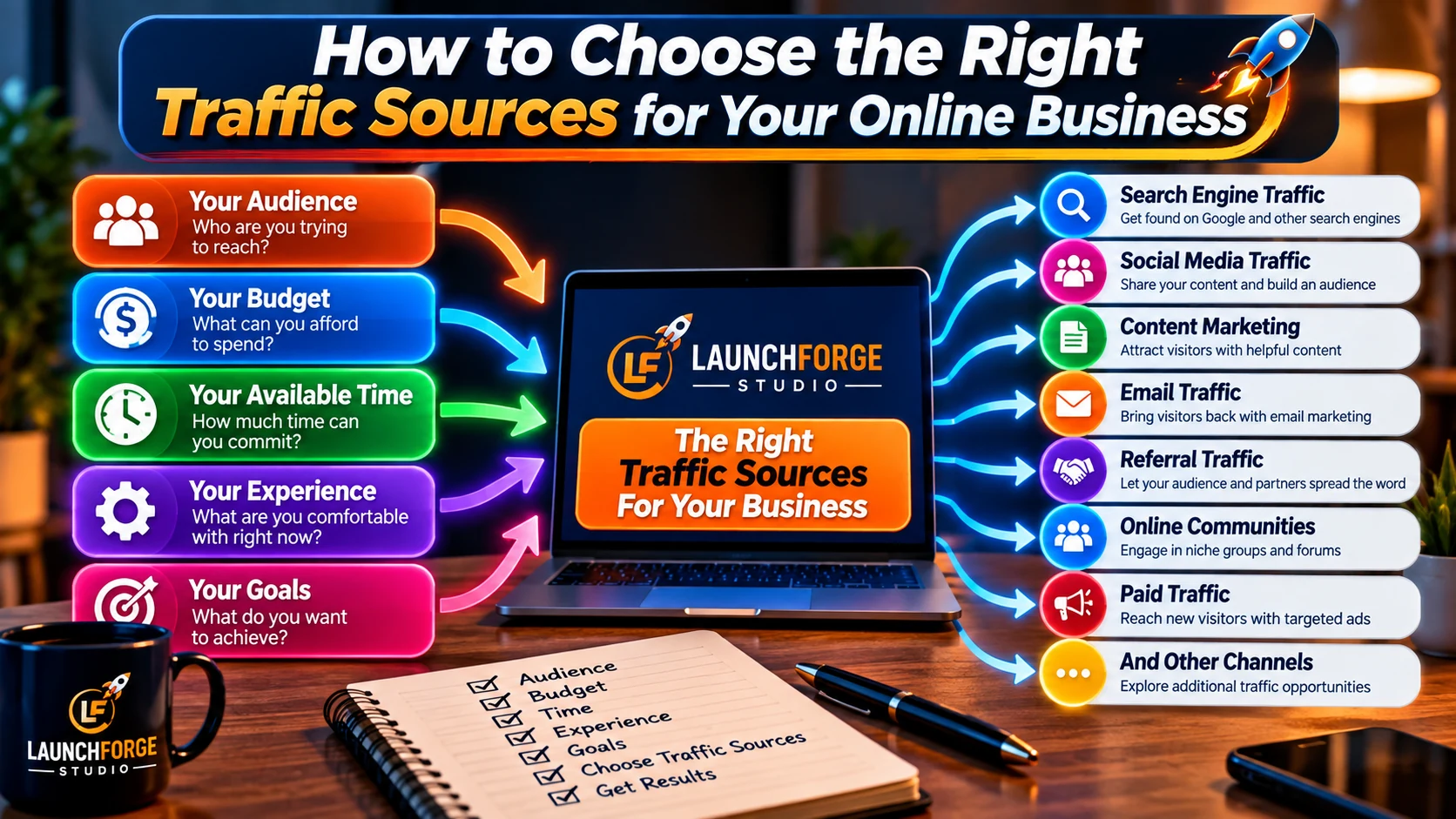
The right traffic sources depend on your audience, budget, available time, experience, and business goals.
Knowing where traffic can come from is useful.
Knowing which traffic sources you should actually spend your time and money on is even more important.
This is where beginners can easily get overwhelmed.
You see someone talking about SEO.
Then someone says social media is the answer.
Someone else tells you to buy paid traffic.
Another marketer swears by email marketing.
Before long, you’re looking at ten different strategies and wondering which one you’re supposed to use.
The answer isn’t to try all of them at once.
The better approach is to evaluate each traffic source based on your own situation.
Start With Your Audience
The first question should always be:
Where does your audience spend time?
If the people you want to reach are actively searching Google for answers, search traffic may deserve attention.
If they’re spending time on social media, social content may be a better starting point.
If they’re already participating in specific communities, those communities may provide opportunities to connect with them.
If they’re responsive to email, building and nurturing an email list may become one of your most valuable assets.
Your audience should influence your traffic strategy.
Don’t choose a traffic source simply because somebody else says it worked for them.
Consider Your Budget
Your budget matters too.
Some traffic strategies require money.
Others primarily require time.
Paid advertising can potentially get your business in front of people quickly, but every campaign costs money.
Organic strategies such as SEO and content marketing may require less direct advertising spend, but they can require considerable time and consistent effort.
Social media can be inexpensive to start, but creating useful content and maintaining a presence still takes work.
The important thing is understanding what you’re actually investing.
“Free traffic” doesn’t necessarily mean free.
You may not be paying for each visitor, but you’re investing your time.
Consider Your Available Time
Time is another resource beginners often overlook.
You may have a full-time job.
You may be building your business around family responsibilities.
You may only have an hour or two each day available for marketing.
That’s completely different from someone who can spend eight hours a day creating content, networking, and managing campaigns.
Choose strategies you can realistically maintain.
A simple traffic strategy you can consistently execute is usually more useful than a complicated strategy you abandon after two weeks.
Think About Speed Versus Longevity
Different traffic sources can produce results on different timelines.
Paid traffic can potentially produce visitors quickly.
Social media content can sometimes generate attention immediately.
Email can reach an existing audience almost instantly.
SEO and content marketing can take much longer to develop.
That doesn’t automatically make one strategy better than another.
It means they serve different purposes.
You may want some traffic sources that can produce shorter-term activity while you’re also building longer-term assets.
The key is understanding what you’re trying to accomplish.
Don’t Build Your Entire Business Around One Traffic Source
Another important consideration is diversification.
If your entire business depends on one traffic source, changes to that source can have a major impact.
Search algorithms change.
Social platforms change their features and algorithms.
Advertising costs change.
Platforms can change their policies.
Audiences can move.
That’s why it’s useful to gradually build multiple ways for people to discover your business.
You don’t need ten traffic sources.
You might start with one or two that make sense and eventually add others as your business grows.
The goal is to create a system that doesn’t collapse if one source slows down.
Match the Traffic Source to the Goal
Not all traffic needs to accomplish the same thing.
Sometimes you want people to discover your brand.
Sometimes you want them to read an article.
Sometimes you want them to join your email list.
Sometimes you want them to register for something.
Sometimes you want them to purchase.
Sometimes you simply want to start a relationship.
That means the traffic source should make sense for the action you’re asking the visitor to take.
For example, someone searching for a specific problem may be an excellent visitor for an educational article.
Someone who already knows your business may be more likely to respond to an email.
Someone seeing a targeted advertisement may need a focused landing page before they’re ready to take the next step.
Think about the entire journey rather than looking at traffic in isolation.
The Traffic Source Is Only One Part of the System
This is one of the most important concepts in online marketing.
Traffic doesn’t operate by itself.
You have the traffic source.
Then you have the destination.
Then you have what happens after the visitor arrives.
A person might click an advertisement and land on a page.
That page needs to make sense.
The visitor needs to understand what they’re looking at.
They need a reason to continue.
They may need an opportunity to become a lead.
They may need additional information before they’re ready to make a decision.
If those pieces aren’t connected, simply increasing traffic won’t necessarily solve the problem.
You may just end up sending more people into a broken process.
Build the Destination Before You Scale the Traffic
Before increasing traffic, make sure the destination is ready.
That might be your website.
It might be a landing page.
It might be a lead capture page.
It might be a sales funnel.
Whatever the destination is, it should support the next step you want the visitor to take.
This doesn’t mean everything has to be perfect.
Your website can improve over time.
Your pages can be tested.
Your messaging can become clearer.
Your calls to action can be adjusted.
But there should be a solid foundation before you start pouring more traffic into the system.
Measure What Happens After the Click
One of the easiest mistakes to make is measuring only the number of visitors.
Traffic numbers are useful.
But they don’t tell the entire story.
You should also pay attention to what those visitors do.
Do they stay on the page?
Do they visit another page?
Do they join your email list?
Do they download something?
Do they contact you?
Do they purchase?
Do they come back?
Those actions tell you much more about the quality of your traffic.
A traffic source that sends fewer visitors but produces more leads may be more valuable than one that sends enormous numbers of visitors who immediately leave.
Give Each Traffic Source Time to Teach You Something
Another mistake is giving up too quickly.
You try a traffic source for a few days.
You don’t see a flood of visitors.
You decide it doesn’t work.
But meaningful results often require consistency.
You need enough activity to identify patterns.
You need to see what type of content gets attention.
You need to see which messages generate clicks.
You need to understand which visitors actually engage.
That doesn’t mean you should blindly continue something that clearly isn’t working.
It means you should give your strategy enough time and activity to produce useful information before making a decision.
Start Small and Build From There
You don’t need a massive traffic operation to get started.
In fact, starting smaller can make the process easier.
Choose a traffic source.
Learn how it works.
Create useful content or campaigns.
Send people to a clear destination.
Measure what happens.
Make improvements.
Then repeat the process.
Once you understand what’s working, you can gradually increase your effort.
That’s a much more manageable approach than trying to master every marketing channel at the same time.
10 Practical Strategies to Get Your First 100 Website Visitors
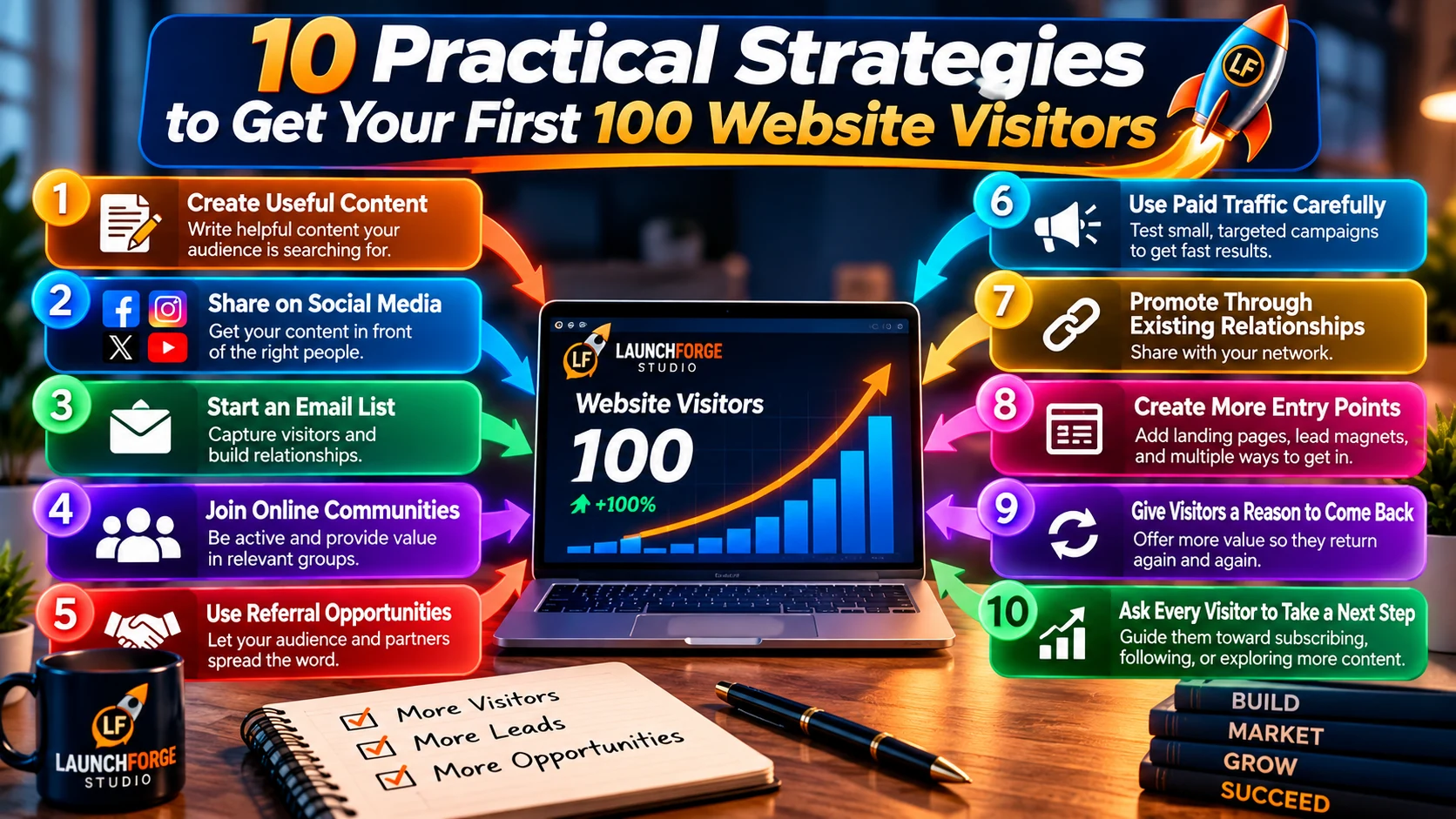
Ten practical ways beginners can start attracting their first 100 website visitors and turn that traffic into future growth.
Now we get to the part you’ve probably been waiting for.
You understand what traffic is.
You know where traffic can come from.
You understand why the right traffic matters.
And you know that you don’t need to master every traffic source at the same time.
So how do you actually start getting visitors?
The good news is that your first 100 visitors don’t require a massive audience, an enormous advertising budget, or some secret marketing trick.
They require action.
You need to put your business in places where people can discover it, give those people a reason to visit, and make sure your website gives them somewhere useful to go once they arrive.
Here are ten practical strategies you can use to start building that first wave of traffic.
1. Create Useful Content Around What Your Audience Is Searching For
One of the simplest ways to begin attracting visitors is to create content that answers questions your audience is already asking.
Think about the problems your potential visitors are trying to solve.
What are they searching for?
What are they confused about?
What information would make their lives easier?
What mistakes are they trying to avoid?
Those questions can become the foundation for your content.
For example, if you’re building a website for people who want to start an online business, you could create articles about choosing a niche, building a website, generating leads, creating landing pages, getting traffic, or understanding online marketing.
You’re not creating content simply because you need something to publish.
You’re creating resources that give people a reason to discover your business.
Over time, those resources can attract visitors through search engines, social media, email, referrals, and other channels.
2. Share Your Content on Social Media
Creating useful content is only half the job.
You also need to put it where people can see it.
Social media gives you an opportunity to introduce your content to potential visitors without waiting for them to discover it through search.
Share your articles.
Break larger topics into shorter posts.
Ask questions.
Share useful tips.
Explain common mistakes.
Start conversations.
Then give people a logical reason to visit your website when the full information is available there.
Don’t assume that publishing something once means everyone has seen it.
Social feeds move quickly.
Your audience may not have been online when you shared the post.
That means useful content can often be repurposed and shared again in different ways.
3. Start Building an Email List
If someone visits your website and leaves, you may never see that person again.
Unless you give them a reason to stay connected.
That’s where an email list becomes valuable.
Give visitors a useful reason to subscribe.
That might be a checklist, guide, resource, tutorial, email course, or another piece of content that solves a problem for them.
Once someone joins your list, you have another way to communicate with them.
You can share new articles.
You can provide useful information.
You can introduce relevant offers.
You can bring people back to your website.
You’re no longer relying entirely on finding that person again through a search engine or social media post.
4. Participate in Relevant Online Communities
Find communities where your target audience already spends time.
Then participate.
Answer questions.
Help people.
Share useful information.
Become part of the conversation.
If someone asks a question that one of your articles genuinely answers, you may have an opportunity to point them toward that resource.
But don’t turn every interaction into an advertisement.
People can tell when someone has joined a community solely to promote something.
The goal is to become useful first.
Traffic can follow naturally when people begin recognizing that you have something valuable to contribute.
5. Use Referral Opportunities
Think about who already has access to the audience you want to reach.
Could another website benefit from mentioning your content?
Could you contribute an article somewhere else?
Could you collaborate with another creator?
Could someone recommend your resource?
Could your content provide useful information for another audience?
Referral traffic doesn’t always happen automatically.
Sometimes you need to create relationships and give people a reason to share what you’ve built.
That starts with making your website worth recommending.
6. Use Paid Traffic Carefully
If you have a budget, paid traffic can help you get visitors faster.
But don’t treat paid traffic like a magic button.
Before spending money, know exactly where those visitors are going.
Make sure the page is relevant to the advertisement.
Make sure the offer is understandable.
Make sure the visitor has a clear next step.
And most importantly, know what you’re trying to accomplish.
If you’re paying for traffic but have no way to measure what happens after someone clicks, you’re essentially buying visitors without knowing whether they’re helping your business.
Start small.
Test.
Measure.
Learn.
Then decide whether increasing the budget makes sense.
7. Promote Your Website Through Existing Relationships
You may already know people who could benefit from what you’re building.
Friends, professional contacts, business relationships, customers, colleagues, and other connections may already be interested in your subject.
That doesn’t mean you should spam everyone you know with your website.
Instead, look for legitimate opportunities to introduce your business.
If someone asks what you’re working on, tell them.
If someone needs information you’ve created, share it.
If someone is looking for a solution you provide, point them toward the appropriate page.
Sometimes your first visitors are closer than you think.
8. Create More Than One Entry Point
Don’t assume every visitor needs to land on your homepage.
Different people will discover your business through different pieces of content.
Someone might find a blog article through Google.
Another person might discover a landing page through social media.
Someone else might click an email link.
Another visitor might arrive through a referral.
Each of these can become an entry point into your business.
That’s why creating useful pages and resources around different topics can expand the number of ways people can discover you.
Your website becomes less like a single front door and more like a building with multiple entrances.
9. Give Visitors a Reason to Come Back
Getting someone to visit once is good.
Giving them a reason to return is even better.
Publish new content.
Update existing resources.
Create useful follow-up information.
Send emails when you have something worthwhile to share.
Build a collection of resources that people can continue exploring.
The more useful your website becomes, the more reasons people have to return.
And returning visitors can become increasingly valuable because they’re no longer complete strangers to your business.
They’ve already seen what you do.
They’ve already experienced your content.
They may already have some level of trust.
10. Ask Every Visitor to Take a Useful Next Step
This final strategy ties everything together.
Getting someone to your website shouldn’t be the end of the process.
It should be the beginning.
When someone arrives, give them somewhere useful to go next.
That might mean reading another article.
Joining your email list.
Checking out a guide.
Exploring your services.
Learning about a product.
Watching a training.
Contacting you.
The next step doesn’t always have to be a purchase.
Sometimes the best conversion is simply keeping the relationship moving forward.
That’s how a visitor can become a subscriber.
A subscriber can become a lead.
A lead can become a customer.
And a customer can become someone who continues doing business with you.
Your first 100 visitors aren’t just a number.
They’re the beginning of that process.
Make the Most of Your First 100 Visitors
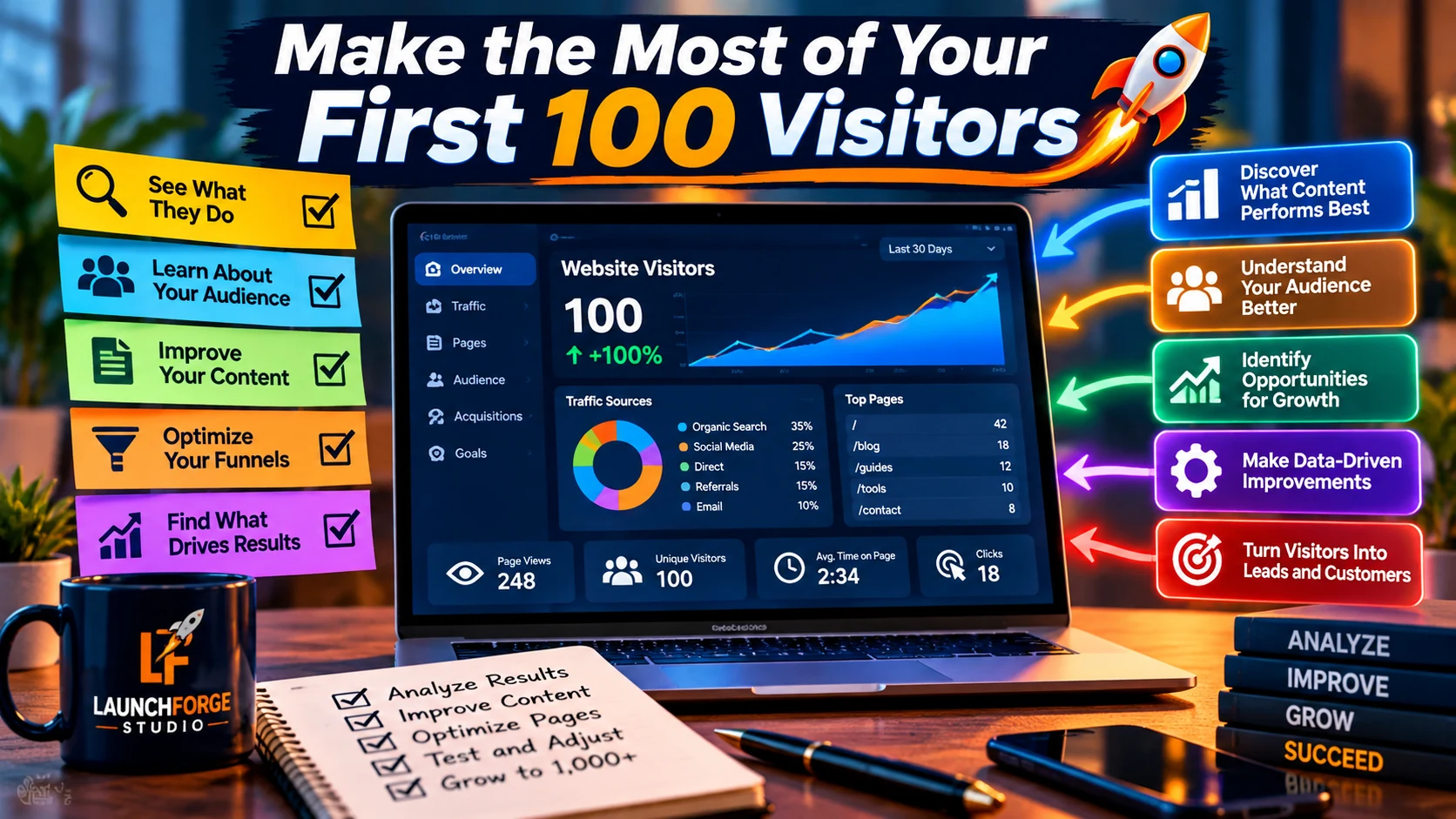
Your first 100 visitors can reveal what is working, what needs improvement, and where your next opportunities for growth may be.
Getting your first 100 website visitors is an accomplishment.
But don’t make the mistake of thinking the job is finished once the counter reaches 100.
Those first visitors can give you information that is far more valuable than the number itself.
They can help you understand which traffic sources are working.
They can show you which pages people are interested in.
They can reveal whether your messaging is connecting with your audience.
And they can help you identify what needs to be improved before you start trying to attract your next 1,000 visitors.
Pay Attention to Where Your Visitors Come From
Start by looking at your traffic sources.
Did people find you through Google?
Did they click from social media?
Did they come from an email?
Did another website send them your way?
Did they arrive through a paid advertisement?
Knowing where your visitors came from helps you understand which activities are actually producing results.
You may discover that one traffic source is sending most of your visitors.
You may also discover that another source is sending fewer visitors but producing people who spend more time on your website.
Both pieces of information are useful.
Don’t automatically assume the source sending the most traffic is the best source.
Look at What Visitors Do on Your Website
Getting someone to your website is only the first step.
Now pay attention to what happens after they arrive.
Which pages do they visit?
Which articles get the most attention?
Do people click through to other pages?
Are visitors joining your email list?
Are they contacting you?
Are they checking out your products or services?
Are they leaving immediately?
These behaviors can tell you whether your website is giving visitors what they expected when they clicked.
If people are arriving but immediately leaving, that may be a sign that your page needs improvement.
If people are reading several articles and exploring your website, that’s a different signal.
Your first 100 visitors can help you identify those patterns.
Use What You Learn to Improve Your Website
Don’t look at your first 100 visitors simply as people who came and went.
Look at them as feedback.
Maybe your homepage needs a clearer message.
Maybe an article needs a stronger call to action.
Maybe your navigation could be easier to understand.
Maybe visitors need more information before they’re ready to take the next step.
Maybe one particular topic is getting significantly more attention than everything else you’ve published.
These discoveries can help you make smarter decisions.
Instead of guessing what your audience wants, you’re beginning to learn from actual behavior.
Don’t Chase Perfection Before You Start
There’s another lesson worth remembering.
Your website doesn’t need to be perfect before you start bringing visitors to it.
If you wait until everything is absolutely perfect, you may never launch.
Your website will change.
Your content will improve.
Your messaging will evolve.
Your audience will teach you things you couldn’t have known beforehand.
That’s part of building an online business.
The important thing is to make sure your website is useful, functional, understandable, and ready to serve the people you’re trying to reach.
Then start learning from the people who actually show up.
Your First 100 Visitors Are Data
This is one of the biggest mindset shifts a new business owner can make.
Don’t look at your first 100 visitors as simply 100 people who clicked something.
Look at them as 100 opportunities to learn.
Every visitor can provide another piece of information.
Where did they come from?
What interested them?
What did they click?
What made them stay?
What made them leave?
Did they take the next step?
The more you learn, the better you can make your website and marketing.
And that’s how you begin moving from simply getting traffic to building a traffic system.
Common Mistakes That Can Keep You From Reaching 100 Visitors
Getting your first 100 website visitors isn’t necessarily difficult because there aren’t enough ways to get traffic.
In many cases, the problem is that beginners make the process harder than it needs to be.
They jump between strategies.
They chase quick fixes.
They focus on numbers instead of people.
Or they spend so much time looking for the perfect traffic source that they never consistently work the ones they already have.
Here are some of the most common mistakes to watch out for.
Trying Every Traffic Source at Once
When you first start learning about online marketing, every traffic source can sound like the answer.
SEO sounds great.
Social media sounds great.
Paid advertising sounds great.
Email sounds great.
Online communities sound great.
Before long, you’ve created a giant list of things you think you need to do every day.
That’s a recipe for burnout.
You don’t need to master every traffic source to get your first 100 visitors.
Choose one or two strategies that make sense for your audience and your situation.
Learn them.
Use them consistently.
Measure the results.
Then expand when you have a reason to do so.
Chasing Numbers Instead of Relevant Visitors
It’s easy to get excited when you see your traffic numbers increasing.
But remember what we covered earlier:
More traffic isn’t automatically better traffic.
A thousand visitors who have no interest in your business may accomplish less than 100 visitors who genuinely want what you’re providing.
Don’t become obsessed with getting the biggest possible number.
Pay attention to whether you’re attracting people who have a legitimate reason to visit your website.
Relevant traffic gives you something to build on.
Sending Traffic to an Unprepared Website
This is one of the easiest mistakes to make.
You discover a traffic strategy that works, start getting visitors, and then realize your website isn’t ready for them.
Maybe your homepage doesn’t clearly explain what you do.
Maybe your navigation is confusing.
Maybe your pages take too long to load.
Maybe your mobile experience is frustrating.
Maybe your links don’t work.
Maybe there isn’t an obvious next step.
Traffic can’t fix those problems.
In fact, sending more visitors to an unprepared website can simply expose those problems to more people.
Before you start aggressively promoting your website, take the time to make sure the basics are working.
Giving Up Too Quickly
Not every traffic strategy produces immediate results.
SEO can take time.
Content can take time to gain traction.
Social media audiences take time to build.
Relationships and referrals take time.
Even paid traffic requires testing before you know what works.
That doesn’t mean you should continue doing something forever when it clearly isn’t producing results.
It means you need enough consistency and information to make an informed decision.
Give a strategy a fair opportunity.
Measure what happens.
Make adjustments.
Then decide whether to continue, change your approach, or move on.
Never Measuring What Happens
If you’re not measuring your traffic, you’re mostly guessing.
You need to know where visitors are coming from and what they’re doing once they arrive.
Otherwise, how will you know which activities deserve more of your time?
You don’t need an incredibly complicated analytics system to begin learning.
Start with the basics.
Look at your traffic sources.
Look at your most visited pages.
Pay attention to engagement.
Track leads and other meaningful actions.
Then use what you learn to make better decisions.
Constantly Chasing the Next Traffic Trick
There’s always another traffic strategy.
Another platform.
Another tool.
Another “secret.”
Another person claiming they’ve discovered the fastest way to get visitors.
If you constantly jump from one tactic to another, you’ll spend more time learning about traffic than actually generating it.
Don’t let the search for the next big thing keep you from using strategies that already make sense for your business.
Consistency isn’t nearly as exciting as a secret traffic hack.
But consistency can be a lot more useful.
Focusing Only on Getting the Click
A click isn’t the same thing as a relationship.
Someone can click your link and leave five seconds later.
They can visit one page and never return.
They can arrive expecting one thing and discover something completely different.
That’s why your job doesn’t end when someone clicks.
Your website, landing page, content, offer, and call to action all need to work together.
Getting the visitor is important.
Giving that visitor a good reason to stay is just as important.
Expecting Free Traffic to Require No Work
Free traffic can be extremely useful.
But “free” doesn’t mean effortless.
You may not pay for every visitor, but you may invest hours creating content, answering questions, participating in communities, building relationships, posting on social media, and optimizing your website.
That’s still an investment.
The advantage is that your investment can create assets that continue working for you.
A useful article can continue attracting visitors.
A helpful resource can continue getting shared.
An email list can continue bringing people back.
A strong relationship can continue producing referrals.
Understand what you’re investing, and choose strategies that fit the resources you actually have available.
What to Do After You Reach Your First 100 Visitors
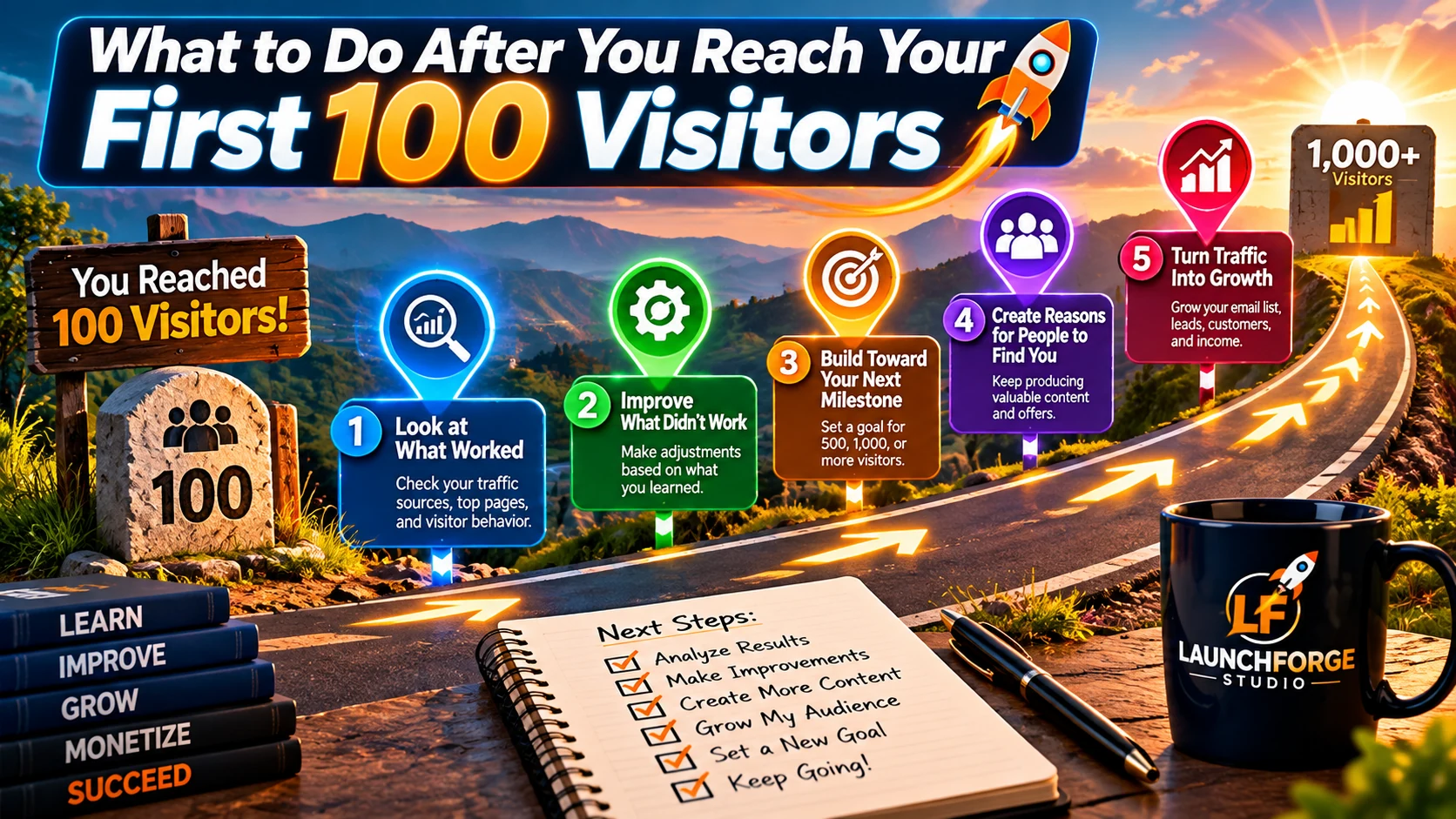
Your first 100 visitors are a starting point—learn what worked, make improvements, and use what you discover to build toward your next milestone.
Reaching your first 100 website visitors is worth celebrating.
But don’t stop there.
The real value of reaching that milestone is what you do with everything you’ve learned along the way.
By the time you reach 100 visitors, you should have some early clues about your audience, your content, your traffic sources, and your website.
Now you can use those clues to make your next 100 visitors easier to get.
Look at What Worked
Go back and examine how those first visitors found you.
Which traffic sources produced the most visitors?
Which ones produced the most engaged visitors?
Did a particular article attract more attention than others?
Did one social media post outperform the rest?
Did an email generate clicks?
Did another website or person send visitors your way?
You don’t need to treat your first 100 visitors as a massive scientific study.
You’re simply looking for patterns.
If something worked, ask yourself why.
Then look for ways to do more of it.
Improve What Didn’t Work
Not everything you try is going to work.
That’s normal.
Maybe a particular social platform produced very little activity.
Maybe an article received very few visitors.
Maybe a landing page didn’t generate the response you expected.
Maybe you spent time on a traffic source that simply wasn’t a good fit for your audience.
Instead of viewing those results as failures, use them as information.
Ask what you could change.
Maybe the message needs improvement.
Maybe the content isn’t addressing the right problem.
Maybe you’re reaching the wrong audience.
Maybe the traffic source simply isn’t a good fit.
Learning what doesn’t work can save you just as much time as discovering what does.
Build Toward Your Next Milestone
Once you’ve reached 100 visitors, your next goal might be 500.
Then perhaps 1,000.
But don’t become obsessed with hitting an arbitrary number.
The point of each milestone is to give you another opportunity to learn and improve.
Your website should become more useful.
Your content should become stronger.
Your marketing should become more focused.
Your traffic sources should become easier to identify and manage.
Your conversion process should become clearer.
Growth should be the result of improving the system rather than simply chasing a bigger number.
Keep Creating Reasons for People to Find You
Your website should continue growing alongside your audience.
Keep creating useful content.
Keep improving older articles.
Keep sharing your resources.
Keep building relationships.
Keep giving people reasons to return.
Every useful piece of content creates another potential entry point into your business.
Every helpful interaction creates another opportunity for someone to discover you.
And every visitor gives you another chance to learn what your audience actually wants.
That’s how a website can gradually move from having its first few visitors to building a steady stream of traffic.
Don’t Forget About the People Who Already Found You
While you’re working to attract new visitors, don’t overlook the people you’ve already reached.
Someone who visited your website once may be interested in hearing from you again.
That’s why email lists, useful content, follow-up, and returning visitors matter.
You don’t want to spend all your energy constantly finding new people while ignoring everyone who has already shown interest.
Building an audience isn’t just about acquisition.
It’s also about creating enough value that people want to stay connected.
Your First 100 Can Become the Foundation for Much More
The first 100 visitors may seem small compared with the traffic numbers you see other websites reporting.
Don’t let that discourage you.
Every established website had to start somewhere.
Your first visitor mattered.
Your tenth visitor mattered.
Your first 100 matter.
They represent the beginning of a process that can become much larger over time.
The objective isn’t to prove that you can get exactly 100 people to visit your website.
It’s to learn how to consistently attract the right people, give them something useful, and create a reason for them to continue the relationship.
Once you understand that process, you’re no longer simply trying to get traffic.
You’re learning how to build an audience.
Ready to Build Your Online Business?
Getting your first 100 website visitors is an important milestone.
But as you’ve seen throughout this guide, traffic is only one part of building an online business.
You need somewhere to send those visitors.
You need useful content and pages that give them a reason to stay.
You need ways to turn interested visitors into leads.
You need follow-up.
You need marketing tools.
And eventually, you need systems that can help you manage all of those moving pieces without making your business unnecessarily complicated.
You Don’t Need to Build Everything From Scratch
One of the biggest challenges for beginners isn’t necessarily learning how to get traffic.
It’s figuring out how all the other pieces fit together.
You may need a website.
You may need landing pages.
You may need funnels.
You may need email marketing.
You may need automation.
You may need lead generation tools.
You may need ways to manage contacts and follow up with people who show interest.
Trying to find, purchase, learn, and connect every tool separately can quickly become overwhelming.
That’s one of the reasons I chose Profit Hub System as the platform behind LaunchForge Studio.
It brings many of the tools needed to build, market, and grow an online business together in one system.
Build the Foundation Before You Chase Bigger Numbers
Remember what we talked about earlier.
Getting 100 visitors isn’t the finish line.
It’s the beginning.
As your traffic grows, the systems behind your website become increasingly important.
You don’t want to wait until you’re getting thousands of visitors to realize that your website isn’t prepared to handle them.
Build the foundation.
Create useful content.
Give visitors a clear next step.
Capture leads.
Follow up.
Measure what happens.
Then keep improving.
That’s how you turn traffic into something more valuable than a number in an analytics report.
Your Next 100 Visitors Can Be Different
Your first 100 visitors teach you.
Your next 100 can benefit from what you learned.
You may discover which content attracts the most attention.
You may identify your strongest traffic sources.
You may improve your calls to action.
You may build a better email follow-up process.
You may create additional resources for the questions your audience keeps asking.
Every improvement can make the next stage of your business stronger.
And that’s the real lesson behind getting your first 100 website visitors.
Don’t simply chase traffic.
Build a system that knows what to do with it.
See What Profit Hub System Can Do for Your Online Business
If you’re ready to move beyond simply trying to get your first visitors and start building a more complete online business system, take a closer look at Profit Hub System.
It’s the platform I use as the foundation for LaunchForge Studio, and it’s designed to bring many of the tools needed to build, market, and grow an online business together in one place.
Instead of trying to piece everything together from separate services, you can explore a platform built around the different parts of running an online business.
If you’re looking for a place to build your website, create funnels, manage leads, market your business, and develop the systems behind your traffic, take a look at Profit Hub System and see what it can do for you.
Traffic gets people through the door.
Your system gives them a reason to stay.
Final Thoughts: Your First 100 Visitors Are Just the Beginning
Getting your first 100 website visitors can feel like a huge challenge when you’re starting an online business.
And honestly, it can be.
You’re starting with a website that may have very little traffic, very little visibility, and an audience that doesn’t know you yet.
But those first visitors matter.
They give you something you didn’t have before.
Data.
Experience.
Feedback.
And, most importantly, momentum.
You begin to learn what happens when real people discover your business.
You learn which pages attract attention.
You learn which topics people care about.
You learn which traffic sources actually send visitors.
You learn where people leave.
You learn what makes someone click.
And you learn what gives someone a reason to come back.
That’s far more valuable than simply watching a visitor counter increase.
Getting your first 100 website visitors isn’t about proving that you can generate a huge amount of traffic.
It’s about proving that you can create a repeatable process for getting people to your website.
Start with one traffic source.
Learn how it works.
Give people something worth visiting.
Pay attention to what happens.
Then improve.
Once you understand that process, you can begin adding other traffic sources without turning your business into a confusing collection of disconnected marketing activities.
Your first 100 visitors can become the foundation for your next 1,000.
But don’t rush past the lessons those first visitors can teach you.
Some of them may become customers.
Some may join your email list.
Some may read several articles and come back later.
Some may simply visit once and disappear.
That’s normal.
Your job isn’t to force every visitor to become a customer.
Your job is to build a business that gives the right people a reason to stay, return, and eventually take the next step.
Traffic is important.
But traffic is only the beginning.
The real opportunity comes from what you do after people arrive.
If your website is useful, your content answers questions, your offers make sense, and your visitors have a clear next step, you’re building something much more valuable than a website that simply receives clicks.
You’re building a system.
And systems can improve.
Your first 100 visitors don’t have to be perfect.
Your website doesn’t have to be perfect.
Your marketing doesn’t have to be perfect.
You don’t have to know everything before you begin.
You simply need to start paying attention.
Find out who you’re trying to reach.
Create something useful for those people.
Choose traffic sources that make sense for your audience.
Give visitors a reason to click.
Give them a reason to continue.
Measure what happens.
Then make the next version better.
That’s how an online business grows.
Not necessarily through one massive breakthrough.
But through a series of small improvements that build on each other.
Your first 100 visitors are therefore more than a number.
They’re the beginning of the learning process.
They’re the beginning of your data.
They’re the beginning of your audience.
And they can be the beginning of something much bigger.
So don’t get discouraged if your website doesn’t suddenly explode with traffic.
Don’t assume your business is failing because you’re not getting thousands of visitors.
And don’t spend money on every traffic source you encounter simply because someone promises instant results.
Build deliberately.
Learn continuously.
Focus on the right people.
And remember what we’ve been talking about throughout this guide:
Traffic gets people through the door. Your business gives them a reason to stay.
Your first 100 visitors are just the beginning.