
Google is making another significant change to how people discover websites through AI-powered search. And for small website owners, bloggers, and independent content creators, the timing couldn’t be more interesting.
On October 15, 2026, Google announced new updates designed to make website links more visible within AI Overviews and AI Mode. The changes include more prominent links, improved ways to discover related content, and additional opportunities for publishers and creators to appear in AI-powered search experiences.
On the surface, that sounds like encouraging news.
After all, website owners have spent years creating helpful content, optimizing pages for search engines, and working to attract visitors through Google. But as AI-generated answers become a larger part of the search experience, an important question has emerged:
If Google answers someone’s question directly, will that person still have a reason to visit the website that helped provide the information?
That’s the challenge behind the latest Google AI Search changes.
Research has already raised concerns about how AI-generated summaries affect website traffic. A 2025 Pew Research Center study found that users were less likely to click traditional search results when an AI summary appeared.
Now Google is introducing changes intended to make links easier to discover within its AI search experiences.
But there’s a difference between making a website link more visible and convincing someone to click it.
And for small website owners, that difference matters.
At LaunchForge Studio, we’re building our own growing library of educational content designed to help beginners start and grow online businesses. Like many independent publishers, we understand how much work goes into researching, writing, optimizing, and maintaining useful website content.
That’s why this development deserves more than another dramatic headline claiming that artificial intelligence is either saving or destroying SEO.
In this article, we’ll examine what Google announced, why these changes matter, what existing research tells us about AI search and website traffic, and what smaller website owners can realistically do moving forward.
Because the real question isn’t simply whether Google is adding more links to AI-generated answers.
It’s whether those links will help independent websites reach the people they’re working so hard to serve.
Google Just Changed How Links Appear in AI Search
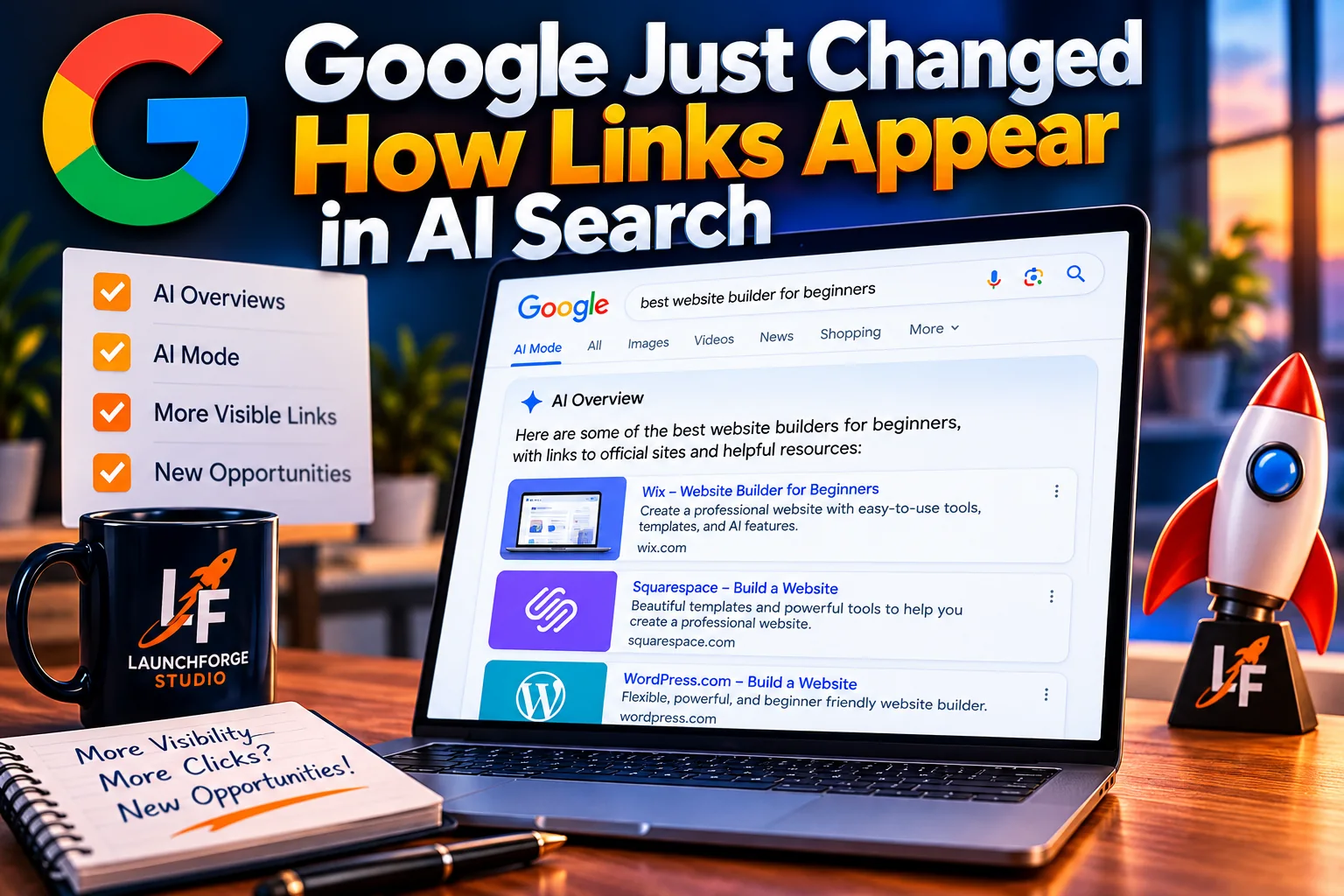
Google’s latest AI Search updates aim to make website links more visible within AI-powered search experiences.
For years, Google Search followed a relatively familiar pattern. Someone entered a question, Google displayed a collection of relevant websites, and users clicked through to the pages they believed would provide the best answers.
That relationship helped businesses, bloggers, publishers, and independent website owners attract visitors by creating content that matched what people were searching for.
Artificial intelligence has been changing that experience.
With AI Overviews and AI Mode, Google can now provide generated answers directly within its search environment. Instead of immediately choosing a website from a list of results, users may receive a summarized explanation that combines information from multiple sources.
For searchers, this can make finding information faster and more convenient.
For website owners, however, it introduces a different challenge.
When someone gets the answer they need without leaving Google, the websites contributing useful information may receive fewer opportunities to earn a visit.
Google’s latest announcement addresses part of that concern by introducing changes intended to make links to websites more noticeable and accessible within AI-powered search results.
But understanding what these changes actually accomplish requires looking beyond the announcement itself.
What Google Announced on October 15, 2026
On October 15, 2026, Google announced several updates to the way users discover websites, articles, publishers, and creators through its AI-powered search experiences.
The announcement, titled More ways to connect with the web from Search, outlined changes involving AI Overviews, AI Mode, news content, and creator discovery.
One of the central themes was making it easier for people to move from an AI-generated response to the original websites and resources that offer additional information.
Among the announced developments were:
- More prominent website links: Google is making certain links within AI-generated answers easier to notice, including displaying them more prominently within responses.
- Highlighted official websites: Google is experimenting with dedicated ways to surface official websites relevant to a user’s search.
- Expanded news discovery: News carousels and related discovery features are being expanded to help people find timely reporting and relevant publishers.
- Improved visibility for related articles: Google is exploring more noticeable presentations of supporting articles and website content, including visual elements.
- Additional creator discovery opportunities: New experiments aim to help users discover creators and their associated content more easily.
These developments suggest that Google recognizes the importance of connecting AI-generated answers with the broader web.
However, there is an important distinction between an announced feature, an experiment, and a change that has already reached every Google Search user.
Not every feature described in the announcement should be interpreted as a completed worldwide rollout.
Some changes are being introduced or tested, and their eventual impact may vary depending on the search experience, the type of query, and how users interact with the results.
For website owners, that means the announcement is worth paying attention to, but it is not yet proof that organic traffic will increase.
Google’s official announcement provides the details behind these developments:
Source: Google — More ways to connect with the web from Search
https://blog.google/products-and-platforms/products/search/updates-ai-mode-overviews-explore-web/
Why Google Is Making These Changes
The growth of AI-powered search has created a balancing challenge.
On one side are people who want quick, useful answers without having to visit several websites.
On the other are the publishers, businesses, educators, and independent creators who invest time and resources into producing the information people search for.
Google needs its search experience to remain useful to both groups.
If AI-generated answers become increasingly capable of satisfying searches without encouraging further exploration, website owners may have fewer opportunities to attract visitors through traditional organic search.
That possibility matters because many independent websites depend on search traffic to introduce their content, products, services, and educational resources to new audiences.
A beginner-friendly website might spend hours producing a useful article explaining how to build a landing page, create an email list, or choose an online business platform.
If someone receives a sufficient summary directly in Google Search, they may never discover the full article.
That doesn’t necessarily mean the website’s information lacks value. It means the way people encounter and consume information is evolving.
Google’s latest changes appear intended to make exploring the original sources a more visible part of the AI search experience.
More noticeable links could encourage users to investigate topics further, compare information, discover relevant businesses, or explore resources beyond an initial AI-generated answer.
For certain searches, that additional visibility could be useful.
Someone researching an online business platform, for example, might appreciate a quick AI-generated explanation but still want to visit individual websites to compare features, examine pricing, read detailed reviews, or evaluate the available tools.
Those deeper decisions often require information that a short summary cannot fully provide.
However, increased link visibility does not automatically guarantee increased traffic.
The outcome depends on whether users have a meaningful reason to click.
And that brings us to the most important part of this story:
What exactly is Google changing inside AI Overviews and AI Mode, and which of those changes could create new opportunities for smaller websites?
Five Changes Coming to AI Overviews and AI Mode
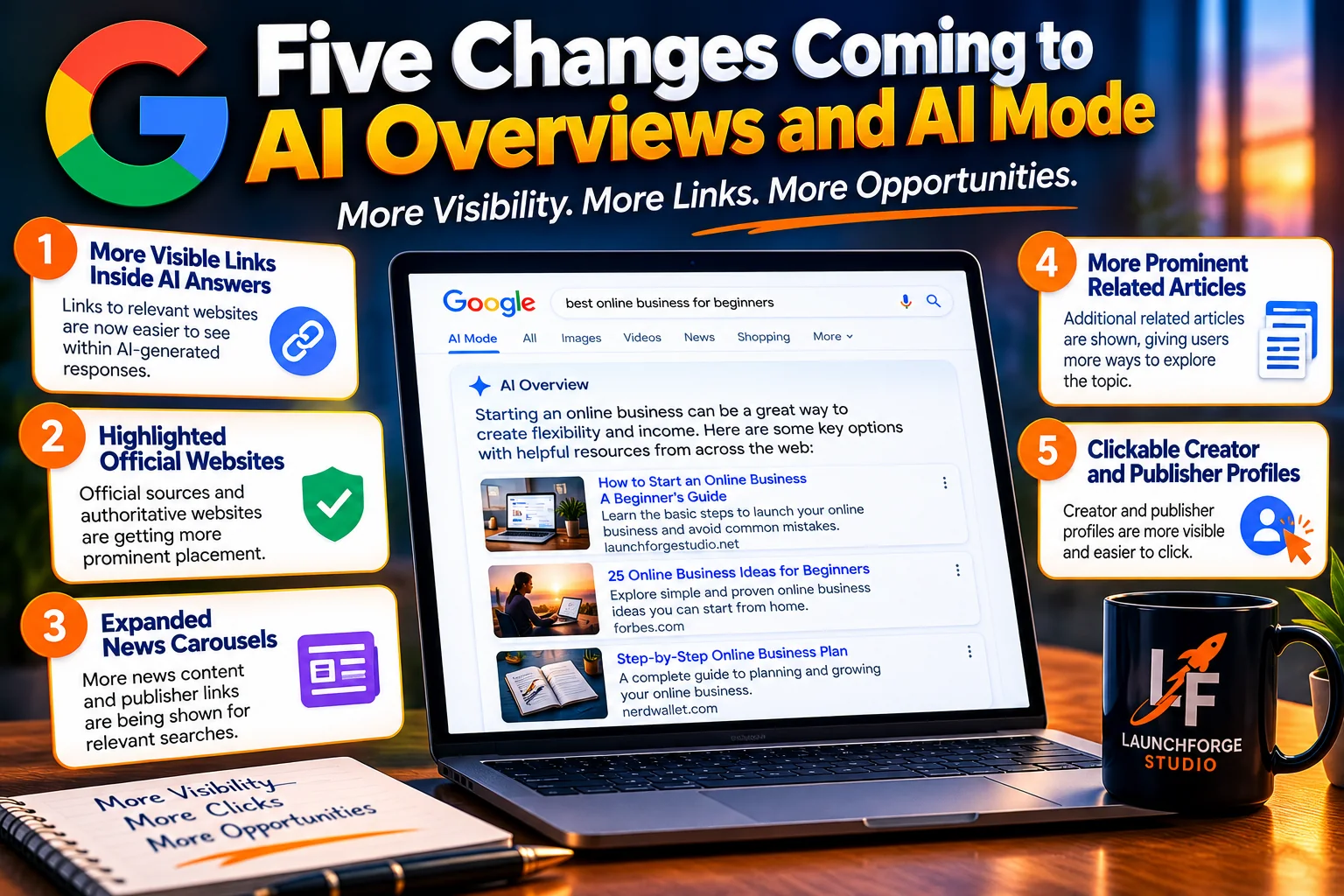
Five changes to Google’s AI-powered search experience could create new opportunities for website discovery.
Google’s October 15, 2026 announcement outlined five changes designed to make websites, articles, and creators easier to discover through AI-powered search.
Some involve making existing links more noticeable. Others introduce new layouts, expand previously announced features, or test additional ways for users to connect with original sources.
For independent website owners, the important question isn’t simply what Google is changing. It’s whether these changes could help people discover useful content they might otherwise overlook.
Let’s examine each development and what it could mean for smaller websites.
More Visible Links Inside AI Answers
One of Google’s most significant announcements involves the placement of links directly within AI-generated responses.
These are called inline links, meaning clickable words or phrases embedded naturally within an AI-generated explanation.
For example, imagine someone searching for information about starting an online business.
An AI-generated response might explain the importance of choosing a niche, creating a website, and building an email list. Certain phrases within that explanation could link to websites offering more detailed information.
Google says it has already increased the presence of these links and is now making them appear higher within AI responses more frequently.
Why does placement matter?
Because a link buried near the bottom of a lengthy response may be easier to overlook than one appearing while someone is actively reading about a subject.
If users encounter a relevant link at the moment they’re interested in learning more, they may have a stronger reason to explore the original source.
For smaller websites, this creates a potential opportunity.
A helpful article doesn’t necessarily need to answer every possible question about a subject. It can provide focused information that supports a particular part of someone’s research.
However, Google hasn’t established that placing inline links higher will automatically produce more clicks for independent publishers.
The opportunity is greater visibility. The unanswered question is whether that visibility will translate into visitors.
Highlighted Official Websites
Google is also testing a new way to highlight official websites when users need to complete a specific task or locate authoritative information.
Instead of expecting someone to identify the correct destination among several links, Google may display a dedicated section near the top of an AI-generated response.
This section is intended to feature one or two particularly relevant official websites, along with context explaining why those links are useful.
Imagine someone searching for an airline’s official refund process.
Rather than simply summarizing refund policies, Google could prominently display the airline’s official refund page so the person can take the next step directly.
This is especially useful when a task requires visiting a particular website.
But what does this mean for smaller businesses?
The potential benefit depends heavily on the search.
A small business with an official website may be a useful destination when someone is specifically looking for its products, services, policies, or company information.
However, Google’s announcement does not establish that every small business will receive this type of prominent placement.
The feature is being tested, and its intended purpose is to help users find the right official destination for particular tasks.
For website owners, the practical lesson is to make essential business information clear, accurate, and easy to locate.
Your website should explain who you are, what you provide, and how visitors can take the next step.
Even without special placement inside AI Search, those fundamentals improve the experience for people who discover your business.
Expanded News Carousels
Google is expanding prominent article carousels within AI-powered search experiences to additional locations and languages.
These carousels help users discover timely reporting and articles related to developing topics.
Rather than presenting only a written AI-generated explanation, Google can display a collection of relevant articles that readers can explore.
The expanded experience also incorporates Preferred Sources, a feature that allows users to identify websites and publishers they particularly value.
Google reported that the number of people using Preferred Sources had grown more than sevenfold since the beginning of 2026.
That suggests growing interest in having more influence over which sources appear prominently during the search experience.
For independent publishers, this development is worth watching.
Consider a website that regularly publishes thoughtful commentary about digital marketing, online business trends, or changes in search technology.
When a relevant industry development occurs, timely and useful coverage could give readers a reason to visit the website rather than relying entirely on a generated summary.
However, appearing in these carousels isn’t guaranteed.
Google still determines which content is relevant to a particular search, and the expanded features may become available at different times across locations and languages.
The opportunity for smaller publishers is to contribute original, relevant perspectives to conversations people are already following.
This doesn’t mean every website needs to become a breaking-news publication.
It means timely content can complement educational guides, tutorials, and other resources that remain useful over longer periods.
More Prominent Related Articles
Another change involves the links Google displays near the end of certain AI-generated responses.
Google is making these related links more visually engaging by introducing image thumbnails and a more noticeable, clickable design.
The idea is straightforward.
After reading an initial explanation, someone may want to explore a specific part of the subject in greater detail.
Instead of displaying a less noticeable collection of text links, Google can present related articles in a format that encourages further exploration.
For example, someone researching online business marketing might receive an AI-generated overview explaining several strategies.
Afterward, related links could direct that person toward more detailed resources covering email marketing, content creation, website traffic, or lead generation.
For independent websites, this could create additional opportunities to be discovered by people interested in learning more.
It also reinforces an important principle of content creation.
Useful content should give readers a reason to go beyond a brief summary.
Original examples, practical demonstrations, firsthand experiences, detailed comparisons, and actionable resources can provide value that a short overview may not fully deliver.
That doesn’t guarantee placement in Google’s related-article features.
But it gives website owners a sensible reason to keep producing content that offers something meaningful beyond a generic explanation.
Clickable Creator and Publisher Profiles
Google’s fifth announcement focuses on helping users discover the people and organizations behind certain content.
The company has started testing clickable creator and publisher names on video results within AI Mode.
These links can direct users to Search profiles that provide additional context about the creator or publisher and their broader work.
This is different from simply displaying a website link.
It gives users another way to learn about the source behind the information they’re viewing.
For creators who publish educational videos, commentary, tutorials, or other useful material, that additional context could help interested viewers discover more of their work.
However, this feature is currently a test, and Search profiles have eligibility requirements.
It would be inaccurate to assume that every blogger, small business, or independent website owner can immediately participate.
Still, the broader direction is interesting.
Google is experimenting with ways to make the identity and background of content creators more visible within AI-powered search.
For small business owners, that reinforces the value of developing a recognizable identity across their website and other publishing channels.
A clear About page, consistent business information, original content, and an identifiable brand can help visitors understand who is providing the information.
Trust isn’t created simply because a search engine displays your name. It’s built through the quality, consistency, and usefulness of what you publish.
And that’s something independent website owners can work on regardless of how Google’s experiments develop.
Taken together, these five changes suggest that Google is putting additional emphasis on connecting AI-generated answers with websites, publishers, and creators.
More visible links, official website sections, news carousels, related article previews, and creator profiles all provide different ways for users to move beyond an initial AI response.
But there is still a major unanswered question.
Will people actually click those links, or will they continue getting most of the information they need without leaving Google?
To understand why that question matters, we need to examine the growing concern surrounding AI-generated answers and declining website click-through activity.
Why Website Owners Are Worried About AI Search
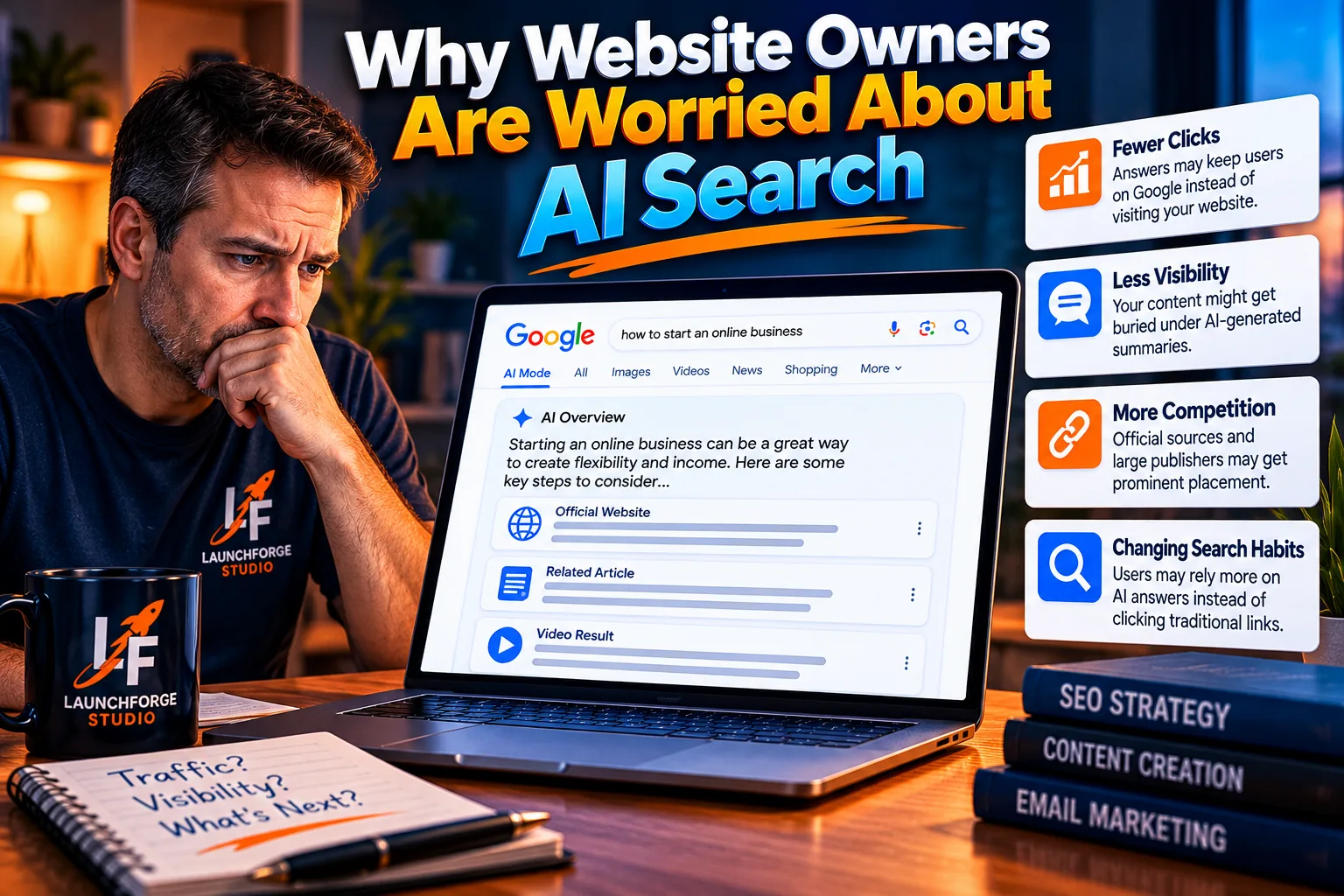
As AI-generated answers become more prominent, independent website owners are questioning how search visibility will translate into actual visitors.
Google’s latest changes may offer more opportunities for people to discover websites, but they arrive at a time when many publishers are already questioning the future of organic search traffic.
The concern isn’t simply that artificial intelligence is becoming more prominent in search results.
It’s that the relationship between search visibility and website visits may be changing.
For years, appearing prominently in Google Search gave website owners an opportunity to attract people who were actively looking for information.
A helpful article could answer a question, introduce someone to a business, encourage an email signup, or lead visitors toward additional resources.
AI-generated answers introduce another possibility.
Someone can search for information, receive a useful explanation, and leave without visiting any of the websites that contributed to the answer.
This behavior is commonly associated with zero-click searches, where a search session ends without the user clicking through to another website.
Zero-click searches existed before AI Overviews. Featured snippets, knowledge panels, and other search features have provided direct answers for years.
However, AI-generated summaries can address more complex questions and combine information from multiple sources into a single response.
That makes the potential effect on website traffic especially important for independent publishers.
The Problem With Searches That Don’t Produce Clicks
Imagine spending several days researching and writing an article about creating a successful email marketing strategy.
You organize the information, explain the important concepts, provide examples, and publish a resource designed to help beginners.
Over time, Google discovers the article and may consider it relevant to certain searches.
Now imagine someone searching for a question your article addresses.
Instead of clicking through to your website, that person receives an AI-generated summary containing enough information to satisfy their immediate curiosity.
They read the answer and move on.
Your content may still have contributed useful information to the broader search experience, but your website doesn’t necessarily receive a visitor.
And without that visit, you lose an opportunity to build a direct relationship with the reader.
For a small online business, that relationship can be important.
Website visitors may explore additional articles, download helpful resources, join an email list, compare products, or discover services that solve their problems.
Those opportunities become more difficult when people never reach the website.
This doesn’t mean every search needs to produce a click.
Some questions can be answered quickly, and users may appreciate receiving immediate information.
The challenge arises when website owners invest in producing original, useful resources but find that search visibility doesn’t consistently translate into visits.
There is also an important distinction between different types of searches.
Someone asking for a simple definition may be satisfied with a brief explanation.
Someone researching business software, comparing marketing platforms, or learning how to complete a complicated task may still want detailed examples, pricing information, demonstrations, and firsthand experiences.
The more valuable information a website provides beyond a basic summary, the more reasons a reader may have to visit it.
That doesn’t guarantee traffic, but it helps explain why useful, differentiated content remains important.
What the Research Tells Us
Concerns about AI-generated search results aren’t based entirely on speculation.
In July 2025, the Pew Research Center published findings examining how people interacted with Google Search results when AI-generated summaries appeared.
The research analyzed browsing activity from 900 U.S. adults who agreed to share their online activity during March 2025.
Researchers examined Google searches to better understand whether people clicked links when an AI summary appeared and how their behavior differed when one did not.
The findings revealed a notable difference.
When an AI-generated summary appeared, users clicked a traditional search result in approximately 8% of visits.
When no AI-generated summary appeared, users clicked a traditional search result in approximately 15% of visits.
In other words, traditional result clicks were considerably less common during search visits that included an AI summary.
The study also found that users clicked links appearing directly within AI-generated summaries in only about 1% of visits where those summaries appeared.
These figures are significant because they illustrate a challenge that more prominent links alone may not solve.
Making a link available doesn’t necessarily mean someone will use it.
However, the findings require careful interpretation.
The Pew study observed search behavior during March 2025. It did not evaluate Google’s October 2026 updates, and it doesn’t establish that every individual website experienced the same change in traffic.
The results also describe an observed relationship between AI summaries and clicking behavior, rather than proving that AI summaries caused every difference.
Different search queries may produce different outcomes, and people searching for quick answers may behave differently from those researching products, services, or complicated decisions.
Still, the research gives website owners a legitimate reason to pay attention.
If people are less likely to click traditional results when AI summaries appear, making links more visible within those summaries could be an important development.
But the effectiveness of Google’s new approach will ultimately depend on what users actually do.
Will they notice the links?
Will they consider the original sources worth visiting?
And will those visits provide meaningful opportunities for independent publishers?
Those questions cannot be answered simply by looking at how Google redesigns its search results.
They require evidence about user behavior after the changes become available.
For small website owners, the takeaway isn’t that organic search has become worthless. It’s that appearing in search results and earning meaningful website visits are two different measures of success.
A website can still benefit from search visibility, but publishers should pay attention to what happens beyond impressions.
That includes monitoring clicks, understanding which pages attract visitors, and recognizing whether those visitors take useful actions once they arrive.
The Pew Research Center’s findings provide an important foundation for understanding this evolving challenge.
Research source: Pew Research Center — Google users are less likely to click on links when an AI summary appears in the results
https://www.pewresearch.org/short-reads/2025/07/22/google-users-are-less-likely-to-click-on-links-when-an-ai-summary-appears-in-the-results/
And that brings us back to Google’s latest announcement.
If AI-generated summaries have been associated with fewer traditional search clicks, could more prominent website links help reverse that pattern?
The answer is possible, but far from certain.
To understand why, we need to separate what Google’s changes could accomplish from what has actually been demonstrated so far.
Will Google’s Changes Actually Help Smaller Websites?
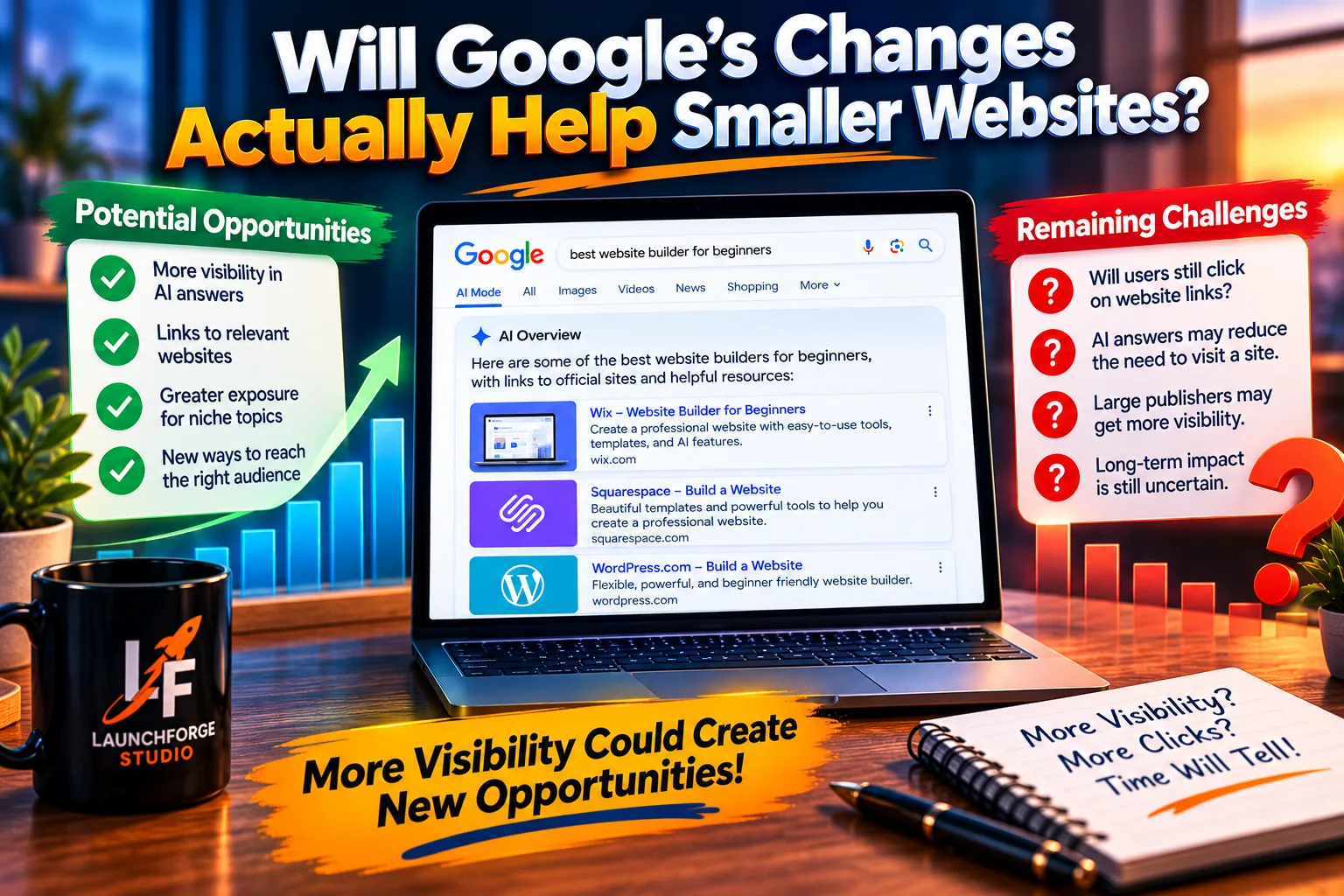
Greater visibility in Google’s AI-powered search could help independent websites, but increased clicks are not guaranteed.
Google’s decision to make website links more visible within AI-powered search results is an encouraging development. But for smaller website owners, the real question isn’t whether the new features look promising.
It’s whether those features will make a measurable difference.
Independent websites compete for attention alongside established publications, major brands, and businesses with substantially larger marketing budgets.
For a small publisher, even a modest increase in relevant visitors can create opportunities to build an audience, attract subscribers, or introduce potential customers to useful products and services.
That’s why Google’s latest announcement deserves attention.
However, there is an important difference between creating more opportunities for discovery and demonstrating that those opportunities produce results.
Let’s examine both sides.
Why Greater Visibility Could Help
One reason Google’s changes could benefit smaller websites is that they introduce additional opportunities for users to encounter links while interacting with AI-generated answers.
Traditional search results generally present users with a list of websites to choose from.
AI-powered search can introduce links at different stages of the experience, including within an explanation, alongside related content, or when a user needs to visit an official website.
That creates several potential advantages.
Relevant links can appear when someone is already interested in a topic.
A person researching email marketing might encounter a link to a detailed resource while reading an AI-generated explanation about building a subscriber list.
If that resource provides practical examples, demonstrations, or information beyond the initial answer, the reader may have a reason to explore it.
Visual presentation can make supporting content easier to notice.
Related article previews featuring thumbnails and clearer link presentation may help users recognize additional resources.
For publishers who invest in helpful articles and relevant imagery, that could create another opportunity to attract attention.
Specific questions can lead to more focused resources.
Not every search requires a comprehensive guide.
Someone comparing business tools, researching a particular feature, or trying to solve a specific problem may appreciate a link to a resource that addresses their immediate concern.
A smaller website with genuinely useful, focused content could potentially benefit from that type of discovery.
However, none of these possibilities guarantees that Google will select a particular website or that users will click its links.
The potential benefit comes from connecting relevant information with people who have a reason to explore it further.
For independent publishers, that’s an encouraging possibility, but it remains something to measure rather than assume.
What Google Hasn’t Proven Yet
Google’s October 15 announcement describes changes intended to improve how users discover websites and creators.
What it does not establish is that these changes will consistently increase organic traffic for smaller websites.
Several important questions remain unanswered.
Will users click more often?
A link can become more visible without necessarily attracting more visitors.
If someone receives a complete answer from an AI-generated summary, a prominent link may not change their behavior.
Will smaller publishers receive meaningful exposure?
Google’s announcement does not promise equal visibility for independent websites, established publishers, and major brands.
Search visibility will continue to depend on relevance and Google’s systems for selecting and presenting information.
Will the additional visitors be genuinely interested?
Traffic volume alone doesn’t tell the complete story.
A website receiving fewer but more engaged visitors may accomplish more than one attracting a larger audience that immediately leaves.
For example, someone who reads an educational article and subscribes to receive a useful resource may represent a more meaningful connection than someone who briefly opens a page without exploring further.
Will the benefits vary by search topic?
Almost certainly, user behavior will differ depending on what someone is trying to accomplish.
A simple factual question may require little additional research.
Choosing a business platform, evaluating marketing software, or learning a complicated process may involve multiple searches and website visits.
But exactly how Google’s latest changes will influence those behaviors remains uncertain.
The most responsible approach is to watch the evidence as these features become more widely available.
Website owners should monitor search impressions, clicks, click-through rates, and visitor engagement rather than assuming that every Google announcement requires an immediate change in strategy.
And they should avoid purchasing expensive tools or completely restructuring their websites based solely on speculation about AI Search.
The bottom line is that Google’s changes may create opportunities, but meaningful results will depend on how people actually use them.
For smaller websites, that means continuing to build a strong foundation while remaining flexible enough to respond to new information.
Instead of chasing every search engine development, independent publishers can focus on the parts of their online presence they actually control.
And that’s where the next section becomes especially important.
What Small Website Owners Should Do Now
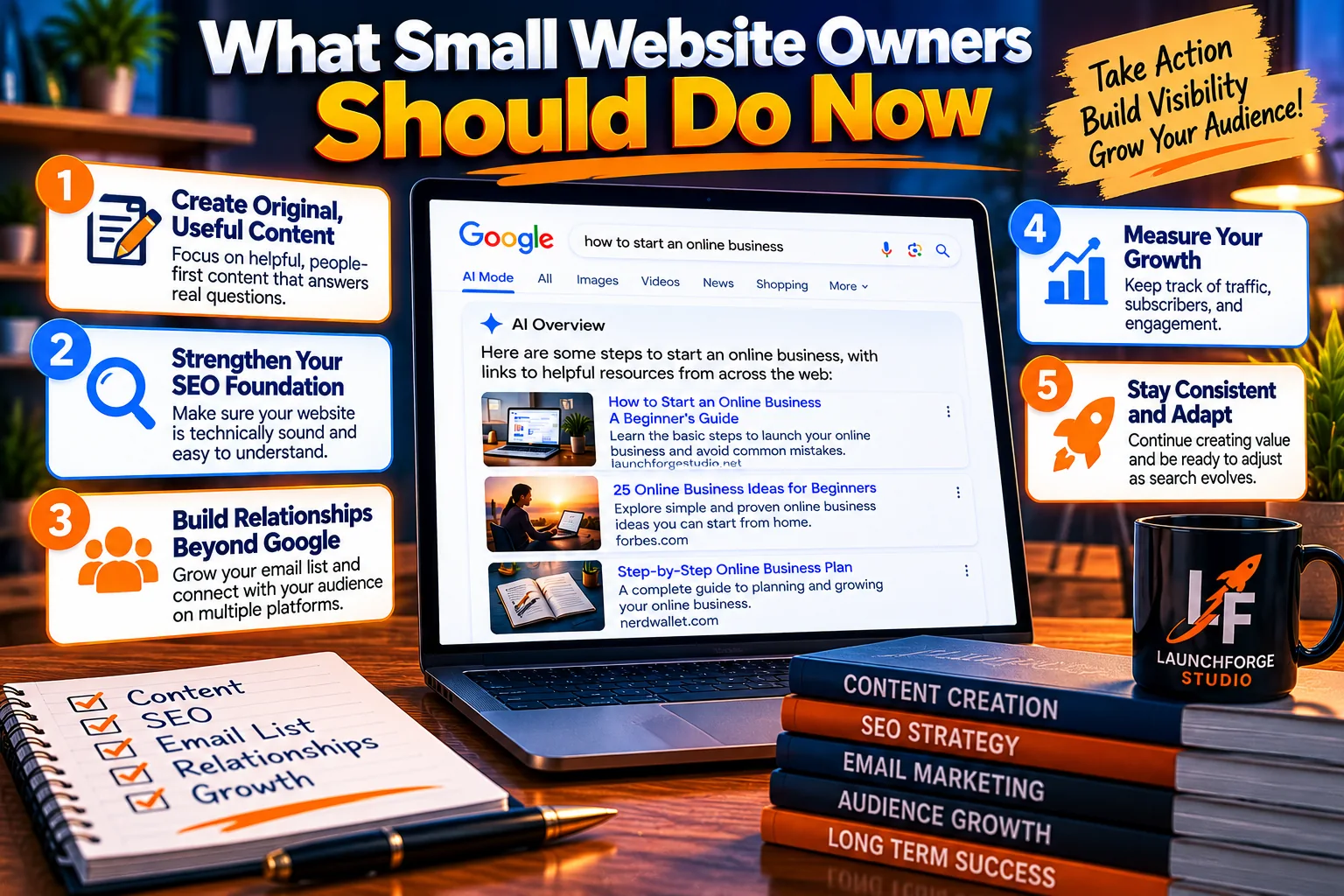
Small website owners can prepare for AI Search changes by improving content, strengthening SEO, building audience relationships, and measuring results.
Google’s latest AI Search changes may create new opportunities for website discovery, but waiting to see what happens shouldn’t be the only strategy for independent publishers.
Small website owners don’t control how Google designs AI Overviews, selects supporting links, or introduces new search features.
What they can control is the quality of their content, the experience visitors have on their websites, and the relationships they build with their audiences.
And those fundamentals remain valuable regardless of how AI-powered search evolves.
The goal isn’t to abandon search engine optimization or completely rebuild your marketing strategy every time Google announces something new.
It’s to develop an online presence that remains useful, discoverable, and capable of growing beyond a single traffic source.
Here are four practical areas worth focusing on.
Keep Creating Original, Useful Content
One of the most important things smaller websites can do is continue publishing information that genuinely helps their intended audience.
But there’s an important distinction between producing content and creating something worth visiting.
AI-powered tools have made it easier than ever to generate explanations, summaries, and articles covering almost any subject.
That convenience also means readers may encounter similar information across numerous websites.
If every article simply repeats the same general advice, visitors have fewer reasons to choose one resource over another.
Originality doesn’t necessarily mean discovering something nobody has ever discussed. It means contributing something useful that reflects your own knowledge, research, experience, or perspective.
For example, consider two articles about building an email list.
One provides a general explanation of email marketing, describes several common benefits, and recommends collecting subscribers.
The other explains those same fundamentals but also includes an example of a signup page, discusses how an actual lead magnet was developed, and walks through practical decisions involved in creating a follow-up system.
Both articles may contain useful information.
However, the second offers additional context that readers may find difficult to obtain from a brief AI-generated summary.
That doesn’t guarantee better rankings or inclusion in Google’s AI-powered results.
It does create a stronger reason for someone to explore the complete resource.
Independent website owners can apply this principle by incorporating:
- Firsthand experiences: Explain what you’ve actually tried, built, tested, or learned.
- Original examples: Demonstrate how a concept applies to a realistic situation.
- Practical resources: Offer worksheets, checklists, templates, or other materials readers can use.
- Thoughtful comparisons: Help people understand meaningful differences between available approaches or tools.
- Clear explanations: Make complicated subjects easier to understand without removing important details.
- Updated information: Revisit articles when products, policies, research, or industry practices change.
The objective isn’t to make every article longer.
A focused 1,500-word article that solves a specific problem can be more valuable than a 7,000-word guide that repeatedly explains the same concepts.
Create content because it helps your audience accomplish something, not simply because another keyword appears attractive.
That’s a foundation worth maintaining even as search technology changes.
Strengthen Your Existing SEO Foundation
With so much attention surrounding artificial intelligence, it’s easy to assume that traditional SEO practices are becoming irrelevant.
But Google’s own guidance continues to emphasize established search fundamentals for websites that want to appear in AI-powered search experiences.
According to Google Search Central, website owners don’t need to create special AI-specific files or implement entirely new technical requirements simply to become eligible for AI features in Search.
Existing SEO best practices remain relevant.
That means smaller website owners should resist the temptation to chase every new optimization trend before addressing the basics.
Start by making sure your website is technically accessible and genuinely useful.
Several areas deserve attention.
Clear page titles and descriptions
Each important page should have a descriptive title that helps people understand what the content covers.
Meta descriptions can provide additional context, although Google may generate different snippets depending on the search.
Avoid misleading headlines that promise information the article doesn’t actually deliver.
Logical headings and readable content
Organize articles with meaningful headings and subsections.
Use clear language, manageable paragraphs, and formatting that helps readers locate relevant information.
A logical structure benefits visitors first and can also help search engines understand the organization of a page.
Helpful internal linking
Connect related articles when those links provide meaningful additional information.
For example, an article discussing website traffic might naturally reference a guide about lead generation or improving landing page conversions.
Internal links help visitors continue learning without having to search your website from scratch.
They also help search engines discover and understand relationships between pages.
Mobile-friendly design and website performance
A website should be comfortable to use on smartphones, tablets, and desktop computers.
Readable text, responsive layouts, working navigation, and reasonable loading performance all contribute to a better visitor experience.
Accurate, maintained information
Review important articles periodically.
Outdated instructions, broken links, discontinued products, and inaccurate claims can reduce the usefulness of otherwise valuable content.
This is especially important when publishing about fast-changing subjects such as AI, digital marketing software, and search engine updates.
Google Search Central’s guidance is a useful reference for understanding how established SEO practices apply to AI-powered search.
Official resource: https://developers.google.com/search/docs/appearance/ai-features
The larger lesson is straightforward.
You don’t need to abandon good SEO practices to prepare for AI Search. You need to make sure those practices are serving real people.
Build Relationships Beyond Google Search
Organic search can be an important source of website visitors, but relying entirely on one platform creates uncertainty.
Google can change its search layouts, ranking systems, AI features, and the way it displays information.
Social media platforms can change their algorithms.
Advertising costs can increase.
Traffic sources that perform well today may behave differently in the future.
That’s why independent website owners should think beyond attracting a visitor once.
The more meaningful goal is to give interested people a reason to return and stay connected.
One practical way to accomplish this is through email marketing.
When someone voluntarily joins your email list, you have an opportunity to continue communicating with them without depending on that person discovering every new article through Google Search.
For example, a beginner interested in starting an online business might discover an educational article through search.
After reading it, they could choose to download a free resource that helps them organize their next steps.
If they subscribe, a thoughtful welcome sequence can introduce additional educational content and relevant resources over time.
The relationship no longer depends entirely on another search result.
Of course, email marketing isn’t automatic success.
Subscribers need to receive the information they were promised, and ongoing messages should remain useful and relevant.
Consent, transparency, and an easy unsubscribe process are also essential.
Other opportunities for developing direct relationships include:
- Social media communities: Share useful insights and participate in relevant conversations rather than simply posting promotional links.
- Educational resources: Create downloadable materials that help readers apply what they’ve learned.
- Consistent publishing: Give people a reason to revisit your website for updated information and practical guidance.
- Brand recognition: Maintain a clear identity so readers can recognize your business across different platforms.
- Audience feedback: Pay attention to the questions, challenges, and suggestions people share.
The objective isn’t to participate in every marketing channel available.
For a beginner or small business owner, that can quickly become overwhelming.
Start with a manageable combination of channels that supports your audience and available time.
A smaller, engaged audience that recognizes and trusts your business can be more valuable than a large number of visitors who never return.
And in an environment where search behavior may be changing, building those direct connections becomes especially worthwhile.
Measure Traffic and Subscriber Growth
Google’s AI Search announcement also reinforces the importance of measuring what actually happens on your website.
It’s tempting to judge success entirely by rankings, impressions, or the number of visitors arriving each day.
Those measurements can be useful, but they don’t explain everything.
A website might receive more impressions without earning additional clicks.
Another might experience fewer visitors but attract people who spend more time exploring relevant content.
And a third might generate consistent traffic without encouraging meaningful actions.
Understanding performance requires looking beyond a single number.
For independent website owners, several measurements can provide useful insight.
Search impressions
Google Search Console reports how often your website appears in eligible Google Search results.
An increase in impressions may indicate greater visibility, but it doesn’t necessarily mean more people are visiting your website.
Organic search clicks
Clicks help show how many visits begin when someone selects your website from Google Search results.
Comparing clicks with impressions can help identify changes in search performance.
Click-through rate
Click-through rate, or CTR, represents the percentage of impressions that result in clicks.
For example, if a page receives 1,000 impressions and 50 clicks, its CTR is 5%.
However, changes in CTR can result from several factors, including search intent, ranking position, query mix, and how Google presents the results.
A declining CTR shouldn’t automatically be blamed on AI Overviews.
Visitor engagement
Website analytics can help you understand which pages people visit, how they navigate your website, and whether they interact with additional content.
Engagement metrics require context, but they can reveal patterns that search rankings alone cannot explain.
Email subscribers and conversions
If your website offers a lead magnet, newsletter, or another relevant signup opportunity, monitor how many visitors choose to subscribe.
You can also evaluate whether those subscribers engage with subsequent emails and resources.
For an educational business, these actions may reveal more about audience interest than raw traffic totals.
Look for patterns over time rather than reacting to every daily fluctuation.
A single week of declining clicks doesn’t prove that Google’s AI Search changes are responsible.
Seasonality, competition, ranking changes, technical problems, and shifting search demand can all influence website performance.
Google Search Console and your website analytics platform can help you investigate those possibilities.
It’s also important to understand that Search Console doesn’t provide a simple, universal report isolating every visit or impression associated with AI Overviews and AI Mode.
That makes it difficult to attribute individual traffic changes directly to Google’s AI features.
For smaller website owners, the practical approach is to establish a baseline, monitor important pages, and compare performance over meaningful periods.
Pay particular attention to whether the visitors you attract are finding the information they need and taking actions that align with your website’s purpose.
The ultimate goal isn’t simply to appear more often in Google. It’s to build a website that creates meaningful opportunities when people arrive.
And that leads to an interesting question for us at LaunchForge Studio.
How do these developments influence the way we’re building our own educational website?
What This Means for LaunchForge Studio
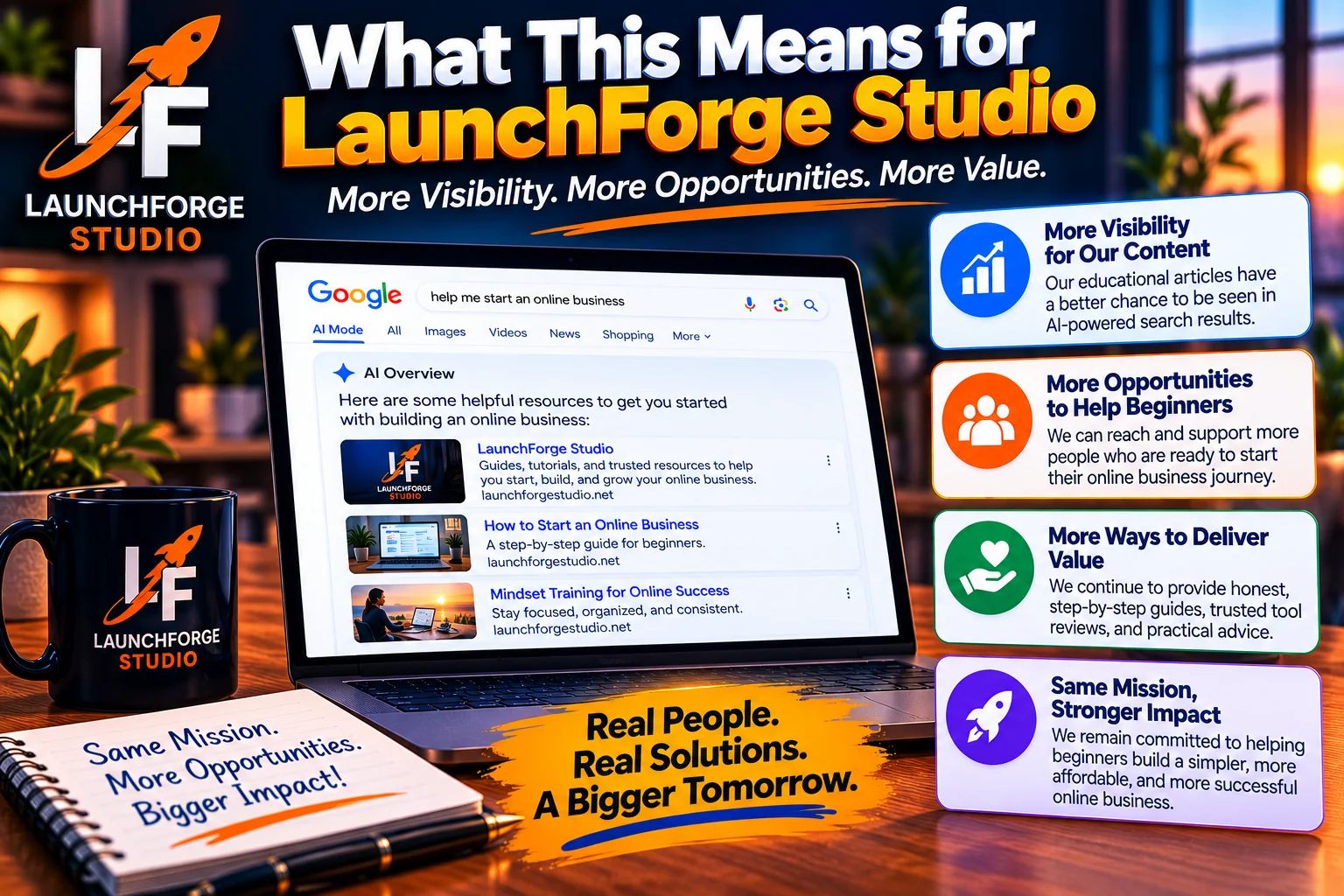
LaunchForge Studio continues building helpful educational resources and meaningful audience relationships as AI-powered search evolves.
At LaunchForge Studio, Google’s latest AI Search changes are more than another technology headline.
They’re directly relevant to the kind of online business we’re building.
We’re an independent educational website focused on helping beginners understand how to start, build, and grow an online business without getting overwhelmed by unnecessary complexity.
Our approach has been straightforward: create useful resources, explain complicated subjects in understandable language, and help people make informed decisions about the tools and strategies available to them.
As of October 2026, we’ve published 52 educational articles, tutorials, reviews, and business-building insights covering topics such as website creation, landing pages, lead generation, email marketing, traffic strategies, and online business development.
Each article represents an opportunity to answer a question, solve a problem, or help someone take another step forward.
But publishing helpful information is only part of the challenge.
People still need a way to discover it.
That’s why developments involving Google AI Search matter to us.
Like other independent publishers, we’re working to build visibility in an online environment where established websites, major brands, and increasingly sophisticated AI-generated answers compete for attention.
We don’t have a massive publishing operation or an unlimited advertising budget.
What we do have is the ability to focus on practical education, share our experiences, and build resources around the needs of the people we’re trying to help.
And we believe those things remain worth investing in.
Our Content Strategy Is About More Than Search Rankings
Search engine optimization plays an important role in how we organize and publish content.
We pay attention to relevant topics, article structure, internal linking, website performance, and making our resources accessible to readers.
But we don’t want the value of an article to depend entirely on whether it reaches a particular position in Google Search.
An educational resource should still be useful when someone discovers it through social media, follows a link from another article, or receives it through an email.
That’s one reason we’ve been developing interconnected content rather than treating every article as an isolated publication.
Someone researching how to start an online business might begin with a guide about choosing a business idea.
From there, they could explore website creation, landing pages, lead generation, email marketing, and strategies for attracting visitors.
Each resource can help them understand another part of the process.
Our goal is to create a learning experience that continues beyond a single search result.
If Google’s new AI Search features help more people discover those resources, that would be encouraging.
But our responsibility is to make sure the content is genuinely useful when they arrive.
We’re Also Building Ways to Connect With Readers Directly
Another part of our approach involves giving visitors opportunities to continue learning after reading an article.
For example, we recently created the Online Business Starter Blueprint, a free 12-page downloadable resource designed to help beginners move from uncertainty toward taking practical action.
The blueprint includes seven foundational steps, a seven-day action plan, and two worksheets to help readers organize their business ideas.
We also created a dedicated signup page and connected the resource to an email delivery and follow-up system.
The purpose isn’t simply to collect email addresses.
It’s to offer something useful and create an opportunity to continue helping people who are interested in building an online business.
This approach becomes especially relevant when considering the uncertainty surrounding AI-powered search traffic.
If someone discovers LaunchForge Studio through Google, reads a helpful article, and decides to subscribe for additional resources, we’ve created an opportunity for an ongoing relationship.
That relationship doesn’t have to depend on the same person finding us through another Google search.
Of course, building an email list takes time, and offering a free resource doesn’t guarantee that visitors will subscribe.
But it gives us a practical way to provide additional value beyond the original article.
We’re Paying Attention Without Abandoning Our Direction
Google’s October 2026 announcement gives us another reason to monitor how people discover and interact with our website.
We’ll continue using available analytics and search performance information to understand which topics attract attention and how visitors engage with our resources.
We’ll also keep reviewing our existing articles, improving internal connections, and updating information when necessary.
What we’re not planning to do is abandon our educational approach every time a new AI Search feature is announced.
We don’t believe beginners benefit from constantly chasing the latest marketing trend or purchasing another collection of tools simply because the industry is changing.
Instead, we’re focused on building a manageable system that supports useful content, audience relationships, and sustainable progress.
That doesn’t mean ignoring new technology.
It means evaluating developments carefully and deciding which changes genuinely deserve our attention.
And perhaps that’s the most important lesson for independent website owners.
You don’t need to compete with Google’s technology to build something worthwhile.
You need to understand how the environment is changing, recognize the opportunities and limitations, and continue creating reasons for people to discover, trust, and return to your website.
At LaunchForge Studio, we’re still learning, building, testing, and improving.
We’re not presenting our approach as a guaranteed formula for traffic or business success.
We’re sharing the process because we believe practical experience can be just as valuable as another list of marketing recommendations.
And regardless of how Google’s AI Search evolves, that commitment to useful education is something we intend to keep.
Search technology will continue changing. Our responsibility to the people we’re trying to help shouldn’t.
Final Thoughts: More Links Are Encouraging, but Clicks Still Matter
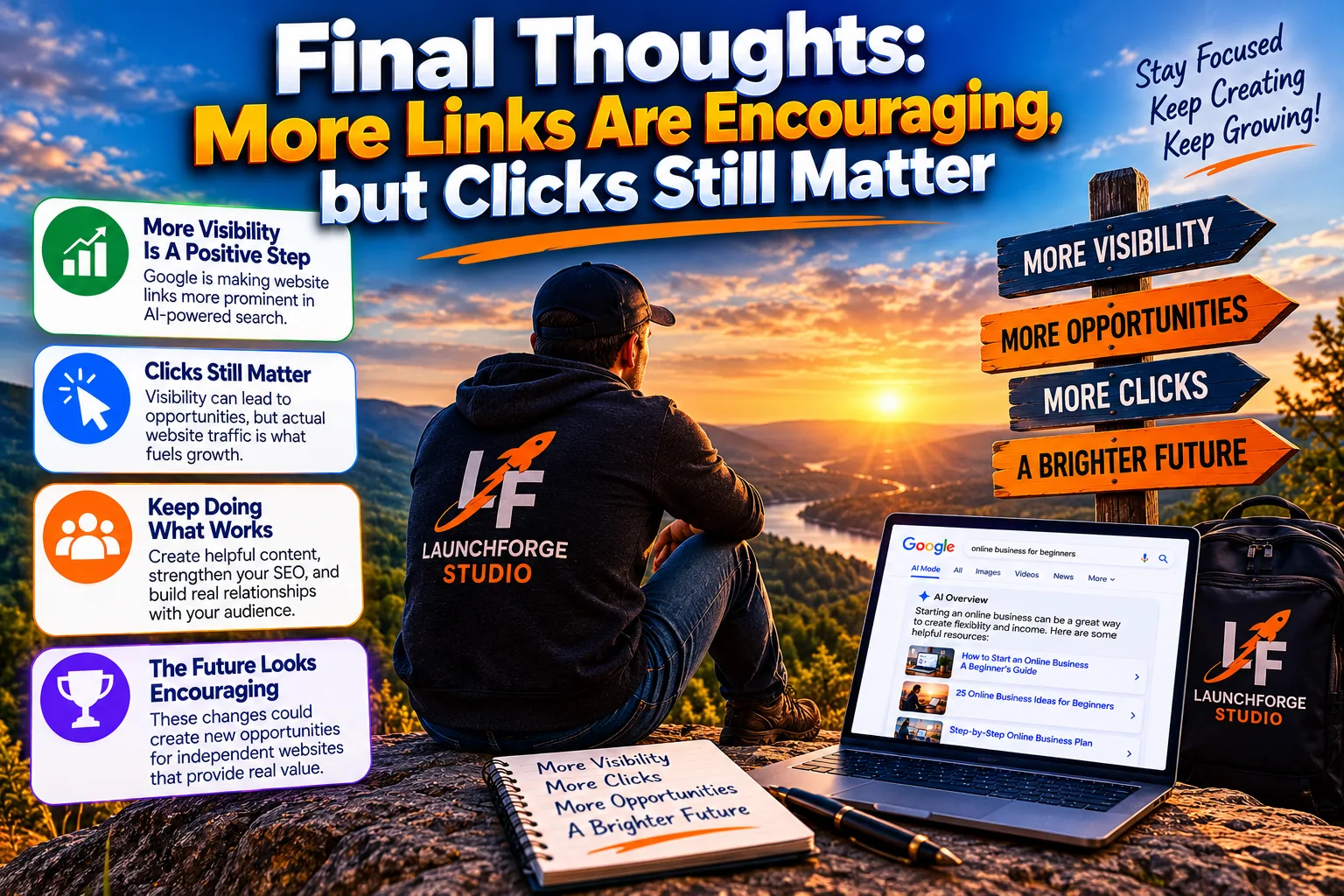
Greater visibility is encouraging, but meaningful website visits, useful content, and audience relationships remain essential.
Google’s October 2026 AI Search changes represent an interesting development for website owners who have been watching artificial intelligence reshape how people discover information online.
More prominent links, improved article previews, expanded news discovery, and new ways to highlight websites and creators all suggest that Google is placing additional attention on connecting AI-generated answers with the broader web.
For independent publishers, that’s encouraging.
But it doesn’t answer the question that matters most.
Will these changes actually help smaller websites attract more visitors?
Right now, we don’t have enough evidence to say.
The research examining earlier AI search behavior gives website owners legitimate reasons to be concerned about declining click-through activity. Google’s latest announcement introduces features that could improve discovery, but their real-world impact still needs to be measured.
And that’s an important distinction.
A website can appear in search results without receiving a visitor.
A link can become more prominent without earning a click.
And an increase in visibility doesn’t automatically translate into subscribers, customers, or meaningful business growth.
What matters is whether the people discovering your website have a reason to visit, explore, and connect with what you’re offering.
For beginners and small business owners, the best response isn’t to panic about artificial intelligence or abandon the strategies they’ve been building.
It’s to focus on what remains within their control.
Create content that answers real questions and offers something useful beyond a quick summary.
Maintain a website that’s accessible, organized, and easy to navigate.
Connect related resources so visitors can continue learning.
Build direct relationships through email, social communities, and other appropriate channels.
And measure meaningful results instead of assuming that every change in traffic is caused by Google’s latest technology.
None of those actions guarantees search rankings or business success.
But they create a stronger foundation than constantly reacting to headlines or chasing another supposedly revolutionary marketing shortcut.
At LaunchForge Studio, that’s the approach we’re continuing to take.
We’re building our educational library, sharing practical experiences, developing useful resources, and working to make online business concepts easier for beginners to understand.
We’ll continue paying attention to Google’s AI Search developments because they matter to anyone who depends on being discovered online.
But we won’t allow uncertainty about the next search update to distract us from the reason we’re creating content in the first place.
Helping people solve problems and take meaningful steps forward.
The search experience may look very different in the years ahead. AI-generated answers will continue evolving, and the relationship between search engines, publishers, and readers will likely keep changing.
Independent website owners will need to adapt.
But adaptation doesn’t have to mean abandoning everything that already makes a website valuable.
The opportunity is to build something worth discovering, regardless of how people eventually find it.
Google may be making links more visible.
Now we’ll have to see whether people actually click them.
And for smaller websites working hard to earn their place on the web, that’s a story worth following.