
If you are new to building a business online, one of the most basic questions can also be one of the most confusing:
How does an online business make money?
The simple answer is that an online business makes money by creating or providing something valuable and connecting that value with people who are willing to pay for it.
What changes from one online business to another is what is being offered, who pays for it, and how the business gets paid.
One business might sell a physical product through an online store.
Another might provide a service.
Someone else might create a digital product, earn commissions through affiliate marketing, charge for a membership, sell access to software, or generate revenue from advertising.
Those businesses can look completely different on the surface, but underneath them is the same basic idea.
Value has to connect with a way for revenue to enter the business.
That sounds obvious, but it is an important distinction because many of the things we talk about when building an online business do not actually make money by themselves.
A website does not automatically make money.
Traffic does not automatically make money.
An email list does not automatically make money.
A sales funnel does not automatically make money.
Even a large audience does not automatically make money.
Those things can become important parts of an online business, but there still needs to be a way for the business to turn attention, trust, interest, or demand into a transaction.
That is where the business model and revenue model come into the picture.
You need to understand what value your business provides, who that value is for, what you are offering, and what eventually causes money to change hands.
A useful way to picture that process is:
VALUE → AUDIENCE → OFFER → TRANSACTION → REVENUE
You create or provide something valuable.
You put it in front of people who may need or want it.
You give them a relevant offer or another reason to take action.
A transaction takes place.
Revenue enters the business.
Of course, the real world is rarely quite that neat. People may discover your business through search, social media, advertising, referrals, email, or dozens of other paths. They may visit several times before buying anything. Some businesses do not even collect money directly from the person consuming their content.
But understanding that basic flow makes the rest of online business much easier to understand.
In this guide, we are going to answer how does an online business make money by breaking down the most common revenue models, how they actually work, and how websites, traffic, leads, funnels, and marketing systems can help create a path toward revenue.
Because once you understand where the money actually comes from, all of those other pieces begin to make a lot more sense.
How Does an Online Business Actually Make Money?
At the most basic level, an online business makes money when it creates a transaction that produces revenue.
That transaction can happen in many different ways.
A customer might purchase a product.
A client might pay for a service.
A subscriber might pay a monthly fee.
A company might pay a commission for a referred sale.
An advertiser might pay to reach an audience.
The details are different, but every sustainable revenue model needs to answer a few basic questions:
What value is being provided?
Who wants or needs that value?
What is being offered?
What causes money to change hands?
Those questions are important because it is easy to focus on the visible parts of an online business while overlooking the actual revenue mechanism underneath them.
You might spend weeks building a website, publishing content, creating social media accounts, collecting email subscribers, or generating traffic.
All of those things can be useful.
But none of them answers the most important monetization question:
What creates the transaction?
That is why the simple framework we introduced earlier is useful.
Value → Audience → Offer → Transaction → Revenue
Each part has a different job.
Value is the reason somebody should care in the first place.
It might be a product that solves a problem, a service that saves time, information that helps someone accomplish something, software that makes a task easier, entertainment that attracts attention, or access to something people want.
Audience is the group of people who may have a reason to want that value.
Without the right people seeing what you provide, even an excellent product or service can sit unnoticed.
Offer gives those people something specific to act on.
It explains what they can buy, access, join, use, request, or otherwise receive.
Transaction is the point where the revenue mechanism actually activates.
Someone buys the product, pays for the service, starts the subscription, clicks an advertisement, completes a qualifying referral, or takes whatever action the particular revenue model requires.
Revenue is the money the business receives as a result.
This does not mean every visitor has to move through those five stages in a perfectly straight line.
Real customer journeys can be messy.
Someone might discover an article through Google today, join an email list next week, return through an email a month later, compare several options, and finally make a purchase.
Another person might discover exactly what they need and buy within five minutes.
The path can change.
The underlying business question does not:
Where in this system does revenue actually enter the business?
Once you can answer that clearly, it becomes much easier to understand what the website, content, traffic, email marketing, sales funnels, automation, and other tools surrounding the business are actually supposed to accomplish.
They are not the revenue model themselves.
They are pieces that can help the revenue model work.
What Is the Difference Between a Business Model and a Revenue Model?
The terms business model and revenue model are often used interchangeably, but they are not exactly the same thing.
A business model is the bigger picture.
It describes how a business creates value, who it serves, what it provides, how it reaches customers, what resources or systems it needs, and how the different pieces work together to create a functioning business.
A revenue model is more specific.
It explains how money enters the business.
Think of the business model as the entire machine and the revenue model as the part of that machine responsible for generating revenue.
For example, imagine someone creates a website that teaches beginners how to improve their photography.
The website, educational content, audience, email list, marketing strategy, tools, and customer relationships could all be parts of the broader business model.
But there are several different ways that same business could generate revenue.
It could sell a photography course.
It could sell downloadable editing presets.
It could recommend cameras and software through affiliate partnerships.
It could offer a paid membership.
It could provide one-on-one photography coaching.
It could attract sponsors or advertisers interested in reaching the audience.
The subject of the business has not necessarily changed.
The way money enters the business has.
That is the revenue model.
One Business Can Have More Than One Revenue Model
This distinction becomes especially important because an online business does not have to rely on a single source of revenue forever.
A business might begin by providing services and later create digital products.
A content website might start with affiliate marketing and eventually add advertising or sponsorships.
A software company might offer a free version of its product while charging customers for additional features or higher levels of access.
An educator might sell individual courses while also offering a recurring membership.
These combinations can create multiple revenue streams inside the same overall business.
But that does not mean a beginner needs to build all of them at once.
Adding more ways to make money also adds more things to manage.
Every new product, service, subscription, affiliate relationship, or monetization method can introduce additional pages, systems, customer journeys, marketing requirements, support needs, and decisions.
That can turn a simple business into a complicated one very quickly.
A better starting point is usually to understand one clear path to revenue.
What value are you providing?
Who is it for?
What are you offering?
How does the transaction happen?
Once that path makes sense and the supporting system is working, additional revenue streams can be considered based on what the business actually needs.
The goal is not to collect as many monetization methods as possible.
The goal is to build a business where you can clearly explain why someone would pay, what they are paying for, and how that payment becomes revenue.
With that distinction in place, we can look at some of the most common ways online businesses actually do it.
8 Common Ways Online Businesses Make Money
There is no single way an online business has to make money.
Some businesses sell things they create themselves. Others sell their time or expertise. Some earn commissions by recommending products from other companies. Others build audiences and earn revenue from advertisers, subscriptions, referrals, or access to software.
The important part is understanding what creates the transaction in each model.
Here are eight common ways that happens.
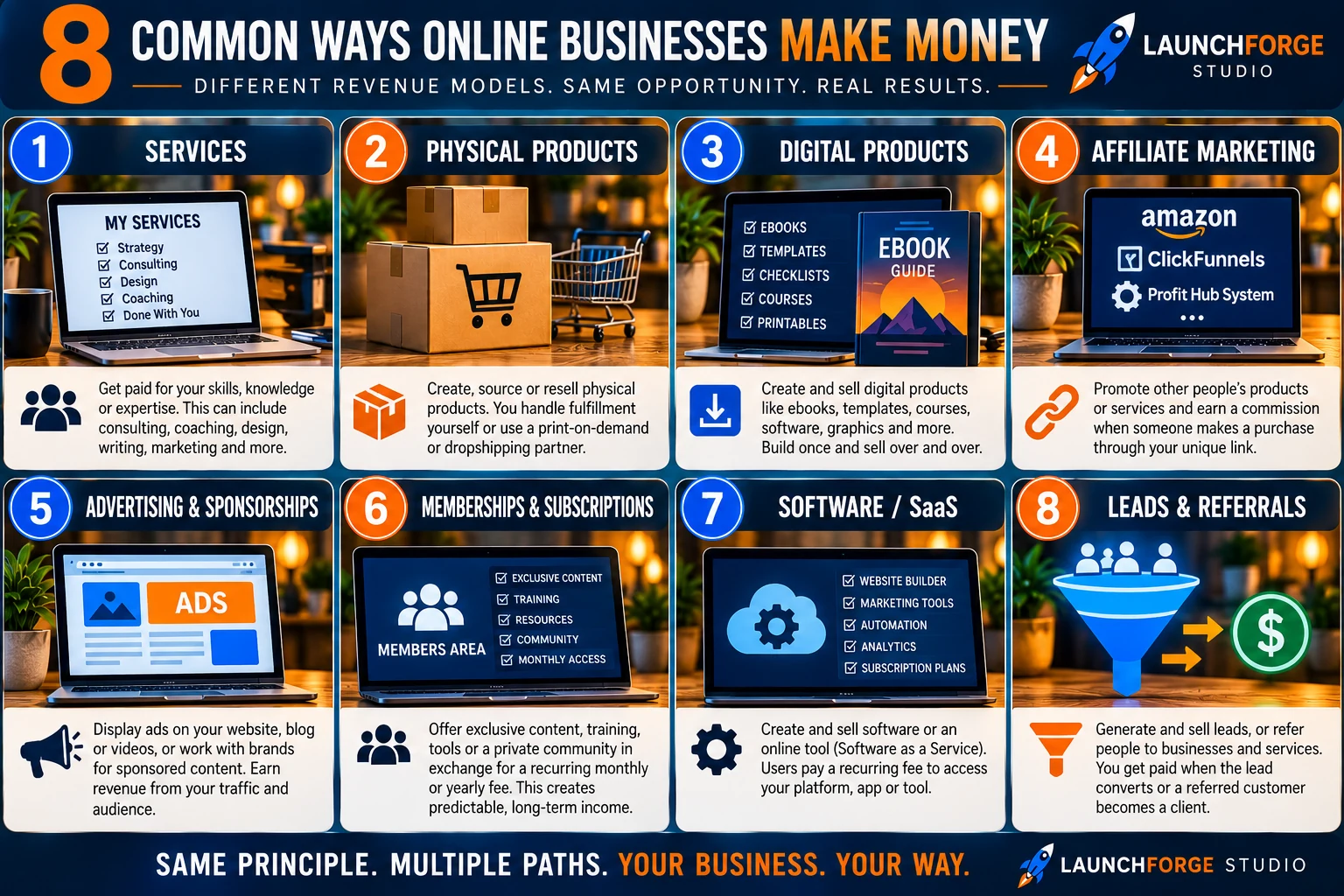
Eight common online business revenue models include services, physical products, digital products, affiliate marketing, advertising and sponsorships, memberships and subscriptions, software or SaaS, and leads and referrals.
1. Selling Services
Selling a service is one of the most straightforward online revenue models because the exchange of value is usually easy to see.
Someone needs something done. A business provides the work. The customer pays for the service.
The service could involve:
- Website design
- Graphic design
- Copywriting
- Consulting
- Coaching
- Bookkeeping
- Video editing
- Marketing
- Virtual assistance
- Technical support
- Freelance writing
- Professional services
The internet does not necessarily change what the service is.
What it changes is how the business can reach customers, communicate with them, deliver certain types of work, collect payments, and maintain the relationship.
A web designer, for example, might attract a potential client through a search result, educational article, social media post, referral, or advertisement.
That person visits the designer’s website and sees examples of the work being offered.
They might complete a contact form, schedule a consultation, request a quote, or purchase a predefined service directly.
If they become a client, the business earns revenue by performing the agreed service.
The basic revenue path might look something like this:
Customer Has a Need → Finds the Business → Reviews the Offer → Hires the Business → Business Provides the Service → Customer Pays
That makes services relatively easy to understand from a monetization perspective.
But services can also have an important limitation:
The business may be selling time as well as expertise.
If every new customer requires several additional hours of work, increasing revenue can also increase the owner’s workload.
That does not make services a bad business model.
For someone with a valuable skill, services can provide a very direct way to turn that skill into an offer people are willing to pay for.
It simply means the business owner needs to understand what is being sold and how much work is required to deliver it.
Some service businesses eventually create standardized packages, hire additional people, automate parts of the process, or add other revenue streams so every additional dollar does not depend entirely on another hour of the owner’s time.
But the underlying transaction remains simple:
A customer pays the business to perform something valuable.
2. Selling Physical Products Through E-Commerce
Another familiar way an online business can make money is by selling physical products.
This is the basic idea behind e-commerce.
A customer finds a product online, places an order, pays the business, and receives a physical item.
The product could be almost anything that can legally and practically be sold and delivered:
- Clothing
- Electronics
- Books
- Home goods
- Handmade products
- Beauty products
- Hobby supplies
- Equipment
- Specialty products
- Branded merchandise
The business might manufacture its own products, purchase inventory from a supplier, create handmade goods, use a print-on-demand provider, or work with another company that handles some portion of production and fulfillment.
Those operational details can vary considerably.
The basic revenue path is much easier to understand:
Customer Wants a Product → Finds the Product Online → Places an Order → Pays the Business → Product Is Delivered
The amount the customer pays becomes revenue for the business.
But there is an important lesson hiding inside that transaction.
Revenue Is Not the Same Thing as Profit
Suppose an online store sells a product for $50.
That does not mean the business made $50 in profit.
The business may have expenses associated with making that sale, including:
- Product or manufacturing costs
- Packaging
- Shipping
- Payment processing fees
- Website or platform costs
- Advertising
- Returns
- Storage or fulfillment
- Customer service
If the business receives $50 from the sale but spends $35 acquiring, selling, and delivering the product, the entire $50 should not be treated as profit.
This distinction matters regardless of the type of online business you build.
Revenue is money coming into the business. Profit is what remains after the relevant expenses are accounted for.
A business can generate plenty of revenue and still struggle if the cost of generating that revenue is too high.
The Website Is the Storefront, Not the Revenue Model
E-commerce also gives us a good example of why a website and a revenue model should not be confused.
An online store might contain beautiful product pages, photographs, reviews, shopping-cart software, email capture forms, automated follow-up, and dozens of other features.
Those pieces can help the business attract customers and make purchasing easier.
But the website itself is not what creates the revenue.
The transaction does.
Someone decides the product is worth the price and completes the purchase.
Everything surrounding that transaction should help the customer discover the product, understand its value, trust the business, make a buying decision, and complete the order as smoothly as possible.
That is a theme we are going to see repeatedly throughout this guide.
The tools and systems may change.
The path may become more sophisticated.
But eventually, there has to be a reason for money to enter the business.
For an e-commerce business, that reason is straightforward:
The customer pays the business in exchange for a physical product.
3. Selling Digital Products
Digital products change the transaction in an important way.
Instead of purchasing something that has to be packaged and physically delivered, the customer purchases something that can usually be accessed, viewed, downloaded, or delivered electronically.
Examples can include:
- Ebooks
- Templates
- Online courses
- Printables
- Design assets
- Stock photography
- Spreadsheets
- Checklists
- Training materials
- Digital guides
- Presets
- Downloadable resources
The basic revenue path might look like this:
Customer Has a Need → Discovers the Digital Product → Reviews the Offer → Purchases → Receives Digital Access
The customer still exchanges money for value.
What changes is the way that value is delivered.
Digital Products Can Be Created Once and Sold More Than Once
One of the major differences between a digital product and many service businesses is that the product does not necessarily have to be recreated for every customer.
Imagine someone creates a detailed spreadsheet template that helps small-business owners organize a particular part of their business.
Creating that spreadsheet might require substantial work initially.
But once the product exists, another customer can purchase a copy without the creator rebuilding the spreadsheet from scratch.
Then another customer can purchase it.
And another.
That creates a different relationship between time and revenue than a service business where each new customer may require additional hours of work.
But there is an important trap here.
Digital products are sometimes described as though you simply create something once, upload it to the internet, and collect money forever.
That leaves out most of the business.
The product still needs to solve a real problem or provide something people value.
Potential customers still need to discover it.
They still need to understand what it does.
They still need a reason to trust the offer.
The purchase and delivery process still needs to work.
Customers may still need support.
And the product may need to be updated as information, technology, or customer expectations change.
Digital delivery does not eliminate the need to build a business around the product.
The Product Is Only One Part of the System
Suppose you create an excellent digital guide.
If nobody knows it exists, there are no customers.
If people find it but cannot understand why it is useful, they may not buy it.
If they want it but the checkout process does not work, there is no transaction.
That is where the surrounding online business system becomes important.
Content can help people discover the business.
A landing page can explain the product.
An email list can help maintain the relationship with interested people.
A sales funnel can create a clearer path from discovery to purchase.
Automation can help deliver the product or follow up with customers.
Traffic can bring potential buyers into the system.
Each piece can support the transaction, but the revenue mechanism remains:
The customer pays the business in exchange for access to a digital product.
That makes digital products an interesting model for online businesses because valuable information, knowledge, designs, resources, or systems can be turned into something that can potentially be sold repeatedly without physically shipping an item each time.
The opportunity is not simply that the product is digital.
The opportunity comes from creating something useful enough that the right person has a reason to pay for it.
4. Earning Commissions Through Affiliate Marketing
Affiliate marketing works differently from selling your own product or service.
Instead of creating the product yourself, you recommend or refer people to a product or service offered by another business.
If someone completes a qualifying action through your affiliate relationship, you may earn a commission according to the terms of that affiliate program.
The basic revenue path often looks something like this:
Audience Has a Need → Affiliate Recommends a Relevant Offer → Person Follows the Referral → Qualifying Purchase or Action Occurs → Affiliate Earns a Commission
The important word there is qualifying.
A click by itself does not necessarily create revenue.
Someone visiting an offer does not necessarily create revenue.
And recommending a product certainly does not guarantee a commission.
The requirements depend on the affiliate program.
Some programs pay when a referred customer completes a purchase. Others may have different qualifying actions, commission structures, tracking periods, or payment terms.
But the basic concept remains the same:
The affiliate helps connect a potential customer with another company’s offer and receives compensation when the requirements of the affiliate agreement are met.
Where Does the Money Actually Come From?
This is where affiliate marketing can become confusing for beginners.
Imagine a software company sells a product for $100 and operates an affiliate program.
You publish useful content explaining a problem that software can help solve and include your affiliate link as a relevant recommendation.
A reader follows the link, decides the software is right for them, and completes a qualifying purchase.
The customer pays the software company.
The software company receives the sale.
The affiliate program tracks the qualifying referral.
You receive the commission specified by the program.
You did not manufacture the software.
You did not process the customer’s purchase as the seller.
Your role was helping create the connection between the potential customer and the offer.
That is the value exchange behind the affiliate revenue model.
Affiliate Marketing Still Needs a Reason for Someone to Buy
Putting affiliate links all over a website does not automatically create an affiliate business.
People still need a reason to discover your content.
They need useful information.
They need to understand the product or service being recommended.
And most importantly, the recommendation should make sense in the context of what they are trying to accomplish.
That is why educational content can fit naturally with affiliate marketing.
A tutorial might explain how to solve a problem and mention a tool that helps accomplish part of the process.
A comparison might help someone understand the differences between two products.
A review might examine how a particular platform works, who it is designed for, and what someone should consider before deciding whether it fits their needs.
In each case, the useful part comes first.
The affiliate offer should support the content rather than becoming the entire reason the content exists.
That distinction matters.
If every article is simply a disguised advertisement, building long-term trust becomes much harder.
Transparency Is Part of the System
When affiliate relationships are involved, readers should not have to guess whether you may receive compensation from a recommendation.
Clear affiliate disclosures help readers understand the relationship behind the link and allow them to evaluate the recommendation with that information in mind.
For an educational business, that transparency is especially important.
The goal should not be to push every visitor toward whichever offer happens to pay a commission.
The better question is:
Does this recommendation genuinely make sense for the person reading this content?
When it does, affiliate marketing can create a revenue stream without requiring the affiliate to develop and deliver the underlying product.
The revenue mechanism is straightforward:
A business provides the product or service, the affiliate helps connect a potential customer with that offer, and a qualifying referral can generate a commission.
5. Making Money Through Advertising and Sponsorships
Advertising introduces a different kind of revenue model.
With products and services, the person receiving the value is usually also the person paying the business.
Advertising can work differently.
A website, newsletter, podcast, video channel, or other online platform can attract an audience by providing useful or entertaining content.
Another business may then pay for the opportunity to reach that audience.
In that situation, the basic revenue path might look like this:
Business Creates Content → Content Attracts an Audience → Advertiser Wants Access to That Audience → Advertising Is Displayed → Business Earns Revenue
The person consuming the content may never purchase anything directly from the publisher.
Instead, the advertiser is the one paying.
That makes attention and audience access an important part of the value being monetized.
How Online Advertising Can Generate Revenue
Advertising arrangements can take several forms.
A website might display advertisements within articles or around its content.
A newsletter might include a sponsored placement.
A podcast might include a sponsor message.
A video creator might earn advertising revenue from ads displayed with their content.
A business with a highly relevant audience might also work directly with a sponsor that wants exposure to that particular group of people.
Depending on the arrangement, compensation could be based on factors such as ad impressions, clicks, agreed sponsorship fees, or other terms established between the publisher and advertiser.
The specific payment model can vary.
The underlying idea is much simpler:
The business has attracted attention that another business considers valuable.
Traffic Matters, but Not All Traffic Has the Same Value
This model helps explain why traffic can matter so much to some online businesses.
If advertising revenue depends partly on people viewing content, then attracting more visitors can create more opportunities for advertisements to be seen.
But raw traffic numbers do not tell the entire story.
Imagine two websites.
One receives a large number of visitors who arrive accidentally, leave almost immediately, and have little connection to the subject of the website.
The other has a smaller audience made up of people who regularly consume content about a specific topic.
Depending on what an advertiser is trying to accomplish, that smaller but more relevant audience may be extremely useful.
This is another reason traffic and revenue should not be treated as the same thing.
Traffic creates an opportunity.
The revenue model determines how that opportunity can become money.
Sponsorships Can Work Differently From Display Advertising
Sponsorships are related to advertising, but the relationship can be more direct.
Instead of automatically displaying advertisements through an advertising network, a business or creator may establish an arrangement with a sponsor.
For example, a company might sponsor:
- A newsletter
- A video
- A podcast episode
- A piece of content
- An online event
- A recurring content series
The sponsor receives agreed exposure to the audience, and the publisher or creator receives compensation according to the sponsorship arrangement.
Again, the audience is central to the transaction.
Without people paying attention, there is very little for an advertiser or sponsor to reach.
Building an Audience Is Not the Same as Monetizing One
This distinction is important for beginners.
You can build a website with thousands of visitors and still have no advertising revenue if there is no advertising system or sponsorship arrangement in place.
You can also place advertisements on a website and earn very little if hardly anyone visits.
The audience and the monetization mechanism have to connect.
That brings us back to the framework:
VALUE → AUDIENCE → OFFER OR MONETIZATION METHOD → TRANSACTION → REVENUE
In an advertising-supported business, the content may provide the initial value to the audience while the advertiser supplies the revenue.
That makes the revenue mechanism different from selling a product, service, or digital download.
But the central principle remains:
Revenue enters the business because someone is willing to pay for something they consider valuable—in this case, access or exposure to an audience.
6. Earning Recurring Revenue Through Memberships and Subscriptions
Memberships and subscriptions introduce another important concept into online business:
Recurring revenue.
Instead of a customer making one purchase and completing the transaction, they agree to pay repeatedly for continued access to something they value.
That payment might occur monthly, annually, or according to another recurring schedule.
The basic revenue path can look like this:
Customer Wants Ongoing Value → Joins or Subscribes → Receives Continued Access → Recurring Payment Occurs → Business Earns Revenue
Examples can include:
- Paid communities
- Membership websites
- Premium newsletters
- Educational libraries
- Ongoing training
- Research or industry information
- Digital content subscriptions
- Professional resources
- Subscription boxes
- Premium access to tools or features
The specific offer can vary considerably.
What makes the model different is that the customer is not simply paying once for a single transaction.
They are paying for continued value or continued access.
Why Recurring Revenue Can Be Valuable
Imagine a business sells a digital guide for $30.
When someone purchases it, the business receives revenue from that individual transaction.
If the same business instead offers a membership for $30 per month, a customer who remains a member for several months can generate multiple payments over time.
That can make recurring revenue attractive because the business is not necessarily starting from zero after every transaction.
Existing customers may continue contributing revenue while the business also attracts new customers.
But there is another side to that equation.
Recurring payments create an ongoing responsibility to provide value.
A customer who pays once for a downloadable template may be satisfied as long as the template does what was promised.
A customer paying every month has another decision coming:
Is this still worth paying for?
If the answer becomes no, they can cancel.
The Transaction Does Not End at Signup
This makes memberships and subscriptions particularly useful for understanding the difference between acquiring a customer and keeping one.
Getting someone to subscribe is only the beginning.
The business may need to continue providing:
- Useful content
- New resources
- Access
- Support
- Community
- Updates
- Convenience
- Entertainment
- Features
- Other ongoing benefits
Exactly what needs to continue depends on what the customer was promised.
But the principle is straightforward:
If the payment continues, the reason for paying needs to continue too.
That means customer experience, retention, communication, and ongoing value can become especially important in a subscription business.
Recurring Revenue Does Not Mean Guaranteed Revenue
It is also important not to confuse recurring revenue with guaranteed revenue.
A business might have 100 subscribers today and fewer next month.
Customers cancel.
Payment methods fail.
Needs change.
Competitors appear.
People stop using products.
A subscription business still has to attract customers and give existing customers a reason to remain.
The advantage is not that the money is automatic.
The advantage is that the revenue model allows a customer relationship to produce repeated transactions instead of requiring an entirely new customer for every payment.
That creates a different type of business system.
Marketing helps attract potential subscribers.
The offer gives them a reason to join.
The product, service, content, or experience gives them a reason to stay.
And the recurring payment creates the revenue.
The core mechanism is:
The customer continues paying because the business continues providing access or value worth paying for.
7. Selling Software or SaaS
Software creates another way for an online business to turn something useful into revenue.
Instead of selling a physical product or performing a service for each customer, the business develops software that helps people accomplish a particular task.
That software might help someone:
- Build a website
- Manage customers
- Send email campaigns
- Create graphics
- Track finances
- Manage projects
- Automate repetitive tasks
- Analyze data
- Schedule appointments
- Communicate with a team
- Create or edit content
- Run another part of a business
Some software is sold through a one-time purchase.
Other software businesses use subscriptions.
This is where you will often hear the term SaaS, which stands for Software as a Service.
With a SaaS model, customers typically pay for continued access to software that is provided and maintained by the business.
A simplified revenue path might look like this:
Customer Has a Problem → Discovers the Software → Evaluates the Solution → Chooses a Plan → Pays for Access → Uses the Software
If the software uses a recurring subscription, that cycle continues as long as the customer keeps the account and continues paying.
The Software Is the Value Being Delivered
This model gives us another useful way to think about value.
A customer usually does not buy software simply because they want another piece of software.
They buy it because of what the software helps them do.
A business owner might pay for email marketing software because it helps communicate with subscribers.
A designer might pay for creative software because it helps produce graphics.
A company might pay for project-management software because it helps organize work across a team.
The software is valuable because it helps create an outcome, solve a problem, save time, simplify a process, or make something possible.
That means the real question is not:
What software can we build?
It is:
What useful problem can the software help someone solve?
SaaS Can Combine Several Ideas We Have Already Covered
A SaaS business can look different from the other models in this guide, but many of the same principles still apply.
It needs an audience.
It needs an offer.
It needs a way for potential customers to understand what the software does.
It needs a transaction.
And if customers are paying repeatedly, it needs to keep providing enough value for them to continue using it.
Some software companies may offer several pricing levels based on features, usage, number of users, or other factors.
Others may offer a limited free version and charge for additional capabilities.
Some may provide a free trial so potential customers can evaluate the software before deciding whether to pay.
The exact pricing structure can change without changing the underlying principle.
Customers are paying for access to useful software.
Software Revenue Is Not Automatically Passive
Software can sometimes look highly scalable because one application may serve many customers.
But that does not mean the business simply builds the software once and walks away.
Software may require:
- Development
- Hosting
- Security
- Maintenance
- Bug fixes
- Updates
- Customer support
- Documentation
- Payment processing
- Infrastructure
- Continued improvement
As the number of customers grows, some of those requirements may grow too.
This is another example of why understanding revenue alone is not enough to understand the entire business.
The revenue model tells us how money comes in.
It does not tell us everything required to create, deliver, maintain, and support the value customers are paying for.
For a software or SaaS business, the revenue mechanism is:
The customer pays the business for access to software that helps them accomplish something valuable.
If that access is subscription-based, continued revenue depends on continuing to provide a reason for the customer to stay.
8. Generating Revenue Through Leads and Referrals
Some online businesses make money by helping connect potential customers with other businesses that provide the product or service those customers need.
This can take the form of lead generation, referral arrangements, or other performance-based partnerships.
The basic idea is that a business attracts someone who has demonstrated interest in a particular product or service and then connects that person with a business that may be able to help them.
A simplified revenue path might look like this:
Person Has a Need → Finds Useful Content or an Offer → Expresses Interest → Becomes a Lead → Lead Is Connected With a Business → Qualifying Lead or Referral Generates Revenue
Exactly when revenue is earned depends on the arrangement.
A business might be compensated for a qualified lead.
Another arrangement might pay only when the referred person schedules an appointment, requests a quote, becomes a customer, or completes another agreed action.
The important distinction is this:
Generating a lead does not automatically mean generating revenue.
There has to be a defined business relationship that determines what qualifies for compensation.
What Makes a Lead Valuable?
A lead is more than a random website visitor.
Generally, a lead is someone who has taken an action that indicates some level of interest.
That might include:
- Completing a contact form
- Requesting information
- Asking for a quote
- Scheduling a consultation
- Registering for something
- Providing contact information
- Requesting to be contacted
The exact action depends on the business.
Consider a website that publishes useful information about home improvement.
Someone searching for information about replacing a roof finds one of the site’s articles.
After reading it, they complete a form requesting information from a roofing professional in their area.
That person has moved beyond simply reading content.
They have expressed a specific interest.
If the website has a legitimate arrangement with participating roofing businesses to provide qualified leads, that connection may have monetary value.
The roofing company gets an opportunity to speak with someone who has already shown interest.
The person gets connected with a business that may be able to solve the problem.
And the lead-generation business may receive compensation according to the terms of the arrangement.
A Lead Is Not the Same Thing as a Customer
This distinction becomes extremely important as we start connecting monetization with the rest of an online marketing system.
A visitor is not necessarily a lead.
A lead is not necessarily a customer.
And a customer is not necessarily profitable.
Each represents a different point in the relationship.
Someone can visit a website and leave without taking another action.
Someone can join an email list and never purchase anything.
Someone can request a quote and decide not to move forward.
That is why simply saying, “My website generated 100 leads,” does not tell us how much money the business made.
We still need to know what happened next.
Did those leads meet the qualification requirements?
Were they connected with the appropriate business?
Did the agreement compensate for qualified leads or only completed sales?
Did any of them become customers?
What did it cost to generate those leads?
The revenue mechanism has to be understood before the number of leads means very much financially.
Referral Models Can Take Different Forms
Referral arrangements can also exist outside traditional lead-generation websites.
A business may have an agreement where it introduces potential customers to another provider and receives compensation when an agreed result occurs.
The details can vary considerably, which is why the terms of the particular arrangement matter.
This model also needs to be distinguished from affiliate marketing.
They can overlap conceptually because both involve connecting people with another business, but the structure and qualifying action may be different.
An affiliate program might track a purchase through a specific affiliate link.
A lead-generation arrangement might compensate for a qualified inquiry or another defined action before a purchase occurs.
A referral arrangement might operate according to separately agreed terms between the businesses involved.
Rather than getting caught up in the labels, focus on the underlying question:
What specific event creates the revenue?
If you can answer that, the model becomes much easier to understand.
For lead generation and referrals, the core mechanism is:
The business creates a valuable connection between an interested person and another business, and an agreed qualifying action can generate compensation.
Where Does the Customer Fit Into the System?
So far, we have looked at several different ways an online business can generate revenue.
But there is something almost every one of those models depends on:
A person has to see enough value to take an action.
That person might be a customer purchasing a product.
They might be a client hiring someone to perform a service.
They might be a subscriber deciding that continued access is worth a recurring payment.
They might be a potential customer following an affiliate recommendation.
They might be a lead requesting information from a business.
And in an advertising-supported model, they may be part of the audience that makes the advertising opportunity valuable in the first place.
The revenue model changes.
The importance of understanding the person on the other side of the screen does not.
People Usually Arrive With a Reason
Most people do not wake up in the morning thinking:
I wonder which online business I can give money to today.
They have their own reason for being online.
They may be trying to solve a problem.
Learn something.
Compare options.
Find a product.
Save time.
Improve a skill.
Get help.
Research a purchase.
Accomplish a goal.
Or simply understand something they did not understand before.
That reason is where the business relationship begins.
If your business can help someone move from where they are toward where they want to be, you have the beginning of a value exchange.
That does not mean they are immediately ready to buy.
It means you have a reason to earn their attention.
Attention Comes Before Many Transactions
Imagine someone searches Google because they want to learn how to build a sales funnel.
They find an educational article that answers the question.
At that moment, the article has created value.
But there may be no transaction.
The reader might leave.
They might read another article.
They might join an email list.
They might return several days later.
They might eventually discover a tool, product, or service that helps them build the funnel they were researching.
Only then might a transaction occur.
This is why the path between audience and revenue can contain several steps.
A simplified customer journey might look like this:
Problem or Goal → Discovery → Value → Trust → Offer → Decision → Transaction
Not every customer will follow that exact path.
Some journeys are much shorter.
Others can take weeks or months.
The point is not to force every person through a rigid sequence.
The point is to understand that revenue usually has something happening before it.
Trust Helps Connect Value With an Offer
A business can have an excellent offer and still struggle if potential customers do not trust it.
That is especially true online.
The customer may never meet the person behind the business.
They may be evaluating a website they discovered five minutes ago.
They may be comparing several alternatives.
They may have seen exaggerated promises from other businesses in the same market.
Before entering payment information, subscribing, requesting a quote, or following a recommendation, they may need reasons to believe the business is credible.
Trust can develop through many things:
- Helpful content
- Clear explanations
- Transparent pricing or terms
- Accurate product information
- Reviews or legitimate customer experiences
- Professional presentation
- Useful communication
- Consistency
- Clear policies
- Honest disclosures
- Delivering what was promised
None of those things guarantees a sale.
But they can reduce uncertainty and help someone make an informed decision.
That is why trust should not be treated as another conversion trick.
Trust is part of the relationship between the business and the person it hopes to serve.
The Offer Gives the Customer Something to Decide
Eventually, if the business is going to generate revenue directly from that person, there needs to be something they can act on.
That is the offer.
An offer might be:
A product.
A service package.
A subscription.
A digital download.
A software plan.
A recommended affiliate product.
Or another clearly defined exchange of value.
The offer answers questions such as:
What am I getting?
What does it cost?
Why might this help me?
What happens if I choose it?
A strong online business system helps the right person understand those answers without creating unnecessary confusion between discovery and the decision.
The Transaction Is a Result, Not the Entire Relationship
It can be tempting to view the transaction as the only part that matters because that is where revenue appears.
But the transaction is usually the result of everything that came before it.
The customer had a need.
They discovered the business.
The business provided or demonstrated value.
The customer developed enough confidence to consider the offer.
They decided the exchange was worthwhile.
Then the transaction happened.
And the relationship may continue after the transaction.
The customer still needs to receive what was promised.
They may need support.
They may return for another purchase.
They may remain subscribed.
They may recommend the business to someone else.
Or they may decide not to return.
That means making money online is not simply about getting someone to click a button.
It is about creating a value exchange that makes sense for both sides.
The business needs revenue to survive and grow.
The customer needs a reason to believe what they receive is worth what they give in return.
When those two things connect, the transaction has a reason to exist.
Traffic Is Not the Same Thing as Revenue
Traffic is one of the most talked-about numbers in online business.
How many people visited the website?
How many people clicked the link?
How many views did the article receive?
How many people saw the landing page?
Those numbers can be useful.
But there is an important distinction every beginner should understand:
Traffic is not revenue.
Traffic represents people arriving somewhere.
Revenue represents money entering the business.
Something has to happen between those two events.
Traffic Creates Opportunity
Imagine you open a physical store and 100 people walk through the door.
Those 100 visitors create opportunities for sales.
But simply walking into the store does not mean they purchased anything.
Some might look around and leave.
Some might discover that the store does not have what they need.
Some might compare prices and decide to come back later.
Others might make a purchase.
Website traffic works in a similar way.
A visitor arriving at your website gives the business an opportunity to provide value, build trust, capture a lead, present an offer, generate a sale, or create another useful interaction.
But the visit itself does not automatically accomplish any of those things.
That is why a traffic number without context can be misleading.
A website receiving 10,000 visits is not automatically a healthier business than one receiving 1,000.
You need to know what those visitors are doing and whether the traffic supports the goals of the business.
The Right Traffic Matters More Than Traffic for Its Own Sake
Suppose you sell software designed for independent photographers.
You publish an article that suddenly receives thousands of visitors because it ranks for a popular search about celebrity photography.
The traffic graph looks fantastic.
But if most of those visitors have no interest in running a photography business or using your software, the increase in traffic may produce very little business value.
Now imagine another article receives far fewer visitors, but those people are actively searching for a solution to the exact problem your software solves.
That smaller group may be much more relevant to the business.
This does not mean every visitor needs to be ready to buy.
Educational content can reach people much earlier in their journey and still provide enormous value.
It means traffic should have a purpose beyond making an analytics chart go up.
Traffic Needs Somewhere Useful to Go
This is also why sending traffic to a weak or incomplete system rarely solves the underlying problem.
You can buy advertising.
Publish social media posts.
Improve your search visibility.
Send emails.
Participate in communities.
Earn referrals.
Use traffic platforms.
But after someone clicks, what happens next?
Do they land on a page that matches what they expected?
Can they understand what the business does?
Is there useful content?
Can they find the next relevant step?
Is there a way to become a lead if they are interested but not ready to buy?
Is there an offer when an offer makes sense?
Can they complete the transaction without unnecessary confusion?
Traffic can fill the top of the system with opportunities.
It cannot repair everything underneath it.
More Traffic Does Not Automatically Fix a Conversion Problem
Imagine a landing page receives 1,000 relevant visitors but almost nobody takes the intended action.
One response would be:
We need more traffic.
Maybe.
But if there is a problem with the page, offer, message, audience match, trust, or user experience, sending another 10,000 people to the same situation may simply create a larger version of the same problem.
Sometimes the better question is not:
How do I get more visitors?
It is:
Why aren’t the visitors I already have taking the next useful step?
That question connects traffic with the rest of the business system.
Traffic Sits Upstream From Revenue
For many online businesses, the journey might look something like this:
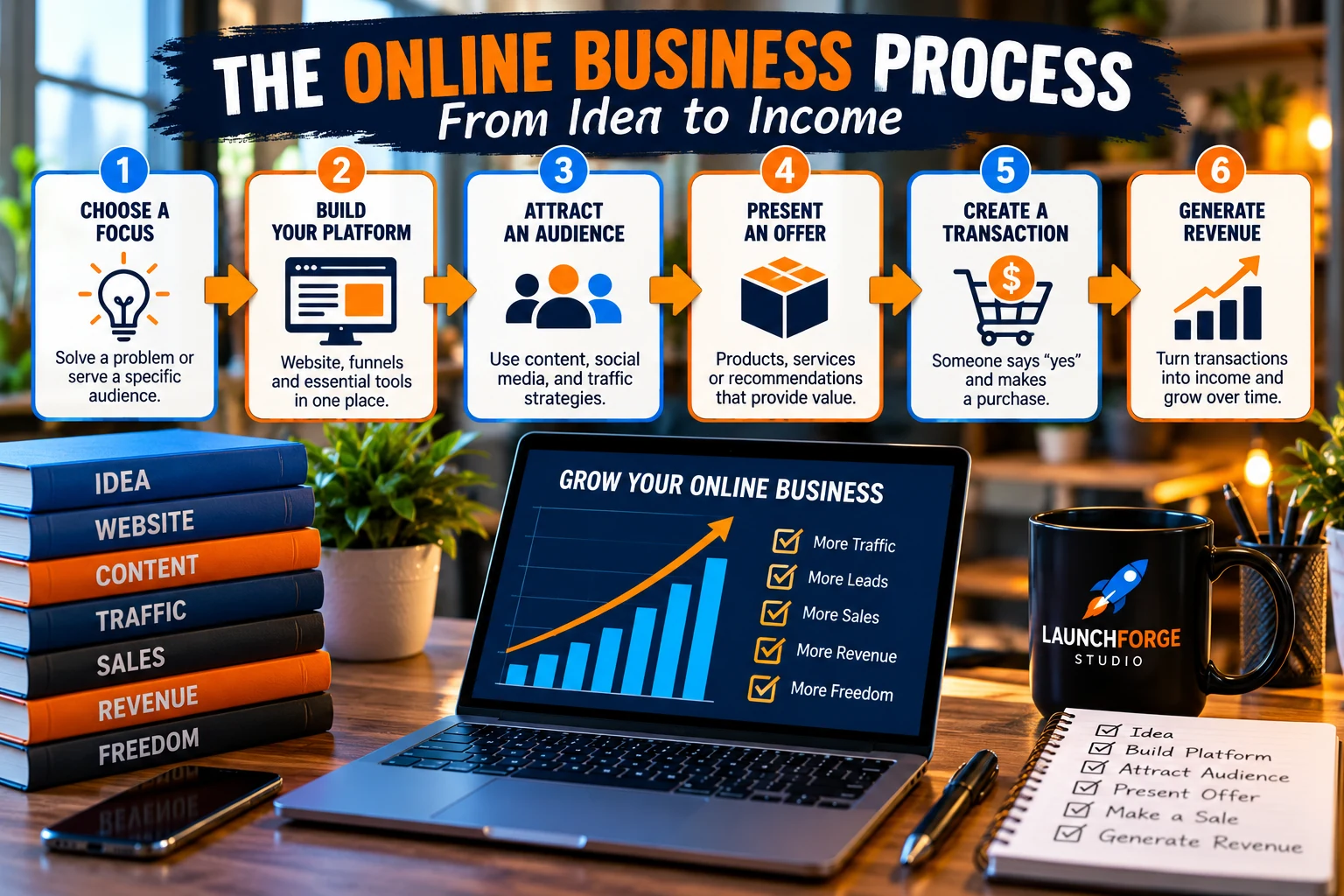
An online business connects a useful idea with an audience, an offer, and a transaction before revenue can be generated.
Traffic → Engagement → Lead → Follow-Up → Offer → Customer → Revenue
Other businesses may have a much shorter path:
Traffic → Product Page → Purchase → Revenue
An advertising-supported website could have a different path:
Traffic → Content Consumption → Ad Exposure → Advertising Revenue
There is no single sequence that every business must follow.
What matters is knowing how traffic connects to the revenue model you actually use.
If you cannot explain that connection, increasing traffic may increase activity without necessarily improving the business.
That is why traffic is valuable but should not be confused with the end result.
Traffic brings people into the system.
The business model determines how some of those opportunities can eventually become revenue.
Leads Are Not Revenue Either
If traffic represents people arriving, a lead represents someone who has taken another step.
They may have joined an email list.
Downloaded a lead magnet.
Completed a contact form.
Requested information.
Registered for a webinar.
Asked for a quote.
Started a free trial.
Or taken another action that gives the business an opportunity to continue the relationship.
That can make a lead extremely valuable.
But just like traffic:
A lead is not revenue.
Someone can join your email list without ever purchasing anything.
They can download a free resource and never return.
They can request information and decide the offer is not right for them.
They can begin a checkout process and never complete it.
The lead has created an opportunity.
What happens after that opportunity determines whether it eventually contributes to revenue.
Why Businesses Capture Leads in the First Place
If someone visits your website and leaves without giving you any way to reconnect with them, the relationship may end when they close the page.
You might never see them again.
Lead generation can change that.
When someone voluntarily provides their contact information, the business may now have a way to continue communicating with them according to what they agreed to receive.
That is why an email list can become such an important business asset.
Instead of depending entirely on someone remembering your website and finding their way back, you have an opportunity to continue providing value.
You can share useful information.
Answer common questions.
Introduce relevant resources.
Explain products or services.
Notify subscribers about something new.
And when appropriate, present an offer.
The lead does not guarantee any of those interactions will produce a sale.
It simply creates the possibility of continuing the relationship.
This Is Where Follow-Up Becomes Important
Imagine two businesses receive 100 leads.
The first business collects the email addresses and does almost nothing afterward.
The second has a useful follow-up system.
New subscribers receive what they requested.
They receive additional information related to why they subscribed.
They learn more about the business.
They are introduced to relevant resources.
And when there is a logical connection between their interests and an offer, they have an opportunity to consider it.
Both businesses generated 100 leads.
But the second business created a system for doing something useful with those leads.
That does not mean every lead will become a customer.
They should not.
Some people will decide the offer is not right for them.
Some will lose interest.
Some will remain readers without purchasing.
Others may not be ready today but could become customers later.
Follow-up gives the relationship somewhere to go.
Email Subscribers Are People, Not Numbers in a Database
This is where it becomes easy to lose sight of what a lead actually represents.
You open an email marketing dashboard and see:
500 subscribers.
It looks like a number.
But those are 500 individual people who made some decision to connect with the business.
They may have different problems.
Different levels of experience.
Different budgets.
Different goals.
Different reasons for subscribing.
Treating the entire list as nothing more than a collection of people to repeatedly blast with offers can quickly destroy the value of the relationship you worked to create.
A healthier approach is to ask:
Why did these people join in the first place?
Then continue helping them with that reason in mind.
That is why useful educational content and email marketing can work so well together.
The article answers a question.
A lead magnet might help the reader take the next step.
Email can continue the conversation.
A relevant offer can appear when it genuinely fits that journey.
Now the different pieces have a reason to exist.
A Bigger Email List Does Not Automatically Mean a Better Business
This is the lead-generation version of chasing traffic numbers.
A list of 10,000 subscribers can sound impressive.
But how many of those people actually want to hear from the business?
How many open the emails?
How many find the content useful?
How many joined because they were genuinely interested rather than simply chasing a free download?
How many are still engaged?
And most importantly for this article:
How does the email list connect with the revenue model?
If there is no answer to that question, the business may have built an audience asset without building a clear path from that asset to revenue.
That does not make the list worthless.
It means the system is incomplete.
Leads Create Possibilities for Future Transactions
This gives us another useful progression:
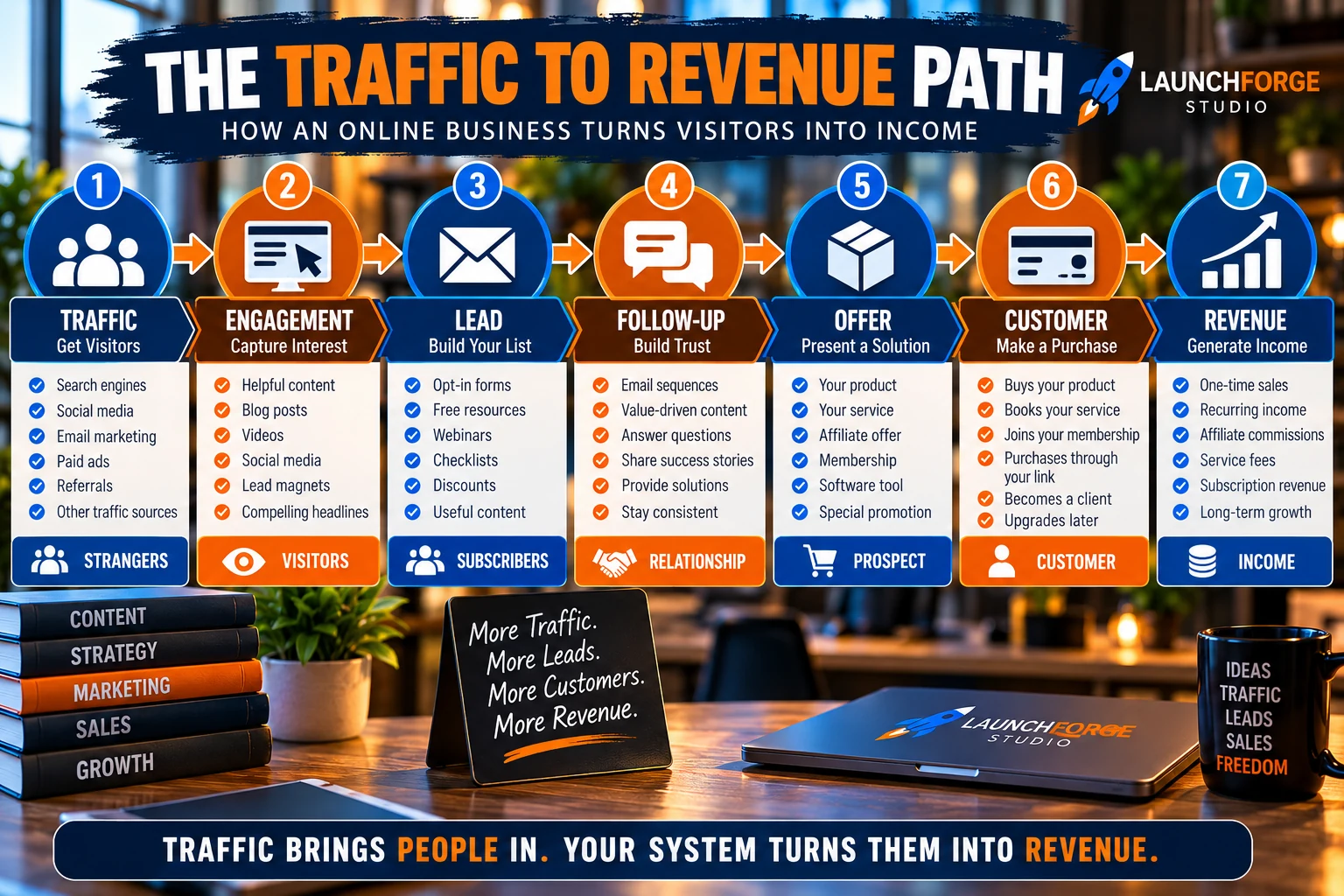
Traffic can create leads, but a business still needs engagement, follow-up, an offer, and a customer transaction before revenue is generated.
Visitor → Lead → Relationship → Offer → Customer → Revenue
Again, not every online business needs that exact sequence.
An e-commerce customer may discover a product and purchase it immediately without ever joining an email list.
A service business might receive a lead through a contact form and convert that person into a client after a conversation.
An affiliate marketer might have a reader follow a recommendation directly from an article.
But when a business does use lead generation, it should understand what role those leads play.
The goal is not simply to collect the largest number of email addresses possible.
The goal is to create permission and opportunity to continue a useful relationship.
Some of those relationships may eventually produce transactions.
Others may not.
That is why leads can be extremely valuable without being confused with revenue itself.
Traffic creates opportunities to be discovered.
Lead generation creates opportunities to continue the relationship.
Follow-up helps develop that relationship.
An appropriate offer creates an opportunity for a transaction.
The transaction creates revenue.
Once those distinctions are clear, the purpose of each part of an online marketing system becomes much easier to understand.
How Sales Funnels Help Turn Interest Into Revenue
Once you understand the difference between traffic, leads, customers, and revenue, sales funnels become much easier to understand.
A sales funnel is not a revenue model.
It is a system for helping people move through the stages between discovering a business and taking a desired action.
That action might eventually produce revenue.
For example, imagine an online business sells a digital course.
The revenue model is straightforward:
The customer pays for access to the course.
But before that transaction happens, the customer might move through several steps:
Discovers Helpful Content → Visits a Landing Page → Joins an Email List → Receives Follow-Up → Reviews the Course Offer → Purchases the Course
That sequence is part of the sales funnel.
The funnel did not create the revenue model.
The course sale did.
The funnel helped create a clearer path toward that transaction.
A Sales Funnel Connects the Steps
Without some kind of path, an online business can become a collection of disconnected pieces.
There is a website.
There are blog posts.
There is an email list.
There are social media accounts.
There is a product.
There might even be traffic.
But what is someone supposed to do after discovering the business?
Where should they go next?
What happens if they are interested but not ready to buy?
How do they learn more?
Where is the offer?
How do they complete the transaction?
A sales funnel helps answer those questions by connecting the relevant steps.
That does not mean every funnel needs to be complicated.
A very simple funnel might be:
Landing Page → Offer → Checkout
Another might be:
Content → Lead Capture Page → Email Follow-Up → Offer → Purchase
A service business could use:
Website → Contact Form → Consultation → Proposal → Client
The exact funnel depends on the business and what the customer needs to do.
Funnels Should Support the Customer Journey
It is easy to think about a sales funnel entirely from the business owner’s perspective.
Get the click.
Capture the lead.
Send the emails.
Make the sale.
But there is a person moving through that system.
From their perspective, the journey might feel more like this:
I found something useful.
I want to learn more.
This resource might help me.
I understand what this business offers.
This looks relevant to what I need.
I am comfortable making a decision.
A useful funnel helps those steps connect naturally.
It should reduce unnecessary confusion rather than create more of it.
That is why the best next step is not always BUY NOW.
Someone reading an introductory educational article may not be anywhere near a buying decision.
Their logical next step might be another article.
A guide.
An email subscription.
A comparison.
A demonstration.
A consultation.
Or simply more information.
The funnel should make sense for where the person actually is.
A Funnel Cannot Rescue an Offer Nobody Wants
This is another important distinction.
Funnels can improve how people move toward an offer.
They cannot make an irrelevant or unwanted offer valuable simply by adding more pages, emails, countdown timers, buttons, or automation.
If the audience does not need the product, the funnel has a problem.
If the offer is confusing, the funnel has a problem.
If the traffic is completely mismatched with the offer, the funnel has a problem.
If the business has not established enough trust for the decision being requested, adding another automated email may not solve it.
The funnel is part of the system.
It is not a substitute for creating genuine value.
Measure What Happens Between the Steps
Funnels can also help a business understand where people stop moving forward.
Suppose 1,000 people visit a landing page.
One hundred become leads.
Twenty review an offer.
Five become customers.
Those numbers give the business more useful information than simply saying:
We received 1,000 visitors.
Now there are questions worth investigating.
Why did some visitors become leads while others did not?
Did the landing page clearly communicate the next step?
Did people engage with the follow-up?
Did the offer match why they entered the funnel?
Was something preventing interested people from completing the transaction?
The purpose is not to obsess over every percentage or assume there is one universal conversion rate every business should achieve.
It is to understand what is happening inside your own system.
That information can help you decide what deserves attention next.
The Funnel Connects Attention With an Opportunity to Buy
This brings us back to the larger picture.
Traffic can introduce people to the business.
Content can provide value.
A landing page can focus attention on a specific next step.
Lead generation can create an ongoing connection.
Email can support follow-up.
An offer can give someone something to consider.
A checkout page or sales process can make the transaction possible.
And when the transaction occurs, the business can generate revenue.
Those pieces might all exist inside or around a sales funnel.
But they still have different jobs.
Traffic creates the opportunity to be discovered.
Content can create value and trust.
Lead generation creates an opportunity to continue the relationship.
Follow-up keeps the relationship moving.
The offer gives the person a decision to make.
The funnel connects the steps.
The transaction creates the revenue.
Understanding those roles prevents one of the biggest sources of confusion in online business:
Buying or building a funnel does not mean you have built a business.
You still need something valuable to offer, people who have a reason to want it, and a revenue model that explains how money actually enters the system.
A funnel simply helps connect those pieces into a path people can follow.
Can an Online Business Have Multiple Income Streams?
Yes.
An online business can generate revenue in more than one way.
In fact, many businesses eventually combine several of the revenue models we have already covered.
A content-based business might earn affiliate commissions while also selling digital products.
A service business might provide client work and later create templates, training, or other resources based on its expertise.
A software company might charge recurring subscription fees while also offering higher-priced services or additional products.
An e-commerce business might sell its own products while also earning revenue from complementary partnerships.
The possibilities are almost endless.
But there is an important difference between having multiple revenue streams and trying to build every possible revenue stream at the same time.
Multiple Revenue Streams Can Strengthen a Business
Relying entirely on one source of revenue can create risk.
Imagine a business earns nearly all of its revenue from one affiliate program.
If that company changes its commission structure, closes the program, changes its terms, or the product becomes less relevant to the audience, the affiliate business could experience an immediate loss of revenue.
Or imagine a service business where nearly all revenue comes from one large client.
If that client leaves, the effect can be significant.
Additional revenue streams can sometimes reduce that dependence.
A business might eventually have revenue coming from several places:
Services + Digital Products + Affiliate Commissions
or
Advertising + Sponsorships + Memberships
or
Software Subscriptions + Training + Professional Services
The combination itself is not what makes the business strong.
What matters is whether each revenue stream makes sense for the audience and fits the larger business.
More Revenue Streams Also Mean More Systems
This is the part that is easy to overlook.
Every new way of making money can create additional work.
Add a digital product and now you may need:
- A sales page
- A checkout process
- Product delivery
- Customer support
- Updates
- Marketing
Add a membership and you may also need:
- Member access
- Recurring billing
- Ongoing content or benefits
- Retention systems
- Cancellation management
Add affiliate marketing and you may need:
- Relevant content
- Affiliate disclosures
- Link management
- Program compliance
- Tracking
Add services and you may need:
- Lead qualification
- Proposals
- Scheduling
- Client communication
- Project delivery
Suddenly, what looked like four exciting income streams can become four separate systems competing for the same owner’s time and attention.
That is why diversification and complication are not the same thing.
A second revenue stream can strengthen a business.
A seventh half-built revenue stream can simply create another mess.
Start With One Clear Path to Revenue
For a beginner, one of the most useful things you can do is identify the simplest revenue path that makes sense for the business you are trying to build.
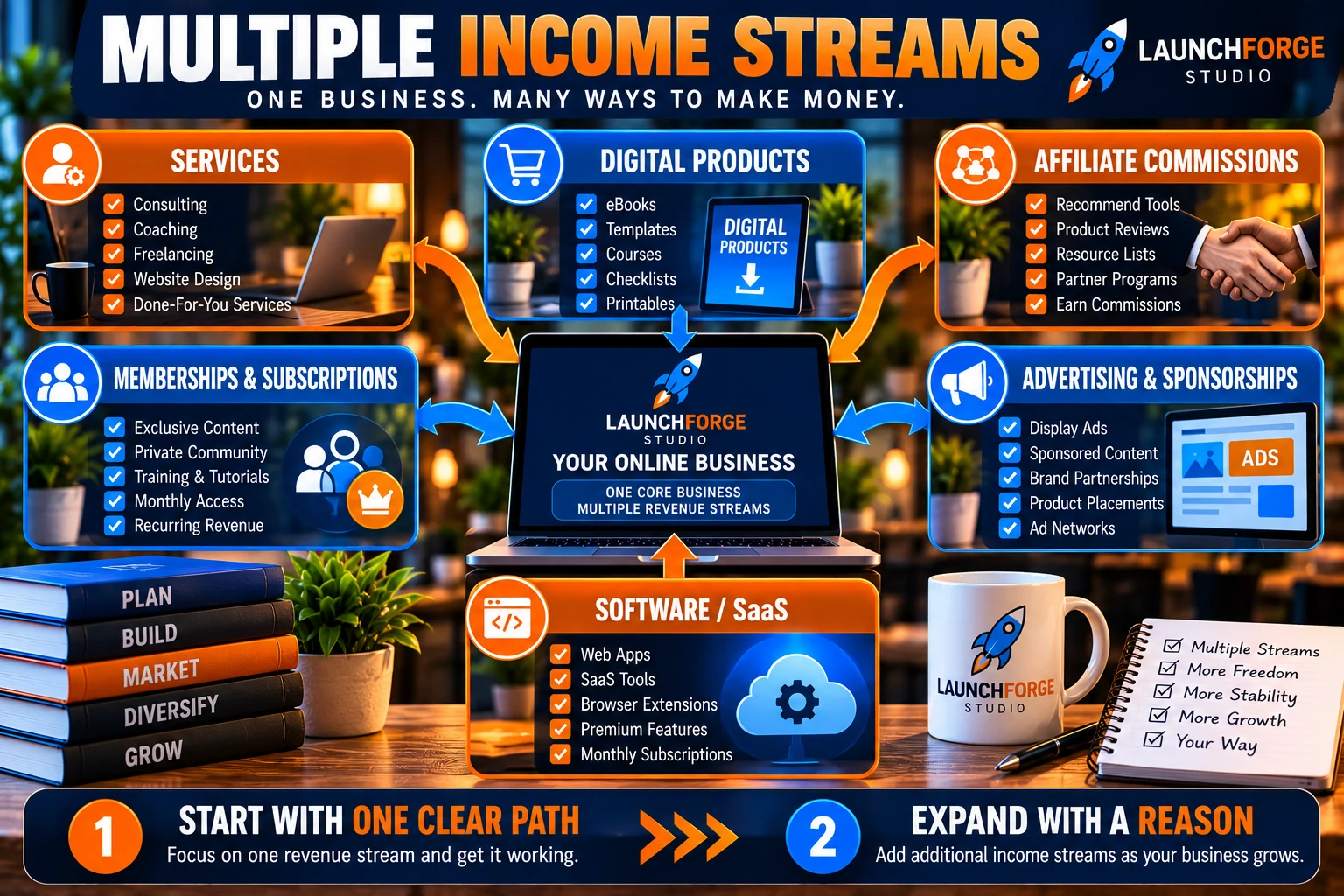
An online business can develop multiple income streams, but building one clear revenue path first can create a stronger foundation for expansion.
Ask:
What value can I realistically provide?
Who needs or wants that value?
What can I offer them?
What specific transaction creates revenue?
Then build the system around that answer.
If you sell a service, learn how people will discover the service, understand the offer, contact you, become clients, and pay.
If you sell a digital product, learn how people will discover the product, understand why it is useful, purchase it, and receive it.
If you use affiliate marketing, build useful content around the problems your audience is trying to solve and recommend relevant products when they genuinely fit.
If you build a membership, understand what ongoing value gives people a reason to join and remain members.
You do not need six monetization methods to prove that you have an online business.
You need a clear value exchange and a working path to a transaction.
Add Revenue Streams for a Reason
Once the first model is functioning, another revenue stream may begin to make sense.
Maybe customers repeatedly ask for something you do not currently offer.
Maybe your audience reveals another problem you can help solve.
Maybe existing content naturally supports relevant affiliate recommendations.
Maybe a service you repeatedly perform could become a standardized product.
Maybe a large content library creates an opportunity for advertising or sponsorship.
Those are reasons to consider expanding.
The business is telling you something.
That is very different from seeing another monetization method online and adding it simply because someone said every business should have seven income streams.
Different Revenue Streams Can Serve the Same Audience
One of the most useful ways to think about multiple revenue streams is not:
How many different things can I sell?
Instead ask:
What else would genuinely help the people I already serve?
Imagine a business teaches people how to improve their photography.
Free articles help beginners learn.
Affiliate recommendations point readers toward relevant equipment or software.
A digital course provides structured training.
Downloadable presets provide a practical resource.
A membership offers continued education and community.
Those revenue streams are different, but they can exist around the same audience and subject.
That creates a more coherent business than randomly adding unrelated offers simply because each one can make money.
Build Depth Before You Build Sprawl
There is nothing wrong with having several ways for an online business to generate revenue.
The mistake is assuming more revenue streams automatically create a better business.
Sometimes the stronger move is to improve the system you already have.
Make the offer clearer.
Create better content.
Improve the customer experience.
Strengthen follow-up.
Understand where traffic is coming from.
Learn why people buy.
Learn why they do not.
Improve what is already working.
Then decide whether another revenue stream actually belongs.
One working revenue model is more useful than five unfinished ones.
And once you understand the first one, you will be in a much better position to decide what should come next.
How to Choose a Revenue Model for Your Online Business
After looking at all these different ways an online business can make money, the next question is usually:
Which revenue model should I use?
There is no single answer that fits every business.
The right model depends on what you can provide, who you want to help, what those people value, how you want to operate the business, and what you can realistically support.
Instead of starting with:
Which model can make the most money?
Start with a more useful question:
What value can I realistically create or provide for someone?
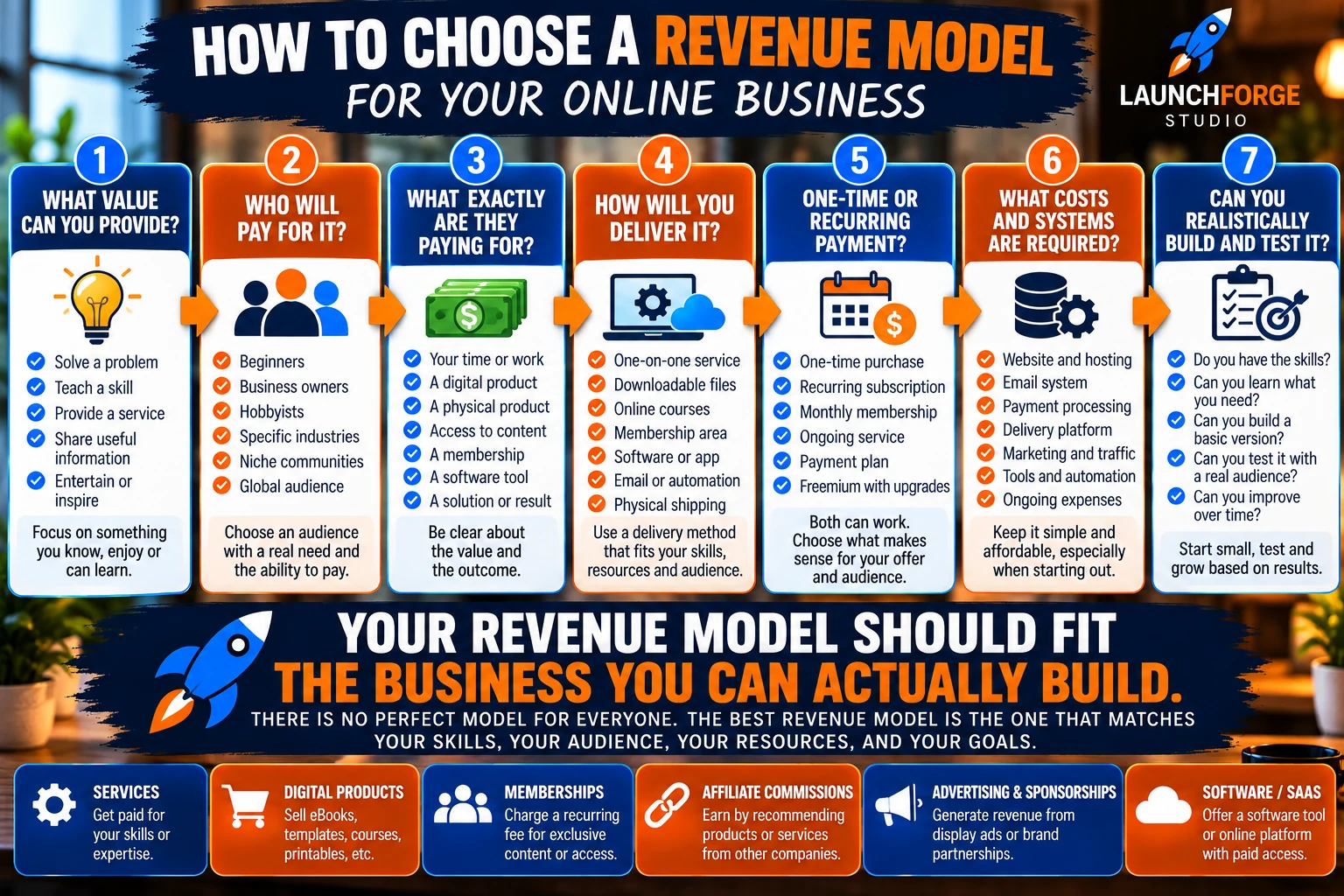
Choosing a revenue model starts with understanding the value you can provide, who will pay for it, how you will deliver it, and whether you can realistically build and test the model.
That changes the entire conversation.
Start With the Value You Can Provide
Every revenue model we have discussed begins with some form of value.
A service business might provide expertise or completed work.
An e-commerce business provides a physical product.
A digital product business provides information, resources, designs, or tools.
An affiliate business helps people discover and evaluate relevant products or services.
A membership provides ongoing access or benefits.
Software helps people accomplish something.
A lead-generation business helps create valuable connections.
Advertising gives another business access to an audience.
Before choosing the monetization method, ask:
What can I actually provide that another person or business might value?
You do not need the perfect answer on day one.
But you need enough of an answer to start building around something real.
Consider Who the Value Is For
Next, think about the person or business receiving that value.
Who are they?
What are they trying to accomplish?
What problem are they trying to solve?
What are they already spending money on?
What alternatives do they have?
How do they currently solve the problem?
A great revenue model attached to the wrong audience is still a problem.
You might create an excellent premium service for an audience that primarily wants inexpensive do-it-yourself solutions.
You might create a low-priced digital product for a problem businesses would gladly pay much more to have solved for them.
You might build a subscription around something people only need once.
Understanding the audience helps you understand what kind of exchange makes sense.
Decide Whether You Want to Sell Your Own Offer
One major decision is whether you want to create and sell something yourself or earn revenue by connecting people with offers from other businesses.
If you sell your own product or service, you generally have more control over:
- The offer
- Pricing
- Customer experience
- Delivery
- Positioning
- Updates
But you also take responsibility for creating and supporting what you sell.
Affiliate marketing changes that relationship.
You do not have to create the underlying product, but you also do not control it.
The company can change the product.
Pricing can change.
Commission structures can change.
Affiliate terms can change.
The program can close.
Neither approach is automatically better.
They create different responsibilities and different types of control.
Think About One-Time Versus Recurring Revenue
Another question is whether the transaction happens once or can continue over time.
A physical product purchase may be a one-time transaction, although the customer could return later.
A digital product might be purchased once.
A service could be a single project or an ongoing arrangement.
A membership or SaaS product may use recurring payments.
Recurring revenue can provide continuity, but as we discussed earlier, it also creates an ongoing responsibility to provide value.
Ask yourself:
Does what I provide naturally create ongoing value?
If the answer is no, forcing it into a subscription simply because recurring revenue sounds attractive may create a poor experience.
The payment model should fit the value being delivered.
Consider How Much of Your Time Is Required
Your time matters too.
Suppose you provide a service that requires ten hours of your personal work for every client.
That may be perfectly reasonable if the pricing supports the work and you enjoy providing the service.
But the model will behave differently from selling a digital resource that can be delivered repeatedly without ten additional hours of work for every customer.
This is not simply a question of which one scales better.
It is a question of what kind of business you actually want to operate.
Some people enjoy working closely with a smaller number of clients.
Others would rather create products.
Some enjoy teaching.
Some enjoy software development.
Some prefer building audiences and publishing content.
Some want a combination.
Your revenue model affects what your working day can eventually look like.
That deserves consideration.
Look at the Systems the Model Requires
Every revenue model creates operational requirements.
A service business needs a way to attract, qualify, onboard, communicate with, and deliver work to clients.
An e-commerce business may need inventory, payments, shipping, returns, and customer support.
A digital product business needs product delivery.
A membership needs access management and continued value.
A SaaS business needs software infrastructure and maintenance.
An affiliate business needs useful content, relevant offers, tracking, and disclosures.
Before choosing a model because it sounds simple, look at what has to happen after someone says yes.
Getting the sale is only one part of operating the business.
Ask What the First Transaction Would Actually Look Like
This is one of the simplest exercises you can do.
Forget about building a massive business for a moment.
Imagine the first person who ever pays you.
What exactly happens?
What do they buy?
Why do they want it?
How do they find it?
How much do they pay?
How does payment reach the business?
What do they receive afterward?
If you are using affiliate marketing, what qualifying action creates the commission?
If you are using advertising, what makes the audience valuable enough for an advertiser to pay?
If you are generating leads, what qualifies the lead for compensation?
If you cannot describe the transaction yet, that is useful information.
It means the revenue model needs more thought before you start building a complicated system around it.
You Can Start Simple and Learn From Reality
Your first revenue model does not have to determine everything your business will ever become.
Businesses evolve.
Audiences reveal new needs.
Skills improve.
Products change.
Technology changes.
New opportunities appear.
Something you expected to work may not.
Something you barely considered may become surprisingly important.
That is why it can be useful to choose a reasonable starting model, build the simplest system needed to test it, and learn from what actually happens.
You can improve the offer.
Change the pricing.
Refine the audience.
Adjust the customer journey.
Add another revenue stream later.
Or decide the original model was not the right fit.
Those are not necessarily signs that the business failed.
They are part of learning how the business actually works.
The goal at the beginning is not to predict every future revenue stream.
It is to be able to answer:
What value am I providing?
Who is it for?
What am I offering?
What creates the transaction?
How does that transaction produce revenue?
If those answers are clear, you have something concrete to build around.
What Building LaunchForge Is Teaching Me About Monetization
Building LaunchForge Studio has given me a much clearer understanding of something that sounds obvious once you see it:
Having ways to make money and having a working monetization system are not the same thing.
LaunchForge has affiliate relationships.
It has articles reviewing and explaining tools.
It has educational content attracting people through search.
It has email capture and follow-up systems.
It has pages that connect readers with relevant resources and offers.
Those are all pieces that can support monetization.
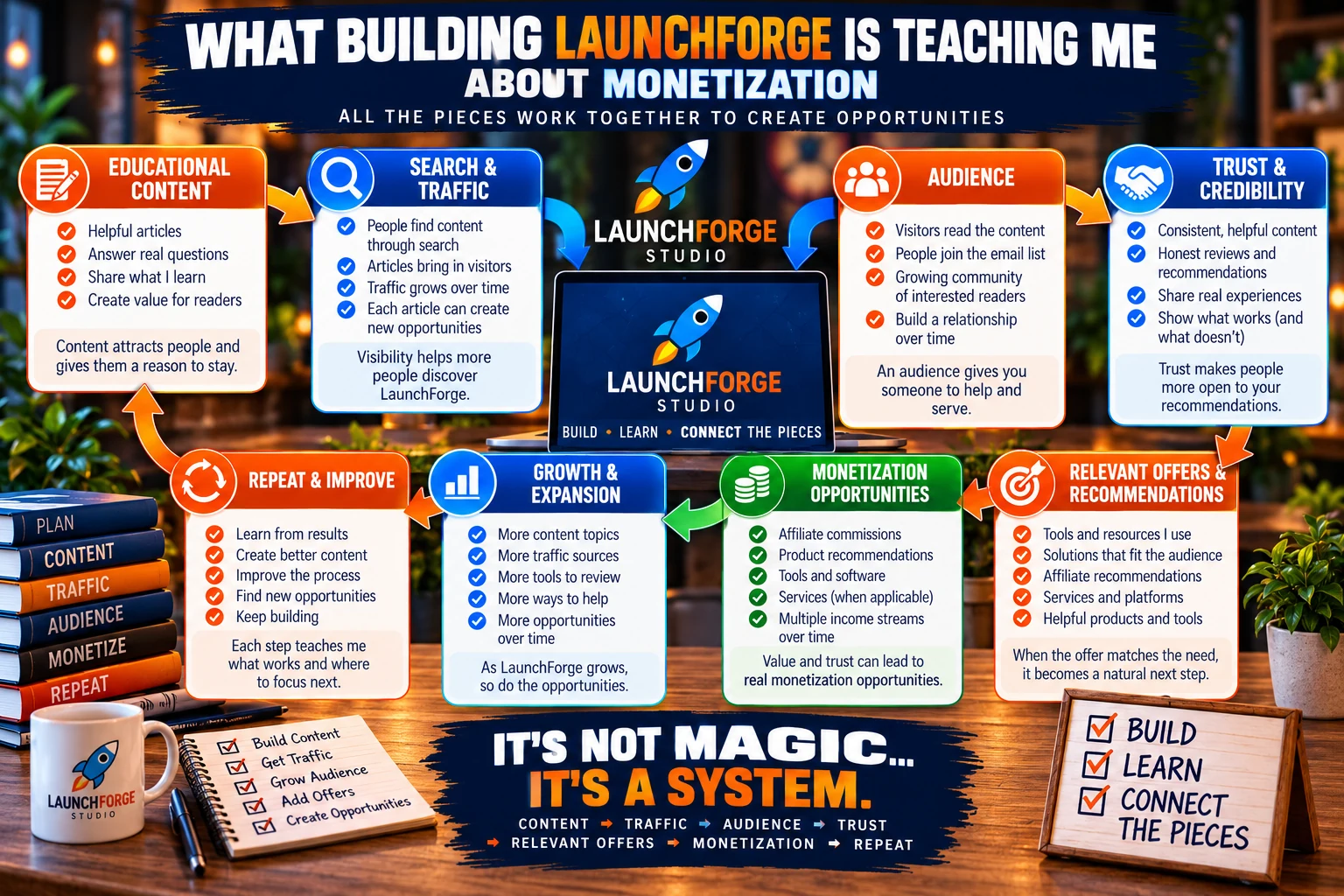
Building LaunchForge is showing me how educational content, search visibility, audience relationships, trust, and relevant offers can connect to create monetization opportunities.
But simply having those pieces does not mean revenue magically appears.
They have to connect.
That has become much easier to see while actually building the business.
Content Can Create the Beginning of the Revenue Path
A large part of LaunchForge is educational content.
I publish articles around the questions people encounter while building an online business:
Websites.
Landing pages.
Sales funnels.
Lead generation.
Email marketing.
Traffic.
Automation.
Business tools.
And now, monetization.
Those articles can create value before anyone is asked to buy anything.
Someone might discover LaunchForge because they searched for an answer to a question.
If the article helps them, they may read another one.
They might explore a tool mentioned in the content.
They might join the email list.
They might return later through another search.
Eventually, some readers may encounter an offer that genuinely fits what they are trying to accomplish.
That creates a possible revenue path.
But the article itself is not automatically revenue.
It creates an opportunity for a relationship to begin.
Search Visibility Is Useful Because Real People Are Behind the Numbers
One of the interesting parts of building LaunchForge has been watching articles begin appearing in search results.
Inside an analytics or search dashboard, it is easy to see impressions, clicks, positions, and percentages as nothing more than numbers.
But every impression represents an opportunity for someone searching for something to encounter LaunchForge.
Every click represents someone who chose to visit.
What happens after that click matters.
Does the article answer the question?
Is there another useful resource when they need it?
If a tool is relevant, can they find it?
If they want to stay connected, is there a clear way to do that?
If there is an affiliate relationship, is it disclosed and connected naturally to the content?
Those questions move the conversation beyond:
How much traffic did this article get?
and toward:
What role does this article play in the larger business?
That is a much more useful question.
I Have Already Seen Why Clear Paths Matter
While reviewing LaunchForge content, I found articles that were receiving search exposure but did not always give the reader a strong, obvious next step when a relevant affiliate opportunity existed.
That was an important lesson.
The content could do its job.
Google could send someone to the page.
The reader could learn about the tool.
But if the path from useful information to the relevant next step was weak or unclear, the system had a gap.
Improving those calls to action did not guarantee that someone would click.
It did not guarantee a signup.
And it certainly did not guarantee revenue.
What it did was make the path clearer.
That distinction matters.
You cannot control whether someone decides to take an offer, but you can make sure the opportunity is actually there when it makes sense.
That is monetization at the system level.
Not Every Article Needs to Sell Something
This has also reinforced the opposite lesson.
If every article exists only to push someone toward an affiliate link, the educational purpose of LaunchForge disappears.
Some articles are foundational.
Their job is to answer a question.
Some connect related topics.
Some help readers understand a process.
Some document what I am learning while building the business.
Some naturally connect with a tool or offer.
Those roles do not need to be identical.
This article is a good example.
If someone searches for how an online business makes money, the first responsibility of this page is to answer that question well.
The reader should leave understanding revenue models better than when they arrived.
That value comes first.
Monetization can exist around useful content without every paragraph becoming a sales pitch.
The Business Has to Connect the Pieces
Building LaunchForge has also made it obvious why I keep returning to systems.
An article by itself is a piece.
A landing page is a piece.
An email form is a piece.
An affiliate offer is a piece.
A traffic source is a piece.
A follow-up sequence is a piece.
A website is a collection of pieces.
The business starts becoming much more interesting when those pieces have reasons to connect.
An educational article can bring someone into the site.
A related article can help them go deeper.
An email signup can create an ongoing relationship.
Follow-up can continue providing useful information.
A relevant recommendation can introduce a tool.
A clearly disclosed affiliate relationship can create a potential commission if the reader decides the offer fits and completes the required action.
Now there is a path.
That path still does not guarantee revenue.
But at least the business has a way for revenue to happen.
Monetization Is Something I Am Building, Not Something I Pretend to Have Finished
This may be the most important lesson.
LaunchForge is still being built.
I am still publishing content.
Still strengthening the different topic clusters.
Still improving internal connections.
Still watching what people find through search.
Still learning which articles gain visibility.
Still improving calls to action.
Still building the email side of the business.
Still testing tools and traffic sources.
And still learning how all of those pieces work together.
That is exactly why I think documenting the process is useful.
It is easy to look at a finished business and see the polished website, products, funnels, email campaigns, traffic, and revenue streams as though they all appeared at the same time.
They did not.
They were built.
One piece created the need for another.
Some things worked.
Some things needed improvement.
Some ideas changed.
And the system developed over time.
That is how I am approaching monetization with LaunchForge too.
I do not need every possible revenue stream today.
I need to understand the revenue paths that actually fit the business, make those paths clear, learn from what happens, and improve them as LaunchForge grows.
That brings us right back to the principle behind Build Along with LaunchForge:
See what is being built. Understand why it is being built. Take what applies to your business. Then build your next useful piece.
Monetization is another one of those pieces.
Not the only piece.
But eventually, if you are building a business rather than simply a website or hobby project, it is a piece that needs a clear place in the system.
Your First Goal Is Not to Build Every Revenue Stream
After reading about services, products, affiliate marketing, advertising, subscriptions, software, lead generation, and multiple income streams, it would be easy to walk away thinking you need to start building all of them.
You do not.
Especially if you are just getting started.
Your first goal is not to create the most complicated monetization system possible.
Your first goal is to understand how your business could create one clear path from value to revenue.
Remember the framework we started with:
VALUE → AUDIENCE → OFFER → TRANSACTION → REVENUE
That framework does not require eight revenue streams.
It requires clarity.
Start With the Next Useful Piece
If you already know what you want to sell, your next useful piece might be figuring out how people will discover it.
If you have traffic but no way to continue the relationship, your next useful piece might be lead generation.
If you are collecting leads but doing nothing with them, it might be follow-up.
If you have an audience but no offer, it might be defining what you can provide that those people would genuinely value.
If you have an offer but people seem confused about it, your next useful piece might be improving the way you explain it.
If you have several disconnected tools, your next useful piece might simply be connecting the system you already have.
Different businesses need different things at different times.
That is why copying someone else’s entire online business rarely makes sense.
Their next step may have nothing to do with yours.
Do Not Confuse More Activity With More Progress
Online business makes it incredibly easy to stay busy.
There is always another tool to try.
Another traffic source.
Another social platform.
Another funnel.
Another email campaign.
Another product idea.
Another affiliate program.
Another piece of software.
Another strategy somebody says you absolutely need.
You can spend every available hour adding things to a business without making the path to revenue any clearer.
That is activity.
It is not necessarily progress.
Sometimes progress means adding something.
Sometimes it means improving something.
And sometimes it means removing something that no longer has a useful job.
The question should remain:
Does this help the business create, deliver, communicate, or monetize value more effectively?
If you cannot explain why something belongs in the system, it may not need to be there yet.
Build Around a Real Transaction
One of the best ways to keep monetization simple is to return to the transaction itself.
Picture a real person deciding to pay.
What happens immediately before that decision?
What are they buying?
Why do they believe it is valuable?
How did they discover it?
What information did they need?
What happens immediately after they pay?
Now work outward from that transaction.
Maybe the customer needs a sales page.
Before the sales page, perhaps they need educational content.
Maybe some people need email follow-up.
Maybe traffic needs to come from search.
Maybe a landing page needs to capture interested visitors.
Now those pieces have a reason to exist.
You are not assembling random marketing tools.
You are building a system around an understandable value exchange.
Let the Business Earn Its Complexity
A new business does not need to look like a business that has been operating for ten years.
It does not need every automation.
Every funnel.
Every traffic channel.
Every revenue stream.
Every social platform.
Every marketing tool.
Complexity should have to earn its place.
Add something because the business has developed a reason to need it.
Maybe your growing audience needs a better follow-up system.
Maybe customers repeatedly request a resource that could become a digital product.
Maybe a successful service creates an opportunity for a standardized package.
Maybe consistent traffic makes advertising worth considering.
Maybe your content naturally creates opportunities for relevant affiliate partnerships.
Now the next piece is responding to something real.
That is very different from building an enormous system based entirely on what you think you might someday need.
Learn From What Actually Happens
Once your first revenue path exists, pay attention.
What brings people into the business?
What content attracts the right audience?
Where do people become leads?
Which offers receive interest?
Where do people stop moving forward?
What questions do customers ask?
What do people repeatedly need help with?
Which parts of the system are useful?
Which parts are barely being used?
Those answers can guide what you build next.
Your business begins producing information.
And that information is often more useful than another generic checklist telling you what every online business is supposed to have.
You may discover that the revenue model you originally planned is exactly right.
You may discover that it needs adjustment.
You may find another opportunity that fits the audience better.
You may realize that something you spent weeks building was unnecessary.
All of that can teach you something.
Build One Revenue Path You Can Understand
You do not need to know exactly what your online business will look like five years from now.
You do not need to predict every product you will create.
You do not need to know every tool you will eventually use.
And you do not need every possible source of income before you begin.
Start by building something you can explain.
This is the value I provide.
These are the people it is intended to help.
This is the offer.
This is how someone can take the next step.
This is the transaction that creates revenue.
When you can explain those pieces clearly, you have something much more useful than a pile of disconnected monetization ideas.
You have the beginning of a business system.
Then you can learn from it.
Improve it.
And when the business gives you a genuine reason to do so, build the next useful piece.
An Online Business Makes Money by Creating a Reason for a Transaction
So, how does an online business make money?
At its simplest, an online business makes money by creating or providing something valuable and connecting that value with a revenue model that gives someone a reason to complete a transaction.
The details can look completely different from one business to another.
A customer might purchase a physical product.
A client might pay for a service.
Someone might buy a digital product.
A subscriber might pay for continued access.
A software user might pay for a monthly plan.
An advertiser might pay to reach an audience.
An affiliate might earn a commission from a qualifying referral.
A lead-generation business might receive compensation when an agreed qualifying action occurs.
Different models.
Different systems.
Different transactions.
But underneath them all is the same fundamental question:
Why does money enter this business?
If you can answer that clearly, the rest of the business becomes easier to understand.
Bring It Back to the Basic Framework
Throughout this guide, we have returned to one simple framework:
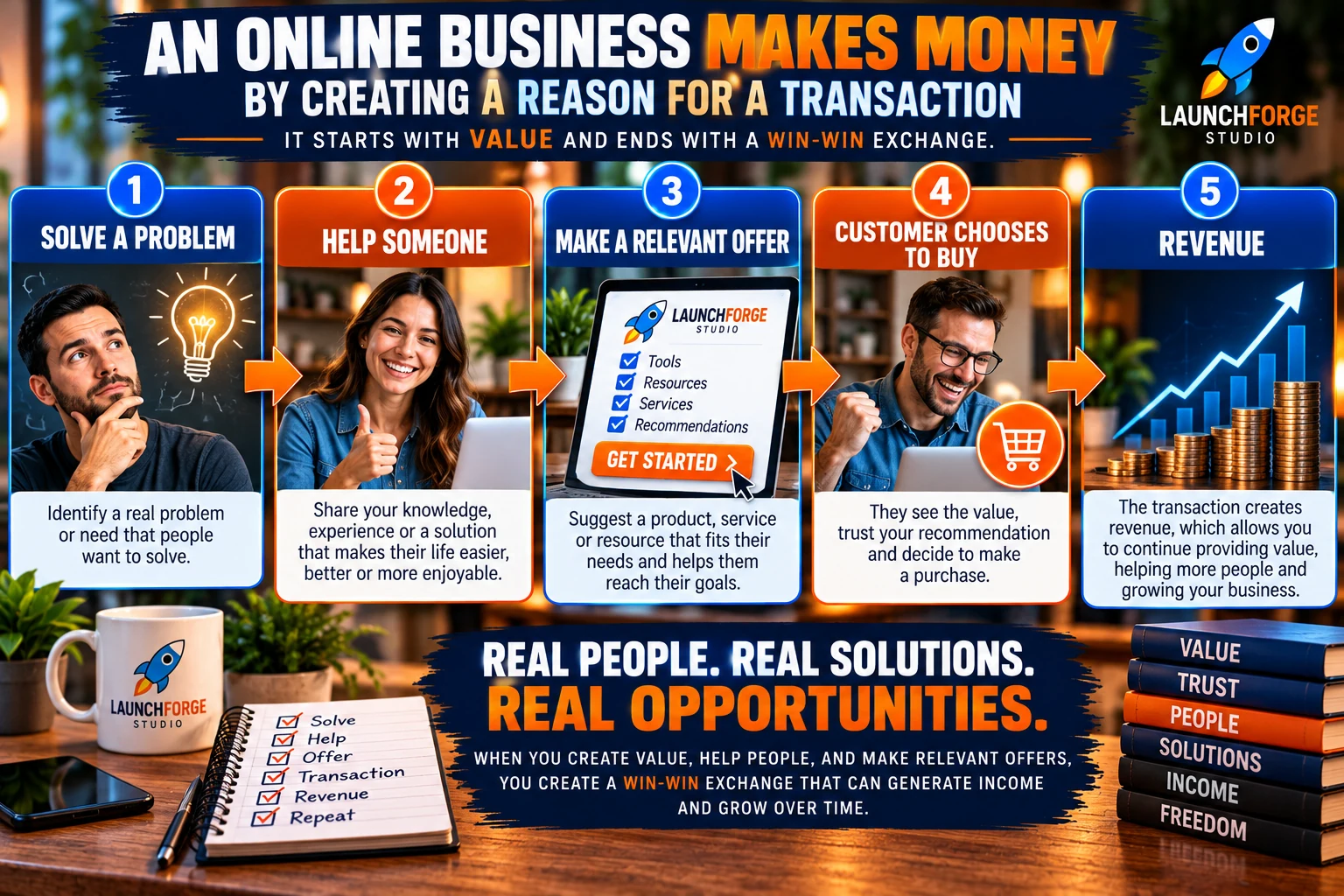
An online business creates revenue when useful value connects with a relevant offer and gives a customer a reason to complete a transaction.
VALUE → AUDIENCE → OFFER → TRANSACTION → REVENUE
Create or provide something valuable.
Connect it with people who have a reason to care about it.
Give them a relevant offer or monetization path.
Make the transaction possible.
Generate revenue when the requirements of that transaction are met.
Everything else can help support that process.
Your website gives the business somewhere to live online.
Content can help people discover you and understand what you know or provide.
Traffic brings people into the system.
Lead generation creates an opportunity to continue the relationship.
Email marketing and follow-up can keep that relationship moving.
Landing pages can focus attention on a particular next step.
Sales funnels can connect those steps into a clearer path.
Automation can help parts of the system operate more efficiently.
But none of those things should distract you from understanding where the actual value exchange happens.
You Do Not Need to Build Everything Today
If there is one idea I want you to take from this guide, it is this:
You do not need every revenue stream, every marketing tool, every funnel, and every traffic source before your online business can begin taking shape.
You need to understand the next useful piece.
Maybe that is defining the value you can provide.
Maybe it is identifying the audience you want to help.
Maybe it is creating your first offer.
Maybe it is building the website.
Maybe it is publishing useful content.
Maybe it is creating a way to capture leads.
Maybe it is establishing a clear path from an existing audience to an existing offer.
Or maybe it is finally answering the question we started with:
What transaction will actually create revenue for this business?
Once you know that, you have something concrete to build around.
Then build it.
Watch what happens.
Learn from it.
Improve it.
And when the business gives you a reason to add something else, build the next useful piece.
That is how an online business starts becoming more than a collection of pages, tools, ideas, and marketing tactics.
It becomes a system.
Create value.
Reach the right people.
Make a relevant offer.
Create a clear path to the transaction.
Learn from what happens next.
Then keep building.